
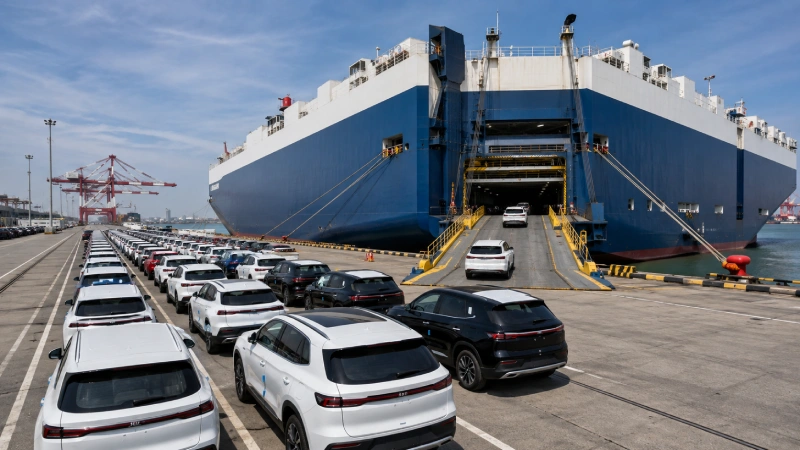
Can you ship a car from China by RoRo? In many cases, yes—but only when the vehicle, carrier, loading port, destination port and importing country all meet the required conditions. New petrol and diesel cars, hybrids and approved new battery electric vehicles may have suitable RoRo options. Some carriers also accept used petrol and diesel vehicles. Used BEVs, however, are frequently restricted and should never be assumed acceptable without written carrier approval.
For a broader overview of available transport methods, see Vehicle Shipping from China.
What Is RoRo Car Shipping?
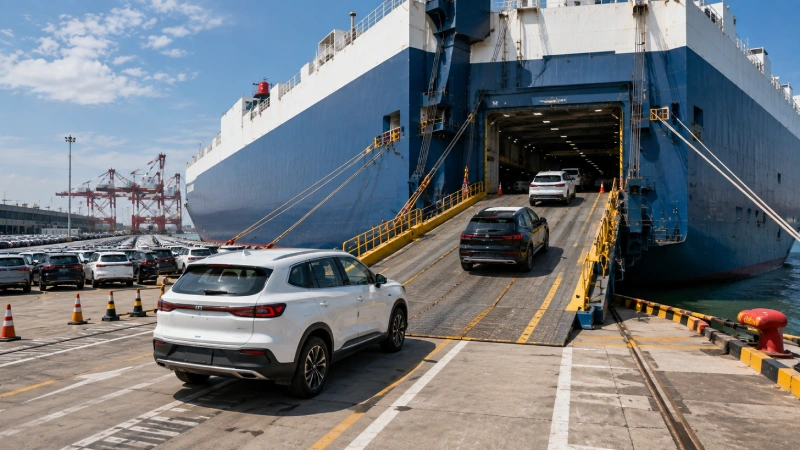
RoRo means “roll-on/roll-off.” Instead of lifting a vehicle into a container, terminal drivers move it through a ship’s ramp and onto a designated vehicle deck.
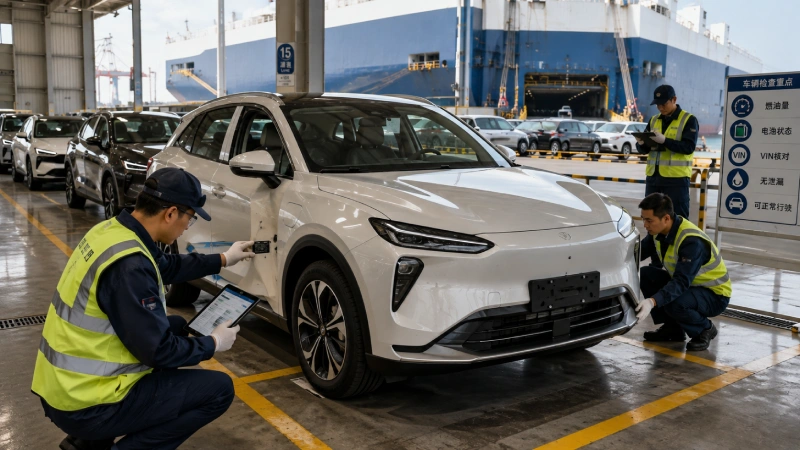
At the loading terminal, staff may check the VIN, booking details, labels and vehicle condition. Professional drivers then move the vehicle onboard, park it on the assigned deck and secure it with approved equipment. At destination, it is released and driven off.
Most vehicle exports move on a PCTC, or Pure Car and Truck Carrier. A ConRo vessel carries both rolling cargo and containers.
Vehicles on PCTCs are normally stowed inside enclosed decks rather than continuously exposed on an open deck. They still pass through terminal storage, driving and several handovers, so their risk profile differs from a sealed container shipment.
When Is RoRo Suitable for Shipping Cars from China?
RoRo is generally suitable when the vehicle can start, steer, brake and move under its own power; a practical RoRo service connects the ports; the carrier accepts the powertrain; and no undeclared cargo is left inside.
It can be efficient for dealers and fleet buyers because automotive terminals are designed for rapid handling. A single vehicle may also be accepted when the route and available space permit.
RoRo may not suit a used BEV without written approval, a non-running or accident-damaged vehicle, suspected battery damage, leakage, no suitable destination RoRo port or a shipment that needs enclosed handling and many spare parts.
| Decision point | RoRo may fit | Container may fit better |
|---|---|---|
| Vehicle condition | Fully running and accepted | Non-running or special handling |
| Cargo inside vehicle | Normally not allowed | Approved parts packed separately |
| Handling preference | Fast drive-on and drive-off | More enclosed control |
| EV acceptance | Carrier approval required | Separate container DG rules apply |
| Route coverage | Suitable RoRo ports available | Broader container network |
See Container vs RoRo Shipping for a broader comparison.
What Types of Vehicles Can Be Shipped by RoRo?
Carrier acceptance depends on the model, age, condition, battery system, dimensions, route and terminal rules.
| Vehicle type | Typical RoRo position | Main verification |
|---|---|---|
| New petrol or diesel car | Commonly accepted | Running condition, fuel and dimensions |
| New HEV or PHEV | Commonly possible | Fuel, battery condition and carrier rules |
| New BEV | Possible with approval | UN entry, battery condition and SOC |
| Used petrol or diesel car | Accepted by some carriers | Leakage, tires, battery and documents |
| Used HEV or PHEV | Carrier-specific | OBD report, photos, SOC and condition |
| Used BEV | Frequently restricted | Written carrier approval required |
| Non-running vehicle | Restricted | Special equipment and approval |
| Accident or damaged vehicle | Often rejected | Damage and battery safety review |
“Commonly accepted” does not mean automatically accepted. Used petrol and diesel vehicles can move on some services when they meet operating, fuel, leakage and documentation requirements.
Several major carriers apply tighter restrictions to used BEVs. Every booking should therefore be checked against the actual carrier’s current requirements rather than a generic claim that all vehicles are accepted.
RoRo Requirements for Electric and Hybrid Vehicles in 2026
The IMDG Code 2024 Edition, including Amendment 42-24, became mandatory on January 1, 2026. Current information is available through the official IMO IMDG Code page.
A lithium-ion battery-powered BEV is generally classified under UN3556. Lithium-metal battery vehicles fall under UN3557, while sodium-ion battery vehicles fall under UN3558.
Petrol and diesel vehicles, and hybrids such as HEVs or PHEVs that include an internal-combustion engine, are generally associated with UN3166. UN3171 is no longer the correct general entry for lithium-ion battery-powered BEVs.
Special Provision 961 can exempt qualifying vehicles from much of the IMDG Code when they are carried in an approved RoRo space or relevant vehicle deck and there is no leakage from the battery, engine, fuel or gas system. The same exception should not automatically be applied to a vehicle packed inside a freight container.
IMDG classification establishes the regulatory framework. Carrier acceptance determines whether a vehicle can actually be booked.
A carrier may impose SOC limits, request battery-condition declarations, emergency instructions, OEM or shipper statements, OBD reports, vehicle photographs or production-date information, and reject certain used BEVs.
A 50% SOC limit or one-quarter fuel-tank limit may be carrier policy rather than a universal IMO rule. Confirm the current requirement before port delivery.
For detailed preparation guidance, see How to Ship Electric Cars from China by Sea and the UN3556 Electric Vehicle Shipping Guide.
Main RoRo Car Export Ports in China
China has several important automobile RoRo gateways.
| Region | Representative gateways | Typical sourcing area |
|---|---|---|
| East China | Shanghai Haitong, Shanghai Nangang and Taicang | Shanghai, Jiangsu, Zhejiang and Anhui |
| North China | Tianjin and Yantai | Beijing-Tianjin-Hebei, Shandong and North China |
| South China | Guangzhou Nansha and Shenzhen Xiaomo | Guangdong and South China |
| Southeast China | Xiamen | Fujian and nearby provinces |
This is not a fixed allocation, and the closest port is not always best.
Port selection should consider vehicle location, inland cost, destination calls, direct or transshipment service, sailing frequency, available space, vehicle type, carrier acceptance, terminal receiving windows and cut-off dates.
A more distant port may be better when it offers a direct sailing or a carrier with a more suitable used-vehicle or EV policy. Do not rely on fixed route or transit claims without checking the current sailing schedule.
Step-by-Step RoRo Car Shipping Process from China
1. Confirm destination import eligibility
Check age, steering side, emissions, energy-efficiency rules, importer qualifications, inspection requirements and restrictions on damaged, modified or salvage vehicles.
A destination port may accept RoRo discharge even when the vehicle cannot legally be imported or registered.
2. Identify the vehicle accurately
Confirm the make, model, VIN, quantity, powertrain, dimensions, weight, production and registration dates, running condition and accident or battery history.
3. Verify the Chinese exporter
Ensure that the exporting party can legally complete the applicable vehicle export procedure and customs declaration.
From January 1, 2026, China applies export-licence administration to a specified category of passenger vehicles referenced under customs code 8703801090 that have a VIN and are powered only by a drive motor. This is separate from RoRo safety approval.
4. Select the POL and POD
Compare inland transport, schedules, destination access, direct or transshipment routing and terminal rules.
Keep five layers separate:
- Chinese export qualification
- Customs declaration
- IMDG classification
- Carrier and terminal acceptance
- Destination import approval
Approval at one level does not guarantee approval at another.
5. Request carrier acceptance
This is essential for used vehicles, BEVs, hybrids, unusual dimensions, non-running units, modified vehicles or prior damage.
6. Obtain a written quotation
Confirm the pricing basis, included services, excluded destination costs and charges subject to adjustment.
7. Confirm booking and cut-offs
Record the booking cut-off, documentation cut-off, terminal receiving window and estimated departure.
8. Prepare the documents
Submit the VIN list, commercial papers, customs information, declarations and Bill of Lading instructions.
9. Arrange inland transport and vehicle preparation
Move the vehicle to port within the receiving window. Adjust fuel or SOC to the carrier limit, remove personal items, inspect for leakage, disable alarms where required and provide the keys.
10. Complete customs and terminal acceptance
A vehicle can still be rejected after reaching port if its condition, VIN, documents, fuel level, SOC, dimensions or battery status does not match the booking.
11. Load, stow and secure the vehicle
Terminal drivers move the vehicle onboard and secure it in the assigned deck position.
12. Issue the Bill of Lading
Confirm whether the shipment uses an original Bill of Lading, Sea Waybill or telex release.
13. Track the voyage and prepare clearance
Check destination free storage, terminal charges and collection procedures before arrival.
14. Discharge and collect the vehicle
Complete customs clearance, taxes, terminal release and collection promptly.
Information and Documents Required for RoRo Booking
A complete enquiry should include:
- Make, model and VIN
- Quantity and new-or-used status
- Petrol, diesel, HEV, PHEV or BEV
- Length, width, height and gross weight
- Running or non-running condition
- Production and registration dates
- Battery, accident, repair and leakage status
- Current vehicle location
- POL and POD
- Cargo-ready date
Typical documents include the commercial invoice, vehicle packing list or VIN list, export customs documents, export licence where applicable and Bill of Lading instructions.
Depending on the vehicle and destination, the shipment may also require a certificate of origin, conformity document, destination inspection record, SOC statement, battery declaration, OBD report, photographs or shipper confirmation.
RoRo Vehicle Preparation Checklist
Before terminal delivery, confirm:
- The vehicle starts and moves normally.
- Steering, brakes and transmission work.
- Tires are inflated.
- There is no oil, coolant, fuel or battery leakage.
- Fuel level meets the carrier limit.
- SOC meets the carrier requirement.
- The battery shows no damage or warning.
- The VIN is visible and matches the documents.
- Alarm and anti-theft systems are handled as instructed.
- Doors, windows and trunk can be opened or secured.
- The vehicle is clean and the keys are supplied.
- Personal items and undeclared cargo are removed.
- Factory tools and the spare tire comply with carrier rules.
- Dated condition photographs have been taken.
Fuel and SOC limits should be described as carrier-specific requirements, not universal IMO rules.
Do not assume that the trunk can be used to move spare parts free of charge. Personal belongings and undeclared cargo are generally prohibited.
How RoRo Shipping Costs Are Calculated
RoRo pricing depends on vehicle type, quantity, dimensions, weight, ports, routing, space, season, surcharges, EV handling and inland distance. Freight may be quoted per vehicle, by cubic measurement or under a CEU-based method.
Ask for these items in writing:
- China inland transport
- Origin terminal handling
- Export customs and documentation
- Ocean freight
- Carrier surcharges
- Marine cargo insurance
- Destination terminal charges
- Customs clearance, duties and taxes
- Storage, inspection or late-collection charges
Ask whether the quotation is port-to-port, FOB-related, CFR or CIF, and identify which origin and destination charges are excluded.
Avoid relying on a long-term fixed price. Rates and space can change by vessel, sailing, season and carrier allocation.
RoRo Transit Time and Sailing Frequency
Ocean transit time is only one part of the complete delivery period.
A realistic schedule also includes waiting for space, inland collection, terminal receiving, export customs, possible inspection, actual vessel departure, transshipment, destination discharge, clearance and collection.
Base estimates on the current carrier schedule and state the date checked. Sailing time should not be presented as complete door-to-door delivery time.
Risks, Insurance and Destination Handover
RoRo involves terminal driving and multiple handovers. Risks include scratches, minor exterior damage, schedule changes, rolled bookings, document delays, storage charges and late collection.
A transportable vehicle may still fail destination import or registration rules. Confirm eligibility before booking.
RoRo freight does not necessarily include full-value insurance. Confirm insured value, coverage, exclusions, deductible and claims procedure. Keep pre-delivery photographs, VIN records and signed condition documents.
How Winsail Coordinates RoRo Car Shipping from China
Winsail can:
- Review vehicle details and transport requirements
- Compare available ports and RoRo services
- Check current carrier acceptance requirements
- Coordinate inland pickup and terminal delivery
- Arrange booking, customs support and shipping documents
- Follow loading and voyage progress
- Coordinate with destination agents
- Assess container alternatives when RoRo is unsuitable
Winsail does not own RoRo vessels, issue vehicle export licences, guarantee carrier space or guarantee destination customs clearance.
FAQ
What is RoRo car shipping from China?
A running vehicle is driven through the vessel ramp, secured on an internal deck and driven off at the destination port.
Can one car be shipped from China by RoRo?
Yes, when the carrier, route, booking channel and available space allow a single-unit shipment.
Can used cars be shipped from China by RoRo?
Some carriers accept used petrol and diesel vehicles when they are roadworthy, leak-free, documented and compliant with current fuel, battery and terminal rules.
Can used electric cars be shipped by RoRo?
Used BEVs cannot be assumed acceptable. Several major carriers restrict or reject them, so written approval is required before port delivery.
How much does RoRo car shipping from China cost?
Cost depends on the vehicle, dimensions, route, carrier, sailing, inland transport and included origin and destination charges.
Can personal items or spare parts be left inside the car?
Usually not. Most RoRo rules prohibit personal belongings and undeclared cargo.
Does a RoRo vehicle need to be in running condition?
Normally yes. Steering, brakes, transmission and tires must allow safe terminal and vessel movement.
Is marine insurance included in RoRo shipping?
Not necessarily. Confirm whether insurance is included and whether it matches the vehicle value, exclusions and deductible.
Get a RoRo Car Shipping Quote from China
To check feasibility and pricing, provide:
- Vehicle make and model
- VIN
- Quantity
- New or used status
- Powertrain
- Running condition
- Dimensions and gross weight
- Vehicle location in China
- Destination country and port
- Cargo-ready date
- Exporter status
- Vehicle photographs
- Battery condition
- Accident or repair information
Complete information helps identify carrier restrictions, document requirements and container alternatives before the vehicle is delivered to the port.
