
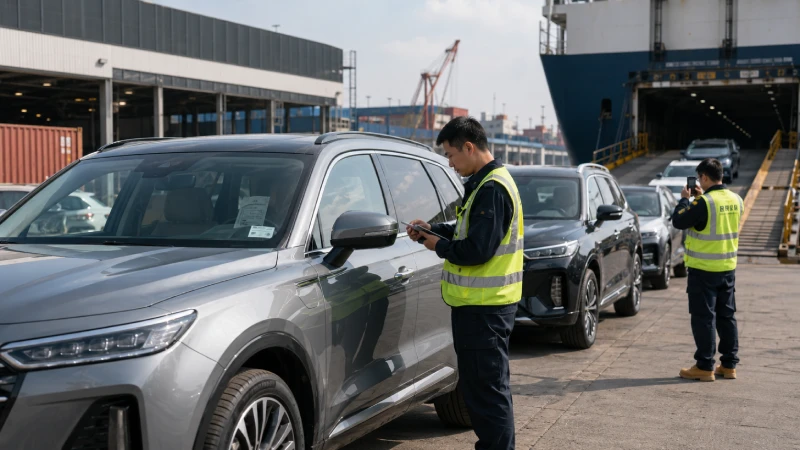
When buying vehicles in China, supplier identity, legal ownership, export authority and actual vehicle condition are four separate questions. A company can be legally registered but still lack the authority required for a particular vehicle export. A real vehicle can exist in a yard but have unclear ownership. And a vehicle that can legally leave China may still fail the destination country’s import or registration requirements.
That is why verification should happen before the deposit, before the final payment and again before loading. If you are still planning the transport side, start with our guide to vehicle shipping from China.
The safest approach is simple: verify the company, verify its export authority, verify the vehicle, and then verify that every company name, VIN, date and payment detail matches across the transaction.
No single business license, inspection report, photograph or export document can prove everything.
Quick Answer—What Should Be Verified Before You Pay?
Before paying a Chinese vehicle supplier, pass the transaction through five verification gates:
- Identity: Is the company legally registered and genuinely operating?
- Authority: Is the correct company authorized to export this type of vehicle?
- Ownership: Can the vehicle’s VIN and legal ownership be verified?
- Condition: Does the actual vehicle match its advertised condition?
- Transaction Control: Do the contract, beneficiary, documents and loading evidence form a consistent chain?
Different documents prove different things:
| Evidence | What It Can Prove | What It Cannot Prove |
|---|---|---|
| Business license | The company is legally registered | Vehicle export authority |
| Customs filing | Customs consignee/consignor filing exists | Authority to export a specific vehicle |
| Exporter approval or annual list | Eligibility under the applicable export regime | A specific vehicle already has an export license |
| Registration certificate | Registered vehicle and owner information | Complete accident or technical history |
| Inspection report | Condition within the tested scope and date | Ownership or destination-country eligibility |
| Export license | China-side authorization for the covered export | Destination customs clearance or registration |
The strongest transactions are those in which government records, vehicle documents and independent physical evidence support one another.
Step 1—Verify the Exporter’s Legal Identity
Obtain the exporter’s exact Chinese legal information
Ask the supplier for:
- A stamped Chinese business license
- Exact Chinese legal company name
- 18-digit Unified Social Credit Code
- Legal representative and registered address
- Corporate bank account information
- Actual office, showroom, storage or vehicle-yard address
Do not rely only on an English trading name. The English name used on a website, Alibaba profile or quotation may be completely different from the company’s registered Chinese legal name.
Search the National Enterprise Credit Information Publicity System
Use the Chinese legal name or Unified Social Credit Code to search the National Enterprise Credit Information Publicity System.
Review the company’s:
- Registration status
- Establishment date
- Registered address
- Legal representative
- Business scope
- Shareholders and major corporate changes
- Annual reports
- Administrative penalties
- Current abnormal-operation status
- Serious illegal or dishonest enterprise status
These checks establish a baseline, but they have limits.
A business scope that includes automobile sales or import-export activities does not automatically mean the company has vehicle export authority. Registered capital does not equal available cash or repayment capacity. And the absence of a current abnormal-status marker does not prove the company has never had commercial disputes.
Conduct operational verification
Government records should be combined with real-world checks.
Where practical, call a telephone number obtained independently from the company’s website or public records rather than relying only on the salesperson’s mobile number. Request a live video call showing the office, vehicle yard and actual vehicle.
Ask the supplier to show the current date, physical VIN and vehicle startup during the call. For higher-value purchases, also check relevant Chinese court enforcement information and compare the website domain, business email, contracting party and proposed bank beneficiary.
A professional website and polished sales presentation are useful signals, but they are not proof of inventory, export authority or financial reliability.
Step 2—Confirm the Company Is Authorized to Export That Type of Vehicle
One of the most common due-diligence mistakes is treating a legitimate Chinese company as automatically equivalent to a legitimate vehicle exporter.
Separate the roles in the transaction
Identify every party involved:
- Vehicle seller
- Registered vehicle owner
- Licensed exporter
- Manufacturer or authorized distributor
- Freight forwarder
- Customs broker
- Bank beneficiary
Different companies can legitimately perform different roles. That does not automatically indicate fraud. The important point is that every relationship must be explainable and supported by written authorization, contracts or other verifiable records.
For used vehicles
Under China’s 2024 Announcement No. 6 on used-vehicle exports, used-vehicle export enterprises are reviewed by the competent provincial commerce authority.
An approved enterprise may conduct used-vehicle export business for one year and must apply again for the following year. Used vehicles are subject to export-license administration, following the principle of “who exports, who applies.” The applicable exporter cannot simply have an unrelated company or individual apply for the license on its behalf.
Before purchasing, ask for evidence of the exporter’s current used-vehicle export approval, identify the reviewing authority and confirm that the approval remains applicable to the transaction.
For the actual vehicle, request the relevant export license rather than accepting a sample from another shipment.
For the broader process, see how to export used cars from China.
For new vehicles and pure-electric passenger cars
For vehicle categories subject to annual automobile export licensing, check the company’s exact Chinese legal name against the Ministry of Commerce’s applicable annual list.
For 2026, buyers should verify whether the company appears on the official list of enterprises meeting the conditions to apply for automobile export licenses.
Being listed means the enterprise meets the relevant conditions to apply. It does not mean every vehicle sold by that company already has an export license.
From January 1, 2026, specified pure-electric passenger vehicles with VINs are also subject to export-license administration. Buyers of EVs should therefore verify both the exporter and the vehicle-specific documentation rather than relying only on a brand authorization letter or an English company name.
Verify customs registration separately
Import-export consignees and consignors are subject to customs filing, with information published through China’s customs enterprise credit systems. The General Administration of Customs filing guide can be used as a reference for this requirement.
Customs filing is a basic compliance check, but it does not replace vehicle export authority.
AEO certification should also not be misunderstood. It can be a useful customs credit indicator, but ordinary vehicle exporters are not universally required to hold AEO certification. Lack of AEO status alone is not evidence of fraud.
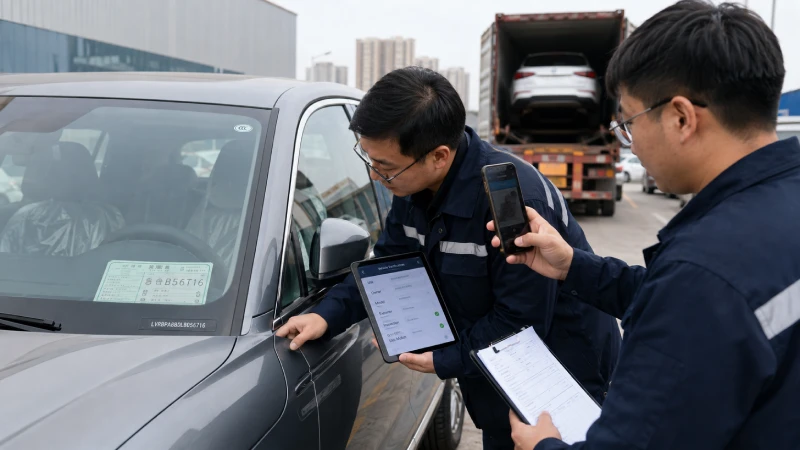
Step 3—Verify the Vehicle’s VIN, Identity and Legal Ownership
Build a complete VIN evidence chain
A proper China vehicle VIN check is more than entering a VIN into an online decoder.
Compare the VIN across:
- The physical chassis or body
- The windshield VIN location
- Manufacturer identification plate
- Motor Vehicle Registration Certificate
- Sales contract
- Commercial invoice
- Inspection report
- Manufacturer confirmation, where applicable
- Export license
- Customs declaration
- Final shipping documents
If even one VIN character differs without a credible explanation, pause payment and shipment until the discrepancy is resolved.
Verify ownership for used vehicles
For a used vehicle, examine all pages of the Motor Vehicle Registration Certificate.
Check:
- Current registered owner
- First registration date
- Transfer-for-export information
- Relevant transfer dates
- Mortgage or pledge status
- Seizure, detention or customs-supervision status
- Unresolved traffic violations or accidents
- Whether the vehicle is close to mandatory scrappage
Under the current used-vehicle export rules, the enterprise applying for the export license should match the vehicle owner recorded in the registration certificate.
Vehicles subject to specified mortgages, pledges, seizure, detention, customs supervision, failed inspections, unresolved traffic violations or other prohibited conditions may not qualify for export.
Treat recently registered used vehicles separately
The 180-day rule is frequently misunderstood.
According to the 2025 official notice strengthening used-vehicle export management, from January 1, 2026, vehicles applying for export within 180 days, including 180 days, of registration require a manufacturer-stamped After-Sales Maintenance Service Confirmation.
The confirmation should include relevant vehicle information, destination country and after-sales service arrangements.
This is not a blanket ban on exporting vehicles registered for less than 180 days. The key issue is whether the required manufacturer confirmation can be obtained. If it cannot be provided when required, the export license will not be issued.
Step 4—Verify Vehicle History and Technical Condition
Legal exportability does not prove that a vehicle is mechanically sound or accurately described.
Request available maintenance and recall records
Ask the exporter or owner for available:
- Maintenance records from China’s automobile maintenance electronic health-record system
- Authorized brand service records
- Outstanding recall information
- Proof of completed recall repairs
- Insurance or accident-repair records where available
- Records of major component replacement where available
Treat missing history cautiously. China’s repair-record systems mainly capture information from participating repair networks. No record does not necessarily mean no repair or accident occurred.
Maintenance and recall data also cannot replace ownership verification or a physical inspection.
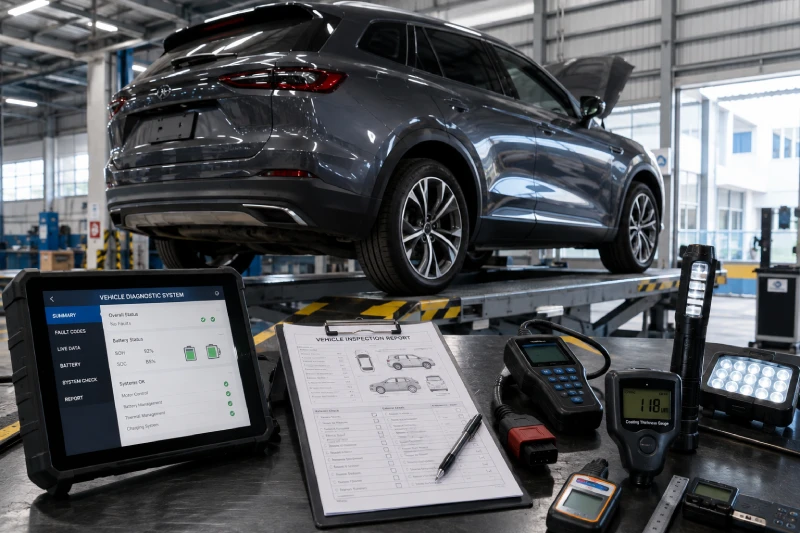
Review the mandatory export inspection report
Used-vehicle export licensing requires a third-party inspection report under the applicable standards, including:
- WM/T 8-2022, Quality Requirements for Export of Used Passenger Vehicles
- WM/T 9-2022, Quality Requirements for Export of Used Commercial Vehicles and Trailers
Check the inspection agency name, contact details, report number, issue date, VIN, model, inspection scope, original photographs and results.
Where practical, contact the inspection organization independently to confirm that the report is genuine.
However, statutory export inspection and buyer-appointed inspection serve different purposes.
Arrange a buyer-appointed pre-shipment inspection
A buyer-appointed inspection should focus on commercial and technical risks that may go beyond the statutory export test.
For combustion vehicles, consider checking:
- Structural damage and chassis repair
- Welding or cutting traces
- Paint thickness
- Replaced body panels
- Flood, fire and corrosion evidence
- Airbags and seat belts
- OBD fault codes
- Dashboard warning lights
- Engine and transmission condition
- Brakes, tires and lights
- Fluid leakage
- Cold-start behavior
- Road test where legally and safely possible
- Keys, spare tire and agreed accessories
For electric vehicles, add:
- Battery enclosure and underbody impact damage
- Battery health data and original diagnostic information
- Charging test
- High-voltage system faults
- Software status
- Outstanding recalls
- Charging cable and related accessories
For EV-specific transport considerations, see electric vehicle shipping from China.
Step 5—Cross-Check Every Name, VIN, Model and Date
Before final payment, build a simple document consistency matrix:
Sales Contract → Commercial Invoice → Registration Certificate → Inspection Report → Manufacturer Confirmation → Export License → Customs Declaration → Booking Confirmation → Bill of Lading
The goal is to detect discrepancies before they become a shipment problem.
Vehicle consistency
VIN, brand, model, propulsion type, manufacturing information, first registration date, mileage and key vehicle specifications should be consistent across the transaction documents.
Company consistency
Compare the contract seller, registered vehicle owner, export-license applicant, invoice issuer and bank beneficiary.
They do not always have to be the same company, but every difference should have a clear commercial reason and written supporting evidence.
Date consistency
Check whether the sales contract, ownership transfer, inspection, manufacturer confirmation, export license and loading dates form a logical sequence.
Be cautious with screenshots, cropped photographs and PDFs that cannot be independently traced to their issuer. A report for one VIN should never be accepted as evidence for another vehicle.
A freight forwarder or customs broker may legitimately appear in shipping or customs documents, but that does not make the forwarder the legal vehicle exporter.
For a broader document review, see used car export documents from China.
Step 6—Control the Contract and Payment Risk
A good contract should identify the exact vehicle rather than describing only a model or quantity.
At minimum, include:
- Exact VIN
- Vehicle model and configuration
- New, used or modified status
- Disclosed mileage
- Known accident and repair history
- Battery condition where applicable
- Number of keys and accessories
- Delivery location
- Incoterm
- Inspection rights
- Rejection conditions
- Refund conditions
- Responsibility for export licensing and documents
- After-sales and spare-parts responsibilities where relevant
- Responsibility for checking destination-country admissibility
A Chinese export license does not guarantee that the vehicle will clear customs or qualify for registration in the destination country.
For payment control, the clearest arrangement is normally payment to a verified corporate account belonging to the contracting party.
A request for payment to a personal account is a major risk signal.
Third-party or offshore beneficiaries are not automatically illegal, but they require stronger evidence, such as written authorization, a tripartite agreement or another credible explanation linking the beneficiary to the transaction.
Any last-minute bank-account change should be treated as a fraud-control event. Confirm the new instructions using previously verified contact details rather than replying only to the message requesting the change.
Payment milestones should be connected to objectively verifiable events. There is no universal deposit percentage that is safe for every transaction.
Letters of credit, escrow and trade-credit insurance may reduce certain financial risks, but they cannot prove that the vehicle is genuine, accurately described or supported by authentic documents.
Step 7—Re-Verify the Vehicle at Pickup and Loading
Verification should continue until the actual vehicle has been handed over for transport.
At pickup or loading:
- Photograph the VIN
- Record the mileage
- Photograph the vehicle exterior
- Compare the condition against the earlier inspection
- Record any new damage
- Count keys, charging cables and accessories
- Confirm the vehicle matches the approved shipment list
For container shipping, photograph each vehicle during loading, the securing method and the final container seal number.
For RoRo shipping, retain terminal handover and vehicle-condition records where available.
Finally, compare the loading VIN list against the contract, export license, booking and bill of lading.
The key principle is:
The vehicle loaded must be the same vehicle that was inspected, documented and paid for.
Red Flags That Should Stop the Transaction
Red—Stop and investigate
- Supplier refuses to provide the VIN before payment
- Only an English company name is provided
- Business-license entity differs from the contract without explanation
- Used-vehicle registered owner conflicts with the export-license applicant
- Payment is requested to a personal account
- Bank information changes unexpectedly
- Independent inspection is refused
- Supplier cannot show the actual inventory live
- The same VIN appears in different vehicle offers
- Inspection report cannot be independently confirmed
- Price is materially below a reasonable market level without explanation
- Full payment is demanded before critical documents are available
Yellow—Require stronger evidence
- Very recently established exporter
- Another company is acting as the licensed exporter
- Offshore or third-party beneficiary
- Incomplete maintenance records
- Vehicle registered for 180 days or less
- Modified or accident-repaired vehicle
- Electric vehicle with unclear battery condition
A yellow flag does not automatically prove a China car export scam. It means the transaction requires stronger evidence, tighter contract terms and more independent verification.
Pre-Payment Verification Checklist
- Chinese legal name and Unified Social Credit Code verified
- Current company registration and credit status checked
- Applicable vehicle export authority confirmed
- Customs filing checked
- VIN physically and documentarily verified
- Registered owner confirmed
- Mortgage, seizure and prohibited-export risks checked
- Third-party export inspection report verified
- Buyer-appointed inspection completed
- Maintenance and recall information reviewed
- VIN and model match across all key documents
- Roles of participating companies explained
- Corporate payment account independently verified
- Contract contains inspection, rejection and refund provisions
- Loading re-verification and photographic evidence agreed
What a Freight Forwarder Can—and Cannot—Verify
A freight forwarder can help collect documents, perform preliminary consistency checks, coordinate buyer-appointed inspection, confirm pickup locations, retain pickup and loading evidence, record container securing and seal numbers, review booking details and coordinate container or RoRo transportation.
A forwarder may also identify obvious inconsistencies, such as a VIN on a booking that does not match the vehicle list.
However, a freight forwarder cannot replace:
- The government authority issuing a vehicle export license
- A legal title or ownership investigation
- A professional vehicle-quality inspection
- Financial due diligence on the exporter’s solvency
- Destination-country customs authorities
- Destination-country vehicle registration authorities
A freight forwarder also cannot guarantee that a vehicle has no undisclosed defects or that it will qualify for registration after arrival.
Winsail’s role is to help make the logistics and document chain more transparent, coordinate inspection and transport, and identify inconsistencies that affect shipping. It should not be treated as a substitute for the buyer’s commercial, legal or technical due diligence.
FAQ
Is a Chinese business license enough to verify a car exporter?
No. A business license confirms that a legal entity is registered, but it does not by itself prove vehicle export authority, vehicle ownership, actual inventory or the condition of a specific car.
How can I check whether a Chinese company is allowed to export vehicles?
Identify whether the vehicle is new, used or subject to a specific licensing regime, then verify the company's Chinese legal name against the applicable Ministry of Commerce approval or annual list and request vehicle-specific export documentation where required.
Can a Chinese trading company legally export cars?
It can in some circumstances, but an ordinary trading-company business license is not enough. The company must meet the regulatory requirements applicable to the vehicle category and export transaction.
How do I verify a vehicle’s VIN and ownership in China?
Compare the physical VIN against the registration certificate, contract, invoice, inspection report, export license and final shipping documents. For used vehicles, also verify the current registered owner and applicable export-ownership requirements.
Are Chinese used cars registered for less than 180 days banned from export?
No. From January 1, 2026, vehicles within the applicable 180-day period require a manufacturer-stamped After-Sales Maintenance Service Confirmation. If the required confirmation cannot be supplied, the export license will not be issued.
Is the mandatory export inspection the same as a pre-purchase inspection?
No. The mandatory inspection supports export compliance. A buyer-appointed inspection is a separate commercial risk-control measure focusing on actual condition, repairs, mechanical issues, battery health and other purchase risks.
Should the bank beneficiary match the exporter?
A verified corporate account matching the contracting entity normally provides the clearest payment chain. If another beneficiary is used, the relationship should be formally explained and documented before payment.
Can a freight forwarder verify the vehicle and seller for me?
A forwarder can help cross-check documents, coordinate inspection, verify pickup and loading evidence and flag inconsistencies, but cannot guarantee ownership, seller solvency, hidden vehicle condition or destination registration.
Conclusion: Use Triangulation, Not Trust
The safest way to verify a vehicle exporter in China is not to rely on one certificate, one inspection or one salesperson’s assurance.
Corporate identity, export authority, legal ownership, technical condition and payment security must be verified separately.
Then triangulate three evidence layers:
- Government registration and regulatory records
- Vehicle and transaction documents
- Independent physical inspection and loading evidence
When those three layers support one another, the buyer has a much stronger basis for proceeding.
If a critical company name, VIN, ownership record, date or bank beneficiary cannot be explained, pause payment or shipment until the discrepancy is resolved.
For pre-shipment logistics support, you can provide Winsail with the vehicle VIN, make, model, year, propulsion type, exporter’s Chinese legal name and Unified Social Credit Code, available vehicle documents, pickup location and destination country. We can help review the logistics document chain, coordinate inspection and plan the appropriate vehicle shipping method without overstating what a freight forwarder can legally certify.
