
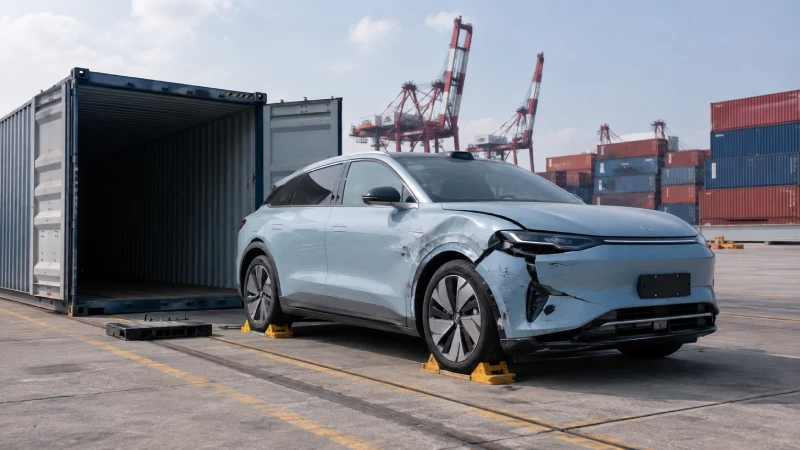
The short answer is: sometimes. A non-running electric vehicle is not automatically prohibited from ocean shipping, and body damage does not necessarily mean the traction battery is damaged. However, an EV with a damaged, defective, or unverified high-voltage battery normally cannot be booked as an ordinary intact electric vehicle with that battery still installed.
For shipping damaged EVs from China, four questions must be answered separately: Is the traction battery safe? Can the vehicle be loaded and secured safely? Will the carrier accept the actual vehicle and route in writing? And does the vehicle comply with both Chinese export requirements and destination-country import rules?
If you are arranging vehicle shipping from China, the technical condition of the vehicle should therefore be reviewed before requesting a final freight rate.
Non-Running, Damaged and Battery-Damaged Are Not the Same
These terms should not be used interchangeably.
Non-Running EV
A non-running EV cannot start or move under its own power, but its traction battery may still be completely serviceable. Possible causes include:
- A discharged 12V auxiliary battery
- Lost keys or an immobilizer problem
- Software locking
- Flat tires or mechanical failure
- Collision-triggered safety shutdown
- Drivetrain or high-voltage system faults
The cause must be identified before the vehicle can be classified for transport.
Damaged EV
A damaged EV may have dents, broken glass, suspension damage, damaged body panels, or even structural accident damage while the traction battery remains unaffected.
Light cosmetic damage is very different from an impact that has reached the underbody or battery enclosure.
EV With a Damaged or Defective Traction Battery
This is the highest-risk category. Warning conditions include battery-pack deformation, puncture, leakage, abnormal temperature, insulation faults, BMS problems, high-voltage faults, water immersion, fire exposure, smoke, or thermal runaway.
When battery condition is unknown, the absence of visible fire or dashboard warnings is not enough to prove safety.
Quick Decision Matrix—Can This EV Be Shipped?
| Vehicle Condition | Container | RoRo | Recommended Action |
|---|---|---|---|
| Dead 12V battery only | Possibly | Carrier-dependent | Diagnose and disclose |
| Lost key or software lock | Possibly | Often difficult | Restore steering/braking access |
| Cosmetic body damage | Possibly | Carrier-dependent | Complete condition survey |
| Mechanical non-runner | Case-by-case | Often rejected | Prepare container handling plan |
| Structural accident damage | High scrutiny | Usually unsuitable | Independent inspection |
| Battery-pack deformation | Normally no | No | Remove and reclassify battery |
| Flood or saltwater exposure | Usually rejected | Usually rejected | Specialist battery assessment |
| Fire or thermal event | Usually rejected | No | Specialist/authority route |
| Battery condition unknown | Usually rejected | Usually rejected | Diagnose before booking |
The decisive issue is usually not whether the car can drive. It is whether the traction battery and vehicle can be demonstrated to be safe for the proposed transport operation.
Start With the Traction Battery Assessment
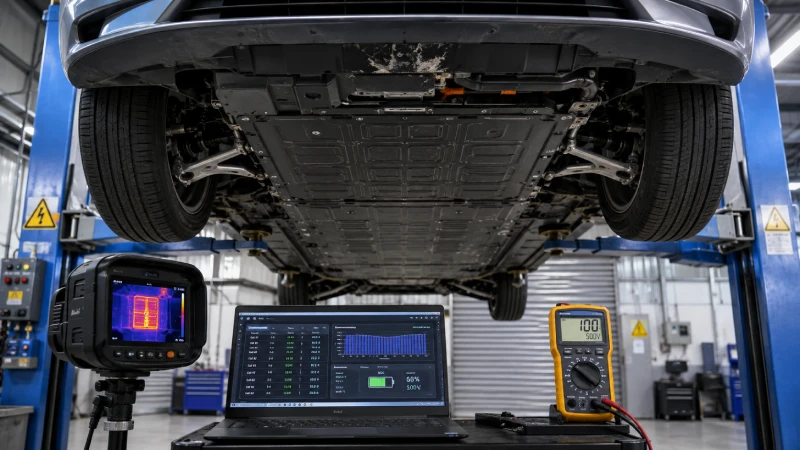
Before asking a carrier to approve a damaged or non-running EV, inspect the traction battery and high-voltage system.
The assessment should consider:
- Deformation or impact to the battery enclosure
- Underbody collision damage
- Electrolyte or cooling-fluid leakage
- Burn marks, smoke residue, odor, or venting
- Abnormal battery temperature
- High-voltage insulation resistance
- Whether the BMS can be read
- Relevant high-voltage fault codes
- Previous flooding or water immersion
- Manufacturer recalls
- Unauthorized battery repair or disassembly
Do not rely only on statements such as “the vehicle still charges,” “there is no warning light,” or “the seller says the battery is fine.” Accident photographs showing no obvious battery damage also do not establish the battery’s internal condition.
Where the vehicle has been involved in a significant collision, flooding, or high-voltage fault, assessment by the OEM, an authorized repair facility, or another technician with appropriate EV battery expertise is advisable.
What IMDG 42-24 Requires for the Vehicle
From January 1, 2026, IMDG Code Amendment 42-24 is mandatory. Battery-powered vehicles are classified using the relevant vehicle entries, including:
- UN3556 — Vehicle, Lithium Ion Battery Powered
- UN3557 — Vehicle, Lithium Metal Battery Powered
- UN3558 — Vehicle, Sodium Ion Battery Powered
These are Class 9 entries. UN3171 should no longer be used for lithium-ion, lithium-metal, or sodium-ion battery-powered vehicles under the updated classification.
For an intact EV, the shipper must confirm the correct UN number and Proper Shipping Name, determine the applicability of SP961 or SP962, meet applicable dangerous-goods declaration and marking requirements, prevent short circuits and accidental activation, and follow the applicable packing and securing provisions.
Booking information, the Dangerous Goods Declaration, packing documentation, and transport documents should also be consistent.
For more detail, see our UN3556 electric vehicle shipping guide.
What Happens If the Traction Battery Is Damaged?
A damaged or defective traction battery changes the transport situation substantially.
The Battery Normally Has to Be Removed
An EV should not simply continue through the booking process as an ordinary intact UN3556 vehicle when the installed battery is damaged or defective.
Carrier requirements may require the battery to be removed before the vehicle can be considered further.
The Removed Battery Becomes Separate Dangerous Goods
Once removed, the battery must be assessed independently. Depending on chemistry, the relevant entries may include UN3480 for lithium-ion batteries, UN3090 for lithium-metal batteries, or UN3551 for sodium-ion batteries.
The shipper must determine whether it is damaged or defective and whether it presents a more severe hazard.
Under Special Provision 376, batteries that are damaged or defective but are not liable to dangerously react under normal transport conditions may involve P908 or LP904. Batteries liable to rapidly disassemble, dangerously react, produce flame, generate dangerous heat, or emit dangerous gases may require the more stringent P911 or LP906 provisions and, where applicable, competent-authority approval.
Required damaged/defective battery wording must also be reflected in the package marking and transport documentation as applicable.
Crucially, a regulatory packaging route does not mean a carrier is obliged to accept the battery. Shipping lines, terminals, transshipment ports, and destination authorities may impose stricter restrictions.
Can a Non-Running EV Be Shipped in a Container?
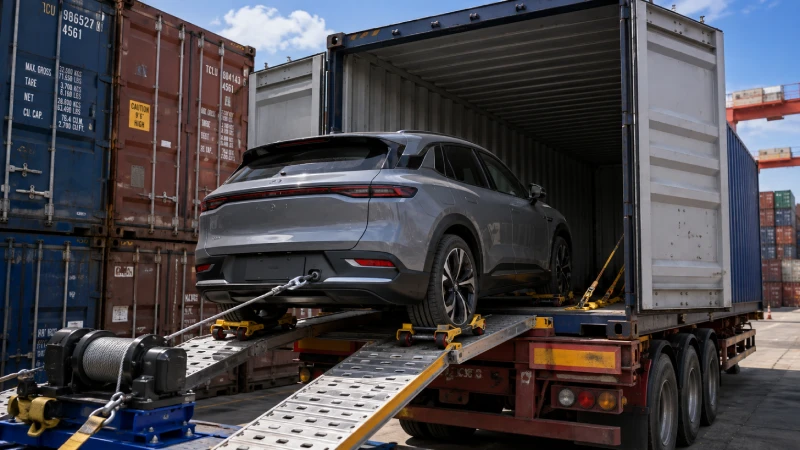
Yes, in some cases. Container shipping usually provides more operational flexibility than RoRo for a vehicle that cannot move under its own power, but loading must be engineered safely.
Before loading, confirm that:
- The wheels can rotate
- Steering can be unlocked
- Brakes can be released
- Tires can support the vehicle
- Factory towing points are usable
- Structural lashing points are undamaged
- The vehicle can remain upright
- A winch can move it into the container safely
- Ramps and equipment will not strike the battery pack
Never place forklift forks directly under the battery floor, attach a winch to non-structural bodywork, or secure the vehicle through accident-damaged suspension components.
The carrier should receive the proposed loading and securing method before the vehicle is delivered to the terminal.
Can a Non-Running EV Be Shipped by RoRo?
RoRo normally has stricter operability requirements.
Vehicles may need to drive on and off the vessel, while some carriers only consider non-running vehicles under restricted circumstances. Steering, braking, tires, and transmission functions may have to remain operable, and the vehicle generally must not leak.
For example, some published carrier requirements treat non-running vehicles as exceptional cargo and may restrict acceptance to new OEM vehicles meeting specified operating conditions.
Used BEVs, accident vehicles, or non-runners may therefore be rejected even when a technical loading method exists.
See RoRo vs container shipping for cars for the broader differences between the two methods.
China Export Requirements for Damaged or Used EVs
Carrier approval is only one part of the process. A used EV must also qualify for export from China.
Third-Party Vehicle Inspection
Used passenger vehicles are subject to third-party inspection requirements, including applicable WM/T 8-2022 requirements. Exported vehicles must pass the required inspection and comply with the destination market’s access standards.
Export Licence and Vehicle Registration Documents
Depending on the shipment, documentation may include:
- Export licence
- Motor vehicle registration certificate
- Transfer-for-export procedures
- Export contract
- VIN information
- Customs export declaration
Vehicle Condition Must Be Truthfully Disclosed
Vehicle condition must be disclosed truthfully, including actual mileage, accident and repair history, flooding or fire exposure, battery condition, and whether the vehicle can operate normally.
Prohibited Export Cases
An accident history alone does not automatically prohibit export. However, vehicles that have reached mandatory scrapping standards, fail the required inspection, are illegally assembled, lack required documentation, have unresolved traffic accidents, or do not correspond with their registration records cannot simply be exported as normal used vehicles.
From 2026, pure-electric passenger vehicles are also subject to China’s export licence administration. Vehicles registered for less than 180 days and exported as used vehicles may additionally require the applicable after-sales maintenance service confirmation.
Documents Required for Carrier Pre-Approval
For a damaged or non-running electric car, prepare the technical file before booking. A carrier may request some or all of the following:
- Make, model, year, and VIN
- New or used status
- Exact reason the vehicle cannot run
- Accident and repair history
- Vehicle condition report
- Independent survey report
- Battery diagnostic report
- BMS fault-code report
- Underbody and battery-pack photographs
- Confirmation of no leakage, deformation, or abnormal heat
- UN38.3 Test Summary
- SDS/MSDS
- Battery specification sheet
- SOC declaration where required
- Dangerous Goods Declaration
- Container/Vehicle Packing Certificate
- Loading and lashing plan
- OEM emergency response guide
- Carrier questionnaire or LOI
A UN38.3 Test Summary describes the battery type’s transport testing history; it should not be treated as proof that an accident-damaged battery remains safe today.
See EV battery documents required before ocean shipping for a more detailed document checklist.
Inspection Photos the Carrier May Request
Good photographs can significantly improve pre-approval review.
Provide dated images showing all four sides of the vehicle, the damaged area, underbody, battery enclosure and protective panels, wheels, tires, suspension, towing points, lashing points, dashboard fault information, VIN plate, charging port, and any leakage or burn area.
The photographs should correspond to the actual VIN being shipped. Do not substitute images from another vehicle of the same model or crop photographs to hide damaged areas.
Carrier Policies Can Be Stricter Than IMDG
Three separate levels must be considered.
First, the IMDG Code determines under what conditions dangerous goods may be transported. Second, a shipping line decides whether it is willing to accept that cargo. Third, the vessel, terminal, transshipment port, or particular service may impose additional restrictions.
A carrier may reject all vehicles containing damaged batteries, refuse used BEVs, accept non-runners only from OEMs, or require independent evidence that the battery was not affected.
Therefore, obtain written pre-approval for the actual VIN, actual route, and intended sailing. A verbal statement that the shipment “should be fine” is not sufficient.
Destination-Country Rules Are a Separate Test
Export clearance in China and carrier acceptance do not guarantee that the vehicle can be imported or registered at destination.
Some countries restrict salvage or total-loss vehicles, major accident vehicles, flooded or fire-damaged vehicles, structurally repaired vehicles, scrap vehicles, certain vehicle ages, or vehicles with the wrong steering configuration.
The buyer should therefore verify customs, vehicle safety inspection, road-registration, and resale requirements separately before shipment.
When a Damaged EV May Be Treated as Waste
If a vehicle or removed battery is intended only for dismantling, recycling, or disposal, cannot reasonably be repaired, has been declared scrap, or is no longer intended to perform its original function, waste-control rules may become relevant.
The Basel Convention framework can involve prior notification, consent from importing and transit countries, specific movement documents, authorized recovery or disposal facilities, and obligations relating to illegal traffic.
Describing scrap material as a “used vehicle” does not remove applicable waste-control obligations.
Cost and Insurance Implications
Non-running and damaged EV shipments can incur costs far beyond normal vehicle freight.
Possible extras include battery diagnostics, third-party inspection, marine surveys, towing, low-bed transport, winching, wheel dollies, lifting equipment, special container loading, customized lashing, dangerous-goods surcharges, terminal inspection, battery removal, SP376 packaging, authority approvals, and special destination handling.
Existing vehicle damage should also be disclosed when arranging cargo insurance. Policies may exclude pre-existing damage, battery defects, or losses caused by inadequate packing or securing.
A dated pre-loading condition report is therefore highly recommended. Carrier liability should not be regarded as a substitute for appropriate cargo insurance.
Red Flags—Do Not Book the Vehicle Yet
Pause the booking if:
- The battery enclosure is dented, cracked, or punctured
- The EV has been submerged, especially in saltwater
- There has been smoke, fire, or thermal runaway
- Battery temperature is abnormal
- Coolant or electrolyte is leaking
- A high-voltage insulation fault exists
- The BMS cannot be diagnosed
- Accident history is incomplete or concealed
- Structural lashing points are damaged
- The seller refuses to provide underbody photographs
- Carrier approval is only verbal
- The destination classifies the vehicle as scrap or waste
These problems should be resolved before freight and equipment are committed.
Recommended Pre-Shipment Workflow
A practical workflow is:
- Obtain the VIN, accident history, and current photographs.
- Identify exactly why the EV cannot operate.
- Inspect the traction battery and high-voltage system.
- Determine whether the battery is normal, damaged/defective, or presents a more severe hazard.
- Confirm Chinese used-vehicle inspection and export requirements.
- Check destination rules for accident, salvage, scrap, and registration status.
- Select container shipping or an acceptable RoRo solution.
- Submit the complete technical package to the carrier’s dangerous-goods team.
- Obtain written acceptance before arranging final towing and loading.
- Complete final dangerous-goods and packing documentation after loading.
- Keep photographs of loading, lashing, container sealing, and vehicle condition.
This sequence avoids one of the most expensive mistakes in damaged EV shipping: moving the vehicle to port before the carrier has reviewed its true condition.
FAQ
Can a non-running EV be shipped from China?
Possibly. The cause of the non-running condition must be identified, the traction battery must be shown to be safe, and loading, steering, braking, and securing issues must be resolved. Carrier approval is still required.
Does a dead 12V battery make an EV a damaged-battery shipment?
Normally no. A discharged auxiliary battery is different from a damaged traction battery. However, the shipper should establish that the problem is limited to the 12V system.
Can an accident-damaged EV be shipped in a container?
Light cosmetic or non-structural damage may be acceptable. Structural damage, underbody impact, or suspected battery-pack impact requires additional technical assessment and carrier review.
Can a damaged traction battery remain installed during shipping?
Normally, an EV with a damaged or defective installed traction battery cannot continue to be treated as an ordinary intact battery-powered vehicle. Removal and separate dangerous-goods classification may be required.
Can a flooded EV be shipped?
Flooded EVs, particularly those exposed to saltwater, present significant electrical and battery risks. Many carriers will reject them unless a specialist assessment and an acceptable transport route can be established.
Is RoRo or container better for a non-running EV?
Container shipping usually provides greater flexibility for winching and controlled securing. RoRo often has stricter requirements for self-propulsion or functional steering, brakes, tires, and towing capability. Neither method guarantees acceptance.
What inspection is needed before booking?
At minimum, review overall vehicle condition, battery enclosure, underbody, temperature, leakage, high-voltage insulation, BMS fault codes, and evidence of impact, fire, or flooding.
Does carrier acceptance guarantee import clearance?
No. Chinese export compliance, ocean-carrier acceptance, destination customs clearance, and vehicle registration are separate compliance stages.
Submit the Vehicle Condition Before Requesting a Freight Rate
For a damaged or non-running EV, send WINSail the make, model, year, VIN, new or used status, reason it cannot run, accident/flood/fire history, available battery diagnostic results, vehicle and underbody photographs, loading port, destination port, and preferred container or RoRo method.
WINSail can help review shipping feasibility, documentation, loading requirements, and carrier acceptance conditions. Official battery safety reports, competent-authority approvals, carrier acceptance, customs clearance, and destination registration remain subject to the relevant qualified organizations and authorities.
