
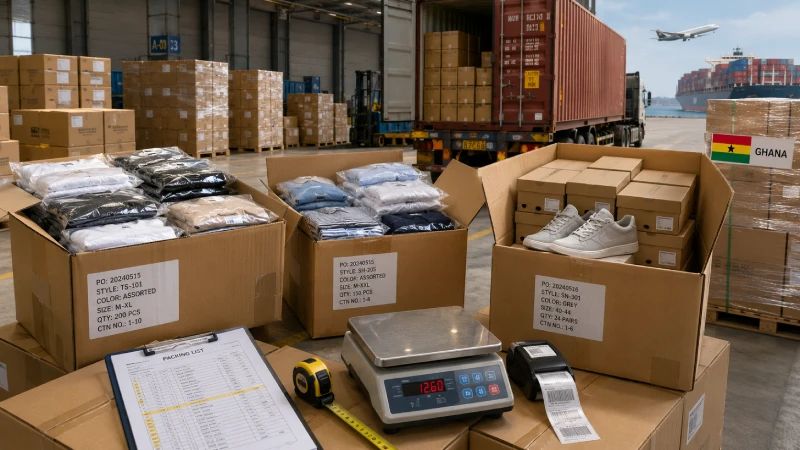
Importing clothing or footwear from China to Ghana involves much more than finding a supplier with an attractive unit price. For wholesalers, boutique distributors, shoe dealers, fashion retailers and private-label buyers, the final landed cost can change significantly depending on carton dimensions, packaging, SKU complexity, supplier locations, freight mode and Ghana import requirements.
This is especially important for fashion products. Soft garments can often be packed efficiently, while footwear tends to occupy considerably more space because individual shoe boxes create fixed volume. An order may also contain dozens of combinations of styles, colors and sizes that must remain traceable from the factory to the warehouse and eventually to the importer in Ghana.
For the wider sourcing, documentation and clearance sequence, refer to Winsail’s how to import from China to Ghana guide. This article focuses specifically on new commercial apparel and footwear.
Important: New clothing and footwear should not be treated as if they were second-hand goods. Ghana has separate regulatory considerations for used products, which are discussed later in this guide.
Quick Answer: What Should You Check Before Shipping Clothing or Shoes to Ghana?
Before booking clothing shipping from China to Ghana:
- Confirm whether the products are new or used.
- Record the product type, material and proposed HS classification.
- Ask each supplier for final carton quantities, dimensions and gross weights.
- Prepare one SKU master covering Style / Color / Size / Quantity.
- Consolidate multiple suppliers when this improves shipment control.
- Check Ghana conformity, labeling and customs requirements before departure.
- Compare courier, air freight, LCL and FCL based on final chargeable weight or CBM rather than the purchase price alone.
Do not rely on estimated cartons if final packing could materially change freight charges.
MOQ Is Only One Part of the Cost
When buying clothing wholesale from China for Ghana, importers often focus first on MOQ and unit price.
Those figures matter, but they do not show the complete landed cost.
A shipment may also involve:
- supplier pickup in China;
- private-label setup and packaging;
- export cartons;
- warehouse receiving;
- multi-supplier consolidation;
- inspection if separately commissioned;
- repacking or relabeling;
- international freight;
- destination handling;
- customs clearance;
- applicable duties and taxes;
- delivery within Ghana.
This is why an extremely low-cost garment is not automatically the most economical product to import.
For example, one supplier may quote a lower unit price but use large, poorly filled cartons. Another may charge slightly more while packing more saleable pieces into each cubic meter. Once international transport is considered, the difference in logistics cost per piece can become important.
The same principle is even more relevant when importing shoes from China to Ghana.
Shoes and Apparel Behave Differently in Freight
Clothes and shoes may be sold by the same fashion importer, but their freight characteristics are different.
Shoes vs Apparel Logistics Comparison
| Factor | Apparel | Footwear |
|---|---|---|
| Product structure | Usually soft and flexible | Structured and less compressible |
| Main volume issue | Carton utilization | Individual shoe boxes |
| Vacuum packing | Possible for selected products | Usually unsuitable |
| Shape protection | Moderate for many garments | Important |
| SKU complexity | Style + color + size | Style + color + size |
| Retail packaging | Often polybag or folded | Frequently individual box |
| Air freight concern | Dimensional weight on bulky cartons | Often significant dimensional weight |
| Repacking potential | Generally higher | More limited |
Why Carton Dimensions Matter
For air freight and courier shipments, the physical size of a carton can affect the chargeable weight.
A carton may weigh relatively little but occupy a large amount of aircraft space. Depending on the carrier and service, dimensional or volumetric weight may therefore exceed the actual scale weight.
For LCL sea freight, final cargo volume is also important because charges commonly depend heavily on the shipment’s measured CBM and the applicable weight-or-measure rules.
This means that a statement such as “the order weighs about 300 kg” is not enough to prepare a reliable freight comparison.
You also need:
- number of cartons;
- length × width × height of each carton type;
- gross weight;
- total CBM.
Why Shoes Can Generate More Volumetric Weight
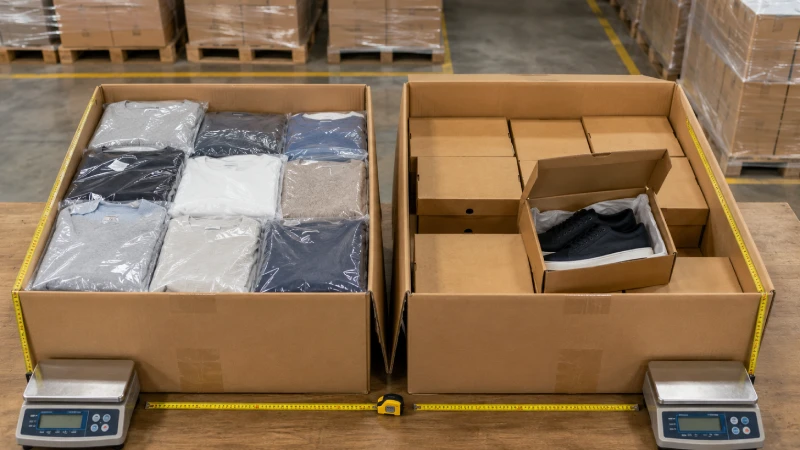
Footwear is normally more difficult to compress than T-shirts, shorts or other soft garments.
A pair of shoes may be relatively light, but each pair can require its own retail box. That box contains unavoidable space around the shoe, and several retail boxes are then packed into an outer master carton.
As a result, shoes can produce a relatively high cubic volume compared with their actual weight.
For footwear imports, reducing unnecessary packaging volume can sometimes have more impact on freight efficiency than removing a few kilograms from the shipment.
Optimize Packaging Without Damaging the Product
Packing optimization should reduce unnecessary volume without creating damaged or unsaleable stock.
Volume Optimization Checklist
Before booking freight:
- obtain final outer-carton dimensions;
- avoid half-empty export cartons;
- reduce unnecessary void space;
- standardize master cartons where practical;
- confirm carton strength before increasing quantity per carton;
- keep SKU identification visible;
- check whether apparel can safely be compressed;
- review whether shoe boxes are oversized;
- recalculate total CBM after repacking;
- photograph the final packing configuration.
When Vacuum Packing Can Work for Apparel
Vacuum packing can be useful for some soft apparel, including products such as basic T-shirts, simple knitwear and non-structured garments.
It is not suitable for every product.
Be careful with:
- structured jackets;
- padded garments;
- delicate embroidery;
- decorative trims;
- products that crease heavily;
- premium products whose presentation is part of their retail value.
Compression is useful only when the garment can recover after unpacking without creating a quality problem.
Why You Should Not Automatically Remove Every Shoe Box
Removing individual shoe boxes can reduce volume, but it also introduces risks.
The box may protect the shoe from:
- crushing;
- deformation;
- scuffing;
- mixed pairs;
- incorrect size identification.
For private-label products, the retail box may also carry important brand, SKU or product information.
Instead of automatically eliminating boxes, consider whether the supplier can:
- reduce oversized boxes;
- standardize box dimensions;
- improve master-carton utilization;
- strengthen outer cartons.
Box removal makes more sense when the sales model does not require individual retail packaging and adequate alternative protection has been agreed.
Control Multi-SKU Orders Before They Reach the Warehouse
A statement such as “1,000 pieces of clothing” provides very little operational information.
Fashion orders frequently contain many combinations of:
- style;
- color;
- size;
- supplier;
- carton number.
A structured SKU packing list makes discrepancies easier to identify.
SKU Packing List Template
| Style | Product | Color | Size | Qty / Carton | Cartons | Total Qty |
|---|---|---|---|---|---|---|
| TS-101 | T-Shirt | Black | M | 40 | 2 | 80 |
| TS-101 | T-Shirt | Black | L | 40 | 2 | 80 |
| TS-101 | T-Shirt | White | M | 40 | 1 | 40 |
| SH-208 | Sneakers | White | 42 | 12 pairs | 2 | 24 pairs |
Useful additional columns include:
- supplier;
- purchase order number;
- carton number;
- barcode;
- gross weight;
- carton dimensions;
- CBM.
This format makes it easier to find missing sizes, wrong colors, duplicate cartons or unexplained quantity differences before the shipment leaves China.
For multi-SKU garments, the warehouse count sheet should ultimately reconcile with the supplier packing list and commercial documents.
Consolidating Guangzhou and Yiwu Clothing Suppliers
Many Ghana importers purchase from more than one Chinese supplier.
For example, one shipment may include garments from suppliers around Guangzhou, accessories from another supplier and footwear or small fashion items sourced from Yiwu or elsewhere in Zhejiang.
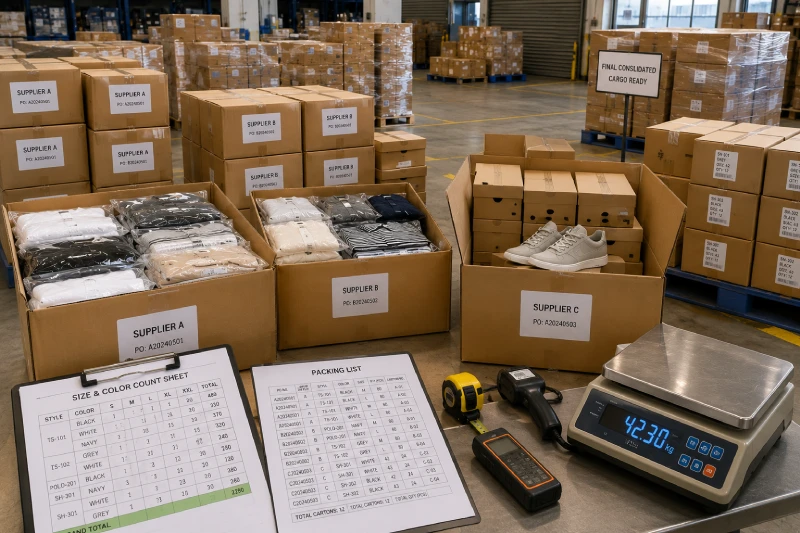
Instead of shipping every supplier independently, the cargo can be coordinated through a China consolidation warehouse.
Supplier Consolidation Workflow
Supplier cargo ready
↓
Pickup or warehouse delivery
↓
Warehouse receiving
↓
Supplier / PO identification
↓
Carton and SKU reconciliation
↓
Repacking or labeling if agreed
↓
Final dimensions, weight and CBM
↓
Air / LCL / FCL booking
↓
Shipment to Ghana
A detailed explanation of this process is available in Winsail’s China to Ghana cargo consolidation guide.
However, putting cargo from several suppliers in one warehouse does not automatically mean all goods can use one commercial invoice, one export declaration or one regulatory document. Documentation and exporter arrangements need to be checked separately.
What a Consolidation Warehouse Can—and Cannot—Check
Warehouse receiving is valuable, but it should not be confused with a full product inspection.
Depending on the agreed receiving scope, the warehouse may check:
- supplier identity;
- purchase-order reference;
- carton quantity;
- visible carton condition;
- shipping marks;
- gross weight;
- carton dimensions;
- receiving photographs;
- SKU labels;
- selected quantity information.
These checks can detect obvious logistics discrepancies.
They do not automatically confirm:
- workmanship quality;
- fabric composition;
- colorfastness;
- garment measurements;
- seam quality;
- shoe bonding;
- sole performance;
- full AQL compliance;
- laboratory conformity;
- authenticity of a branded product.
A warehouse can confirm what physically arrived within the agreed receiving scope. It cannot certify that every garment or pair of shoes complies with the buyer’s manufacturing specification.
If product quality is important, arrange the appropriate inspection separately.
Private-Label Apparel and Footwear: Check Labels Before Production
Private-label buyers should review labels and retail packaging before mass production rather than trying to correct them after hundreds or thousands of units have been packed.
Private Label Pre-Shipment Checklist
Review:
- brand name;
- product description;
- manufacturer details;
- country of origin;
- size system;
- material or fiber declaration where applicable;
- care information;
- wash symbols;
- style / SKU number;
- barcode;
- carton marks;
- polybag information where applicable;
- retail shoe-box markings.
The Ghana Standards Authority’s imported-product guidance includes general labeling information such as the product name, manufacturer name and address, and country of origin. It also states that information presented in a foreign language other than English should be translated into English and that products must satisfy the specific labeling requirements of the applicable standard.
This distinction is important.
Do not assume that every garment entering Ghana is automatically subject to one universal fiber-content or sizing rule. Fiber composition, size labeling, care labeling and other textile-specific information should be checked against the applicable Ghana Standard for the exact product.
For private-label production, this check should happen before labels, hangtags and packaging are printed.
Ghana Standards Checks for New Clothing and Footwear
GSA’s current EasyPASS information lists Textile, Textile Articles and Leatherware including African Prints among covered product categories. It separately lists Selected Used Products, including used clothes and footwear, which reinforces the need to treat new and used goods as different compliance categories.
Before shipping new commercial apparel or footwear, establish:
- the exact product description;
- main materials;
- proposed HS classification;
- whether the exact product falls within an applicable conformity-assessment scope;
- which Ghana Standard applies;
- whether conformity documentation or testing is required;
- what product-specific labeling is required.
Do not assume that every T-shirt, leather shoe, synthetic sneaker or textile article follows an identical conformity path.
New vs Used Clothing and Footwear Are Not the Same
Used clothing should never be treated as simply another version of new apparel.
New vs Used Goods Compliance
| Issue | New Clothing / Footwear | Used Clothing / Footwear |
|---|---|---|
| Same regulatory treatment? | No | No |
| Product standards | Check exact category | Separate used-product controls may apply |
| GSA conformity scope | Verify exact textile / leatherware category | Selected used clothes and footwear are separately identified |
| High Risk Goods | Depends on applicable category | Second-hand clothing appears in GSA’s High Risk Goods framework |
| Specific used-item prohibitions | Do not automatically apply | Some second-hand articles are expressly prohibited |
GSA’s import-inspection guidance identifies second-hand clothing within its High Risk Goods framework. It also states that certain second-hand goods, including handkerchiefs and men’s, women’s and children’s underpants, cannot be imported for commercial purposes.
That does not mean all used clothing or footwear is automatically prohibited, and these second-hand provisions should not be applied to new clothing.
If the cargo contains used garments or shoes, verify the exact current rules before purchasing or shipping.
Brand and Intellectual Property Risks
Branded fashion requires another level of due diligence.
Products described as:
- “factory surplus”;
- “original copy”;
- “1:1 quality”;
- unauthorized branded stock;
- shoes carrying copied logos;
- garments with copied hangtags or packaging
should not be treated as ordinary commercial freight simply because a supplier is willing to sell them.
Counterfeit products can create trademark, customs and seizure risks. They are not a normal freight-forwarding opportunity and should not be represented as one.
For legitimate branded products, keep relevant supporting documentation such as:
- supplier invoice;
- brand authorization where relevant;
- licensing evidence where applicable;
- accurate product descriptions;
- legitimate packaging and trademarks.
Courier, Air Freight, LCL or FCL?
There is no single shipping method that is cheapest for every clothing shipment.
Air vs Sea by Shipment Situation
| Shipment Situation | Usually Compare First | Main Cost Driver |
|---|---|---|
| Samples | Courier | Chargeable weight |
| Small urgent replenishment | Courier vs air | Weight + dimensions |
| Larger urgent shipment | Air freight | Chargeable kg |
| Several CBM, non-urgent | LCL | CBM + destination charges |
| Larger consolidated order | LCL vs FCL | Total shipment economics |
| High container utilization | FCL | Container utilization |
Courier
Courier is usually suitable for:
- samples;
- approval pieces;
- very small urgent orders.
Air Freight
Air freight is worth considering for:
- urgent inventory;
- higher-value garments;
- time-sensitive replenishment.
For shoes, always check dimensional weight carefully.
LCL Sea Freight
LCL can make sense when an order has become too large for economical air freight but does not justify a full container.
Final CBM matters, so supplier estimates should be replaced with warehouse measurements before booking whenever possible.
FCL Sea Freight
Compare FCL when consolidated volumes become substantial.
A dedicated container can also reduce some cargo handling compared with LCL, although the correct choice should be made from actual shipment data rather than an arbitrary CBM rule.
For current freight variables, refer to Winsail’s shipping cost from China to Ghana guide rather than relying on static rate tables inside a product-category article.
Why Very Cheap Products Can Lose Their Price Advantage
Suppose two suppliers offer similar basic garments.
Supplier A provides a slightly lower purchase price but uses large cartons with poor utilization.
Supplier B charges somewhat more but packs considerably more saleable pieces into the same amount of shipping space.
For an international wholesale shipment, comparing only the factory price hides part of the economics.
A better calculation is:
Landed logistics cost per saleable piece
= origin pickup
+ warehouse handling
+ repacking
+ international freight
+ destination charges
+ clearance and applicable taxes
+ local delivery
÷ saleable quantity
This does not tell you whether a fashion product will be profitable in Ghana. It simply helps reveal whether an apparently inexpensive product is inefficient to transport.
Clothing Duty in Ghana: Do Not Calculate It from Purchase Price Alone
There is no reliable single “Ghana clothing duty” percentage that should be applied to every garment or every pair of shoes.
The Ghana Revenue Authority’s import procedures explain that import declarations in ICUMS proceed through classification, valuation and approval. The final assessment depends on the product classification, customs value and the duties, taxes and levies applicable to the specific import.
That is why an invoice saying “2,000 T-shirts × supplier unit price” is not, by itself, a complete customs calculation.
Assessment may depend on factors such as:
- exact HS Code;
- garment or footwear type;
- material;
- customs value;
- country of origin;
- applicable tariff treatment;
- VAT and other applicable charges.
Before estimating landed cost, confirm the proposed classification with the Ghana importer, clearing agent or GRA rather than relying on a generic duty figure found on a supplier website.
For the wider process, see Winsail’s customs clearance in Ghana guide.
Reconcile the Documents Before Departure
GRA’s import procedures identify documents such as the Bill of Lading or waybill, invoice, packing list, Import Declaration Form and applicable regulatory permits as part of the clearance documentation framework.
For clothing and footwear, the logistics records should also reconcile.
Check:
Commercial Invoice quantity
↕
Packing List quantity
↕
Style / Size / Color SKU sheet
↕
Warehouse receiving record
↕
Final carton count
If the commercial invoice states 1,000 pieces but the detailed packing list contains only 973 identifiable pieces across colors and sizes, resolve the difference before the cargo departs China.
This is much easier than discovering the discrepancy after arrival in Ghana.
What Information Is Needed for a Clothing or Footwear Freight Quote?
The quality of a freight quotation depends on the quality of the shipment information.
Quote Checklist
Provide:
- clothing, footwear or textile product type;
- whether goods are new or used;
- main material or composition;
- brand / private-label status;
- number of suppliers;
- supplier pickup locations;
- total carton quantity;
- carton dimensions;
- gross weight per carton;
- total gross weight;
- final CBM if available;
- Style / Color / Size quantity breakdown;
- Incoterm;
- cargo-ready date;
- proposed HS Code if known;
- available compliance documents;
- preferred shipping method;
- destination in Ghana;
- delivery address if inland delivery is required.
For multi-supplier apparel orders, an early freight estimate can be prepared from supplier packing data. However, the shipment should be reviewed again after all cargo has reached the consolidation warehouse and the final dimensions, weight and CBM are known.
FAQ
Can I import clothing from China to Ghana?
Yes. New commercial clothing can be imported subject to Ghana customs requirements and any applicable product standards or conformity requirements. Used clothing should be checked separately because different controls apply.
How much duty do I pay on clothing imported into Ghana?
There is no single percentage that accurately covers every garment. Duty and other import charges depend on the HS classification, customs value, product characteristics and the applicable Ghana tariff and tax treatment.
Is it cheaper to ship clothes by air or sea from China to Ghana?
It depends on shipment size, urgency, actual weight and carton volume. Small urgent orders may suit courier or air freight, while larger non-urgent wholesale orders should normally be compared using LCL or FCL sea freight options.
Why can shoes cost more to ship than clothing?
Shoes are relatively rigid and commonly packed in individual retail boxes. This creates more cubic volume relative to the actual weight and can increase dimensional-weight or CBM-based freight costs.
Can I remove shoe boxes to save freight?
Sometimes, but not automatically. Removing boxes may cause deformation, scuffing, mixed sizes or loss of retail packaging. Right-sizing the boxes and improving master-carton utilization may be a better approach.
Can clothing from several Chinese suppliers be consolidated?
Yes. Orders from different suppliers can be received at a consolidation warehouse, identified, measured and prepared for one coordinated shipping plan. However, consolidation does not automatically combine all invoices, exporter arrangements or regulatory documentation.
What labels should private-label clothing have for Ghana?
GSA's general imported-product guidance includes information such as product identification, manufacturer details and country of origin. The exact garment or footwear standard should also be checked for additional requirements such as care, composition or other product-specific labeling.
Are used clothes subject to the same rules as new clothes?
No. Ghana's official materials treat selected used clothing and footwear separately, and specific second-hand articles are prohibited. Always confirm the current rules for the exact used product before shipment.
