
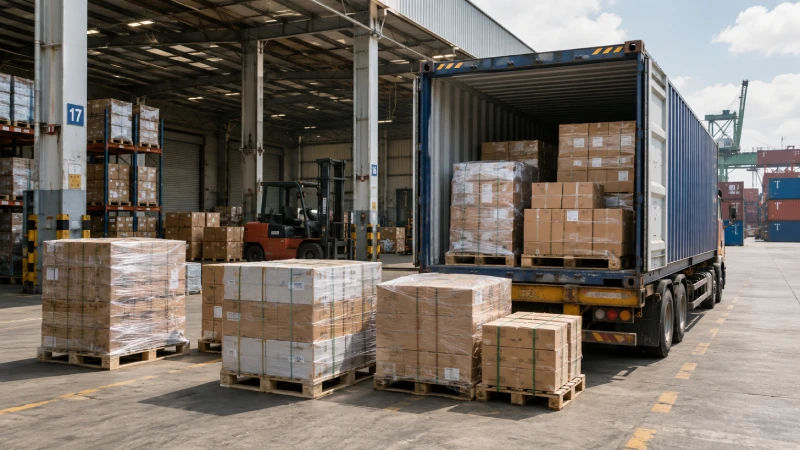
For UK importers moving several pallets or approximately 1–15 CBM of commercial cargo from China, LCL shipping can be one of the most practical sea freight options. Instead of paying for an entire container, your goods share container space with cargo from other shippers.
But LCL is not simply a matter of multiplying your shipment volume by a “price per CBM.”
A China-to-UK LCL shipment normally involves supplier collection, delivery to a Container Freight Station (CFS), consolidation in China, container loading, ocean transport, deconsolidation in the UK, customs clearance and final delivery. Each stage can affect the final cost and lead time.
This guide explains how LCL shipping from China to the UK actually works, how W/M charging is calculated, what destination charges to expect, when supplier consolidation makes sense, and when air freight or FCL should be compared instead.
For a broader comparison of sea freight, air freight, express, DDP and other shipping options, see our Shipping from China to the UK guide.
Last reviewed: September 2026
Quick Answer: Is LCL a Good Choice for Shipping from China to the UK?
LCL, or Less than Container Load, is generally worth considering when your commercial shipment is too large for economical courier or air shipping but does not require a dedicated container. For many non-urgent, well-packed general cargo shipments of roughly 1–10 CBM, LCL can provide a practical balance between freight cost and inventory requirements.
Once cargo approaches approximately 10–15 CBM, however, do not assume LCL remains cheaper. Request both an LCL quotation and a 20ft FCL quotation and compare the total landed logistics cost, including origin handling, destination CFS charges, customs clearance and inland delivery.
LCL is also less suitable for some fragile, high-value, very dense, non-stackable or dangerous goods because the cargo is handled several times during consolidation and deconsolidation.
| Shipment Profile | LCL Suitability | What to Compare |
|---|---|---|
| Below ~1 CBM | Possible, but minimum charges may be inefficient | Courier or air freight |
| ~1–5 CBM | Strong LCL candidate for non-urgent general cargo | LCL vs air |
| ~5–10 CBM | Typical LCL range | LCL |
| ~10–15 CBM | Comparison zone | LCL vs 20ft FCL |
| 15+ CBM | FCL deserves serious consideration | FCL vs LCL |
| Fragile/high-value cargo | Depends on packaging and handling sensitivity | Air or FCL |
| Very heavy cargo | W/M charging may change economics | LCL vs FCL |
| Dangerous goods | Specialist review required | DG-compatible service |
These ranges are planning guidelines rather than carrier rules. Cargo density, packaging, local charges, shipment value, delivery location and current container rates can move the LCL/FCL break-even point significantly.
Is LCL the Right Choice for Your China-to-UK Shipment?
Volume is important, but it should not be the only factor used to select LCL.
A better decision considers four things:
- shipment volume and weight
- urgency
- cargo characteristics
- tolerance for additional handling
LCL Suitability by Cargo Profile
| Factor | Good LCL Fit | Compare Carefully | Poor Standard-LCL Fit |
|---|---|---|---|
| Volume | 1–10 CBM | 10–15 CBM | Near FCL economics |
| Urgency | Flexible replenishment | Moderate deadline | Critical stock |
| Cargo type | Cartons and palletised general cargo | Machinery or special cargo | Highly fragile/high-value cargo |
| Handling sensitivity | Low | Moderate | High |
| Density | Normal | Heavy pieces | Extremely dense pieces |
| Stackability | Stackable | Partially stackable | Large non-stackable units |
| Dangerous goods | Approved groupage only | Specialist review | Cargo incompatible with the consolidation |
For example, 12 CBM of robust, stackable consumer goods and 12 CBM of delicate precision machinery should not automatically use the same shipping method simply because the volume is identical.
Three Questions to Ask Before Choosing LCL
Can the goods tolerate additional handling?
LCL cargo is normally handled when entering the consolidation warehouse, during container stuffing, during deconsolidation in the UK and again for final collection or delivery.
Can your inventory plan tolerate extra consolidation time?
The vessel sailing itself is only one part of the LCL lead time.
Is the total LCL cost still competitive?
A low ocean freight rate per CBM can be misleading if destination CFS charges, minimum fees or delivery costs are high.
How LCL Shipping from China to the UK Actually Works
An LCL shipment does not normally move directly from a Chinese factory into a container and then directly to your UK warehouse.
Understanding the intermediate steps makes both the quotation and the transit time easier to evaluate.
1. Supplier Pickup or Delivery to the China Warehouse
Depending on the agreed Incoterm and service scope, cargo may be:
- collected from the supplier
- delivered by the supplier to the nominated warehouse
- consolidated from several different factories
At the receiving warehouse, important details typically include:
- carton or pallet quantity
- final packed dimensions
- gross weight
- packaging condition
- shipping marks
- cargo description
Do not rely only on the supplier’s estimated CBM.
The freight calculation should ultimately use the final packed shipment dimensions, particularly after palletisation, crating or other export packaging.
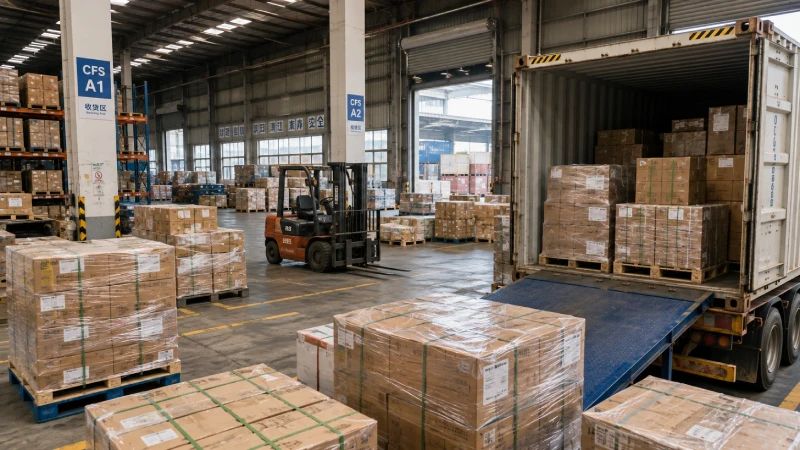
2. Cargo Enters the China CFS
LCL cargo is normally delivered to a Container Freight Station, or CFS, where shipments from different customers are prepared for consolidation.
The shipment must normally arrive before the warehouse or consolidation cut-off.
This creates an important distinction:
CFS cut-off is not the same thing as vessel departure time.
A supplier that finishes production shortly before the vessel departs can still miss that week’s consolidation if the CFS receiving deadline has already passed.
3. Consolidation and Container Stuffing
The consolidator groups compatible shipments travelling through the same service.
Cargo is then arranged and loaded into the shared container.
This stage is one reason LCL requires good packaging. Your cargo is sharing space with other consignments, and the shipper generally has less control over the entire container environment than with a dedicated FCL container.
4. Ocean Transport to the UK
Once consolidated, the container enters the international ocean freight leg.
The routing may involve:
- a direct service
- a transshipment service
- different loading and discharge ports depending on the consolidator
Do not assume every China-to-UK LCL shipment follows exactly the same port pair.
More importantly, vessel transit time is not the same as total LCL lead time.
5. UK Deconsolidation
After the shared container reaches the destination network, it must be discharged and stripped so that the individual LCL consignments can be separated.
The destination process can include:
- container discharge
- CFS handling
- container stripping
- cargo identification
- individual shipment release
- documentation
- customs processing
- collection or delivery arrangement
This is why an LCL shipment normally does not become available immediately when the vessel itself arrives.
6. Customs Clearance and Final UK Delivery
Once the shipment is ready for release and the necessary customs requirements have been completed, cargo can move to its final destination.
Depending on the agreed service scope, this may include delivery to:
- an importer warehouse
- a wholesaler
- a distribution centre
- a 3PL
- a commercial address
- an Amazon-related fulfilment operation where the required receiving and appointment procedures have been arranged
Winsail can coordinate relevant parts of the China-side collection, consolidation, international freight and UK-side delivery process depending on the agreed shipment scope. Customs clearance can also be coordinated where applicable, but the importer structure and customs responsibilities should be confirmed for each shipment.
How LCL Freight Is Charged: CBM, Weight and W/M
One of the most important differences between LCL and FCL is how the international freight is calculated.
For shipment-size examples and destination-cost logic, compare the LCL shipping cost per CBM guide.
FCL is generally priced around the container.
LCL is normally calculated according to the amount of space or chargeable weight your shipment occupies.
How to Calculate CBM
For one carton or pallet:
Length × Width × Height = CBM
When measurements are in metres:
1.2 m × 1.0 m × 1.1 m = 1.32 CBM
For multiple identical packages:
CBM per package × quantity = total CBM
Always calculate using the outer dimensions after final packing.
If products are palletised, the pallet dimensions—not the dimensions of the individual cartons before palletisation—become relevant.
What Does W/M Mean in LCL Shipping?
Many ocean LCL tariffs use Weight or Measure, usually written as W/M.
Under a commonly used 1:1 W/M basis:
- 1 CBM = 1 revenue unit
- 1,000 kg = 1 weight unit
The higher figure is used as the chargeable quantity.
Maersk’s published LCL terms, for example, state that where bookings are calculated in Weight and Measure Units, the calculation uses the higher of gross CBM or gross weight, with 1 CBM equivalent to 1,000 kg. Actual rules should always be confirmed against the quotation or consolidator tariff used for your shipment. Maersk LCL Terms
Example 1: Volume Is Higher
Shipment:
- 4.2 CBM
- 900 kg
Volume basis:
4.2
Weight basis:
0.9
The chargeable quantity would typically be approximately 4.2 W/M under a 1:1 W/M tariff.
Example 2: Weight Is Higher
Shipment:
- 2.0 CBM
- 2,700 kg
Volume basis:
2.0
Weight basis:
2.7
The shipment may therefore be charged on approximately 2.7 W/M.
This is why very dense products can behave differently from normal cartons when LCL pricing is calculated.
Pro Tip: Tell your freight forwarder about unusually heavy individual pieces as well as total shipment weight. Heavy-piece handling or warehouse limitations can matter even when the total CBM looks small.
Minimum LCL Charges Matter on Very Small Shipments
A shipment measuring only 0.4 or 0.7 CBM does not necessarily mean every cost will simply be multiplied by 0.4 or 0.7.
Some freight and handling components may have minimum charges.
For very small commercial consignments, compare the complete LCL cost against air freight or courier rather than assuming sea freight must be cheaper.
What Does LCL Shipping from China to the UK Really Cost?
A useful LCL quotation should be understood as a cost chain, not one freight rate.
The international ocean freight may be quoted per CBM or W/M, but that is only one part of the shipment.
| Cost Stage | Typical Charging Basis | Main Variables |
|---|---|---|
| Supplier pickup | Shipment / vehicle | Factory location, cargo size |
| China CFS receiving | CBM, W/M or shipment | Cargo dimensions and handling |
| Export/documentation | Shipment | Service and documentation |
| Ocean freight | W/M | Origin, destination, market |
| UK CFS/deconsolidation | W/M or shipment | Destination tariff |
| Customs clearance | Entry / declaration | Commodity and complexity |
| Customs Duty | Commodity-specific | Commodity code and customs value |
| Import VAT | UK VAT rules | VAT value and product treatment |
| UK delivery | Shipment / vehicle | Postcode, access, delivery type |
| Exceptional charges | Actual event | Inspection, storage, special handling |
Actual freight rates can change with vessel capacity, season, fuel costs, routing and carrier market conditions. For that reason, current China-to-UK LCL costs should be confirmed through a live quotation rather than treated as a permanent per-CBM figure.
For detailed rate calculations, see LCL Shipping Cost per CBM from China to UK.
Why Two LCL Quotes With Different Per-CBM Rates May Be Misleading
Consider two hypothetical quotations.
Quotation A
- lower ocean freight rate
- destination handling excluded
- customs clearance excluded
- UK delivery excluded
Quotation B
- higher ocean freight rate
- some destination handling included
- customs entry included
- delivery quoted separately
If you compare only the ocean freight line, Quotation A appears cheaper.
It may not be cheaper after arrival.
The more useful question is:
What remains payable after the cargo reaches the UK?
UK Destination Charges: The Part of LCL Pricing You Should Not Ignore
Destination charges are especially important with LCL because the shared container must be deconsolidated and individual consignments processed.
Depending on the quotation and destination arrangement, charges may include:
- destination CFS handling
- deconsolidation
- documentation or release fees
- customs clearance
- storage if release or collection is delayed
- inspection or examination-related charges if incurred
- final inland transport
Not every shipment will incur every charge, and different consolidators structure their tariffs differently.
That is why publishing a single universal “UK destination charge per CBM” is usually misleading.
Fixed Charges Affect Small Shipments More
Suppose a destination process contains a fixed shipment-level charge.
The same fixed cost spread across 1 CBM has a much larger cost-per-CBM impact than when spread across 8, 10 or 12 CBM.
This is another reason extremely small LCL shipments are not automatically economical.
Before Accepting an LCL Quotation, Ask These Questions
- Is the quotation port-to-port, CFS-to-CFS or door-to-door?
- What China origin charges are included?
- What UK destination charges are included?
- Are CFS and deconsolidation charges included?
- Is customs clearance included?
- Is final UK delivery included?
- Which charges will be payable separately after arrival?
- Are inspection or storage charges excluded?
- What minimum charges apply?
- Is the freight calculation based on CBM or W/M?
Pro Tip: Never choose a China-to-UK LCL service purely because it shows the lowest ocean freight rate per CBM. Compare the complete shipment cost.
How Long Does LCL Shipping from China to the UK Take?
LCL normally needs more processing time than a comparable FCL shipment because cargo has to be consolidated before departure and separated again after arrival.
A realistic lead-time discussion should therefore distinguish between ocean transit and total shipment lead time.
| Stage | What Can Affect the Time |
|---|---|
| Supplier pickup | Cargo-ready date |
| China CFS receiving | Warehouse cut-off |
| Consolidation | Groupage schedule |
| Ocean movement | Route and transshipment |
| UK deconsolidation | CFS processing |
| Customs | Declaration and shipment status |
| Final delivery | Postcode and appointment requirements |
As a planning reference, many China-to-UK LCL shipments fall around 30–45 days for the main international/CFS movement, although actual timing depends on origin, routing, consolidation schedule and destination arrangements. Total supplier-to-door time can be longer because pickup, consolidation, customs and final delivery also need to be included.
For a wider transit-time comparison across sea freight, air freight, express and DDP, see How Long Does It Take to Ship from China to UK?.
Actual schedules should always be confirmed when booking.
Why LCL Can Take Longer Than FCL
Additional time may arise from:
- waiting for the CFS cut-off
- consolidation before container loading
- transshipment routing
- destination container stripping
- individual cargo release
- final collection scheduling
If the shipment is tied to a production deadline, stockout risk or retail launch, compare the cost of a faster mode rather than looking only at ocean freight savings.
Consolidating Goods from Multiple Suppliers in China
Supplier consolidation is one of the most practical uses of LCL for UK importers buying from several Chinese factories.
The China-to-UK cargo consolidation guide explains how supplier receiving, cargo checks and export consolidation can be organised before LCL booking.
Instead of sending three or four small international shipments separately, goods can potentially be collected or delivered into one China consolidation point and shipped together.
This is particularly relevant for:
- wholesalers sourcing multiple SKUs
- distributors buying from several factories
- e-commerce inventory
- project procurement
- furniture and interior products
- machinery plus accessories or spare parts
A Typical Supplier-Consolidation Workflow
- Collect each supplier’s address and contact details.
- Confirm each supplier’s cargo-ready date.
- Obtain carton or pallet quantities.
- Arrange pickup or delivery into the consolidation warehouse.
- Check received quantities and packing information.
- Confirm final dimensions and weights.
- Align commercial invoice and packing-list information.
- Prepare the combined international shipment.
- Book the LCL consolidation to the UK.
Winsail, as a China-based freight forwarder, can coordinate supplier pickup and cargo consolidation depending on the agreed service scope.
Consolidation Can Save Freight but Increase Waiting Time
Imagine four suppliers have the following cargo-ready dates:
- Supplier A: 3 September
- Supplier B: 5 September
- Supplier C: 6 September
- Supplier D: 16 September
Waiting for Supplier D may reduce the number of international shipments.
But it can also hold the first three suppliers’ goods for almost two weeks.
The correct decision depends on inventory priorities and freight savings.
Sometimes the best logistics plan is not “consolidate everything.”
It may be:
- consolidate the first three suppliers
- send the urgent supplier separately
- move a critical portion by air
- hold non-urgent stock for the next LCL shipment
Keep Documents Consistent
Multi-supplier consolidation requires careful document coordination.
Common problems include:
- product descriptions that differ between documents
- packing-list quantities that do not match received cargo
- missing invoice information
- unclear commodity classifications
- cargo arriving before documentation is ready
These issues are easier to resolve before export than after the container has sailed.
Pro Tip: When purchasing from several Chinese suppliers, build the freight schedule around the suppliers’ real cargo-ready dates—not the dates originally promised on purchase orders.
When Air Freight or Courier Is Better Than LCL
LCL is not automatically the best solution simply because the shipment is smaller than a container.
Very Small Shipments
If the shipment is:
- low volume
- relatively light
- urgent
- subject to high LCL minimum charges
courier or air freight may provide better total economics.
This is especially true when the cost difference is small but sea freight adds several weeks of inventory delay.
Urgent Inventory
Consider air freight when a delayed shipment could cause:
- production stoppage
- an Amazon or 3PL stockout
- missed retail replenishment
- a product-launch delay
- urgent replacement requirements
The correct calculation is not only:
air freight cost vs LCL freight cost
It should also consider:
freight premium vs cost of the inventory delay
High-Value Cargo
High-value goods are not automatically unsuitable for LCL, but additional handling can matter.
Depending on cargo dimensions and value, compare:
- air freight
- LCL with enhanced packaging
- dedicated FCL
rather than selecting the mode solely from CBM.
| Shipment Situation | First Option to Compare |
|---|---|
| Samples or a few cartons | Courier |
| Small urgent commercial cargo | Air freight |
| 2–8 CBM non-urgent general cargo | LCL |
| 8–15 CBM | LCL plus FCL |
| 15+ CBM | FCL comparison |
| Fragile/high-value equipment | Air or FCL depending on size |
When Does FCL Become Worth Comparing?
There is no universal number of cubic metres at which LCL suddenly becomes more expensive than FCL.
The often-used “15 CBM rule” is too simplistic.
Instead, think of approximately 10–15 CBM as a comparison zone.
At that point, request both quotations.
Compare the Complete Cost Structures
An LCL quotation may contain:
- origin pickup
- CFS receiving
- W/M ocean freight
- destination deconsolidation
- shipment-level fees
- customs clearance
- inland delivery
An FCL quotation may contain:
- container freight
- origin haulage
- container loading
- destination container charges
- customs clearance
- container haulage
- unloading arrangements
The cheaper ocean freight line does not determine the cheaper final option.
FCL Can Become Attractive Earlier When Cargo Is Difficult to Handle
Even below the normal volume crossover, FCL may deserve comparison when the shipment includes:
- fragile goods
- valuable machinery
- many pallets
- non-stackable cargo
- sensitive finished surfaces
- cargo requiring greater loading control
- unusually dense freight
- large or awkward pieces
A dedicated container also reduces some of the piece-handling steps associated with shared-container consolidation.
For a detailed comparison, see LCL vs FCL Shipping from China to UK.
Cargo That May Not Be Suitable for Standard LCL Groupage
Many commercial goods move successfully by LCL, but not every shipment is a good fit for normal groupage.
Fragile or High-Value Cargo
Examples may include:
- precision instruments
- glass products
- delicate furniture finishes
- sensitive electronics
- expensive machinery components
The issue is not simply whether the cargo can physically fit in a container.
The question is whether it can tolerate the additional warehouse and deconsolidation handling associated with LCL.
Very Heavy and Dense Pieces
A shipment can have a small physical footprint but a high gross weight.
This can affect:
- W/M charging
- forklift requirements
- floor loading
- warehouse handling
- consolidation compatibility
Provide the forwarder with the weight of the heaviest individual piece, not only the total shipment weight.
Dangerous Goods
Dangerous goods should never be presented as ordinary LCL cargo without review.
Some dangerous goods can move through specialist LCL consolidations, while others may be restricted because of:
- UN classification
- carrier policy
- route
- packaging
- segregation requirements
- compatibility with other cargo
For sea transport, UK government guidance refers dangerous-goods movements to the International Maritime Dangerous Goods Code. IMDG Amendment 42-24 became mandatory internationally and in the UK from 1 January 2026. GOV.UK dangerous goods guidance
Acceptance must therefore be confirmed before booking.
Non-Stackable or Oversized Cargo
LCL consolidators need to use container space efficiently.
Large cargo that cannot be stacked may occupy substantially more effective container space than its simple product dimensions suggest.
Always identify non-stackable cargo during quotation.
How to Pack LCL Cargo to Reduce Handling Risk
LCL packaging needs to protect goods through more than the ocean voyage.
The cargo may pass through:
- supplier loading
- pickup transport
- China CFS receiving
- warehouse movement
- container stuffing
- destination stripping
- UK CFS handling
- final delivery
Packaging should therefore be designed for repeated freight handling.
Depending on the goods, suitable methods may include:
- strong export cartons
- palletisation
- stretch wrapping
- strapping
- corner protection
- internal cushioning
- crates for suitable machinery or high-risk items
Avoid allowing cartons to overhang pallet edges because overhang can increase damage risk and final packed dimensions.
Cargo markings should also allow the shipment to be identified clearly. Depending on operational requirements, this may include:
- consignee or shipment reference
- package numbering
- handling marks
- pallet identification
There is no single packaging method suitable for every product. Fragile, heavy, dangerous or unusual cargo should be reviewed individually.
For broader ocean shipping options, see Sea Freight from China to UK and our Ocean Freight from China service page.
UK Customs, EORI, Customs Duty and Import VAT for LCL Shipments
LCL does not create a different customs system from other commercial sea freight.
The importer still needs to plan the normal UK import requirements.
EORI Number
For businesses moving goods into or out of Great Britain—England, Scotland and Wales—GOV.UK states that the business must obtain an EORI number beginning with GB. Movements involving Northern Ireland may also require an XI EORI depending on the circumstances. Check which EORI number you need on GOV.UK
Not having the correct EORI can create customs delays and storage costs.
Commodity Code
Every imported product needs the correct commodity classification.
The UK Trade Tariff allows importers to check:
- commodity codes
- Customs Duty
- VAT
- suspensions or reductions
- other applicable tariff measures
The commodity code is also required on the customs declaration.
This is why statements such as “UK import duty from China is X%” should be treated cautiously.
There is no single universal duty rate for all goods imported from China.
The rate depends on the product classification and any applicable trade measures.
Import VAT
The standard UK VAT rate is currently 20% for most goods and services, while some goods qualify for reduced or zero rates. GOV.UK VAT rates
Import VAT should not simply be calculated as:
Chinese supplier invoice × 20%
HMRC states that the import VAT value is based on the customs value and can include Customs Duty and relevant incidental expenses such as transport, insurance, clearance, handling and other costs up to the applicable UK destination. HMRC guidance on working out the VAT value
Importers should confirm the correct treatment for their own shipment.
Postponed VAT Accounting
Eligible UK VAT-registered businesses may be able to use Postponed VAT Accounting (PVA) to account for import VAT through their VAT Return instead of paying it at the point of importation. HMRC guidance on Postponed VAT Accounting
This can be important for cash-flow planning, but eligibility and accounting treatment should be confirmed with the importer’s customs or tax adviser.
Using a Customs Agent
An importer can appoint a customs agent or other representative to handle declarations.
HMRC nevertheless states that businesses remain responsible for due diligence relating to their customs declarations when appointing someone to deal with customs on their behalf. GOV.UK guidance on appointing a customs representative
Freight forwarding and customs coordination should therefore not be confused with transferring every importer responsibility to the freight forwarder.
Shipping LCL to Great Britain vs Northern Ireland
If the destination is Northern Ireland, identify this before the shipment is quoted.
The customs and product-compliance framework is not identical to Great Britain.
Great Britain
Great Britain consists of:
- England
- Scotland
- Wales
Commercial imports generally use a GB EORI, with customs treatment under the Great Britain import framework. GOV.UK EORI guidance
Northern Ireland
GOV.UK states that an XI EORI is usually required in a number of Northern Ireland movements and declaration scenarios. GOV.UK Northern Ireland EORI guidance
Product-market rules can also differ. Under the Windsor Framework, relevant EU rules continue to apply to many manufactured products placed on the Northern Ireland market, with CE or CE plus UKNI marking used where applicable. GOV.UK CE and UKNI guidance
For this reason, do not simply change the UK delivery postcode from Birmingham to Belfast after customs planning has already been completed.
Confirm the final market at the beginning.
Product Compliance Is Separate from Freight Booking
A freight forwarder accepting cargo for shipment does not mean the goods automatically comply with UK product regulations.
Before importing regulated commercial goods, the importer should check:
- applicable product regulations
- conformity assessment requirements
- permitted conformity markings
- technical documentation
- labelling
- importer identification requirements
- licences or certificates
- product-specific restrictions
The UK’s current Great Britain UKCA/CE guidance should be checked for the relevant product sector. Not every product requires a conformity marking, and sector-specific rules must be reviewed. GOV.UK guidance on placing UKCA or CE marked products on the Great Britain market
The UK government also publishes current guidance covering goods subject to import prohibitions and restrictions, including regulated food, animal products, plants, chemicals, controlled goods and other categories. GOV.UK prohibited and restricted imports guidance
Compliance should therefore be checked before the goods are consolidated and shipped, not after arrival.
Winsail can coordinate freight movements according to the agreed service scope but does not certify that a product is legally compliant for sale in the UK.
What Information Should You Send for an Accurate LCL Quote?
A quotation becomes more reliable when the freight forwarder receives complete shipment data.
At minimum, provide:
- supplier city or pickup address
- agreed Incoterm
- cargo-ready date
- product description
- commodity or HS code if available
- number of cartons or pallets
- packed dimensions
- total CBM
- total gross weight
- weight of the heaviest piece
- whether the cargo is stackable
- whether it contains batteries, liquids, magnets or dangerous goods where relevant
- commercial value
- final UK postcode
- required delivery date
- customs-clearance requirement
- number of suppliers if consolidation is required
Why the UK Postcode Matters
A quote to a warehouse close to the destination network and a quote to a remote UK delivery point may have very different inland transport costs.
Providing only:
“Shipping to the UK”
is therefore not enough for an accurate door-delivery quotation.
Pro Tip: If your shipment is already around 10–15 CBM, ask for both LCL and 20ft FCL pricing in the same enquiry. This makes the comparison much easier because both quotations are based on the same cargo and delivery details.
LCL Booking Checklist for UK Importers
Before cargo leaves the Chinese supplier:
- confirm final packed dimensions
- confirm gross weight
- verify carton or pallet count
- check product descriptions
- confirm commodity classification
- review UK import requirements
- check product compliance where applicable
- confirm packaging quality
- confirm cargo-ready date
Before booking LCL:
- check whether the quote uses CBM or W/M
- confirm minimum charges
- identify China origin charges
- identify UK destination charges
- confirm the consolidation cut-off
- ask whether the route is direct or involves transshipment
- confirm whether customs clearance is included
- confirm whether UK delivery is included
- compare FCL when volume approaches the crossover range
- declare DG, batteries or special cargo before booking
Before UK arrival:
- confirm the correct EORI
- prepare customs information
- confirm Customs Duty and import VAT arrangements
- confirm delivery postcode
- arrange delivery appointments where required
- monitor arrival and deconsolidation notifications
LCL, Air or FCL: A Simple Decision Guide
| Situation | LCL | Air/Courier | FCL |
|---|---|---|---|
| 0.5 CBM urgent cartons | Compare | Strong | No |
| 3 CBM general cargo | Strong | Compare if urgent | Usually no |
| 7 CBM palletised goods | Strong | Usually costly | Compare selectively |
| 11 CBM general cargo | Strong | Usually not | Strong comparison |
| 14 CBM general cargo | Compare | Usually not | Strong comparison |
| Fragile machinery | Review carefully | Compare | Compare |
| Dense heavy cargo | Review W/M | Usually costly | Compare |
| Specialist DG | Specialist LCL only | Mode-specific review | DG FCL comparison |
The correct shipping mode should come from the shipment profile, not simply the number of cubic metres.
For a broader cost comparison across available methods, see Shipping Cost from China to UK.
FAQ
What is the minimum volume for LCL shipping from China to the UK?
There is not one universal physical minimum for every LCL service. Very small shipments may be subject to minimum freight or handling charges. For cargo below approximately 1 CBM, compare the complete LCL quotation against courier and air freight before booking.
How much does LCL shipping from China to the UK cost per CBM?
LCL ocean freight is commonly calculated using CBM or W/M, but the sea freight rate is only part of the final cost. China CFS charges, UK deconsolidation, destination handling, customs clearance and inland delivery can all affect the total. Current rates should therefore be obtained from a live quotation. See u003ca href=u0022https://winsaillogistics.com/lcl-shipping-cost-china-to-uk-per-cbm/u0022u003eu003cstrongu003eLCL Shipping Cost per CBM from China to UKu003c/strongu003eu003c/au003e for detailed pricing logic.
How long does LCL freight take from China to the UK?
As a planning reference, many China-to-UK LCL movements fall around 30–45 days for the main international/CFS process, although actual timing depends on origin, routing, consolidation schedule and destination. Supplier-to-door lead time can be longer because pickup, consolidation, customs and final delivery also need to be included.
At what CBM should I switch from LCL to FCL?
There is no fixed crossover. Once cargo reaches approximately 10–15 CBM, it is sensible to compare a complete LCL quotation with a 20ft FCL quotation. Cargo characteristics and destination charges can make FCL worth comparing even earlier.
Can I consolidate goods from several suppliers in China into one UK shipment?
Yes. Supplier consolidation can often be arranged when cargo timing, documentation, routing and cargo compatibility allow it. The factories can deliver to or be collected into a China consolidation warehouse before the international shipment is prepared.
Is LCL suitable for fragile or high-value goods?
It depends on the product, packaging and handling sensitivity. LCL involves more cargo handling than a dedicated container, so fragile or valuable goods should be reviewed carefully. Air freight or FCL may sometimes provide a better operational solution.
Do I need an EORI number for an LCL shipment from China?
For commercial goods moving into Great Britain, businesses normally need a GB EORI. Movements involving Northern Ireland can require different EORI arrangements, including an XI EORI in relevant circumstances.
Plan Your China-to-UK LCL Shipment
LCL works best when it is treated as a complete logistics process rather than a cheap price per CBM.
For many UK importers moving approximately 1–10 CBM of well-packed, non-urgent commercial cargo, shared-container shipping can provide an efficient way to use ocean freight without paying for an entire container.
But the decision changes as the shipment becomes larger, heavier, more fragile or more urgent.
Once your cargo approaches approximately 10–15 CBM, compare LCL and FCL side by side. For very small or urgent shipments, compare air freight. And before accepting any LCL quotation, understand the destination charges as well as the headline ocean freight rate.
If you are sourcing from several Chinese suppliers, consolidation can also simplify international freight—but only when supplier-ready dates, documents and inventory priorities are coordinated correctly.
For broader route planning, see Shipping from China to the UK, or continue with:
- LCL Shipping Cost per CBM from China to UK
- LCL vs FCL Shipping from China to UK
- Sea Freight from China to UK
- Shipping Cost from China to UK
For a shipment-specific comparison, provide the supplier location, packed CBM, gross weight, cargo type and final UK postcode. Winsail can review the shipment and coordinate an appropriate LCL, FCL or alternative freight solution depending on the cargo requirements and agreed service scope.
Continue with related UK shipping guides
Use these focused guides for the next part of your China-to-UK shipping plan.
