
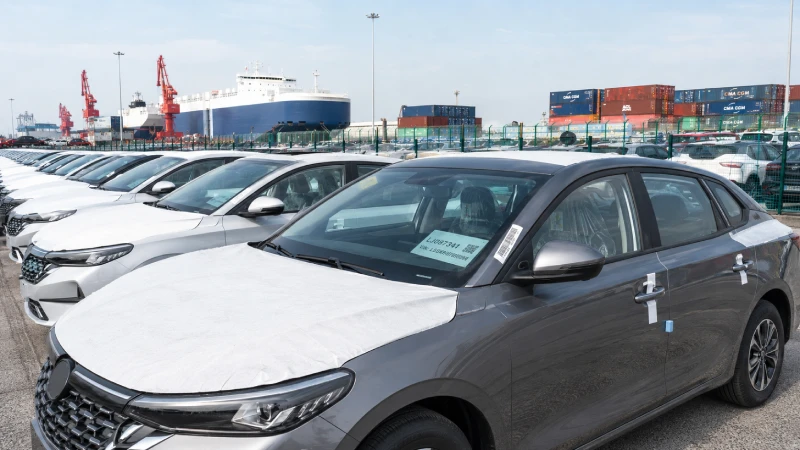
A zero-mileage used car can look almost identical to a brand-new vehicle. It may still have protective film on the seats, a spotless interior and only a few kilometres on the odometer. Yet its legal and commercial status can be very different from that of a new vehicle.
In China, “zero-mileage used car” is a market term rather than a separate legal vehicle category. A vehicle may have been registered for the first time, transferred to a used-car export company and prepared for export even though it has barely been driven. Once registration and ownership history are involved, low mileage alone does not make the vehicle “new.”
For overseas buyers considering vehicle shipping from China, this distinction matters. A nearly unused vehicle may still be treated as used for export licensing, destination-country import rules, warranty coverage, taxation and resale.
The key principle is simple:
A zero-mileage used car may be physically close to new while being legally, commercially and financially treated as used.
What Is a Zero-Mileage Used Car?
The commercial meaning
A typical zero-kilometer used-car transaction may follow this pattern:
- A manufacturer or dealer sells the vehicle.
- The vehicle completes its first registration in China.
- Ownership is transferred to a qualified used-car export enterprise.
- The exporter applies for a used-car export licence.
- The vehicle is exported with very little actual road use.
Its mileage may consist largely of factory movement, dealer handling, storage-yard transfers and transport to inspection or port facilities.
This is why “zero mileage” should not be interpreted literally as an odometer reading of 0 km.
Why mileage is not the legal test
Under China’s current used-car export framework, the important questions concern registration, ownership transfer and whether the vehicle meets applicable scrappage and export requirements. There is no national legal rule stating that a vehicle below 50 km, 100 km or another mileage threshold automatically qualifies as a zero-mileage vehicle.
The 2024 Ministry of Commerce used-car export rules therefore make the document trail far more important than the odometer.
Importers should request at least three separate fields:
- Production date
- First registration date
- Current mileage
A seller showing only the mileage is not giving enough information to assess the vehicle’s status.
Why can these vehicles be cheaper?
A low price does not automatically mean fraud. Possible commercial reasons include dealer inventory pressure, model-year changes, slow-moving configurations, differences between domestic and export sales channels, or the loss of a vehicle’s original new-car retail status.
However, some discounts may also reflect limited overseas manufacturer support, reduced warranty coverage or a need to liquidate inventory quickly.
The buyer should therefore ask not only, “How cheap is the car?” but also, “Why is it being sold at this price?”
China’s 180-Day Export Rule Explained
One of the most misunderstood issues in China zero-mileage car exports is the so-called 180-day rule.
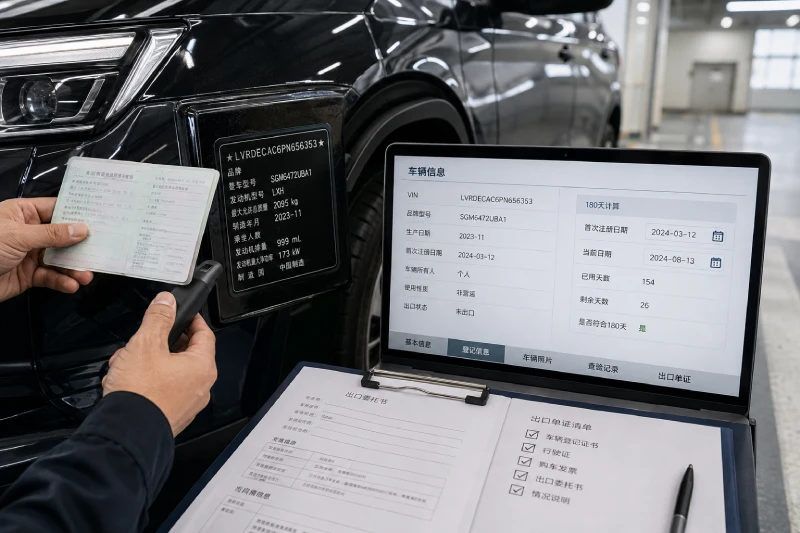
From January 1, 2026, vehicles whose export licence application occurs within 180 days of their first registration require additional manufacturer documentation under the 2025 notice on strengthening used-car export management.
This is not a general requirement that every vehicle must wait 180 days before export.
Which date starts the 180-day calculation?
Importers should distinguish between:
- Production date
- First registration date
- Transfer-for-export date
- Export-licence application date
The relevant comparison is between the first registration date and the export-licence application date.
A simplified timeline is:
Production → First Registration → Transfer Pending Export → Licence Application → Customs Export → Registration Cancellation
The calculation is not based on the contract date, deposit date, expected sailing date or vehicle mileage.
What is required within 180 days?
If the vehicle falls within the applicable 180-day period, the exporter must obtain an After-Sales Maintenance Service Confirmation Letter issued and stamped by the vehicle manufacturer.
It should identify information including:
- The destination country
- Vehicle information
- After-sales service outlet information
A buyer should verify that the document matches the actual VIN, model and destination country and, where practical, independently confirm it with the manufacturer.
Documents that should not be treated as substitutes include an exporter-written promise, a dealer marketing brochure, an unverifiable stamped PDF or a confirmation issued for another VIN or destination.
What happens after 180 days?
Passing the 180-day point does not automatically solve the transaction.
The vehicle still needs to comply with the normal used-car export licensing process, vehicle registration requirements, inspection rules and destination-country import requirements.
Waiting beyond 180 days changes one Chinese export-document requirement. It does not automatically restore factory warranty, correct poor storage conditions, make the vehicle legal in the destination market or guarantee an export licence.
The Main Risks of Buying a Zero-Mileage Used Car
| Risk | Why It Matters | Evidence Required |
|---|---|---|
| Vehicle classification | Destination authorities may regulate it as used | Written customs or registration guidance |
| Manufacturer support | Grey-channel vehicles may lack local support | Manufacturer and warranty confirmation |
| Title and export licence | VIN or owner mismatch may stop export | Registration certificate and export licence |
| Inventory condition | Low mileage does not prove good storage | Independent inspection |
| EV compatibility | Charging, battery or software may not work locally | Battery, charging and software checks |
| Customs value and tax | Customs may reject an unusually low declared value | Contract, payment proof and valuation rules |
| Resale value | A registered vehicle may lose new-car status | Local dealer or valuation advice |
Risk 1—The Destination Country May Treat It as a Used Vehicle
China’s permission to export a vehicle does not mean the destination country will accept it.
Before paying, verify how the importing country defines new and used vehicles and how vehicle age is calculated. Requirements may depend on first registration, manufacturing year or model year.
Other issues may include:
- Maximum used-vehicle age
- Emissions requirements
- Technical standards
- Left-hand-drive or right-hand-drive restrictions
- Restrictions on accident, flood or fire-damaged vehicles
- Type approval
- Conformity certificates
- Pre-shipment inspection
Three approvals must not be confused:
China export approval ≠ destination import approval ≠ destination registration approval.
Similarly, a shipping line accepting a booking does not prove the vehicle is legally importable.
Ask your local customs broker or registration specialist to conduct a written pre-check using the VIN, production date, first registration date and exact model.
Risk 2—After-Sales Confirmation Is Not the Same as Warranty Coverage
This distinction is especially important for vehicles exported within 180 days.
Manufacturer after-sales confirmation
The confirmation letter supports the Chinese export-licence application when the rule applies.
Manufacturer warranty
A factory warranty defines what the manufacturer will repair, for how long, under what mileage limits and subject to which exclusions.
Third-party warranty
This is separate contractual protection provided by an exporter, insurer or warranty company.
A manufacturer after-sales confirmation does not automatically prove that the vehicle retains its full original new-car warranty overseas.
Buyers should separately confirm:
- When the warranty period begins
- Whether export terminates or restricts coverage
- Whether the traction battery has separate coverage
- Which local service centre will accept the vehicle
- Who pays for parts, labour and international transport
- Whether software and connected-service problems are covered
- Whether claims are handled by the manufacturer, exporter or a third party
A service outlet listed in a confirmation letter does not automatically prove that every repair will be covered free of charge.
Risk 3—The Registration and Export Document Chain May Be Incomplete
The document chain is one of the strongest indicators of whether a transaction is ready to proceed.
For used car export documents from China, buyers should cross-check the following:
- Complete Motor Vehicle Registration Certificate
- Transfer-pending-export endorsement
- Current registered owner
- First registration date
- Transfer-for-export date
- Required third-party export inspection
- Manufacturer after-sales confirmation, when applicable
- Export licence
- Sales contract and commercial invoice
- Customs and shipping documents
VIN, brand, model, exporter and registered owner information should remain consistent throughout the process.
Warning signs include statements such as “we will transfer ownership later,” refusal to show the full registration certificate, a registered owner unrelated to the exporting company, hidden registration dates or requests for full payment before essential licensing steps are completed.
For broader counterparty checks, see how to verify a vehicle and exporter before shipping from China.
Risk 4—Low Mileage Does Not Guarantee New-Car Condition
A vehicle can travel only 20 km and still have been stored for a year or more.
Zero-mileage used vehicles may spend extended periods in factory lots, dealership compounds, export yards, ports or bonded warehouses. Exposure to heat, humidity, salt air and long periods without movement can create problems unrelated to mileage.
An independent inspection should examine:
- Odometer condition and mileage consistency
- Production date and inventory age
- Paintwork, chassis and structural damage
- Loading, transport or hail damage
- Tyre manufacturing dates and flat spotting
- 12V battery condition
- Brake-disc corrosion
- Fluids, seals and cooling systems
- Lights, air conditioning, airbags and electronics
- Keys, tools and accessories
- Outstanding recalls
China’s statutory used-car export inspection requirements, including applicable WM/T standards, are important, but they should not replace a buyer-commissioned commercial inspection.
Importers can also check vehicle recall information through China’s Defective Product Recall Center.
Risk 5—Electric Vehicles Need Additional Checks
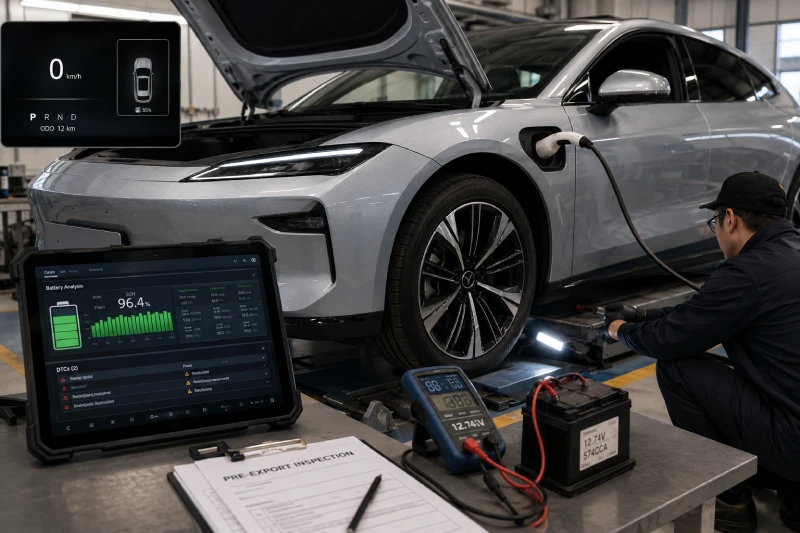
Zero-mileage EVs require further due diligence because a vehicle can be mechanically sound while still being unsuitable for the destination market.
Battery condition
Request, where available:
- High-voltage battery diagnostic results
- State of Health data
- Cell-voltage differences and fault codes
- Photographs of the battery pack underside
- Charging-test results
- Storage charging records
Charging compatibility
Check the AC and DC charging standards, voltage, frequency, supplied charger and compatibility with local public charging networks.
A physical adapter does not automatically solve differences in communication protocols, safety requirements or charging performance.
Software and connected services
Confirm whether the vehicle’s:
- Interface language
- Navigation
- Mobile application
- eSIM
- Connected services
- OTA updates
- Remote diagnostics
- Digital key
- ADAS functions
will operate in the destination country.
For more EV-specific transport considerations, see electric vehicle shipping from China.
From January 1, 2026, China also applies export-licence management to specified pure-electric passenger vehicles with VINs under the relevant 2025 Ministry of Commerce announcement. Buyers should therefore confirm the current licensing arrangement for the exact vehicle and exporter.
What to Check Before Paying a Deposit
The deposit should be your first transaction gate.
Before paying it, obtain at least:
- VIN
- Production date
- First registration date
- Current mileage
- Chinese vehicle model designation
- Specification sheet
- Registration certificate
- Current registered owner
- Exporter’s legal Chinese company name
- Manufacturer-confirmation plan if the 180-day rule applies
- Written destination-country pre-check
- Preliminary warranty and after-sales terms
The contract should clearly state that the vehicle is already registered as a used vehicle where applicable, rather than describing it ambiguously as a new vehicle.
It should also specify mileage, production date, first registration date, refund treatment if an export licence cannot be obtained, destination-compliance conditions and whether the exporter may substitute another VIN.
What to Check Before Final Payment
Final payment should be linked to objective milestones rather than verbal promises.
Before releasing the balance, confirm:
- Independent inspection has passed
- Physical VIN matches the documents
- Registered ownership has been correctly transferred
- Transfer-pending-export endorsement is complete
- Manufacturer confirmation has been obtained and verified when required
- Export inspection is valid
- Export licence has been issued or the contractual licensing milestone has been reached
- Warranty terms are in writing
- The destination importer reconfirms eligibility
- Contract, invoice and receiving bank account belong to the correct entity
Statements such as “the licence is being processed” or “port space is limited” are not sufficient reasons to make an unconditional full payment.
Recheck the Vehicle Before Loading
A final inspection should take place before container loading or delivery into the RoRo terminal.
Check:
- VIN
- Mileage
- Body and chassis condition
- Dashboard warning lights
- EV battery state of charge
- Keys and accessories
- New transport damage
- Container vehicle list
- Securing and protection
- Container seal number or RoRo handover record
The rule is straightforward:
The vehicle loaded must be the same VIN that was inspected, licensed and paid for.
When Should an Importer Walk Away?
Consider stopping the transaction if:
- The exporter claims every zero-mileage vehicle is exempt from manufacturer confirmation
- The 180-day rule is explained as “just wait six months and everything is legal”
- The first registration date is withheld
- The confirmation letter was created by the exporter or dealer
- The manufacturer cannot verify the confirmation
- Registered ownership does not match the licensing exporter
- A used vehicle is to be falsely declared as new at destination
- Third-party inspection is refused
- EV battery or charging tests are refused
- Warranty status cannot be explained
- An unusually low price has no credible commercial explanation
- Payment is requested to a personal account
- Non-refundable final payment is demanded before essential documentation is complete
What a Freight Forwarder Can and Cannot Do
A freight forwarder can help coordinate the logistics surrounding the transaction.
This may include checking VIN details in booking documents, coordinating vehicle pickup and independent inspection, recording loading and securing conditions, reviewing consistency between the vehicle list and bill of lading, arranging container or RoRo transport and reminding shippers about carrier requirements for EVs.
A freight forwarder cannot replace:
- Manufacturer-issued after-sales confirmation
- Government export licensing
- Manufacturer warranty verification
- Legal title investigation
- Destination-country certification
- Registration approval
- A professional vehicle-condition inspection
The forwarder’s role is to make the transportation chain more controlled, not to convert an unsuitable vehicle into a compliant one.
Zero-Mileage Used Car Pre-Purchase Checklist
- Confirm whether the vehicle is legally new or used.
- Obtain production and first registration dates.
- Calculate whether the licence application falls within 180 days.
- Obtain and independently verify manufacturer after-sales confirmation when applicable.
- Confirm factory or third-party warranty separately.
- Verify the registered owner and exporting company.
- Match VIN, brand and model across all documents.
- Confirm destination import and registration eligibility.
- Complete an independent buyer-appointed inspection.
- Check storage ageing and outstanding recalls.
- For EVs, verify battery, charging and software compatibility.
- Include refund clauses for licence or destination-compliance failure.
- Link final payment to objective documentation milestones.
- Recheck VIN and condition immediately before loading.
FAQ
Are zero-mileage used cars illegal to export from China?
No. “Zero-mileage used car” is not an independent illegal vehicle category. A very low-mileage vehicle can be legally exported as a used vehicle if the applicable registration, ownership, inspection and licensing requirements are satisfied.
Does a zero-mileage car have to wait 180 days before export?
No. From January 1, 2026, vehicles applying for export within 180 days of first registration require manufacturer-issued after-sales maintenance service confirmation. The rule does not impose a universal 180-day waiting period.
What is a manufacturer after-sales service confirmation letter?
It is a document issued and stamped by the vehicle manufacturer for applicable vehicles, identifying information such as the export country, vehicle and after-sales service outlets. Its regulatory purpose is to support the export-licence application.
Does the confirmation letter guarantee the original vehicle warranty?
Not necessarily. Warranty coverage should be confirmed separately in writing, including coverage period, battery warranty, eligible service locations, exclusions and responsibility for repair costs.
Can a zero-mileage used car be imported as a new car?
That depends on destination-country rules. If the vehicle has already been registered, some countries may classify it as used regardless of its mileage or physical condition. Never assume it can be declared as new.
Why can a low-mileage vehicle still have battery or tyre problems?
Mileage does not measure storage age. Long-term parking can affect tyres, 12V batteries, brake components and, in EVs, high-voltage battery condition, especially when storage conditions are poor.
Is waiting 180 days enough to remove the export risk?
No. It may remove the specific manufacturer-confirmation requirement associated with the 180-day rule, but it does not resolve warranty, title, vehicle-condition, destination-compliance or registration risks.
Can a freight forwarder verify a zero-mileage used car?
A forwarder can help verify shipping-document consistency, VIN information and loading condition and can coordinate third-party inspections. It cannot replace a manufacturer, licensing authority, customs adviser, vehicle inspector or destination registration authority.
Conclusion: Buy Based on Legal Status, Not Odometer Reading
A zero-mileage used car can be a commercially reasonable purchase. Low mileage may allow an importer to obtain an almost-unused vehicle at a price below the normal new-car retail level.
But the buying decision should never be based on mileage alone.
The important questions are the production date, first registration date, registered owner, manufacturer support, export-licence status, actual vehicle condition, warranty position and destination-country eligibility.
China’s 180-day rule should also be understood correctly. It creates an additional manufacturer after-sales confirmation requirement for certain recently registered vehicles; it is not a universal export waiting period, and waiting until day 181 does not eliminate the other risks.
Before committing to a shipment, make sure the Chinese export documents, manufacturer information, independent inspection and destination-country advice all describe the same vehicle and lead to the same conclusion.
If you are evaluating a zero-mileage or low-mileage vehicle in China, send Winsail Logistics the VIN, production date, first registration date, current mileage, brand, model, powertrain type, exporter’s Chinese legal name, pickup location and destination country. We can help coordinate the logistics checks, vehicle pickup, inspection arrangements and international shipping around your transaction.
