
There is no single best vehicle shipping method for every African car dealer. A buyer importing one running SUV has a different cost structure from a wholesaler moving twelve sedans, an EV distributor shipping cars with chargers, or a dealer buying trucks for an inland market.
The right choice depends on shipment size, vehicle dimensions and condition, EV battery status, route availability, destination-country rules and inventory timing. Instead of choosing the lowest ocean-freight quote, compare the landed cost per retail-ready vehicle. For the wider export process, see vehicle shipping from China.
Quick Answer—Which Shipping Option Fits Your Dealership?
| Dealer purchasing scenario | Option to evaluate first | Main reason | Confirm before booking |
|---|---|---|---|
| One running sedan or SUV | RoRo | No need to wait for a container batch | Port pair, schedule and vehicle acceptance |
| 2–4 compact vehicles plus declared parts | 40HQ container | Batch control and compatible accessories | Load plan, securing and unloading |
| Luxury or classic vehicle | Dedicated 20ft container | More controlled handling | Insurance, professional loading and clearance |
| 10+ running vehicles | RoRo/PCTC allocation | Scales vehicle by vehicle | Space, frequency, transshipment and dwell |
| EV fleet | Quote RoRo and container separately | DG treatment may differ | UN number, battery condition, SOC and carrier rules |
| Non-running or accident vehicle | Container, flat rack or specialist solution | Standard RoRo may reject it | Import eligibility and vehicle/battery condition |
| Bus, truck or oversized vehicle | RoRo, Mafi, flat rack or breakbulk | Standard container may not fit | Dimensions, weight, ramps and lifting |
| Inland African destination | Container often deserves review | May support controlled inland movement | Corridor, dry port, DG and detention costs |
This table is an initial screening tool only. Carrier acceptance does not prove that a vehicle will be legally importable, cleared or registered at destination.
Why the Lowest Ocean Freight Is Not Always the Cheapest Option
Calculate Cost Per Retail-Ready Vehicle
For a dealer, the useful comparison is:
Landed unit cost = total vehicle purchase + China inland/export + ocean freight + DG charges + destination charges + duties/taxes + insurance + inland delivery + reconditioning + storage/financing costs ÷ number of retail-ready vehicles
A low freight rate can disappear quickly if a vehicle needs repairs, remains in port, incurs storage or cannot be registered.
Include Cash-Flow and Inventory Costs
Waiting two or three weeks to buy a fourth car just to improve 40HQ utilization can cost more than it saves if inventory turnover slows. The same applies to buying a slow-selling model only to fill space.
Compare door-to-yard cost, expected arrival-to-sale time and capital tied up in stock. Transshipment, inspections, storage, detention, unloading and local delivery all affect the dealer’s real margin.
When RoRo Is Usually the Best Option
Suitable Dealer Profiles
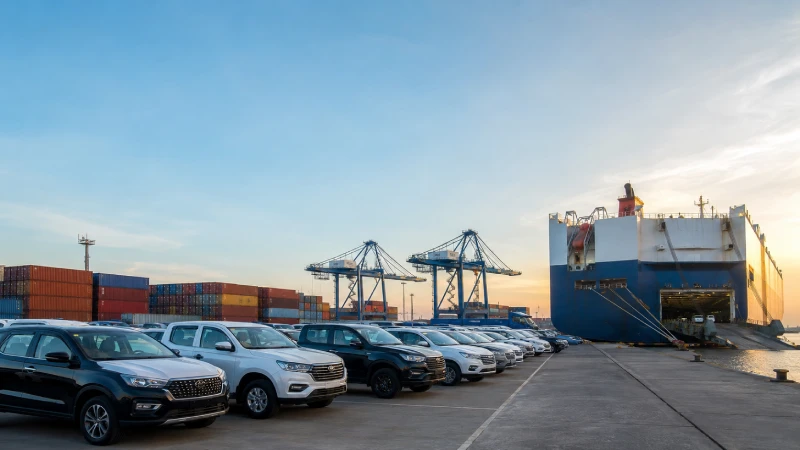
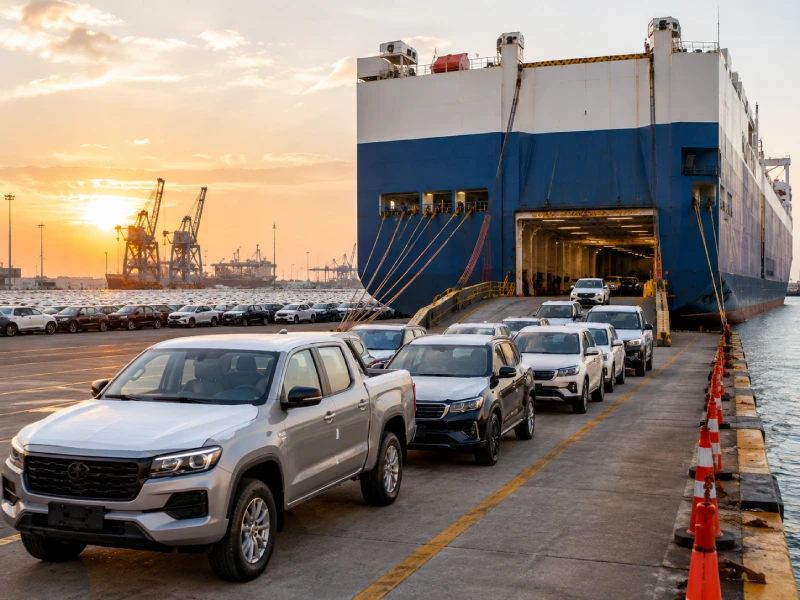
RoRo is often worth evaluating first when vehicles are fully operational, suitable vehicle-carrier services exist, and the dealer wants flexibility in quantity. It can work for a single car, larger batches, SUVs, pickups, trucks and buses without waiting to assemble a container lot.
Vehicles generally need to start, steer, brake and move safely. Exact acceptance standards remain carrier-specific.
Main Commercial Advantages
RoRo avoids the engineered positioning and securing required when several cars are loaded into a container. Dealers can also add vehicles one by one, helping purchases follow market demand rather than container capacity.
On mature routes, the cost per vehicle may be competitive, but this is route-specific—not a universal rule. Dealers also avoid buying extra stock simply to fill unused container space.
Important Limitations
Do not assume every Chinese port has direct RoRo service to every African port. Sailing frequency, transshipment and terminal procedures vary.
Carriers also control what can remain inside a vehicle. Höegh Autoliners’ automotive requirements, for example, address vehicle operability, items inside vehicles, fuel and battery state of charge. These are carrier rules, not universal regulations.
RoRo also does not automatically provide comprehensive cargo insurance. For a more basic method comparison, see RoRo vs container shipping for cars to Africa.
When a Full Container Is Better for a Car Dealer
Suitable Dealer Profiles
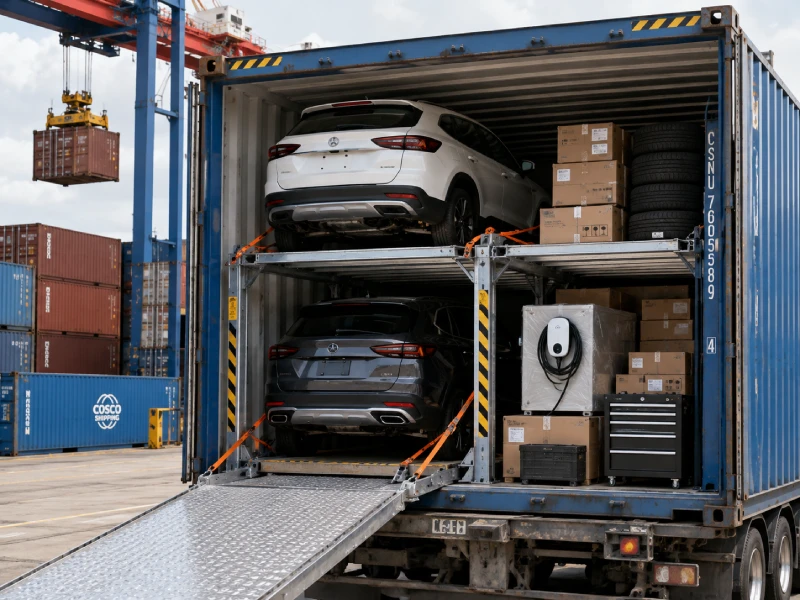
A full container can make more sense when a dealer buys several vehicles together, needs to ship properly declared compatible spare parts, tools or charging equipment, wants more controlled handling for high-value vehicles, or serves a destination with stronger container services than RoRo.
Containers can also be useful for inland markets where cargo continues toward a dry port, bonded facility or inland logistics node. Whether that reduces cost depends on the corridor and local container-control costs.
20ft or 40HQ?
A 20ft container is commonly evaluated for one normal passenger vehicle. A 40HQ can carry several cars, but “four cars per 40HQ” is not a guaranteed capacity.
Actual loading depends on vehicle length, width, mirror width, height, clearance and weight; container-door dimensions; loading angle; rack design; lashing points; and safe working space. Three or four compact cars may require an engineered rack or inclined-loading system. Tall SUVs and pickups can be limited by the door opening before internal cubic volume becomes relevant.
See how many sedans, SUVs or pickups fit in a 40HQ for a detailed loading analysis.
Container-Specific Risks
Poor loading can damage body panels, suspension or underbody components. Vehicles and accessories must be properly blocked, braced and secured, with a safe unloading plan at destination.
Dealers should also budget for terminal handling, detention, demurrage where applicable, unloading and empty-container return. The IMO/ILO/UNECE CTU Code provides useful principles for packing and securing cargo transport units.
When Flat Rack, Mafi or Breakbulk Is Required
Large buses, construction vehicles, specialist trucks and some non-running units may exceed container doors, dimensions or handling limits and require flat rack, Mafi or breakbulk/project-cargo arrangements.
Compare overall dimensions, weight, center of gravity, lifting points, lashing design, weather exposure, oversize surcharges and destination-port lifting capability. These are specialist solutions, not defaults for ordinary passenger cars.
Electric Vehicles Can Change the Best Shipping Choice
2026 IMDG Classification
EVs should not be priced as conventional cars with a different powertrain. The IMO IMDG Code 2024 Edition incorporating Amendment 42-24 became mandatory on January 1, 2026.
Lithium-ion-battery-powered vehicles use UN 3556, lithium-metal-battery-powered vehicles use UN 3557, and sodium-ion-battery-powered vehicles use UN 3558. UN 3171 should not be used as a generic description for all battery-powered vehicles.
RoRo and Containerised EVs Are Not Treated Identically
Eligible vehicles carried in approved vehicle spaces may meet the conditions of IMDG Special Provision 961. Vehicles outside those conditions fall under the applicable dangerous-goods framework, including SP962 requirements.
That difference can change documentation, declaration, marking, carrier approval and DG charges. A containerized EV should therefore not automatically be quoted as if it receives the same treatment as a qualifying EV on an approved RoRo vehicle deck.
Damaged Batteries and SOC
Collision damage, battery deformation, leakage, warning indications, water exposure or suspected thermal damage can trigger rejection or specialist requirements.
SOC limits must be confirmed with the actual carrier. A percentage published by one line should not be presented as a universal IMDG rule. Carrier acceptance also does not establish import or registration eligibility at destination.
Check Destination-Country Eligibility Before Choosing the Mode
One of the worst dealer outcomes is shipping a low-cost vehicle that cannot legally enter the market or be sold.
In Kenya, dealers need to consider the applicable vehicle age limit, right-hand-drive requirements and roadworthiness or pre-export inspection requirements. The qualifying year and inspection procedure should be verified before purchase.
In Ghana, used-vehicle standards and the phased enforcement of pre-export conformity procedures should be checked against the latest Ghana Standards Authority requirements, especially for shipments around implementation dates.
South Africa maintains strict controls on used-vehicle imports, and commercial resale of used imports is generally restricted outside defined permit exceptions.
Elsewhere, the cost drivers differ. Ethiopia-bound EVs may require analysis of current EV policy, charging compatibility and the Djibouti inland corridor. Nigeria-bound stock should include realistic Lagos or Apapa destination charges, storage exposure, customs valuation, clearance and inland delivery.
The goal is not an Africa-wide rules table. It is to screen the exact destination before committing to stock.
Route Availability Matters More Than Generic Transit-Time Claims
Always check transit by port pair: Chinese loading port, African destination and any transshipment hub. A direct service and a route changing vessels can have very different inventory-cycle risks.
Compare cutoff frequency, space, number of transfers, congestion exposure and the time until vehicles are actually available at the dealer’s yard. Current services may connect major Chinese ports with African gateways such as Durban or Lagos, but that does not mean every African destination has the same frequency, direct call or transit time.
For dealers, the practical question is not “How long does China-to-Africa shipping take?” It is “When will these specific vehicles be available for sale at my yard?”
A Dealer’s Pre-Booking Decision Workflow
- Confirm the models, fuel types, specifications and retail price bands that actually sell in the target market.
- Check destination rules for age, steering side, emissions, inspection, customs eligibility and registration before purchase.
- Verify VIN, ownership, accident history, running condition and EV battery condition where applicable.
- Confirm the Chinese exporter’s qualifications and the document or licensing chain for the vehicle.
- Request comparable RoRo, 20ft, 40HQ and specialist-equipment options where relevant.
- Compare door-to-yard landed cost, timeline, financing exposure and likely retail margin.
- Complete pre-shipment inspection, photographs, insurance and loading or handover records before departure.
China introduced export-license management for covered pure electric passenger vehicles from January 1, 2026. Dealers should therefore confirm the exporter and document chain before payment and booking. The Chinese Ministry of Commerce announcement sets out the licensing measure. A freight forwarder can coordinate logistics documents but does not replace the authority that issues an export or import license.
See how to verify a vehicle and exporter before shipping from China before releasing a deposit or final payment.
Common Mistakes African Car Dealers Should Avoid
Avoid comparing only ocean freight; assuming every 40HQ safely fits four cars; purchasing a large batch before checking routes; leaving commercial cargo or spare batteries in a RoRo vehicle; declaring a damaged EV as an ordinary running EV; treating carrier acceptance as import approval; relying on carrier liability instead of suitable insurance; and keeping no cash buffer for inspections, storage or delays.
FAQ
Is RoRo always the cheapest option for African car dealers?
No. Cost depends on route, quantity, sailing frequency, destination fees, storage exposure and the time a dealer would otherwise wait to fill a container.
How many cars can an African dealer ship in a 40HQ?
There is no fixed number. Exact dimensions, weight, container-door limits, rack design, loading angle and safe securing clearances determine capacity.
Can spare parts be placed inside a vehicle shipped by RoRo?
Do not assume so. Many carriers restrict loose or commercial cargo and additional batteries. Confirm the carrier's written rules before terminal delivery.
Can cars and spare parts be shipped in the same container?
Often yes, if everything is accurately declared, compatible, properly packed and secured, and any dangerous-goods characteristics are identified and accepted.
What is the best option for shipping EVs to Africa?
Compare RoRo and container based on SP961/SP962 treatment, battery condition, carrier acceptance, dangerous-goods charges, route availability and destination-country rules.
Can a non-running vehicle be shipped by RoRo?
Standard RoRo commonly expects operational vehicles. Some carriers may approve specialist handling, but container, flat rack or another solution may be required.
Which destination charges should a dealer compare?
Include terminal handling, documentation, inspection, storage, container detention or demurrage where applicable, customs brokerage, duties and taxes, unloading, inland transport and special dangerous-goods handling.
Does the shipping line automatically insure the vehicles?
Not as comprehensive cargo insurance. Carrier liability is subject to the bill of lading and applicable law and may be limited, so dealers should arrange suitable marine cargo cover.
Conclusion: Choose the Option That Protects Margin and Inventory Turnover
RoRo often suits running single vehicles and scalable dealer volumes. Full containers can suit controlled batches, higher-value vehicles and declared compatible accessories, while oversized, damaged or non-running units may need specialist equipment.
The final choice should pass three tests: the vehicle is legal for the destination market, the carrier accepts it in its actual condition, and the total landed cost still leaves a viable retail margin.
To compare options, provide the vehicle models, quantities, running condition, EV or battery details if applicable, China loading point, African destination and target shipping window. The shipment can then be assessed on cost, timing and operational risk—not freight rate alone.
