

If you are planning shipping from China to USA, customs clearance should be prepared before the cargo leaves China—not after the vessel or aircraft arrives. The importer, supplier, freight forwarder, customs broker and carrier must provide consistent information at the correct shipment milestones. A missing customs bond, unclear product description or unconfirmed Importer of Record can delay entry filing even when the freight itself is moving on schedule.
US customs clearance is not one isolated action. It is a sequence covering importer setup, broker authorization, classification review, pre-arrival filing, customs entry, duty payment, government-agency review, cargo release and final delivery coordination.
Last reviewed: July 20, 2026. Import requirements may change and should be reconfirmed for the specific product and shipment before departure.
Is Your Shipment Ready for US Customs Clearance?
A shipment is generally ready for clearance when the parties, product data and filing arrangements have been confirmed before departure.
Use this quick assessment:
| Readiness item | Main responsible party | When to confirm |
|---|---|---|
| Importer of Record | US importer | Before booking |
| Importer number | Importer and customs broker | Before entry preparation |
| Customs broker and power of attorney | Importer | Before departure |
| Customs bond | Importer and broker | Before entry filing |
| HTS classification | Importer and broker | Before finalizing the invoice |
| Product compliance requirements | Importer | Before purchase or production |
| Commercial shipment data | Supplier and importer | Before departure |
| ISF data for applicable ocean cargo | Importer, broker or filing agent | Before vessel loading |
| Duty-payment arrangement | Importer and broker | Before arrival |
| Final delivery plan | Importer and forwarder | Before cargo release |
An importer should not treat a supplier’s statement that it will “handle customs” as sufficient confirmation. The importer should know which legal entity will appear as the Importer of Record, which licensed customs broker will file the entry, and how duties, agency requirements and post-release records will be managed.
Who Is Responsible for the Clearance Process?
Several parties contribute to customs clearance, but they do not have interchangeable responsibilities.
Importer of Record
The Importer of Record, commonly called the IOR, is the party associated with the customs entry and is responsible for the accuracy of information such as classification, value, origin and applicable duties.
A customs broker may prepare and transmit the entry, but using a broker does not automatically transfer the importer’s underlying compliance responsibility. CBP advises importers to understand the rules applying to their goods and exercise reasonable care when providing entry information. See the official CBP Tips for New Importers and Exporters for current guidance.
Licensed Customs Broker
A licensed customs broker can represent the importer in customs business, prepare entry data, arrange a customs bond and communicate with CBP.
US law does not require every importer to appoint a broker, but many commercial importers use one because the entry process involves technical classification, valuation and filing requirements. A broker normally needs a valid power of attorney executed directly with the importer before conducting customs business on its behalf.
Freight Forwarder
A freight forwarder coordinates the physical movement and logistics information surrounding the shipment. For China-to-USA cargo, this may include:
- supplier pickup and export handling in China;
- ocean or air freight booking;
- FCL or LCL coordination;
- cargo consolidation;
- bill of lading or air waybill information;
- arrival notices and shipment milestones;
- communication with the importer’s customs broker;
- port-to-door or warehouse delivery.
A freight forwarder is not automatically the Importer of Record or the customs broker. These roles must be confirmed rather than assumed.
Supplier and Carrier
The supplier provides transaction and product information, including the commercial description, quantity, value, manufacturer details and country of origin.
The carrier transmits cargo and manifest information, transports the shipment and confirms arrival. Incorrect supplier information can affect the customs entry even when the carrier’s transport data is correct.
Before Cargo Leaves China: Build the Clearance File
The safest time to resolve a customs problem is before the cargo is loaded.
Confirm the Importer and Importer Number
US customs entries must identify the responsible importer. For a US business, the importer number is commonly connected to its Employer Identification Number. Foreign entities may need a CBP-assigned importer number, depending on the entry arrangement.
A first-time importer should ask its broker to confirm that the importer identity is active and correctly recorded. CBP Form 5106 may be used to create or update importer identity information where applicable.
Do not wait until the vessel is approaching the destination port to discover that the company name, address or importer number does not match the broker’s records.
Appoint the Broker and Complete the Power of Attorney
Broker onboarding may require:
- legal company name and address;
- importer number or EIN;
- responsible company contact;
- signed power of attorney;
- bond instructions;
- payment or credit arrangements;
- shipment and product details.
Complete this process before departure, especially for a first shipment or a shipment handled by a new broker.
Confirm the Customs Bond
A customs bond financially guarantees that the importer will meet certain obligations to CBP. A single-entry bond may cover one transaction, while a continuous bond may cover multiple entries during its effective period.
CBP currently states that a bond is generally required for commercial imports valued above $2,500 and may also be required for goods subject to other federal-agency requirements. Applicability must be checked for the actual product and entry type rather than determined by value alone.
Review the HTS Classification and Product Requirements
The HTS code affects the duty rate, reporting requirements and potential government-agency indicators attached to the product.
Classification should be based on what the product is, its material, function, composition and intended use—not simply the code suggested by the supplier. Importers and brokers should consult the current Harmonized Tariff Schedule maintained by the USITC because the schedule and related tariff provisions can change.
The importer should also determine whether the product is regulated by agencies such as the FDA, USDA, EPA, CPSC, FCC or another authority. Agency requirements depend on the specific merchandise and cannot be determined from the shipping route alone.
File ISF for Applicable Ocean Shipments
The Importer Security Filing, or ISF, applies to relevant cargo moving to the United States by ocean vessel. Core importer data is generally required no later than 24 hours before the cargo is loaded aboard the vessel destined for the United States.
Required information may involve the seller, buyer, Importer of Record number, consignee, manufacturer, ship-to party, country of origin and HTS classification.
ISF should therefore be treated as a pre-loading control, not an arrival-stage document. Late, incomplete or inaccurate filing can expose the responsible party to operational and enforcement consequences.
While the Cargo Is in Transit: Validate the Entry Data
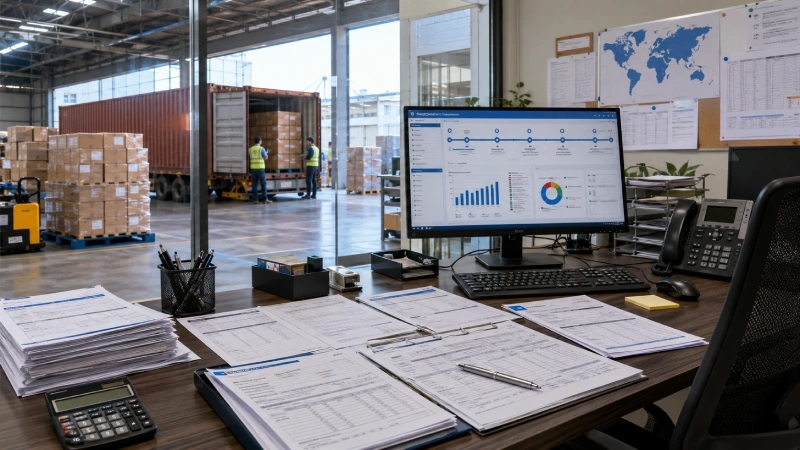
Transit time should be used to complete the entry preparation rather than simply monitor the vessel or flight.
The broker should receive the final clearance packet, which commonly includes:
- commercial invoice;
- packing list;
- bill of lading or air waybill information;
- importer and bond details;
- HTS classification instructions;
- country-of-origin and manufacturer information;
- product specifications;
- government-agency data, permits or registrations where applicable.
For a detailed breakdown of document ownership and common errors, refer to documents required to import from China to the USA.
The importer should compare key data across the purchase order, commercial invoice, packing list, transport document and entry instructions. Product description, quantity, value, weight, carton count, consignee, manufacturer and Incoterm should not conflict.
CBP recommends clear, precise commodity descriptions that identify the goods in plain language. Descriptions such as “parts,” “accessories,” “samples” or “general merchandise” may not provide enough information to identify and assess the cargo.
Entry documentation may be submitted before the merchandise arrives at the port where entry will be made. Preparing the entry in advance gives the broker time to identify missing information and ask questions while the cargo is still in transit. The current filing framework is available in 19 CFR Part 142.

At Arrival: Entry Filing and Government Review
Most commercial entry information is transmitted electronically through CBP’s Automated Commercial Environment, or ACE. CBP describes ACE as its electronic platform for manifest, cargo release, post-release and partner-government-agency trade processing.
Cargo Release and Entry Summary
Cargo release and entry summary are related but distinct parts of the entry process.
Cargo release information supports the request for CBP to release the merchandise. Entry summary information reports details such as classification, value, origin and estimated duties, taxes and fees.
Under the general entry rule, merchandise requiring entry must be entered within 15 calendar days after arrival. Entry documentation may also be filed before arrival. When the entry summary is not filed at the time of entry, it is generally due within 10 working days after the time of entry.
These are regulatory limits, not recommended planning targets. Commercial importers should prepare much earlier, and the current rule should be checked before relying on a filing deadline.
Estimated Duties and Fees
The broker calculates estimated duties and applicable customs fees from the declared classification, value, origin and entry information. The importer should have a payment method or funding arrangement ready before the entry reaches the payment stage.
This article does not calculate tariff rates because additional duties and trade measures can change. Importers evaluating the complete landed cost should consult US import duties and tariffs on goods from China and verify current treatment for the exact HTS code.
Partner Government Agency Review
CBP release is not always the only government decision required.
FDA-regulated products, for example, are entered through CBP and then referred electronically to the FDA for admissibility review. Complete and accurate data may support faster automated processing, while missing information or higher-risk products may be routed for document review, examination or sampling.
The FDA may request product labels, ingredient information, certificates, processing records or other evidence before making a decision. The official FDA Entry Review guidance explains the agency’s import review process.
Importers of food, medical devices, cosmetics, electronics, chemicals, children’s products, agricultural goods or other regulated merchandise should verify product-specific agency requirements before placing the purchase order.
Customs Release Is Not the Same as Cargo Availability
A shipment may have cleared CBP but still be unavailable for pickup. Importers should track three separate release gates.
| Release gate | What it confirms | Who normally provides the status |
|---|---|---|
| CBP release | Customs has released the entry, subject to any remaining conditions | Customs broker |
| Agency release | A relevant partner agency has completed its admissibility review | Broker or agency system |
| Carrier or terminal release | Freight and operational conditions allow pickup | Carrier, terminal or forwarder |
After CBP release, cargo may still be waiting for vessel discharge, destination-charge settlement, freight release, a delivery order, terminal availability or a pickup appointment.
For FDA-regulated products, the goods may not be distributed into US commerce while FDA admissibility review remains pending.
This distinction prevents a common communication problem: the importer asks whether “customs is complete,” while the actual issue belongs to the carrier, terminal or delivery provider.
After Release: Coordinate Final Delivery
Before dispatching a truck, confirm:
- CBP release;
- relevant agency release;
- carrier freight release;
- terminal or warehouse availability;
- destination charges;
- delivery order;
- pickup appointment;
- container free time;
- receiving hours and appointment requirements.
The cargo can then move to an importer’s warehouse, third-party logistics facility, Amazon preparation center, Amazon FBA facility or another commercial delivery point.
Keep the customs entry, purchase, payment, classification and product-compliance records in an organized shipment file. The required retention period and record scope can vary, so importers should confirm the applicable rules with their customs broker or trade-compliance adviser.
What to Do When Clearance Does Not Progress
Do not begin with the general question, “Why is customs delayed?” First identify the last completed milestone.
Ask the broker or forwarder:
- Was the ISF accepted for the ocean shipment?
- Was the customs entry transmitted?
- Is the importer number active?
- Is the bond valid?
- Has CBP issued a release?
- Is another government agency reviewing the goods?
- Has the carrier issued freight release?
- Is the terminal showing the cargo as available?
Request the exact rejection, hold or status message, the party responsible for the next response and the information required to move forward.
An entry rejection belongs primarily with the broker and importer. Conflicting commercial data may require the supplier’s correction. A government-agency request may require technical product information from the importer or manufacturer. Cargo that is customs-released but unavailable normally requires follow-up with the carrier, terminal or forwarder.
Pre-Shipment Customs Clearance Checklist
Before authorizing departure from China, confirm that:
- the Importer of Record has been identified;
- the importer number has been validated;
- a licensed customs broker has been appointed;
- the power of attorney is complete;
- the customs bond is active where required;
- the proposed HTS classification has been reviewed;
- the manufacturer and country of origin are confirmed;
- product-agency requirements have been checked;
- invoice and packing data are consistent;
- ISF data has been submitted for applicable ocean freight;
- the final clearance packet has been sent to the broker;
- duty-payment arrangements are ready;
- clearance contacts and escalation roles are assigned;
- the final delivery address and receiving requirements are confirmed.
How Winsail Supports China-to-USA Clearance Coordination
Winsail Logistics coordinates the logistics information and physical shipment milestones surrounding US customs clearance. Support may include supplier pickup, China export handling, ocean or air freight booking, FCL and LCL planning, cargo consolidation, transport-document coordination, broker communication and final port-to-door delivery.
For DDP or supplier-controlled arrangements, importers should still understand who acts as the Importer of Record and who controls the customs entry. The allocation of freight, duties and clearance responsibilities is explained further in DDP shipping from China to USA.
Winsail is a freight forwarder and logistics coordinator, not a US government authority. Customs entries and regulated customs business should be handled by the importer and appropriately licensed or authorized parties.
To prepare a shipment review, provide the product description, material, intended use, invoice value, proposed HTS code, cargo dimensions, origin city, US destination, Incoterm, cargo-ready date and importer or broker status.
Request a pre-shipment US clearance readiness review and China-to-USA freight quotation.
FAQ
Can a Chinese supplier act as the Importer of Record for a US shipment?
A supplier should not be assumed to be the Importer of Record. The parties must confirm which legal entity will be listed on the entry, whether it has an appropriate importer number, and who accepts responsibility for classification, value, duties and compliance.
Can US customs clearance begin before the vessel or aircraft arrives?
Yes. Entry information may be prepared and submitted before arrival when the required shipment and importer data is available. Pre-arrival preparation gives the broker more time to identify inconsistencies or missing information.
Is a customs broker required for every commercial import?
CBP does not require every importer to use a customs broker, but many businesses appoint one because classification, valuation, bonds and electronic entry filing can be technically demanding.
Is CBP release the same as container availability?
No. CBP release confirms the customs status, but the cargo may still require partner-agency release, carrier freight release, terminal availability, payment of destination charges or a pickup appointment.
What happens if the commercial invoice changes after departure?
Inform the customs broker and freight forwarder immediately. The importer should provide the corrected commercial information and ensure that the invoice, packing list, transport record and entry instructions remain consistent.
Can one customs bond cover multiple shipments?
A continuous bond may cover multiple eligible entries during its effective period, while a single-entry bond applies to one transaction. The importer should confirm the appropriate bond type and amount with its broker or surety.
Does DDP shipping remove the US buyer’s customs-compliance risk?
Not automatically. A DDP quotation may allocate freight and duty payment to the seller, but the buyer should still understand the Importer of Record arrangement, entry visibility, product compliance responsibilities and recordkeeping structure.
