
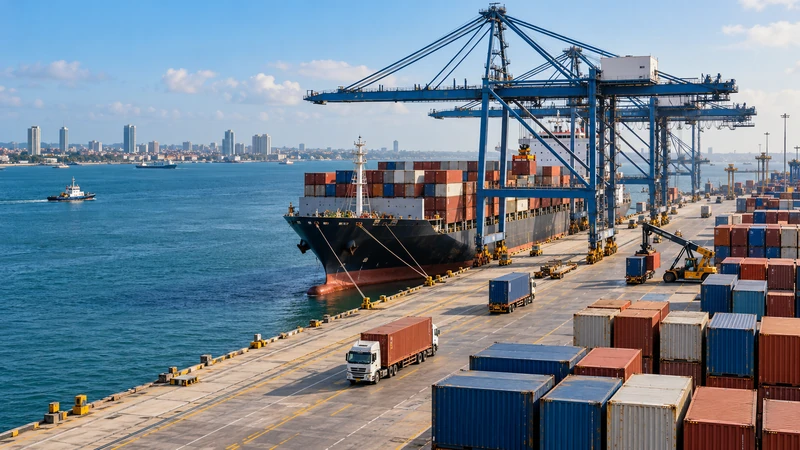
Shipping a container to Dar es Salaam is only part of the import process. Once the vessel arrives, the importer may still need to settle port charges, shipping-line fees, customs-related payments, and local handling costs before the cargo can be collected.
These expenses are not always included in the original freight quotation. They may also come from different service providers, with different payment deadlines and charging rules.
Understanding Dar es Salaam port charges for imports helps businesses prepare an accurate arrival budget, identify who is responsible for each payment, and avoid unnecessary storage, demurrage, and detention costs.
Quick Answer
Dar es Salaam importers may receive separate invoices for port or terminal services, shipping-line documentation and container use, CFS or dry-port handling, and clearing-agent services. Import duties and VAT are separate customs liabilities, not port service charges. Actual costs depend on the carrier, terminal, cargo, contract terms, and release timing. Before arrival, request an itemized charge list identifying the billing party, payment responsibility, and applicable free-time deadlines.
Data Note — October 2026
This guide references the Tanzania Ports Authority (TPA) Sea Ports Tariff Book dated January 2026, Tanzania Shipping Agencies Corporation (TASAC) tariff publications, and published shipping-line procedures and fee notices.
A published tariff is not automatically the final amount payable for every shipment. Actual charges must be confirmed against the applicable terminal or facility, shipping line, container size, cargo type, current tariffs, and contractual terms. Storage rules and carrier free-time arrangements may also differ.
The discussion primarily concerns commercial imports entering Mainland Tanzania through Dar es Salaam. Transit cargo, Zanzibar-bound shipments, and cargo handled at other facilities may be subject to different requirements.
1. What Counts as a Destination Charge at Dar es Salaam Port?
Destination charges are expenses associated with receiving, processing, releasing, and collecting cargo after arrival at the destination port.
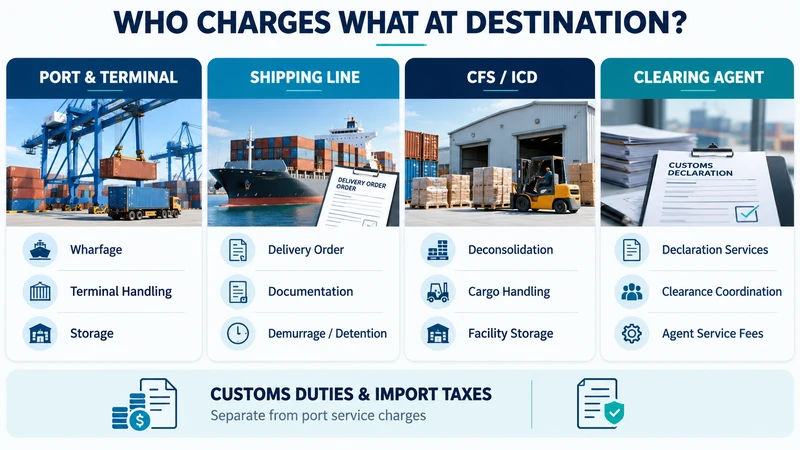
For imports into Dar es Salaam, several organizations may be involved:
- Tanzania Ports Authority (TPA): Port-related services and charges under the applicable TPA tariff.
- Terminal operators: Cargo handling, terminal services, and storage where applicable.
- Shipping lines and shipping agents: Delivery documentation, cargo-release administration, and container-use charges.
- Container Freight Stations (CFS) and Inland Container Depots (ICD): Cargo handling, deconsolidation, storage, and other facility services.
- Clearing and forwarding agents: Customs documentation, clearance coordination, and related professional services.
- Tanzania Revenue Authority (TRA): Customs duties, import taxes, and other customs-administered payments.
These organizations do not necessarily issue separate invoices for every shipment. Some charges may be collected through a shipping agent, clearing agent, or another authorized party.
The important distinction is between who provides the service, who issues or collects the invoice, and who is contractually responsible for paying it.
Port and Terminal Charges
Port and terminal charges relate to the use of port facilities and cargo-handling services.
Depending on the applicable tariff and cargo arrangement, these may include:
Wharfage
Wharfage is a port charge associated with cargo passing through the port. Its assessment depends on the relevant tariff classification and charging basis.
The amount should not be assumed to be identical for all cargo. The applicable calculation may depend on the type of goods, tariff provisions, and cargo characteristics.
Shore and Terminal Handling
These charges relate to moving or handling cargo within the port or terminal.
The services covered can vary according to the operating arrangement and tariff. A charge described as terminal handling in one quotation may not cover precisely the same services as a similarly named charge in another.
Port or Terminal Storage
Storage charges may arise when cargo remains within a facility beyond its applicable free-storage allowance.
The charging period, start event, daily rates, and exemptions must be checked against the relevant terminal or facility’s rules.
Shipping-Line Charges
Shipping-line destination charges are separate from many port authority or terminal charges.
They may include:
- Delivery order or destination documentation fees.
- Other applicable shipping-agent or carrier local charges.
- Container demurrage.
- Container detention.
- Container deposits or guarantees, where required.
The shipping line may also require outstanding payments and supporting documentation before issuing cargo-release authorization.
CFS, ICD, and Clearing-Agent Charges
LCL cargo commonly requires deconsolidation at a CFS or another designated facility before individual shipments can be released.
Depending on the arrangement, the consignee may face cargo handling, deconsolidation, documentation, storage, or other facility charges.
An ICD or dry port may have its own handling and storage rules. Those rules should not automatically be treated as identical to the seaport terminal tariff.
Separately, a clearing and forwarding agent may charge a professional service fee for preparing and processing documents, coordinating customs clearance, arranging payments, and organizing collection.
Import Duties and Taxes Are Not Port Service Charges
Import duty, import VAT, and other applicable customs-administered taxes or levies are part of the broader import cost, but they are not the same as port handling or storage fees.
For example, a business importing machinery may need to pay customs duties and applicable import taxes while also settling terminal handling and delivery documentation charges.
Even if one clearing agent coordinates all payments, the importer should distinguish:
- Customs and government-related payments.
- Port and terminal service charges.
- Shipping-line and equipment charges.
- Clearing-agent professional fees.
- Inland transportation costs.
Taxes that may apply to individual service invoices should also be distinguished from import VAT assessed on the goods.
For a detailed explanation of customs declarations and tax assessment, see our customs clearance guide for Tanzania.
2. Dar es Salaam Import Charges: Who Bills What and When?
There is no single destination-charge amount that applies to every import arriving at Dar es Salaam.
A standard dry container, refrigerated container, LCL shipment, and cargo moved to an inland depot can all have different billing arrangements.
The following matrix shows the main charge categories importers should investigate before the vessel arrives.
Dar es Salaam Destination Charge Verification Matrix
| Charge | Typical Billing Party | Possible Trigger | Can It Be Checked Before Arrival? | Usually Not Included |
|---|---|---|---|---|
| Wharfage | TPA or authorized collecting party | Cargo handling or movement through applicable port facilities | Yes, subject to cargo details and applicable tariff | Carrier documentation, customs taxes |
| Shore or terminal handling | TPA, terminal operator, or collecting party | Discharge and related handling services | Usually, once terminal and service coverage are known | Storage, additional handling unless specified |
| Terminal storage | Applicable port or terminal operator | Cargo remains beyond the applicable free period | Tariff can be checked; final amount depends on dates | Carrier demurrage and detention |
| Delivery order fee | Shipping line or authorized shipping agent | Processing the cargo-release documentation | Usually, with the named carrier | Customs clearance, terminal charges |
| Destination documentation fee | Shipping line or authorized shipping agent | Destination documentation administration | Usually, subject to booking terms and tariff validity | Other local fees not expressly covered |
| Container demurrage | Shipping line or equipment provider | Applicable container free time is exceeded | Rate structure usually available; final amount depends on use | Terminal storage, unless specifically combined |
| Container detention | Shipping line or equipment provider | Container is retained beyond the permitted return period | Rate structure usually available; final amount depends on return | Inland transport and depot services |
| CFS handling and deconsolidation | CFS operator, consolidator, or destination agent | LCL cargo is received, unpacked, or processed | Usually, subject to shipment and facility details | Import duties, inland delivery |
| ICD or dry-port charges | Applicable facility or collecting party | Cargo is transferred, handled, or stored at the facility | Conditional on facility and transfer arrangement | Seaport or carrier charges not covered by the service |
| Clearing-agent service fee | Registered clearing and forwarding agent | Preparation and processing of clearance and related services | Yes, with a scope-specific quotation | Customs taxes and third-party charges unless expressly included |
| Additional handling or inspection services | Relevant service provider | An extra service is required or authorized | Conditional | Routine charges already quoted |
| Container deposit or guarantee | Shipping line or designated agent | Required as a condition of container release | Usually, with the actual carrier | Nonrefundable service charges |
This table identifies potential charge categories, not charges that every importer must pay. Exact amounts, invoicing entities, and applicability require shipment-specific confirmation.
Why the Shipping Line Matters
Different carriers may publish different destination documentation charges, payment requirements, and container-use tariffs.
For example, Maersk’s notice dated June 18, 2026 announced a Destination Documentation Fee (DDF) of USD 38 per document for Tanzania shipments with a Price Calculation Date on or after July 15, 2026, subject to its stated booking and tariff conditions.
This is a carrier-specific published fee, not a universal Dar es Salaam port charge. It should not be applied to shipments carried by other shipping lines or assumed to cover every delivery-order-related service.
Source: Maersk — World to Tanzania Destination Documentation Fee Update.
A destination invoice should therefore be checked against the actual carrier’s tariff and the relevant shipment details, rather than against a generic online price list.
How to Check a Destination Charge Invoice
Before authorizing payment, an importer should be able to identify:
- The official name of the charge.
- The company or authority providing the service.
- The party issuing or collecting the invoice.
- The container, bill of lading, or shipment reference.
- The relevant service or charging event.
- The billing unit and rate applied.
- The applicable currency and tax treatment.
- Whether the amount has already been included in another invoice or freight quotation.
A charge that was not included in the original quotation is not necessarily invalid. However, the party requesting payment should be able to explain the service and provide an appropriate invoice or supporting documentation.
Request a Destination Charge Checklist
Planning an import from China to Dar es Salaam? Share your shipment type, container details, shipping line, ETA, and agreed trade terms with Winsail Logistics to request a destination-charge checklist and identify which charges need confirmation with the relevant providers.
3. FCL vs. LCL: Which Destination Charges Apply to Your Shipment?
Destination charges are influenced by how the goods are shipped.
A full container load (FCL) generally involves the release and collection of an individual container. Less than container load (LCL) cargo requires a process for separating multiple shipments before delivery to their respective consignees.
These operational differences can change both the fee structure and the responsible billing parties.
FCL Imports: 20ft, 40ft, and Special Containers
With FCL shipping, the shipment occupies a dedicated container.
Destination costs may include applicable port or terminal charges, carrier documentation fees, container demurrage, detention, and customs-clearance services.
The importer or appointed agent must also arrange cargo collection and, for a carrier-owned container, comply with the equipment return requirements.
Container size matters because some tariff schedules distinguish between containers up to 20ft and those exceeding 20ft.
Refrigerated, dangerous, out-of-gauge, or other special cargo may attract different rates or additional services. These should be confirmed before accepting a destination budget.
For example, a standard 40ft dry container should not automatically be assigned the same handling or equipment-use rate as a 40ft refrigerated container.
LCL Imports: CFS and Deconsolidation Charges
LCL shipments are consolidated with cargo from other shippers in a shared container.
After arrival, the container may be moved to a designated CFS or another authorized handling facility, where the individual shipments are separated and processed for release.
The importer may encounter charges for:
- Deconsolidation and cargo handling.
- CFS receiving or warehouse services.
- Destination documentation or cargo-release administration.
- Storage beyond the applicable free period.
- Other required services based on cargo type or handling circumstances.
LCL destination fees may be assessed per CBM, weight, revenue ton, shipment, or bill of lading, often subject to minimum charges.
However, the billing method depends on the consolidator, facility, and agreed service terms.
The consignee may not receive a separate terminal invoice for the underlying shared container because some container-level charges are handled through the consolidator or destination agent.
That does not mean all destination handling is included in the original LCL freight rate.
FCL vs. LCL Destination Charge Comparison
| Cost or Obligation | FCL | LCL |
|---|---|---|
| Main cargo unit | Dedicated container | Individual shipment within a shared container |
| Terminal container handling | May be billed or collected under the applicable arrangement | Often handled through consolidator or destination arrangements |
| Deconsolidation | Generally not required for a standard intact FCL delivery | Normally required |
| CFS handling | Only when applicable | Commonly relevant |
| Carrier-owned container return | Usually a direct operational obligation under the release arrangement | Typically managed at the consolidation-container level |
| Carrier demurrage/detention exposure | Depends on container and contract terms | Often managed through consolidation arrangements; indirect cost exposure may remain |
| Cargo storage | Applicable terminal or facility rules | Applicable CFS or other storage-facility rules |
For an explanation of when each shipping method makes commercial sense, read our FCL and LCL sea freight guide for Tanzania.
What Changes When Cargo Goes to an ICD or Dry Port?
Not every import remains at the original discharge terminal until collection.
Some cargo may be transferred to an inland container depot or dry-port facility under the applicable operating arrangements.
That transfer can affect:
- Which facility handles or stores the cargo.
- The applicable handling and storage tariff.
- The start and end of relevant storage periods.
- The collection location.
- Responsibility for any transfer or onward movement charges.
TASAC published a Dry Port Tariff Order in September 2026. Importers should check the applicable regulatory provisions, commencement, facility, and current approved rates rather than assume that the seaport storage rules apply unchanged at every dry port.
The relevant publications can be checked through TASAC’s official tariff resources.
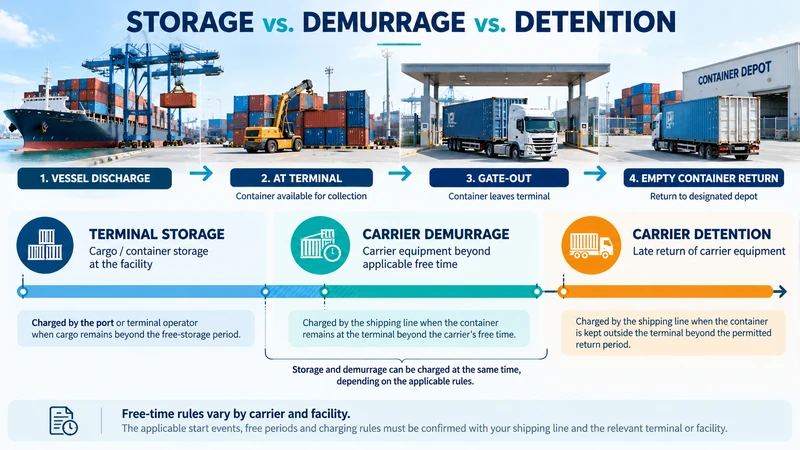
4. Free Time, Storage, Demurrage and Detention: What’s the Difference?
One of the most expensive misunderstandings in destination logistics is assuming that a container has only one free-time period.
In practice, storage and container-use charges may be controlled by different organizations and subject to separate deadlines.
A shipping line may provide equipment free time while a terminal applies its own storage rules.
Consequently, a container may incur terminal storage charges even when no carrier demurrage is payable under the relevant shipping contract.
Port and Terminal Storage
Storage is the charge associated with keeping cargo or containers within a port, terminal, CFS, or other applicable facility beyond the allowance provided by that facility.
The TPA Sea Ports Tariff Book dated January 2026 includes a schedule for domestic FCL import containers.
Under Clause 20.1.2(a), the published tariff provides a five-day free-storage period for the relevant domestic FCL imports, calculated by reference to cargo discharge and posting in the TRA system. Subsequent periods are subject to the applicable tariff charges.
This is an example of a specific published TPA tariff provision, not a guarantee of five free days at every Dar es Salaam terminal, CFS, or dry port.
Importers must confirm whether the provision governs their shipment, which facility holds the cargo, and whether any other applicable rules or amendments alter the calculation.
Source: TPA Sea Ports Tariff Book — January 2026.
Shipping-Line Demurrage
Demurrage is a carrier-related charge associated with keeping a container beyond the agreed free-time allowance under the applicable equipment and shipping-line terms.
It is distinct from terminal storage, although both may be associated with a container remaining at the terminal.
The carrier determines its applicable free-time provisions and charging structure under the relevant booking and tariff.
Demurrage calculations may depend on container type, shipment category, booking agreement, and the actual period of equipment use.
Importers should not rely on the demurrage schedule of a different shipping line.
Container Detention
Detention generally concerns keeping carrier-owned equipment beyond the permitted period outside the applicable terminal or depot.
For example, an importer may collect an FCL container, arrange unloading at a warehouse, and then return the empty container to the designated facility.
If the container is returned late under the relevant carrier terms, detention may apply.
It is important to confirm:
- The authorized empty-container return location.
- The last permitted return date.
- The return acceptance requirements.
- Whether a depot appointment is needed.
- Which record establishes successful equipment return.
Some carriers use combined demurrage and detention arrangements, so the charge structure and the transition between periods must be checked against the actual contract.
Free-Time Clock Comparison
| Charge or Clock | Responsible Party | Relevant Start Event | When Charging May Begin | Required Confirmation |
|---|---|---|---|---|
| Port or terminal storage | Port or terminal operator | As defined by the applicable facility tariff | After the applicable free-storage allowance | Facility, start event, tariff, calendar rules |
| Shipping-line demurrage | Carrier/equipment provider | As defined by the booking and D&D terms | After the applicable carrier free time | Carrier, booking, container type, rate tiers |
| Container detention | Carrier/equipment provider | According to equipment release and return terms | When permitted equipment-use time is exceeded | Return depot, deadline, acceptance record |
| CFS storage | CFS or relevant facility | As defined by the facility’s storage terms | After the relevant free period | Cargo availability, free-time start, tariff |
| ICD/dry-port storage | Applicable facility | As defined by the relevant facility and regulatory terms | After the applicable allowance | Facility, tariff, cargo classification |
Maersk’s Tanzania import guidance, for example, distinguishes carrier demurrage and detention from storage billed by the port operator. Its published free-time arrangements also vary with shipment categories and equipment types.
Other carriers may apply different arrangements.
Source: Maersk Tanzania Import Information.
Can Storage and Demurrage Be Charged at the Same Time?
Yes, depending on the applicable agreements and tariffs.
Suppose a full container remains at a terminal while the importer resolves a documentation issue.
The terminal may assess storage according to its tariff, while the shipping line separately calculates equipment-related charges according to its own free-time schedule.
Whether both charges become payable depends on the actual dates and conditions.
The importer should therefore request separate confirmations rather than accept an unspecified statement that the shipment has a certain number of “free days.”
Pro Tip — Confirm Every Free-Time Deadline
Ask your shipping line and destination agent to confirm terminal storage, carrier demurrage, detention, and any CFS or ICD storage deadlines separately. Request the exact calculation start event, chargeable-day rules, and applicable rate tiers in writing.
5. Delivery Order and Cargo Release: From Arrival to Collection
Paying freight charges does not automatically authorize an importer to collect cargo from Dar es Salaam Port.
Several release and payment requirements may need to be satisfied before the cargo can leave the relevant terminal.
The TPA’s published import process describes the involvement of a registered clearing and forwarding agent, customs clearance, shipping-agent documentation, port billing, truck registration, and final gate procedures.
The practical sequence may differ according to the carrier, cargo type, terminal, and shipment status.
Step 1: Confirm the Bill of Lading and Shipping-Line Release Requirements
The consignee or appointed clearing and forwarding agent must establish the status of the bill of lading (B/L).
Depending on the transport arrangement, cargo release may require properly surrendered original documents, an accepted telex or electronic release, a sea waybill, or other authorized documentation.
The consignee details and agent authorization must be consistent with the shipping line’s requirements.
A discrepancy in the consignee name, document status, or authorization can prevent the delivery order from being issued.
Step 2: Obtain the Delivery Order
A delivery order (DO) is a key document used to authorize cargo delivery under the carrier’s release process.
The shipping line or authorized shipping agent normally controls its issuance.
Before the DO is released, the carrier may require applicable payments, approved documentation, and any required container guarantees.
For example, Maersk’s Tanzania import guidance identifies requirements for its DO request procedure, including an authorized clearing agent, the latest applicable B/L copy, consignee authorization, payment evidence, and a valid PRV Pass.
These requirements are specific to the published Maersk procedure. Other carriers may use different documentation or electronic-release arrangements.
A delivery order is not a substitute for customs clearance or final terminal gate authorization.
Step 3: Complete Customs and Regulatory Release
The importer must ensure that customs formalities and any applicable regulatory requirements have been completed.
This normally involves a properly authorized clearing and forwarding agent and the relevant TRA customs procedures.
Depending on the goods, the process may include document review, duty and tax assessment, inspection, and other required approvals.
Paying carrier or terminal invoices does not remove a customs hold.
Likewise, completing customs clearance does not automatically settle unpaid terminal charges.
Importers needing more detail about the customs process should consult our Tanzania customs clearance guide.
Step 4: Generate and Settle Port Charges
According to the TPA import process, the clearing and forwarding agent submits the relevant documentation, including B/L, DO, and release documentation, through the TPA Electronic Payment Portal (TePP) for port-charge billing.
The TPA describes invoice generation and payment through the applicable control-number process.
The importer should confirm which invoices have been issued, which have been paid, and whether the payments have been reflected in the relevant system.
Proof that money was sent to an intermediary is not necessarily the same as confirmation that the port or terminal has credited the required invoice.
Step 5: Arrange Truck Collection and Gate Procedures
Once the applicable release conditions have been satisfied, the appointed party coordinates cargo collection.
For cargo handled under the TPA workflow, the clearing and forwarding agent arranges the required truck and driver announcement and obtains the relevant entry authorization.
The nominated vehicle is then used for collection according to port procedures.
Final checks at the port gate may include cargo, container, vehicle, and documentation verification.
A release instruction should not be mistaken for evidence that the truck has actually exited the facility.
Step 6: Track Empty-Container Return for FCL Cargo
For a carrier-owned FCL container, collection is not necessarily the end of the importer’s container-related obligations.
After unloading, the empty equipment must be returned according to the carrier’s instructions.
The importer should retain:
- Gate-out confirmation.
- Delivery or collection evidence.
- Empty-return appointment details, where applicable.
- Depot acceptance or equipment-return confirmation.
- Final records of any detention settlement.
These records are useful when investigating additional invoices or disputing the period used for an equipment charge.
Cargo Release Process at a Glance
- Vessel Arrival and Discharge
- Shipping-Line Documentation and Delivery Order, alongside customs and regulatory clearance as applicable
- Applicable Port/Terminal Billing and Payment
- Cargo-Release Confirmation
- Truck Registration and Gate Procedures
- Cargo Collection and Gate-Out
- Empty-Container Return, where applicable
The sequence is a simplified operational view. Documentation, customs processing, and billing may proceed concurrently, and the required steps must be confirmed for the shipment.
Pro Tip — Identify the Exact Release Blocker
If cargo collection is delayed, ask the responsible agent to identify the specific outstanding item: missing documentation, carrier release, customs hold, unpaid invoice, terminal authorization, truck arrangements, or another issue. Request the responsible party and the next action needed to resolve it.
6. Who Pays Destination Charges Under FOB, CIF, DAP and DDP?
One of the most common sources of disputes is assuming that the party booking the international freight must also pay every charge at the destination port.
Payment responsibility depends on the agreed trade terms, the sales contract, the carrier contract, and the actual services being billed.
Three questions should be considered separately:
- Who issues the invoice?
- Who must settle it to obtain release or continue the service?
- Who ultimately bears the cost under the relevant contract?
These parties may not be identical.
For example, a local clearing agent may pay a port invoice on behalf of an importer and subsequently seek reimbursement. The agent’s role as payment intermediary does not make the amount an additional clearing-agent service fee.
FOB: The Buyer Typically Arranges Main Carriage and Importation
Under FOB (Free on Board), the seller delivers the goods on board the vessel at the named port of shipment, while the buyer takes responsibility for the main carriage and subsequent obligations under the applicable Incoterms rule.
For a typical FOB import arrangement, the buyer should budget for destination handling, import clearance, applicable duties and taxes, and subsequent transportation.
However, a charge that has already been paid under the actual freight contract should not automatically be paid again.
FOB is specifically a sea and inland waterway Incoterms rule. For containerized transactions, the chosen trade term should reflect the actual delivery arrangement.
CIF: Ocean Freight and Insurance Do Not Mean All Destination Costs Are Paid
Under CIF (Cost, Insurance and Freight), the seller arranges and pays for carriage to the named destination port and provides the insurance required by the rule.
However, CIF does not automatically include destination customs clearance, import duties, every local terminal charge, or inland delivery.
The allocation of particular unloading or destination charges can depend on the carriage contract and the specific Incoterms cost provisions.
Therefore, a buyer purchasing under CIF Dar es Salaam should ask the supplier or booking party:
- Which terminal or handling charges are included?
- Are any destination carrier documentation fees prepaid?
- Who is responsible for destination storage?
- Who arranges and pays for import clearance?
- Who pays for cargo pickup and inland transportation?
A CIF commercial invoice alone may not provide enough detail to answer these questions.
DAP: Delivery to an Agreed Place Without Seller Import Clearance Obligations
Under DAP (Delivered at Place), the seller is responsible for bringing goods to the named destination and making them available ready for unloading under the rule’s conditions.
The buyer generally handles import clearance and pays the applicable import duties and taxes.
For example, DAP Dar es Salaam Port and DAP Buyer’s Warehouse, Dar es Salaam identify different delivery points. The precise named place matters when evaluating which transportation and handling costs the seller must bear.
A shipment described as “door-to-door” is not automatically DDP. It may be arranged under DAP or another contractual structure.
DDP: Seller Responsibility for Import Clearance and Taxes
Under DDP (Delivered Duty Paid), the seller assumes responsibility for import clearance and applicable import duties and taxes, as well as delivery to the agreed named place under the rule.
Because this imposes substantial obligations on the seller, the arrangement must be legally and operationally feasible in the importing country.
Before agreeing to DDP Tanzania, the parties should establish who can lawfully undertake the importer and customs formalities, who will make statutory payments, and which charges are included in the agreement.
A freight forwarder coordinating transportation does not automatically become the importer of record.
Destination Charge Responsibility by Incoterm
| Trade Term | Main Commercial Responsibility | Import Clearance and Duties | What to Check at Destination |
|---|---|---|---|
| FOB | Buyer normally arranges main carriage after seller delivers on board | Normally buyer | Carrier local charges, handling, clearance, storage, inland delivery |
| CIF | Seller arranges freight and required insurance to named destination port | Normally buyer | Whether unloading/THC is included, local carrier charges, clearance and pickup |
| DAP | Seller arranges carriage to the named destination | Normally buyer | Named delivery point, import charges, unloading, service scope |
| DDP | Seller bears carriage and import-clearance obligations to the named place | Normally seller under the rule | Legal import capability, documented tax payments, agreed exclusions and exceptional costs |
The table summarizes general Incoterms 2020 obligations. Actual invoice settlement and any contractual variations should be verified against the signed sales and transport documents.
Source: International Chamber of Commerce — Incoterms 2020.
Who Pays an Unexpected Storage or Demurrage Invoice?
The fact that a shipment was delayed does not, by itself, establish who ultimately bears the cost.
The shipping line or terminal may initially charge the party responsible under its service agreement. The importer, supplier, or logistics provider may then have separate contractual rights and obligations concerning reimbursement.
The parties should review:
- Who controlled the required documents.
- Whether the delay arose before or after cargo became available.
- The carrier’s free-time and charging terms.
- Any relevant customs or terminal hold.
- Whether release instructions were provided on time.
- The actual sales and logistics-service contracts.
Do not assume that customs inspection automatically cancels demurrage or storage. Any waiver, extension, or adjustment must follow the applicable provider’s rules and be supported by confirmation.
7. How to Estimate Dar es Salaam Destination Charges Before Arrival
A reliable destination-charge estimate starts with the shipment details, not with an average cost per container found online.
Two containers of the same size can have different destination expenses because they use different carriers, terminals, cargo classifications, service agreements, or release schedules.
Step 1: Collect the Shipment Information
Before requesting charges, prepare the following information.
| Required Detail | Why It Matters |
|---|---|
| FCL or LCL | Determines the cargo-handling and release arrangement |
| Container size and type | May affect handling, storage, and carrier equipment rates |
| Number of containers | Determines the number of chargeable units where applicable |
| Cargo description | Identifies potential special-handling conditions |
| LCL volume and weight | Helps determine the applicable CFS billing basis |
| Shipping line | Determines carrier local fees and equipment terms |
| Bill of lading arrangement | Affects documentation and cargo-release processes |
| Discharge terminal or facility | Identifies applicable terminal charges |
| CFS or ICD location, if applicable | Identifies additional facility tariffs |
| Estimated arrival date | Supports pre-arrival coordination |
| Incoterm and named place | Helps determine payment responsibility |
| Destination service quotation | Shows included and excluded services |
If a detail is unknown, ask the booking party to confirm it instead of making assumptions.
Step 2: Separate Fixed and Variable Charges
For budgeting purposes, divide destination charges into three categories.
A. Charges That Can Usually Be Quoted in Advance
These may include applicable documentation, handling, and agreed clearing-agent service fees.
Their amounts should be supported by a valid tariff or written quotation.
B. Charges That Depend on Cargo or Operational Conditions
These may include additional handling, inspections, special equipment services, or facility transfers.
They should be treated as conditional rather than automatically added to every shipment.
C. Time-Based Charges
Storage, demurrage, and detention depend on actual events and the terms of the relevant service provider.
These charges may not be known precisely until cargo collection and, where applicable, container return are completed.
Step 3: Calculate Using the Applicable Billing Rules
A practical budgeting framework is:
Estimated Destination Service Charges = Confirmed Fixed Charges + Applicable Handling Charges + Forecast Time-Based Charges + Conditional Services
For a charge billed at a single daily rate:
Time-Based Charge = Chargeable Days × Applicable Daily Rate
Where a tariff uses progressive tiers, the charge must be calculated separately for the relevant days within each tier.
The calculation should follow the provider’s actual terms for partial days, holidays, start dates, and equipment categories.
Import duties, import taxes, and inland transportation should be shown separately in the overall import budget rather than merged into the port-service subtotal.
For a broader landed-cost comparison, see our shipping cost guide from China to Tanzania.
Step 4: Check for Duplicate or Missing Charges
A destination quotation should be compared with the original freight quotation and purchase terms.
Pay particular attention to:
Terminal Handling Charges (THC)
Confirm whether the relevant handling service is already included or paid under the carriage arrangement. Avoid assuming that an identically named fee necessarily covers the same service.
Documentation Fees
Ask whether delivery order, destination documentation, and administrative charges are separate items or different descriptions of a service already covered.
CFS Charges
For LCL cargo, verify whether deconsolidation, destination handling, document release, and warehouse services are included in one tariff or billed separately.
Agent Disbursements
Separate the agent’s professional service fee from port, carrier, government, and other third-party invoices paid on the client’s behalf.
Deposits
A refundable container deposit or guarantee should be identified separately from nonrefundable service charges.
Step 5: Request a Written Breakdown
A useful destination-charge quotation should identify:
- Service description.
- Billing party.
- Billing unit.
- Rate or calculation method.
- Currency.
- Included and excluded services.
- Applicable taxes on the service, if any.
- Tariff or quotation validity.
- Payment responsibility.
- Conditions under which additional charges may arise.
If the final amount depends on information available only after arrival, the quotation should clearly identify that uncertainty.
A cost breakdown based on a named carrier, terminal, and shipment arrangement is more useful than a generic estimate claiming to represent every Dar es Salaam import.
8. How to Avoid Destination Charge Disputes and Cargo Release Delays
Controlling destination charges requires coordination before the cargo arrives.
Waiting until the vessel has discharged to investigate missing documents, unpaid fees, or equipment deadlines can reduce the time available for resolving problems.
Before the Shipment Leaves China
Confirm the agreed Incoterm and named destination, and request the destination-charge inclusion and exclusion list.
Check the shipping line, consignee details, and bill of lading instructions.
Appoint or arrange access to a properly registered clearing and forwarding agent for the required local procedures.
For regulated goods, confirm applicable import documents and approvals through the relevant authorities and qualified local professionals.
Before Vessel Arrival
Request updated shipping documentation and confirm the expected discharge terminal.
Establish which party is obtaining the delivery order and which party will coordinate customs clearance.
Obtain the current carrier and terminal billing requirements, and confirm all relevant free-time rules.
Check whether the importer has completed any required payments, guarantees, and document authorizations.
After Discharge
Monitor the actual cargo-availability and release status.
Request invoices with valid shipment references and reconcile them against the expected breakdown.
Confirm that customs release, carrier authorization, port or terminal payment, and vehicle arrangements are complete.
Where cargo cannot be collected, identify the specific hold or outstanding requirement.
Before and After Collection
Confirm the correct truck and collection location.
Retain relevant payment receipts and release records.
For FCL cargo, arrange timely unloading and container return to the authorized depot.
Obtain evidence of final equipment acceptance where applicable.
Pre-Arrival Destination Charge Checklist
| Task | Responsible Party to Confirm | Status |
|---|---|---|
| Final bill of lading details checked | Supplier / shipping line / consignee | Pending / Complete |
| Delivery order requirements confirmed | Shipping line / appointed agent | Pending / Complete |
| Customs documents prepared | Importer / clearing agent | Pending / Complete |
| Destination-charge quotation reviewed | Forwarder / carrier / facility | Pending / Complete |
| Terminal or port tariff identified | Clearing agent / terminal | Pending / Complete |
| Carrier free time confirmed | Shipping line | Pending / Complete |
| Storage free time confirmed | Relevant terminal or facility | Pending / Complete |
| Payment responsibility agreed | Buyer / seller / logistics provider | Pending / Complete |
| Required releases obtained | Relevant authorities / carrier / agent | Pending / Complete |
| Cargo collection arranged | Clearing agent / transport provider | Pending / Complete |
| Empty-return deadline confirmed, if applicable | Shipping line / transport coordinator | Pending / Complete |
Each outstanding task should also have an agreed deadline and supporting evidence, such as an email confirmation, valid invoice, portal record, or release document.
Request a Destination Charge Checklist
If you are preparing an FCL or LCL shipment from China to Dar es Salaam, Winsail Logistics can review the shipment information you provide and help identify the destination-charge items that should be confirmed before arrival.
Include your cargo description, container or LCL details, shipping line, expected arrival date, agreed Incoterm, and destination to request a more relevant checklist.
FAQ
Are Dar es Salaam Port Charges Included in CIF Shipping?
Not necessarily. CIF requires the seller to arrange and pay for carriage to the named destination port and provide the insurance required under the rule. It does not automatically include all destination handling, customs clearance, import duties, storage, or inland delivery. Some unloading or handling costs may already be covered by the seller's carriage contract. Buyers should check the quotation and transport terms before paying a separate destination invoice.
Who Issues the Delivery Order for an Import Container in Tanzania?
The delivery order is normally issued or authorized by the shipping line or its designated shipping agent after the applicable carrier release requirements have been satisfied. The consignee's appointed clearing agent may coordinate the request. Required documentation can include an appropriately released bill of lading, consignee authorization, payment evidence, and carrier-specific forms or guarantees. The precise procedure should be confirmed with the named shipping line.
Can I Pay Port Storage Even If My Shipping Line Gives Me Free Time?
Yes. Terminal storage and carrier demurrage or detention may be governed by separate rules and charging periods. The shipping line's free-time allowance does not necessarily prevent a terminal or CFS from charging for storage. Ask both the carrier and the relevant facility to confirm their applicable free-time deadlines, calculation rules, and charging start events.
Do LCL Shipments Have the Same Destination Charges as FCL Containers?
No. LCL shipments commonly require deconsolidation and cargo handling at a CFS or another designated facility. Individual consignees may be billed according to shipment volume, weight, bill of lading, or minimum chargeable units. FCL cargo is typically released as a dedicated container and may involve direct container return obligations. The exact fees depend on the actual consolidator, carrier, facility, and service agreement.
Can I Pay Port Charges Before Customs Clearance Is Completed?
Some invoices or preparatory payments may be processed before every release requirement has been completed, depending on the relevant system and service provider. However, paying port charges does not automatically authorize the cargo to leave the port. Final collection remains subject to applicable customs, carrier, terminal, and gate-release conditions. The appointed clearing agent should confirm which payments can be completed and what documentation remains outstanding.
Who Pays Demurrage If Customs Inspection Delays My Shipment?
The answer depends on the carrier's terms, the relevant contract, and the circumstances of the delay. A customs inspection does not automatically cancel carrier demurrage or terminal storage. The carrier or facility may charge the party liable under its terms, while the buyer and seller may have separate contractual arrangements regarding ultimate cost responsibility. Ask for the detailed charge calculation, inspection and release dates, and any applicable extension or waiver procedure.
What Should I Do If My Clearing Agent Requests an Unexpected Port Fee?
Ask for an itemized explanation before authorizing payment. Request the charge name, actual service provider, invoice reference, billing unit, tariff or contractual basis, applicable service period, and confirmation that it has not already been paid. If the agent is collecting money on behalf of a third party, request the underlying invoice or other appropriate supporting record. Where a charge remains disputed, use the relevant service provider's or regulator's established inquiry or complaint procedure rather than assume that every additional charge is illegitimate.
Final Takeaway: Know the Charges Before Your Cargo Arrives
Dar es Salaam destination charges are not one fixed fee added to the ocean freight price.
They may involve separate port, terminal, shipping-line, CFS, dry-port, and clearing-agent services. The amount payable depends on which services apply, how they are billed, and how quickly the shipment can satisfy release requirements.
For importers, the most effective approach is to obtain an itemized destination-charge breakdown before arrival, confirm contractual payment responsibility, and track the separate deadlines for terminal storage and carrier container use.
It is equally important to distinguish customs payments from port service charges and to know which release step remains outstanding.
A well-prepared importer should be able to answer four questions before cargo collection begins:
- What charges are expected?
- Which organization issues or collects each charge?
- Who is responsible for payment?
- What documents, payments, and deadlines determine when the cargo can be collected?
These answers provide a more reliable basis for budgeting and planning than a generalized port-fee estimate.
For broader shipping arrangements, transportation methods, and shipment planning, visit our complete guide to shipping from China to Tanzania.
Sources and Reference Notes
The following primary sources support the tariff classifications, carrier requirements, and import-release procedures discussed in this article.
- Tanzania Ports Authority (TPA): Sea Ports Tariff Book — January 2026. Refer particularly to the applicable cargo-handling and storage clauses, including Clause 20.1.2 for containerized cargo.
- Tanzania Ports Authority: Official Import Process. Covers clearing-agent involvement, documentation, port billing, payments, and collection procedures.
- Tanzania Shipping Agencies Corporation (TASAC): Official Regulated Tariff Publications. Includes the Dry Port Tariff Order published in September 2026. Confirm current commencement and facility applicability.
- Maersk: Tanzania Import Information. Provides carrier-specific DO, demurrage, detention, and free-time information.
- Maersk: Tanzania Destination Documentation Fee Update — June 18, 2026. A carrier-specific fee notice with an effective booking-condition date.
- Tanzania Trade Portal: Official Trade Procedures and Import Information. Reference for current import procedures and regulatory requirements.
- International Chamber of Commerce: Incoterms 2020. Reference for FOB, CIF, DAP, and DDP obligations.
Important: This article provides general operational and budgeting guidance, not a binding tariff quotation or legal determination of payment responsibility. Published rates, local procedures, carrier conditions, and regulatory requirements may change. Final charges should be verified with the actual shipping line, port or terminal operator, authorized agent, and relevant authority before payment or cargo collection.
