
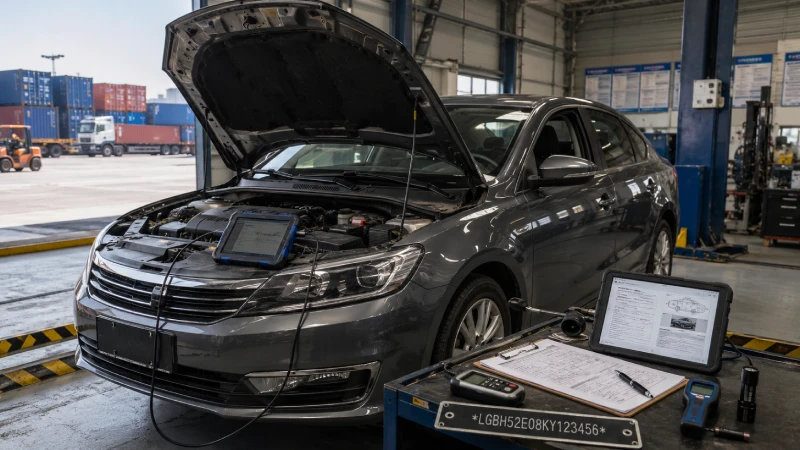
A used car that has passed China’s export quality inspection is not automatically a low-risk purchase. Overseas buyers should separate three different checks: an independent pre-purchase inspection, the mandatory China export quality inspection, and a final pre-shipment condition survey.
Each serves a different purpose. The export inspection establishes a regulatory quality and safety baseline, but it does not necessarily reveal odometer manipulation, minor accident repairs, hidden maintenance problems, or serious EV battery degradation. More importantly, every inspection should be tied to the actual VIN being purchased, not a showroom vehicle or another car of the same model.
Before arranging vehicle shipping from China, buyers should therefore inspect the car, verify the documents, and record its condition at handover separately.
The Three Inspections Every Overseas Buyer Should Understand
| Inspection | Main Purpose | Recommended Party | What It Cannot Replace |
|---|---|---|---|
| Pre-purchase vehicle inspection | Determine actual condition, history and commercial value | Independent inspector appointed by buyer | Mandatory export inspection |
| Mandatory export quality inspection | Meet China-side export quality requirements | Qualified third-party testing organization | Destination-country approval |
| Pre-shipment condition survey | Record condition immediately before transport | Buyer representative, inspector or logistics-site personnel | Either of the first two inspections |
Pre-Purchase Vehicle Inspection
This should normally take place before the buyer releases the final payment. It focuses on the specific vehicle’s identity, accident history, flood or fire evidence, mechanical condition, mileage, EV battery condition and overall value.
Mandatory Export Quality Inspection
Under China’s current used-vehicle export framework, used passenger cars are inspected against WM/T 8-2022, while used commercial vehicles and trailers use WM/T 9-2022. A third-party product inspection report is among the documents required when the approved exporter applies for the export license. China Ministry of Commerce Announcement No. 6 of 2024
The official WM/T 8-2022 standard is currently in force. It states that the passenger-car quality report is valid for four months and that the report, registration documents, photographs and related records should be electronically archived for at least six years.
A passed report should not be interpreted as approval for registration in another country. China separately requires the exporter to declare compliance with the destination market’s access standards.
There is also an important 2026 requirement: for vehicles whose registration age is 180 days or less, the exporter must submit a manufacturer-issued After-Sales Maintenance Service Confirmation when applying for export. Without the required confirmation, the export license will not be issued. See the Ministry of Commerce notice on strengthening used-car export management.
Pre-Shipment Condition Survey
After repairs or preparation are completed, inspect the vehicle again before it enters the terminal or container. Record VIN, mileage, visible damage, keys, accessories and operating condition. This creates evidence for later transport-damage claims.
Step 1 — Confirm the Vehicle’s Identity
Start with the VIN. Never approve a vehicle based only on photographs, model information or a supplier’s stock list.
Compare the VIN shown on the:
- chassis or body stamping;
- manufacturer identification plate;
- windshield VIN area, where applicable;
- ECU or diagnostic system;
- Motor Vehicle Registration Certificate;
- invoice and sales contract;
- inspection report.
WM/T 8-2022 specifically requires the VIN to match the registration records and checks for abnormalities such as grinding, patching, unauthorized re-stamping or suspicious repainting around the stamped VIN area. If the vehicle’s identity is questionable, the VIN stored electronically may also be checked.
The engine number or drive-motor identification should also correspond with the registration documents.
Finally, confirm the exact specification: brand, model, trim, production date, first-registration date, seating capacity, propulsion type and modifications. Similar-looking versions of the same vehicle can have different batteries, charging systems, safety equipment and destination eligibility.
Step 2 — Review Registration, Service and Ownership History
Build a timeline of the vehicle before judging its mileage or condition.
Check:
- first-registration and ownership-transfer dates;
- number and type of previous owners;
- taxi, ride-hailing, rental or other commercial use;
- maintenance and repair records;
- insurance or accident information where available;
- engine, transmission or traction-battery replacement;
- outstanding recalls;
- historical mileage readings.
Do not interpret missing records as proof that nothing happened.
China’s export framework encourages use of the national automobile maintenance electronic health archive, and relevant repair-record services are available within the regulatory system to eligible participants. That does not create a single complete public database containing every accident, repair and ownership event for every overseas buyer.
Mileage should therefore be cross-checked against service records, inspection records, diagnostic data and physical wear.
Step 3 — Inspect the Body and Structural Components
Not every repainted panel means that a vehicle has suffered a major accident.
A repainted bumper, repaired scratch or replaced door may primarily affect value. Structural repairs are much more serious.
Inspect safety-critical areas including:
- A, B and C pillars;
- front and rear longitudinal members;
- suspension towers;
- rocker panels and upper side members;
- trunk floor;
- front and rear impact structures;
- roof structure;
- load-bearing underbody sections.
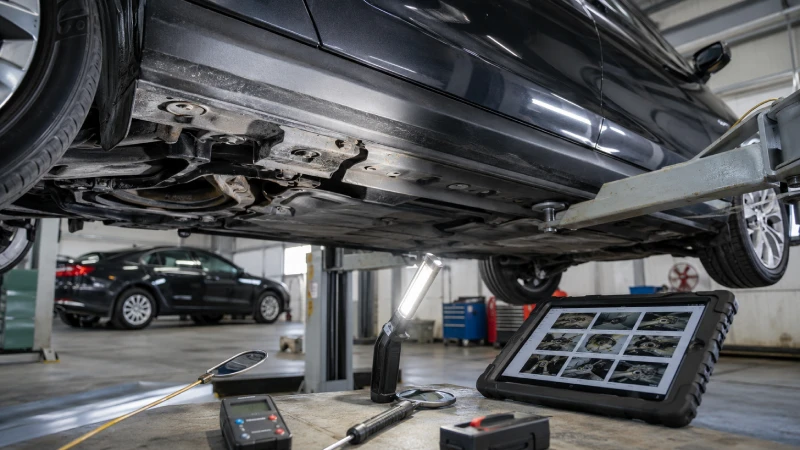
Look for deformation, cutting, welding, pulling repairs, non-original welds, unusual seam sealer, replaced structural panels and disturbed fasteners.
WM/T 8-2022 defines a major-accident vehicle as one that has suffered structural damage from a serious impact or has experienced flooding or fire. Its export inspection specifically checks for severe deformation, cutting and welding of structural areas.
Paint-depth gauges, lifts and body-dimension measuring equipment can improve the inspection, but avoid treating one universal paint-thickness number as an accident threshold. Factory paint characteristics vary by brand, panel material and production process.
Step 4 — Check for Flood and Fire Damage
Flood-damaged vehicles can look surprisingly clean after professional detailing.
Inspect hidden areas for:
- rust on seat rails and bolts;
- mud or water lines beneath carpets;
- staining at the ends of seat belts;
- corrosion in connectors and fuse boxes;
- contamination inside cavities;
- mold or unusually strong deodorizer;
- inconsistent production dates on interior or electronic components.
For fire history, look for smoke residue, melted wiring, replaced insulation, heat discoloration and localized repair work.
The export standard requires the passenger compartment to be free from obvious flood evidence and the vehicle to be free from obvious fire damage. Vehicles failing the major-accident assessment receive a non-conforming result.
That makes physical inspection important: a cleaned carpet alone does not establish that a vehicle has never been flooded.
Step 5 — Inspect the Mechanical and Safety Systems
A commercial pre-purchase inspection should go beyond checking whether the vehicle starts.
Cold Start and Powertrain
Where practical, request a genuine cold start rather than receiving a vehicle that has already been warmed up.
Check for unusual engine noise, smoke, unstable idle, vibration and fluid leaks. Inspect engine oil for contamination or emulsification and examine coolant, transmission fluid and surrounding components. Test transmission engagement and shifting.
Steering, Suspension and Brakes
Inspect steering play, suspension bushings, springs, dampers, wheel bearings and tires. Test braking performance, directional stability and the parking brake.
Tire production dates, specifications and abnormal wear can also reveal alignment or suspension issues.
Electronic Diagnostics
A buyer-side inspection should normally obtain a raw diagnostic scan covering systems such as:
- engine or powertrain;
- ABS;
- EPS;
- SRS/airbags;
- transmission;
- emissions-related systems where applicable.
Record current and stored fault information before anyone clears the codes. Also verify that warning lights illuminate normally during the instrument-cluster self-test rather than being disabled or concealed.
Where conditions allow, conduct a road test and document steering, braking, shifting, noise and vibration.
Step 6 — Perform Additional Checks on Used EVs and Hybrids
Used EV inspection requires a separate battery-health assessment.
Understand the Limit of the Export Standard
WM/T 8-2022 checks important safety-related EV items. For applicable electric, plug-in hybrid and fuel-cell vehicles, there should be no warning relating to the electric-drive system, high-voltage insulation or traction battery. The manual service disconnect, or MSD, must also be intact, properly fitted and locked.
These are valuable safety checks, but they do not establish the battery’s remaining usable capacity, real-world range or economic value.
A dashboard without battery warnings is therefore not equivalent to a healthy battery.
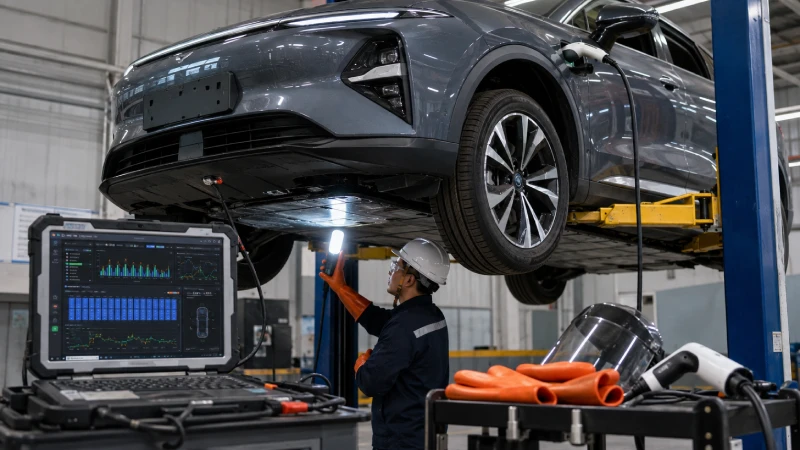
Request a Commercial Battery Health Assessment
For a valuable used EV, consider requesting:
- battery SOH and the method used to calculate it;
- usable capacity or capacity-test results;
- cell-voltage deviation;
- battery-pack temperature distribution;
- current and historical BMS faults;
- AC charging test;
- DC fast-charging test where practical;
- high-voltage insulation and interlock checks;
- photographs of the battery-pack underside;
- evidence of impact, deformation, leakage or removal;
- battery model, serial number and replacement history.
Avoid applying one universal SOH pass/fail threshold to every vehicle. SOH calculations vary by OEM, diagnostic equipment, battery chemistry, software and test procedure. If battery condition affects price or acceptance, define the test method and contractual threshold before payment.
Also verify battery ownership. Some vehicles may have been sold under battery-leasing, battery-service or battery-swap arrangements. The buyer should confirm that the battery installed in the vehicle can legally transfer with the car.
UN 38.3 documentation should also not be confused with a battery-health certificate. UN 38.3 concerns transport-related testing of battery designs; it does not tell the buyer how much usable capacity remains in one particular used vehicle.
For shipping considerations, see Electric Vehicle Shipping from China.
Step 7 — Check Destination-Country Compliance Before Approval
A mechanically sound vehicle can still be a poor purchase if it cannot be imported or registered.
Before approving the vehicle, check destination requirements covering:
- left-hand or right-hand drive;
- maximum vehicle age;
- emissions;
- lighting and glazing;
- charging connector compatibility;
- instrument language;
- maps, connectivity and software functions;
- type approval or conformity documentation;
- diagnostic support and spare-parts availability.
Do not treat a Chinese export inspection report as proof that a car can automatically be registered in Saudi Arabia, the UAE, Kenya, Ghana, Tanzania or another market. China-side export requirements and destination-country admission requirements are separate processes.
Step 8 — Build a VIN-Specific Inspection Evidence Pack
Do not accept only a short edited sales video.
For each purchased VIN, retain:
- VIN close-ups and whole-vehicle photographs;
- left-front and right-rear 45-degree photographs;
- engine or drive-motor identification;
- odometer and warning-light photographs;
- chassis and structural-area photographs;
- EV battery underside photographs;
- cold-start video;
- continuous walk-around video;
- original diagnostic scan;
- paint-measurement map where used;
- road-test record;
- keys, charging cables, spare tire and accessory inventory;
- inspection date, location and inspector details.
The video should ideally show the premises, complete vehicle, VIN, odometer, startup and key inspection points in a continuous sequence. This makes substitution and selective filming more difficult.
Step 9 — Reinspect the Vehicle Before Loading
Condition can change between purchase inspection and shipment.
Immediately before port delivery or container loading, reconfirm:
- the VIN has not changed;
- agreed repairs were completed;
- mileage has not increased abnormally;
- no new body damage has appeared;
- the vehicle starts, steers, brakes and moves normally;
- there is no significant leakage;
- keys and accessories are present;
- EV state of charge meets the booked carrier’s instructions;
- condition photographs are complete before lashing or handover.
These records help determine whether later damage occurred at the seller’s premises, warehouse, terminal, during loading or during ocean transport.
How to Choose an Independent Vehicle Inspector in China
The buyer should appoint or independently verify the inspector rather than relying exclusively on a party selected by the seller.
Confirm the inspector can provide VIN-specific reports and has access to appropriate lifting, diagnostic, road-test and, when required, EV battery-testing equipment.
Ask for original photographs, diagnostic files and measurements to be sent directly to the buyer.
Most importantly, distinguish commercial pre-purchase inspection capability from authorization to issue the official export-quality report. A freight forwarder can coordinate an inspection appointment, but the legally required report must be issued by an appropriate third-party inspection organization.
Contract Clauses That Turn Inspection into Buyer Protection
An inspection has limited value if the purchase contract does not define what happens when the vehicle fails.
Specify:
- exact VIN and configuration;
- stated mileage and permitted tolerance;
- whether repainting or previous component replacement is acceptable;
- declaration regarding major structural accidents, flood and fire;
- EV battery test method and agreed battery-health criteria;
- buyer’s right to reinspect;
- rejection conditions;
- repair, replacement, price-reduction or refund mechanism;
- responsibility if undisclosed condition causes terminal or carrier rejection;
- requirement for before-and-after photographs and invoices for agreed repairs.
For EVs, do not simply write “battery SOH must be good.” Define the diagnostic source and measurement method.
Red Flags That Should Stop the Purchase
Treat the following as reasons to delay payment and investigate further:
- seller refuses to disclose the VIN or registration certificate;
- buyer may inspect only another vehicle of the same model;
- cold start or underbody inspection is refused;
- fault codes are cleared immediately before inspection;
- VIN, engine or motor identification does not match;
- only edited promotional videos are provided;
- an export report is marketed as a “zero-accident certificate”;
- battery, airbags or structural-part replacement cannot be explained;
- the official inspection report has expired;
- full payment is demanded before independent inspection.
Recommended Inspection Workflow
A practical sequence is:
- Obtain VIN and registration records.
- Verify the exact vehicle and exporter.
- Review ownership, maintenance, recall and repair information.
- Arrange an independent buyer-side pre-purchase inspection.
- Complete agreed repairs and reinspect them.
- Complete the mandatory export quality inspection.
- Verify export-license and vehicle-document consistency.
- Perform a pre-shipment condition handover.
- Archive the original reports, photographs and videos.
For the wider document process, see Used Car Export Documents from China: 2026 Checklist.
FAQ
Is a third-party inspection report mandatory for exporting a used car from China?
Yes. Under the current framework, the export-license application includes a product inspection report issued by a third-party inspection organization. Passenger cars use WM/T 8-2022, while commercial vehicles and trailers use WM/T 9-2022.
Can the exporter’s own inspection replace an independent inspection?
It should not replace a buyer-controlled pre-purchase inspection. The two checks serve different purposes, and an independent inspection reduces the commercial conflict of interest before payment.
Does a passed WM/T 8-2022 inspection prove the car has never had an accident?
No. It checks specified export-quality requirements, including major structural damage, flood and fire indicators, but it is not a complete lifetime accident-history certificate or commercial valuation.
Does repainting mean a vehicle is a major-accident car?
No. Cosmetic paint repair is different from serious structural damage. Evaluate where the repair occurred, why it was performed and whether load-bearing structures were affected.
How can an overseas buyer verify the odometer?
Use multiple sources, including maintenance history, historical inspections, diagnostic information, tire condition, pedals, steering wheel, seats and other wear patterns. No single method is infallible.
How should the battery of a used EV be inspected?
Combine battery SOH or capacity information with BMS diagnostics, cell-voltage consistency, temperature data, charging tests, high-voltage checks and physical inspection of the battery pack. Always document the test method used.
How long is a WM/T 8-2022 inspection report valid?
Four months. The standard states that the report automatically expires after that period.
Is another inspection required in the destination country?
Possibly. Destination countries may impose their own conformity, roadworthiness, emissions, pre-shipment or registration inspections. A Chinese export-quality report does not replace those requirements.
Conclusion: Inspect the Car, the Documents and the Handover Separately
The safest approach is to inspect the specific VIN before final payment, use the mandatory export inspection for China-side compliance, and perform another condition survey immediately before shipment.
For EVs, add a dedicated traction-battery assessment rather than relying on the absence of dashboard warnings.
If you are preparing a vehicle shipment from China, send Winsail the VIN, model, propulsion type, destination country and intended shipping method. We can help coordinate the inspection and logistics workflow while the required official reports remain the responsibility of qualified inspection organizations and the relevant authorities.
