
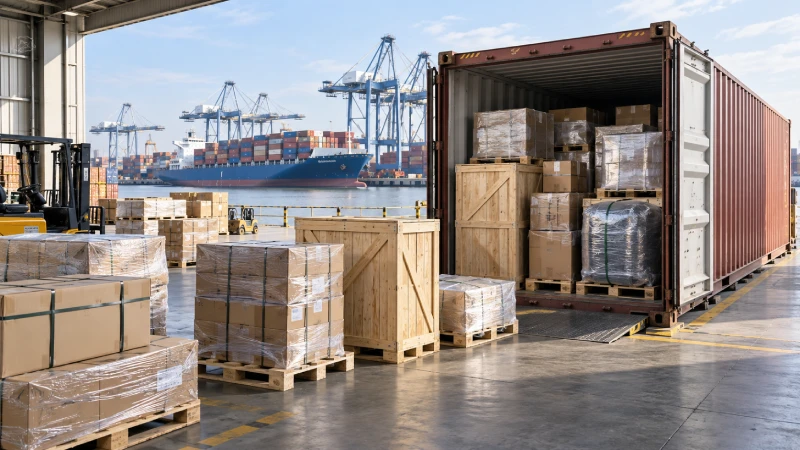
If your cargo from China does not fill a full container, LCL shipping from China to Germany is often the most practical ocean freight option.
LCL, or Less than Container Load, allows your cartons, pallets or crates to share container space with cargo from other shippers. Instead of paying for an entire 20ft or 40ft container, you generally pay according to the space or chargeable weight your shipment uses.
However, LCL is not simply a matter of multiplying your cargo volume by a cheap “USD per CBM” rate.
A typical China-Germany LCL shipment passes through a consolidation warehouse in China, container loading, ocean transport, German deconsolidation, destination CFS handling, customs clearance and final delivery. Each stage can affect both the total cost and the actual transit time.
For German importers, the key question is therefore not:
“What is the cheapest LCL rate per CBM?”
It is:
“What is the complete cost and realistic lead time from my supplier in China to my final destination in Germany?”
If you need to compare LCL with other transport methods first, see our Shipping from China to Germany guide.
LCL Shipping from China to Germany: Quick Answer
| Question | What Importers Should Know |
|---|---|
| Best suited for | Commercial cargo that does not economically justify a dedicated container |
| Main German gateways | Hamburg, with Bremerhaven used where the consolidator’s routing makes it more suitable |
| Main pricing basis | Usually W/M: weight or measurement |
| Typical measurement unit | CBM, subject to the applicable W/M rule |
| China-side operations | Pickup, CFS receiving, consolidation, export handling and container loading |
| Germany-side operations | Discharge, deconsolidation, CFS handling, customs release and delivery |
| Main schedule risk | Consolidation cutoff, vessel schedule, transshipment and destination deconsolidation |
| Main cost risk | Minimums, CFS charges, destination handling and inland delivery |
| LCL vs FCL decision | Compare complete current LCL and FCL costs rather than relying on a universal CBM cutoff |
LCL works particularly well for regular smaller commercial shipments, trial orders, replenishment cargo, several pallets or shipments collected from multiple Chinese suppliers.
But it involves more cargo handling than FCL and can become less attractive as volume, weight, handling complexity or cargo value increases.
What Is LCL Shipping from China to Germany?
LCL means Less than Container Load.
Your shipment occupies only part of a container, while the remaining space is used by cargo belonging to other shippers.
For example, an importer in Germany might have:
- 4 pallets of machine parts from Ningbo
- 2.8 CBM of furniture accessories from Foshan
- 6 CBM of electrical components from Shenzhen
- several small orders from different Chinese factories
Instead of reserving an entire container for one shipment, the freight forwarder or consolidator combines compatible shipments at a Container Freight Station, commonly called a CFS.
The consolidated container is then transported to Germany. At destination, the container is unpacked and each individual shipment is separated before customs release or local delivery.
Freightos also explains that LCL cargo shares container space and that the additional consolidation and deconsolidation stages normally make LCL slower than comparable FCL transport: Freightos China to Germany shipping guide.
Is LCL the Same as Groupage Freight?
In practical freight discussions, groupage freight and LCL are often used to describe the same basic concept: multiple smaller shipments being grouped together rather than one shipper using an entire container.
“LCL” is the standard ocean-freight term, while “groupage” is frequently used in European logistics.
For a German importer, both usually refer to a shipment moving through a consolidation network rather than as a dedicated FCL container.
Who Should Consider LCL?
LCL can be appropriate when you are shipping:
- cartons
- several pallets
- spare parts
- industrial components
- machinery accessories
- samples or trial commercial orders
- replenishment stock
- products from several suppliers that can be consolidated in China
The deciding factor should not be cargo volume alone.
You also need to consider weight, packaging, stackability, cargo value, transit-time requirements and the full origin-to-destination cost.
How LCL Shipping from China to Germany Works
An LCL shipment involves more steps than simply putting your goods on a vessel.
A typical China-to-Germany process looks like this:
| Stage | What Happens | Main Risk to Watch |
|---|---|---|
| 1. Supplier pickup | Cargo is collected from the Chinese factory | Cargo is not actually ready |
| 2. CFS receiving | Warehouse receives and checks the shipment | Dimensions or weight differ |
| 3. Consolidation | Cargo is grouped with other shipments | Missed consolidation cutoff |
| 4. Export processing | Export documents and customs formalities are completed | Document mismatch |
| 5. Container stuffing | Multiple LCL shipments are loaded together | Packaging or stacking risk |
| 6. Ocean transport | Shared container moves to Germany | Vessel or transshipment delay |
| 7. German deconsolidation | Container is unpacked at the destination facility | CFS processing delay |
| 8. Customs clearance | Import declaration is completed | HS code or document problem |
| 9. Cargo release | Individual shipment is released | Charges or documents outstanding |
| 10. Final delivery | Cargo moves to the German consignee | Delivery appointment or access issue |
The simplified physical flow is:
Supplier → China CFS → Consolidation → Shared Container → Hamburg/Bremerhaven → German CFS → Deconsolidation → Customs → Delivery
This extra handling is one of the biggest differences between LCL and FCL.
Pro Tip: Do not treat the vessel’s ETA as the date your LCL cargo will be ready for collection or delivery. After vessel arrival, the shared container still needs to be discharged, transferred for deconsolidation, unpacked and released.
How Is LCL Shipping Cost from China to Germany Calculated?
LCL pricing is fundamentally different from FCL pricing.
With FCL, you generally pay for the container.
With LCL, the freight calculation usually starts with the weight and measurement of your individual shipment.
That makes accurate dimensions extremely important.
How to Calculate CBM
CBM means cubic metre.
The basic calculation is:
Length × Width × Height × Quantity = CBM
Measurements should be converted to metres.
For example, assume you have 10 cartons measuring:
60 × 50 × 40 cm each
Convert that to:
0.60 × 0.50 × 0.40 m
Each carton is:
0.12 CBM
For 10 cartons:
0.12 × 10 = 1.20 CBM
Your shipment therefore occupies approximately 1.20 CBM before any later palletization or repacking.
This last point matters.
If your supplier tells you the dimensions of loose cartons but your forwarder later palletizes them, your final chargeable volume may increase.
Pro Tip: Ask for the final packed or palletized dimensions, not only the dimensions of the products or loose cartons.
What Does W/M Mean in LCL Shipping?
LCL ocean freight is commonly calculated using W/M, meaning Weight or Measurement.
DHL explains that LCL freight calculations compare cargo weight in metric tons with volume in cubic metres and use whichever produces the larger chargeable quantity. Maersk’s LCL terms likewise use a W/M concept in which volume and gross weight are compared according to the applicable tariff.
Under a common 1:1 ocean LCL basis:
- 1 CBM = 1 W/M
- 1,000 kg = 1 W/M
Consider three examples:
| Cargo | Volume | Gross Weight | Indicative Chargeable W/M |
|---|---|---|---|
| Furniture components | 3.8 CBM | 1,450 kg | 3.8 W/M |
| Metal components | 1.2 CBM | 1,800 kg | 1.8 W/M |
| Consumer goods | 4.5 CBM | 900 kg | 4.5 W/M |
In the second example, the shipment physically occupies only 1.2 CBM, but its weight produces 1.8 W/M.
That means a dense shipment can cost more than its physical CBM initially suggests.
The important qualification is that your actual quotation controls.
Different inland, CFS or local charges can have their own calculation rules, minimum quantities, rounding methods or density ratios. Do not assume every line on an LCL invoice uses exactly the same charging basis.
For additional background, see DHL’s explanation of LCL cost drivers.
Minimum Charges for LCL Shipments
One of the most common misunderstandings with small LCL shipments is assuming that a shipment of 0.3 CBM will necessarily cost 30% of a 1 CBM shipment.
It often does not.
Many LCL services apply minimum charges.
Depending on the forwarder, consolidator and local tariff, you may encounter:
- minimum ocean freight
- minimum chargeable W/M
- minimum origin CFS handling
- minimum destination CFS handling
- minimum pickup charge
- documentation charges per shipment
- customs clearance minimums
- minimum local delivery charges
For example, imagine your shipment measures:
0.45 CBM / 120 kg
Its physical cargo volume is less than half a cubic metre.
But if a particular freight or handling line has a minimum billing quantity, that minimum, not 0.45, may determine the charge.
This is why very small sea-freight shipments sometimes have a surprisingly high effective cost per CBM.
What Should You Ask Your Forwarder?
For a very small shipment, ask:
“What minimum charge applies to the ocean freight, China CFS and Germany destination CFS?”
Do not assume that each cost component has the same minimum.
For especially small shipments, it is also worth comparing LCL with air freight or other consolidated services rather than selecting ocean freight automatically.
The Real LCL Cost Is More Than the Ocean Rate per CBM
An advertised rate such as:
“China to Germany LCL: USD XX/CBM”
does not tell you the total shipping cost.
A complete shipment can contain several separate cost layers.
| Cost Component | Common Charging Method | What to Check |
|---|---|---|
| China pickup | Shipment, weight, truck or distance | Supplier location |
| Origin CFS | W/M or minimum | Receiving and warehouse handling |
| Consolidation | W/M or shipment | Included or separate |
| Export documentation | Per shipment | What documents are covered |
| Ocean freight | W/M | Rate validity and route |
| Carrier surcharges | W/M or shipment | Included or excluded |
| German CFS | W/M or minimum | Deconsolidation charges |
| Release or documentation | Per shipment | Included or excluded |
| Customs brokerage | Declaration | Number of HS lines |
| Duty and import VAT | Customs calculation | Normally separate from freight |
| Final delivery | Weight, volume, postcode | Access and delivery requirements |
| Storage | Day or W/M | Free time and trigger point |
DHL notes that LCL invoices normally contain origin and destination handling charges in addition to ocean freight because shared-container cargo requires loading, unloading and handling at both ends.
That leads to one of the most important rules for comparing LCL quotations:
Never compare two forwarders only by the ocean freight rate per CBM.
Instead, compare the same shipment on the same basis:
Supplier in China → complete transport → German delivery point
If one quote is USD 20 cheaper per CBM but has substantially higher CFS, release or inland delivery charges, it may be more expensive in total.
Why German Destination Charges Matter
Destination costs are especially important for LCL because your individual cargo must be separated from the shared container before it can be released.
Depending on the service and quotation, German-side costs may include:
- destination CFS handling
- deconsolidation
- warehouse handling
- delivery order or release
- customs brokerage
- inspection costs where applicable
- storage
- pallet handling
- local trucking
- appointment delivery
- tail-lift or special access requirements
The exact terminology varies between forwarders and consolidators.
The commercial principle does not:
You need to know what happens after the container reaches Germany and who pays for each step.
Port-to-Port vs CFS-to-CFS vs Door-to-Door
A port-to-port price may represent only part of your actual shipping chain.
A CFS-to-CFS quotation generally covers movement from the consolidation facility at origin to the destination consolidation facility, subject to the stated inclusions.
A door-to-door service can include supplier pickup and final German delivery, but this still does not automatically mean every customs, tax, inspection or special handling charge is included.
Always confirm the Incoterm and detailed quotation inclusions.
Need the Real LCL Cost to Your German Warehouse?
Send us:
supplier city + commodity + number of cartons/pallets + dimensions + gross weight + cargo-ready date + German delivery postcode
We can compare the complete LCL routing and cost structure rather than looking only at the ocean rate per CBM.
CTA: Check My LCL Shipping Cost
LCL Consolidation in China
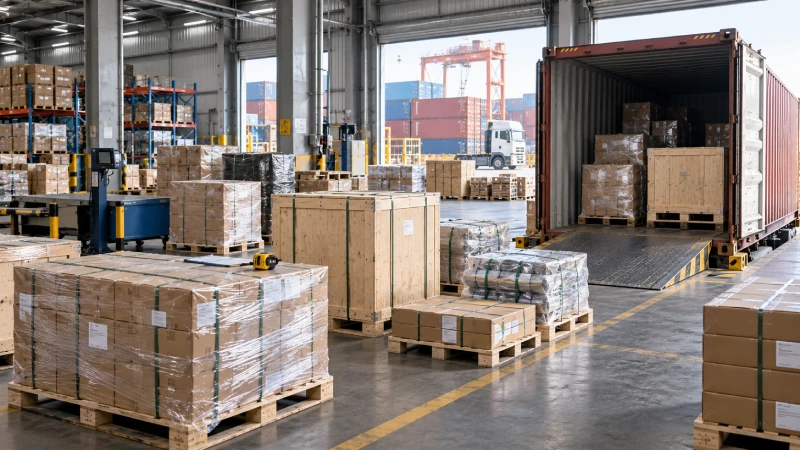
China-side consolidation is one of the most important parts of the LCL process.
It determines when your cargo can enter the planned container, which sailing it can catch and how efficiently multiple suppliers can be combined.
Supplier Pickup
If you buy under EXW or require pickup assistance, cargo first needs to move from the supplier to the nominated consolidation warehouse.
Pickup cost depends on factors such as:
- factory city
- distance to the CFS
- cargo size and weight
- truck type
- loading conditions
- whether multiple factories are involved
For example, cargo produced in Foshan may need to be trucked into a South China consolidation network before being exported through the selected gateway.
The cheapest ocean routing is therefore not automatically the cheapest origin solution.
Receiving Cargo at the CFS
Once cargo arrives at the consolidation warehouse, it may be checked for:
- number of packages
- visible packaging condition
- dimensions
- gross weight
- marks and labels
- booking details
If the physical cargo is larger or heavier than the supplier originally declared, the final freight calculation may change.
That is another reason to avoid building your landed-cost calculation solely from a preliminary packing estimate.
Consolidating Multiple Chinese Suppliers
LCL can be particularly useful when one German importer buys from several suppliers.
For example:
| Supplier | Location | Cargo |
|---|---|---|
| Supplier A | Shenzhen | Electrical components |
| Supplier B | Dongguan | Accessories |
| Supplier C | Foshan | Packaging or components |
Rather than arranging three unrelated international shipments, it may be possible to collect the cargo and combine it through one coordinated consolidation plan.
Potential advantages include:
- fewer international shipments
- better use of minimum charges
- simpler delivery planning
- coordinated customs documentation
- one consolidated international movement
But consolidation is only efficient when the suppliers are properly coordinated.
If Supplier C finishes production five days later than everyone else, you must decide whether to:
- wait for Supplier C
- ship A and B first
- move C separately
Pro Tip: Give your suppliers an internal cargo-ready deadline before the consolidator’s official warehouse cutoff. Do not plan every factory to deliver on the final cutoff day.
Main LCL Routes from China to Germany
Germany-bound LCL cargo can originate from virtually every major Chinese manufacturing region.
The best export gateway depends on the supplier location and the consolidator’s network.
| China Origin | Common Gateway | German Gateway | Typical Consideration |
|---|---|---|---|
| Shanghai / Jiangsu | Shanghai | Hamburg | Strong East China connectivity |
| Ningbo / Zhejiang | Ningbo | Hamburg | Major manufacturing and export region |
| Shenzhen / Dongguan | Yantian or Shenzhen area | Hamburg or Bremerhaven | Consolidator-dependent |
| Guangzhou / Foshan | South China gateway | Hamburg or Bremerhaven | Origin trucking and consolidation matter |
| Qingdao / Shandong | Qingdao | Hamburg or Bremerhaven | Service schedule matters |
| Xiamen / Fujian | Xiamen | Hamburg | Check direct vs indirect consolidation |
Hamburg has longstanding liner and commercial connections with major Chinese ports and acts as an important northern European logistics hub for China-related cargo. See Port of Hamburg’s China information.
Bremerhaven is likewise a major north-western European container hub, supported by rail, road and feeder connections into European markets. See bremenports container information.
For LCL cargo, however, port size alone should not determine the booking.
The consolidator’s actual CFS network is more important.
Hamburg vs Bremerhaven for LCL Cargo
Hamburg will often appear in China-Germany LCL quotations, but that does not mean every importer should automatically request Hamburg.
The correct comparison is:
| Factor | Hamburg | Bremerhaven |
|---|---|---|
| China connectivity | Very strong | Strong |
| LCL consolidation availability | Depends on consolidator | Depends on consolidator |
| Destination CFS | Must be confirmed | Must be confirmed |
| Inland Germany delivery | Postcode-dependent | Postcode-dependent |
| Transit time | Service-dependent | Service-dependent |
| Final choice | Compare complete route | Compare complete route |
Suppose your consignee is geographically closer to Bremerhaven.
That alone does not prove that Bremerhaven will be cheaper.
A consolidator may operate a better weekly LCL service into Hamburg, with lower CFS charges or stronger inland distribution.
The reverse can also happen.
The better gateway is therefore the one that produces the best combination of:
routing + schedule + destination handling + inland delivery + total cost
rather than simply the shortest distance on a map.
LCL Transit Time from China to Hamburg or Bremerhaven
“How long does LCL shipping from China to Germany take?” sounds like a simple question.
It is not.
The first thing to clarify is what the quoted transit time actually measures.
Vessel Transit Time
This usually refers mainly to the sea leg between ports.
It does not necessarily include:
- supplier pickup
- waiting for consolidation
- CFS receiving
- export processing
- German deconsolidation
- customs
- local delivery
CFS-to-CFS Transit
This is more useful for LCL because it considers the consolidation network more directly.
But it may still exclude pickup and final delivery.
Door-to-Door Lead Time
For import planning, this is usually the most relevant figure.
It measures the period from collection or shipment acceptance in China to delivery in Germany, subject to the specific quotation.
Why Published Transit Times Differ
Public booking examples illustrate the problem.
In September 2026, Flexport’s Shanghai-to-Hamburg page showed an estimated LCL transit of around 43 days, while Guangzhou-area options to Hamburg showed approximately 50-56 days, depending on the routing. These figures are booking estimates rather than guaranteed lead times, but they demonstrate how much route design can change the result.
See the current Flexport Shanghai to Hamburg rate page for an example of how quoted lead times can vary by service.
Freightos also notes that transit times vary with shipment size, location, market conditions and other disruptions.
You should therefore avoid planning inventory around a generic statement such as:
“China to Germany LCL takes 30 days.”
Instead, break the lead time into stages:
| Stage | Main Time Variable |
|---|---|
| Factory pickup | Supplier location and readiness |
| CFS receiving | Warehouse schedule |
| Consolidation | Next available groupage cutoff |
| Export handling | Documents and customs |
| Ocean transport | Vessel rotation and routing |
| Transshipment | Connection reliability |
| German discharge | Terminal operations |
| Deconsolidation | CFS workload |
| Customs | Documents and inspection |
| Delivery | Postcode and appointment |
Pro Tip: When a forwarder gives you a transit time, ask: “Is that port-to-port, CFS-to-CFS or estimated door-to-door?”
That question can prevent major inventory-planning misunderstandings.
Why LCL Shipments Can Be Delayed
LCL depends on more operational handoffs than FCL.
A delay does not necessarily mean the ocean vessel itself was late.
| Delay Source | What Can Happen | How to Reduce the Risk |
|---|---|---|
| Supplier misses cutoff | Cargo rolls to next consolidation | Set earlier factory deadline |
| Consolidation schedule | Cargo waits for planned groupage | Choose regular services |
| Vessel booking | Container rolls to later sailing | Book ahead |
| Transshipment | Connection is missed | Prefer simpler routing where practical |
| Wrong dimensions | Booking must be recalculated | Verify packing data |
| Document issue | Export or import processing stops | Pre-check documents |
| Destination CFS | Container waits for deconsolidation | Allow arrival buffer |
| Customs control | Cargo cannot be released | Prepare classification and compliance |
| Delivery booking | Warehouse appointment unavailable | Coordinate in advance |
This is why two forwarders using similar ocean carriers can still deliver very different LCL service quality.
The quality of the consolidation network and operational coordination matters.
What Happens During German Deconsolidation?
An LCL importer does not simply collect “their part” of a container from the marine terminal.
The shared container must first be processed.
A typical sequence is:
- the vessel arrives
- the container is discharged
- the container is released or transferred to the destination operation
- it moves to the relevant warehouse or CFS
- the container is opened
- individual shipments are separated
- packages are checked and matched to their HBL records
- customs and release requirements are completed
- destination charges are settled as applicable
- cargo becomes available for collection or local delivery
This process explains why the vessel ETA and the cargo-available date can differ.
It also explains why destination CFS performance matters so much for LCL.
With FCL, one importer controls the entire container.
With LCL, each shipment depends on the processing of the consolidated container first.
Customs Clearance for LCL Cargo in Germany
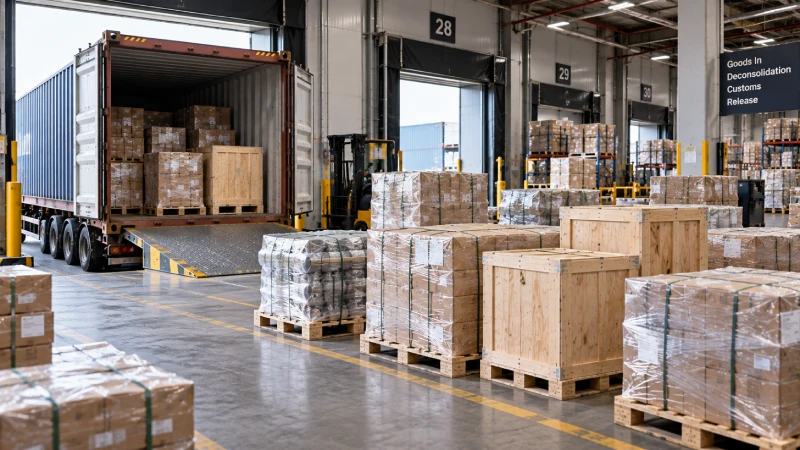
LCL does not change the fundamental obligation to comply with German and EU import requirements.
Typical commercial documentation can include:
- commercial invoice
- packing list
- House Bill of Lading
- product description
- HS classification
- customs value information
- importer details
- origin or product-specific documents where applicable
The European Commission states that an EORI number is required for customs operations in the EU customs territory for applicable economic operators. See the European Commission’s EORI guidance.
Product compliance must also be considered independently from freight transport.
Depending on the goods, this could involve requirements relating to areas such as:
- electrical safety
- CE conformity
- batteries
- chemicals
- food contact
- medical devices
- machinery
- labeling
Do not assume that because a consolidator accepts the cargo in China, the product is automatically compliant for import into Germany.
For a more detailed customs discussion, see our Customs Clearance When Shipping from China to Germany guide.
When Does FCL Become Better Than LCL?
This is where many online shipping guides become misleading.
You may see statements such as:
“Use LCL below 15 CBM and FCL above 15 CBM.”
That can be useful as a rough discussion point, but it is not a universal commercial rule.
There is no fixed CBM at which every China-Germany shipment should automatically switch from LCL to FCL.
Why There Is No Universal LCL/FCL Cutoff
Consider two shipments that are both 10 CBM.
Shipment A
- lightweight
- stackable
- standard cartons
- low CFS handling complexity
- regular direct LCL lane
Shipment B
- heavy machinery
- non-stackable crates
- expensive handling
- high cargo value
- tight delivery schedule
The physical volume is identical.
The best shipping decision may not be.
Compare the Complete LCL Cost
Your LCL calculation can include:
Chargeable W/M × applicable freight rate
plus:
- pickup
- origin CFS
- consolidation
- documentation
- surcharges
- destination CFS
- customs handling
- delivery
- special handling
Compare the Complete FCL Cost
An FCL calculation can include:
- container freight
- origin handling
- factory loading or trucking
- export charges
- terminal charges
- customs clearance
- German drayage
- applicable equipment charges
Then compare the two on the same route, cargo-ready date, Incoterm and destination.
LCL vs FCL Decision Framework
| Shipment Situation | Compare LCL | Compare FCL | Reason |
|---|---|---|---|
| Small, standard, stackable shipment | ✓ | Optional | LCL normally makes practical sense |
| Shipment volume is increasing | ✓ | ✓ | Cost crossover may be approaching |
| Dense or heavy cargo | ✓ | ✓ | W/M can increase LCL cost |
| Non-stackable pallets | ✓ | ✓ | Effective LCL space can become expensive |
| Multiple large pallets | ✓ | ✓ | Handling costs accumulate |
| Fragile machinery | ✓ | ✓ | Reduced handling may justify FCL |
| High-value cargo | ✓ | ✓ | Risk may matter more than freight alone |
| Tight delivery schedule | ✓ | ✓ | LCL adds consolidation stages |
| All-in LCL cost approaches 20GP | ✓ | Dedicated container deserves comparison |
Use the Two-Quote Test
Once your shipment is large enough that the answer is no longer obvious, request two quotations at the same time:
Option 1: Complete LCL delivered cost
Option 2: Complete 20GP FCL delivered cost
Use exactly the same:
- pickup location
- cargo
- dimensions
- weight
- cargo-ready date
- Incoterm
- destination postcode
Then evaluate:
total delivered cost + lead time + handling risk
rather than simply:
number of CBM
This is the most reliable way to decide whether your next shipment should remain LCL or move to FCL.
For more detail, see our FCL Shipping from China to Germany guide.
Why the Cheapest LCL Quote May Not Be the Cheapest Shipment
A very low ocean freight rate can attract attention.
But the base rate does not tell you what you will ultimately pay.
A cheaper quotation may involve:
- higher German destination charges
- indirect consolidation routing
- higher minimum handling fees
- expensive delivery
- less favorable CFS terms
- a longer consolidation cycle
- transshipment
- incomplete destination-charge disclosure
Carrier surcharges also change over time. Quote validity dates and surcharge inclusions should therefore always be checked.
Before choosing an LCL quotation, compare these questions:
| Question | Why It Matters |
|---|---|
| What is the exact W/M rule? | Determines chargeable quantity |
| What minimums apply? | Critical for smaller shipments |
| Are origin CFS charges included? | Prevents unexpected China charges |
| Are German CFS charges included? | Major LCL cost factor |
| Where is the destination CFS? | Affects handling and delivery |
| Is the routing via Hamburg or Bremerhaven? | Affects route planning |
| Is the service direct or transshipment? | Affects schedule risk |
| How often does the consolidation depart? | Affects waiting time |
| Which surcharges are excluded? | Prevents quote surprises |
| Is final German delivery included? | Required for true comparison |
A low per-CBM rate with unclear destination costs is not necessarily a good quotation.
Fragile Cargo Risks in LCL Shipping
LCL cargo is normally handled more times than FCL cargo.
A shipment may be moved during:
- supplier loading
- China CFS receiving
- warehouse handling
- container stuffing
- destination deconsolidation
- German CFS handling
- final delivery
For robust standard commercial cargo, this is normally manageable.
For fragile cargo, packaging becomes much more important.
| Cargo Risk | Recommended Control |
|---|---|
| Fragile goods | Export-grade cushioning or crating |
| Machinery | Strong skid or timber base where suitable |
| Electronics | Moisture and anti-static protection where required |
| High-value products | Secure and tamper-conscious packaging |
| Cartons | Palletize where commercially appropriate |
| Non-stackable cargo | Declare before booking |
| Odd-shaped equipment | Confirm dimensions and handling |
| Moisture-sensitive cargo | Consider barrier protection or desiccants |
Do Not Misdeclare Non-Stackable Cargo
If nothing can safely be placed on top of your pallet or crate, tell the forwarder before the quotation is finalized.
Non-stackable freight can consume significantly more usable container space than its physical CBM suggests.
Some LCL tariffs therefore apply specific handling or pricing adjustments to non-stackable cargo.
Pro Tip: Never describe cargo as stackable simply to reduce the quoted LCL price. Saving on the booking is not worth increasing the risk of cargo damage.
Is LCL Suitable for High-Value Cargo?
High cargo value does not automatically mean LCL is unsuitable.
But the decision should involve more than transport price.
Consider:
- packaging quality
- theft exposure
- sensitivity to impact
- number of handling stages
- insurance
- traceability requirements
- delivery urgency
- consequence of loss or damage
- price difference between LCL and FCL
| Cargo Type | General LCL Consideration |
|---|---|
| Well-packed standard commercial goods | Normally suitable |
| High-value components in strong crates | Assess case by case |
| Precision equipment | Compare LCL and FCL |
| Fragile loose cartons | Improve packaging before shipping |
| Cargo with severe consequence of damage | Dedicated transport may be preferable |
A shipment can be physically small enough for LCL while commercially important enough to justify FCL.
The cheapest freight option is not automatically the lowest-risk supply-chain decision.
How to Reduce LCL Shipping Costs Without Increasing Risk
The best savings usually come from improving the shipment before it enters the freight network.
First, make sure your supplier provides accurate final dimensions and gross weight.
Second, coordinate multiple suppliers where consolidation genuinely reduces duplicated shipments and minimum charges.
Third, review packaging efficiency. Large amounts of empty space can increase chargeable CBM.
Fourth, confirm whether cargo is genuinely stackable. Do not sacrifice safe packaging simply to reduce volume.
Fifth, book early enough to meet the correct consolidation cutoff.
Sixth, compare German destination charges rather than comparing only ocean freight.
Seventh, choose the China CFS and German gateway according to the complete route rather than port name alone.
Eighth, prepare customs documents before arrival to reduce the risk of storage.
Finally, as cargo grows, compare LCL with FCL again.
A shipping method that was ideal when you imported 3 CBM may no longer be ideal when the same order grows substantially.
What Information Is Needed for an Accurate LCL Quote?
An accurate LCL quotation requires more information than simply saying:
“I have 5 CBM from China to Germany.”
At minimum, provide:
Cargo Information
- commodity
- number of cartons, crates or pallets
- dimensions of each package type
- total gross weight
- total CBM
- cargo value
- stackable or non-stackable
- dangerous goods status
- packaging method
China Information
- supplier or factory address
- number of suppliers
- cargo-ready date
- applicable Incoterm
Germany Information
- destination postcode
- business or residential delivery
- unloading facilities
- forklift or loading dock availability where relevant
- customs clearance requirement
Helpful Supporting Information
Where available, also provide:
- HS code
- packing list
- product photos
- previous shipping documents
- product compliance information
The more accurate the input data, the more useful the comparison between different LCL services will be.
Shipping Less Than a Container from China to Germany?
If your cargo does not justify a dedicated container, the right question is not just how much the ocean freight costs per CBM.
You need to know:
- the chargeable W/M
- China pickup and consolidation cost
- origin CFS charges
- the actual sailing and consolidation schedule
- whether Hamburg or Bremerhaven provides the better route
- German deconsolidation and CFS costs
- customs requirements
- final delivery cost
- whether FCL has become commercially more attractive
Send us your:
commodity + supplier city + cartons/pallets + dimensions + gross weight + cargo-ready date + German postcode
and we can assess the practical LCL route from China to Germany.
FAQ
What is LCL shipping from China to Germany?
LCL, or Less than Container Load, is an ocean-freight method in which your cargo shares container space with shipments belonging to other importers. Your goods are normally received at a Chinese CFS, consolidated into a container, transported to Germany and then deconsolidated before customs clearance and delivery.
Is LCL the same as groupage freight?
In most practical shipping discussions, yes. LCL is the standard ocean-freight term, while groupage is frequently used in European logistics to describe smaller shipments grouped together for transport.
How is LCL freight from China to Germany charged?
Ocean LCL commonly uses Weight or Measurement, or W/M. Under a common 1:1 basis, 1 CBM is compared with 1,000 kg and the greater chargeable quantity is used. Final costs can also include pickup, CFS handling, documentation, deconsolidation, customs brokerage and German delivery.
Is there a minimum charge for LCL shipping?
Often, yes. LCL freight, CFS handling, pickup, documentation or delivery may have minimum charges even when the physical shipment is very small. Confirm the minimum separately for ocean freight, China origin charges and German destination charges.
How long does LCL shipping from China to Hamburg take?
There is no single fixed transit time. It depends on the Chinese origin, consolidation schedule, vessel routing, transshipment, German deconsolidation and whether the quoted time is port-to-port, CFS-to-CFS or door-to-door.
Is Hamburg or Bremerhaven better for LCL shipments from China?
Neither port is automatically better. Compare the consolidatoru0026#x27;s service frequency, routing, destination CFS, handling charges, transit time and inland cost to your German postcode.
At how many CBM should I switch from LCL to FCL?
There is no universal CBM cutoff. As cargo volume increases, compare an all-in LCL quotation with an all-in 20GP FCL quotation for the same origin, cargo-ready date, Incoterm and German destination.
Is LCL safe for fragile or high-value cargo?
It can be, but LCL normally involves more handling than FCL. Fragile or valuable cargo should use packaging designed for repeated warehouse and container handling, and higher-risk shipments should also be compared with FCL from a cost and risk perspective.
