
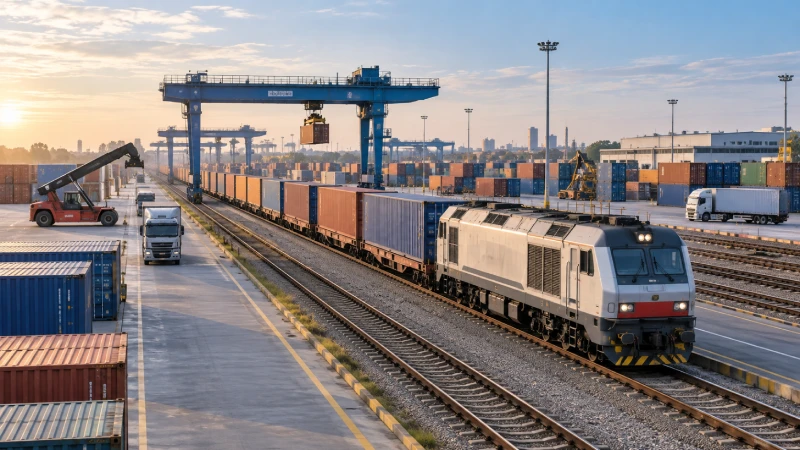
Rail freight from China to Germany sits between sea and air freight in both speed and cost. It can be a practical option when ocean shipping is too slow for your inventory plan, but air freight is too expensive for the shipment value, weight, or volume.
For German importers, Duisburg is one of the most important China-Europe rail gateways. Regular services connect major Chinese logistics hubs such as Xi’an, Chengdu, Chongqing, Zhengzhou, Wuhan, and Yiwu with European rail terminals, followed by customs procedures and onward delivery to destinations across Germany.
However, rail freight should not be treated as a guaranteed “12-day China-to-Germany” service.
Published railway schedules, actual train performance, consolidation time, border transfers, customs procedures, terminal congestion, and final truck delivery can produce very different lead times. DB Cargo currently publishes Xi’an-Duisburg at about 15-17 days and Yiwu-Duisburg at about 18-20 days for its standard China-Europe rail services, while premium timetable products can advertise shorter scheduled transit. Actual train data can be slower, which is why importers should separate scheduled rail transit from complete door-to-door lead time.
This guide explains how rail freight from China to Germany works, when it makes sense, the main routes and terminals, LCL and FCL options, realistic transit times, cost positioning, customs procedures, cargo suitability, and the corridor risks importers should consider before booking.
If you are comparing all available transport modes, start with our Shipping from China to Germany guide for an overview of sea freight, air freight, rail, express, DDP, and door-to-door options.
Quick Answer: When Does Rail Freight from China to Germany Make Sense?
Rail freight usually makes sense when your cargo needs to reach Germany faster than normal ocean freight but does not justify the cost of air freight.
It is particularly useful for industrial components, machinery, automotive parts, electronics, seasonal inventory, e-commerce replenishment, and other medium-to-high-value goods where losing several weeks in transit could create stock shortages or production delays.
The strongest use case is not simply “rail is faster than sea.” The real question is whether the value of saving time is greater than the additional freight cost.
| Shipping Situation | Rail Freight Fit | Usually Better Alternative |
|---|---|---|
| Inventory required within roughly 3-5 weeks | Excellent | — |
| Machinery or industrial components | Excellent | Rail FCL/LCL |
| Automotive parts for production | Excellent | Rail or air |
| 3-15 CBM commercial shipment | Good | Rail LCL |
| Large time-sensitive container shipment | Good | Rail FCL |
| High-value electronics | Good | Rail or air |
| Extremely urgent spare parts | Poor | Air freight |
| Low-value, non-urgent cargo | Poor | Sea freight |
| Heavy bulk cargo | Usually poor | Sea freight |
| Oversized project cargo | Case-by-case | Sea/project logistics |
| Controlled or sanctions-sensitive cargo | Case-by-case | Compliance review required |
Rail should therefore be evaluated as a time-cost compromise, rather than as a replacement for every sea or air shipment.
Pro Tip: Start with the required delivery date, not the transport mode. If sea freight can still meet your deadline, paying extra for rail may not create enough value. If even rail is too slow, move only the urgent portion by air and send the balance by rail or sea.
Check If Rail Fits Your Shipment
Send your cargo type, dimensions, weight, pickup city in China, cargo-ready date, and German delivery postcode. The shipment can then be compared across rail, sea, and air on the same delivery scope.
How Does Rail Freight from China to Germany Work?
China-Germany rail freight is not one uninterrupted train running from a Chinese factory directly to a German warehouse.
It is a multi-stage international transport chain involving trucking, rail terminals, different railway networks, border transshipment, customs procedures, and usually final-mile road delivery.
A typical northern-corridor shipment may follow this sequence:
Chinese supplier → pickup by truck → China rail terminal → export customs → China-Kazakhstan border → Kazakhstan → Russia → Belarus → Brest/Małaszewicze → EU rail network → Duisburg or another terminal → customs/transit procedures → final delivery in Germany
Why Are Containers Transferred Between Trains?
One important difference between China-Europe rail freight and domestic rail transport is railway gauge.
China and most of the European Union use standard-gauge track of approximately 1,435 mm, while Kazakhstan, Russia, and Belarus largely use the broader 1,520 mm railway gauge.
Containers therefore need to be transferred between wagons at gauge-change points.
On the traditional China-Europe route, important transfer areas include:
- Alashankou/Dostyk or Khorgos/Altynkol between China and Kazakhstan
- Brest/Małaszewicze between Belarus and Poland
This is why the phrase “direct train from China to Germany” needs context. It normally means a coordinated through service under one route or operating plan, not that one wagon physically travels from China to Duisburg without handling.
Pro Tip: For machinery, electronics, glass, precision parts, and other damage-sensitive goods, packaging should account for terminal lifting and cross-border container handling, not only normal rail vibration.
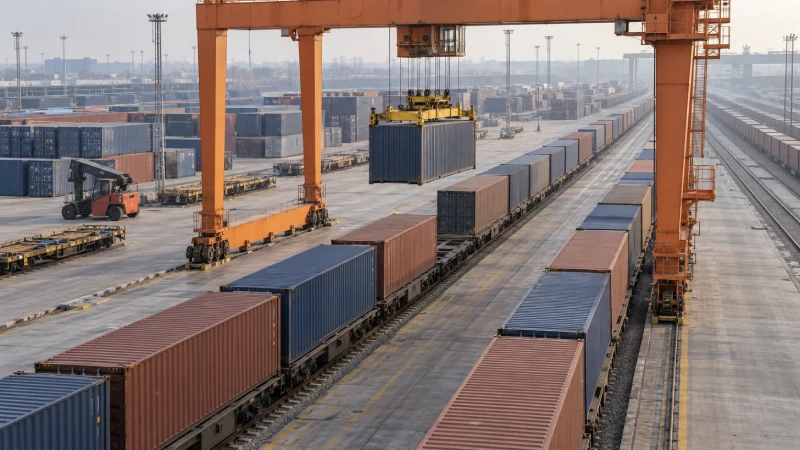
Main Rail Freight Routes from China to Germany
There is no single railway corridor used for every China-Germany shipment.
The two route concepts importers increasingly need to understand are the traditional northern corridor and the Trans-Caspian, or Middle Corridor.
Northern Corridor via Kazakhstan, Russia, Belarus and Poland
The traditional route commonly follows:
China → Kazakhstan → Russia → Belarus → Poland → Germany
Depending on the departure hub, cargo normally exits China through Alashankou/Dostyk or Khorgos/Altynkol, crosses Kazakhstan and Russia, enters Belarus, and then reaches the EU railway network through the Brest-Małaszewicze area.
From Poland, trains can continue towards Germany, including Duisburg.
This corridor remains commercially important because it has:
- established railway infrastructure;
- high historical train volumes;
- mature terminal procedures;
- established China-Europe operators;
- relatively frequent departures on major routes;
- fewer maritime interfaces than the Middle Corridor.
DB Cargo Eurasia currently publishes Xi’an-Duisburg at approximately 15-17 days and Yiwu-Duisburg at approximately 18-20 days on its China-Europe services.
The important issue is geopolitical exposure.
Cargo travelling through Russia and Belarus may require additional sanctions screening, commodity checks, customer and end-user screening, and operator approval.
Rail freight through these countries is not automatically prohibited simply because the route passes through them. However, EU restrictions apply to specific goods, technologies, entities, and transit activities. Sensitive cargo should therefore be checked against current EU legal requirements before booking.
When the Northern Corridor Makes Sense
It may remain suitable when:
- the commodity is accepted;
- sanctions screening is clear;
- the train operator accepts the shipment;
- the current border situation is stable;
- transit time is commercially attractive;
- the importer is comfortable with the geopolitical exposure.
For regulated, dual-use, advanced industrial, electronics, chemical, or potentially controlled products, routing should be checked before cargo is collected.
Trans-Caspian / Middle Corridor
The Trans-Caspian International Transport Route, often called the Middle Corridor, provides an alternative route between China and Europe that avoids Russia and Belarus.
A typical route may run:
China → Kazakhstan → Aktau/Kuryk → Caspian Sea → Azerbaijan → Georgia → Türkiye and/or Black Sea connections → Europe
It is important to understand that this is not simply another continuous railway.
The corridor combines multiple modes:
- rail;
- port handling;
- Caspian Sea vessel transport;
- railway transfer;
- additional border procedures;
- and, depending on the service, another maritime or road connection into Europe.
The World Bank’s Middle Corridor analysis describes the route as a multimodal rail and maritime corridor linking Chinese and European markets through Kazakhstan, Azerbaijan, and Georgia. It also identifies infrastructure, port capacity, railway capacity, digitalization, and coordination as areas requiring continued improvement.
Development is accelerating, but the Middle Corridor should not automatically be described as faster or more reliable than the northern route.
Its challenges can include:
- more transport handoffs;
- port waiting time;
- ferry availability on the Caspian;
- changing weather conditions;
- lower overall capacity;
- railway bottlenecks;
- multiple customs jurisdictions;
- greater coordination requirements.
Northern Corridor vs Middle Corridor
| Factor | Northern Corridor | Middle Corridor |
|---|---|---|
| Typical routing | Kazakhstan-Russia-Belarus-Poland | Kazakhstan-Caspian-Azerbaijan-Georgia-Türkiye/Europe |
| Russia/Belarus exposure | Yes | No |
| Infrastructure maturity | Higher | Developing rapidly |
| Maritime segment | Usually no | Yes |
| Number of handoffs | Lower | Higher |
| Capacity | Generally higher | Growing |
| Schedule predictability | Strong on established services, but politically exposed | More operationally variable |
| Geopolitical risk | Russia/Belarus/Poland corridor | Different regional risks |
| Main advantage | Mature mainline network | Avoids Russia and Belarus |
| Best use | Mainstream accepted cargo | Routing diversification / Russia avoidance |
For many importers, the correct question is no longer simply “Which rail route is fastest?”
A better question is:
Which route is currently operating, accepts the commodity, meets the compliance requirements, and offers an acceptable combination of transit time, cost, and disruption risk?
Why Corridor Risk Matters
Rail freight can be relatively predictable when its corridor is operating normally, but the land route is concentrated around critical borders and terminals.
That creates a different type of risk from sea freight.
Poland-Belarus Border Disruption
The Brest-Małaszewicze corridor is strategically important for China-Europe rail freight entering the European Union.
In September 2025, Poland temporarily closed its border crossings with Belarus during heightened security concerns. Freight railway movements were interrupted before crossings reopened later that month. The episode demonstrated how a political or security decision at one border can temporarily affect a large amount of rail capacity.
The lesson is not that the route is permanently closed. The lesson is that a concentrated land corridor can be disrupted quickly.
A realistic China-Germany rail plan therefore needs:
- schedule buffer;
- route confirmation before booking;
- cargo compliance screening;
- an alternative mode for genuinely critical shipments.
Sanctions and Compliance Risk
The fact that a train transits Russia or Belarus does not automatically make the shipment illegal.
However, depending on the HS code, technical specification, consignee, end user, and transaction structure, restrictions can apply.
Importers and exporters should therefore check:
- commodity classification;
- dual-use status;
- sanctions lists;
- restricted end users;
- applicable transit prohibitions;
- carrier acceptance;
- insurance and banking restrictions.
Do not wait until the container reaches the rail terminal to discover that the selected corridor cannot accept the cargo.
Main Rail Freight Hubs in China
China-Europe Railway Express services operate through a wide inland network rather than through one single “China rail port.”
Major consolidation and departure hubs include Xi’an, Chengdu, Chongqing, Zhengzhou, Wuhan, and Yiwu.
The best terminal depends on supplier location, weekly schedules, cargo type, rate, available space, and destination.
| China Rail Hub | Main Catchment | Typical Strength |
|---|---|---|
| Xi’an | Northwest and nationwide consolidation | High-frequency Europe services |
| Chengdu | Sichuan / Western China | Electronics and manufacturing |
| Chongqing | Southwest China | Automotive and electronics |
| Zhengzhou | Central China | Broad manufacturing catchment |
| Wuhan | Central China | Automotive and industrial cargo |
| Yiwu | Zhejiang / East China | Consumer goods and LCL |
| Shanghai / Suzhou region | Yangtze River Delta | Feeder/truck connection to rail hubs |
| Shenzhen / Guangzhou | South China | Domestic pre-carriage to departure terminals |
DB Cargo’s current network lists Chinese locations including Shanghai, Xi’an, Wuhan, Qingdao, Tianjin, Shenzhen, Ningbo, and Yiwu.
That does not mean every listed Chinese city has a direct Duisburg train on every departure date.
For example, cargo manufactured in Shenzhen may be collected by truck and moved to a designated inland rail terminal before joining the international train.
Similarly, a supplier near Shanghai does not automatically mean Shanghai itself is the best international rail departure terminal.
How to Choose the Departure Hub
Consider:
- distance from the supplier;
- domestic pickup cost;
- actual cargo-ready date;
- next available train;
- LCL consolidation schedule;
- commodity restrictions;
- destination terminal;
- current rail rate;
- expected corridor performance.
Choosing a farther terminal with a confirmed departure can sometimes produce a shorter total lead time than waiting several days for a theoretically closer service.
Duisburg: Germany’s Main China-Europe Rail Gateway
Duisburg plays a central role in China-Germany rail freight because it combines rail infrastructure with road, inland waterway, warehousing, container handling, and onward European distribution.
The Port of Duisburg reports more than 400 weekly intermodal train connections to around 100 national and international destinations.
This makes Duisburg particularly useful for cargo destined for:
- Düsseldorf;
- Cologne;
- Essen;
- Dortmund;
- the Rhine-Ruhr industrial region;
- Frankfurt;
- western Germany;
- neighbouring European markets.
What Happens When the Train Reaches Duisburg?
Depending on the shipment structure, the container may undergo:
- terminal discharge;
- transit-document processing;
- customs clearance or onward customs transit;
- LCL deconsolidation, if applicable;
- container release;
- final truck delivery.
For FCL cargo, the container can often continue by truck after release.
For LCL, cargo generally needs to be unloaded at a consolidation/deconsolidation facility before individual shipments are delivered.
Other German Rail Destinations
Duisburg is important, but it is not the only possible German logistics point.
Depending on the operator and schedule, services or onward rail connections may involve:
- Hamburg;
- Munich or southern Germany;
- other European terminals followed by trucking into Germany.
Cargo can also enter the EU at a terminal outside Germany and continue under customs transit or commercial onward transport.
Do not assume the city closest to the consignee must be the international train’s destination.
A Duisburg arrival followed by road delivery can sometimes be more practical than waiting for a lower-frequency rail connection to another German terminal.
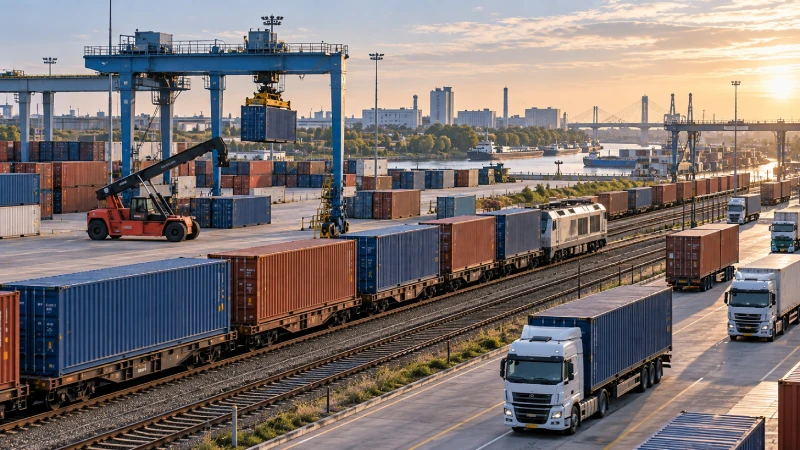
Rail LCL vs FCL from China to Germany
Both LCL and FCL rail freight are available on many China-Germany routes.
The correct choice depends on cargo volume, weight, schedule, handling requirements, and current pricing.
Rail LCL
LCL, or Less than Container Load, means your cargo shares a railway container with shipments from other customers.
A typical rail LCL process is:
supplier pickup → China consolidation warehouse → container loading → international rail → European CFS/deconsolidation → customs/release → final delivery
Rail LCL can work well for:
- several pallets;
- machinery components;
- commercial spare parts;
- electronics;
- regular inventory replenishment;
- shipments too large for economical air freight but too small for FCL.
The main advantage is that you do not pay for an entire container.
However, LCL adds operational steps.
Your freight may need to wait for:
- cargo consolidation;
- scheduled container closing;
- railway departure;
- destination deconsolidation.
That means LCL transit time should not be measured only from the day the train leaves China.
Rail FCL
FCL, or Full Container Load, means one shipper uses the container exclusively.
For China-Europe rail freight, 40-foot and 40HQ containers are widely used, although actual equipment options depend on the operator and route.
DB Cargo currently lists both carrier-owned containers (COC) and shipper-owned containers (SOC) within its China-Europe service.
FCL works well for:
- larger shipment volumes;
- high-value machinery;
- regular production cargo;
- goods requiring less handling;
- shipments where LCL pricing approaches the cost of a complete container.
| Factor | Rail LCL | Rail FCL |
|---|---|---|
| Container | Shared | Dedicated |
| Pricing | Usually CBM/chargeable basis | Per container |
| Best for | Small-medium cargo | Larger shipments |
| Consolidation required | Yes | No |
| Cargo handling | More | Less |
| Departure | Consolidation dependent | Schedule dependent |
| Destination process | Deconsolidation required | Container release |
| Damage exposure | More handling points | Fewer handling points |
| Main advantage | No need to fill a container | Control and lower unit cost at volume |
Pro Tip: Do not use a fixed rule such as “15 CBM means LCL and 16 CBM means FCL.” Ask for both prices once the shipment becomes substantial. Railway line-haul, terminal fees, minimum charges, cargo density, and available equipment can change the real break-even point.
Terminal-to-Terminal vs Door-to-Door Rail Freight
When comparing rail freight prices, always check where the quoted service starts and ends.
A cheap terminal-to-terminal quote cannot be fairly compared with a door-to-door quote.
| Service | Typical Scope |
|---|---|
| Terminal-to-terminal | China rail terminal to German/European rail terminal |
| Door-to-terminal | China supplier pickup through destination rail terminal |
| Terminal-to-door | Origin terminal through final German address |
| Door-to-door | Pickup in China through delivery to German consignee |
Door-to-door can include:
- supplier pickup;
- China export handling;
- export customs;
- international rail freight;
- European terminal handling;
- customs brokerage coordination;
- final truck delivery.
But door-to-door does not automatically mean DDP.
Under DAP or another arrangement, the German importer may still be responsible for customs duty, import VAT, and importer-of-record obligations.
Under DDP, the seller or logistics structure takes on additional import responsibilities, but whether DDP is legally and operationally suitable must be checked shipment by shipment. For the broader service structure, see DDP Shipping from China and Door-to-Door Shipping from China.
Always ask:
Does this price include customs duty and German import VAT, or only customs clearance service?
Those are very different things.
How Long Does Rail Freight from China to Germany Take?
A realistic planning answer is:
Rail freight can take around 15-25+ days terminal-to-terminal on major China-Germany routes, while complete door-to-door shipments often require roughly 22-35 days. Actual performance depends heavily on the departure hub, train product, consolidation, borders, and final delivery.
That is more useful than claiming one fixed transit time.
Published Rail Schedules
DB Cargo currently publishes:
| Route | Published Transit |
|---|---|
| Xi’an → Duisburg | Approx. 15-17 days |
| Yiwu → Duisburg | Approx. 18-20 days |
| Premium timetable products | Can be shorter on specific scheduled services |
These are valid operator schedule references, but they should not be presented as a universal China-Germany delivery time.
What Does Real Train Performance Look Like?
Actual shipment data shows the difference between published schedules and observed arrivals.
As of September 11, 2026, a public operational dataset covering recent Chengdu-Duisburg movements reported:
- 116 trains over the last 90 days;
- average station-to-station transit of about 25.9 days;
- fastest recorded transit of 17 days;
- 90% arriving within 33 days;
- latest 10 trains averaging 20.7 days, with a range of 18-25 days.
The same dataset showed Chengdu-Małaszewicze moving faster on average because Małaszewicze is the first major EU-side gateway rather than the final German terminal. See the China-Europe Rail Transit Times dataset for the current figures.
This illustrates why advertised rail schedules and observed end-to-end railway performance should be treated separately.
What Adds Time Before and After the Train?
A complete shipment includes more than the international train journey.
| Stage | Possible Time Impact |
|---|---|
| Supplier pickup | Depends on factory location |
| LCL consolidation | May add several days |
| Export declaration | Documentation dependent |
| Waiting for train cut-off | Schedule dependent |
| International rail journey | Main component |
| China/Kazakhstan transshipment | Operational |
| Brest/Małaszewicze transfer | Possible bottleneck |
| EU customs transit | Service dependent |
| German terminal release | Congestion/document dependent |
| LCL deconsolidation | Additional handling |
| German final delivery | Usually 1-several days |
For planning purposes, a shipment that is genuinely required at a German warehouse in 25 days should not be booked on the assumption that a “17-day train” leaves the moment the factory finishes production.
Pro Tip: Ask your forwarder exactly what the quoted transit time measures: terminal departure to terminal arrival, warehouse pickup to terminal arrival, or complete door-to-door delivery. A quote that simply says “18 days” is incomplete.
For a broader comparison across all modes, see How Long Does Shipping from China to Germany Take?.
How Much Does Rail Freight from China to Germany Cost?
Rail freight generally costs more than sea freight and less than air freight.
But there is no reliable permanent rate such as:
“China to Germany rail costs USD X per container.”
Rates change with:
- departure terminal;
- destination terminal;
- train product;
- LCL/FCL;
- cargo weight;
- cargo type;
- SOC versus COC container;
- available capacity;
- seasonal demand;
- corridor selection;
- terminal charges;
- final delivery location.
2026 Market Position
A published August 2026 Xi’an-Europe rate card illustrates the market position of rail freight rather than establishing a universal rate.
For Xi’an-Duisburg, it listed approximately:
- USD 185/CBM for LCL;
- USD 8,200 per 40′ SOC on a public train;
- USD 8,600 per 40′ SOC on a timetable train.
The same rate card stated that the rates were valid only for August 2026 and that service scope and surcharges varied. See the August 2026 China-Europe rail rate card for the underlying example.
These values should not be treated as permanent Winsail pricing. The real quotation depends on the cargo-ready date, equipment ownership, train product, origin, destination, cargo type, and included terminal services.
For a long-term comparison, the more useful view is cost positioning:
| Mode | Cost Position | Main Pricing Basis |
|---|---|---|
| Sea LCL | Low | CBM / W/M |
| Sea FCL | Low for large shipments | Per container |
| Rail LCL | Medium | CBM / chargeable basis |
| Rail FCL | Medium | Per container |
| Air freight | High | Chargeable kg |
| Express courier | Highest for larger cargo | Chargeable kg |
What Determines Your Rail Freight Quote?
Pickup location in China
A supplier in Chengdu and a supplier in Shenzhen may use very different pre-carriage arrangements.
Departure terminal
Two Chinese rail hubs can have different rates and departure frequencies for the same German destination.
LCL or FCL
LCL is normally volume-based or chargeable-weight based, while FCL is quoted per container.
Container ownership
SOC and COC equipment can have different pricing and return requirements.
Cargo density
Very heavy cargo may not be priced purely by CBM.
Commodity
Batteries, chemicals, high-value electronics, oversized cargo, and special commodities may need additional approval or incur extra fees.
Destination
Delivery to a warehouse near Duisburg can cost less than onward delivery to southern or eastern Germany.
Customs and tax scope
Customs brokerage fees are not the same as import duty and VAT.
What Should a Good Rail Quote Show?
At minimum:
- China pickup;
- origin terminal;
- rail route;
- LCL/FCL;
- container type;
- rail freight;
- origin terminal charges;
- destination terminal charges;
- customs-clearance fee;
- final delivery;
- insurance, if requested;
- estimated schedule;
- exclusions;
- rate validity.
For a wider cost comparison across modes, see Shipping Cost from China to Germany.
Compare Rail, Sea & Air Costs
Send the cargo dimensions, gross weight, pickup city, cargo-ready date, and German delivery postcode. Compare the modes using the same pickup and delivery scope rather than comparing unrelated headline freight rates.
Customs and Transit Procedures for China-Germany Rail Freight
International rail freight crosses multiple borders, but the cargo is not necessarily formally imported into every country it passes through.
The shipment moves under relevant customs and railway transit procedures until it reaches the appropriate place for import clearance.
China Export Customs
Typical documents include:
- commercial invoice;
- packing list;
- HS code;
- sales or transport information where required;
- shipper and consignee details;
- export declaration;
- commodity-specific permits or certificates.
For regulated goods, additional documents may be required before the railway operator accepts the booking.
Common examples include:
- batteries;
- chemicals;
- dangerous goods;
- medical products;
- food-related products;
- machinery with controlled technologies.
Accurate documentation is especially important for rail because correcting a document after a container reaches a cross-border terminal can cause significant delay.
Customs Transit After Entering the European Union
When non-EU goods enter the EU, they do not necessarily need to be released for free circulation at the first border.
EU customs transit procedures can allow goods to continue from the entry point to a customs destination elsewhere while duties, taxes, and certain commercial-policy measures remain temporarily suspended.
For example, depending on the logistics arrangement, cargo entering through Poland may continue under transit before final customs clearance in Germany.
This distinction is important.
It means:
entering the EU in Poland does not automatically mean the shipment must be fully imported into Poland.
The actual procedure should be confirmed with the customs broker and rail operator.
Import Clearance in Germany
For commercial imports into Germany, the importer and customs broker should normally prepare for:
- EORI details;
- correct HS classification;
- customs value;
- commercial invoice;
- packing list;
- country of origin;
- applicable customs duty;
- import VAT;
- product-specific conformity requirements;
- licences or certificates where applicable.
German Customs provides official guidance on import procedures and customs requirements.
Germany’s standard import VAT rate is generally 19%, while certain goods qualify for a reduced rate. Customs duty depends on the product’s tariff classification, origin, and applicable trade measures.
Do not calculate the landed cost from the freight rate alone. Customs value, duty, import VAT, brokerage, terminal handling, and delivery can materially change the total.
What Cargo Is Suitable for Rail Freight?
Rail works best for cargo with enough value or urgency to justify paying more than sea freight, but not enough urgency to justify air freight.
| Cargo | Rail Suitability | Notes |
|---|---|---|
| Machinery | Excellent | Good time/cost balance |
| Automotive parts | Excellent | Useful for production schedules |
| Industrial components | Excellent | Common replenishment cargo |
| Electronics | Good | Battery/compliance checks may apply |
| Consumer goods | Good | Especially seasonal stock |
| E-commerce inventory | Good | Useful for replenishment |
| Textiles | Good | When sea is too slow |
| High-value equipment | Good | Consider cargo insurance |
| Lithium batteries | Case-by-case | Operator acceptance required |
| Dangerous goods | Case-by-case | Classification and corridor dependent |
| Chemicals | Case-by-case | Documents/acceptance required |
| Oversized machinery | Case-by-case | Loading gauge and terminal constraints |
| Low-value bulk goods | Poor | Sea usually more economical |
| Extremely urgent spare parts | Poor | Air usually better |
| Perishable cargo | Specialist only | Temperature and lead-time risk |
Batteries and Dangerous Goods
Do not assume all dangerous goods are banned from China-Europe rail freight.
Equally, do not assume that because one operator accepts a commodity, every service will accept it.
Acceptance can depend on:
- UN number;
- hazard class;
- battery configuration;
- packaging;
- MSDS;
- transport appraisal;
- departure terminal;
- transit country;
- train operator;
- destination terminal.
Always provide complete commodity information before requesting the final rate.
If a battery or chemical shipment is booked as “general cargo” and later fails terminal inspection, both cost and delay can increase significantly.
Main Risks of Rail Freight from China to Germany
Rail is not inherently unreliable, but its risk profile is different from both sea and air freight.
A good shipping decision accounts for these risks before the container is loaded.
| Risk | Possible Impact | Mitigation |
|---|---|---|
| Russia/Belarus geopolitical change | Routing or compliance problems | Confirm corridor before booking |
| Poland-Belarus restrictions | Border delay / backlog | Add schedule buffer |
| Małaszewicze congestion | Slower onward movement | Do not promise minimum transit |
| Gauge-change handling | Extra handling | Strong packaging |
| Missed rail cut-off | Multi-day delay | Confirm cargo-ready date |
| LCL consolidation | Delayed departure | Check actual closing date |
| Customs error | Hold or inspection | Pre-check documents |
| Sanctions-sensitive commodity | Booking rejection | Screen before pickup |
| Battery/DG acceptance | Cargo refused | Obtain operator approval |
| Middle Corridor ferry delay | Variable transit | Build additional buffer |
| Peak-season capacity | Higher rates / rollover | Book earlier |
| Final-mile trucking | Delivery delay | Confirm appointment requirements |
Reliability Should Be Measured Against Your Deadline
Suppose a German manufacturer needs components within 30 days.
A 20-25 day rail solution may be commercially attractive even if the train occasionally experiences several days of variation.
But if those components must arrive within 12 days to prevent production shutdown, rail may be too risky even when an operator advertises a short premium timetable.
In that situation, air freight may be the correct choice.
Reliability therefore means:
the probability of meeting your required delivery date, not whether a marketing page advertises the fastest possible transit time.
Pro Tip: For production-critical cargo, calculate the cost of running out of stock. A rail shipment that costs more than sea freight may still reduce total supply-chain cost if it avoids an expensive production delay.
Sea vs Rail vs Air Freight from China to Germany
For most commercial shipments, these are the three modes that should be compared.
The correct method depends on the required delivery date, cargo value, shipment size, inventory level, and logistics budget.
| Factor | Sea Freight | Rail Freight | Air Freight |
|---|---|---|---|
| Speed | Slowest | Medium | Fastest |
| Typical door-to-door planning | ~35-55+ days | ~22-35+ days | ~5-10 days |
| Cost | Lowest | Medium | Highest |
| LCL | Yes | Yes | Charged by weight/volume |
| FCL | Yes | Yes | Not applicable |
| Best cargo size | Large/heavy | Medium to container loads | Small-medium urgent cargo |
| Best cargo value | Low-medium | Medium-high | High |
| Main gateway | Hamburg/Bremerhaven etc. | Duisburg / rail terminals | Frankfurt/Munich etc. |
| Main advantage | Lowest transport cost | Time-cost balance | Speed |
| Main weakness | Long lead time | Corridor complexity | High cost |
These are planning ranges, not guaranteed transit times.
Actual sea transit can vary due to port rotation, transshipment, vessel schedules, maritime disruptions, and final delivery.
Actual rail transit can vary due to train product, border transfers, corridor conditions, and terminal congestion.
Actual air transit can vary based on uplift capacity, routing, customs, and airport handling.
Choose Sea Freight When Cost Matters Most
Sea freight is usually the better option when:
- cargo is large or heavy;
- product value is relatively low;
- there is enough inventory;
- the delivery date is flexible;
- freight cost per unit matters more than speed.
A full container of furniture, packaging products, building materials, or other non-urgent cargo will usually be more economical by sea.
Rail should not be selected simply because it is faster if the business gains nothing from the time saved.
For general sea freight service details, see Ocean Freight from China.
Choose Rail Freight When Sea Is Too Slow and Air Is Too Expensive
Rail becomes attractive when the cargo sits in the middle.
Typical examples include:
- production components;
- automotive parts;
- machinery;
- valuable industrial equipment;
- seasonal goods;
- electronics;
- inventory replenishment.
Consider an importer that would run out of stock 15 days before a sea shipment arrives.
Paying more for rail could protect sales and avoid emergency air shipments later.
Rail is therefore often best evaluated against the financial cost of inventory delay, rather than only the sea freight rate.
Choose Air Freight When the Deadline Is Critical
Air freight is usually better when:
- goods are urgently required;
- the shipment is relatively small;
- cargo value is high;
- a production shutdown is possible;
- replacement parts are urgently needed;
- launch or sales deadlines cannot move.
If a 300 kg shipment prevents a German factory from losing several days of production, choosing rail solely because it is cheaper may be a false economy.
For service details, see Air Freight from China.
Four Practical Shipping Scenarios
Scenario 1: 8 CBM of Machine Components
A German distributor has 8 CBM of replacement parts ready in China. Existing stock will last approximately one month.
Sea freight may leave too little safety margin, while air freight would significantly increase landed cost.
Recommended starting point: Rail LCL
Why:
- enough urgency to justify a faster mode;
- too small for economical FCL;
- commercial value supports higher freight cost;
- delivery deadline is compatible with rail.
The final decision should compare rail LCL with sea LCL using the actual cargo-ready date.
Scenario 2: One 40HQ of Furniture
A German importer is replenishing standard furniture inventory. The goods are not seasonal and the warehouse still has six weeks of stock.
Recommended starting point: Sea FCL
Rail may save time, but unless that time creates measurable commercial value, the importer is likely paying more freight without improving the business outcome.
Scenario 3: 280 kg of Automotive Components
A production line in Germany could stop next week without replacement components.
Recommended starting point: Air freight
Even if rail is much cheaper, its transit profile does not match the commercial risk.
The logistics objective is to prevent the production shutdown.
Scenario 4: One 40HQ of Electronics
A German importer expects a major stockout before the next normal ocean shipment can arrive.
Air freight for a complete container-equivalent volume would be too expensive.
Recommended starting point: Compare rail FCL with faster sea options
If rail protects several weeks of sales, its higher cost may be justified.
Alternatively, split the shipment:
- urgent portion by air;
- main volume by rail or sea.
This often produces a better balance than forcing the entire shipment into one transport mode.
How to Request an Accurate Rail Freight Quote
The quality of a rail quote depends on the information supplied.
Before requesting pricing, prepare:
- Pickup address in China
- Delivery postcode in Germany
- Commodity
- HS code, if known
- Number of cartons or pallets
- Dimensions of each package
- Total gross weight
- Total CBM
- Cargo value
- Battery or dangerous-goods status
- Cargo-ready date
- Incoterm
- LCL or FCL preference
- Required delivery date
The cargo-ready date is particularly important.
A rail price without an actual departure date may not tell you whether the service can meet your deadline.
Likewise, simply asking “How much is rail freight from China to Germany?” does not provide enough information for an accurate commercial comparison.
Check the Current Rail Schedule
Send the cargo details, pickup location, cargo-ready date, and German delivery postcode. The appropriate China departure terminal, current rail schedule, transit range, and alternative sea or air options can then be compared before booking.
FAQ
How long does rail freight from China to Germany take?
Major China-Germany rail services can operate in roughly 15-25+ days terminal-to-terminal, depending on the route and train product. Complete door-to-door delivery often needs about 22-35 days once pickup, consolidation, customs, terminal handling, and final delivery are included.
Is rail freight faster than sea freight from China to Germany?
Usually yes. Rail often saves several weeks compared with conventional ocean freight, but the actual saving depends on the Chinese origin, departure schedule, German destination, customs, and final-mile delivery.
Is rail freight cheaper than air freight?
Rail is normally cheaper than air freight for larger commercial shipments. Air can still make more financial sense for small, high-value, or extremely urgent cargo.
How much does rail freight from China to Germany cost?
There is no fixed universal rate. Rail LCL is commonly priced by CBM or chargeable basis, while FCL is priced by container. Rates change with the departure terminal, destination, train product, equipment, cargo type, space, and cargo-ready date.
What are the main rail hubs in China for shipments to Germany?
Major China-Europe rail hubs include Xiu0026#x27;an, Chengdu, Chongqing, Zhengzhou, Wuhan, and Yiwu. Other manufacturing cities can connect to these hubs by domestic truck or feeder rail.
Why is Duisburg important for China-Europe railway freight?
Duisburg is one of Europeu0026#x27;s largest inland logistics hubs, combining rail, road, inland waterway, terminal handling, warehousing, and onward distribution. It is especially practical for western and central German delivery.
Can I ship LCL cargo by rail from China to Germany?
Yes. Rail LCL allows multiple shippers to share a container and is often suitable for pallets or medium-size commercial shipments that are too large for economical air freight but do not justify a full container.
Should I choose rail LCL or rail FCL?
Use the actual cost comparison rather than a fixed CBM threshold. LCL is usually better for smaller volumes, while FCL becomes more competitive as volume increases and can reduce handling.
Does China-Germany rail freight pass through Russia?
Many traditional northern-corridor services do. Alternative Trans-Caspian or Middle Corridor services can avoid Russia and Belarus by travelling through Kazakhstan, the Caspian Sea, Azerbaijan, Georgia, and onward toward Europe.
Is rail freight through Russia and Belarus prohibited?
Not automatically. However, EU sanctions and transit restrictions apply to specific commodities, technologies, entities, and activities. Sensitive cargo should be screened by HS code, technical specification, parties, end use, and route before booking.
Can lithium batteries be shipped by rail from China to Germany?
Some battery cargo can move by rail, but acceptance depends on the battery configuration, documents, operator, departure terminal, and corridor. Approval should be confirmed before pickup.
Can dangerous goods be shipped by rail?
Some dangerous goods may be accepted on specific services. Acceptance depends on the UN number, dangerous-goods class, packaging, documentation, operator, transit countries, and terminal rules.
Where is customs clearance completed?
It depends on the service. Cargo may enter the EU through Poland and continue under customs transit to another approved location before final import clearance in Germany.
Is rail freight reliable?
Rail can be a predictable option on established services, but reliability varies by train product, border conditions, terminal congestion, and corridor risk. Plan against your required delivery date rather than the fastest advertised transit time.
Final Takeaway: Is Rail Freight the Right Choice for Your Germany Shipment?
Rail freight from China to Germany is most valuable when time has measurable commercial value, but air freight is still too expensive.
It can be an excellent solution for machinery, automotive components, industrial parts, electronics, seasonal goods, and inventory replenishment.
Duisburg remains a major German gateway, while Chinese hubs such as Xi’an, Chengdu, Chongqing, Zhengzhou, Wuhan, and Yiwu provide access to the wider China-Europe rail network.
But the decision should not be based on a headline such as “12 days from China to Germany.”
Before booking, confirm:
- the actual China departure terminal;
- LCL or FCL;
- scheduled departure date;
- corridor used;
- recent transit performance;
- commodity acceptance;
- sanctions and compliance requirements;
- customs arrangement;
- final German delivery;
- total door-to-door cost.
Then compare the rail option with sea and air using the same cargo-ready date and delivery point.
For cargo that is not urgent, sea freight will often remain the most economical solution.
For cargo that must arrive within days, air freight will usually be more appropriate.
But when waiting several additional weeks for sea freight creates a real inventory or production problem, rail can provide one of the most useful middle-ground transport options between China and Germany.
