
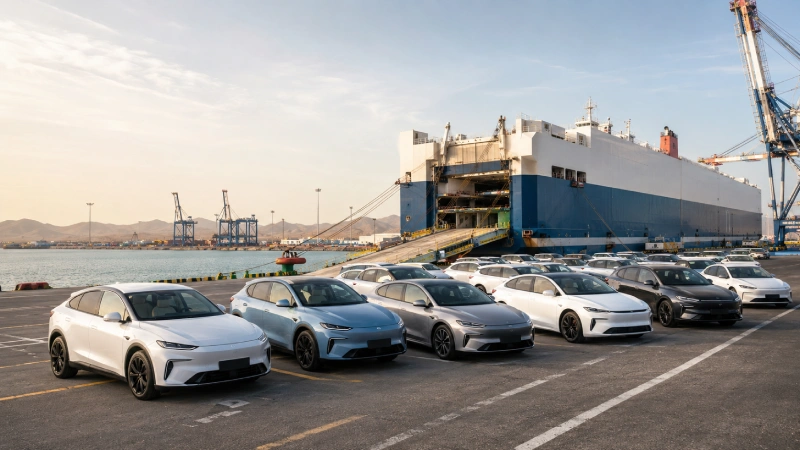
Ethiopia is landlocked, so cars shipped from China normally arrive by sea in Djibouti before continuing through cross-border transit and an Ethiopian inland terminal. For a normal passenger-car shipment in 2026, begin with a battery-electric vehicle rather than a petrol, diesel or hybrid model.
Before paying the supplier or booking space, confirm the Ethiopian importer, bank permit, Chinese export eligibility, carrier acceptance and Djibouti-to-Ethiopia inland plan. For the broader origin process, see Vehicle Shipping from China.
Quick Answer: Do not buy or ship a petrol, diesel, hybrid or plug-in hybrid passenger car to Ethiopia based only on a supplier’s assurance. Start with a battery-electric vehicle and confirm the importer, bank permit, VIN eligibility, Chinese export licence, carrier acceptance and inland transit plan before payment.
Can You Import the Vehicle into Ethiopia?
A successful shipment requires five separate approval layers:
- Ethiopian vehicle-import eligibility
- Importer, bank and payment authorization
- China export eligibility
- Carrier and terminal acceptance
- Ethiopian customs clearance, inspection and registration
Approval at one stage does not satisfy the others. A carrier may accept a vehicle for Djibouti even when the buyer cannot legally import or register it in Ethiopia.
Which Powertrains Should Be Considered?
Ethiopia’s current policy direction prioritizes battery-electric vehicles. Its official E-Mobility Strategy and Implementation Plan 2025–2030 treats restrictions on importing and assembling internal-combustion-engine vehicles as implemented measures.
For an ordinary passenger car or SUV, a pure BEV is the main category to evaluate. Petrol and diesel cars should be treated as restricted. HEVs and PHEVs contain an internal-combustion engine and must not be assumed eligible merely because they also use an electric motor.
“Electrified” is not the same as “battery-electric.” Any claimed exception for a special-purpose or government-project vehicle should be confirmed in writing before payment.
New Versus Used EVs
Do not rely on old claims that every used EV has no age restriction. Check each vehicle by VIN, production date, first-registration date, mileage, customs classification and condition.
For a used EV, also request battery state of health, accident history, flood or fire history, repair records and recall status. A seller describing a vehicle as “new” does not guarantee the same Ethiopian customs classification.
Ethiopian Importer, Bank Permit and Payment Route
Identify the importer before shipment. Depending on the transaction, the file may require the importer identity, TIN, trade or import licence, Ethiopian address, customs agent, bank permit, payment arrangement, insurance and final inland destination.
Do not ship a vehicle as an ordinary personal effect. Ethiopia’s 2026 Franco Valuta rules exclude motor vehicles from that category. A gift, personal-use vehicle or purchase funded from abroad does not automatically bypass import or banking procedures.
Review the National Bank of Ethiopia Import on Franco Valuta Directive No. FVD/01/2026 and obtain the applicable bank and import confirmation before the vehicle leaves China.
Ethiopia’s EV, Steering and Vehicle-Condition Rules
| Powertrain | Planning position |
|---|---|
| BEV | Main passenger-car category, subject to all approvals |
| HEV or PHEV | Contains an engine; do not assume eligibility |
| Petrol or diesel | Treat as restricted for normal passenger-car imports |
| Fuel-cell vehicle | Assess propulsion and hydrogen systems separately |
Ethiopia drives on the right. Choose a factory-built left-hand-drive vehicle unless the transport and registration authorities confirm otherwise in writing. Carrier acceptance does not prove that a right-hand-drive car can be registered.
For used or damaged EVs, check VIN integrity, collision, flood or fire exposure, battery alarms and repairs, chassis work, airbags, recalls, running condition and battery health. A carrier may reject a damaged or electrically abnormal vehicle. Customs release also does not guarantee technical approval or registration.
Why Cars Are Shipped Through Djibouti
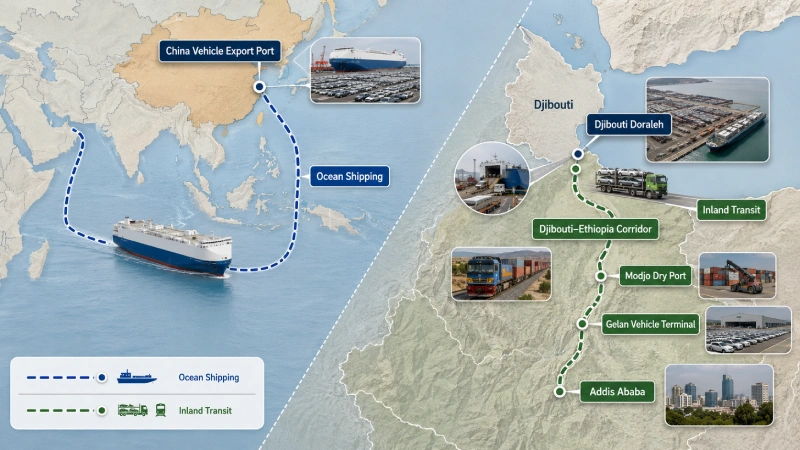
Ethiopia has no ocean port. Vehicles are discharged at a Djibouti maritime terminal, then move through port procedures, transit documentation and the Djibouti–Ethiopia corridor.
The normal route is:
China pickup → Chinese export port → Djibouti terminal → transit procedures → road or rail movement → Ethiopian inland terminal → clearance, inspection and delivery.
Modjo Dry Port
Modjo is mainly relevant to containerized vehicles, container customs procedures and multimodal road or rail transport.
Gelan RoRo / Vehicles Terminal
Gelan is more relevant to RoRo passenger vehicles, fleet receipts, vehicle-terminal handling and handover after transfer from Djibouti.
Djibouti is the maritime gateway; Modjo and Gelan are inland logistics nodes, not seaports.
Unimodal or Multimodal Transport
A unimodal quotation may end in Djibouti, leaving the consignee to arrange the transitor and inland carrier. A multimodal arrangement may continue to a named Ethiopian inland point. In either case, confirm the responsibility endpoint and who pays port storage, transit, inland transport, detention and empty-container return.
| Logistics node | Main function | Common risk |
|---|---|---|
| Djibouti or Doraleh | Ocean discharge and port handling | Storage, documents and transit delay |
| Modjo Dry Port | Container and customs operations | Inspection and detention |
| Gelan Terminal | RoRo and vehicle handover | Storage and collection delay |
| Final city | Delivery and registration preparation | Insurance and vehicle condition |
RoRo or Container Shipping to Ethiopia?
RoRo Shipping via Djibouti
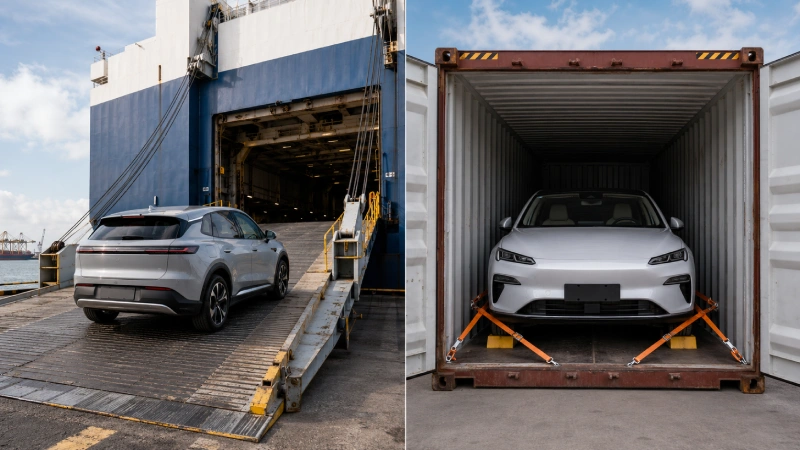
RoRo can suit running EVs, standard cars and SUVs, fleet shipments, and carrier-approved used vehicles. The vehicle normally needs to start, steer and brake, with no undisclosed leakage, battery alarm or serious damage.
Confirm the Chinese loading port, sailing schedule, direct or transshipment routing, Djibouti terminal, single-vehicle policy and acceptance of the exact model, battery and age. Do not leave undeclared goods inside.
Also confirm who moves the vehicle from Djibouti to Gelan or another Ethiopian destination, whether it will be driven during transfer, where it will be stored and whether insurance covers the inland stage. See RoRo Car Shipping from China.
Container Shipping via Djibouti and Modjo
A 20GP, 40GP or 40HQ may suit one or several EVs, high-value vehicles, limited RoRo schedules or enclosed handling. Proper loading requires wheel chocks, approved lashing points, safe clearances, weight control, photographs, a Container Packing Certificate and VGM.
Container loading does not remove the EV dangerous-goods review. Confirm the road or rail transit plan, destination unloading and empty-container return.
Do not promise that a 40HQ always carries three or four cars. Capacity depends on vehicle dimensions, loading structure, safety clearances, securing and carrier approval. See Container Car Shipping from China.
Electric Vehicle Shipping and UN3556 Requirements
Ethiopian import approval, the Chinese export licence and maritime dangerous-goods acceptance are separate procedures.
Under IMDG Amendment 42-24, mandatory in 2026, a lithium-ion BEV is generally evaluated under UN3556. Lithium-metal vehicles may fall under UN3557 and sodium-ion vehicles under UN3558. HEVs and PHEVs require separate assessment and may fall under UN3166 because of their fuel systems.
Do not declare every EV as UN3171. There is also no universal IMDG rule requiring every complete vehicle to ship at 30% SOC. The booked carrier may impose its own SOC, vehicle-age, document and stowage conditions.
Requested information may include the VIN, battery chemistry and capacity, SOC, vehicle photographs, condition declaration, recall status, emergency information, DG Declaration and packing or lashing records. SP961 or SP962 does not compel a carrier to accept the shipment. See Electric Vehicle Shipping from China.
Documents Required to Ship an EV to Ethiopia
China Vehicle and Export Documents
The origin file may include:
- Commercial invoice and sales contract
- Vehicle specification and VIN list
- Certificate of Origin
- Export customs declaration
- Electric passenger-vehicle export licence
- Registration and used-vehicle inspection records
- Transfer-pending-export documents
- After-sales service confirmation where applicable
From January 1, 2026, China applies export-licence administration to qualifying pure electric passenger vehicles with a VIN under the referenced classification 8703801090. Used vehicles registered for 180 days or less may require a manufacturer-issued after-sales maintenance service confirmation.
The exporter should review the Chinese Ministry of Commerce Announcement No. 54 of 2025. Winsail can coordinate document collection with an eligible exporter but does not issue the licence.
Carrier and EV Documents
The carrier file may include vehicle dimensions and weight, battery type and capacity, UN classification, battery-condition and SOC declarations, photographs, recall information, DG Declaration, Container Packing Certificate, VGM, lashing plan and marine insurance.
Ethiopian Import and Transit Documents
The destination file may include importer and TIN records, trade or import licence, bank permit, foreign-exchange authorization, invoices, Bill of Lading, VIN list, Certificate of Origin, insurance, customs declaration, transit documents, duty evidence, customs release and registration records.
Ordinary electric passenger vehicles are not currently treated as universally requiring Ethiopia’s general PVoC certificate before shipment. This does not remove import, customs, technical-inspection or registration requirements. Confirm the final list by VIN and HS code.
Step-by-Step Shipping Process
- Identify the importer. Confirm the TIN, bank, customs agent and final city.
- Confirm the powertrain. Verify that the vehicle is a true BEV.
- Check the VIN and condition. Review dates, mileage, steering side, accidents, battery health and recalls.
- Obtain Ethiopian confirmation. Confirm import eligibility, bank permit, payment route and tax classification.
- Confirm China export eligibility. Check the exporter, licence requirements and the 180-day rule.
- Apply for carrier acceptance. Submit battery, SOC, photographs, dimensions and condition details.
- Choose RoRo or container. Compare origin ports, schedules, Djibouti handling and inland arrangements.
- Complete origin operations. Arrange pickup, customs, terminal delivery or container loading and lashing.
- Prepare Djibouti transit. Appoint the port agent, transitor and inland carrier.
- Clear at the Ethiopian inland point. Complete valuation, taxes, examination and release.
- Inspect, insure and register. Complete technical inspection, insurance and registration.
Car Shipping Cost from China to Ethiopia
Calculate the complete landed cost:
China pickup + vehicle yard + export documents and licence coordination + carrier and DG approval + RoRo or container freight + insurance + Djibouti terminal handling + transit documents + inland transport + Ethiopian dry-port charges + customs duty and taxes + customs agent + inspection + registration + final delivery.
RoRo is commonly priced by dimensions or revenue tons. Container cost depends on equipment, route, loading and dangerous-goods conditions. Every quotation should state whether it ends in Djibouti or includes an Ethiopian inland point.
Do not present 15% as the current universal EV duty. A 20% policy reference may apply to some completely built electric passenger cars, but it is not the entire landed tax. Final assessment depends on the HS code, vehicle category, CBU, SKD or CKD status, new or used classification, CIF value, exemptions and customs valuation.
For pricing, provide the model, VIN, dates, mileage, battery details, steering side, running condition, dimensions, weight, pickup city, importer and bank-permit status, final city and cargo-ready date.
Transit Time and Delay Risks
China-to-Djibouti ocean transit may take approximately 25–35 days on some services. The complete process often requires about 35–50 days or longer after export preparation, licensing, carrier approval, sailing availability, Djibouti procedures, corridor transport, inland customs, inspection and registration.
Delays may result from permit problems, licence mismatch, carrier rejection, RoRo space shortages, transshipment changes, Djibouti congestion, transit-document errors, corridor disruption, Modjo clearance, storage, demurrage, detention or late collection.
Booking Reminder: Reconfirm schedules, freight rates, DG acceptance, Djibouti transit arrangements and Ethiopian inland charges before booking.
What to Check Before Buying a Chinese EV
Before paying the supplier, verify:
- Battery-electric powertrain
- Factory-built left-hand drive
- VIN, production date and registration history
- Battery state of health
- Accident, flood, fire and repair history
- AC and DC charging connectors
- Charging-voltage compatibility
- Charging cable
- English-language interface
- Software and app availability
- Diagnostic tools and spare parts
- Battery warranty and local repair support
- Ground clearance
- Dust and heat suitability
- Real-world driving range
A vehicle that can be exported and shipped may still be unsuitable for daily use in Ethiopia.
How Winsail Coordinates Car Shipping to Ethiopia
Winsail can coordinate China pickup, compare RoRo and container options, confirm the planned Djibouti and Ethiopian inland endpoints, submit vehicle information for carrier review, connect with an eligible exporter, coordinate customs and loading, provide shipment updates and work with destination partners on transit logistics.
Winsail does not issue export licences, approve Ethiopian imports, determine customs value, approve dangerous-goods transport or guarantee carrier acceptance, clearance, registration, vessel space or fixed transit time.
FAQ
Can petrol or diesel cars be shipped from China to Ethiopia?
Ocean transport may be available, but Ethiopia's current passenger-vehicle policy restricts internal-combustion imports. Do not purchase or ship one merely because a supplier or carrier accepts it. Obtain written import, banking, customs and registration confirmation first.
Can hybrid or plug-in hybrid cars be imported into Ethiopia?
HEVs and PHEVs contain an internal-combustion engine, so they should not be treated as pure battery-electric vehicles. Any claimed eligibility or exception must be checked by VIN with the importer, bank, customs agent and transport authority.
How much does it cost to ship an electric car from China to Ethiopia?
There is no reliable flat rate. The total includes China pickup, export and DG handling, ocean freight, Djibouti terminal charges, transit documents, inland transport, Ethiopian customs costs, inspection, registration and final delivery.
How long does car shipping from China to Ethiopia take?
China-to-Djibouti ocean transit may take roughly 25–35 days on some services. The complete movement often requires about 35–50 days or longer after approvals, sailing waits, transit, inland customs, inspection and registration.
Is RoRo or container shipping better for Ethiopia?
RoRo can suit running, carrier-approved vehicles and fleet shipments. Containers provide enclosed handling and broader origin options. The better method depends on the vehicle, sailing availability, Djibouti terminal, inland destination and total landed cost.
Do cars ship directly to Addis Ababa or Modjo?
No ocean vessel ships directly to Addis Ababa or Modjo. Djibouti is the maritime gateway. Vehicles then move under transit procedures by road or rail to Modjo, Gelan or another Ethiopian customs point.
Is there an age limit for importing used electric cars into Ethiopia?
Current public information does not support a universal “no age limit” statement or one fixed maximum age for every used BEV. Confirm the VIN, production date, registration date, mileage, customs classification and battery condition.
Does an electric vehicle need a PVoC Certificate of Conformity?
Ordinary electric passenger vehicles are not currently treated as universally requiring Ethiopia's general PVoC certificate before shipment. PVoC and vehicle-import approval are different, and all import, customs, inspection and registration requirements still apply.
Get an Electric Car Shipping Quote from China to Ethiopia
Prepare the importer type, TIN and licence status, bank-permit status, final city, inland terminal, vehicle quantity, make, model, VIN, production and registration dates, mileage, battery details, condition, steering side, dimensions, China pickup city, cargo-ready date and available export, DG and Ethiopian import documents.
Winsail can assess the route through Djibouti and coordinate the confirmed logistics scope. Verify importability, Chinese export licensing, carrier acceptance, legal transit and local EV usability before paying the supplier.
