
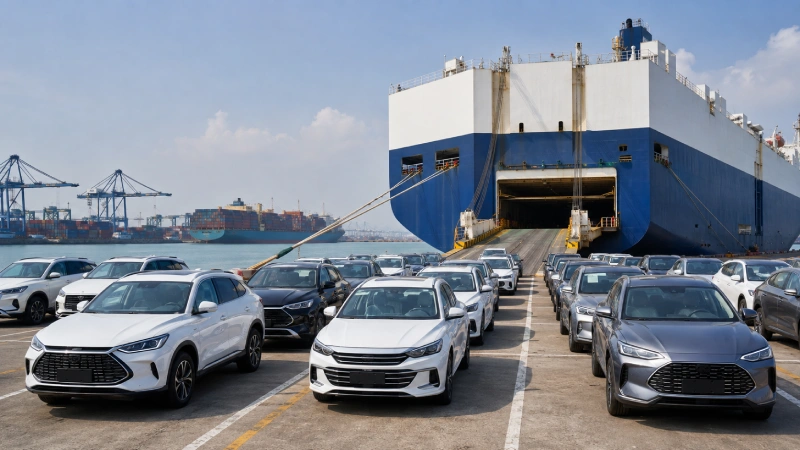
Cars can be shipped from China to Ghana by RoRo or container, with Tema Port normally the first destination to evaluate for passenger cars and SUVs. Takoradi should be used only when the selected carrier, vessel and terminal confirm vehicle acceptance. Before booking, importers must separately confirm Chinese export eligibility, Ghana vehicle admissibility, Ghana Standards Authority conformity, carrier acceptance, customs clearance and DVLA registration.
For used vehicles shipped on or after October 1, 2026, Ghana’s conformity check begins before the vehicle leaves China. The vehicle must complete the applicable Pre-Export Verification of Conformity inspection and obtain a valid Certificate of Conformance before shipment. Customs release at Tema and vehicle registration through the DVLA remain separate procedures.
For the broader origin-to-destination process, see Vehicle Shipping from China.
Quick Answer: Before paying for a car, confirm its age, factory-built left-hand-drive configuration, title, damage history, Ghana conformity pathway, Chinese export eligibility and carrier acceptance. Used vehicles shipped on or after October 1, 2026 must complete PVoC inspection and obtain a valid CoC before leaving China.
Can the Car Be Imported and Registered in Ghana?
A successful vehicle shipment involves five separate approval layers:
- Ghana vehicle-import eligibility
- GSA homologation or used-vehicle conformity
- China export eligibility
- Carrier and terminal acceptance
- GRA clearance and DVLA registration
Approval at one stage does not satisfy the remaining stages. A shipping line may accept a vehicle that later fails Ghana conformity. A car may obtain a Ghana CoC but still lack the Chinese export licence required for departure. Customs release also does not guarantee that the DVLA will approve registration.
This guide mainly covers passenger cars, sedans, hatchbacks, station wagons, SUVs and crossovers using petrol, diesel, BEV, HEV or PHEV powertrains. Buses, vans, pickups, trucks, armoured vehicles, ambulances, fire trucks and other special-purpose vehicles require separate classification and age-rule checks.
Ghana’s 2026 Vehicle Conformity Rules
New Vehicles Require Homologation
A vehicle bought directly from a Chinese factory is not automatically approved for import into Ghana. Importers, manufacturers or dealers may need to register with the GSA, while relevant vehicle models may require homologation.
A Chinese factory certificate does not automatically replace Ghanaian model approval. Different trims, powertrains or technical configurations should not be assumed to share the same approval. Confirm the exact model, variant and intended use before paying the supplier.
Used Vehicles Require Vehicle-Specific Conformity
Used vehicles are assessed under GS 4510:2022 using the VIN and the condition of the individual vehicle. The review may include manufacturing year, mileage, title, structural condition, emissions information, safety systems and accident history.
A Certificate of Conformance is vehicle-specific. It is not a general supplier certificate that can be reused for every car in a shipment.
What Changes on October 1, 2026?
| Shipment timing | Required action |
|---|---|
| Before October 1, 2026 | Confirm the current GSA, Customs and registration requirements before loading |
| On or after October 1, 2026 | Complete PVoC in China and obtain a valid CoC before shipment |
| Near the transition date | Confirm whether inspection, loading, Bill of Lading or departure date controls the cut-off |
The Ghana Standards Authority’s PVoC programme is scheduled to take effect on October 1, 2026. Do not load a used vehicle close to the enforcement date until the approved inspection body confirms the applicable cut-off and inspection arrangement.
Used-Car Age Rules and Overage Penalties
Ghana’s current passenger-car overage penalty is calculated from the vehicle’s CIF value.
| Vehicle age | Overage penalty |
|---|---|
| Up to 10 years | Nil |
| Over 10 to 12 years | 5% of CIF |
| Over 12 to 15 years | 20% of CIF |
| Over 15 to 25 years | 50% of CIF |
| Over 25 to 35 years | 70% of CIF |
| Over 35 years | 100% of CIF |
Vehicle age is based on the first year of manufacture, not only the Chinese registration date or the model year advertised by the seller. The VIN, production plate, model information and registration records should be consistent.
Before purchase, send the VIN, make, model and manufacturing year to a Ghanaian clearing agent for an estimated ICUMS assessment. The GRA vehicle-importation guidance explains that vehicle-duty checks use the chassis number or VIN, make, model and year.
The October 2026 PVoC requirement is not merely another tax. Paying an overage penalty does not prove that an older vehicle will pass conformity inspection, while obtaining a CoC does not remove an applicable age penalty.
Importers should not assume either that every vehicle over ten years old is permitted or that all such cars automatically become prohibited on October 1, 2026. Obtain written confirmation from both the approved inspection body and the Ghanaian clearing agent before paying for an older vehicle.
Steering, Title and Vehicle-Condition Requirements
Choose a Factory-Built Left-Hand-Drive Vehicle
Ghana drives on the right side of the road, so normal import projects should use factory-built left-hand-drive vehicles. Right-hand-drive vehicles are generally restricted, and ministerial approval is an exceptional route rather than a normal purchasing strategy.
Confirm steering configuration through the VIN, specification sheet and factory records. Photographs alone are not sufficient. Carrier acceptance does not override Ghana’s steering restrictions, while converting a vehicle after arrival may affect steering integrity, airbags, braking, insurance, inspection and registration.
Check the Title and Damage History
Before purchase, verify:
- Clean or salvage title
- Collision history
- Flood or fire history
- Chassis damage
- Airbag deployment
- Odometer consistency
- VIN integrity
- Structural repairs
- Recall status
Salvage-title, flood-damaged, fire-damaged and severely repaired cars carry high conformity and registration risk. A shipping booking is not proof that a CoC will be issued.
For an electric vehicle, also check battery warnings, water ingress, overheating, battery-pack repairs, insulation faults, charging faults, state of health and recall status.
A running car is not automatically a safe, conforming or registrable vehicle. Export eligibility, carrier safety approval, Ghana conformity assessment and DVLA registration remain separate decisions.
Tema or Takoradi for Car Shipping?
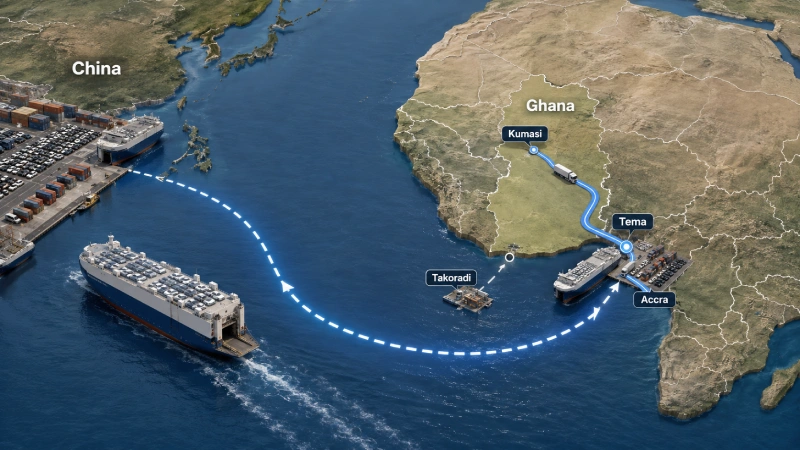
Tema is normally the first port to evaluate for passenger cars, SUVs, RoRo shipments and containerized vehicles serving Accra, Kumasi and wider dealer or fleet markets.
Takoradi may suit western Ghana, Sekondi-Takoradi importers, mining or project vehicles, and shipments for which the actual carrier confirms a suitable vessel call and terminal arrangement.
| Port or city | Best starting use | What must be confirmed |
|---|---|---|
| Tema | Most passenger-car, RoRo and container imports | Terminal, carrier, vehicle category and destination charges |
| Takoradi | Western Ghana or confirmed special service | Actual vessel call, RoRo handling and inland cost |
| Accra | Final market or delivery city | Inland delivery from Tema |
| Kumasi | Inland destination | Trucking, insurance and delivery schedule |
Tema should be treated as the normal starting point for route planning, but not as a guaranteed direct call from every Chinese vehicle-export port. Accra is a final market and delivery city, not the normal ocean-port name for vehicle clearance.
RoRo or Container Shipping from China to Ghana?
RoRo Shipping to Tema
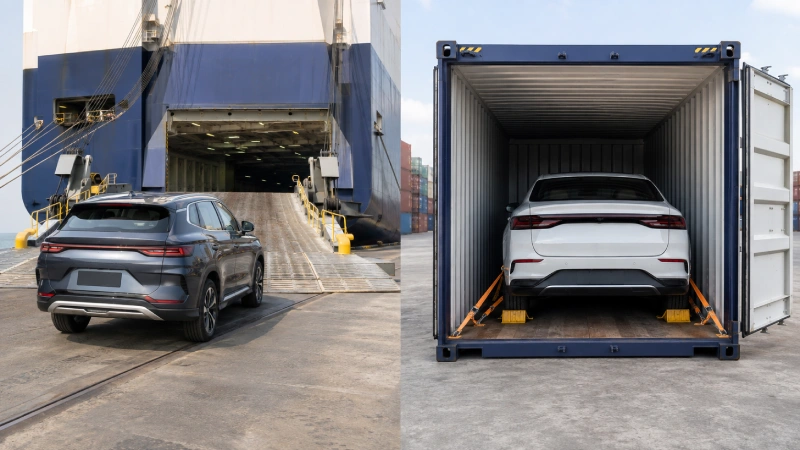
RoRo often suits running new cars, standard passenger vehicles, SUVs, fleet shipments and carrier-approved used cars. The vehicle normally must:
- Start, steer and brake safely
- Have serviceable tires
- Show no serious leakage
- Meet the carrier’s fuel or battery SOC requirements
- Have working keys and a controlled alarm system
- Contain no undeclared cargo
Confirm the Chinese loading port, direct or transshipment routing, acceptance of used cars and electric vehicles, the Tema vehicle terminal, destination free time and the carrier’s rules for goods stored inside the vehicle.
RoRo can reduce loading complexity, but sailing frequency and available space may be less flexible. Vehicle acceptance must be reconfirmed for the selected vessel rather than assumed from a previous shipment.
See RoRo Car Shipping from China for more information about booking, vehicle preparation and port handling.
Container Shipping to Tema
Container shipping may suit one or several vehicles, high-value cars, enclosed transport or routes with limited RoRo capacity.
Check the vehicle’s actual dimensions and weight against a 20GP, 40GP or 40HQ container. Loading may require:
- Professional wheel chocks
- Suitable lashing points and straps
- Safe weight distribution
- Loading photographs
- Verified Gross Mass
- Container Packing Certificate
- Compliant fuel or battery SOC
- Destination unloading arrangements
- Empty-container return planning
A 40HQ does not always fit three or four cars. Capacity depends on vehicle size, weight, loading frames, loading angle, lashing clearance and carrier approval.
See Container Car Shipping from China for container selection and vehicle-loading requirements.
Shipping Electric and Hybrid Cars to Ghana
EV shipping involves separate decisions by the Ghana Standards Authority, Ghana Revenue Authority, Chinese export authorities, the maritime dangerous-goods framework and the carrier.
Under IMDG Code 42-24, mandatory from January 1, 2026, common vehicle classifications include:
- Lithium-ion battery electric vehicle: UN3556
- Lithium-metal battery vehicle: UN3557
- Sodium-ion battery vehicle: UN3558
- HEV or PHEV: commonly assessed under UN3166 according to the fuel and propulsion design
Complete electric vehicles should no longer be universally declared as UN3171. There is also no single IMDG rule requiring every complete vehicle to ship at 30% SOC. Carriers may impose stricter SOC limits, and RoRo and container shipments may follow different acceptance conditions.
A Ghana CoC does not replace carrier dangerous-goods approval. Damaged, flooded, overheated, recalled or seriously faulted battery vehicles may be rejected even when other vehicle documents are available.
Ghana’s EV incentives are use-specific. Certain public-transport vehicles or qualified local-assembly projects may receive policy support, but a privately imported BEV is not automatically tax-free. Eligibility should be confirmed using the VIN, HS code, importer, declared use and intended registration pathway. HEVs and PHEVs should not automatically be treated as fully electric vehicles because they contain an internal-combustion system.
See Electric Vehicle Shipping from China for the 2026 export and maritime requirements.
Documents Required to Ship a Car to Ghana
China Vehicle and Export Documents
Documents may include:
- Commercial invoice
- Sales contract
- Vehicle specification sheet
- VIN or chassis list
- Certificate of origin
- Export customs declaration
- Vehicle export licence
- Chinese registration documents
- Used-vehicle inspection report
- Ownership-transfer documents
- After-sales service confirmation where applicable
- Modification records where applicable
From January 1, 2026, certain pure electric passenger vehicles require a Chinese export licence under China’s 2025 Announcement No. 54. Used vehicles exported within 180 days of registration may also require a manufacturer-issued after-sales service confirmation.
A Ghana CoC does not replace the Chinese vehicle export licence, and Ghanaian import acceptance does not prove that the Chinese exporter is qualified.
GSA Conformity Documents
Depending on the vehicle, the file may include:
- New-vehicle homologation documents
- Used-vehicle inspection application
- PVoC inspection report
- Certificate of Conformance
- Vehicle photographs
- Title document
- Accident-history information
- Technical specifications
- Emission or environmental information
Carrier Documents
Carrier and terminal requirements may include:
- Booking application
- VIN list
- Vehicle dimensions and weight
- Running-condition statement
- Fuel or SOC declaration
- Battery type and capacity
- Battery-condition declaration
- Dangerous Goods Declaration
- Container Packing Certificate
- VGM
- Lashing plan
- Marine insurance certificate
Ghana Customs Documents
The Ghana clearance file may include:
- Bill of Lading or Sea Waybill
- Vehicle title
- Attested commercial invoice
- Packing or VIN list
- Import Declaration Form
- TIN or GhanaCard PIN
- Required permits
- GSA conformity document
- ICUMS declaration
- Customs tax bill
- Delivery order
- Duty-payment evidence
- Customs release
The final document list must be confirmed with the importer, GSA inspection provider, carrier, clearing agent, GRA and DVLA.
Step-by-Step Car Shipping Process
Identify the importer. Confirm the Ghanaian importer, TIN or GhanaCard PIN, customs agent, address, final city and intended vehicle use.
Verify the vehicle before payment. Check the VIN, manufacturing year, registration date, mileage, steering side, title, accident history, powertrain and battery condition.
Confirm Ghana conformity. Determine whether model homologation, a vehicle-specific CoC and PVoC inspection apply.
Obtain an ICUMS estimate. Send the VIN, make, model, year, powertrain and intended use to the Ghanaian clearing agent.
Confirm China export eligibility. Verify the qualified export entity, export licence and applicable used-vehicle 180-day rule.
Apply for carrier acceptance. Submit photographs, dimensions, running condition, powertrain, battery data and SOC information.
Choose RoRo or container. Compare the Chinese departure port, routing, terminal, freight and total destination cost.
Complete PVoC where required. For used vehicles shipped on or after October 1, 2026, obtain the CoC before loading.
Complete origin handling. Arrange pickup, handover inspection, export customs, port delivery or professional container lashing.
Prepare Ghana clearance before arrival. Complete ICUMS preparation, delivery-order requirements and tax funding.
Clear and collect the vehicle. Complete valuation, tax payment, scanning or examination, customs release and port pickup.
Complete DVLA procedures. Arrange inspection, insurance, roadworthiness certification, registration and licensing.
Vehicles not declared and cleared within the statutory period after final discharge may face forfeiture, while storage and demurrage begin much earlier. Do not wait until the vehicle reaches Tema to appoint a clearing agent.
Car Shipping Cost from China to Ghana
The total landed cost may include:
China pickup + vehicle inspection + export documents + export-licence coordination + PVoC and CoC + carrier or dangerous-goods approval + RoRo or container freight + marine insurance + shipping-line charges + terminal handling + ICUMS charges + import duty + VAT and levies + overage penalty + examination + storage + customs agent + inland delivery + DVLA costs.
From January 1, 2026, Ghana applies VAT at 15%, NHIL at 2.5% and the GETFund Levy at 2.5% on the applicable tax base. The former 1% COVID-19 Health Recovery Levy has been removed. These rates do not represent the entire vehicle-clearance cost.
Other charges may include import duty, AU and ECOWAS levies, examination fees, special import levies, overage penalties, terminal handling, shipping-line fees, storage, customs-agent charges and registration expenses.
GRA may use manufacturer value, depreciation, freight, insurance, exchange rates and ICUMS vehicle data. A low supplier invoice does not guarantee a low customs assessment.
RoRo may be priced by vehicle dimensions, CBM or revenue tons. Container pricing depends on equipment, route, dangerous-goods conditions and loading method. Request a VIN-specific quotation rather than relying on a fixed percentage of the Chinese purchase price.
For an accurate quotation, provide:
- Make and model
- VIN
- New or used condition
- Manufacturing year
- Registration date
- Mileage
- Clean or salvage title
- Accident, flood or fire history
- Petrol, diesel, HEV, PHEV or BEV powertrain
- Battery type, capacity and condition
- Left- or right-hand drive
- Running condition
- Dimensions and weight
- Pickup city
- Cargo-ready date
- Preferred shipping method
- Final Ghanaian city
- Intended private or public-transport use
- PVoC status
- China export-licence status
Transit Time and Delay Risks
Planning may include:
- China pickup and export preparation: 3–10 days or longer
- PVoC, CoC and export licensing: case-specific
- China-to-Tema ocean transit: approximately 30–45 days for some services
- Complete pickup-to-release process: commonly 35–55 days or longer
Delays may result from vehicle-data mismatches, failed inspections, CoC or licence delays, carrier rejection, RoRo space shortages, transshipment changes, dangerous-goods review, ICUMS valuation disputes, customs examination, missing title documents, late duty payment or delayed vehicle collection.
Sailing schedules, PVoC arrangements, carrier acceptance, freight rates and Ghana destination charges must be reconfirmed before delivering the vehicle to port.
What to Check Before Buying a Chinese Car for Ghana
Confirm the following before paying the Chinese supplier:
- Factory-built left-hand drive
- VIN and manufacturing year
- Clean title
- Accident, flood and fire history
- GSA homologation or CoC pathway
- PVoC availability in China
- Spare-parts availability
- Diagnostic equipment and technical support
- English-language vehicle interface
- Warranty validity outside China
- Ghana service support
- Ground clearance
- Air-conditioning performance
- Fuel-quality compatibility
- AC and DC charging connectors
- Ghana charging compatibility
- Charging cable availability
- Battery state of health
- Software region and remote-app access
- Recall status
A vehicle that can be exported from China and carried to Tema may still fail Ghana’s conformity, customs or registration process.
How Winsail Coordinates Car Shipping to Ghana
Winsail can collect vehicle and importer information, coordinate pickup in China, compare RoRo and container options, check current Tema or Takoradi acceptance, prepare carrier submissions, coordinate EV dangerous-goods review, arrange export customs, loading and lashing, and support document handover to the Ghanaian importer and clearing agent.
Winsail does not issue Chinese export licences, Ghana Certificates of Conformance or GRA customs valuations. Winsail also cannot guarantee customs clearance, DVLA registration, fixed taxes, vessel space or transit time.
FAQ
How much does it cost to ship a car from China to Ghana?
Cost depends on the vehicle’s size, VIN, age, powertrain, title, pickup city, shipping method, freight market, PVoC requirements and Ghanaian taxes. A complete quotation should separate China charges, ocean freight, Tema destination fees, customs taxes, overage penalties, clearance, inland delivery and registration.
How long does car shipping from China to Ghana take?
Some ocean services to Tema may take approximately 30 to 45 days, while the complete pickup-to-release process often requires 35 to 55 days or longer. PVoC inspection, export licensing, carrier approval, transshipment, customs valuation and examination can extend the schedule.
Is Tema or Takoradi better for importing a car?
Tema is normally the first port to evaluate for passenger cars, SUVs, RoRo and container shipments serving Accra and Kumasi. Takoradi should be considered only when the carrier confirms a suitable vessel call, vehicle terminal, destination charges and inland delivery plan.
Can a car over ten years old be imported into Ghana?
Vehicle age and conformity are separate checks. Current law includes CIF-based overage penalties, but paying the penalty does not prove that the vehicle will satisfy GSA conformity requirements. Obtain written confirmation from the inspection body and Ghanaian clearing agent before purchasing an older vehicle.
What changes for used vehicles on October 1, 2026?
Used vehicles shipped on or after October 1, 2026 must complete Ghana’s Pre-Export Verification of Conformity inspection in the exporting country and obtain a valid Certificate of Conformance before shipment. Confirm the controlling cut-off date with the approved inspection provider before loading.
Can a right-hand-drive or salvage car be imported into Ghana?
Right-hand-drive vehicles are generally restricted, while ministerial approval is exceptional. Salvage, flood, fire and severely damaged vehicles carry substantial conformity and registration risks. Do not purchase or ship one until its title, condition, PVoC eligibility and registration pathway are confirmed.
Is RoRo or container shipping better for Ghana?
RoRo is often efficient for running, carrier-approved standard vehicles. Containers provide enclosed transport and greater loading-port flexibility but require professional blocking, lashing, VGM, unloading and empty-return planning. The better option depends on vehicle condition, route, schedule, total cost and carrier rules.
Are electric cars imported into Ghana duty-free?
Not automatically. Ghana’s EV incentives are linked to specific uses or qualified programmes, including certain public-transport and local-assembly arrangements. A private BEV, dealer-stock EV, HEV or PHEV should be assessed using its VIN, HS code, importer, declared purpose and current ICUMS treatment.
Get a Car Shipping Quote from China to Ghana
Send the vehicle VIN, manufacturing year, registration date, title status, powertrain, battery information, steering side, running condition, dimensions, pickup city and final Ghanaian destination.
Winsail will help compare RoRo and container options and identify the Chinese export, carrier acceptance and Ghana conformity checks required before loading.
