
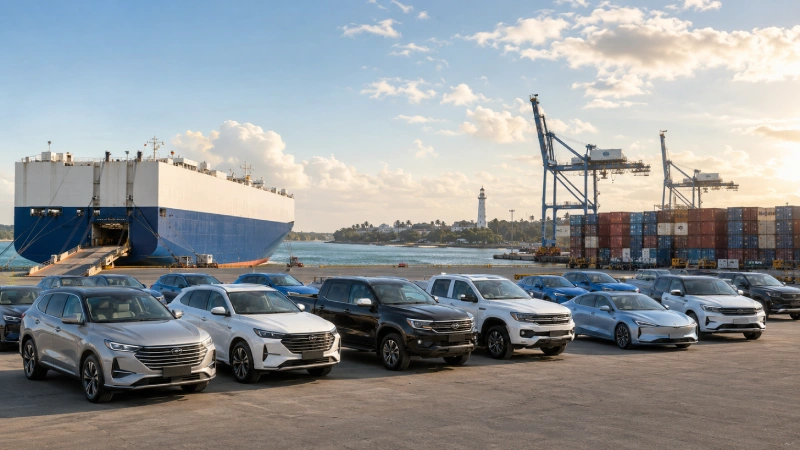
Shipping cars from China to Tanzania involves much more than booking ocean freight. Importers must align China export eligibility, vehicle identity and condition, Tanzania Bureau of Standards (TBS) requirements, carrier acceptance, Tanzania Revenue Authority (TRA) taxation, customs clearance and local registration.
This guide focuses on Tanzania Mainland, especially vehicles cleared through Dar es Salaam. Zanzibar follows a different inspection and tax framework, so its requirements should be checked separately before purchase or shipment.
Quick Answer: Can You Ship a Car from China to Tanzania?
Yes. Cars can be shipped from China to Tanzania, but a successful import depends on clearing six separate layers:
- China export eligibility
- Vehicle identity, age and technical condition
- The applicable TBS inspection or approved alternative route
- Carrier acceptance, including dangerous-goods review where relevant
- TRA valuation, taxation and customs clearance
- Local registration and licensing
Do not pay the vehicle balance or ship a used vehicle from China until the TBS inspection route has been confirmed in writing.
This is especially important for China-origin used cars. An inspection arrangement available for vehicles exported from another country should not automatically be assumed to apply to vehicles departing from China.
Tanzania Mainland and Zanzibar Follow Different Rules
Imports Through Dar es Salaam
Vehicle imports into Tanzania Mainland normally involve TRA, TBS, Tanzania Ports Authority and the TANCIS customs system. TRA requires importers to use a licensed clearing and forwarding agent and generally recommends completing the customs declaration before the vessel arrives.
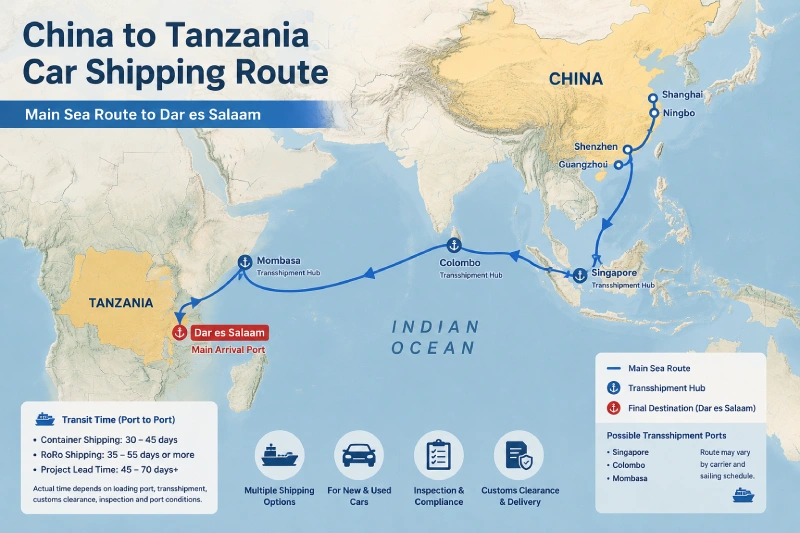
Dar es Salaam is the main entry point for many vehicle shipments serving Tanzania Mainland and can also handle transit cargo moving to inland destinations.
Imports to Zanzibar
Zanzibar uses a separate compliance framework. Zanzibar Bureau of Standards (ZBS) publishes its own destination-inspection arrangements for used vehicles, while taxation and clearance are handled under the relevant Zanzibar authorities.
A vehicle shipment planned for Zanzibar should therefore not simply copy a Dar es Salaam clearance procedure. Confirm ZBS inspection, local tax treatment and registration requirements separately.
Check the Vehicle Before You Buy
Right-Hand Drive or Left-Hand Drive?
Tanzania drives on the left, so a factory right-hand-drive vehicle is usually the more practical configuration for an ordinary passenger car. Many vehicles originally sold in the Chinese domestic market are left-hand drive, which makes steering position an important sourcing check.
However, it is not prudent to describe Tanzania as having a blanket, verified legal rule that every imported passenger vehicle must be right-hand drive. Left-hand-drive vehicles, converted vehicles and special-purpose vehicles should be checked by VIN with TBS, TRA and the local registration agent before purchase.
Also verify the original steering position, headlamp beam direction, speedometer units, mirror visibility, manufacturer plate and any steering-conversion history.
Verify the Vehicle Identity
Before paying the supplier, match the following information across the vehicle and documents:
- VIN or chassis number
- Manufacture year and first-registration date
- Engine number, displacement and fuel type
- New or used vehicle status
- Accident, flood, fire and recall history
- Vehicle dimensions and curb weight
- Original steering position
- Battery chemistry and capacity for an EV
These details affect export licensing, carrier acceptance, TBS inspection, TRA valuation and registration.
Is There a Vehicle Age Limit in Tanzania?
No General Eight-Year Import Ban
Tanzania should not be confused with Kenya. Tanzania Mainland does not currently apply a general Kenya-style rule that automatically prohibits ordinary used cars once they exceed eight years of age.
Instead, age can materially increase import taxation. Under Tanzania’s Finance Act 2026, effective July 1, 2026, additional excise duty applies according to vehicle age:
| Vehicle age | Additional excise duty |
|---|---|
| 8–10 years | 18% |
| More than 10–20 years | 35% |
| More than 20 years | 40% |
The practical result is that an older vehicle can remain importable but become uneconomic after tax, maintenance risk and spare-parts availability are considered.
A low purchase price in China therefore does not automatically mean a low landed cost in Tanzania. Obtain a vehicle-specific TRA estimate before committing to the purchase.
TBS Roadworthiness Inspection for Used Cars from China
Imported used vehicles are subject to TBS roadworthiness requirements under TZS 698:2012. Depending on the approved inspection pathway, roadworthiness checks may include brakes, steering, lights, tyres, chassis, glazing, emissions and other safety-related items.
It is also important to distinguish between different forms of conformity evidence:
| Document | Common purpose |
|---|---|
| General PVoC CoC | General regulated products |
| Vehicle roadworthiness certificate / CoR | Used-vehicle roadworthiness |
| Destination inspection record | Evidence under an approved arrival-inspection route |
A general product PVoC CoC should not automatically be treated as a substitute for a used-vehicle roadworthiness certificate.
The main China-specific risk is the inspection pathway. Publicly available material does not establish a blanket rule that every used vehicle exported from China can routinely obtain the required TBS roadworthiness certificate inside China. Arrangements announced for vehicles originating in another country, such as Japan, should not be assumed to apply to China-origin shipments.
Before paying the balance or booking freight, provide TBS or the Tanzanian importer’s licensed clearing agent with the VIN, manufacture year, vehicle condition, export country and supporting documents. Ask for written confirmation of whether pre-shipment inspection, destination inspection or another approved route applies.
Do not assume that a vehicle without the required pre-shipment evidence can always be inspected successfully after arrival.

China Export Requirements
China export approval and Tanzania import approval are separate compliance layers. A vehicle may be legally exportable from China but still fail a Tanzanian inspection, tax or registration requirement.
For used vehicles, verify the legal source of the car, exporter eligibility, customs documentation and consistency of VIN and registration records. See our used car export from China guide for the China-side process.
For used vehicles registered for 180 days or less, China’s 2026 export-licence rules generally require an after-sales maintenance service confirmation issued by the vehicle manufacturer. Without the required confirmation, an export licence may not be issued.
China also introduced export-licence management for specified pure-electric passenger vehicles from January 1, 2026. The China export licence does not replace TBS inspection, TRA customs clearance or Tanzanian registration approval.
Why Dar es Salaam Is the Main Arrival Port
Dar es Salaam is Tanzania’s principal seaport and the most practical arrival point for many vehicle shipments. It combines container services, vehicle-handling capability, customs infrastructure and inland connections.
The port also serves transit cargo moving toward inland markets in East and Central Africa, including Zambia, Rwanda, Burundi and parts of the Democratic Republic of the Congo.
Tanga or Mtwara may be considered for specific projects, but only after confirming the actual vessel service, terminal capability and vehicle-handling arrangement for the shipment.
RoRo or Container Shipping?
RoRo Shipping
RoRo can be suitable for standard cars that can start, move, steer and brake safely, especially when appropriate PCTC or RoRo space is available. It can work well for batches of vehicles and avoids container loading design.
However, China-to-Dar es Salaam RoRo schedules, origin ports and transshipment patterns vary. Carriers may restrict used, non-running, damaged, hybrid or electric vehicles. Do not assume every Chinese port offers direct RoRo service to Tanzania.
For more detail, see RoRo ocean freight from China.
Container Shipping
Container shipping offers enclosed transport and can be useful for higher-value vehicles, multi-car projects or shipments requiring more flexibility in the Chinese port of loading.
Exact vehicle dimensions and weight are essential. Cars must be professionally positioned, wheel-chocked and lashed, and the container must meet verified gross mass requirements.
Do not assume a 40HQ can always carry a fixed number of vehicles. The practical loading quantity depends on the actual vehicle models and engineered loading plan. Our guide on how many cars fit in a shipping container explains the main variables.
| Factor | RoRo | Container |
|---|---|---|
| Vehicle condition | Usually operational | More project flexibility |
| Protection | Moderate | Higher enclosure |
| Port choice | Vessel-dependent | Usually broader |
| Multi-car loads | Good for fleets | Requires load planning |
| EV acceptance | Carrier approval | Carrier and DG approval |
Shipping Electric and Hybrid Cars to Tanzania
Electric cars are not automatically duty-free in Tanzania. Relief from an engine-displacement-based excise does not mean exemption from import duty, VAT, age-based excise or port and registration charges.
For ocean transport, IMDG Code Amendment 42-24 became mandatory on January 1, 2026. Depending on the actual propulsion system and battery chemistry, vehicles may fall under:
- UN 3556 for vehicles powered by lithium-ion batteries
- UN 3557 for vehicles powered by lithium-metal batteries
- UN 3558 for vehicles powered by sodium-ion batteries
- UN 3166 for certain hybrid vehicles carrying fuel
The final dangerous-goods classification and declaration must be confirmed by the carrier or a qualified dangerous-goods professional for the specific vehicle.
Before booking an EV or hybrid, provide battery type and capacity, battery health information where available, required state of charge, accident/flood/fire/recall history, evidence of leakage or thermal damage, manufacturer battery documentation and emergency-response information.
Documents Required
China Export Documents
Common China-side documents include:
- Commercial invoice
- Packing list
- Sales contract
- Export declaration
- Export licence where applicable
- Vehicle registration or cancellation documents
- VIN or chassis record
- Certificate of origin where applicable
- Battery and dangerous-goods documentation for EVs and hybrids
For a more detailed checklist, see used-car export documents from China.
Tanzania Import Documents
Documents commonly required for Tanzania may include:
- Bill of lading
- Final commercial invoice
- Packing list
- TBS certificate or approved inspection evidence
- Clearing-agent authorization
- Import permit where applicable
- Insurance documents
- TRA customs declaration
- Vehicle title or export certificate
- Importer identification and tax records
VIN, model, manufacture year, engine and powertrain information should remain consistent across the vehicle, invoice, export records, inspection documents and customs declaration.
Tanzania Car Import Taxes and Landing Cost
For a typical complete passenger car classified under HS 8703, the EAC Common External Tariff generally applies a 25% import duty, subject to the exact HS classification and any applicable national treatment.
Major cost components can include:
| Cost item | Typical 2026 treatment |
|---|---|
| Import duty | Usually 25% for complete passenger cars |
| Engine-capacity excise | Commonly 5% up to 2,000 cc and 10% above 2,000 cc, subject to classification |
| Age-based additional excise | 18%, 35% or 40% according to age |
| VAT | 18% standard rate |
| Railway Development Levy | Usually 2% of CIF |
| Customs Processing Fee | Generally 1% from July 1, 2026; confirm the applicable base |
| Other costs | TBS, port, carrier, broker, storage, registration and inland delivery |
Do not estimate Tanzania vehicle taxes by simply adding headline percentages. Several taxes are calculated on different or cascading tax bases.
The Chinese seller’s invoice is also not necessarily the sole customs-valuation basis. TRA may assess or review the vehicle value using model, age, displacement, fuel type, condition, HS classification, freight and insurance information.
Before purchase, give the Tanzanian clearing agent the VIN, model, manufacture year, displacement, fuel type, FOB price, freight and insurance. Ask for a vehicle-specific TRA estimate that is as close as possible to the formal declaration basis.
Step-by-Step Shipping Process
- Confirm whether the destination is Tanzania Mainland or Zanzibar.
- Collect the VIN, manufacture year, engine capacity, vehicle dimensions, weight and powertrain information.
- Verify China export eligibility and exporter documentation.
- Confirm the original steering position and local registration acceptability.
- Ask a licensed Tanzanian clearing agent for a pre-purchase TRA tax estimate.
- Obtain written confirmation of the applicable TBS inspection pathway.
- Compare RoRo and container shipping options.
- Obtain formal carrier acceptance for the used vehicle, EV or hybrid.
- Complete the required inspection, export licence and document review.
- Arrange professional loading, lashing and dangerous-goods declarations where required.
- Submit the TANCIS pre-arrival declaration and prepare destination clearance.
- Complete tax payment, vehicle release, registration and inland delivery.
The order matters. The compliance path should be established before ocean freight becomes the final booking decision.
Transit Time from China to Dar es Salaam
Use transit times as planning ranges rather than guarantees.
A reasonable planning range for container port-to-port transit is approximately 30–45 days. RoRo or vehicle-carrier shipments involving transshipment may take around 35–55 days or longer. A complete purchase-to-release project can extend to 45–70 days or more.
Actual timing depends on the China port of loading, transshipment arrangement, TBS inspection, export licensing, EV dangerous-goods review, vessel space, cut-off dates, TANCIS filing, port examination and destination handling.
A published sailing schedule may show a shorter or longer example, but one service should not be treated as a fixed transit-time commitment for every booking.
Common Mistakes to Avoid
Avoid these common mistakes when importing a vehicle from China to Tanzania:
- Treating Tanzania as having a Kenya-style eight-year import ban
- Buying a China-origin used vehicle before confirming the TBS inspection route
- Treating a general PVoC CoC as a vehicle roadworthiness certificate
- Assuming every left-hand-drive or converted vehicle can be registered
- Buying a steering-converted vehicle without disclosing the modification
- Assuming electric cars are exempt from all import taxes
- Estimating taxes only from the Chinese invoice price
- Promising direct RoRo before carrier confirmation
- Ignoring EV battery accident, flood, fire or recall history
- Preparing customs documents only after the vessel has arrived
How Winsail Logistics Can Help
Winsail Logistics can support China export-document pre-checks, VIN and vehicle-data review, coordination with the Tanzanian importer’s TBS and clearing contacts, RoRo-versus-container comparison, EV and hybrid carrier acceptance review, professional loading and lashing, China export customs, ocean freight to Dar es Salaam and coordination with destination agents or inland transport.
TBS approval, TRA tax assessment, customs-clearance timing and direct RoRo availability remain decisions of the relevant authorities, terminals and carriers and cannot be guaranteed.
FAQ
How much does it cost to ship a car from China to Tanzania?
The cost depends on the Chinese load port, vehicle dimensions and weight, RoRo or container service, powertrain, carrier acceptance and destination charges. A reliable quote should be based on the VIN, dimensions and shipping method.
Does Tanzania have an eight-year vehicle age limit?
No general Kenya-style eight-year import ban applies to ordinary used vehicles in Tanzania Mainland. However, vehicles from eight years old can attract age-based additional excise duty, with higher rates for older vehicles.
Can I ship a left-hand-drive car to Tanzania?
Tanzania drives on the left, so factory right-hand drive is generally the more practical passenger-car configuration. Left-hand-drive, converted or special-purpose vehicles should be checked by VIN for compliance and registration acceptability before purchase.
Can a used Chinese car obtain TBS certification in China?
It cannot be generalized. Public information does not establish one blanket China inspection route for every used vehicle. Confirm the currently approved inspection pathway in writing with TBS or the importer's licensed clearing agent before booking.
Is RoRo cheaper than container shipping?
Sometimes, but not always. RoRo economics depend on vehicle-carrier space, vehicle condition, transshipment and carrier policy. Container shipping may be more practical when RoRo space is unavailable or enclosed transport is preferred.
Are electric cars tax-free in Tanzania?
No. A relief from engine-displacement excise does not automatically remove import duty, VAT, age-based excise, port charges, clearance costs or registration fees.
How long does shipping from China to Dar es Salaam take?
A useful planning range is about 30–45 days port to port for many container routings. RoRo transshipment, inspection, export licensing or EV acceptance can make the total timeline longer.
Which documents are most important for importing a car into Tanzania?
Prioritize VIN-consistent commercial and vehicle records, the bill of lading, required China export documents or licences, approved TBS inspection evidence and the documents needed by the licensed Tanzanian clearing agent for the TRA declaration.
