
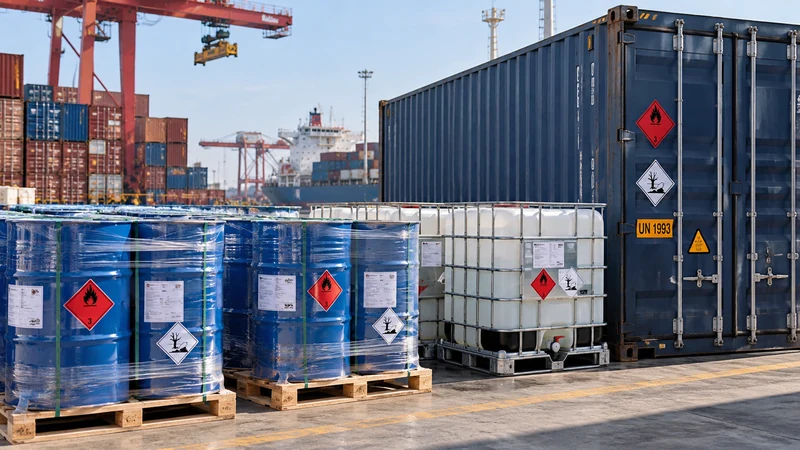
Shipping chemicals from China to Nigeria starts with a different question from ordinary freight:
What exactly is the chemical, is it dangerous for transport, is it legally eligible for import into Nigeria, and will the selected carrier, transshipment port and destination terminal accept it?
The word “chemical” does not automatically mean dangerous goods. At the same time, a supplier describing a product as “non-hazardous” on a quotation, product sheet or commercial invoice does not establish its transport classification.
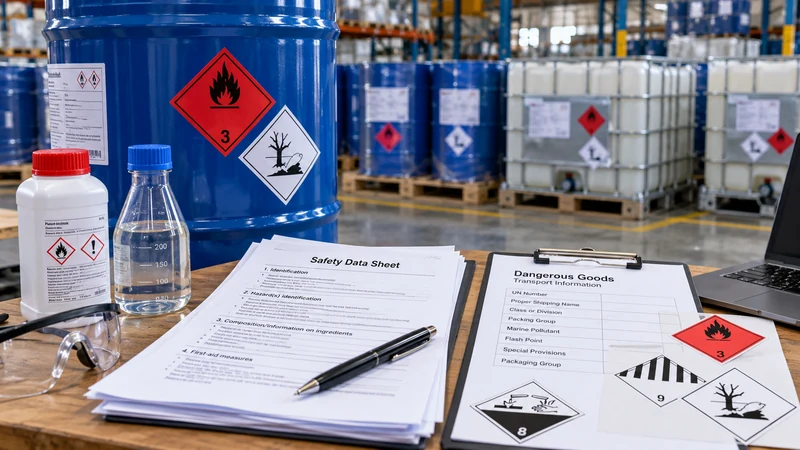
Before freight is booked, the chemical should be identified using reliable technical information such as its product name, chemical composition, CAS number and current Safety Data Sheet (SDS). If it is regulated as dangerous goods for transport, the booking normally also needs information such as the UN number, Proper Shipping Name, hazard class, packing group, flashpoint where relevant, marine-pollutant status and packaging details.
Import regulation is a separate question. A chemical that can legally move under the IMDG Code or IATA Dangerous Goods Regulations may still require a Nigerian permit, registration, standard-conformity procedure or other authorization before import.
For that reason, Winsail recommends treating every chemical shipment as a classification and acceptance project before treating it as a freight quotation.
Important: Do not send chemical cargo to a freight warehouse simply because the supplier says it is “general cargo.” Review the SDS and transport classification first, then confirm the warehouse and carrier can accept the shipment.
For the wider route, freight-mode and destination framework, see Shipping from China to Nigeria.
Quick Answer: How Do You Ship Chemicals from China to Nigeria?
A typical chemical shipment should pass four checks before it moves:
- Import eligibility — confirm that the exact product can be imported into Nigeria and identify whether NAFDAC, SON, Nigeria Customs Service or another regulator is involved.
- Transport classification — establish whether the product is non-dangerous or dangerous goods and identify the correct UN transport details.
- Carrier and facility acceptance — obtain approval from the shipping line, airline, consolidation warehouse, transshipment point and destination facility where applicable.
- Packaging and documentation — prepare compliant packaging, markings, declarations and supporting documents before cargo handover.
These checks are related, but they are not interchangeable.
An HS code is not a dangerous-goods classification.
A CAS number is not a UN number.
An SDS is not a carrier approval.
A Nigerian import permit is not an ocean-carrier DG approval.
Getting one of these right does not remove the need to verify the others.
Step 1 — Can the Chemical Be Imported into Nigeria?
Before discussing FCL, LCL or air freight, identify the product precisely enough to screen it against Nigerian import requirements.
At minimum, collect:
- exact commercial product name
- chemical name or composition
- CAS number where applicable
- concentration or formulation
- intended use in Nigeria
- manufacturer
- HS code or proposed HS classification
- whether the product is a raw material or finished chemical product
- Nigerian importer and end-user type
- SDS
- quantity to be imported
Nigeria Customs Service maintains tariff and import-control information by HS classification, while Nigerian law allows restrictions on certain goods for reasons including health, safety and environmental protection. The precise tariff classification and substance identity should therefore be checked rather than assuming that “industrial chemical” is sufficient for customs screening.
Chemical Regulatory Screening
| Question | What to Check | Why It Matters |
|---|---|---|
| What exactly is the product? | Chemical name, composition, CAS number, concentration | Similar trade names can represent different substances or formulations |
| What is it used for? | Industrial production, laboratory use, water treatment, mining, coatings, food production, agriculture, etc. | Intended use can affect the regulator and permit route |
| What is the HS code? | Nigerian CET classification | Customs controls and duties depend on classification |
| Is it prohibited or restricted? | Nigeria Customs controls and regulator-specific restrictions | Some substances or tariff lines may not be freely importable |
| Does NAFDAC apply? | Industrial/laboratory chemical permit, restricted chemical route, pesticides or other regulated uses | Different chemicals can follow different NAFDAC procedures |
| Does SON apply? | SONCAP, exemption or import-permit treatment | Raw-material exemptions are not universal |
| Is another regulator involved? | Sector, environmental or controlled-substance requirements | Certain substances require additional approvals |
| Is it dangerous for transport? | UN classification under the applicable transport rules | Determines packaging, documentation and carrier acceptance |
A Practical Decision Tree
Start with the exact chemical identity.
If the supplier cannot provide a usable SDS, composition and manufacturer information, stop the freight-planning process until the product is properly identified.
Next, confirm the proposed HS classification and Nigerian import status.
Then determine whether NAFDAC, SON or another regulator needs to review the import.
Only after import eligibility is reasonably established should the transport classification and carrier-acceptance process move forward.
This order helps prevent a common and expensive mistake: obtaining a DG booking for cargo that later encounters a Nigerian regulatory problem.
For broader import documentation and clearance planning, see Winsail’s Customs Clearance & Cargo Insurance service overview.
NAFDAC Chemical Import Requirements
NAFDAC publishes a specific pathway for companies seeking permits to import industrial and laboratory chemicals. Its published guidance includes requirements relating to the applicant, the chemicals and quantities requested, their intended uses, HS codes and supporting technical information such as the manufacturer’s MSDS/SDS.
This distinction matters.
You should not assume that every chemical entering Nigeria follows exactly the same NAFDAC permit route.
NAFDAC separately publishes guidance for other chemical categories, including severely restricted chemicals, pesticides, agrochemicals and fertilizers. Restricted or controlled products can require additional review and should be screened against the current regulator requirements before shipment.
Pesticides are an especially important example. Product registration and import eligibility can involve a different process from ordinary industrial chemicals, and products on applicable prohibition or banned lists should not be treated as routine chemical freight.
Therefore, when screening a chemical shipment, determine whether it is:
- a general industrial chemical
- a laboratory chemical
- a chemical raw material
- a chemical marketed for resale
- a pesticide or agrochemical
- a fertilizer
- a severely restricted chemical
- a chemical associated with another NAFDAC-regulated product
- another controlled substance requiring a separate regulatory pathway
The correct answer depends on the substance, concentration, intended use, importer and end user.
For publication-time verification, refer to the NAFDAC regulatory resources and current chemical guidance.
Do Not Treat the SDS as an Import Permit
An SDS can help identify the product and its hazards, but it does not prove that the product is legally importable into Nigeria.
Import eligibility must be checked separately against the applicable Nigerian regulatory pathway.
SON May Also Matter for Some Chemicals
The Standards Organisation of Nigeria can also be relevant, but the boundary should be checked carefully rather than simplified into “all chemicals need SONCAP” or “all chemical raw materials are exempt.”
SON guidance lists certain raw-material situations among SONCAP exemptions. Its guidance also distinguishes chemicals used as raw materials by qualifying manufacturers in food or medicine production from chemicals that have wider industrial uses. Exemption from the ordinary offshore SONCAP process does not necessarily mean that a product is outside SON regulation altogether.
This creates an important practical rule:
Do not decide SON applicability from the word “chemical” alone.
Verify:
- the exact chemical
- whether it is a raw material
- what will be manufactured from it
- whether it will be resold
- the importer’s manufacturing status
- whether the product falls under a SON-regulated standard
- whether SONCAP, an import permit or an exemption route applies
For borderline cases, the Nigerian importer should obtain confirmation before the cargo leaves China.
Current SONCAP and exemption information should be checked through the Standards Organisation of Nigeria.
Step 2 — Determine the Transport Classification
Once the product identity is clear, determine whether it is dangerous goods for the selected mode of transport.
This should be based on competent classification, not a freight forwarder’s guess.
For a potential DG shipment, the core transport data normally includes:
- UN number
- Proper Shipping Name
- hazard class or division
- subsidiary hazard where applicable
- packing group where applicable
- physical state
- flashpoint where relevant
- marine-pollutant status
- limited-quantity or excepted-quantity status where applicable
- packaging information
- net dangerous-goods quantity
- any relevant special provisions
Major carriers explicitly place responsibility for correct cargo classification on the shipper or cargo owner. When the classification is uncertain, the shipper should consult a competent chemical specialist, laboratory or appropriate authority before declaring the cargo for transport.
This is why a freight forwarder should not “convert” an unclear SDS into a definitive transport classification without appropriate technical support.
Three Numbers That Buyers Often Confuse
CAS number
Identifies a chemical substance.
UN number
Identifies a dangerous substance or article for transport purposes when applicable.
HS code
Classifies goods for customs and tariff purposes.
One product can therefore have a CAS number, a UN number and an HS code, each serving a different purpose.
Send SDS for Review
Before requesting a firm chemical or DG freight solution, send:
- the latest SDS
- exact product name
- CAS number where available
- proposed UN number and class if already classified
- packaging type
- package count
- quantity per package
- total net product weight
- total gross shipment weight
- China pickup address
- Nigerian destination
Winsail can use this information to assess freight-booking feasibility and the operational acceptance path.
Where the classification itself is uncertain, the shipper should obtain confirmation from a competent chemical specialist, laboratory or appropriate authority before the cargo is declared for transport.
SDS/MSDS — Necessary Information, But Not Automatic Carrier Approval
The terms SDS and MSDS are still both used in international trade, although SDS is the modern term.
For freight review, the document should be sufficiently current and should accurately match the actual product being shipped.
Important sections normally include:
- manufacturer and product identification
- composition or ingredients
- hazard identification
- handling and storage information
- physical and chemical properties
- stability and reactivity
- toxicological information where relevant
- transport information
- emergency information
Section 14 of an SDS often contains transport information, but freight acceptance should not depend on one line copied from that section without checking whether the document is complete, current and consistent.
A carrier may also require:
- Dangerous Goods Declaration
- container or vehicle packing certificate
- additional technical certificate
- laboratory report
- special approval
- emergency-response information
- supporting documentation for an N.O.S. Proper Shipping Name
- route-specific information
Major container lines can require prior hazardous-cargo acceptance and detailed DG data before cargo is approved.
So:
SDS available does not mean booking approved.
Sea Freight Under the IMDG Code
For packaged dangerous goods moving by sea, the International Maritime Dangerous Goods Code is the primary international framework.
The International Maritime Organization states that packaged dangerous goods carried by sea must comply with the applicable IMDG requirements covering matters including classification, packaging, marking, labelling, documentation, stowage and segregation.
As of October 2026, IMDG Code Amendment 42-24, mandatory from January 1, 2026, is the current mandatory amendment for packaged dangerous goods carried by sea.
For a China-to-Nigeria shipment, IMDG compliance can affect:
- packaging selection
- package markings and labels
- container placards
- documentation
- segregation from incompatible substances
- container stuffing
- permitted stowage
- vessel acceptance
- transshipment-port acceptance
- destination-terminal acceptance
For general FCL and LCL routing context, see Sea Freight from China to Nigeria.
What Is a “DG Container”?
A DG container is not necessarily a special physical container type.
In many cases it is a standard dry container carrying dangerous goods that have been properly packed, declared, marked and placarded according to the applicable requirements.
However, some products may need specialized equipment or additional controls because of temperature, pressure, ventilation, segregation or other hazards.
Container type should therefore follow the product’s technical requirements rather than the assumption that all DG can simply be loaded into a standard dry box.
Carrier Approval Before Cargo Delivery
Carrier approval should come before cargo is delivered into the export handling chain whenever practical.
A typical approval workflow is:
1. Collect the Technical File
Prepare:
- SDS
- UN number
- Proper Shipping Name
- class/division
- subsidiary risk
- packing group
- flashpoint where applicable
- marine-pollutant status
- package type
- package quantity
- net DG weight
- gross weight
- emergency information
- routing
2. Submit the DG Booking Request
The shipping line or its dangerous-cargo department reviews the commodity against:
- carrier policy
- IMDG requirements
- vessel restrictions
- port restrictions
- transshipment restrictions
- partner-vessel restrictions
- destination requirements
3. Resolve Additional Questions
The carrier may ask for:
- revised SDS
- additional declaration
- laboratory information
- packaging certification
- technical name
- special permit
- clarification of flashpoint or concentration
- emergency-response information
4. Receive DG Acceptance
Do not interpret a normal booking reference as final dangerous-goods acceptance unless the carrier has actually approved the hazardous cargo.
Dangerous-goods acceptance can also change when a partner vessel, feeder operator, transshipment terminal or destination facility imposes an additional restriction.
5. Prepare Final Cargo and Documentation
The final declaration, package count, weights, container details and other information should match the approved booking.
Changes to the product or packing after approval can require the hazardous-cargo review to be repeated.
Can Dangerous Goods Ship LCL from China to Nigeria?
Sometimes—but never assume it.
A DG LCL shipment requires more than finding space in a consolidation container.
The following parties may need to accept the cargo:
- ocean carrier
- LCL co-loader
- origin CFS
- consolidation warehouse
- transshipment facility
- destination CFS
- destination handling agent
The dangerous goods must also be compatible with other cargo in the consolidation unit.
This means a product that a shipping line accepts as FCL may still be rejected for LCL consolidation.
DG LCL is more realistic when:
- the exact UN number and class are known
- the co-loader accepts that class
- compatible consolidation is available
- the origin CFS is authorized and willing to handle it
- destination handling can be arranged
- documentation and packaging are compliant
For some classes, routes or products, FCL or a specialized DG service may be the practical option even when the volume is small.
Never promise DG LCL availability until the exact chemical and route have been checked.
Air Freight for Chemicals and Dangerous Goods
Air transport is often faster, but dangerous-goods acceptance is generally more restrictive.
As of 2026, air DG shipments should be assessed against the current IATA Dangerous Goods Regulations, 67th Edition, together with applicable ICAO requirements, state variations and airline variations. The 2026 edition took effect on January 1, 2026.
For an air chemical shipment, the review may include:
- UN classification
- Proper Shipping Name
- class and subsidiary hazard
- packing group
- quantity per package
- permitted packaging instruction
- passenger-aircraft limitations
- cargo-aircraft-only limitations
- airline-specific variations
- airport acceptance
- documentation
- trained-person requirements
Where required, dangerous-goods consignors must prepare the applicable shipper declaration and certify that the cargo has been packed, labelled and declared under the applicable air DG rules.
Because technical quantity and packaging limits vary by substance and by current regulation, they should be checked against the current DGR rather than copied from an old online table.
For non-DG and DG air-freight planning context, see Air Freight from China.
Sea vs Air DG
| Factor | Sea Freight DG | Air Freight DG |
|---|---|---|
| Suitable volume | Small to container-scale depending on acceptance | Usually smaller, urgent cargo |
| Main regulatory framework | IMDG Code | IATA DGR / ICAO requirements |
| Carrier restrictions | Significant | Usually stricter |
| Package quantity restrictions | Product-specific | Often more restrictive |
| Cost | Usually lower for larger volumes | Usually much higher |
| Transit | Slower | Faster |
| LCL/consolidation | Possible only when accepted | Consolidation subject to airline/agent rules |
| Documentation | DG transport documents and carrier requirements | Air DG declaration and airline requirements where applicable |
| Best use | Industrial supply, drums, IBCs, larger quantities | Urgent compliant chemical cargo |
Dangerous-Goods Packaging and Container Stuffing
Correct classification is only the beginning.
The package must also be suitable for the material and the applicable transport requirements.
Depending on the chemical, requirements may include:
- UN specification packaging
- approved drums, jerricans, boxes or combination packaging
- compatible inner packaging
- absorbent material
- leak prevention
- pressure-resistant closures
- package labels
- orientation arrows
- UN markings
- overpack markings
- pallet restraint
- segregation from incompatible cargo
Container Stuffing
For sea shipments, the loading process should address:
Container condition
The container should be suitable, structurally sound and free from defects that could increase transport risk.
Package condition
Leaking, swollen, damaged or poorly closed packages should not be loaded.
Segregation
Incompatible dangerous goods must not be combined contrary to applicable segregation requirements.
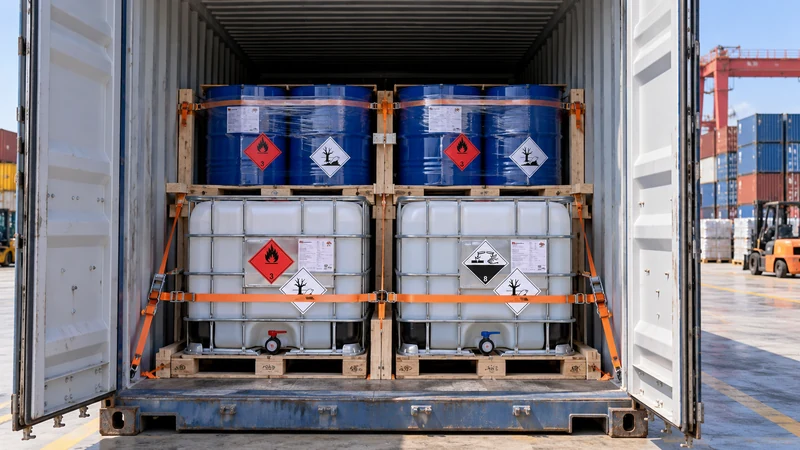
Securing
Drums, IBCs and other packages must be restrained to prevent movement during road and ocean transport.
Spill protection
Where appropriate, the loading arrangement should consider leakage containment and protection against package damage.
Placarding
Applicable placards and marks should correspond to the actual approved DG cargo.
Documentation
Where required, the container/vehicle packing certificate and DG documentation must be completed accurately.
Correct identification, classification, packaging, labelling, handling, loading, stowage and segregation are core elements of safe dangerous-goods transport.
Nigeria Destination Handling for Chemical and DG Cargo
Destination planning should begin before the container leaves China.
Do not assume that because a vessel accepts a DG container, every Nigerian terminal, local warehouse or trucking company will handle it in the same way as ordinary cargo.
Before shipment, confirm as applicable:
- discharge terminal acceptance
- maximum permitted dwell time
- whether direct delivery is required
- customs-clearance arrangements
- NAFDAC or SON inspection requirements
- hazardous-storage availability
- local truck acceptance
- route to final destination
- final-site unloading capability
- emergency contact arrangements
For industrial cargo, the final destination may be Lagos or another manufacturing area, or the cargo may need routing toward Port Harcourt, Onne or another industrial destination depending on the consignee and available shipping service.
The correct route should be selected from the actual cargo, consignee location and terminal acceptance—not from a general assumption that all Nigeria-bound chemicals should use one port.
Avoid Long Terminal Storage
DG storage can be expensive and operationally restrictive.
Delays caused by:
- missing permits
- incomplete customs documentation
- mismatched DG declarations
- importer readiness problems
- inspection delays
- lack of suitable local trucking
can create much higher charges than an ordinary dry-cargo delay.
For higher-risk chemicals, the destination clearance plan should therefore be prepared before departure.
Costs Beyond the Basic Freight Rate
The cheapest base ocean freight is rarely the correct way to compare chemical shipping options.
A DG quotation may contain additional costs such as:
- hazardous-cargo surcharge
- DG documentation fee
- carrier approval or handling fee
- special warehouse handling
- CFS DG fee
- specialized packaging
- container placarding
- inspection
- special equipment
- terminal DG surcharge
- destination hazardous-cargo handling
- regulatory permit fees
- testing or certification
- local hazardous-goods trucking
- restricted storage
- demurrage or storage caused by delayed clearance
- emergency or compliance support
The final cost can also change according to:
- UN number
- hazard class
- packing group
- flashpoint
- package size
- quantity
- routing
- vessel
- carrier
- transshipment port
- destination terminal
That is why a useful DG quote cannot be prepared from only “20 drums of chemical from Guangzhou to Lagos.”
Best Shipping Method for Chemicals from China to Nigeria
| Method | Best For | Main Requirement | Key Limitation |
|---|---|---|---|
| Non-DG sea freight | Properly classified non-dangerous chemicals | Reliable SDS and non-DG classification | Carrier may still request SDS or additional review |
| DG FCL | Larger hazardous shipments | Full DG declaration, compliant packaging and carrier approval | Higher handling and surcharge exposure |
| DG LCL | Smaller DG cargo where consolidation is available | Co-loader, CFS and carrier acceptance | Availability can be limited by class and route |
| Air DG | Small, urgent hazardous cargo | Current IATA classification, compliant packing and airline acceptance | Strict limits and high cost |
For larger industrial chemical shipments, DG FCL is often operationally simpler than trying to force a hazardous product into an LCL service that does not support the class.
For small urgent cargo, air freight can work—but only when the substance, quantity, packaging and airline restrictions allow it.
Chemical and DG Compliance Checklist
Before booking, confirm:
- exact chemical/product name
- manufacturer
- current SDS
- composition/concentration
- CAS number where applicable
- HS code
- Nigerian import eligibility
- NAFDAC route checked
- restricted-chemical status checked
- SON/SONCAP applicability checked
- other sector regulator checked where applicable
- UN number
- Proper Shipping Name
- class/division
- subsidiary risk
- packing group
- flashpoint where relevant
- marine-pollutant status
- net DG quantity
- packaging details
- Dangerous Goods Declaration
- carrier DG approval
- origin warehouse acceptance
- transshipment acceptance where applicable
- destination handling confirmed
Dangerous-Goods Packaging Checklist
Before cargo handover, verify as applicable:
- UN-approved packaging where required
- packaging compatible with the chemical
- correct closures
- no leakage or damage
- package labels applied
- UN marks applied
- orientation marks where required
- inner packaging protected
- spill-control measures considered
- pallets properly restrained
- incompatible products segregated
- container placards correct
- container inspected before loading
- cargo secured against movement
- emergency contact available
- packing certificate prepared where required
Cargo Data Required Before Quoting DG Freight
For dangerous-goods shipments, Winsail needs more information than for ordinary cargo.
Please prepare:
Product Details
- exact chemical or product name
- manufacturer
- latest SDS
- CAS number
- concentration or formulation
- intended use
Dangerous-Goods Details
- UN number
- Proper Shipping Name
- class/division
- subsidiary hazard
- packing group
- flashpoint
- marine-pollutant status
- limited-quantity status if applicable
Packing Details
- drums, IBCs, cartons, jerricans or other package type
- number of packages
- capacity per package
- net DG weight
- total product weight
- gross shipment weight
- pallet count
- package dimensions
Route Details
- supplier or pickup address in China
- preferred Chinese loading port or airport if known
- Nigerian destination
- whether delivery is required beyond the port/airport
- requested shipping mode
- target shipping date
Without this information, any DG rate should be treated as preliminary only.
Pro Tip
Do not deliver chemical cargo to Winsail’s warehouse until the SDS and transport classification have been reviewed and the booking or warehouse acceptance has been confirmed.
A supplier sending the cargo first and providing the SDS later can create serious problems.
If the product is subsequently identified as dangerous goods, an ordinary warehouse may not be permitted or willing to keep it, and the shipment may require repacking, transfer to another facility, additional documentation or a completely different carrier.
Review first. Deliver second.
Check DG Carrier Acceptance
Once the chemical identity and transport classification are clear, the next step is to check the actual route.
Carrier acceptance can depend on:
- UN number
- class
- packing group
- quantity
- packaging
- loading port
- destination port
- transshipment port
- vessel
- partner carrier
- destination-terminal rules
This is why Winsail cannot responsibly guarantee a DG booking before the technical file has been reviewed and the relevant carrier or handling party has approved it.
Final Guidance
Shipping chemicals and dangerous goods from China to Nigeria is not simply a matter of finding a container rate.
The safest workflow is:
Identify the chemical → confirm Nigerian import eligibility → establish competent transport classification → prepare the SDS and DG data → check packaging → obtain carrier acceptance → confirm destination handling → move the cargo.
The most expensive mistakes usually happen when that sequence is reversed.
A product may look ordinary in a supplier’s warehouse but still fall within a controlled Nigerian import category. A chemical may be legally importable but classified as dangerous for sea or air transport. A properly classified DG shipment may still be rejected by a particular carrier, vessel, transshipment port or consolidation warehouse.
Treat the SDS, regulatory review and carrier approval as part of the shipment itself—not paperwork to solve after the cargo has already reached the warehouse.
For related planning, review Shipping from China to Nigeria, Sea Freight from China to Nigeria, Air Freight from China and Customs Clearance & Cargo Insurance.
Regulatory review note: This guide reflects official information and transport-rule editions applicable in October 2026. IMDG Code Amendment 42-24 became mandatory on January 1, 2026, and the 2026 IATA Dangerous Goods Regulations are the 67th Edition. Nigerian regulator requirements, terminal rules and carrier acceptance policies can change, so the exact product and shipment should be rechecked before booking.
FAQ
Are all chemicals dangerous goods?
No. Many industrial chemicals are not regulated as dangerous goods for a particular mode of transport. Classification should be based on the actual substance, formulation and physical properties rather than the word “chemical” or a supplier's sales description.
Is an MSDS enough to book dangerous goods?
Usually not. The SDS is an important technical document, but a DG booking can also require a Dangerous Goods Declaration, UN number, Proper Shipping Name, class, packing group, package details, weights, flashpoint and other carrier-specific information. Carrier approval is still required.
What is a UN number?
A UN number is a four-digit identifier used in dangerous-goods transport for regulated dangerous substances, materials or articles. It is different from a customs HS code and a chemical CAS number.
What is a packing group?
Where applicable, the packing group indicates the degree of danger associated with a substance and influences packaging requirements. Packing Groups I, II and III may be used, but not every dangerous good is assigned a packing group.
Does NAFDAC regulate industrial chemicals?
NAFDAC publishes permit procedures for industrial and laboratory chemicals, but the exact route depends on the product and use. Separate procedures can apply to severely restricted chemicals, pesticides, agrochemicals, fertilizers and other regulated categories.
Can DG cargo ship LCL to Nigeria?
Potentially, but only when the complete transport chain accepts the cargo. The co-loader, CFS, ocean carrier, transshipment location and destination handling arrangement may all affect acceptance, and some DG shipments may require FCL or a specialized service.
Can dangerous goods be shipped by air?
Some dangerous goods can move by air when they comply with the current air-transport regulations and the selected airline accepts them. Air DG restrictions can be stricter than sea freight, especially for package quantity, packaging instructions and passenger-aircraft or cargo-aircraft limitations.
Can Winsail guarantee a chemical booking?
No responsible freight forwarder should guarantee acceptance before the product, classification, packaging, route and required approvals have been reviewed. Final acceptance remains subject to the relevant carrier, facility and regulatory requirements.
