
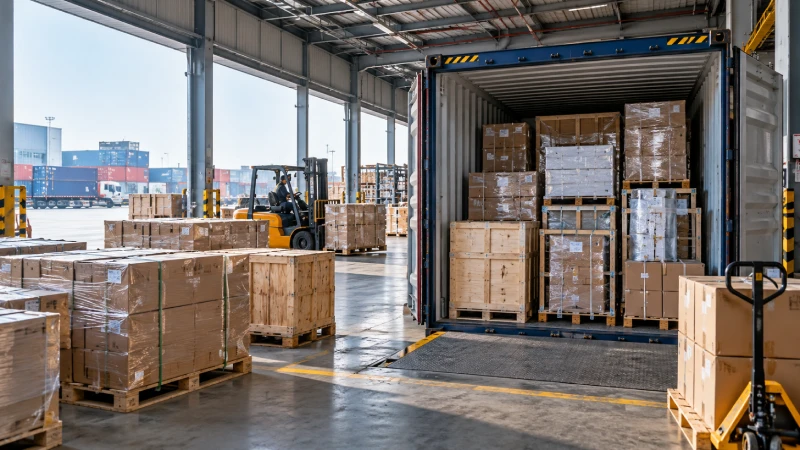
LCL shipping from China to Nigeria lets you ship commercial cargo by sea without paying for an entire container.
Instead of booking a 20ft or 40ft container exclusively for your goods, your shipment shares container space with cargo from other shippers moving toward the same destination.
That can make LCL an efficient option for smaller commercial shipments—but it also introduces two additional operational layers: consolidation in China and deconsolidation in Nigeria.
Your cartons or pallets must first enter a consolidation warehouse in China, where they are measured, checked and loaded together with other shipments. After the master container arrives in Nigeria, it must be unloaded and separated before your individual shipment can be released.
This means the right questions are not simply:
“What is the LCL rate per CBM?”
You should also ask:
- How will my cargo be measured?
- Is the quote based on CBM or W/M?
- What origin charges are included?
- Where will the cargo be consolidated in China?
- Who will deconsolidate the container in Nigeria?
- What destination charges will apply?
- How long will deconsolidation and release take?
- At what shipment size should I compare LCL with FCL?
For importers buying from Chinese factories, wholesalers or multiple suppliers, understanding these points is more important than choosing the lowest advertised rate per cubic meter.
If you are still comparing different transport modes, start with Shipping from China to Nigeria for the wider route overview, or review Sea Freight from China to Nigeria for the broader ocean-freight framework.
What LCL Means on the China–Nigeria Lane
LCL, or Less than Container Load, means your shipment does not occupy an entire ocean container.
A freight forwarder or co-loader combines your cargo with compatible shipments from other customers into a shared container. Each shipment remains separately documented even though several shipments travel inside the same master container.
A simplified China-to-Nigeria LCL movement looks like this:
Your supplier → China consolidation warehouse/CFS → shared container → ocean transport → Nigeria CFS/deconsolidation facility → individual cargo release
This differs from FCL shipping, where one shipper normally books the complete container and the container moves without being opened for consolidation with unrelated cargo.
LCL is commonly considered for:
- several cartons of commercial goods;
- palletized goods;
- shipments from one or several Chinese suppliers;
- cargo too large for economical air freight;
- cargo that does not economically justify a full container;
- regular replenishment orders where inventory is shipped in smaller batches.
LCL does not automatically mean that every shipment below a particular number of CBM should use LCL. The economic crossover with FCL depends on freight rates, local charges, cargo density and destination costs.
Pro Tip: Treat LCL as a complete logistics product, not simply “ocean freight sold per CBM.”
How LCL Cargo Is Consolidated in China
LCL shipping requires more handling at origin than FCL because individual shipments must be collected before the shared container can be loaded.
A typical process follows these stages.
1. Supplier Pickup or Warehouse Delivery
Your Chinese supplier may deliver the cargo to the nominated consolidation warehouse, or the freight forwarder can arrange pickup from the factory.
For buyers working with several Chinese suppliers, cargo can often be collected from different factories and brought into one consolidation point.
2. Cargo Receiving
The warehouse receives the cartons, crates or pallets and checks the shipment against the booking information.
Depending on the service and warehouse procedure, receiving records may include:
- number of packages;
- packaging condition;
- marks and labels;
- gross weight;
- dimensions;
- commodity description.
Any major discrepancy should be resolved before the shipment is loaded.
3. Final Measurement
The consolidation warehouse measures the actual cargo.
For a carton:
CBM = Length × Width × Height in metres
If one carton measures:
0.60 m × 0.40 m × 0.50 m
the volume is:
0.60 × 0.40 × 0.50 = 0.12 CBM
For 50 identical cartons:
0.12 × 50 = 6.00 CBM
The warehouse measurement can differ from the supplier’s estimate because of outer packaging, pallets, reinforcement, measurement rounding or changes made before delivery.
Pro Tip: Obtain the final warehouse measurement before relying on the supplier’s estimated CBM for your landed-cost calculation.
4. Export Documentation and Consolidation Planning
The forwarder or co-loader prepares the shipment for export and allocates cargo into a suitable consolidation.
Cargo compatibility matters. Dangerous goods, oversized cargo, restricted commodities, batteries, liquids and other special cargo may require separate approval or a different service.
5. Shared Container Loading
Approved shipments are loaded into the master container.
The co-loader must use the container efficiently while considering:
- weight distribution;
- stackability;
- packaging strength;
- cargo compatibility;
- handling requirements;
- destination separation.
6. Container Gate-In and Ocean Shipment
Once consolidation is complete, the container moves to the relevant container terminal and sails toward Nigeria according to the booked routing.
Your shipment travels as part of the consolidated container rather than as an independently controlled container.

How LCL Is Priced — CBM and W/M
One reason LCL quotations are frequently misunderstood is that several different charging methods can appear on the same quotation.
For a deeper route-level pricing overview, see Shipping Cost per CBM from China to Nigeria.
What Is CBM?
CBM means cubic metre and represents how much physical space your cargo occupies.
The basic formula is:
Length × Width × Height × Number of Packages
All dimensions must first be converted into metres.
For example:
40 cartons × 0.60 m × 0.40 m × 0.35 m
= 3.36 CBM
For light but bulky products, CBM is usually the most important number.
Examples include:
- furniture;
- plastic household products;
- empty containers or packaging;
- lightweight machinery parts;
- promotional displays.
What Does W/M Mean?
W/M means Weight or Measurement.
A common ocean LCL approach compares:
- weight measured in metric tonnes; and
- volume measured in cubic metres.
The larger charging unit is then used.
For example, under a tariff using 1 CBM = 1 metric tonne:
Shipment A
- Volume: 6 CBM
- Gross weight: 3,200 kg = 3.2 tonnes
Chargeable quantity: 6 W/M
Shipment B
- Volume: 2.5 CBM
- Gross weight: 4,000 kg = 4 tonnes
Chargeable quantity: 4 W/M
Maersk’s published LCL terms state that where volume is calculated in Weight and Measure Units, gross CBM or gross weight is compared and the higher figure is used, with 1 CBM equal to 1,000 kg under that methodology. However, do not assume every co-loader, local handling charge or inland service uses exactly the same density conversion.
Always confirm the calculation basis on the actual quotation.
Is There a Minimum LCL Charge?
Often, yes.
A co-loader may apply a minimum chargeable volume or minimum shipment amount even when your physical cargo is smaller.
For example, a shipment measuring only 0.45 CBM may still be charged according to a 1-CBM minimum if that is the service’s tariff.
But minimums are service-specific. Do not assume a 1-CBM minimum applies to every China–Nigeria consolidation.
LCL Quote Anatomy
| Charge | Typical Basis | Where Applied | What to Verify |
|---|---|---|---|
| Pickup | Per shipment / vehicle / distance | China | Supplier location and pickup scope |
| China CFS receiving | CBM, W/M or shipment | Origin | Minimum charge and warehouse basis |
| Export documentation | Per shipment | Origin | Which export documents are included |
| Consolidation handling | CBM/W-M | Origin | Loading and warehouse scope |
| Ocean freight | CBM/W-M | Main carriage | Base freight and applicable surcharges |
| Destination deconsolidation | CBM/W-M or shipment | Nigeria | Deconsolidator and calculation basis |
| Documentation / release | Per HBL / shipment | Nigeria | Delivery-order or document fees |
| Storage | Time-based | Nigeria | Free period and charging trigger |
| Customs clearance | Shipment / declaration | Nigeria | Included or excluded |
| Final delivery | Vehicle / distance / shipment | Nigeria | Destination city and unloading scope |
A quotation showing “USD X/CBM” therefore does not necessarily represent the final cost of moving your cargo from a Chinese factory to your Nigerian warehouse.
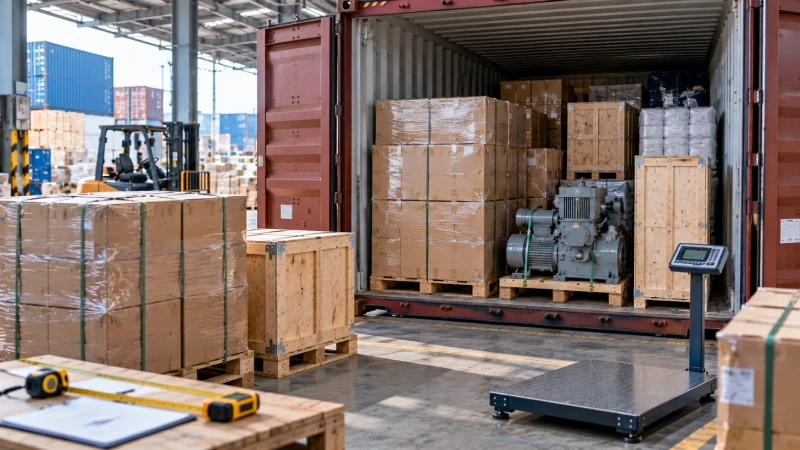
Current LCL Market Benchmark — Why Scope Matters
Public China-to-Nigeria LCL references show exactly why headline /CBM prices should be treated carefully.
As of October 2026, one published China–Nigeria LCL reference lists selected routes at approximately USD 150–195 per CBM, with a 1-CBM minimum. Importantly, that source describes the figures as indicative port-to-port ocean freight references and states that origin haulage, warehouse charges, customs-related costs, destination port charges and other surcharges are excluded.
Another October 2026 market guide publishes an LCL benchmark of approximately USD 435 per CBM for Lagos.
These figures should not be averaged into a supposed China-to-Nigeria market rate.
The gap is more useful as evidence that you need to ask:
What exactly is included in this number?
A lower /CBM figure may cover only one portion of the transportation chain, while another rate may be built around a different origin, consolidation product, sailing schedule, surcharge structure or destination arrangement.
Carrier surcharges can also change during the year. For budgeting, compare quotations only after aligning:
- Chinese origin;
- receiving warehouse;
- final measured CBM/W-M;
- destination;
- sailing schedule;
- ocean surcharge scope;
- origin CFS charges;
- Nigerian destination charges;
- customs-clearance scope;
- final-delivery scope.
Rate note — October 2026: Public values above are market references, not Winsail Logistics quotations. A shipment-specific rate should be reconfirmed using the current cargo dimensions, gross weight, commodity, China origin and Nigerian destination before booking.
LCL Routes and Nigerian CFS Handling
China-to-Nigeria LCL cargo does not necessarily follow exactly the same operational path as an FCL booking.
The forwarder may use a co-loader with an existing consolidation service. Your shipment enters that co-loader’s master container and follows the routing assigned to the consolidation.
Depending on the service, the container may:
- move directly to the discharge region;
- transship through another hub;
- connect onto another vessel;
- follow a schedule determined by the master consolidation.
This is one reason the lowest LCL rate is not always the best operational choice.
What Happens After the Master Container Arrives?
The master container must first be processed before your individual cargo can be collected.
Operationally, the sequence may look like:
Vessel arrival → container discharge → master container release → transfer/deconsolidation → container opened → individual shipments separated → HBL/document release → customs/release procedures → cargo pickup or delivery
The master container may move under a master bill of lading, while your individual shipment is represented by a house bill of lading or equivalent forwarder documentation.
Nigeria has several major seaport facilities, including Lagos Port Complex, Tin Can Island Port Complex and Lekki Deep Sea Port. However, that does not mean every China LCL consolidation can automatically be booked to every Nigerian container terminal.
The actual destination facility depends on the co-loader, carrier, master consolidation and destination agent.
Before the cargo sails, confirm:
- destination shown on the booking;
- Nigerian deconsolidation agent;
- destination CFS or nominated facility;
- HBL release procedure;
- destination-charge structure;
- cargo pickup requirements.
Pro Tip: Ask who the Nigeria deconsolidator or destination agent is before the container leaves China. This makes it easier to understand release procedures and destination charges in advance.
Why LCL Normally Takes Longer Than FCL
LCL and FCL may travel on similar ocean routes, but their total cargo handling timeline is not identical.
LCL needs additional time on both sides of the voyage.
Before Sailing: Cargo Receiving Window
An FCL container can move toward the terminal once loading and export requirements are complete.
LCL cargo usually has to arrive before the co-loader’s warehouse cut-off so it can be measured, processed and combined with other shipments.
Missing the consolidation cut-off may mean waiting for the next consolidation.
Consolidation Dependency
Your shipment does not control the master container.
The co-loader must coordinate enough compatible cargo, documentation and container loading to meet the planned sailing.
Destination Deconsolidation
After arrival in Nigeria, the shipment is not immediately available merely because the vessel has discharged the master container.
The container must be processed, moved to the relevant facility if required, opened and separated.
Only then can your individual shipment proceed through the applicable release process.
LCL vs FCL Timeline
| Stage | LCL | FCL |
|---|---|---|
| Supplier cargo ready | Required | Required |
| Origin warehouse receiving | Usually required | May not be required |
| Cargo measurement | Individual shipment measurement | Container booking/load planning |
| Consolidation wait | Yes | No shared-cargo consolidation |
| Ocean movement | Yes | Yes |
| Destination deconsolidation | Yes | No shared-container deconsolidation |
| Individual release coordination | Required | Container-level release |
| Customs and delivery | Required | Required |
Public references can show different transit benchmarks because they may measure different route and service scopes. For inventory planning, distinguish between:
port transit time
and
total time from supplier handover in China to cargo availability or final delivery in Nigeria.
For a wider comparison of route timing, read How Long Does It Take to Ship from China to Nigeria?.
Nigeria LCL Destination Charges
Destination charges are one of the most important parts of an LCL quotation.
Unlike a simple ocean-freight number, the Nigerian side may contain several cost categories.
Deconsolidation Charges
These relate to separating your shipment from the master container after arrival.
CFS or Handling Charges
Cargo may incur handling costs associated with unloading, warehouse processing and movement through the destination facility.
Documentation and Release Charges
The destination agent may charge for documents, HBL processing, release administration or similar services.
Storage
If the cargo remains at the facility beyond the applicable free period, storage can become payable.
The amount depends on the facility, cargo, number of days and local tariff.
Customs Clearance
Customs duties, taxes, regulatory requirements and customs-clearance services should not be confused with the basic LCL ocean freight rate.
Nigeria Customs procedures and documentation requirements should be confirmed for the actual commodity before shipment.
Final Delivery
Transport from the Lagos-area facility or other release location to your warehouse is another separate cost unless the quotation specifically includes it.
Delivery to Lagos is different from delivery to inland destinations such as Abuja, Kano, Ibadan or other Nigerian cities.
A dedicated Nigeria LCL destination-charge guide should be used for deeper local-fee analysis rather than turning the ocean-freight quote into a misleading all-in number.
Cargo Risks Specific to Shared Containers
Because your shipment shares a container and passes through additional handling stages, packaging quality is especially important.
Weak Cartons
Soft or under-strength cartons can deform when cargo is stacked nearby.
Use export-quality cartons suitable for warehouse handling and ocean transport.
Non-Stackable Cargo
If your cargo cannot support anything above it, inform the forwarder before booking.
Non-stackable cargo may reduce usable consolidation space and can affect pricing or acceptance.
Moisture
Ocean shipments can experience temperature and humidity changes.
Products sensitive to condensation should use appropriate moisture protection, internal wrapping, desiccants or stronger packaging where appropriate.
Mixed Cargo Environment
Your cargo may travel beside unrelated commercial goods.
The consolidator should assess compatibility, but packaging must still protect the product from normal transport and handling conditions.
Fragile or High-Value Goods
Every additional warehouse move increases handling exposure.
For fragile machinery, glass products, delicate instruments or high-value cargo, stronger crates, pallets or other protective packaging may be worth the additional cost.
Measurement Discrepancies
A supplier may report 5.2 CBM while the warehouse measures 5.8 CBM after including final packaging or pallets.
Since LCL charges are frequently measurement-based, this difference can affect the final invoice.
For this reason, calculate your margin using final warehouse measurements whenever possible.
When Should You Compare LCL with FCL?
There is no universal CBM number at which LCL automatically becomes more expensive than FCL.
The correct comparison is not:
LCL rate per CBM vs FCL ocean freight
Instead compare the complete structures.
LCL
LCL ocean freight
+ China receiving/consolidation costs
+ origin fixed charges
+ applicable surcharges
+ Nigeria deconsolidation and destination handling
+ release/storage costs if applicable
versus:
FCL
FCL ocean freight
+ container-related origin charges
+ destination terminal/container charges
+ applicable surcharges
+ trucking and clearance
As shipment volume increases, LCL’s variable CBM/W-M charges can eventually approach or exceed the cost of booking a complete container.
But the crossover point moves with the market.
LCL vs FCL
| Factor | LCL | FCL |
|---|---|---|
| Container space | Shared | Exclusive |
| Main pricing basis | CBM/W-M + local charges | Per container + local charges |
| Consolidation | Required | No shared consolidation |
| Deconsolidation | Required | No shared deconsolidation |
| Cargo handling | More individual handling | Generally less cargo handling |
| Small shipment economics | Usually stronger | Fixed container cost may be inefficient |
| Larger-volume economics | Declines as variable charges accumulate | Can become more competitive |
| Control | Lower | Higher |
| Fragile/high-value cargo | Requires careful packaging | Greater container-level control |
Decision Matrix
Small commercial shipment
→ LCL is a strong candidate.
Heavy, high-density cargo
→ Check the W/M calculation rather than relying only on CBM.
Cargo approaching full-container economics
→ Request both LCL and FCL quotations.
High-value, fragile or difficult-to-handle cargo
→ Compare the additional control of FCL, not only the freight rate.
Urgent small shipment
→ Compare air freight as well as LCL.
Container utilization does not need to reach 100% before FCL becomes worth considering. If your LCL landed logistics cost is approaching the cost of a 20GP, run both quotations.
For a broader mode-selection framework, see Best Shipping Methods from China to Nigeria.
Information Required for an LCL Booking
Accurate information at the beginning produces a more reliable LCL quote.
Send the forwarder:
1. Commodity
State exactly what you are shipping.
For example:
“LED commercial lighting fixtures”
is more useful than:
“electronics.”
2. Number and Type of Packages
Specify:
- cartons;
- pallets;
- wooden cases;
- crates;
- drums;
- other packaging.
3. Dimensions
Provide the external dimensions of each package type.
Use:
Length × Width × Height
and identify the unit clearly.
4. Gross Weight
Provide total gross weight including packaging and pallets.
This is necessary for W/M calculations and cargo planning.
5. Total CBM
Provide the supplier’s CBM estimate if available, but expect the consolidation warehouse to confirm the final measurement.
6. Stackability
Tell the forwarder whether other cargo can safely be placed above yours.
7. Supplier Location
Provide the factory or warehouse city in China.
Pickup from Guangzhou, Foshan, Shenzhen, Yiwu, Ningbo, Shanghai or another manufacturing region can create very different origin costs.
8. Cargo-Ready Date
The forwarder needs to know when the shipment will actually be available.
The cargo-ready date determines which consolidation cut-off and sailing can realistically be used.
9. Nigerian Final Destination
Do not provide only “Nigeria.”
Specify whether the cargo ultimately needs to reach:
- Lagos;
- Abuja;
- Kano;
- Ibadan;
- Port Harcourt;
- another city.
This allows the forwarder to separate port/CFS costs from inland delivery.
China-to-Nigeria LCL Process
A simple operational flow is:
Supplier
↓
Pickup or supplier delivery
↓
China consolidation warehouse / CFS
↓
Final measurement and receiving
↓
Export documentation
↓
Cargo consolidated into shared container
↓
Container terminal and ocean transport
↓
Nigeria destination facility / CFS
↓
Master container deconsolidation
↓
Individual shipment / HBL release
↓
Customs clearance
↓
Cargo pickup or final delivery
The ocean voyage is only one part of the total LCL process. Origin consolidation and Nigerian deconsolidation are equally important when estimating actual lead time and landed cost.
Which Shipping Option Should You Compare?
LCL Shipping
Best starting point when you have a commercial sea shipment that does not justify a dedicated container.
Compare:
- W/M;
- origin fixed charges;
- destination handling;
- consolidation schedule;
- total release time.
20GP FCL
Request an FCL comparison when your LCL volume and destination charges become substantial.
Do not wait for the cargo to physically fill every cubic metre of a 20ft container before comparing the economics.
Air Freight
For small, valuable or urgent shipments, compare air freight against LCL.
A higher freight rate can still be commercially justified if faster arrival prevents:
- stockouts;
- production downtime;
- missed project deadlines;
- lost seasonal sales.
For urgent commercial cargo, see Air Freight from China to Nigeria.
The correct shipping method is therefore determined by total logistics cost and business timing, not simply by the lowest freight rate.
Check Your LCL Shipment Before Booking
For an accurate LCL shipping from China to Nigeria quotation, prepare:
- commodity;
- number of cartons or pallets;
- dimensions;
- gross weight;
- estimated CBM;
- supplier city in China;
- cargo-ready date;
- stackability;
- Nigerian destination city.
Winsail Logistics handles shipments originating from China and can use these details to check the applicable consolidation option, current rate basis and destination arrangement.
Check LCL Rate
Send your cargo dimensions, gross weight, commodity and China pickup location to check the current LCL option.
Compare LCL vs FCL
If your cargo volume is becoming significant, compare both LCL and 20GP pricing instead of assuming LCL remains cheaper.
Send Dimensions & Weight
If your supplier has already provided a packing list, send the carton dimensions and gross weight so the shipment’s CBM and likely W/M basis can be reviewed.
FAQ
What is LCL shipping from China to Nigeria?
LCL, or Less than Container Load, allows your cargo to share an ocean container with shipments from other customers. Your goods are consolidated in China, transported inside a master container and separated again at the destination before individual release.
How is LCL charged per CBM?
For volume-based cargo, the forwarder calculates the space occupied by your shipment in cubic metres. Some charges may instead use W/M, and origin, destination, documentation and delivery charges can apply separately.
What does W/M mean?
W/M means Weight or Measurement. Under a common LCL methodology, cargo volume in cubic metres is compared with cargo weight in metric tonnes and the higher applicable charging quantity is used. The exact rule should be confirmed on the quotation.
Is there a minimum LCL charge?
Many LCL services apply a minimum volume or minimum shipment charge. A 1-CBM minimum is common in some services, but it is not universal and should be confirmed for the actual consolidation.
Why does LCL take longer than FCL?
LCL requires consolidation before sailing and deconsolidation after arrival. Cargo must meet warehouse cut-offs, share a master container and wait for individual separation and release at destination.
What happens at the Nigeria CFS?
The master container is processed and opened, individual shipments are separated, and shipment documents are matched before the cargo can proceed through the applicable release and customs procedures.
Are destination charges included?
Not always. Destination CFS handling, deconsolidation, documentation, storage, customs clearance, duties, taxes and final delivery may be separate unless the quotation clearly states they are included.
When should I switch from LCL to FCL?
There is no fixed CBM threshold. Compare the complete LCL cost with the complete FCL cost once your shipment uses a meaningful amount of container capacity or when handling control, cargo value or fragility makes a dedicated container more attractive.
