
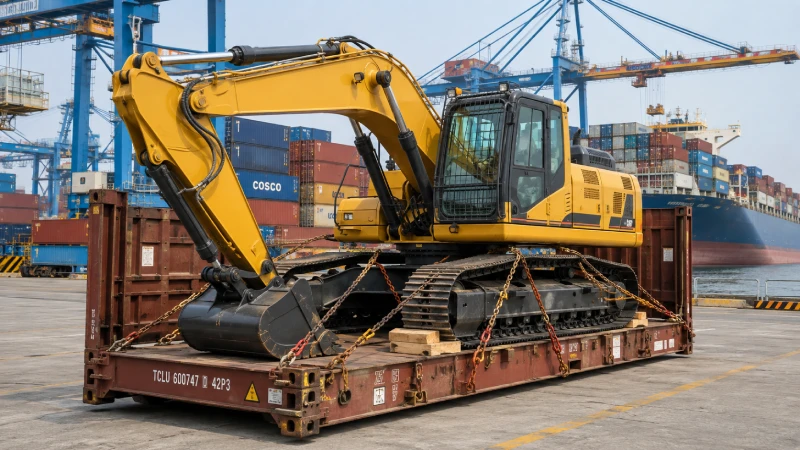
Shipping construction machinery from China to Ghana is not the same as booking a standard container shipment. An excavator, wheel loader, bulldozer, road roller or large forklift may require a 40HQ container, flat rack, RoRo service or breakbulk solution depending on its final transport dimensions, gross weight, operating condition and securing requirements.
The most important step is therefore not asking, “How much does it cost to ship one excavator?” It is defining exactly what will be shipped, in what configuration, and how the machine will move from the Chinese factory to Tema and then to its final site in Ghana.
For a broader overview of the trade lane, see shipping from China to Ghana.
Quick Answer: Which Shipping Method Fits Your Construction Machine?
There is no single best method for shipping heavy equipment to Ghana.
A compact machine may fit inside a standard container after approved preparation. A wider or taller excavator may be better suited to a flat rack. Self-propelled machinery may be suitable for RoRo, while very large, heavy or irregular equipment may require breakbulk or another project cargo solution.
A practical decision sequence is:
Can the machine fit safely inside an enclosed container in its final shipping configuration?
If not:
Can it be safely loaded and secured on a flat rack within the carrier’s equipment and OOG limits?
If that is not practical:
Can the machinery be accepted by a RoRo carrier as rolling cargo or carrier-handled static cargo?
If none of these options is suitable, a breakbulk or engineered project cargo solution may be required.
Höegh Autoliners, for example, states that its RoRo services handle both rolling and non-rolling machinery, with static machinery transported on rolltrailers. This is why “non-running” does not automatically mean “RoRo is impossible.” Carrier and route acceptance must still be confirmed for the actual shipment.
Equipment Shipping Method Selector
| Shipping Method | Usually Suitable For | Main Limitation |
|---|---|---|
| Standard Container | Compact machinery or suitably dismantled equipment | Door opening, internal dimensions, payload and floor loading |
| Flat Rack | Oversized machinery that can be safely unitised on special container equipment | OOG dimensions, point loads, center of gravity and securing |
| RoRo | Self-propelled equipment and some carrier-accepted static machinery | Route, dimensions, operability and carrier acceptance |
| Breakbulk | Very large, heavy or irregular project equipment | Lifting, stowage, securing and port handling plan |
The machine name alone is never enough to select the method.
Measure the Machine Before You Request a Freight Quote
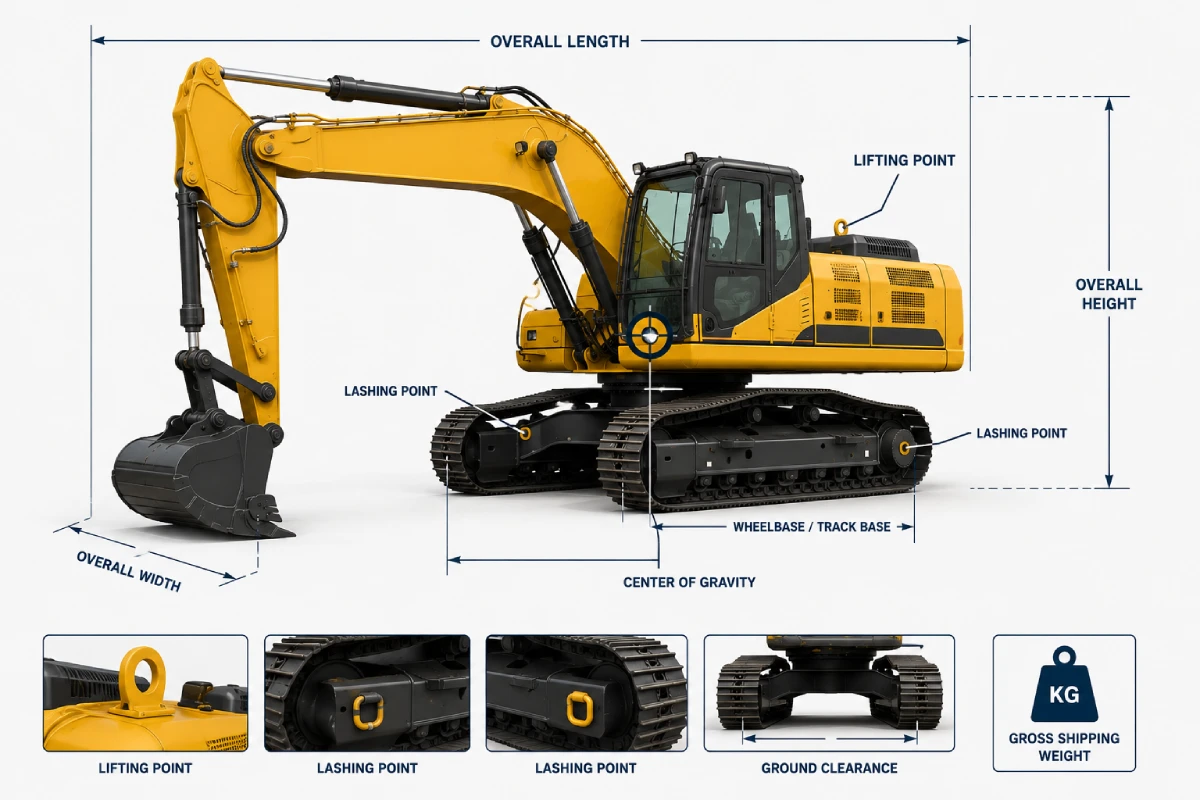
One of the most common problems in China to Ghana machinery shipping is an incomplete inquiry such as:
“Please quote one excavator from China to Tema.”
Two excavators with similar operating weights can have very different transport profiles. Boom position, bucket size, track width, counterweight, cab height and attachments can all change the shipping solution.
At minimum, provide:
- Overall length in shipping position
- Overall width
- Overall height
- Gross shipping weight
- Wheelbase or track dimensions
- Ground clearance
- Center of gravity, if available
- Lifting points
- Lashing or securing points
- Attachment dimensions and weights
Operating Dimensions Are Not Shipping Dimensions
The dimensions shown in a manufacturer’s brochure may describe the machine in its normal operating configuration. Ocean shipping requires the dimensions of the actual configuration presented for transport.
For example, an excavator may travel with its boom lowered, bucket repositioned or removed, mirrors folded and selected attachments shipped separately.
If anything is removed or repositioned, measure the machine again.
This is especially important for OOG cargo. Maersk advises shippers to update the final dimensions when they become available after lashing and pickup, and notes that lashing materials, dunnage and other protrusions can affect the declared OOG envelope.
Machine Shipping Specification Sheet
Before requesting a workable quotation, prepare:
- Equipment type, manufacturer and model
- Quantity
- New or used condition
- Final shipping L × W × H
- Gross weight
- Photos from front, rear and both sides
- Track or wheel dimensions
- Ground clearance
- Attachments
- Center of gravity, if available
- Lifting and securing points
- Whether the machine starts, steers and brakes
- Fuel type and battery type
- China pickup address
- Final destination in Ghana
Accurate information at this stage helps prevent the shipping method from changing after the machine has already left the factory.
Shipping Construction Machinery from China to Ghana: Container vs Flat Rack vs RoRo vs Breakbulk
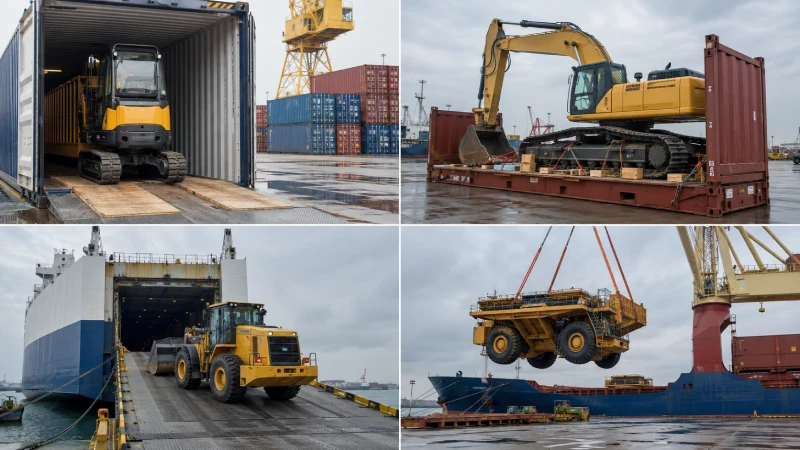
40HQ or Standard Container
A standard container may work for compact construction machines, smaller forklifts, attachments or machinery that can be safely reduced to a container-compatible transport profile.
Do not judge suitability only by nominal machine weight.
The actual checks include:
- Container door opening
- Internal length, width and height
- Payload
- Floor loading
- Safe loading method
- Space required for blocking and securing
- Dimensions of removed components
A machine that appears to “fit” geometrically may still be unsuitable because of excessive point loads or an unsafe loading arrangement.
For more general FCL and ocean-shipping information, see sea freight from China to Ghana.
Flat Rack for OOG Machinery
Flat racks are commonly evaluated for crawler excavators, loaders, bulldozers, rollers and other equipment that exceeds the usable dimensions of an enclosed container.
The decision is based on more than length and width. A proper flat rack assessment should consider:
- Final OOG dimensions
- Gross weight
- Center of gravity
- Track or wheel contact area
- Point loads
- Weight distribution
- Required timber or bedding
- Blocking and bracing
- Lashing points
- Carrier approval
An excavator that can physically sit on a flat rack is not automatically ready for shipment. The load must also be structurally acceptable and capable of being secured for ocean transport.
RoRo for Self-Propelled and Static Equipment
RoRo can be attractive for machines that can be driven safely aboard the vessel because loading does not require stuffing them into an enclosed container.
For self-propelled machinery, confirm:
- Starting condition
- Steering
- Braking
- Ground clearance
- Safe ramp movement
- Machine-specific carrier requirements
Static or non-running machinery may also be carried on specialised rolltrailers where an appropriate RoRo carrier accepts the cargo. Höegh specifically describes static machinery being transported on rolltrailers rather than excluding it simply because it cannot move under its own power.
However, do not assume that a China-to-Tema RoRo sailing or suitable space is always available. Service, routing, equipment and cargo acceptance should be checked for each booking.
Breakbulk for Large Project Cargo
Breakbulk becomes relevant when equipment is too large, heavy or irregular for a practical container or flat rack solution, or when multiple project units require an engineered vessel-loading plan.
Typical considerations include:
- Lifting points
- Center of gravity
- Crane and rigging requirements
- Bedding
- Vessel stowage
- Securing calculations
- Port handling
- Heavy-haul interface at destination
For mining, infrastructure and industrial projects, the lowest ocean freight figure should not be considered separately from lifting, port handling and inland transport.
Construction Machinery Shipping Decision Table
| Equipment Type | Typical Profile | Possible Methods | Main Limitation | Required Before Quoting |
|---|---|---|---|---|
| Mini excavator | Compact | Container / FR / RoRo | Container fit and attachment position | Final L/W/H, weight, photos |
| Crawler excavator | Medium to OOG | FR / RoRo / Breakbulk | Width, CoG, track loads | Dimensions, weight, boom/bucket configuration |
| Large excavator | Large OOG | FR / RoRo / Breakbulk | Weight and stowage | Drawings, CoG, lifting/securing points |
| Wheel loader | Medium to large | Container in limited cases / FR / RoRo | Height, width and articulation | L/W/H, weight, wheelbase |
| Bulldozer | Wide tracked | FR / RoRo / Breakbulk | Blade width and track loading | Blade position, dimensions and weight |
| Road roller | Compact to medium | Container / FR / RoRo | Width, weight and operability | Dimensions, weight and condition |
| Forklift | Compact to large | Container / FR / RoRo | Mast height, fuel or battery | Mast position, L/W/H and power type |
| Crane / mining unit | Large project cargo | FR / RoRo / Breakbulk | Lift, CoG and project handling | Drawings and engineering data |
Can Disassembly Reduce Machinery Shipping Cost?
Sometimes.
Removing a bucket, lowering or detaching an attachment, folding rails or mirrors, or changing the transport configuration may reduce the machine’s shipping envelope.
But freight saving is only one side of the calculation.
| Component | Possible Shipping Benefit | Reassembly Risk |
|---|---|---|
| Bucket or attachment | Reduce length or profile | Low to medium |
| Mirrors / rails | Reduce external dimensions | Low |
| Detachable exhaust | Reduce height | Low to medium |
| Wheels / tyres | Reduce width or height | Medium |
| Boom / arm components | Significant dimensional reduction | High |
| Counterweight | Change weight or profile | High |
| Cab / protective structure | Significant height reduction | Very high |
Major dismantling may require cranes, qualified technicians, hydraulic-system protection, correct torque procedures, replacement seals, calibration or commissioning in Ghana.
The right question is therefore not “Can it be removed?” but:
Will the transport benefit justify the dismantling and reassembly risk?
Always follow manufacturer procedures and use qualified technicians for major disassembly.
Pre-Shipment Preparation for Excavators, Loaders and Heavy Equipment
Before pickup, inspect the machine for loose components, damaged hoses and active fuel or hydraulic leaks.
Fuel, Hydraulic Oil and Batteries
Do not rely on a universal rule such as “leave exactly X% fuel.”
Requirements can vary by carrier, machine type and transport mode.
Before shipment:
- Confirm the booked carrier’s permitted fuel condition
- Identify battery chemistry
- Confirm whether batteries must be isolated or disconnected
- Declare spare or lithium batteries where applicable
- Check whether the machine or any component requires dangerous-goods review
- Repair active fuel or hydraulic leaks
If a machine must drive aboard a RoRo vessel, it also needs enough operational capability to complete the required terminal movements safely.
Clean Used Machinery Before Shipping
Used excavators and tracked equipment should be cleaned thoroughly before transport.
Remove:
- Mud
- Soil
- Seeds
- Plant residue
- Material trapped around tracks and undercarriage
Cleaning reduces inspection, contamination and handling risks. If significant soil or plant contamination is present, the importer should confirm any specific phytosanitary requirement that may apply.
Wood Packaging and ISPM 15
Flat rack shipments often use wooden dunnage, blocks or crates.
ISPM 15 applies to regulated raw-wood packaging material such as pallets, crates and dunnage used in international trade. Processed materials such as plywood are treated differently under the standard.
Flat Rack Loading, Blocking, Bracing and Lashing
Flat rack securing should start with the machine’s weight distribution and center of gravity, not with the question of how many chains are available.
A suitable plan considers:
- Longitudinal and transverse center of gravity
- Track or wheel contact areas
- Point loads
- Flat rack structural limits
- Bedding and weight spreading
- Anti-slip materials
- Blocking and bracing
- Rated securing points
- Lashing capacity and geometry
- Protection of machinery surfaces and hydraulic components
The securing arrangement must control movement caused by acceleration, rolling and pitching during transport.
The IMO/ILO/UNECE CTU Code provides international guidance for loading and securing cargo in cargo transport units and intermodal transport.
There is no responsible universal rule stating that an excavator needs a fixed number of chains. Lashing design depends on cargo weight, geometry, securing points and the transport unit.
After securing is completed, confirm the final OOG dimensions again.
For packed containers subject to SOLAS requirements, the shipper is also responsible for providing the Verified Gross Mass in time for vessel stowage planning; VGM is a condition for loading.
Flat Rack Cargo Risk Checklist
- Final L × W × H confirmed
- Gross weight verified
- Center of gravity identified where required
- Contact and point loads checked
- Suitable bedding installed
- Anti-slip arrangement considered
- Blocking and bracing completed
- Approved lashing points used
- Attachments secured
- Final OOG envelope remeasured
- VGM arranged where applicable
- Loading photographs retained
Who Is Responsible for Loading and Securing the Machine?
Never assume that “the shipping line will handle everything.”
Responsibilities should be agreed before pickup.
| Task | Typical Party |
|---|---|
| Machine technical data | Supplier / manufacturer |
| Transport configuration | Manufacturer + logistics team |
| Factory loading | Factory or appointed contractor |
| China inland transport | Heavy-haul contractor |
| OOG booking | Forwarder / carrier |
| Flat rack loading and securing | Appointed loading/lashing contractor |
| Carrier acceptance | Shipping line |
| Vessel stowage | Carrier / terminal |
| Ghana customs declaration | Importer / authorised clearing agent |
| Ghana inland heavy haul | Destination transport contractor |
Incoterms are important commercially, but they do not replace a clear operational scope for crane work, lashing, surveys, special equipment or project delivery.
China Factory Pickup and Export Handling
For oversized machinery, the project can become technically complex before the cargo reaches the Chinese port.
The logistics team first uses the final machine dimensions to select a suitable low-bed, flatbed or other transport arrangement. For larger equipment, the critical measurement is not only the excavator itself but the loaded vehicle plus cargo combination.
Under China’s current road rules, cargo vehicles can fall within oversize-transport controls when the loaded combination exceeds specified dimensional or weight limits. Current Ministry of Transport guidance identifies, among other thresholds, a loaded height above 4 metres, width above 2.55 metres or length above 18.1 metres; indivisible oversized cargo may require the relevant permit procedure.
A typical origin workflow is:
Final machine configuration → Measurement → Trailer selection → Oversize road check → Factory loading → Port/depot delivery → Loading and securing → Export handling
This is another reason dimensional data should be collected before the machine is dispatched from the supplier.
Arrival at Tema: Unloading, Customs and Inland Haulage
Tema is Ghana’s largest port, and GPHA states that the port handles containerised cargo, general cargo, machinery/equipment and vehicles, while RoRo vessels also call at Tema.
But “arrival at Tema” is not the end of a machinery shipment.
The discharge plan should be prepared before the vessel arrives.
Plan the Tema Discharge by Shipping Method
Container:
Plan container release, devanning and the crane, forklift or ramp required to remove the machine safely.
Flat Rack:
Confirm how the unit will be lifted or transferred, whether a low-bed must be positioned, and which lifting points will be used.
RoRo:
Confirm whether the machine will drive off under its own power or be handled as static cargo.
Breakbulk:
Coordinate lifting, rigging, stevedoring and the receiving trailer as one operation.
Do not rely on a generic published “Tema crane fee” or assumed lifting capacity. The actual terminal, carrier, unit weight and discharge arrangement must be checked for the shipment.
Ghana Import Documents for Construction Machinery
Ghana Revenue Authority currently lists core import documents including the Bill of Lading or waybill, attested invoice, packing list, Import Declaration Form, importer tax identification information and any permits required by relevant regulatory agencies. Customs declarations are processed through ICUMS, including classification, valuation and approval.
For a machinery shipment, also keep the technical documents organised:
- Machine specification
- Model and serial/nameplate information
- Dimensions and gross weight
- Packing list for detached attachments
- Loading or securing documentation where required
- Battery or dangerous-goods documents where applicable
For a more detailed Ghana import procedure, see customs clearance in Ghana.
How Do You Determine the Correct HS Code?
Do not use a generic “construction machinery duty rate.”
Classification depends on the machine’s actual function and configuration.
GRA currently identifies bulldozers, wheel/pay/shovel loaders, excavators, graders and road rollers as off-highway machinery, with these examples shown under heading 8429. That distinction is important because construction equipment should not automatically be treated as passenger vehicles merely because it is self-propelled.
However, that does not mean every type of equipment shares the same tariff classification. Forklifts, cranes and specialised machinery can fall under different headings.
Confirm the exact HS code and current tax treatment before shipment rather than estimating machinery import duty from a generic online percentage.
New vs Used Machinery
Ghana Standards Authority currently lists industrial machinery among its broad groupings of High Risk Goods subject to its import-inspection framework. The exact conformity route should therefore be confirmed for the specific machine and classification before it leaves China.
For used machinery, condition, serial information, contamination and supporting documents deserve additional attention.
Do not automatically apply Ghana’s used-passenger-vehicle rules to excavators, loaders, bulldozers or rollers. GRA itself distinguishes several of these machines as off-highway machinery.
Likewise, EasyPASS should not simply be described as a new mandatory programme for every importer. GSA clarified in July 2026 that EasyPASS introduces no new universal obligation on businesses that do not opt into the programme; those businesses continue under existing conformity-assessment arrangements.
Tema to Accra, Kumasi, Takoradi or the Project Site
For large equipment, inland delivery should be planned at the same time as ocean freight.
Check:
- Low-bed or trailer type
- Loaded dimensions
- Axle distribution and gross weight
- Road access
- Bridges and overhead clearances
- Turns and narrow sections
- Site entrance
- Final unloading equipment
The Ghana Highway Authority states that it controls axle loading, gross weight and truck dimensions on the road network, and its weighing protocol includes checks of truck length, height and width.
For oversized project cargo, a route-specific assessment is therefore more reliable than assuming a machine released from Tema can immediately travel to any inland site.
What Determines the Total Cost of Shipping Heavy Equipment to Ghana?
The lowest ocean freight line item does not necessarily produce the lowest total project cost.
Container
Cost may include:
- Factory pickup
- Dismantling
- Stuffing and securing
- Ocean freight
- Destination handling
- Devanning
- Reassembly
- Customs and inland delivery
Flat Rack
Additional cost drivers can include:
- Special equipment
- OOG dimensions
- Crane loading
- Timber and anti-slip materials
- Lashing
- Survey or engineering where required
- Special terminal handling
- Destination lift
- Low-bed delivery
RoRo
The quotation may depend on:
- Dimensions
- Weight
- Machine type
- Rolling or static condition
- Route availability
- Terminal handling
- Special rolltrailer or cargo-handling requirements
Breakbulk
The cost structure may add:
- Lifting
- Rigging
- Stowage
- Securing
- Stevedoring
- Surveys
- Project staging
- Heavy inland transport
Current market rates change with carrier capacity, route and equipment availability. For pricing context rather than machinery engineering, see shipping cost from China to Ghana.
Common Costly Mistakes When Shipping Construction Machinery
The mistakes that create the largest unexpected costs usually happen before the vessel departs:
- Requesting a quote for “one excavator” without dimensions and weight.
- Using catalogue dimensions instead of final shipping dimensions.
- Removing components but failing to remeasure the machine.
- Assuming a machine fits a 40HQ without checking the door, payload and floor load.
- Selecting RoRo before confirming route and carrier acceptance.
- Dismantling major components without a reassembly plan in Ghana.
- Ignoring oversize transport between the Chinese factory and port.
- Treating an excavator as though it were a passenger vehicle for Ghana import rules.
- Waiting until arrival at Tema to arrange the destination low-bed.
- Using non-compliant raw-wood dunnage where ISPM 15 applies.
The best time to solve these problems is before the machine moves from the supplier’s yard.
What Information Should You Send for a Machinery Shipping Quote?
A complete inquiry allows the forwarder to screen Container, Flat Rack, RoRo and Breakbulk options before pricing.
Send:
- Equipment type and model
- Quantity
- New or used
- Final shipping L × W × H
- Gross weight
- Photos from all sides
- Attachment sizes and weights
- Wheel or track dimensions
- Ground clearance
- Center of gravity if available
- Lifting and lashing points
- Whether the machine starts, steers and brakes
- Fuel and battery type
- China pickup address
- Factory loading capability
- Cargo-ready date
- Ghana port and final project location
- Incoterm
- Whether approved dismantling is acceptable
For oversized machinery, the objective should be to confirm the cargo configuration first and price the correct logistics solution second.
FAQ
Can an excavator fit inside a 40HQ container?
Sometimes. Suitability depends on the excavator's final shipping dimensions, gross weight, container door opening, payload, floor loading and whether approved disassembly is practical. Do not decide only by excavator tonnage or model category.
Is Flat Rack or RoRo better for shipping an excavator to Ghana?
Neither is universally better. Compare final dimensions, weight, operating condition, carrier acceptance, route availability, loading method, destination handling and inland delivery. Flat Rack may suit OOG machines that can be safely secured on special container equipment, while RoRo can be attractive for carrier-accepted rolling or static machinery.
Can a non-running excavator be shipped by RoRo?
Potentially. RoRo carriers can transport certain non-rolling or static machinery using specialised rolltrailers or other handling equipment. Acceptance depends on the carrier, service, cargo dimensions, weight and handling arrangement rather than simply whether the engine starts.
What information is needed to quote an excavator shipment from China to Ghana?
Provide the final transport length, width and height, gross weight, model, photos, attachment data, operating condition, lifting or securing information, China pickup location and final Ghana destination. More complex OOG cargo may also require center-of-gravity and technical drawings.
What documents are required to import construction machinery into Ghana?
Typical core documents include the Bill of Lading, commercial invoice, packing list, current import declaration documentation and any permits or certificates required for the actual equipment. Machinery technical data may also be needed for classification, compliance and cargo handling.
How much import duty is charged on an excavator in Ghana?
There is no responsible single percentage that should be applied to every excavator. Duty and taxes depend on the exact HS classification, customs value and current Ghana tariff treatment. Confirm the correct tariff line with GRA or the authorised clearing agent before shipment.
Do used excavators follow the same Ghana import rules as used cars?
Not automatically. Ghana Revenue Authority currently identifies excavators, bulldozers, loaders, graders and road rollers as off-highway machinery. Passenger-vehicle rules should therefore not be copied to construction machinery without confirming the equipment's actual tariff and regulatory classification.
