
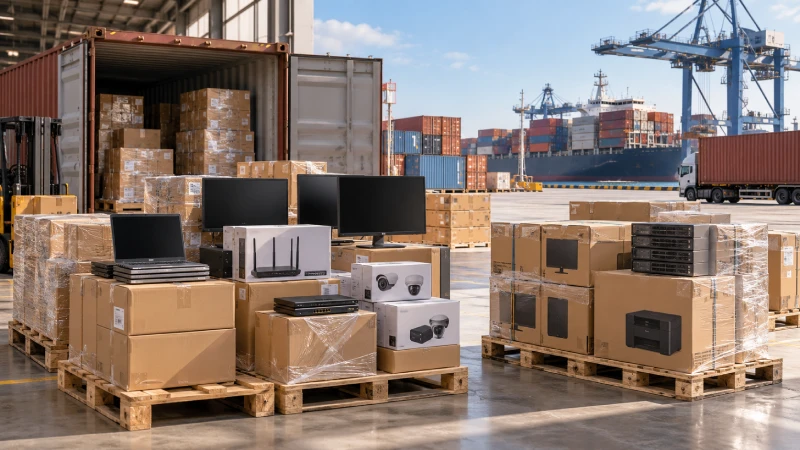
Shipping electronics from China to Kenya requires more preparation than simply choosing between air and sea freight.
A laptop, Wi-Fi router, CCTV camera, industrial control board and power bank may all be described as “electronics,” but they do not necessarily follow the same freight, customs or regulatory process.
The correct shipping plan depends on the exact product, model, function, battery configuration, HS classification and intended use in Kenya.
For some products, the main issue is freight cost. For others, a lithium battery can affect carrier acceptance. Communications equipment may require Communications Authority of Kenya review or Type Approval, while products within the KEBS conformity framework may need PVoC processing and a Certificate of Conformity before shipment.
For this reason, electronics importers should complete the compliance and cargo screening process before asking only:
“How much does it cost to ship electronics from China to Kenya?”
The better first question is:
“What exactly am I importing, and what must be checked before it leaves China?”
For a broader overview of shipping methods, costs, transit planning, customs and inland delivery, see our Shipping from China to Kenya guide.
Data Note — September 2026: Kenyan import documentation and regulatory requirements referenced in this guide were checked against current information from the Kenya Revenue Authority (KRA), Kenya Bureau of Standards (KEBS), Communications Authority of Kenya (CA), Kenya Ports Authority (KPA), ICAO, IATA and IMO. Freight rates, airline acceptance, carrier restrictions and product-specific regulatory requirements can change. Exact requirements should therefore be confirmed against the actual product and shipment before booking.
Quick Answer: How Should You Ship Electronics from China to Kenya?
You can ship most compliant electronics from China to Kenya by express, air freight, sea LCL or sea FCL, but the best method depends on more than shipment weight.
Before choosing a freight method, confirm:
- the exact product and model;
- what the product does;
- whether it has Wi-Fi, Bluetooth, cellular, radio or other communications functions;
- whether it contains lithium batteries;
- whether batteries are standalone, packed with equipment or contained inside the equipment;
- the likely HS classification;
- whether KEBS/PVoC requirements apply;
- whether Communications Authority Type Approval or another product-specific approval applies;
- the required Kenya import and China export documents; and
- cargo value, packaging, dimensions and delivery destination.
For small, urgent or high-value electronics, air freight may be practical.
For larger commercial orders, LCL or FCL sea freight may reduce transport cost.
However, batteries, dangerous-goods classification, carrier acceptance or missing compliance documents can override the normal air-versus-sea decision.
The safest approach is therefore:
Product → Model → Function → Battery → HS Code → Kenya Compliance → Freight Method → Documents → Cargo Protection → Clearance
Before Shipping, Identify the Exact Electronics
“Electronic products” is not a sufficient cargo description for planning a China-to-Kenya shipment.
Before supplier pickup, the importer and freight forwarder should know exactly what is being shipped.
At minimum, prepare:
- exact commercial product name;
- manufacturer;
- brand;
- model number;
- primary function;
- intended use;
- quantity;
- unit value and total cargo value;
- carton count;
- carton dimensions;
- gross weight;
- whether the goods are new or used;
- whether the product uses Wi-Fi, Bluetooth, cellular or radio functions;
- whether it contains batteries;
- battery chemistry;
- battery voltage and capacity;
- Watt-hour rating where applicable; and
- how the battery is presented with the product.
Why “Electronic Equipment” Is Not Enough
Consider these six products:
| Product | Battery issue | Communications issue | Main questions before shipping |
|---|---|---|---|
| Desktop monitor | Usually limited | Usually limited | HS code, KEBS requirements |
| Laptop | Battery contained in equipment | Wi-Fi/Bluetooth | Battery documentation, HS code, applicable conformity requirements |
| Smartphone | Battery contained in equipment | Cellular/Wi-Fi/Bluetooth | Battery rules, CA status, KEBS requirements |
| Wi-Fi router | Depends on model | Yes | CA Type Approval status, KEBS requirements |
| Power bank | Primarily a battery product | Usually limited | Dangerous-goods classification and carrier acceptance |
| Industrial control board | Product-specific | Product-specific | Function, HS code, regulator and battery status |
This table is a screening tool only. It does not mean every product in a row automatically has the same Kenyan regulatory requirement.
The exact specification and model matter.
Product Function and Model Can Change the Compliance Path
This is particularly important for telecommunications and radio equipment.
The Communications Authority of Kenya states that communications equipment intended to send, process or receive information within public telecommunications networks is subject to Type Approval. Its examples include mobile cellular devices, routers, modems, switches and radio communications equipment. CA also states that Type Approval is carried out for each equipment model.
That means an importer should not assume:
- one approved router means every router from the same manufacturer is approved;
- a visually similar model has the same approval;
- all CCTV equipment follows the same regulatory path;
- all “smart devices” can be treated identically.
CA’s Type Approved Equipment information also warns that its published list is not exhaustive and recommends confirming the approval status of the particular equipment where necessary.
Build a SKU and Compliance Sheet Before Pickup
For shipments involving several models, build a simple spreadsheet before arranging collection.
For each SKU include:
- product description;
- model;
- quantity;
- unit value;
- country of origin;
- HS code or proposed HS code;
- battery status;
- battery specifications;
- wireless/radio functions;
- KEBS/PVoC status;
- CA status if relevant;
- supplier;
- pickup address;
- cargo-ready date; and
- available supporting documents.
This becomes especially useful when consolidating products from several Chinese factories.
Air vs Sea Freight for Electronics from China to Kenya
There is no universal weight at which electronics should automatically switch from air freight to sea freight.
The right shipping method depends on the relationship between:
- weight;
- volume;
- cargo value;
- urgency;
- inventory requirements;
- battery status;
- handling sensitivity;
- carrier acceptance; and
- final destination.
When Air Freight Makes Sense for Electronics
Air freight is often considered for electronics that are:
- relatively compact;
- high in value compared with their weight;
- urgently required;
- needed to restore inventory;
- part of a project with a fixed installation date; or
- more expensive to hold out of stock than to transport by air.
Examples could include certain computer equipment, electronics components, industrial electronics or urgent replacement equipment.
But do not make the decision from gross weight alone.
Air cargo can be charged using chargeable weight, which considers actual weight and volumetric weight. A shipment that looks lightweight may still be expensive to fly if it occupies substantial aircraft space.
Battery-powered equipment also needs additional screening before an air booking is confirmed.
For more detail on airport routing, consolidation and chargeable weight, see our air freight service from China.
When Sea LCL Is Practical
LCL can make sense when a shipment is too large to justify air freight but does not require a full container.
It may suit:
- multiple cartons of electronics;
- commercial replenishment orders;
- several supplier shipments consolidated in China;
- bulky but non-urgent electronics;
- equipment where freight cost matters more than speed.
However, LCL normally involves consolidation and deconsolidation activity.
For sensitive or high-value cargo, packaging and handling controls therefore deserve more attention than they would for ordinary low-value goods.
For Kenya-specific ocean routing, see sea freight from China to Kenya.
When FCL Provides Better Cargo Control
FCL becomes worth evaluating when cargo volume increases or when the importer wants better control over how the container is loaded.
For suitable shipments, FCL can reduce the amount of co-loading interaction associated with LCL.
It may be useful for:
- large electronics orders;
- project equipment;
- mixed SKUs from several factories;
- higher-value commercial shipments;
- sensitive equipment requiring deliberate loading arrangements.
FCL does not eliminate risks such as condensation, movement or poor packaging. Container loading still needs to be planned correctly.
For larger container shipments, our ocean freight service covers FCL, LCL, consolidation and special-cargo planning.
What About Express Freight?
Express courier services can be practical for certain:
- samples;
- replacement parts;
- small orders;
- urgent compliant electronics.
But a normal courier parcel should not be used as a way to avoid dangerous-goods or import compliance requirements.
Battery restrictions, product regulations and customs requirements can still apply.
| Decision factor | Express | Air Freight | Sea LCL | Sea FCL |
|---|---|---|---|---|
| Very small shipment | Strong option | Possible | Usually less attractive | Poor fit |
| Urgent cargo | Strong | Strong | Weak | Weak |
| High-value, compact cargo | Often suitable | Often suitable | Possible with controls | Suitable at larger volume |
| Bulky electronics | Limited | Can become costly | Strong option | Strong option |
| Lithium battery cargo | Carrier-specific | Configuration-sensitive | DG review may apply | DG review may apply |
| Multi-supplier consolidation | Limited | Possible | Strong | Strong |
| Large commercial order | Weak | Depends on value/urgency | Possible | Often worth comparing |
Actual freight cost and transit time should be checked using the shipment’s current cargo data and booking date rather than relying on a static online rate table.
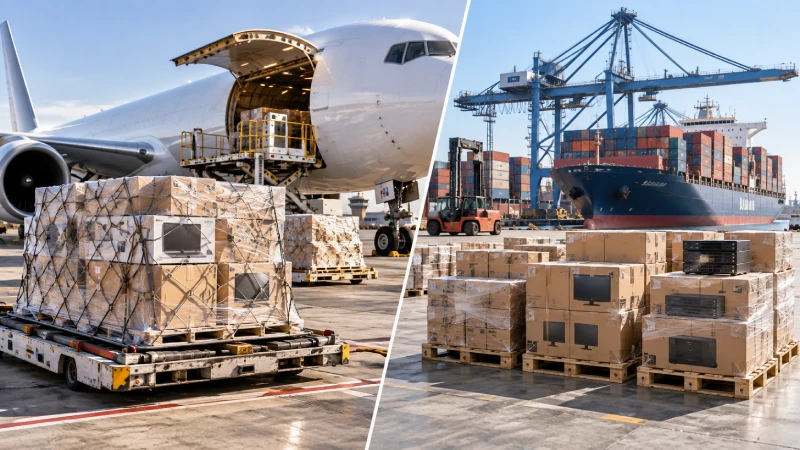
Lithium Batteries Can Change the Shipping Plan
Lithium batteries are one of the most important issues when shipping electronics from China to Kenya.
The first question is not simply:
“Does this product contain a lithium battery?”
You also need to know how the battery is presented for transport.
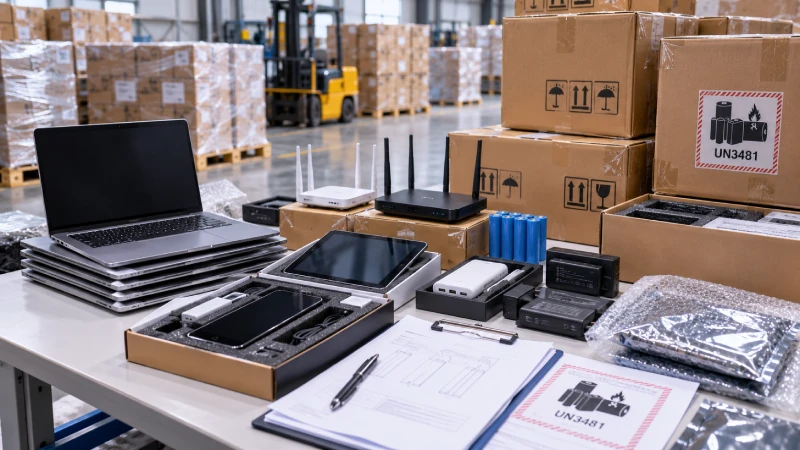
For lithium-ion batteries, common configurations include:
- UN3480 — lithium-ion batteries shipped as batteries
- UN3481 — lithium-ion batteries packed with equipment
- UN3481 — lithium-ion batteries contained in equipment
These categories can lead to different packing, documentation, marking and carrier requirements.
Standalone Batteries vs Batteries Packed With Equipment
A power bank and a laptop are both battery-related products, but they should not automatically be treated in the same way.
IATA’s lithium battery guidance describes power banks as batteries for transport purposes. It also distinguishes batteries packed with equipment from batteries contained inside equipment.
Therefore, before requesting a freight booking, obtain:
- battery chemistry;
- manufacturer;
- battery model;
- nominal voltage;
- capacity in Ah or mAh;
- Watt-hour rating;
- number of batteries;
- battery weight where relevant;
- whether the battery is standalone;
- packed with the device; or
- installed inside the device.
For lithium battery designs subject to transport testing requirements, the supplier should also be able to provide the relevant UN 38.3 test information.
Shipping Battery-Powered Electronics by Air
International air dangerous-goods requirements are based on the ICAO Technical Instructions, supplemented operationally by requirements such as the IATA Dangerous Goods Regulations and individual airline variations.
As of September 2026, the applicable ICAO Technical Instructions are the 2025–2026 edition, valid through December 31, 2026.
Whether a particular electronics shipment can move by air can depend on factors such as:
- battery type;
- Watt-hour rating;
- battery configuration;
- quantity;
- state-of-charge requirements;
- packaging;
- marks and labels;
- documentation;
- aircraft restrictions;
- origin airport;
- airline acceptance; and
- operator variations.
Do not assume that because one airline accepted a previous laptop, battery pack or electronic device, the next shipment will automatically be accepted under the same conditions.
Shipping Battery-Powered Electronics by Sea
Lithium batteries transported by sea are also regulated dangerous goods when applicable.
The IMDG Code 2024 Edition incorporating Amendment 42-24 became mandatory on January 1, 2026.
Ocean acceptance should therefore be checked against the actual battery classification and carrier requirements before goods are delivered for loading.
When Battery and Non-Battery Products Should Be Split
Suppose an importer purchases:
- tablets from Supplier A;
- network switches from Supplier B;
- power banks from Supplier C; and
- monitors from Supplier D.
It may be tempting to consolidate all four suppliers into one shipment immediately.
That is not always the best first step.
The standalone battery products may require a different transport assessment or booking arrangement. If one SKU has incomplete battery documentation, it could delay cargo that would otherwise be ready to ship.
Pro Tip: Screen every SKU for battery status before deciding the final consolidation plan. One battery product can change the transport requirements for the shipment.
KEBS, PVoC and CA Type Approval for Electronics
Electronics importers frequently confuse several different documents and approvals.
A Certificate of Conformity, Certificate of Origin, Communications Authority Type Approval and lithium battery transport document do not perform the same function.
KEBS PVoC and Certificate of Conformity
The Kenya Bureau of Standards operates the Pre-Export Verification of Conformity program to assess applicable products in the country of supply or origin against relevant Kenyan standards or approved specifications.
KEBS states that exporters of products subject to PVoC should ensure compliance before shipment and obtain the necessary Certificate of Conformity from an appointed PVoC agent where required. China is currently listed within PVoC Zone 1.
For an electronics importer, the practical lesson is simple:
Check the PVoC status before cargo leaves China.
Do not wait until the shipment arrives in Kenya to ask whether the product needed conformity assessment.
Some categories or circumstances may qualify for exemptions or other treatment, so this should still be checked against the actual cargo rather than applying one rule to all electronics.
When Communications Authority Type Approval May Apply
KEBS conformity and CA Type Approval are separate issues.
If a product communicates through a telecommunications network or uses regulated radio communications functions, the importer should determine whether CA Type Approval applies.
The Communications Authority identifies equipment including:
- mobile cellular devices;
- radio communications equipment;
- routers;
- modems;
- switches; and
- other communications/network equipment
within its Type Approval framework.
This makes the exact model and function particularly important for products such as:
- smartphones;
- routers;
- wireless gateways;
- certain CCTV systems;
- cellular IoT devices;
- communications terminals; and
- radio-enabled equipment.
Check the Exact Model Before the Supplier Ships
Do not check only the brand.
A manufacturer’s Model A and Model B may differ in:
- radio bands;
- cellular functions;
- Wi-Fi specifications;
- hardware;
- firmware;
- technical standards; or
- intended market.
CA publishes a Type Approved Equipment register and had an August 2026 equipment list available at the time this guide was updated. However, CA explicitly states that the published list is not exhaustive and advises users to confirm the Type Approval status of equipment where necessary.
For regulated communications equipment, model verification should therefore happen before shipment.
Other Product-Specific Regulators
Some electronics may fall into specialized regulatory categories.
Examples can include certain:
- medical devices;
- radio systems;
- drones;
- measurement equipment;
- industrial systems; or
- specialized energy products.
Do not assume KEBS and CA are the only possible authorities for every electronic product.
The applicable regulator should be confirmed from the product’s exact function and intended use.
Do Not Confuse These Documents
| Document / approval | Main purpose | When to investigate |
|---|---|---|
| KEBS Certificate of Conformity | Product conformity | Products subject to applicable PVoC requirements |
| Certificate of Origin | Evidence of origin | Kenya import documentation requirement, subject to published exceptions/provisional measures |
| CA Type Approval | Communications equipment compliance | Covered telecom/radio/network equipment |
| Battery / DG documentation | Transport safety | Applicable dangerous-goods shipments |
KRA’s Certificate of Origin requirement and KEBS conformity requirements are not interchangeable. KRA states that full enforcement of the mandatory COO requirement began on October 1, 2025, subject to stated exceptions and provisional measures.
Pro Tip: Before paying the supplier’s final balance or releasing cargo to the freight warehouse, verify the exact model, battery information and known Kenya compliance requirements. This is an operational recommendation, not a substitute for regulator or customs advice.
HS Classification, Import Duty and Kenya Customs
There is no single “electronics import duty” for Kenya.
Electronics can fall under many different tariff headings depending on:
- what the product does;
- its technical construction;
- its main function;
- how it is used;
- incorporated components; and
- how the product is presented for import.
A router cannot automatically use the tariff classification of a computer.
A security camera cannot automatically use the same classification as a normal video camera.
A power supply, display module, industrial controller and complete machine may also follow different classifications.
Why the HS Code Matters
The HS classification can affect:
- import duty;
- VAT treatment;
- levies;
- regulatory requirements;
- documentation;
- customs declaration; and
- landed-cost calculations.
That is why landed cost should normally be calculated after, not before, the product classification has been reasonably established.
What Information Helps Determine the HS Code?
Give the clearing agent or classification specialist enough technical information to understand the product.
Useful information includes:
- commercial name;
- technical name;
- model;
- product brochure;
- technical datasheet;
- material/components;
- principal function;
- operating method;
- communication features;
- power source;
- photographs; and
- intended use.
A vague invoice description such as “electronic accessories” makes accurate classification more difficult.
When an Advance Ruling May Be Useful
Where classification is genuinely uncertain or commercially important, Kenya Revenue Authority provides formal mechanisms for tariff classification and advance rulings.
KRA’s HS and tariff guidance describes an advance ruling as a ruling issued under the East African Community Customs Management Act and states that tariff rulings provide the applicable HS classification for specified goods.
This can be relevant to an importer bringing in substantial quantities of a technical product repeatedly.
Avoid Generic Online Tax Tables
A web page that says:
“Electronics duty in Kenya is X%”
should not be used as the basis for purchasing or landed-cost decisions.
Before shipment, confirm the current treatment for the actual tariff line, including where relevant:
- import duty;
- VAT;
- excise duty;
- Import Declaration Fee;
- Railway Development Levy;
- exemptions; and
- any product-specific charges.
Actual rates should be checked against the current tariff and applicable law before publishing or using them in a commercial calculation.
Documents to Prepare Before the Goods Leave China
Electronics shipments are easier to manage when the document file is prepared before cargo reaches the export warehouse.
Kenya Revenue Authority’s current import guidance identifies documents including a commercial invoice, packing list, Bill of Lading or Air Waybill, Certificate of Origin, relevant CoC and applicable permits or licences among documents that may be required for import clearance. KRA also states that import clearance requires the engagement of a licensed customs clearing agent.
Core Commercial and Freight Documents
Depending on the shipment, prepare:
- commercial invoice;
- packing list;
- purchase order or contract where relevant;
- Bill of Lading for sea freight;
- Air Waybill for air freight;
- freight invoice where applicable;
- Certificate of Origin;
- China export documentation; and
- insurance documentation if cargo insurance is arranged.
Product Compliance Documents — Where Applicable
Depending on the product:
- KEBS Certificate of Conformity;
- PVoC-related documentation;
- CA Type Approval information;
- product permit or licence;
- technical datasheet;
- manufacturer declarations; and
- other regulator-specific documents.
Battery Documentation — Where Applicable
For lithium battery products, the freight file may also need information such as:
- battery specification;
- UN38.3 test summary;
- battery configuration;
- applicable dangerous-goods declaration;
- package information;
- marks and labels; and
- additional documentation requested by the carrier or forwarder.
An SDS may be requested operationally in some cases, but it should not be described as a universal statutory requirement for every lithium battery shipment.
2026 Update: Kenya Importers Need to Retain Export Documentation
Kenya introduced an important documentation requirement in 2026.
KRA states that from September 1, 2026, importers must obtain and retain an export declaration, export entry, customs export certificate or equivalent document from the country of export.
The document should contain information including the:
- exporter;
- importer;
- goods description;
- quantity;
- value;
- tariff classification; and
- country of export.
KRA says the importer should retain the documentation for at least five years and produce it if requested.
For a Kenya importer buying electronics from China, this creates an important supplier-management task.
Do not treat Chinese export documentation as something that only the factory or export agent needs.
Agree before shipment:
- who will export the goods from China;
- which entity appears as exporter;
- which export document will be available;
- whether the description matches the commercial transaction; and
- how the Kenyan importer will receive and retain the record.
ACD for Containerized Sea Freight to Kenya
Kenya also launched the Advance Cargo Declaration platform for containerized cargo destined for Kenyan ports on August 3, 2026.
KRA states that exporters shipping applicable containerized cargo to Kenya must obtain an ACD reference code at the point of loading.
The ACD application currently requires:
- draft Bill of Lading;
- commercial invoice;
- freight invoice; and
- export declaration.
The generated ACD reference is then endorsed on the Bill of Lading before the shipment proceeds to Kenya.
This is particularly relevant when shipping electronics by container to Mombasa.
It should not be presented as a generic requirement for air freight.
For LCL shipments, house/master Bill of Lading workflow and carrier implementation should be confirmed for the actual booking rather than assumed.
Supplier Pickup and Electronics Consolidation in China
Many Kenyan electronics importers do not purchase everything from one supplier.
A typical order may involve:
- laptops from Shenzhen;
- CCTV equipment from Guangzhou;
- power adapters from Dongguan;
- accessories from Yiwu; and
- packaging from another factory.
Consolidation can reduce fragmented international shipments, but it should be planned around cargo compatibility and compliance—not simply around the number of suppliers.
Collect Cargo Data Before Supplier Pickup
Before arranging collection, ask each Chinese supplier for:
- company and pickup address;
- contact person;
- cargo-ready date;
- product and model;
- quantities;
- cartons;
- carton dimensions;
- gross weight;
- cargo value;
- battery information;
- packaging photos if useful;
- PVoC/CoC preparation status;
- technical documents;
- export-document availability.
If the supplier says:
“Battery included”
ask for the actual specification.
If the invoice says:
“Electronic device”
ask for a better description.
If the supplier says:
“Kenya certificate is no problem”
ask which certificate they mean.
Consolidating Electronics From Several Suppliers
Once cargo arrives at the consolidation warehouse, operational checks may include, depending on the agreed service scope:
- receiving carton count;
- checking visible packaging condition;
- checking carton marks;
- measuring dimensions;
- checking weight;
- matching cargo against supplier references; and
- separating products with different shipping requirements.
This is not the same as a full technical quality inspection.
If you need functional testing, factory inspection or product-quality verification, define that separately rather than assuming freight-warehouse receiving covers it.
For multi-supplier orders, see Winsail’s China LCL consolidation service and warehouse and consolidation service.
When One SKU Should Be Shipped Separately
A mixed electronics shipment may need to be split when:
- one supplier is not ready;
- one model lacks required conformity documentation;
- one SKU contains standalone lithium batteries;
- one product requires another carrier or DG arrangement;
- one item has materially different security requirements;
- regulatory approval is incomplete; or
- waiting for one product would delay the entire shipment.
The cheapest theoretical consolidation is not always the lowest-risk shipping plan.
Protecting High-Value Electronics During Transport
Electronics can be vulnerable to more than visible physical damage.
A complete cargo-protection plan should consider:
- moisture;
- shock and handling;
- theft or loss; and
- insurance.
Protect Electronics Against Moisture
Ocean freight exposes cargo to a long transport cycle with changes in temperature and humidity.
Depending on the product and packaging design, moisture-control measures may include:
- dry export cartons;
- moisture-barrier packaging;
- desiccants;
- protective liners;
- palletization;
- keeping cartons away from wet surfaces;
- suitable dunnage; and
- inspecting container condition before loading.
Desiccants do not guarantee that condensation cannot occur.
The packaging system should be designed for the product, route and expected storage conditions rather than adding a few desiccant bags without calculation.
Reduce Shock and Handling Damage
For sensitive electronics, consider:
- reinforced export cartons;
- molded foam or suitable cushioning;
- protection around displays and vulnerable components;
- stable pallet loads;
- anti-static protection where appropriate;
- sufficient internal support;
- avoiding excessive empty space inside cartons; and
- securing cargo to reduce movement.
For LCL shipments, packaging should account for the additional consolidation and deconsolidation handling that may occur during the transport chain.
Control Theft and Handover Risk
High-value cargo deserves clear chain-of-custody procedures.
Useful controls can include:
- neutral outer packaging where practical;
- clear carton numbering;
- serialized inventory for appropriate equipment;
- handover records;
- loading photographs;
- seal-number records;
- controlled warehouse access;
- minimizing unnecessary handling; and
- appropriate tracking solutions.
Avoid printing unnecessary high-value product information on external cartons if it does not serve an operational purpose.
Consider Cargo Insurance
Freight carrier liability is not the same as cargo insurance.
Before shipping high-value electronics, review:
- insured value;
- policy basis;
- deductible;
- theft coverage;
- breakage coverage;
- moisture/water exclusions;
- packaging conditions;
- geographic coverage;
- claim documentation; and
- any special requirements for high-value cargo.
Do not assume that purchasing “insurance” automatically covers every possible type of electronics loss.
What Happens When Electronics Arrive in Kenya?
The Kenya-side process depends partly on whether the shipment arrives by ocean or air and how the transport document and final delivery are structured.
Sea Freight via Mombasa
For ocean freight, the basic movement may be:
China → Port of Mombasa → customs/compliance procedures → release or inland movement → final destination
If the final customer is in Nairobi, the logistics plan should be agreed before shipment rather than assuming the container will automatically follow one inland route.
Mombasa to Nairobi ICD
Kenya Ports Authority operates inland container depots, including Nairobi ICD.
KPA states that Nairobi ICD is linked to the Port of Mombasa by both Standard Gauge Railway and Meter Gauge Rail services, and imports may move from Mombasa to inland depots using through-Bill-of-Lading arrangements or other applicable haulage structures.
That does not mean every sea shipment for a Nairobi consignee automatically clears at Nairobi ICD.
The actual routing depends on factors including:
- Bill of Lading arrangement;
- carrier;
- container status;
- customs process;
- inland transport plan; and
- delivery requirements.
Air Cargo Into Nairobi
For air freight, the operational flow is typically simpler:
China airport → Nairobi → cargo handling → customs/regulatory checks → release → inland delivery
But “airport arrival” does not mean immediate release.
Documents and product approvals still need to support the import declaration.
Coordinate the Clearing Agent Before Arrival
KRA requires licensed customs clearing agents for the customs-clearance process.
For electronics, the clearing agent should receive relevant documents early enough to review issues before the cargo arrives.
This may include:
- commercial invoice;
- packing list;
- transport document;
- Certificate of Origin;
- HS classification information;
- CoC where applicable;
- CA information where applicable;
- permits;
- battery information; and
- other technical documents relevant to the product.
Sending the documents after the vessel or aircraft arrives can turn a solvable pre-shipment question into a clearance delay.
DAP, DDP and Door-to-Door Shipping for Electronics
Door-to-door shipping is often attractive to electronics importers because it simplifies freight coordination.
However:
A door-to-door service or DDP quotation does not make product-compliance requirements disappear.
DAP for Electronics
Under a DAP arrangement, the seller arranges transport to the agreed destination, but the buyer generally remains responsible for import clearance and import duties/taxes.
For a Kenya electronics shipment, the importer still needs to understand:
- product compliance;
- customs classification;
- required approvals;
- importer responsibilities; and
- clearing-agent coordination.
DDP for Electronics
DDP places broader obligations on the seller under the Incoterm, including import-related responsibilities.
In practice, however, a workable DDP electronics shipment still depends on the legal and operational structure available for the exact cargo.
Questions to resolve include:
- Who is the importer?
- Who can legally make the customs declaration?
- Who holds product approvals?
- Who is responsible for duties and taxes?
- Does the exact electronic product require additional regulatory authorization?
- Does the local DDP arrangement cover that regulated product?
- Is the lithium battery configuration acceptable under the planned transport?
Therefore, do not accept the phrase:
“DDP Kenya, all included”
without understanding what is actually included and which entity is fulfilling the importer-side obligations.
Responsibility Still Has to Be Defined
| Task | China supplier/exporter | Freight forwarder | Kenya importer | Clearing agent |
|---|---|---|---|---|
| Accurate product/model information | Key role | Reviews for shipping | Confirms purchase | Uses for declaration |
| China export documents | Key role | Coordinates | Retains required records | May reference |
| Freight booking | Supports | Key role | Approves | — |
| Battery freight screening | Provides data | Key role | Confirms product | Supports if relevant |
| Kenya import eligibility | Supports documents | Coordinates | Key role | Advises/processes |
| Customs declaration | — | Coordinates where included | Authorizes | Key role |
| Product approvals | Provides supporting documents | Coordinates | Must ensure applicable compliance | Supports clearance |
The exact contractual responsibilities still depend on the agreed Incoterm and service scope.
What Information Should You Send Before Requesting a Freight Plan?
A message that says:
“I have electronics from China to Nairobi. How much?”
is not enough to produce a reliable shipping recommendation.
For a useful air, LCL, FCL or door-to-door assessment, send the following information.
Electronics Freight Checklist
China origin
- supplier city;
- pickup address;
- number of suppliers;
- cargo-ready date.
Product
- exact product name;
- brand;
- model;
- main function;
- intended use;
- whether it has Wi-Fi, Bluetooth, cellular or radio functions.
Battery
- battery yes/no;
- chemistry;
- voltage;
- Ah/mAh;
- Wh;
- standalone / packed with equipment / contained in equipment;
- UN38.3 documentation status.
Cargo
- quantity;
- cartons;
- pallets if applicable;
- carton dimensions;
- gross weight;
- total CBM;
- cargo value.
Compliance
- HS code if known;
- KEBS/PVoC status;
- CoC status;
- CA Type Approval status if relevant;
- other permits if applicable.
Shipment
- final destination in Kenya;
- preferred shipping method if any;
- urgency;
- supplier Incoterm;
- insurance requirement;
- port/airport delivery or door delivery;
- DAP/DDP requirement if applicable.
With this information, a freight forwarder can assess the shipment instead of giving a generic price that may change once the battery, dimensions or compliance status becomes clear.
FAQ
Can I ship laptops and phones with lithium batteries from China to Kenya by air?
Potentially, yes, but acceptance depends on battery configuration, specifications, quantity, packing and applicable air dangerous-goods requirements. Batteries contained inside equipment are treated differently from standalone batteries such as power banks. Provide the battery chemistry, Watt-hour rating, quantity, configuration and UN38.3 information before booking.
Do all electronics imported into Kenya need KEBS PVoC and a Certificate of Conformity?
No single rule should be assumed for every electronic product. KEBS operates PVoC for applicable regulated products and may provide exemptions or other procedures in specific cases. Check the exact product and applicable standard before shipment.
Which electronics require Communications Authority Type Approval in Kenya?
CA Type Approval can apply to communications and radio equipment such as mobile cellular devices, routers, modems, switches and radio equipment. Because approval is model-specific, check the exact equipment rather than relying only on the brand or general product category.
Is a KEBS Certificate of Conformity the same as a Certificate of Origin?
No. A Certificate of Conformity relates to product conformity under the applicable KEBS/PVoC framework, while a Certificate of Origin establishes the origin of imported goods for customs documentation purposes.
Do electronics shipped by sea need Kenya’s Advance Cargo Declaration?
The ACD requirement is not triggered because the cargo is electronic. It applies to applicable containerized cargo destined for Kenyan ports. For the exact sea booking, confirm the current procedure with the shipping line or freight forwarder.
How do I find the correct Kenya HS code and import duty for electronics?
Start with the product's exact function and technical specification. Provide the model, datasheet, components and intended use to the customs clearing agent or classification specialist. Where classification is uncertain, KRA provides tariff-ruling and advance-ruling mechanisms.
Is LCL safe for expensive electronics, or should I use air or FCL?
There is no universal answer. Compare cargo value, shipment size, urgency, packaging, moisture sensitivity, handling exposure, battery status, insurance and total delivered cost. Well-packed electronics can move by LCL, but high-value or highly sensitive shipments may justify comparing air freight or FCL.
Plan Your Electronics Shipment Before the Cargo Leaves China
Shipping electronics from China to Kenya becomes much easier when compliance, freight and supplier coordination are handled in the correct order.
Do not begin with:
“Air or sea?”
Begin with:
What exactly is the product?
Then determine:
Exact model and function
→ Battery configuration
→ HS classification
→ KEBS/PVoC requirements
→ CA or other regulator requirements
→ Shipping method
→ China export documents
→ Cargo protection
→ Kenya customs clearance
→ Inland delivery
This approach is particularly important for importers buying several electronics SKUs or sourcing from multiple Chinese factories.
If you are planning an electronics shipment from China to Kenya, prepare the supplier locations, product models, battery specifications, quantities, carton dimensions, weight, cargo value and final Kenya destination before requesting a freight plan.
That information makes it possible to compare realistic shipping options and identify compliance or battery issues before they become expensive problems after the goods are already in transit.
