
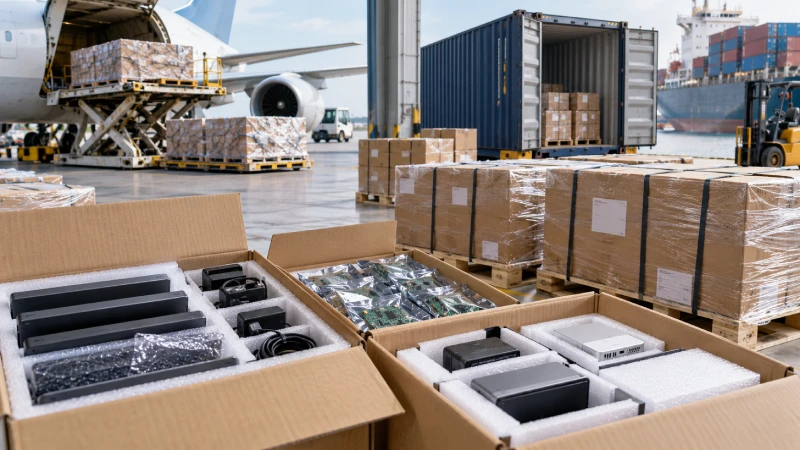
Shipping electronics from China to the UK involves more than finding a freight rate and choosing between air and sea. Electronic products can be relatively high in value, sensitive to moisture or impact, vulnerable to electrostatic discharge, and in some cases subject to lithium battery transport restrictions.
There is also a second issue that should be handled separately: UK product compliance.
Being able to transport an electronic product into the UK does not automatically mean it is compliant for sale there. Likewise, having CE or UKCA-related documentation does not automatically mean an electronic product containing lithium batteries can travel as ordinary general cargo.
A practical shipping plan therefore starts with two separate questions:
- How should the electronics be transported from China to the UK?
- Which UK product rules apply to this specific electronic product?
For the first question, importers usually compare express courier, air freight, LCL sea freight and FCL sea freight.
For the second, the answer can depend on the product’s function, voltage, radio capability, battery configuration and intended market. Electrical safety, EMC, RoHS, conformity marking, battery obligations and WEEE may be relevant—but they should never be applied as one identical checklist to every product described simply as “electronics.”
For a broader overview of route options, customs, transit planning and delivery choices, see Shipping from China to the UK.
Quick Answer: What Is the Best Way to Ship Electronics from China to the UK?
There is no single best freight method for electronics. Small urgent samples may be better by express, while commercial stock may justify standard air freight. Larger non-urgent orders can move by LCL or FCL sea freight.
A useful starting comparison is:
| Shipping Method | Practical Starting Profile | Volume | Urgency | Best Fit for Electronics | Main Watch-Out |
|---|---|---|---|---|---|
| Express courier | Usually small parcels, samples and low-volume shipments; often below roughly 45 kg | Very small | Highest | Samples, prototypes, spare units and small high-value products | Battery restrictions, dimensional weight and high cost at larger weights |
| Air freight | Commonly compared from around 45 kg upward | Small to medium | High | Commercial electronics, components, urgent inventory and valuable cargo | Chargeable weight, battery acceptance and airport handling |
| LCL sea freight | Often worth comparing from around 1 CBM upward | Small to medium | Low to medium | Cartons or pallets that are too large for economical air freight | Consolidation handling, moisture and damage exposure |
| FCL sea freight | Larger commercial volumes; often compared around 12–15+ CBM | Large | Low | Large orders, palletised electronics and higher-value shipments needing greater loading control | Container loading, condensation and total delivered cost |
These figures are planning ranges rather than fixed rules.
A shipment weighing 35 kg but occupying several large cartons may be expensive by express because dimensional weight is high. A dense 80 kg shipment may still justify comparing express with standard air freight. Similarly, a high-value 10 CBM electronics shipment could justify comparing FCL against LCL even though the container would not be physically full.
The crossover depends on weight, dimensions, cargo value, battery status, China origin, UK destination and required delivery date.
For a deeper explanation of airline routing, chargeable weight and UK gateways, see Air Freight from China to UK.
First Identify Exactly What Electronics You Are Shipping
Before choosing a freight method—or deciding which UK regulations apply—identify the product accurately.
“Electronics” is not a useful enough cargo description.
A laptop, PCB assembly, Bluetooth speaker, industrial control unit, mains-powered appliance, power bank and replacement lithium battery can have very different transport and compliance requirements.
Before requesting a shipping assessment, prepare:
- exact product name;
- model number;
- intended use;
- quantity;
- unit and total commercial value;
- number of cartons;
- gross weight;
- carton dimensions;
- total shipment volume;
- whether the goods are new or used;
- whether the product contains a battery;
- battery chemistry;
- whether batteries are installed, packed with the equipment or shipped separately;
- battery capacity or Watt-hour rating where relevant;
- whether the product includes Wi-Fi, Bluetooth or another radio transmitter;
- operating voltage where relevant;
- supplier or pickup city in China;
- whether the destination is in Great Britain or Northern Ireland;
- final UK delivery postcode.
This product identification serves two different purposes.
For logistics, it helps determine whether the shipment can travel as general cargo or requires special handling.
For UK compliance, it helps identify which product regulations actually apply.
Do not start with a list of regulations and try to force the product into all of them. Start with the product, then determine the rules.
Express Shipping Electronics from China to the UK
Express services such as international courier networks can be practical for small electronics shipments when speed and simplicity are more important than achieving the lowest freight cost.
Typical examples include:
- engineering samples;
- prototypes;
- replacement electronic modules;
- small e-commerce replenishment shipments;
- urgent spare parts;
- evaluation units;
- low-volume high-value products.
Express services normally offer a highly integrated network from pickup through international transport and final delivery. This makes them easier to manage than traditional airport-to-airport freight for many small shipments.
However, the cost advantage can disappear quickly as weight and carton size increase.
Couriers normally consider dimensional or volumetric weight as well as actual weight. Large lightweight cartons can therefore be significantly more expensive than their scale weight suggests.
Electronics with Batteries Need Extra Review
Do not assume that an electronic product is acceptable simply because it fits inside a courier parcel.
A device with an installed lithium-ion battery is not necessarily handled in the same way as:
- spare lithium batteries;
- lithium batteries packed alongside equipment;
- standalone battery packs;
- power banks;
- large-capacity batteries.
Courier networks may impose their own acceptance restrictions in addition to the underlying dangerous-goods regulations.
If the product contains batteries, disclose them before booking.
Air Freight Electronics from China to UK
Air freight electronics China UK services are particularly useful when the cargo has a relatively high value compared with its weight and the importer cannot wait for sea freight.
Typical air-freight electronics include:
- consumer electronics;
- electronic components;
- industrial control equipment;
- telecommunications equipment;
- spare modules;
- sensors;
- computer hardware;
- urgent production components;
- retail inventory;
- time-sensitive product launches.
The business case for air freight is often about inventory rather than freight price alone.
Suppose an electronics distributor risks running out of a popular product for three weeks while waiting for the next ocean shipment. The lost sales may cost far more than the difference between air and sea freight.
The same applies when a missing electronic component is stopping a production line.
Air Freight Is Charged by Chargeable Weight
Commercial air cargo is generally rated using the higher of:
- actual gross weight; or
- volumetric weight.
That means “250 kg of electronics” is not enough information for an accurate quotation.
A forwarder also needs carton dimensions.
This is particularly important for products such as monitors, lightweight appliances, speakers or equipment packed with substantial protective foam. The physical volume may generate a chargeable weight much higher than the actual scale weight.
China–UK air freight commonly uses weight breaks beginning around +45 kg, with additional brackets such as +100 kg, +300 kg, +500 kg and +1,000 kg.
High-Value Electronics Need More Than Fast Transit
Air freight is fast, but valuable cargo still moves through multiple operational stages:
China supplier → pickup vehicle → export warehouse → cargo screening → airline terminal → international flight → UK cargo terminal → customs release → local delivery
At each handover, cargo control matters.
For expensive electronics, consider:
- secure origin storage;
- controlled warehouse handling;
- tamper-evident packaging;
- clear handover records;
- suitable final-mile delivery procedures;
- appropriate cargo insurance.
Air freight should not automatically be described as “risk free” or universally safer. The better approach is to review the entire handling chain.
LCL Sea Freight for Electronics
For larger non-urgent shipments, sea freight electronics UK services can provide a much lower transport cost than air freight.
LCL, or Less than Container Load, allows your cargo to share container space with shipments belonging to other customers.
It can work well for:
- several cartons of commercial electronics;
- palletised electronic goods;
- scheduled inventory replenishment;
- non-urgent wholesale orders;
- shipments too large for economical air freight but too small for a dedicated container.
For example, an importer shipping 4 or 5 CBM of packaged electronics will normally want to compare LCL against air freight rather than assuming air is the only realistic option.
Why Packaging Matters More with LCL
LCL generally involves more handling than FCL.
A typical shipment may move through:
supplier → origin warehouse → consolidation → container loading → ocean transport → UK deconsolidation → destination warehouse → delivery
The cargo can therefore be handled several times before reaching the consignee.
For electronics, this creates additional exposure to:
- compression;
- carton deformation;
- pallet movement;
- impact;
- warehouse handling;
- humidity;
- condensation;
- contact with other consolidated cargo.
This does not mean electronics should not move by LCL.
It means the packaging should be designed for an international consolidated freight environment rather than only for domestic factory-to-warehouse delivery.
FCL Shipping for Larger or Higher-Value Electronics Orders
FCL, or Full Container Load, becomes relevant as volume increases.
It is commonly used for:
- large wholesale orders;
- palletised electronics;
- regular retail replenishment;
- commercial appliances;
- IT equipment;
- larger industrial electronic systems.
Importers normally compare 20ft, 40ft and 40HC containers according to cargo volume, pallet configuration and product dimensions.
However, container selection should not be based on volume alone.
For higher-value electronics, FCL can also reduce some of the handling stages associated with LCL consolidation and deconsolidation.
That can matter when the shipment is particularly vulnerable to:
- theft;
- repeated handling;
- carton damage;
- moisture exposure during warehouse movements;
- inventory discrepancies.
This does not mean a partially filled FCL is always better.
The importer should compare the complete LCL and FCL costs while considering cargo value, packing requirements, risk tolerance and final delivery arrangements.
How to Package Electronics for International Freight
Electronics packaging should reflect the actual product.
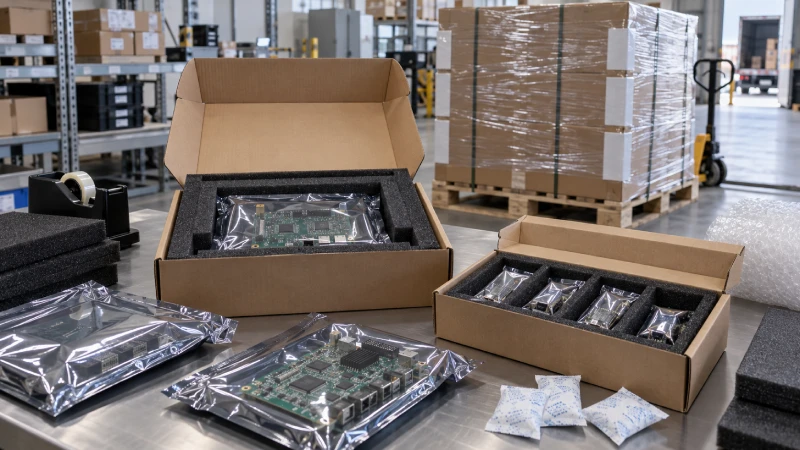
There is no universal specification that every electronic product needs.
A finished household device is not packaged in exactly the same way as a tray of sensitive semiconductors, and a rugged industrial control cabinet does not require the same cushioning system as a monitor.
The main risks to consider are static, moisture, shock and compression.
Anti-Static Packaging
Electrostatic discharge can damage sensitive electronic components even when there is no obvious external physical damage.
ESD protection is especially relevant for products such as:
- printed circuit boards;
- semiconductors;
- electronic modules;
- integrated circuits;
- sensitive assemblies;
- certain sensors and control components.
Depending on the product, appropriate protection may include:
- static-shielding bags;
- ESD-safe packaging materials;
- conductive or dissipative foam;
- suitable internal separation;
- controlled handling procedures.
However, avoid treating elaborate anti-static packaging as mandatory for every finished electronic appliance.
The protection method should match the product’s actual sensitivity.
Moisture Protection
Moisture deserves particular attention when electronics move by sea.
Ocean freight exposes cargo to a much longer transport cycle and potentially significant changes in temperature and humidity.
Problems can arise from:
- humid air trapped inside packaging;
- condensation;
- wet pallets;
- damaged cartons;
- poor warehouse conditions;
- temperature changes during the voyage.
Depending on product sensitivity and transit conditions, protection can include:
- sealed inner packaging;
- moisture-barrier materials;
- suitable desiccants;
- humidity indicator cards for sensitive equipment;
- dry pallets and cartons;
- container moisture-control measures.
Do not automatically add large quantities of desiccant without considering the packaging volume, product and intended moisture-control method.
Shock and Compression Protection
Electronic products can also suffer internal damage even when the outside carton appears relatively intact.
Appropriate packaging may include:
- fitted cushioning;
- corner protection;
- double-wall export cartons;
- palletisation;
- dividers;
- rigid internal supports;
- suitable load distribution;
- reduced empty space inside cartons.
Screens, displays, instruments and other fragile assemblies may need packaging specifically engineered around their failure points.
High-Value Electronics: Theft, Damage and Cargo Insurance
The higher the shipment value, the less useful it becomes to assess the freight decision using transportation cost alone.
A £100,000 shipment and a £5,000 shipment occupying the same number of pallets do not necessarily deserve the same risk-management strategy.
Reduce Unnecessary Theft Exposure
For valuable cargo, appropriate security measures can include:
- avoiding unnecessary external branding that advertises high-value products;
- using tamper-evident sealing where appropriate;
- controlling warehouse access;
- documenting pallet and carton counts;
- verifying handovers;
- using secure final-mile delivery arrangements.
This does not mean hiding the true nature of the goods from the carrier or customs.
Commercial invoices, dangerous-goods declarations and shipping documents must still describe the cargo accurately.
Damage Is Not Always Visible
Electronic equipment may be damaged internally by:
- vibration;
- shock;
- compression;
- moisture;
- electrostatic discharge;
- movement inside inadequate packaging.
For particularly sensitive or expensive equipment, packaging inspection before pickup can be more useful than discovering the problem after arrival.
Consider Cargo Insurance
Carrier liability and cargo insurance are not the same thing.
An importer should not assume that the carrier will automatically reimburse the full commercial value if expensive electronics are lost or damaged.
For higher-value shipments, consider cargo insurance and review:
- insured value;
- deductible or excess;
- coverage basis;
- required packaging standards;
- exclusions;
- used or refurbished goods conditions;
- theft conditions;
- battery-related exclusions where relevant;
- claims documentation requirements.
The correct insurance solution depends on the cargo and policy.
Should You Record Serial Numbers Before Shipping?
Serial-number recording can be useful, but it is not a universal requirement for every electronics shipment.
It is particularly useful for individually identifiable high-value products such as:
- laptops;
- smartphones;
- tablets;
- cameras;
- specialist instruments;
- individually warrantied equipment.
A serial-number list can help with:
- inventory reconciliation;
- shortage investigations;
- warranty management;
- insurance claims;
- customer asset tracking.
For inexpensive accessories, bulk PCBs, simple cables or other non-serialised goods, recording individual units may have little operational value.
Do not treat serial numbers as a universal UK customs requirement.
Shipping Electronics with Lithium Batteries
Electronics containing lithium batteries need a separate transport review.
Products containing cells or batteries should also be checked against the lithium-battery shipping guide before the transport method is confirmed.
The first question should not simply be:
“Does this product have a battery?”
You need to know how the battery is configured.
Common situations include:
- lithium-ion batteries shipped alone;
- lithium-ion batteries packed with equipment;
- lithium-ion batteries contained in equipment;
- lithium-metal batteries shipped alone;
- lithium-metal batteries packed with or contained in equipment.
Examples can include laptops, wireless speakers, power tools, cameras, handheld devices and many other products.
Power banks deserve particular attention because they are generally treated as batteries rather than simply as electronic equipment containing batteries.
For current air-transport requirements, refer to the IATA Battery Shipping Regulations.
Information to Prepare for Lithium Battery Cargo
Depending on the shipment, the forwarder may need to review:
- battery chemistry;
- battery model;
- Watt-hour rating;
- lithium content where relevant;
- quantity of cells or batteries;
- whether they are installed, packed with equipment or standalone;
- battery condition;
- packaging configuration;
- UN classification;
- UN 38.3-related documentation or test summary;
- SDS where relevant;
- marks and labels;
- carrier acceptance.
The applicable requirements depend on the exact battery and shipping configuration.
Air Freight Battery Restrictions
Air transport usually requires closer acceptance review because lithium batteries create fire risks in aviation.
Whether cargo can travel depends on factors including:
- battery configuration;
- battery rating;
- quantities;
- packaging;
- documentation;
- airline policy;
- aircraft type;
- origin station;
- route.
Carrier acceptance can also be stricter than the baseline regulatory requirements.
Therefore, never promise an urgent air shipment before the exact battery configuration has been reviewed.
Sea Freight Does Not Remove Dangerous-Goods Requirements
Importers sometimes assume that if a battery shipment cannot fly, it can simply move as ordinary ocean cargo.
That is not necessarily correct.
Lithium battery cargo transported by sea can still be regulated dangerous goods and may require appropriate classification, packing, marks, labels, declarations and carrier approval.
LCL acceptance can be especially route-specific because a consolidation warehouse must also agree to handle the cargo.
The safest sequence is:
- identify the battery;
- collect the technical documents;
- classify the shipment;
- review the packaging;
- confirm the proposed transport mode;
- obtain carrier acceptance;
- arrange pickup.
Do not collect the goods first and ask whether the carrier accepts them afterwards.
UK Compliance: Start With the Product Category, Not the Shipping Method
Once the transport plan has been considered, the importer needs to address a separate question:
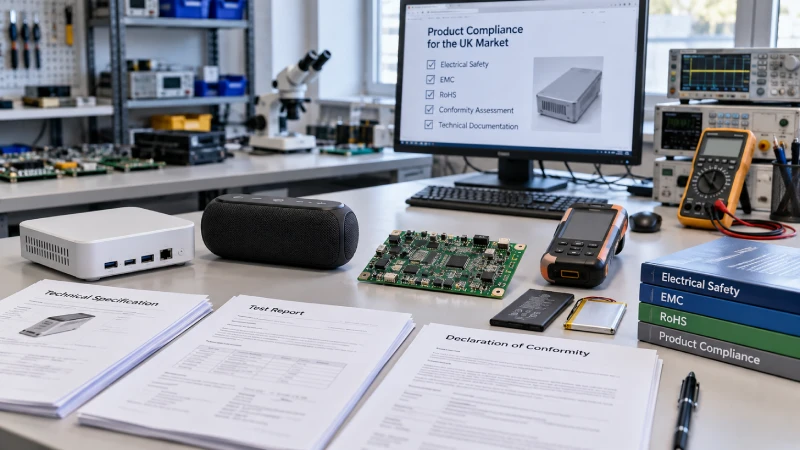
Can this specific electronic product legally be placed on the intended UK market?
Express, air freight, LCL and FCL do not determine product compliance.
Before making claims about electrical safety, EMC, RoHS or product marking, first identify:
- what the product does;
- the voltage at which it operates;
- whether it transmits radio signals;
- whether it falls within electrical and electronic equipment definitions;
- whether batteries are included;
- whether another sector-specific regulatory regime applies;
- whether the product will be placed on the market in Great Britain or Northern Ireland.
This prevents one of the most common mistakes in electronics importing: treating every electronic product as though it follows the same compliance checklist.
Step 1: Is the Product Going to Great Britain or Northern Ireland?
“UK” is often used as one destination in logistics discussions, but product-market rules require more precision.
Great Britain covers:
- England;
- Scotland;
- Wales.
Northern Ireland must be considered separately.
Current UK government guidance provides one market pathway for placing UKCA- or CE-marked products on the market in Great Britain, while separate guidance applies to CE or CE+UKNI products placed on the Northern Ireland market.
For this reason, an importer should establish the destination market before deciding which marking and conformity route applies.
See the current GOV.UK guidance on placing UKCA or CE marked products on the market in Great Britain and placing CE or CE and UKNI marked products on the market in Northern Ireland.
Step 2: Does Electrical Safety Legislation Apply?
It is inaccurate to write that every product containing electronics automatically falls under exactly the same electrical safety regulation.
For Great Britain, the Electrical Equipment (Safety) Regulations 2016 apply to electrical equipment designed or adapted for use with voltage ratings between:
- 50 and 1,000 volts AC; and
- 75 and 1,500 volts DC.
The regulations also contain exclusions.
That means the importer should check the product’s characteristics and scope before deciding that these regulations apply.
Where they do apply, relevant responsibilities can include matters such as:
- meeting applicable safety objectives;
- conformity assessment;
- technical documentation;
- a Declaration of Conformity;
- correct conformity marking;
- product traceability;
- importer identification;
- instructions and safety information.
A factory’s internal QC inspection is not the same thing as demonstrating regulatory conformity.
See the official Electrical Equipment (Safety) Regulations 2016 guidance.
Step 3: Does EMC Apply?
Many electronic and electrical products also need to be assessed for electromagnetic compatibility.
In practical terms, EMC concerns two sides of product behaviour:
- the equipment should not generate electromagnetic disturbance at a level that prevents other equipment from functioning as intended; and
- the equipment should have sufficient immunity to expected electromagnetic disturbance so it can operate without unacceptable degradation.
These are core essential requirements described in the UK’s EMC guidance for Great Britain.
The EMC Regulations include obligations for relevant manufacturers and importers, but the exact scope should still be checked for the product.
Do not assume that “the supplier tested it” proves compliance.
The importer should ensure the technical evidence relates to:
- the actual model;
- the actual configuration;
- the relevant standards or assessment route;
- the product being supplied to the UK market.
See the official Electromagnetic Compatibility Regulations 2016 guidance.
Step 4: Check RoHS Scope
RoHS is another area where importers often receive an overly simple answer.
Many categories of electrical and electronic equipment are regulated for restricted hazardous substances, but scope, exclusions and exemptions matter.
UK guidance explains the compliance requirements for products that fall within the RoHS regime.
The important point is that RoHS compliance should not be reduced to:
“Ask the Chinese supplier for a RoHS certificate.”
Instead, verify that the compliance evidence is relevant to:
- the correct product;
- exact model or product family;
- materials/components concerned;
- applicable regulatory scope;
- current exemption status where one is relied upon.
A generic certificate carrying a similar product name is not automatically sufficient evidence.
See the current GOV.UK RoHS compliance and guidance.
Step 5: CE vs UKCA for Electronics Imported into Great Britain
This is one of the areas where older online articles frequently provide outdated advice.
The CE versus UKCA guide explains how market, product scope and importer responsibilities affect the marking decision.
Do not assume that:
“After Brexit, every electronic product sold in Great Britain must use UKCA instead of CE.”
Current UK guidance provides routes for products placed on the Great Britain market under the UKCA or CE regimes. The correct route depends on the product and the legislation that applies to it.
The correct process is:
- identify the product;
- determine which product regulations apply;
- establish whether conformity marking is required;
- determine which marking route is permitted under those regulations;
- complete the relevant conformity assessment;
- prepare the required documentation;
- apply the marking correctly.
Not every product needs CE or UKCA merely because it contains electronics.
Where conformity marking is required, the manufacturer and importer must still satisfy the substantive requirements behind the selected route. A logo on the product does not by itself demonstrate compliance.
For current details, see the GOV.UK guide to CE vs UKCA routes for products placed on the Great Britain market.
Northern Ireland Is Different
For products placed on the Northern Ireland market, the conformity route needs to be checked separately.
Current government guidance explains that relevant products may use CE, or CE together with UKNI where a UK-based Northern Ireland notified body is used for mandatory third-party conformity assessment. UKNI is not used on its own.
So before asking “CE or UKCA?”, first ask:
Where will the product actually be placed on the market?
Step 6: Wireless Electronics May Trigger Additional Requirements
Wi-Fi, Bluetooth and other wireless functionality can change the regulatory analysis.
Examples include:
- wireless speakers;
- Bluetooth accessories;
- smart-home products;
- Wi-Fi routers;
- wireless sensors;
- IoT devices;
- radio transmitters.
Relevant radio equipment can fall under the Radio Equipment Regulations 2017 in Great Britain.
These rules address safety, electromagnetic compatibility and efficient use of the radio spectrum, among other requirements.
Other specialist products—such as medical devices or certain industrial equipment—may also fall under sector-specific regulatory frameworks.
That is why a checklist containing only “Electrical Safety + EMC + RoHS + UKCA” should never be presented as complete for every electronic product.
See the official Radio Equipment Regulations 2017 guidance.
WEEE Obligations: When Do They Matter?
WEEE obligations are important for many businesses importing electronics, but they should not be confused with freight-booking requirements.
WEEE relates primarily to producer responsibility for electrical and electronic equipment placed on the UK market and the management of that equipment when it becomes waste.
UK Environment Agency guidance explains that a business can be an EEE producer if, among other situations, it commercially imports EEE into the UK and places it on the UK market. Businesses importing equipment for their own use are treated differently.
Depending on the business and quantities involved, obligations can include:
- producer registration;
- joining an appropriate producer compliance scheme where required;
- reporting EEE placed on the market;
- financing or supporting waste treatment obligations;
- supplying required producer information.
The precise duties depend on how the business operates.
WEEE should therefore be assessed from the commercial supply-chain perspective rather than asking:
“Is this an air shipment or a sea shipment?”
The freight method does not determine WEEE status.
See the Environment Agency guidance on electrical and electronic equipment producer responsibility.
Battery Producer Obligations Are Different from Battery Transport Rules
Battery-powered electronics can create another easily confused pair of obligations.
Transport Question
Can the battery legally and safely travel by the intended air or sea route?
This relates to dangerous-goods classification, testing, packaging, documentation and carrier acceptance.
UK Market Question
Is the business placing batteries—or products containing batteries—onto the UK market in a way that creates producer responsibilities?
UK guidance explains that a UK business that is the first person in its selling chain to make batteries available for supply or sale can be a battery producer, including importers. The guidance also covers batteries contained within products.
These producer responsibilities can involve registration, reporting and waste-management obligations depending on battery type and quantity.
An importer can therefore have:
- a transport compliance issue;
- a UK battery producer-responsibility issue;
- both;
- or neither, depending on the circumstances.
Do not treat the UN 38.3 test summary as evidence that UK producer-responsibility obligations have been satisfied. They deal with different questions.
See the GOV.UK guidance on waste batteries producer responsibility.
Documents to Prepare Before Shipping Electronics from China
The exact document package depends on the goods, but the following table provides a useful starting point.
For customs-document and cargo-insurance coordination, see Winsail’s customs and cargo-insurance support.
| Document / Information | Why It Matters | Always Required? |
|---|---|---|
| Commercial invoice | Product description, value and customs declaration | Normally |
| Packing list | Carton count, weight, dimensions and packing details | Normally |
| Commodity / HS classification | Customs declaration and duty treatment | Normally |
| Importer / EORI information | UK customs clearance | Depends on import structure |
| Product specification | Freight and regulatory review | Strongly recommended |
| Model information | Links technical evidence to the actual goods | Strongly recommended |
| Declaration of Conformity | Product compliance | Where applicable |
| Technical compliance evidence | Supports conformity assessment | Regulation-dependent |
| Battery specifications | Battery classification | Battery cargo only |
| UN 38.3-related documentation | Lithium-battery transport review | Where applicable |
| SDS | Supports dangerous-goods review | Where applicable |
| Cargo insurance document | Claims and risk management | If insured |
| Serial-number list | Inventory and claims control | Only where useful |
One distinction is important:
Product compliance records do not necessarily form part of the routine customs-document set presented with every shipment.
The importer may nevertheless have a legal responsibility to maintain appropriate compliance documentation and make it available when required.
Border documentation and product-market compliance are related, but they are not identical processes.
Common Mistakes When Importing Electronics from China to the UK
- Describing the shipment only as “electronics.” A forwarder cannot properly assess battery restrictions, dangerous-goods status or cargo handling from such a broad description.
- Booking freight before declaring lithium batteries. Undeclared batteries can result in warehouse rejection, missed flights, repacking, storage charges or serious safety issues.
- Assuming CE automatically means the product is fully UK-compliant. The importer still needs to identify the applicable product legislation and ensure the supporting compliance route is valid.
- Assuming every product now requires UKCA. Current GB rules allow recognised CE routes for many regulated products, depending on the applicable legislation.
- Accepting a supplier’s generic certificate. A compliance document for another model, another manufacturer or another technical configuration may not support the goods being imported.
- Treating factory QC as regulatory compliance. Factory inspections can check workmanship and functionality, but they are not a substitute for applicable regulatory conformity requirements.
- Treating RoHS as identical for every product. Scope, exclusions and exemptions need to be checked.
- Comparing express and air freight using gross weight alone. Always provide dimensions so chargeable weight can be calculated.
- Using LCL without reviewing moisture protection. Ocean transit is longer and consolidated cargo may experience more handling.
- Shipping high-value electronics without reviewing insurance. Carrier liability may not equal the commercial value of the goods.
- Confusing freight compliance with product compliance. A shipment being accepted by an airline or shipping line does not mean the product is legally ready for the UK market.
- Treating Great Britain and Northern Ireland as identical markets. Determine the actual market before selecting the conformity and marking route.
Pre-Shipment Checklist for Electronics Importers
Before collecting cargo from the supplier, work through the following checklist.
Product Identification
- Exact product name confirmed
- Model confirmed
- Intended use confirmed
- New or used condition confirmed
- Operating voltage checked where relevant
- Wireless functionality identified
- Accurate commodity description prepared
Battery Review
- Does the product contain batteries?
- Battery chemistry identified
- Installed, packed with equipment or standalone?
- Watt-hour rating available where relevant?
- Battery model confirmed?
- Required transport evidence available?
- Carrier acceptance confirmed?
Freight Information
- Number of cartons
- Gross weight
- Carton dimensions
- Total CBM
- Cargo value
- China pickup city
- UK delivery postcode
- Required delivery date
- Express, air, LCL and FCL compared where appropriate
Packaging
- ESD protection where necessary
- Moisture protection where necessary
- Adequate cushioning
- Strong export cartons
- Palletisation where appropriate
- Sensitive units immobilised
- Packaging checked before pickup
UK Compliance
- Great Britain or Northern Ireland identified
- Applicable product legislation identified
- Electrical safety scope checked
- EMC scope checked
- RoHS scope checked
- Radio-equipment rules considered where relevant
- Correct CE / UKCA / CE+UKNI route established
- Technical documentation available
- Declaration of Conformity available where required
- Importer responsibilities reviewed
- WEEE obligations assessed where applicable
- Battery producer obligations assessed where applicable
Cargo Risk
- Shipment value confirmed
- Insurance requirements reviewed
- Security arrangements considered
- Serial numbers recorded where commercially useful
- Handover and carton-count controls established
Which Shipping Method Should You Choose?
Rather than using a rigid kg or CBM rule, consider the following examples.
Scenario 1: 20 kg of Electronic Samples Needed Urgently
Start by comparing express courier options.
The shipment is small and speed is the priority. However, battery status and dimensional weight must still be checked.
Scenario 2: 250 kg of High-Value Commercial Electronics
Start with standard air freight, but compare the complete delivered cost against express.
Because the goods are valuable, also review:
- packaging;
- warehouse handling;
- insurance;
- UK final delivery.
Scenario 3: 5 CBM of Non-Urgent Packaged Electronics
Start by assessing LCL sea freight.
Give particular attention to:
- moisture protection;
- carton strength;
- palletisation;
- consolidation handling;
- UK destination charges.
Scenario 4: 20 CBM of High-Value Electronics
Compare FCL with LCL.
Do not base the decision only on whether the goods physically fill a container.
Also consider:
- cargo value;
- number of handling stages;
- inventory security;
- moisture risk;
- loading control;
- total destination charges.
There is no universal weight or CBM point where one method automatically becomes correct.
The best comparison uses the same:
product + carton dimensions + gross weight + CBM + battery status + China pickup location + UK postcode + required delivery date
for every quotation.
Final Takeaway
Successful shipping electronics from China to UK requires two decisions that should remain clearly separated.
First, decide how the cargo should move.
Small urgent shipments may suit express. Commercial time-sensitive cargo often fits air freight. Larger non-urgent shipments can move by LCL, while bigger or particularly valuable consignments may justify comparing FCL.
Second, determine whether the actual product meets the requirements for the UK market where it will be sold or supplied.
Do not begin with assumptions such as:
“Electronics need UKCA.”
“Every electronic product needs the same RoHS documents.”
“All lithium battery products can move by air.”
Instead use a structured process:
Identify the exact product → identify the battery configuration → choose the freight method → determine the destination market → identify the applicable UK regulations → verify the supporting compliance evidence.
This sequence helps reduce freight delays, carrier rejection, cargo damage and product-compliance problems before the shipment leaves China.
Regulatory information in this guide was reviewed in September 2026. Product rules and carrier requirements can change, and the correct compliance route depends on the specific product and market. Shipment-specific regulatory or dangerous-goods questions should be checked against the current applicable rules before booking.
FAQs
Can I ship electronics from China to the UK by air?
Yes. Many electronic products can move by air, but products containing lithium batteries require a review of battery configuration, rating, packaging, documentation and airline acceptance before booking.
What is the cheapest way to ship electronics from China to the UK?
Sea freight is usually the first option to compare for larger non-urgent shipments. LCL can suit smaller volumes, while FCL becomes more attractive as volume increases. Destination charges, inventory urgency and cargo risk should also be considered.
When should I use air freight instead of express?
Express is often practical for samples and small urgent shipments. As cargo becomes larger, standard air freight should be compared. Around the +45 kg range is a common starting point for commercial air-freight pricing, but it is not a fixed rule.
Do electronics imported from China need UKCA marking?
Not universally. The applicable product legislation and destination market must be identified first. For many regulated products placed on the Great Britain market, current rules allow UKCA or recognised CE routes depending on the legislation.
Do electronics need CE marking in the UK?
Not every product requires CE marking simply because it contains electronics. The requirement depends on the product category, applicable legislation and whether the product is being placed on the Great Britain or Northern Ireland market.
Can electronics containing lithium batteries be shipped by air?
Often yes, but acceptance depends on the battery chemistry, capacity, configuration, quantity, packaging, transport documentation and airline or courier requirements.
Is sea freight better for electronics with lithium batteries?
Sea freight can be practical for some larger battery-containing shipments, but it does not remove dangerous-goods requirements. Classification, packaging, documentation and shipping-line acceptance may still be required.
Do UK electronics importers have WEEE responsibilities?
Potentially. Businesses commercially importing and placing qualifying electrical and electronic equipment on the UK market can fall within EEE producer-responsibility rules. The exact obligations depend on the businessu0026#x27;s role and circumstances.
Are anti-static bags required for all electronics?
No. ESD packaging is particularly relevant to static-sensitive components such as circuit boards, semiconductors and some electronic modules. Packaging should match the actual product sensitivity.
Should I insure electronics shipped from China?
Cargo insurance is worth considering for higher-value electronics because carrier liability may not equal the full commercial value. Review insured value, packaging conditions, deductibles and exclusions before shipping.
What information should I send my freight forwarder?
Provide the exact product, model, quantity, carton count, carton dimensions, gross weight, total CBM, cargo value, battery status, China pickup location, UK delivery postcode and required delivery date.
Continue with related UK shipping guides
Use these focused guides for the next part of your China-to-UK shipping plan.
