
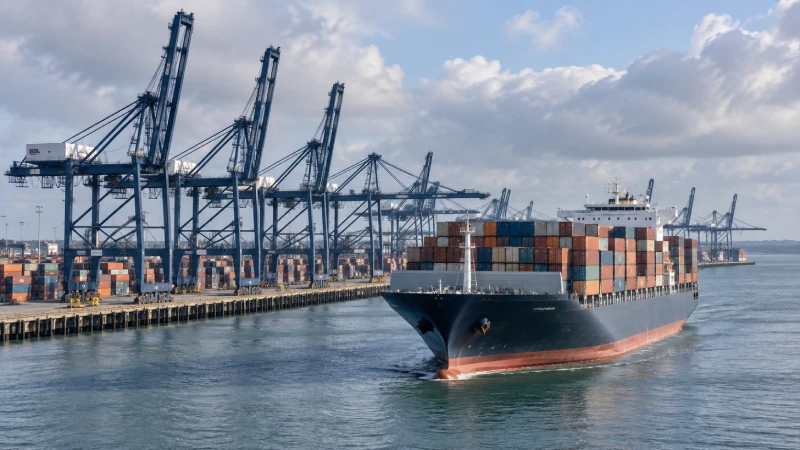
For UK importers buying commercial goods from China, Felixstowe is one of the main container gateways worth considering. It can be particularly practical for FCL and LCL cargo moving onward to the East of England, the Midlands and parts of South East England, supported by extensive road and rail connections.
However, selecting Felixstowe should not be automatic. The right UK discharge port depends on the Chinese origin, carrier service, current vessel rotation, final UK delivery postcode, destination charges, customs readiness and inland transport plan.
This matters even more in 2026 because Asia–North Europe routings are changing. Some carrier services have continued around the Cape of Good Hope, while selected services have begun a gradual return to the Suez Canal. Transit times that were reasonable planning references a few years ago may therefore no longer match the vessel you are actually booking. See Maersk’s 2026 Suez service update for an example of how carrier routing can change during the year.
For a wider comparison of sea freight, air freight, DDP and other shipping options, see our Shipping from China to the UK guide.
Quick Answer: Is Felixstowe a Good Port for Shipping from China?
Felixstowe can be a strong option when your selected Asia–Europe service calls the port efficiently and your cargo ultimately needs to reach the East of England, the Midlands or a suitable location in the South East.
The port has substantial deep-water container infrastructure and one of the UK’s strongest intermodal rail networks. The Port of Felixstowe’s current container terminal information lists nine berths across two terminals, 28 quay cranes and four berths capable of handling 24,000-TEU vessels.
But Felixstowe is not automatically the cheapest or fastest UK port. Importers should compare it with London Gateway and Southampton based on the complete movement from the Chinese supplier to the final UK warehouse.
| Decision factor | Planning direction |
|---|---|
| Most relevant cargo | Containerised commercial imports |
| Common China origins | Ningbo, Shanghai, Yantian, Xiamen, Qingdao, Nansha and North China ports depending on service |
| Ocean transit planning | Service-dependent; current 2026 direct schedules vary materially |
| Inland strength | East of England and Midlands; parts of the South East |
| Inland transport | Road and rail both relevant |
| UK customs | GB EORI, commodity code and CDS declaration normally required |
| Key arrival risks | Schedule changes, customs holds, storage, carrier free time and inland-delivery delays |
The most useful question is therefore not simply “Does this vessel go to Felixstowe?” It is:
“Does this Felixstowe routing produce the best total result to my final delivery point?”
Why Felixstowe Matters on China–UK Container Routes
Felixstowe is designed for large-scale container operations rather than being simply another regional UK port.
The port currently lists nine container berths across Trinity Terminal and Berths 8 & 9. Four berths can accommodate the latest generation of approximately 24,000-TEU vessels, the approach channel is dredged to 16 metres below chart datum, and selected berths provide up to 18 metres of depth. These specifications are published by the Port of Felixstowe.
For a China importer, the important point is not the size statistic itself. The significance is that Felixstowe can act as a direct North European gateway for very large Asia–Europe mainline vessels.
Trinity Terminal and Berths 8 & 9
Trinity Terminal is Felixstowe’s largest container-handling facility, with seven deep-water berths and a continuous quay exceeding two kilometres. Berths 8 & 9 are the port’s newest and deepest facilities and form part of the infrastructure used by ultra-large container vessels.
That makes direct China–Felixstowe services commercially realistic on several carrier networks.
It does not, however, mean every Chinese load port has a direct Felixstowe sailing every week, nor does a direct call guarantee the shortest transit time.
The carrier’s service string still matters.
Which China Ports Commonly Connect with Felixstowe?
The appropriate Chinese load port normally depends on three things:
For the wider route, sailing and equipment picture, use our China-to-UK sea freight guide alongside the Felixstowe-specific details below.
- where the supplier is located;
- which carriers have suitable Felixstowe services;
- how the origin trucking, sailing cut-off and ocean transit compare.
The nearest seaport to a factory is therefore not automatically the best load port.
Ningbo and Shanghai
Ningbo is particularly relevant for exporters in Zhejiang and surrounding manufacturing regions. It appears on multiple published 2026 Asia–Felixstowe service rotations.
Shanghai is also important for Yangtze River Delta cargo and appears on selected Felixstowe services.
For example, MSC’s 2026 network has included Ningbo on several direct Felixstowe rotations, while its Britannia service includes Ningbo and Shanghai before continuing through southern China and Southeast Asia toward Europe. See MSC’s 2026 Asia–Northern Europe network update.
For a supplier in Zhejiang, routing through Ningbo may reduce origin trucking compared with Shanghai. But vessel timing can reverse that advantage, so compare the entire origin plan rather than port names alone.
Yantian, Shenzhen, Nansha and Xiamen
Yantian is a major option for cargo manufactured in Shenzhen, Dongguan and the wider Pearl River Delta. It appears frequently on direct Asia–Felixstowe rotations.
Nansha may be commercially attractive for suppliers on the western side of the Pearl River Delta, while Xiamen is relevant for Fujian and nearby manufacturing areas.
MSC’s April 2026 network update, for example, showed its Albatros service calling Xingang, Dalian, Ningbo, Xiamen and Yantian before Felixstowe, while Britannia included Ningbo, Shanghai, Nansha and Yantian.
This demonstrates why “Shenzhen to Felixstowe” should not automatically be translated into one fixed route. Depending on the supplier location and carrier, Yantian or another South China terminal may make more sense.
Qingdao, Xingang/Tianjin and Dalian
North China cargo can also move to Felixstowe on selected services.
Qingdao is important for Shandong manufacturing, while Xingang/Tianjin and Dalian serve northern production regions. These origins can have longer published port-to-port transit times because they appear earlier in some Asia rotations before the vessel works south toward Singapore and Europe.
| China production region | Likely load-port candidates | What to compare |
|---|---|---|
| Zhejiang / Yangtze River Delta | Ningbo, Shanghai | Trucking, cut-off, direct Felixstowe service |
| Shanghai / Jiangsu | Shanghai, Ningbo | Sailing schedule versus origin transport |
| Shenzhen / Dongguan | Yantian | Carrier rotation and equipment availability |
| Guangzhou / Foshan | Nansha, Yantian | Origin haulage plus sailing |
| Fujian | Xiamen | Current direct-service options |
| Shandong | Qingdao | Rotation and longer North China transit |
| Tianjin / North China | Xingang/Tianjin | Carrier and voyage-specific schedule |
| Liaoning | Dalian | Direct versus alternative routing |
Pro Tip: Ask your forwarder for the carrier, service name, vessel/voyage and load/discharge ports. “Ningbo to Felixstowe” by itself is not enough information to judge the transit plan.
How FCL and LCL Shipments Actually Route to Felixstowe
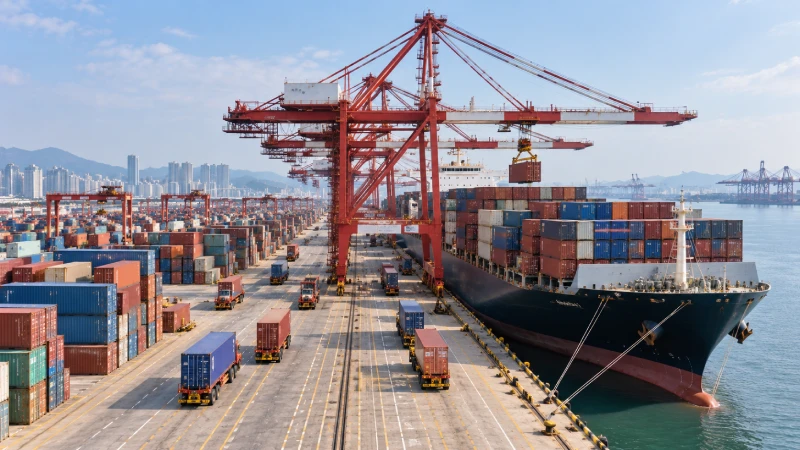
FCL and LCL can both use Felixstowe, but what happens after the vessel arrives is different.
FCL: A Direct Service Is Not Necessarily a Nonstop Voyage
For a typical FCL shipment, the physical flow may look like:
Factory → China container loading → origin terminal → mainline vessel → Felixstowe → customs and shipping-line release → road or rail → UK warehouse
A carrier may describe a service as direct because your container stays aboard the same vessel between the Chinese port and Felixstowe.
That vessel can still call several ports along the route.
For example, a direct Yantian–Felixstowe container may still move through Singapore and other points in the carrier’s service rotation. It is therefore important to distinguish:
- Direct service: no vessel change for your container.
- Transshipment: the container is transferred to another vessel at an intermediate hub.
- Nonstop sailing: effectively no intermediate port calls, which is not what normal Asia–Europe liner services usually mean.
For regular FCL imports, direct services can reduce handovers and transshipment exposure, but vessel schedule and final delivery requirements still need to be compared.
LCL: Find Out Where the Cargo Is Actually Deconsolidated
LCL requires a different question:
Where will my cargo actually be devanned and released?
The master container may discharge at Felixstowe but then move to a separate container freight station or deconsolidation warehouse.
That means:
Felixstowe as port of discharge does not necessarily mean Felixstowe is your LCL cargo collection point.
Before booking an LCL shipment, confirm:
- UK deconsolidation location;
- destination handling charges;
- CFS charges;
- customs-clearance arrangement;
- warehouse release process;
- final delivery lead time.
This information is especially important when comparing two LCL quotations that appear to have similar ocean freight.
China to Felixstowe Transit Time: Use a Planning Range, Not a Promise
A fixed statement such as “China to Felixstowe takes 28 days” is not reliable enough for current planning.
Published 2026 carrier schedules show significant variation by origin and service.
MSC’s 2026 Cape of Good Hope network, for example, showed indicative Felixstowe transit times including approximately 36 days from Yantian, 38 days from Xiamen, 41 days from Ningbo and 51 days from Xingang on its Albatros service. Other MSC services showed different times for the same Chinese origins. MSC itself labels these transit times as indicative and subject to change. See the carrier’s 2026 Asia–North Europe network reference.
ONE’s May 2026 FE3 update provides another useful example: the commencing voyage was scheduled Qingdao on 11 June and Felixstowe on 29 July while operating via the Cape of Good Hope—about 48 days for that specific service schedule. See ONE’s Asia–North Europe service update.
2026 Transit-Time Planning Reference
The following is a planning reference based on published carrier schedules, not a guaranteed Winsail transit time.
| China origin | Example 2026 direct-service planning | Important note |
|---|---|---|
| Yantian | Around 35–38 days | Varies by service string |
| Xiamen | Around 37–38 days | Selected direct services |
| Shanghai | Around 40–43 days | Carrier and rotation dependent |
| Ningbo | Around 41–46 days | Multiple service options |
| Qingdao | Around mid-40s to high-40s | Longer rotation possible |
| Xingang / North China | Around 50 days on some services | Service-specific |
Actual sailing plans can change materially.
In August 2026, MSC announced a partial restoration of Suez Canal transits on selected East–West services, including Albatros, while contingency routing remained available. Maersk has also begun moving selected services back through Suez while stating that a full East–West network return had not yet been planned. See MSC’s Red Sea service update and Maersk’s Suez service update.
So a transit table should be treated as a starting point, not a contractual delivery date.
Port-to-Port Time Is Not Door-to-Door Time
A UK importer should plan the shipment in separate stages:
- cargo-ready date at the supplier;
- factory pickup;
- container stuffing or LCL consolidation;
- China export procedures;
- terminal cut-off;
- ocean transit;
- vessel discharge at Felixstowe;
- customs and other government releases;
- shipping-line release;
- road or rail movement;
- final warehouse delivery.
A 40-day ocean transit does not mean goods will arrive at your warehouse in 40 days.
What Can Change the Transit Plan?
Common variables include:
- Suez versus Cape of Good Hope routing;
- carrier network changes;
- blank sailings;
- Chinese public holidays;
- port omissions;
- vessel delays;
- weather;
- transshipment connections;
- equipment availability;
- customs inspections;
- Port Health or product-compliance holds after arrival.
As a current example, MSC announced in August 2026 that selected Asia–Europe voyages would be blanked around China’s Golden Week, including a Britannia sailing. This illustrates why a published weekly service does not mean every scheduled voyage will operate unchanged. See MSC’s 2026 Golden Week sailing programme.
Felixstowe May Suit You If…
Felixstowe deserves serious consideration when several of the following conditions apply:
- Your selected carrier offers a practical direct Felixstowe call.
- Your supplier is close to a Chinese port with good Felixstowe connectivity.
- Your cargo is moving to the East of England.
- Your distribution centre is in the Midlands and rail is commercially practical.
- You import regular FCL volumes.
- Your warehouse can receive containers efficiently.
- Your customs documentation can be prepared before arrival.
- The combination of UK destination charges and inland transport is competitive.
- You need a major deep-sea gateway with extensive road and rail options.
Compare Another UK Port If…
Felixstowe should not be selected simply because it is a major UK container port.
Compare London Gateway or Southampton when:
- the carrier offers a better sailing or shorter rotation there;
- the final warehouse is significantly closer to another port;
- inland haulage is more competitive from another gateway;
- the carrier’s UK destination charges differ materially;
- your preferred rail service uses another port more efficiently;
- warehouse receiving schedules make another route easier;
- current vessel capacity is better through an alternative gateway.
The best UK port is not necessarily the port with the lowest ocean freight. It is the port that gives the best total result to the final delivery point.
Need to Compare Felixstowe with Another UK Gateway?
Provide the China pickup location, cargo-ready date, shipment dimensions or container requirement, cargo type and final UK postcode.
Winsail can review the available routing and may coordinate China origin handling, ocean freight, UK customs-clearance arrangements and inland delivery depending on the agreed service scope and shipment requirements.
Inland Delivery from Felixstowe: Road or Rail?
Where your cargo goes after customs release can be just as important as the ocean route.
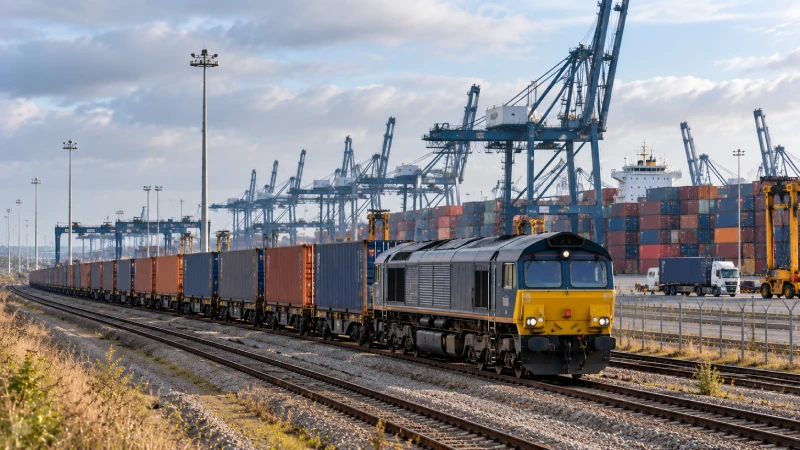
Felixstowe has a particularly strong inland rail operation. Its current rail information states that the port operates 58 trains per day across three rail terminals, serves 20 inland locations and moves around one million TEU by rail annually. Rail represents around 29% of Felixstowe’s UK domestic throughput and approximately 50% of traffic to the North and West Midlands.
That makes inland planning one of Felixstowe’s strongest differentiators.
East of England
For delivery destinations in areas such as:
- Suffolk;
- Norfolk;
- Cambridgeshire;
- parts of Essex;
direct road haulage from Felixstowe can often be operationally straightforward.
The port connects to the A14 corridor, which provides access toward major Midlands distribution areas. Felixstowe’s own road-connectivity information highlights the A14 as a key route connecting the port with UK distribution hubs.
Actual haulage cost still depends on:
- final postcode;
- container size;
- delivery appointment;
- waiting time;
- chassis and haulage availability;
- empty-container return location;
- whether overnight or timed delivery is needed.
Midlands Distribution
For a warehouse or distribution centre in the Midlands, do not automatically assume direct road haulage is the only option.
A container can move:
Felixstowe → rail terminal → inland rail terminal → final-mile truck → warehouse
For regular container flows, it is worth comparing this with:
Felixstowe → direct road haulage → warehouse
Felixstowe’s rail share of approximately 50% for North and West Midlands traffic shows that rail is not a marginal option on these corridors.
| Delivery situation | Direct road | Rail + final mile |
|---|---|---|
| East of England warehouse | Often practical | Usually less necessary |
| Midlands distribution centre | Compare | Strong option to evaluate |
| Regular container programme | Practical | Particularly worth modelling |
| One urgent container | Often simpler | Depends on rail timing |
| Warehouse far from rail terminal | May be simpler | Extra final-mile required |
| Large recurring volume | Compare capacity | Can become strategically useful |
Rail is not automatically cheaper or faster. It needs to be compared against the exact inland terminal, final postcode and delivery schedule.
South East England
Felixstowe can also serve parts of South East England.
However, this is where London Gateway deserves a more careful comparison. A port-to-port rate that looks slightly better through Felixstowe can lose its advantage if the final warehouse is significantly closer to the Thames gateway.
Pro Tip: Always include the full UK delivery postcode when requesting a China–UK freight comparison. Port selection without the postcode is incomplete.
Felixstowe vs London Gateway vs Southampton
All three ports can be relevant to China–UK container trade. None should be treated as universally best.
If the delivery point is London or South East England, also compare the China-to-London Gateway guide before selecting the UK gateway.
London Gateway currently has four deep-water berths and 22 daily rail services, while Southampton has strong national rail connectivity and is less than 3 km from the M27. DP World’s current Southampton information also lists a substantial daily rail network to locations including Birmingham, Manchester, Leeds, Liverpool and Glasgow. See DP World London Gateway infrastructure information for current gateway specifications.
| Factor | Felixstowe | London Gateway | Southampton |
|---|---|---|---|
| General location | East Coast / East Anglia | Thames / South East | South Coast |
| East of England | Strong candidate | Compare by postcode | Usually less direct |
| London / Thames area | Viable | Strong candidate | Compare carefully |
| Midlands | Strong road and rail case | Strong alternative | Strong road/rail alternative |
| Mainline Asia services | Yes | Yes | Yes |
| Rail relevance | Very high | High | High |
| Port choice should depend on | Service + inland cost | Service + inland cost | Service + inland cost |
Consider a shipment from Ningbo to a Midlands distribution centre.
Quotation A may have the lowest ocean freight to London Gateway.
Quotation B may have slightly higher ocean freight to Felixstowe but a more efficient rail or haulage solution to the final warehouse.
Either could be the better commercial choice.
The correct comparison is:
China origin costs + ocean freight + UK destination charges + customs + inland delivery + risk exposure
—not ocean freight alone.
UK Customs Clearance at Felixstowe
Felixstowe is a Great Britain import gateway, so commercial goods arriving from China normally enter under Great Britain customs procedures.
GB EORI
Businesses moving goods into Great Britain generally need an EORI number beginning with GB. GOV.UK EORI guidance warns that using the wrong EORI can cause customs delays and additional storage costs. Northern Ireland movements can require a separate XI EORI.
Confirm the importer structure before shipping rather than attempting to solve it after the vessel arrives.
Commodity Code, Customs Duty and Import VAT
Every commercial shipment needs the correct product classification.
The UK Trade Tariff uses the commodity code to help determine:
- Customs Duty;
- Import VAT treatment;
- tariff measures;
- possible duty relief;
- licences;
- certificates;
- restrictions.
HMRC specifically states that the commodity code is required on the import declaration and is used to determine duty and whether an import licence may be needed.
Do not assume every product from China attracts the same duty rate.
Two products that appear commercially similar can fall under different commodity codes and therefore have different customs treatment.
Customs Declaration Service
Import declarations are submitted through the UK’s Customs Declaration Service, or CDS.
HMRC’s current CDS tariff guidance instructs declarants to use the appropriate UK tariff to identify the commodity code and any tariff measures or document codes applying to the goods.
Importers commonly appoint a customs agent or other representative to submit declarations, but the type of representation and responsibilities should be agreed clearly.
Postponed VAT Accounting
If the UK importer is VAT registered and meets the relevant requirements, postponed VAT accounting may allow import VAT to be accounted for on the VAT Return rather than being paid upfront at import.
HMRC confirms in its postponed VAT accounting guidance that PVA allows eligible UK VAT-registered businesses to declare and, subject to normal input-tax rules, recover import VAT through the VAT return.
PVA should not simply be assumed by the freight forwarder. The importer needs to determine the appropriate VAT treatment and ensure the customs declaration is completed accordingly.
How Customs and Cargo Release Work at Felixstowe
Felixstowe uses the Destin8 port community system for inventory linking.
At a simplified operational level, a normal import container can involve:
shipping-line manifest → customs declaration → vessel arrival → container discharge → customs/agency status → shipping-line release → haulier details → terminal out-gate
MCP’s Destin8 information describes this interaction between shipping lines, forwarding agents, CDS, the terminal operator, government agencies and the nominated haulier.
The important distinction is:
Destin8 is part of the port inventory and cargo-release process; it does not replace the customs declaration.
A container can physically be discharged from the ship but still not be available for collection if, for example:
- customs clearance is pending;
- Port Health has placed a hold;
- product-compliance checks are required;
- the shipping line has not released the container;
- destination charges remain outstanding;
- haulage arrangements are incomplete.
This is why “vessel arrived” should never be interpreted as “cargo can be delivered today.”
Product Compliance Can Affect Felixstowe Release
Customs clearance is only one part of UK import compliance.
For manufactured products, the applicable Great Britain conformity requirements depend on the product category and legislation.
The Department for Business and Trade’s current 2026 UKCA and CE guidance specifically covers both regimes for products placed on the Great Britain market. It is therefore incorrect to make a blanket statement that every manufactured product imported from China must carry UKCA marking.
Importers should determine:
- which product regulations apply;
- required conformity assessment;
- technical documentation;
- marking requirements;
- labelling;
- importer responsibilities;
- any sector-specific registration.
These questions should ideally be resolved before the cargo leaves China.
Food, Animal, Plant and Other Controlled Products
Certain controlled imports require additional border procedures.
IPAFFS guidance applies to advance notifications for categories including products of animal origin, certain high-risk food and feed and medium- or high-risk plants and plant products.
Felixstowe has approved Border Control Post facilities, but approval depends on the exact commodity and required control category. The current UK government Border Control Post list includes several Felixstowe inspection facilities with specific product scopes.
So before booking controlled cargo:
verify that Felixstowe is approved for the exact commodity—not simply that “Felixstowe has a BCP.”
Dangerous Goods
Dangerous goods require separate shipping review.
UK government dangerous goods transport guidance states that dangerous goods moving by sea are subject to the IMDG framework and require appropriate dangerous-goods notification.
For batteries, chemicals and other regulated cargo, classification, packing, declarations, carrier acceptance and UK delivery arrangements should be reviewed before booking.
What Destination Charges Can Arise at Felixstowe?
A common mistake when comparing China–Felixstowe quotations is focusing only on ocean freight.
A useful quotation should make the destination-side scope clear.
Potential items include:
| Cost item | What it relates to | What to confirm |
|---|---|---|
| Destination handling | Arrival/terminal handling | Included or separate? |
| Customs clearance | UK import declaration | Agent fee and scope? |
| Customs Duty | Commodity/import treatment | Who pays and how? |
| Import VAT | VAT treatment | PVA or payment at import? |
| Port storage | Cargo/container remains at terminal | When does charging begin? |
| Carrier demurrage | Carrier’s equipment remains at terminal | How much free time? |
| Detention | Container kept outside terminal | Empty-return deadline? |
| Haulage | Port to final address | Exact postcode included? |
| LCL CFS charges | Deconsolidation | Which warehouse? |
| Delivery waiting | Time at consignee | Free waiting time? |
Port Storage Is Not the Same as Demurrage
This distinction is important.
Port storage is the charge associated with the unit remaining within the port/terminal beyond the applicable free storage period.
Demurrage generally refers to the shipping line’s charge for its container remaining at the terminal beyond the contractual free period.
Detention generally applies when the carrier’s container has left the terminal but has not been returned within the allowed period.
Your actual carrier terms control the demurrage and detention calculation.
Do not assume the port’s storage-free period is identical to the shipping line’s free time.
A 2026 Felixstowe Storage Example
The Port of Felixstowe’s indexed 2026 v1.2 tariff stated that import units collected within five days from commencement of vessel discharge incurred no port storage. For a 40ft container, the published storage rate in that version was £50.05 per day from day 6 to day 12 and £135.28 per day from day 13 onward. See the Port of Felixstowe 2026 tariff example.
This shows why delays can become expensive quickly.
However, these figures should not be treated as permanent rates. Felixstowe’s current commercial information page lists later tariff revisions during 2026. Always check the latest port tariff and the actual shipping-line terms before relying on a storage/free-time figure.
Pro Tip: Ask separately for:
- port storage rules;
- carrier demurrage free time;
- carrier detention free time;
- empty-container return requirements.
Do not ask only, “How many free days do I have?”
How to Manage Congestion and Free-Time Risk
Port conditions change, so it would be misleading to describe Felixstowe as permanently congested or permanently congestion-free.
Instead, importers should build a release process that reduces unnecessary dwell time when disruptions occur.
Prepare the Import File Before Arrival
Where relevant, have the following ready:
- commercial invoice;
- packing list;
- bill of lading details;
- confirmed commodity code;
- GB EORI;
- customs valuation information;
- origin information;
- customs-clearance instructions;
- VAT/PVA instruction;
- licences and permits;
- conformity or product documentation;
- health certificates or IPAFFS notification for controlled cargo.
Waiting until the container is already discharged to identify a missing compliance document is a poor free-time strategy.
Arrange Inland Transport Early
Container availability depends on more than customs.
A typical release chain can include:
customs release → government-agency release → shipping-line release → container availability → haulage booking → warehouse appointment
If the consignee can only unload on Thursday, securing customs release on Monday does not automatically solve the storage risk.
Your inland plan should therefore account for:
- receiving hours;
- timed delivery slots;
- unloading capacity;
- forklift or loading dock availability;
- container drop-and-return requirements;
- possible live unload waiting time.
Monitor the Container Status
Felixstowe’s Ubi service provides information on vessel and container status. The port states that users can see whether a vessel has arrived, whether the container has been discharged, whether it is ready for pickup and whether it has been collected. It also provides rail schedule information.
That type of status monitoring is more useful than estimating availability based only on the vessel’s ETA.
What to Send Your Forwarder Before Booking China to Felixstowe
A meaningful routing comparison requires more than “I have one container from China.”
Winsail’s ocean freight forwarding service can review the origin, container choice, sailing and final UK delivery scope before booking.
Provide:
- supplier/factory city;
- pickup address or postcode;
- cargo-ready date;
- product description;
- commodity code if confirmed;
- cartons or pallets;
- gross weight;
- dimensions;
- total CBM;
- FCL container type if known;
- battery, chemical or dangerous-goods information;
- supplier Incoterm;
- preferred China load port if applicable;
- final UK postcode;
- delivery-site opening hours;
- loading-dock or forklift availability;
- delivery appointment requirements;
- GB EORI status;
- VAT/PVA requirements where relevant;
- required arrival deadline;
- requested additional free time if operationally important.
This information allows the comparison to be made at the level that matters:
supplier → load port → carrier/service → Felixstowe → customs → inland delivery
rather than simply comparing two ocean freight numbers.
Winsail can review the China origin, shipment dimensions, cargo characteristics and final UK delivery location and may coordinate a suitable Felixstowe routing, customs-clearance arrangement and inland delivery depending on the agreed service scope.
Before the Vessel Arrives: Importer Checklist
Use this checklist several days before the planned arrival:
- Confirm final bill of lading details.
- Confirm GB EORI.
- Confirm commodity code.
- Send complete customs instructions.
- Confirm Customs Duty treatment.
- Confirm Import VAT / PVA arrangement.
- Confirm required product licences or certificates.
- Complete IPAFFS or other pre-notifications where applicable.
- Confirm shipping-line destination charges.
- Confirm port storage rules.
- Confirm demurrage and detention free time.
- Arrange road or rail transport.
- Confirm warehouse delivery appointment.
- Confirm empty-container return arrangements.
- Monitor vessel and container status.
A well-prepared arrival file cannot eliminate vessel disruption, but it can prevent avoidable administrative delays after discharge.
FAQ
How long does shipping from China to Felixstowe take?
Current 2026 carrier schedules vary by Chinese origin and service. As a planning reference, published direct-service schedules can run from roughly the mid-30-day range from some South China origins to around 50 days or more from certain North China origins. These are port-to-port planning figures, not door-to-door guarantees, and current Suez/Cape routing, blank sailings and vessel schedules should be checked before booking.
Which ports in China ship to Felixstowe?
Selected direct carrier services connect Felixstowe with Chinese ports such as Ningbo, Shanghai, Yantian, Xiamen, Nansha, Qingdao, Xingang/Tianjin and Dalian. Not every carrier calls every origin, and some shipments may use a transshipment service.
Is Felixstowe better than London Gateway for China imports?
Not universally. Felixstowe can be particularly attractive for East of England and Midlands distribution, while London Gateway can be highly competitive for London, Thames and South East distribution. Compare the vessel service, destination charges, inland transport, final postcode and free-time conditions before choosing.
What customs documents do I need for a China shipment arriving at Felixstowe?
For a normal commercial import, documents and data commonly include a commercial invoice, packing list, bill of lading, GB EORI, commodity code, customs value and origin information, CDS customs declaration, plus any product-specific licences or certificates that apply.
How long can a container stay at Felixstowe before storage charges apply?
Do not rely on a generic answer. Felixstowe publishes port storage rules and tariff revisions, while the shipping line separately sets demurrage and detention terms. Check the current port tariff and the actual carrier free-time conditions before arrival.
Can a Felixstowe container be moved to the Midlands by rail?
Yes, subject to the available service and inland destination. Felixstowe operates three dedicated rail terminals and has substantial intermodal traffic to the Midlands, so comparing direct road haulage with rail plus final-mile delivery can be worthwhile for suitable shipments.
Can DDP shipping from China use Felixstowe?
Potentially, but DDP must be reviewed shipment by shipment. A workable arrangement depends on the importer structure, GB EORI, customs representation, commodity code, Customs Duty, VAT treatment, product compliance and final-delivery arrangement. Felixstowe being the discharge port does not by itself make a shipment suitable for DDP.
Final Takeaway: When Should You Choose Felixstowe?
Felixstowe can be an excellent China–UK container gateway, especially when the carrier provides a practical direct service and your cargo is moving into the East of England or a Midlands distribution network.
Its major strengths include:
- deep-water mainline container infrastructure;
- direct connectivity with multiple Chinese load ports;
- extensive rail capacity;
- strong Midlands distribution relevance;
- road access into the UK’s main logistics corridors.
But none of those advantages means every China shipment should use Felixstowe.
Before deciding, compare:
China origin → carrier/service → current transit → Felixstowe destination costs → customs readiness → storage/free-time exposure → road/rail option → final UK postcode
That full routing view is much more useful than choosing a port because one quotation shows a lower ocean freight number.
For wider route planning—including other UK gateways, sea freight, air freight, DDP options, costs and overall transit planning—continue with our Shipping from China to the UK guide.
Planning a China–Felixstowe shipment? Provide your China pickup location, cargo-ready date, shipment size, cargo type and final UK postcode. Winsail can review the routing and help compare Felixstowe with other practical UK gateway options based on the shipment details and current carrier schedules.
Continue with related UK shipping guides
Use these focused guides for the next part of your China-to-UK shipping plan.
