
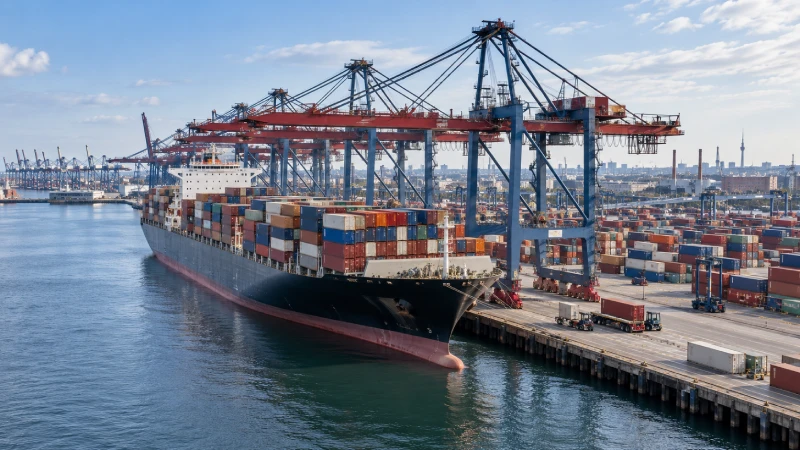
Shipping from China to Hamburg is one of the main sea freight routes for importers moving containerized cargo into Germany. Major Chinese export ports such as Shanghai, Ningbo, Yantian/Shenzhen and Qingdao are connected with Hamburg through Asia–North Europe liner networks, making the port an important entry point for both FCL and LCL shipments.
However, choosing Hamburg should not be based on the ocean freight rate alone. The complete shipment may include factory pickup in China, export handling, ocean freight, Hamburg terminal charges, customs clearance and final delivery by truck or rail.
For importers planning shipping from China to Germany, Hamburg is especially worth considering when the final destination is in northern, central or eastern Germany, or when rail-based inland transport can reduce the cost of moving containers farther into the German hinterland.
China to Hamburg Shipping at a Glance
| Item | Typical Planning Consideration |
|---|---|
| Main transport mode | Sea freight |
| Destination port | Port of Hamburg, Germany |
| Main China origin ports | Shanghai, Ningbo, Yantian/Shenzhen, Qingdao, Tianjin/Xingang, Xiamen, Nansha |
| Shipment types | FCL and LCL |
| Common FCL equipment | 20GP, 40GP, 40HQ |
| Ocean transit | Usually several weeks; current vessel schedule should always be checked |
| FCL pricing | Per container plus origin, carrier and destination charges |
| LCL pricing | Mainly chargeable CBM/W/M plus CFS and local charges |
| Customs | EU and German import requirements apply |
| Inland transport | Truck, rail or combined transport |
| Best suited for | Northern Germany and many central/eastern German destinations |
Port-to-port transit time is only one part of the total lead time. Cargo pickup, export customs, consolidation, vessel cut-off, terminal discharge, import clearance and inland delivery can all extend the factory-to-door schedule.
Pro Tip: When comparing China-to-Hamburg shipping options, ask for both the vessel transit time and the estimated factory-to-door lead time. A sailing with a shorter ocean transit does not necessarily produce the earliest warehouse delivery.
Why Hamburg Is Important for Cargo from China
Hamburg is not simply a German destination port. Its value for China-origin shipments comes from the combination of major Asia liner connections, container terminal capacity and extensive rail and road links into Germany and the wider European hinterland.
China remained the Port of Hamburg’s largest container trading partner in 2025, with approximately 2.3 million TEU handled. In June 2026, Port of Hamburg reported 17 regularly operated liner services connecting Hamburg directly with China, including 12 container services. Port of Hamburg
Strong China–Hamburg Container Connectivity
Current Port of Hamburg liner schedules show rotations connecting Hamburg with major Chinese ports including:
- Shanghai
- Ningbo
- Yantian
- Qingdao
- Tianjin
- Dalian
For example, current Asia–Europe services include weekly rotations covering combinations such as Shanghai, Ningbo and Yantian, while other services connect Hamburg with Shanghai, Tianjin, Dalian and Qingdao. Port of Hamburg liner services
This gives importers several possible origin-port strategies rather than forcing all cargo through one Chinese gateway.
The actual service available for a shipment still depends on the carrier, departure week and current network rotation.
Major Container Handling Capacity
Hamburg has four major container terminals with combined annual handling capacity of around 12 million TEU. All four container terminals have integrated rail facilities, which is particularly important for cargo continuing beyond the Hamburg region. Port of Hamburg terminals
The main container terminals include:
- HHLA Container Terminal Altenwerder
- HHLA Container Terminal Burchardkai
- HHLA Container Terminal Tollerort
- EUROGATE Container Terminal Hamburg
Importers generally do not choose a terminal independently. The terminal is largely determined by the shipping line and the service on which the container is booked.
Strong Rail Connections to the German Hinterland
Hamburg’s inland rail capability is one of its biggest advantages for containerized imports.
In 2025, approximately 44.4 million tonnes and 2.6 million TEU were moved through the port railway. Around 200 freight trains operate daily across a network of almost 300 kilometres of track. Port of Hamburg port railway statistics
That matters because a shipment from China does not necessarily end with a truck leaving the port.
A container arriving in Hamburg can continue by rail toward inland terminals and then complete the final delivery by truck. For regular container flows and longer inland distances, this can be more efficient than moving the entire route by road.
A Useful Gateway for Northern and Central Germany
Hamburg is naturally competitive for destinations close to the port, including Hamburg itself, Schleswig-Holstein and parts of Lower Saxony.
Its rail network also makes it relevant for destinations farther inland, including parts of:
- Brandenburg
- Berlin
- Saxony
- Saxony-Anhalt
- Thuringia
- central Germany
For destinations much farther west or southwest, Hamburg should still be compared with other German or Benelux gateways based on the complete transport chain.
The right port is the port that gives the best combination of vessel schedule, local charges, customs process and inland transport—not simply the closest port on a map.
Main China Origin Ports for Shipping to Hamburg
The best China origin port is usually determined by two factors:
- where the supplier or cargo is located;
- which vessel service offers the most practical Hamburg routing.
Moving cargo hundreds of kilometres inside China just to obtain a slightly lower ocean rate can increase the total cost and make the shipment less reliable.
| China Origin | Main Sourcing Area | Hamburg Route Relevance | Main Planning Point |
|---|---|---|---|
| Shanghai | Shanghai, Jiangsu, Yangtze River Delta | Major Asia–Europe gateway | Strong option for East China suppliers |
| Ningbo | Zhejiang, southern Yangtze River Delta | Common call on North Europe services | Compare factory trucking with Shanghai |
| Yantian / Shenzhen | Shenzhen, Dongguan, Guangdong | Major South China gateway | Important for Pearl River Delta cargo |
| Qingdao | Shandong and northern China | Included in Asia–Hamburg networks | Good option for Shandong suppliers |
| Tianjin / Xingang | Tianjin, Beijing, Hebei | Northern China gateway | Compare rotation and transit with Qingdao |
| Xiamen | Fujian | Regional export gateway | Direct or transshipment service varies |
| Nansha / Guangzhou | Guangzhou, Foshan, Guangdong | Alternative South China origin | Compare with Yantian based on factory location |
Not every port has the same direct service in every departure week. Carrier alliances, vessel rotations and transshipment patterns can change, so the booking should be based on the current sailing rather than a static route list.
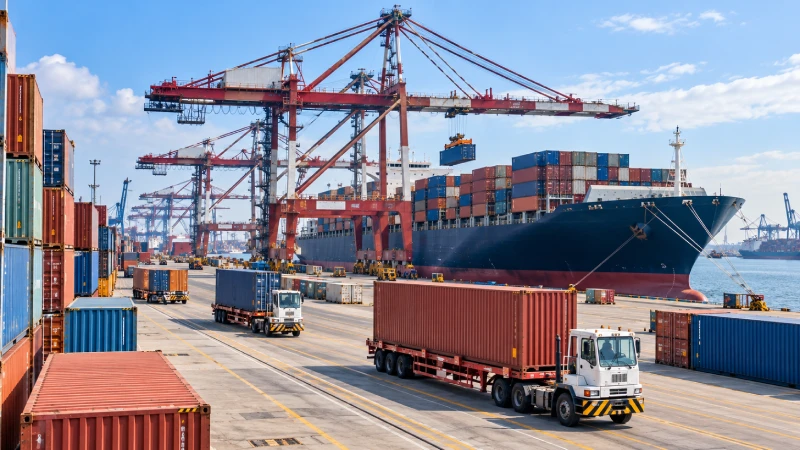
Shanghai to Hamburg Shipping
Shanghai is one of the most important origin ports for sea freight from China to Hamburg.
It is particularly suitable for manufacturers and suppliers in:
- Shanghai
- Suzhou
- Kunshan
- Wuxi
- Changzhou
- other parts of Jiangsu and the Yangtze River Delta
Both FCL and LCL services are widely available.
For FCL cargo, containers can often be collected or loaded close to the supplier before moving into the Shanghai port system. For LCL cargo, the shipment normally moves first to a consolidation warehouse before being loaded with cargo from other shippers.
Shanghai should also be compared with Ningbo when the factory is located between the two gateways.
The lowest ocean rate is not always the lowest total route cost. A Ningbo sailing may appear cheaper, for example, but the saving can disappear if the supplier is substantially closer to Shanghai.
Shenzhen / Yantian to Hamburg Shipping
For cargo manufactured in Shenzhen, Dongguan and the wider Pearl River Delta, Yantian is one of the most important gateways for Hamburg-bound containers.
Current Hamburg liner rotations include Yantian together with ports such as Shanghai, Ningbo and Qingdao. Port of Hamburg liner services
Typical cargo from the region includes electronics, consumer products, machinery, electrical equipment and manufactured goods.
However, Yantian is not automatically the best choice for every Guangdong supplier.
Depending on the factory location and sailing schedule, Nansha may also be worth comparing.
A supplier in Foshan, for example, may face a very different domestic trucking cost from one located in Shenzhen.
Pro Tip: Choose the Chinese origin port based on the total origin logistics cost. Compare factory pickup, trucking, export handling, cut-off time and sailing schedule together with the ocean freight rate.
FCL vs LCL Shipping from China to Hamburg
Both FCL and LCL are widely used for sea freight to Hamburg, but the cost structure and cargo handling process are different.
| Factor | FCL | LCL |
|---|---|---|
| Container use | Dedicated container | Shared container |
| Typical equipment | 20GP, 40GP, 40HQ | Consolidated container |
| Main freight basis | Per container | CBM/W/M |
| Best suited for | Larger shipments | Smaller shipments |
| China handling | Container loading | CFS consolidation |
| Hamburg handling | Full-container release | Deconsolidation required |
| Cargo handling | Less intermediate handling | More handling points |
| Transit process | Usually simpler | Additional consolidation stages |
| Destination charges | Container-related charges | CFS and deconsolidation charges |
| Final delivery | Container or devanned cargo | Usually loose/palletized cargo |
When FCL Makes More Sense
FCL, or Full Container Load, is often the better option when the shipment is large enough to justify using a dedicated container.
Common equipment includes:
- 20GP
- 40GP
- 40HQ
FCL may also be preferred before the container is physically full.
For example, dedicated container shipping may make sense for:
- fragile cargo
- high-value cargo
- large machinery
- multiple pallets
- regular production orders
- cargo where reducing handling points is important
Because the container is not shared with unrelated shipments, there is generally less consolidation and deconsolidation handling than with LCL.
For a broader sea freight comparison, see shipping from China to Germany.
When LCL Makes More Sense
LCL, or Less than Container Load, allows several shippers to share one container.
It is suitable for smaller shipments that do not justify paying for an entire container.
Typical uses include:
- sample or test orders
- smaller wholesale orders
- irregular replenishment
- low-CBM shipments
- businesses starting with a new supplier
The important issue with LCL is that the sea freight itself is only one part of the cost.
An LCL shipment may include:
- China CFS receiving
- consolidation
- documentation
- ocean freight
- Hamburg CFS handling
- deconsolidation
- customs clearance
- local delivery
This is why a very low LCL ocean rate does not always produce a low door-to-door price.
For more pricing detail, see shipping cost from China to Germany.
Pro Tip: Do not choose LCL or FCL using CBM alone. Once a shipment becomes relatively large, compare the complete LCL destination-charge structure against a 20GP or 40GP FCL option.
China to Hamburg Transit Time
Sea freight from China to Hamburg normally takes several weeks.
However, there is no single reliable transit time that applies to every shipment.
The actual schedule depends on:
- China origin port
- carrier
- vessel service
- port rotation
- direct or transshipment routing
- geopolitical routing
- blank sailings
- congestion
- weather
- departure week
For practical planning, many current China–North Europe movements require roughly 30–50+ days port to port, depending on origin and routing.
This should be treated as an indicative planning range rather than a guaranteed schedule.
| Origin | Indicative Port-to-Port Planning Range* |
|---|---|
| Shanghai → Hamburg | About 30–45 days |
| Ningbo → Hamburg | About 30–45 days |
| Yantian / Shenzhen → Hamburg | About 30–45 days |
| Qingdao → Hamburg | About 35–50 days |
| Tianjin / Xingang → Hamburg | About 35–50+ days |
| Xiamen / Nansha → Hamburg | About 35–50+ days depending on service |
*Planning ranges only. Always use the ETD and ETA of the actual booked vessel for shipment planning.
For a wider Germany comparison, see how long shipping from China to Germany takes.
Port-to-Port Time Is Not Door-to-Door Time
A shipment can spend additional time before and after the ocean voyage.
A better way to calculate the schedule is:
Factory pickup → origin handling → vessel departure → ocean transit → Hamburg discharge → customs/release → inland delivery
| Stage | Main Variables |
|---|---|
| Factory pickup | Supplier city and trucking distance |
| Origin handling | Export customs, CY/CFS cut-off, consolidation |
| Ocean voyage | Route, carrier and vessel rotation |
| Hamburg terminal | Discharge and terminal availability |
| Customs | Documentation, classification and inspections |
| Inland transport | Truck/rail availability and final postcode |
LCL usually requires more time around the ocean leg because cargo has to be consolidated before departure and deconsolidated after arrival.
What Can Delay China-to-Hamburg Shipping?
Common causes include:
- missed vessel cut-off
- blank sailing
- vessel schedule changes
- congestion
- transshipment delays
- weather
- customs inspection
- document discrepancies
- terminal congestion
- rail or truck capacity shortages
Operational conditions at the destination port should also be checked close to the actual booking date.
For example, Port of Hamburg reported in August 2026 that ongoing modernisation measures had reduced terminal capacity during part of the first half of 2026. This is a useful reminder that static transit-time estimates should not replace current operational information. Port of Hamburg H1 2026 throughput update
Shipping Cost from China to Hamburg
There is no fixed cost for shipping a container from China to Hamburg.
Ocean rates can move significantly depending on:
- carrier capacity
- container availability
- season
- origin port
- equipment type
- fuel and other carrier surcharges
- geopolitical routing
- market demand
More importantly, the ocean rate is not the total cost of importing cargo through Hamburg.
What Makes Up a China-to-Hamburg Freight Quote?
| Cost Component | FCL | LCL |
|---|---|---|
| China factory pickup | Yes | Yes |
| Origin handling | Yes | Yes |
| Export customs | Usually | Usually |
| Ocean freight | Per container | CBM/W/M |
| Carrier surcharges | Possible | Possible |
| Hamburg terminal / CFS charges | Yes | Yes |
| Customs clearance | Yes | Yes |
| Import duty | Product-dependent | Product-dependent |
| Import VAT | Import-dependent | Import-dependent |
| Truck/rail delivery | If required | If required |
| Storage | If incurred | If incurred |
| Demurrage/detention | Possible | Different rules may apply |
FCL Cost Logic
For an FCL shipment, the total logistics cost can be considered as:
China pickup + origin charges + ocean freight + carrier surcharges + Hamburg local charges + customs clearance + duty/tax + inland delivery
Container size is one of the biggest variables.
A 40GP or 40HQ does not normally cost twice as much as a 20GP, which means larger containers may offer a lower freight cost per cubic metre when cargo volume is high enough.
But equipment selection also depends on:
- cargo dimensions
- weight
- loading method
- container payload limits
- road weight restrictions
- commodity requirements
LCL Cost Logic
LCL quotations work differently.
The shipment is generally charged according to W/M—weight or measurement—with volume usually expressed in CBM.
The total may include:
China pickup + CFS receiving + consolidation + ocean freight + Hamburg deconsolidation/CFS + documents + clearance + delivery
Destination charges deserve particular attention.
A low China-side LCL price may be offset by more expensive destination handling after the container arrives in Hamburg.
What Causes Freight Rates to Change?
The final price can be affected by:
- Shanghai vs Ningbo vs Yantian origin
- 20GP vs 40GP vs 40HQ
- peak season
- carrier space
- container shortages
- heavy cargo
- dangerous goods
- lithium batteries
- temperature-controlled cargo
- oversized cargo
- German delivery postcode
- truck vs rail inland transport
For broader pricing logic, see shipping cost from China to Germany.
Need a China-to-Hamburg Shipping Plan?
Send your:
- product name
- quantity
- cartons or pallets
- dimensions
- gross weight
- total CBM
- China pickup location
- German delivery postcode
We can compare the practical FCL/LCL route, China origin port, Hamburg handling and inland delivery arrangement.
CTA: Check My Hamburg Shipping Options
What Happens After Your Container Arrives in Hamburg?
The shipment is not complete when the vessel reaches Hamburg.
For most importers, the destination-side process includes several separate operational steps.
| Stage | What Happens |
|---|---|
| 1. Vessel arrival | Vessel berths at its assigned terminal |
| 2. Discharge | Container is unloaded from the vessel |
| 3. Terminal processing | Container status is updated in the terminal system |
| 4. Customs | Import declaration and required controls are completed |
| 5. Carrier release | Shipping-line/document release is completed |
| 6. Inland booking | Truck or rail movement is arranged |
| 7. Gate or rail transfer | Container leaves the terminal |
| 8. Final delivery | Cargo reaches the consignee |
Hamburg Container Terminal Handling
Hamburg’s four major container terminals have integrated rail facilities, allowing containers to move from ship to rail without relying exclusively on long-distance trucking. Port of Hamburg terminals
The exact handling process depends on:
- terminal
- shipping line
- customs status
- container type
- inland transport mode
For FCL shipments, the full container may leave the terminal by truck or rail.
For LCL shipments, the container normally has to be deconsolidated before the individual shipment can be released for delivery.
Customs Release Is Not the Same as Cargo Availability
One common misunderstanding is assuming that customs clearance means a container can immediately be collected.
Several statuses may need to align:
- customs release
- shipping-line release
- terminal release
- payment of local charges
- truck appointment or rail booking
A delay in any one of these can prevent the container from leaving the terminal.
Free Time, Demurrage and Detention
Importers should also confirm:
- terminal storage terms
- demurrage
- detention
- container free time
- empty-container return location
These conditions vary by shipping line, equipment and contract.
There is no universal number of free days that should be assumed for every China-to-Hamburg shipment.
Pro Tip: Prepare customs documentation before the vessel arrives. Avoid beginning product classification, invoice correction or importer-registration checks only after the container is already sitting at the terminal.
Customs Clearance in Hamburg
Cargo imported from China through Hamburg enters the EU customs territory and must follow applicable EU and German customs rules.
EU customs declarations provide the authorities with details of the imported goods and place them under the relevant customs procedure. Commercial imports are normally handled electronically. European Commission customs declaration guidance
Documents Commonly Needed
The exact document package depends on the product, but typical commercial imports require information such as:
| Document / Information | Purpose |
|---|---|
| Commercial invoice | Value, seller/buyer and transaction details |
| Packing list | Quantity, packaging, weight and dimensions |
| Bill of lading | Transport information |
| CN/TARIC classification | Customs and regulatory treatment |
| Country of origin | Tariff and trade measures |
| EORI | EU customs identification |
| Product documents | Required for regulated commodities |
EORI Number
An EORI number is required for economic operators carrying out customs operations in the EU, including import, export and transit activities. European Commission EORI guidance
For a commercial shipment, importer details should therefore be confirmed well before vessel arrival.
Waiting until the container reaches Hamburg to discover that the importer structure is incomplete can result in unnecessary storage and delay.
Customs Duty Depends on the Product
Germany does not apply one standard customs-duty percentage to every product imported from China.
The rate depends primarily on the customs classification and relevant EU tariff measures.
The EU uses the Combined Nomenclature and TARIC system. TARIC integrates not only tariff measures but also trade measures such as:
- anti-dumping duties
- countervailing duties
- tariff quotas
- import restrictions
- import controls
- certain licensing requirements
This means an apparently small classification difference can have a significant effect on landed cost or compliance requirements.
Import VAT in Germany
Germany’s standard import VAT rate is currently 19%, while certain qualifying goods use a reduced 7% rate. German Customs
However, it is incorrect to calculate every import as:
Chinese invoice price × 19%
The taxable basis may include customs value, applicable customs duty and certain transport or incidental costs.
The correct calculation should therefore be confirmed using the actual transaction, Incoterm and customs declaration.
For broader Germany import planning, see shipping from China to Germany.
Pro Tip: Confirm the CN/TARIC classification before the cargo leaves China—especially for products that may be subject to anti-dumping measures, product-specific controls or additional documentation.
Inland Delivery from Hamburg
For most importers, Hamburg is not the final destination.
A more useful question is:
How will the container move from Hamburg to the actual warehouse?
The main options are:
- direct truck
- rail + truck
- other combined/intermodal transport arrangements
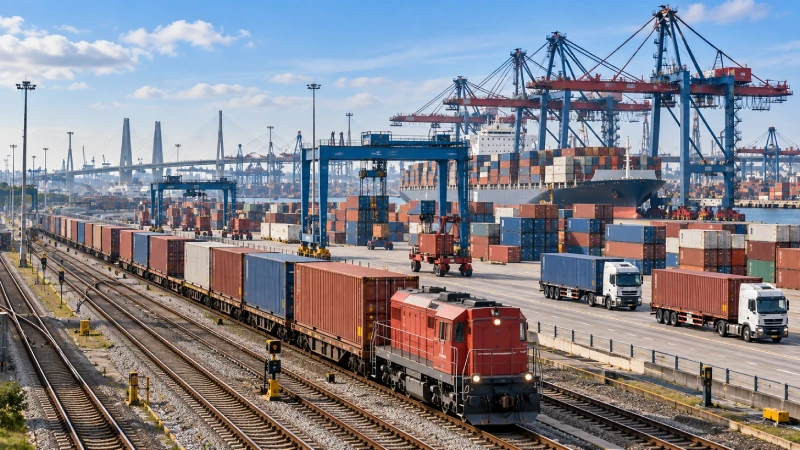
Direct Truck Delivery
Truck delivery is usually the simplest option for shorter inland distances.
It may work well for:
- Hamburg
- nearby northern Germany
- Schleswig-Holstein
- parts of Lower Saxony
- time-sensitive deliveries
- destinations without a useful rail-terminal connection
With an FCL shipment, the container may be collected from the terminal and delivered directly to the consignee for unloading.
The empty equipment then needs to be returned according to the shipping line’s instruction.
That return leg should be considered when calculating inland cost.
Rail + Truck Delivery
Rail becomes increasingly important as inland distance increases.
Hamburg’s port rail system connects terminal operations with German and European hinterland networks, and around 2.6 million TEU moved by rail through the port in 2025. Port of Hamburg port railway statistics
A common intermodal flow is:
Hamburg terminal → inland rail terminal → final truck delivery
This can be attractive for:
- regular container volumes
- longer inland distances
- destinations near intermodal terminals
- central and eastern German distribution
- supply chains seeking to reduce long-distance road mileage
| Final Area | Transport Approach Worth Comparing |
|---|---|
| Hamburg / nearby area | Direct truck |
| Schleswig-Holstein | Direct truck |
| Lower Saxony | Truck vs rail depending on destination |
| Hannover area | Truck or intermodal |
| Berlin / Brandenburg | Rail + truck may be attractive |
| Leipzig / Saxony | Intermodal option worth comparing |
| Central Germany | Compare direct truck with inland rail |
| Southern Germany | Rail can become increasingly relevant |
There is no universal rule that rail is always cheaper after a specific distance.
The result depends on:
- container volume
- rail terminal location
- train frequency
- final-mile trucking
- equipment availability
- delivery appointment
- current rail capacity
Why the German Postcode Matters
An ocean freight request that only says “Hamburg” is incomplete if the actual destination is hundreds of kilometres inland.
For example:
Shanghai → Hamburg port
and
Shanghai → Hamburg → warehouse near Leipzig
are different logistics products.
The second requires inland cost, equipment planning and delivery timing.
For an accurate comparison, always provide the final German postcode.
CTA: Check Hamburg-to-Warehouse Delivery
Hamburg vs Bremerhaven: Which Port Is Better?
Hamburg is one of Germany’s main container gateways, but it is not automatically the best port for every China-origin shipment.
Bremerhaven should also be considered when the sailing schedule or inland destination makes it more competitive.
Bremerhaven handled approximately 5.21 million TEU in 2025 and has extensive rail and road connections into Germany and Europe. It is also particularly strong in automotive logistics, handling approximately 1.25 million vehicles in 2025. bremenports container logistics
| Factor | Hamburg | Bremerhaven |
|---|---|---|
| China container connectivity | Very strong | Strong |
| Container handling | Core activity | Core activity |
| Rail hinterland | Major strength | Strong |
| Hamburg-area delivery | Usually advantageous | Longer inland leg |
| Northwest Germany | Depends on destination | Often worth comparing |
| Central/eastern Germany | Strong rail options | Route-dependent |
| Automotive/RoRo | Available | Major specialisation |
| Final decision | Schedule + total inland cost | Schedule + total inland cost |
Hamburg May Be Better When
Hamburg may be the stronger option if:
- the supplier’s carrier has a better Hamburg sailing;
- Hamburg provides an earlier usable ETA;
- the final delivery is near Hamburg;
- rail service from Hamburg fits the inland destination;
- the overall Hamburg local and inland cost is lower.
Bremerhaven May Be Better When
Bremerhaven may deserve preference if:
- the carrier schedule is better;
- container space is available earlier;
- the final destination is better positioned for Bremerhaven;
- inland rail/truck cost is lower;
- the shipment involves automotive or RoRo logistics;
- Hamburg’s operational conditions create a significant timing disadvantage.
Compare the Total Route, Not Just the Ocean Freight
Suppose one carrier offers:
Shanghai → Hamburg: USD X
and another offers:
Shanghai → Bremerhaven: USD X – 150
That does not automatically mean Bremerhaven is cheaper.
You still need to compare:
China origin cost + ocean freight + German port charges + customs + inland delivery
The destination postcode may reverse the result completely.
China to Hamburg Shipping Process
A typical China-to-Hamburg shipment follows these steps.
1. Send Cargo Details
Provide:
- commodity
- quantity
- dimensions
- gross weight
- CBM
- cargo value
- China pickup location
- German delivery postcode
2. Select the China Origin Port
Compare the factory location with ports such as:
- Shanghai
- Ningbo
- Yantian
- Qingdao
- Tianjin
- Xiamen
- Nansha
3. Compare FCL and LCL
Consider both cargo volume and destination charges.
For medium-size shipments, request both options instead of assuming LCL is cheaper.
4. Select the Carrier and Sailing
Check:
- ETD
- ETA
- vessel schedule
- direct/transshipment routing
- space
- cut-off date
- terminal
5. Collect the Cargo in China
Cargo moves from the supplier to:
- the container loading location for FCL; or
- the consolidation warehouse for LCL.
6. Complete China Export Procedures
Export documents and customs formalities are prepared before departure.
7. Ship the Cargo to Hamburg
The container moves on the booked Asia–North Europe service.
8. Discharge and Clear the Cargo
After arrival:
- container is discharged;
- terminal status is confirmed;
- customs clearance is completed;
- carrier release is obtained.
9. Arrange German Inland Transport
Depending on destination:
- direct truck; or
- rail + truck.
10. Deliver to the Consignee
The cargo reaches the final German warehouse or receiving location.
For FCL cargo, unloading time and empty-container return should be coordinated carefully.
Pro Tip: Request inland transport together with the ocean freight whenever possible. A cheap port-to-port rate can become expensive once terminal handling, container positioning and inland trucking are added.
How to Reduce China-to-Hamburg Shipping Risks
Many shipping problems are caused before the vessel sails rather than during the ocean voyage.
| Risk | Recommended Action |
|---|---|
| Wrong China origin port | Compare factory-to-port cost |
| Missed vessel cut-off | Confirm CY/CFS cut-off before pickup |
| Unexpected LCL charges | Request destination charge structure |
| Schedule delay | Check actual carrier sailing |
| Customs classification error | Confirm CN/TARIC before shipment |
| Missing compliance documents | Check product requirements before loading |
| Hamburg storage charges | Prepare clearance before arrival |
| Demurrage/detention | Confirm free-time conditions |
| No inland capacity | Arrange truck/rail early |
| Wrong German destination port | Compare Hamburg and Bremerhaven all-in |
Check Product Compliance Before Shipping
Customs clearance and product compliance are related but not identical.
A product may have the correct customs classification and still be subject to additional EU regulatory requirements.
Depending on the commodity, these may involve areas such as:
- product safety
- electrical requirements
- CE-related obligations
- food controls
- batteries
- chemicals
- medical devices
- wood packaging
- dangerous goods
Do not wait until cargo arrives in Hamburg to identify these requirements.
Leave Enough Time for Documentation
Before arrival, check that the commercial documents are consistent.
Pay particular attention to:
- importer name
- seller name
- product description
- quantity
- value
- Incoterm
- country of origin
- classification
A generic description such as “parts”, “accessories” or “equipment” may be insufficient for proper customs classification.
What Information Is Needed for a China-to-Hamburg Freight Quote?
A useful freight quotation starts with complete shipment information.
Provide the following whenever possible:
Cargo Information
- product / commodity
- HS code if available
- number of cartons or pallets
- carton/pallet dimensions
- gross weight
- total CBM
- cargo value
China Origin
- supplier city
- factory address or pickup location
- Incoterm
- nearest port if known
Cargo Conditions
State clearly if the shipment contains:
- lithium batteries
- chemicals
- liquids
- magnets
- dangerous goods
- oversized cargo
- temperature-controlled products
Germany Destination
Provide:
- delivery city
- postcode
- business or residential location
- unloading conditions where relevant
The postcode is particularly important because inland delivery can materially affect whether Hamburg is the best destination port.
Plan Your Shipment from China to Hamburg
The most effective way to plan shipping from China to Hamburg is to evaluate the complete transport chain rather than buying ocean freight in isolation.
A practical comparison should include:
China supplier → origin port → FCL/LCL → vessel service → Hamburg terminal → customs → German inland delivery
Send your cargo details, China pickup location and final German postcode to compare the suitable origin port, container option, Hamburg route and inland transport plan.
FAQ
How long does shipping from China to Hamburg take?
Sea freight normally requires several weeks. For current planning, many China-to-Hamburg routes may fall roughly within a 30–50+ day port-to-port range, depending on the China origin port, carrier, vessel rotation and current routing. For an actual shipment, use the ETD and ETA of the booked vessel and add time for China pickup, export handling, Hamburg customs and inland delivery.
How much does it cost to ship a container from China to Hamburg?
There is no permanent fixed price. FCL rates depend on origin port, container size, carrier, departure week, space, surcharges and cargo type. The total cost should also include China pickup, origin charges, Hamburg charges, customs clearance and inland delivery. For LCL, destination CFS and deconsolidation charges are especially important.
Is there direct sea freight from Shanghai to Hamburg?
Yes. Shanghai appears in regular Asia–Hamburg container-service rotations published by Port of Hamburg. The exact service and sailing should still be checked for the required departure date because carrier networks and rotations can change.
Can I ship directly from Shenzhen to Hamburg?
Yes. Cargo from Shenzhen is commonly exported through Yantian, which is included in Asia–Hamburg liner rotations. For factories farther west in Guangdong, Nansha may also be worth comparing based on the supplier location and sailing schedule.
Is FCL or LCL better for shipping from China to Hamburg?
LCL is generally suitable for smaller shipments, while FCL becomes increasingly attractive as cargo volume grows. Compare ocean freight, China handling, Hamburg destination charges, cargo handling risk and final delivery rather than using CBM alone.
What happens to my container after it arrives in Hamburg?
The container is discharged at the assigned terminal, after which customs, shipping-line and terminal-release requirements must be completed. Cargo can then continue to the consignee by truck, rail or combined rail-and-truck transport. LCL cargo normally requires deconsolidation first.
Can a container arriving in Hamburg be delivered by rail within Germany?
Yes. Rail is a major part of Hamburgu0026#x27;s hinterland logistics system. For longer inland routes and regular container volumes, rail plus final-mile trucking can be worth comparing with direct road transport.
Should I choose Hamburg or Bremerhaven for imports from China?
Neither port is automatically better. Compare carrier schedule, destination-port charges, customs, inland transport and total lead time. Hamburg is especially strong for China liner connectivity and rail hinterland transport, while Bremerhaven can be competitive for certain services, northwest German destinations and automotive or RoRo cargo.
