
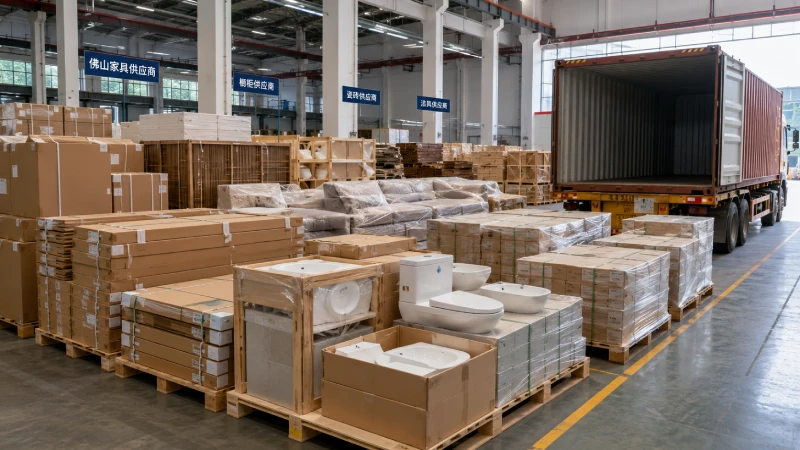
Shipping furniture and building materials from China to Ghana becomes more complex when one order includes several Foshan suppliers. A buyer may source sofas, cabinets, tiles and sanitary ware from different factories.
The main questions are then practical: What is the final packed CBM? Which products can share a container? How should heavy tiles be positioned? And when is FCL more practical than LCL?
For the wider route overview, see our shipping from China to Ghana guide.
Quick Answer
For shipping furniture from China to Ghana, start managing the shipment before suppliers finish packing.
Ask each supplier for package dimensions, gross weight, packing type and cargo-ready date. If several suppliers are located around Foshan or Guangzhou, coordinate them through one warehouse, verify the final packed CBM, inspect packaging, and separate heavy, fragile and moisture-sensitive cargo by risk.
Then compare complete LCL and FCL options, prepare a container load plan and verify applicable Ghana product requirements before shipment.
The goal is to remove unnecessary space without removing necessary protection.
Why Furniture Shipping Cost Is Often Driven by CBM
Furniture is often bulky relative to its weight. Sofas, chairs, wardrobes, tables and cabinet panels can occupy substantial space without being exceptionally heavy, so CBM is especially important for LCL furniture shipping.
The basic calculation is:
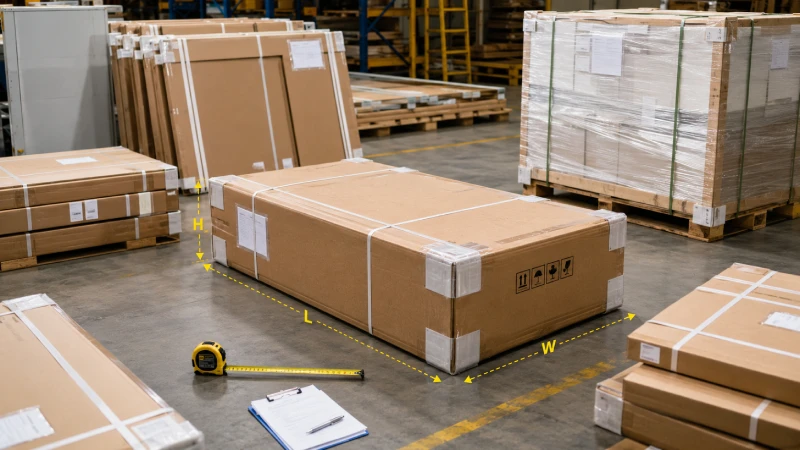
Length × Width × Height × Number of Packages = CBM
Use the outer dimensions of the final shipping package, not bare-product dimensions.
Some LCL tariffs use weight-or-measure rules. For example, Maersk’s published LCL terms calculate chargeable units according to volume or weight under the applicable tariff conditions. Check the exact charging rule for the shipment.
Why Supplier Packing CBM Should Be Checked Again
A supplier packing list is useful for planning, but it is not necessarily the final freight measurement.
Dimensions can change because of:
- thicker export cartons;
- foam and corner protectors;
- pallets or wooden crates;
- irregular package shapes;
- repacking after inspection;
- components packed separately at the last minute.
LCL cargo may also be remeasured before consolidation. Flexport’s CFS measurement guidance notes that supplier dimensions may be estimates and that palletization or additional packaging can increase final volume.
Warehouse receiving records should therefore capture package quantity, final L × W × H, gross weight and condition photos.
Create One Supplier Packing Standard
Different supplier packing rules make consolidation harder. A simple Supplier Packing Standard should therefore be issued before cargo-ready dates.
| Requirement | What Should Be Recorded |
|---|---|
| Package identification | Supplier, PO, SKU and package number |
| Dimensions | Final outer L × W × H |
| Weight | Gross weight per package |
| Packing | Carton, pallet, crate or other method |
| Stackability | Stackable or non-stackable |
| Fragility | Vulnerable faces, edges and components |
| Orientation | Handling direction where required |
| Moisture | Protection required |
| Wood packing | Pallet, crate or dunnage material |
| Evidence | Photos after final packing |
Is Knock-Down Furniture Better for Shipping?
Often, yes—if the product was designed for knock-down transport.
KD furniture can create flatter, more rectangular packages and improve container utilization. Removable legs, nested parts and flat-packed panels can reduce wasted space.
However, CBM optimization should not become unsafe compression. Cabinet doors, veneer panels and furniture surfaces may need stronger face and edge protection after disassembly. The objective is efficient geometry, not the smallest possible carton.
How Multi-Supplier Consolidation Works in Foshan
A practical Foshan furniture consolidation flow is:
Suppliers → Packing Instructions → Cargo-Ready Dates → Warehouse → Receiving → Measurement → Packing Exceptions → Final CBM → Compatibility Review → LCL/FCL Decision → Load Plan → Shipment
Each supplier should receive the warehouse address, receiving reference, carton-mark requirements and delivery appointment. On arrival, cargo can be identified, counted, photographed and measured before final planning.
For broader multi-supplier receiving and documentation, see our China to Ghana cargo consolidation guide.
Which Supplier Should Deliver Last?
There is no universal rule that sanitary ware or other fragile cargo must always arrive last.
Delivery timing should consider:
- whether inspection or repacking is required;
- sensitivity to repeated handling;
- planned position inside the container;
- cargo-ready reliability;
- warehouse cut-off and sailing schedule.
Fragile cargo may benefit from less rehandling, but arriving too late can leave no time to correct poor packaging.
Packing Furniture, Kitchen Cabinets, Tiles and Sanitary Ware
Different products should not be treated as identical general cargo.
Furniture
Furniture normally needs protection against abrasion, pressure, corner impacts and moisture. Where technically suitable, KD packing can improve cube utilization, but furniture cartons should not support dense cargo such as tile pallets or stone crates.
Kitchen Cabinets
Cabinet components are easier to control when packed by function.
Cabinet panels and carcasses can be protected in flat packs with clear package IDs. Doors and decorative fronts need strong face and edge protection. Hardware should be sealed, labeled and traceable to the relevant cabinet or room. Countertops should be packed separately according to material.
For project cargo, labels such as building → floor → room → cabinet/unit can simplify unloading and installation.
Tiles
Tiles combine brittleness with significant weight. Check carton condition, pallet construction, gross pallet weight, edge protection, movement control and forklift accessibility. Do not plan tile placement from CBM alone.
Sanitary Ware
Toilets, basins and ceramic sinks should be immobilized inside suitable packaging, with protection around vulnerable contact points. Heavy packages should not be stacked over sanitary ware unless the packaging has been engineered for that load.
A FRAGILE label helps identification, but it does not replace physical protection.
Marble, Quartz and Stone
Stone should be reviewed separately. Collect dimensions, weight per piece, total crate weight, crate or A-frame design, lifting method and unloading requirements. Heavy stone can change the entire container weight-distribution plan.
LCL vs FCL for Furniture Shipping to Ghana
LCL can suit smaller, well-packed furniture orders. FCL becomes more attractive as volume, supplier count, fragility or the need for loading control increases.
| Factor | LCL | FCL |
|---|---|---|
| Container space | Shared | Dedicated |
| Handling | More consolidation/deconsolidation | More loading control |
| Final CBM | Major pricing input | Important for utilization |
| Fragile cargo | More handling exposure | Better stowage control |
| Mixed suppliers | Possible | Well suited after consolidation |
| Load plan control | Limited | Much greater |
For the wider FCL/LCL route context, see sea freight from China to Ghana.
What If the Shipment Is Around 15–18 CBM?
Do not automatically apply a rule such as 15 CBM = FCL.
When furniture approaches roughly 15–18 CBM, compare a complete LCL calculation with a 20GP option.
For LCL, include CFS handling, origin charges, destination handling, deconsolidation and delivery—not only ocean freight per CBM.
For FCL, include container freight, consolidation or pickup, stuffing, destination charges, trucking and unloading.
Fragility and handling exposure may also make FCL attractive even when the pure freight calculation is close. For current cost components, see shipping cost from China to Ghana.
Can Furniture and Tiles Share One Container?
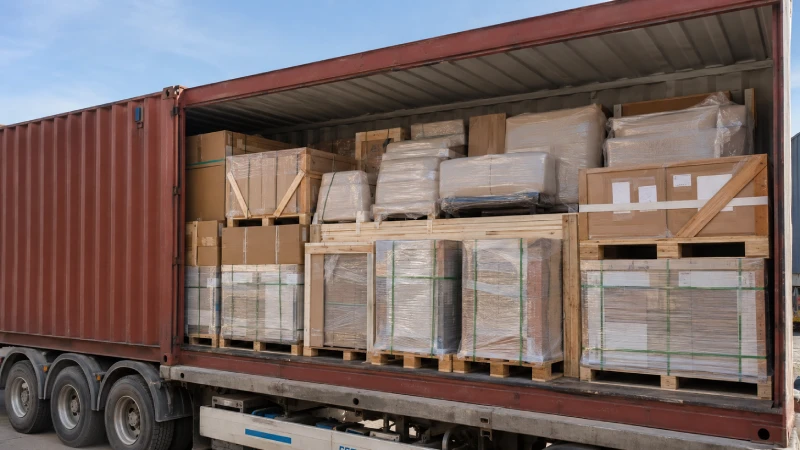
Potentially, yes—but only after checking package strength, dimensions, gross weight, weight distribution and cargo compatibility.
Heavy cargo normally needs to stay low. CMA CGM container guidance emphasizes distributing cargo weight over the floor and maintaining a low center of gravity.
Tile pallets should therefore not be placed wherever empty space appears.
Heavy + Fragile Cargo Compatibility
| Combination | Typical Decision | Main Risk |
|---|---|---|
| Furniture + Tiles | Possible with controls | Crushing and concentrated weight |
| Cabinets + Tiles | Possible with separation | Panel and edge damage |
| Furniture + Sanitary Ware | Possible with protected zones | Impact damage |
| Tiles + Sanitary Ware | Requires close control | Brittle cargo interaction |
| Furniture + Stone | Separate engineering review | High concentrated weight |
Heavy goods should not transfer weight onto unsupported furniture. Dunnage, partitions, blocking, bracing or lashing may be required.
Use a Load Plan Before Stuffing
A useful container Load Plan records:
- package ID;
- supplier;
- product;
- dimensions;
- gross weight;
- fragile or non-fragile status;
- stackability;
- orientation;
- planned container position;
- loading sequence;
- securing requirement;
- unloading priority.
An illustrative sequence may begin with container inspection, floor protection, planned heavy cargo, protected furniture and fragile zones. The actual order must follow real package geometry and weight distribution.
Protect Furniture from Container Moisture
Furniture, cartons and cabinet hardware can all be affected by moisture during ocean transport.
Wood, MDF and veneer may be vulnerable to swelling, warping or mold. Moisture can weaken corrugated cartons, while some metal fittings may corrode.
Hapag-Lloyd’s container packing guidance emphasizes dry cargo and dunnage and the need to manage moisture conditions during container packing.
Before loading:
- inspect the container for water ingress;
- avoid wet pallets and dunnage;
- load cargo as dry as practical;
- use suitable barriers or liners where required;
- select desiccant according to actual cargo and voyage risk.
Avoid fixed desiccant rules for every shipment.
Wooden Crates, Pallets and ISPM 15
If furniture, tiles, sanitary ware or stone uses raw-wood pallets, crates or dunnage, check whether the wood packaging falls within ISPM 15.
The International Plant Protection Convention standard covers qualifying packaging made from raw wood, including dunnage, while processed wood materials such as qualifying plywood are generally excluded.
Do not assume every wooden-looking box has the same requirement. Identify the actual material and verify applicable treatment and marking requirements before shipment.
Ghana Standards Checks for Furniture and Building Materials
Compliance should be checked before the goods leave China, particularly for building-material shipments.
The Ghana Standards Authority currently lists Building Materials among its High Risk Goods categories. Its published EasyPASS scope also covers furniture and construction materials.
However, GSA and GUTA clarified in July 2026 that EasyPASS is not a new universal obligation for every business. Compliance with applicable mandatory Ghana Standards remains the baseline requirement, while other conformity-assessment routes continue to apply where relevant.
Do not assume every sofa, tile or cabinet follows one identical certification route. Confirm the applicable Ghana Standard, HS code and conformity-assessment requirements with the importer, clearing agent or GSA before shipment.
GSA also states that used sanitary ware imported commercially is prohibited. This should not be confused with importing new toilets, basins or other sanitary products.
The Ghana Revenue Authority also lists core clearance documents such as the Bill of Lading, attested invoice, packing list, Import Declaration Form and applicable regulatory permits or certificates.
Delivery from Tema to Accra, Kumasi or the Project Site
After customs and regulatory release, final delivery planning should match the cargo.
Before arranging delivery from Tema to Accra, Kumasi or a project site, confirm:
- final address;
- package dimensions and weights;
- truck access;
- forklift availability;
- crane requirements for heavy stone;
- unloading labour;
- weather protection;
- project receiving schedule.
For hotel or residential projects, Ghana-side unloading priority can even influence the original container Load Plan prepared in Foshan.
Keep Evidence for Damage Prevention and Claims
Packing evidence can help prevent disputes and support a claim if damage occurs.
Keep photographs at four stages:
Supplier: product condition and final packing.
China warehouse: package count, visible damage, dimensions and repacking.
Container loading: container condition, cargo positioning, blocking or lashing, final load and seal.
Ghana arrival: container and package condition before unloading, plus any visible damage before packaging is discarded.
Photos do not guarantee claim acceptance, but incomplete evidence makes it harder to establish when damage occurred.
What Information Is Needed for a Furniture Shipping Quote?
For an accurate furniture or building-material shipment assessment, prepare:
- supplier names and pickup locations;
- cargo-ready date for each supplier;
- product descriptions;
- number of packages;
- final package dimensions;
- gross weight;
- total packed CBM;
- packing photos;
- KD or assembled furniture status;
- tile pallet weights;
- sanitary ware packing type;
- stone dimensions and weights if applicable;
- Incoterm;
- destination in Ghana;
- unloading or site-access restrictions.
For multi-supplier Foshan orders, package-level information is more useful than a supplier’s estimated total CBM alone.
FAQ
How much does it cost to ship furniture from China to Ghana?
There is no reliable fixed rate. Cost depends on final packed CBM, weight, supplier locations, LCL or FCL, origin handling, packaging requirements, destination charges and the final delivery location in Ghana.
Is furniture shipping from China to Ghana charged by weight or CBM?
For LCL, furniture is often volume-driven because it can occupy substantial space relative to weight. The applicable weight or measurement rule depends on the actual LCL tariff. For FCL, the container is booked as a unit, but payload and weight distribution still matter.
Should I use LCL or a 20GP for 15–18 CBM of furniture?
Compare both complete options. Include origin, ocean, destination and delivery charges, as well as fragility, handling exposure and the value of controlling the container load plan.
Can I consolidate furniture from several Foshan suppliers?
Yes. Suppliers can deliver or be collected into one warehouse for identification, receiving, measurement and shipment planning. Physical consolidation does not automatically mean every invoice, export document or regulatory requirement can be merged.
Can furniture and tiles be loaded in the same container?
Yes, in some shipments. Heavy tile pallets should remain low and be positioned according to a weight-distribution plan. Their weight should not be transferred onto furniture packages that cannot support it.
How should sanitary ware be packed for shipping to Ghana?
Ceramic sanitary ware should be immobilized inside suitable protective packaging with adequate protection around vulnerable impact points. Avoid unsupported heavy stacking above it.
Do wooden crates for furniture need ISPM 15 treatment?
Qualifying raw-wood pallets, crates and dunnage fall within ISPM 15, while processed wood packaging such as qualifying plywood may be exempt. Confirm the actual construction material and current destination requirements.
What information should I send for a furniture shipping quotation?
Provide supplier locations, cargo-ready dates, package quantities, final L × W × H, gross weights, CBM, packing photos, product types, tile or stone weights, Incoterm and the final Ghana delivery address.
