
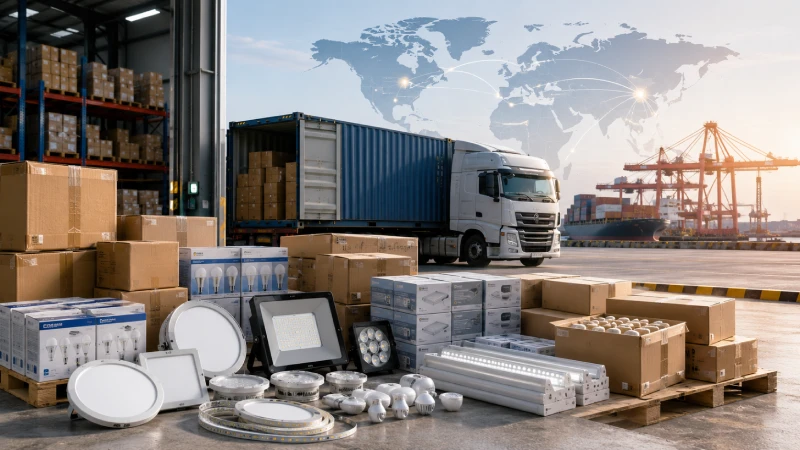
Importing LED lights from China can be a profitable business for Qatar distributors, electrical suppliers, contractors, and project buyers. However, profit is not decided by the factory unit price alone. Freight cost, carton volume, MOQ, customs-related charges, packaging efficiency, and local delivery can all reduce the final margin after the goods arrive. If you need a broader route overview before planning a lighting shipment, you can first review shipping from China to Qatar. This guide focuses specifically on how LED light importers can control landed cost and protect profit margins before confirming the order with a Chinese supplier.
LED lighting products are often margin-sensitive because many models are lightweight but bulky. A carton of LED bulbs may contain many sellable units, while LED panel lights, floodlights, street lights, and decorative lighting may occupy much more container space per unit. If the importer only compares product price and ignores carton dimensions, freight allocation, and MOQ planning, a shipment that looks profitable at the purchasing stage may become much less attractive after delivery in Qatar.
Why LED Light Shipping Requires Margin-Based Planning
For many importers, the first question is “How much is the freight?” But for LED lights, a better question is “How much freight cost is added to each sellable unit?” This difference is important because two suppliers may quote similar LED product prices but use very different packaging sizes. One supplier may offer a lower unit price but pack fewer units per carton, creating a higher CBM and higher shipping cost per unit.
LED lights also vary widely in size, value, and fragility. LED bulbs and strips are usually compact, while panel lights and street lights require more space. Floodlights and outdoor fixtures may have metal housings, glass covers, lenses, drivers, brackets, and accessories that need stronger packaging. Project lighting shipments may involve mixed models, which makes cost allocation more complex.
A profit-focused shipping strategy should therefore consider four questions before shipment:
- How much space does each LED product type occupy?
- How should freight cost be allocated across SKUs?
- Which MOQ gives the best balance between unit cost and inventory risk?
- Does the final landed cost still leave enough margin in Qatar?
Quick Answer: The Most Profitable Way to Ship LED Lights
The most profitable shipping method is not always the cheapest freight quote. It is the option that gives the lowest realistic landed cost per sellable unit while keeping inventory turnover under control.
For small trial orders, LCL sea freight or air freight may be acceptable because the importer is testing demand and avoiding large inventory pressure. For regular wholesale replenishment, LCL or FCL should be compared based on total CBM, carton quantity, and SKU mix. For large project orders, FCL is often more cost-effective, especially when carton size and loading efficiency are planned before production is finished.
| Import Situation | Better Shipping Logic | Margin Impact |
|---|---|---|
| Small trial order | LCL or limited air shipment | Higher unit freight cost but lower inventory risk |
| Regular wholesale order | LCL or FCL based on total CBM | Better cost control |
| Large project order | FCL with optimized carton loading | Lower cost per unit |
| Urgent replenishment | Air freight for selected high-margin SKUs | Protects sales but reduces margin |
| Multiple suppliers | Consolidation in China | Reduces scattered shipment costs |
Importers should avoid judging freight only by the total quotation. A USD 1,000 freight quote may be expensive for a low-value trial order but very reasonable for a large shipment with thousands of sellable units.
Freight Cost Allocation: Calculate the Real Cost per LED Unit
The first step in protecting margin is converting freight into unit-level cost. This is especially important for LED lights because different models may consume very different amounts of space.
This simple formula is useful, but it can still be misleading when the shipment contains mixed SKUs. For example, LED strip lights may be compact and high-density, while LED panel lights occupy more carton volume. If both products share the same average freight cost per unit, the importer may overestimate the margin of bulky products and underestimate the margin of compact products.
A better method is to allocate freight cost by carton volume, carton quantity, or SKU group.
| LED Product Type | Cost Allocation Risk | Better Calculation Method |
|---|---|---|
| LED bulbs | Low unit value, many pieces per carton | Freight cost per 100 or 1,000 units |
| LED panel lights | High carton volume | Freight cost by CBM and unit |
| LED strips | Many models and accessories | Freight cost by SKU group |
| Floodlights | Heavier housing and stronger cartons | Freight cost by carton weight and product value |
| Street lights | Large size and project quantity | Freight cost by project batch |
When the shipment is charged mainly by volume, importers should also compare the cost per CBM. For more detailed CBM-based pricing logic, link this section naturally to shipping cost per CBM from China to Qatar.
Packaging Efficiency: The Hidden Profit Lever
Packaging is not only a safety issue for LED lights. It is also a cost-control tool. Oversized retail boxes, excessive empty space, weak master cartons, and inefficient palletization can all increase freight cost or damage risk.
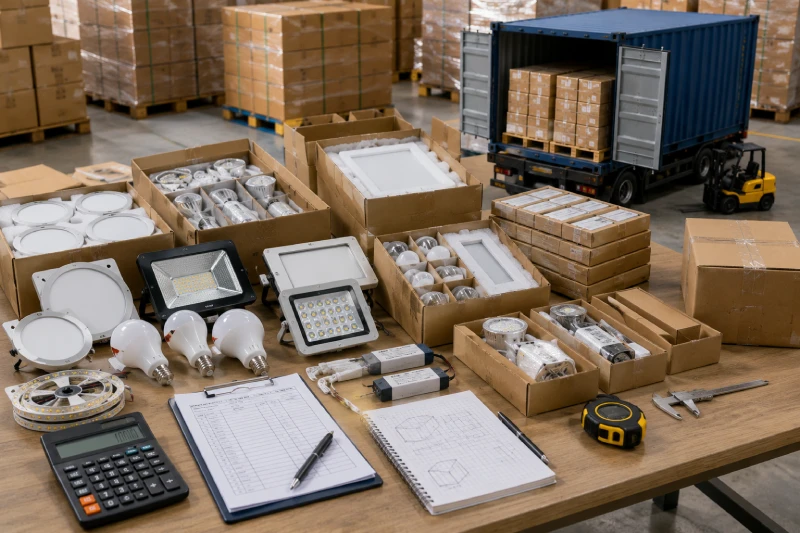
Before confirming the purchase order, importers should ask the supplier for:
- Carton dimensions
- Units per carton
- Gross weight and net weight
- Total carton quantity
- Total CBM
- Packing method
- Whether pallets are required
- Packaging photos or packing list sample
This information should be reviewed before production is completed. Once goods are packed, it is much harder to change carton size or packing method.
For retail LED products, attractive packaging may help the importer sell at a better price in Qatar. But for project supply, contractor orders, or wholesale distribution, excessive retail packaging may reduce profit. A contractor installing LED panels in a hotel, warehouse, school, or commercial building may care more about safe delivery and model identification than colorful retail boxes.
| Sales Channel in Qatar | Packaging Priority | Margin Recommendation |
|---|---|---|
| Retail shops | Attractive product box | Accept higher packaging volume if it supports selling price |
| Wholesale distribution | Strong master cartons | Reduce unnecessary retail packaging |
| Construction projects | Functional protection | Use project-based bulk packing where possible |
| Online resale | Individual protection | Balance courier handling risk and carton volume |
The goal is not to make packaging as small as possible. The goal is to reduce wasted space without increasing damage, return, or replacement costs. For fragile electrical lighting products, packaging must still protect lenses, drivers, glass covers, connectors, brackets, and housings during loading, ocean transport, unloading, and final delivery.
Landed Cost Calculation for LED Lights Imported into Qatar
Many LED importers make pricing decisions too early. They calculate profit using factory price, then add freight and customs-related charges later. This creates a risk: the selling price in Qatar may already be fixed before the true landed cost is known.
A more reliable approach is to calculate landed cost before placing the final order.
Then calculate:
This calculation helps importers compare suppliers more accurately. A supplier with a lower EXW price may not offer the best final margin if the packaging is bulky, cartons are weak, or documents are incomplete. Another supplier with a slightly higher product price but better packing efficiency may produce a lower landed cost per unit.
| Cost Item | Common Importer Mistake | Margin Protection Tip |
|---|---|---|
| Product cost | Comparing only factory unit price | Compare price together with carton CBM |
| Freight | Looking only at total quote | Convert freight into unit cost |
| Customs-related cost | Calculating after shipment | Estimate before setting sales price |
| Local delivery | Ignoring warehouse or site delivery | Include final delivery in landed cost |
| Damage allowance | Assuming zero loss | Add a realistic margin buffer |
| Inventory cost | Ordering too much for discount | Consider turnover and cash flow |
For LED lights, landed cost is the number that should guide the sales price, MOQ decision, and shipping method.
MOQ Planning: Lower Unit Cost Is Not Always Better
MOQ is not just a supplier requirement. It directly affects freight efficiency, inventory pressure, cash flow, and final margin.
A small MOQ is useful when testing a new LED model, new supplier, or new market segment. It reduces purchasing risk but often increases freight cost per unit. This is normal for trial shipments, but importers should not use trial shipment cost as the basis for long-term pricing.
A larger MOQ can reduce product unit cost and freight cost per unit, especially when the shipment moves from LCL to FCL. However, it also ties up capital and may create slow-moving inventory. LED products can change quickly due to design updates, efficiency improvements, new driver specifications, or buyer preference changes. Overstock can quietly reduce profitability even if the original unit price looked attractive.
| MOQ Strategy | Best For | Main Risk | Profitability Advice |
|---|---|---|---|
| Small trial MOQ | New models or new suppliers | High unit freight cost | Use for validation, not long-term pricing |
| Medium mixed order | Distributors with several SKUs | SKU imbalance | Allocate freight cost by SKU |
| Large FCL order | Stable demand and fast turnover | Overstock | Confirm sales forecast before ordering |
| Project MOQ | Construction or tender supply | Delivery schedule pressure | Align shipment with installation timeline |
For smaller mixed shipments, importers may compare options through LCL shipping from China to Qatar. For larger and repeated orders, FCL shipping from China to Qatar may provide better unit cost if the container is well utilized.
Choosing LCL, FCL, or Air Freight from a Margin Perspective
LCL sea freight is suitable when the shipment volume is not enough for a full container. It gives flexibility and helps importers test more SKUs without committing too much capital. The downside is that LCL usually has a higher cost per CBM than FCL, and destination charges may affect the final unit cost.
FCL sea freight is usually better for regular LED wholesalers and project suppliers when shipment volume is large enough. It gives better control over loading, reduces handling compared with LCL, and often improves cost per unit. But FCL only protects margin when the order quantity is commercially justified. Filling a container with slow-moving SKUs can hurt cash flow.
Air freight should be used selectively. It is useful for compact, urgent, high-margin LED products, replacement parts, samples, or emergency replenishment. It is usually not ideal for bulky low-margin LED models because volumetric weight can make the cost too high.
Consolidation is often valuable when importing LED lights from several Chinese suppliers. Instead of shipping each supplier’s goods separately, importers can consolidate cartons in China, check packing data, and ship as one coordinated batch. This can reduce scattered logistics cost and make landed cost easier to control.
Compare Supplier Quotes Beyond Unit Price
When sourcing LED lights from China, many importers compare suppliers mainly by product price. This is risky. A complete supplier comparison should include both commercial and logistics data.
Important items to compare include:
- Unit price
- MOQ
- Carton dimensions
- Units per carton
- Total CBM
- Gross weight and net weight
- Packaging type
- Certification or compliance documents
- Warranty terms
- Production lead time
- Spare parts or accessories
- Supplier export experience
| Supplier Comparison Item | Why It Affects Margin |
|---|---|
| Unit price | Direct product cost |
| Carton CBM | Freight cost allocation |
| MOQ | Inventory and cash flow |
| Packaging strength | Damage and replacement cost |
| Lead time | Replenishment planning |
| Documentation | Delay and compliance risk |
| Warranty support | After-sales cost |
For LED lights, the best supplier is not always the cheapest supplier. It is the supplier whose product price, packaging efficiency, document readiness, and delivery reliability create the best landed margin in Qatar.
Common Margin Mistakes When Shipping LED Lights to Qatar
One common mistake is calculating profit before freight allocation. If an importer only uses product cost to estimate margin, the final profit may be much lower after freight, local delivery, and import charges are added.
Another mistake is applying one average freight cost to all SKUs. LED strips, bulbs, panel lights, floodlights, and street lights do not consume logistics cost in the same way. Bulky or fragile products should carry a more accurate share of freight and handling cost.
Some importers also choose retail packaging for every order. This may be useful for shop distribution, but for project supply it can increase CBM without improving selling price. In many cases, project-based bulk packaging is more profitable.
Air freight misuse is another margin problem. Sending urgent low-margin goods by air may protect delivery speed but destroy profit. Air should be reserved for urgent, compact, higher-margin SKUs or samples.
Finally, importers often ignore damage and replacement cost. Crushed cartons, broken lenses, missing accessories, or damaged drivers can reduce real profit even when freight looks cheap. LED shipments should balance freight savings with reliable protection.
Practical Profit Optimization Plan for LED Importers
Before confirming the next LED light shipment, importers should follow a simple margin checklist.
First, request packing data before confirming the order. Carton dimensions, units per carton, gross weight, and total CBM are essential for calculating freight impact.
Second, calculate freight cost per SKU instead of only looking at total freight. This helps identify which products are truly profitable after shipping.
Third, compare different MOQ scenarios. A trial order, medium replenishment order, and full container order may produce very different landed costs.
Fourth, match the shipping method to sales urgency. Planned replenishment should usually move by sea freight, while air freight should be limited to urgent and profitable products.
Fifth, choose packaging based on sales channel. Retail packaging, wholesale cartons, and project bulk packing should not be treated the same.
Sixth, build a margin buffer. Include possible customs-related costs, destination handling, local delivery, inventory holding cost, and damage allowance.
How Winsail Logistics Supports LED Light Importers
Winsail Logistics helps importers plan LED light shipments from China to Qatar with a focus on cost control and margin protection. Instead of only providing a freight quote, Winsail can review packing lists, carton dimensions, supplier locations, shipment volume, and target delivery requirements to compare LCL, FCL, air freight, and consolidation options.
For LED importers buying from multiple factories in China, consolidation can be especially useful. It allows shipments from different suppliers to be combined before export, reducing scattered shipping costs and improving documentation coordination. Winsail can also help check whether the shipment is more suitable for LCL, FCL, or selective air freight based on CBM, SKU mix, urgency, and landed cost impact.
FAQs
How much does it cost to ship LED lights from China to Qatar?
The cost depends on total CBM, gross weight, carton dimensions, shipping method, destination charges, and local delivery requirements. Importers should calculate freight cost per unit instead of only comparing total freight quotes.
Is sea freight or air freight better for LED lights?
Sea freight is usually better for planned wholesale or project orders because it lowers unit freight cost. Air freight is better for urgent, compact, higher-margin LED products.
Why can LED lights be expensive to ship even if they are lightweight?
Many LED lights are volume-sensitive. Products such as LED panels, floodlights, and street lights may occupy large carton space, so freight cost can be driven by CBM or volumetric weight.
How can I reduce the landed cost of LED lights?
You can reduce landed cost by improving carton utilization, comparing MOQ scenarios, consolidating suppliers, using sea freight for planned orders, and allocating freight cost by SKU.
Is FCL better than LCL for LED light shipments?
FCL can reduce unit freight cost when shipment volume is large enough and container space is well used. LCL is often better for small trial orders or mixed SKU shipments.
Should LED lights use retail packaging or bulk packaging?
It depends on the sales channel. Retail shops may need attractive packaging, while project contractors and wholesale buyers may benefit from efficient bulk packaging that reduces freight cost.
What information should I provide to get an accurate quote?
You should provide product type, quantity, carton dimensions, gross weight, total CBM, supplier location, shipping method preference, and delivery address in Qatar.
How should LED importers plan MOQ?
MOQ should be planned based on sales forecast, SKU margin, carton volume, inventory turnover, and cash flow. A larger MOQ may reduce unit cost, but it can hurt profitability if inventory moves slowly.
