
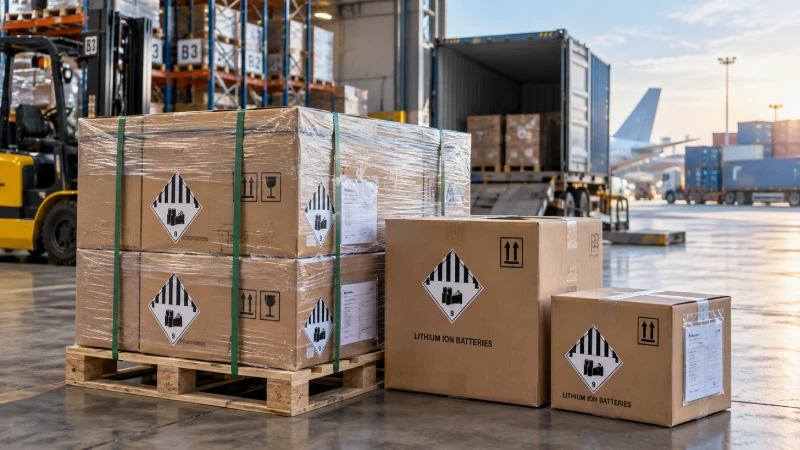
Shipping lithium batteries from China to Germany is possible, but these shipments cannot be handled in the same way as ordinary general cargo. Lithium batteries are regulated dangerous goods, and the correct transport pathway depends on the battery chemistry, capacity, configuration, condition, transport mode and the acceptance policy of the actual carrier.
A shipment may fall under UN3480, UN3481, UN3090 or UN3091 depending on whether it contains lithium-ion or lithium-metal batteries and whether those batteries are shipped alone, packed with equipment or contained in equipment. Air transport is primarily governed by the IATA Dangerous Goods Regulations, while ocean transport follows the IMDG Code. Rail and final inland transport into Germany may also involve RID, ADR and German dangerous-goods legislation.
For 2026 air shipments, the applicable edition is the IATA Dangerous Goods Regulations, 67th Edition, effective from January 1 through December 31, 2026. For ocean freight, the 2024 Edition of the IMDG Code incorporating Amendment 42-24 became mandatory on January 1, 2026.
If you are also comparing general transport options, start with our shipping from China to Germany guide. For lithium batteries, however, classification must come before rate comparison.
The key rule is simple:
Do not choose the freight service before correctly identifying the battery.
Passing UN38.3 does not automatically mean that an airline, shipping line, railway operator or courier will accept the shipment. Regulatory compliance and carrier acceptance are separate checks.
Important: This guide explains the compliance framework for lithium battery shipments from China to Germany. It does not replace classification, packing, documentation or acceptance work performed by trained dangerous-goods personnel and the operating carrier.
First Identify Exactly What You Are Shipping
Before asking for a shipping method or freight rate, determine three things:
- Is the battery lithium-ion or lithium-metal?
- Is the battery shipped alone, packed with equipment or contained in equipment?
- What are the technical specifications of the cells and batteries?
These details affect the UN number, proper shipping name, packing instruction, documentation requirements, quantity limitations and possible carrier options.
Lithium-Ion vs Lithium-Metal Batteries
Lithium-ion batteries are rechargeable batteries commonly used in laptops, smartphones, cameras, power tools, rechargeable industrial equipment and many other electronic products.
Lithium-polymer batteries are treated as lithium-ion batteries for dangerous-goods transport purposes.
Lithium-metal batteries are generally non-rechargeable primary batteries containing lithium metal or lithium alloy. They are commonly used in sensors, meters, tracking devices, watches, medical equipment and certain industrial products.
The two battery types use different UN numbers and different technical criteria. Lithium-ion transport provisions commonly rely on Watt-hour ratings, while lithium-metal provisions use lithium content.
Lithium Battery Classification Table
| Battery type | Shipping configuration | UN number | Proper Shipping Name | Main air packing instruction |
|---|---|---|---|---|
| Lithium-ion | Batteries shipped alone | UN3480 | Lithium ion batteries | PI 965 |
| Lithium-ion | Packed with equipment | UN3481 | Lithium ion batteries packed with equipment | PI 966 |
| Lithium-ion | Contained in equipment | UN3481 | Lithium ion batteries contained in equipment | PI 967 |
| Lithium-metal | Batteries shipped alone | UN3090 | Lithium metal batteries | PI 968 |
| Lithium-metal | Packed with equipment | UN3091 | Lithium metal batteries packed with equipment | PI 969 |
| Lithium-metal | Contained in equipment | UN3091 | Lithium metal batteries contained in equipment | PI 970 |
This table is a starting point, not a substitute for classification. Battery condition, size, quantity, equipment type and other special provisions can change the applicable requirements.
Batteries Shipped Alone
A battery is normally considered to be shipped alone when it is transported without the equipment that it is intended to power.
Typical examples include:
- replacement battery packs;
- spare rechargeable batteries;
- battery modules;
- standalone industrial battery packs;
- power banks.
Power banks require particular attention. Although they may look like consumer electronics, their primary function is to provide power to another device. A lithium-ion power bank is generally treated as a battery rather than as a battery contained in equipment and is normally classified under UN3480.
Batteries Packed With Equipment
“Packed with equipment” means the battery and the device are placed in the same package, but the battery is not installed in the equipment.
For example, a camera packed in the same carton with a separate rechargeable battery may fall under UN3481, lithium ion batteries packed with equipment.
This distinction matters because PI 966 applies rather than PI 967 for air transport.
Batteries Contained in Equipment
“Contained in equipment” means the battery is installed in the device that it powers.
Examples include:
- a laptop with its battery installed;
- a cordless tool with the battery installed;
- a medical device with an internal battery;
- industrial electronics with an integrated rechargeable battery.
These shipments can be subject to different provisions from batteries shipped separately.
Do not classify the cargo from the commercial product name alone. Descriptions such as “electronic equipment,” “machine,” “Bluetooth speaker” or “tool” do not establish whether the battery is UN3480, UN3481, UN3090 or UN3091.
Some battery-powered vehicles, mobility products and other specialized goods can also fall under separate dangerous-goods classifications. They should not automatically be treated as ordinary UN3481 equipment shipments.
Watt-Hour Rating and Lithium Content
Once the chemistry and configuration are known, verify the technical specifications that determine which provisions apply.
Watt-Hour Rating for Lithium-Ion Batteries
Lithium-ion transport requirements commonly use the Watt-hour rating, or Wh.
The basic calculation is:
Wh = nominal voltage × rated capacity in Ah
For example:
12 V × 5 Ah = 60 Wh
If capacity is provided in milliamp-hours, convert mAh to Ah before calculating.
The formula is useful for checking data, but it should not replace manufacturer documentation. Use the rated Wh value on the battery label, specification sheet, test documentation or manufacturer records whenever available.
Certain lithium battery provisions distinguish between:
- lithium-ion cells up to 20 Wh;
- lithium-ion batteries up to 100 Wh;
- cells or batteries above those thresholds.
Being below those thresholds does not make the battery ordinary cargo. It remains a lithium battery and must comply with the applicable transport rules.
Lithium Content for Lithium-Metal Batteries
Lithium-metal batteries are generally evaluated by lithium content rather than Watt-hours.
Certain provisions use thresholds such as:
- up to 1 g lithium per cell;
- up to 2 g aggregate lithium content per battery.
This information should come from the manufacturer or technical documentation rather than being estimated by the importer or freight forwarder.
UN38.3: A Core Requirement for Lithium Battery Transport
Lithium cells and batteries offered for normal transport generally need to be of a type that has passed the applicable tests under Part III, subsection 38.3 of the UN Manual of Tests and Criteria.
These tests evaluate how the battery design type responds to conditions that can occur during transport.
The test program includes transport-related conditions such as altitude simulation, thermal testing, vibration, shock, external short circuit and other safety tests applicable to the cell or battery design.
UN38.3 should therefore be checked before deciding how the shipment will move.
What Is the UN38.3 Test Summary?
Manufacturers and subsequent distributors must make the required UN38.3 Test Summary available for applicable lithium cells and batteries.
The summary normally identifies information such as:
- cell or battery manufacturer;
- manufacturer contact details;
- test laboratory information;
- test report identification;
- test date;
- cell or battery description;
- chemistry;
- mass;
- Watt-hour rating or lithium content;
- model identification;
- tests conducted and results;
- reference to the applicable UN test framework.
The Test Summary does not normally have to be physically inserted into every package. However, it must be available as required and can be requested during carrier or dangerous-goods acceptance review.
Make Sure UN38.3 Matches the Actual Battery
One of the most common documentation problems is receiving a UN38.3 document from the supplier without checking whether it applies to the battery being shipped.
Verify the:
- battery manufacturer;
- battery model;
- cell model;
- chemistry;
- nominal voltage;
- capacity;
- Watt-hour rating;
- physical description;
- design type.
A UN38.3 document for a different battery produced by the same factory should not automatically be treated as evidence for the battery in the shipment.
Pro Tip: Request and verify the UN38.3 Test Summary before choosing the transport mode. Discovering a mismatch after the cargo reaches an airport, port or DG warehouse can lead to rehandling, storage and delay.
Is an SDS or MSDS Required?
An SDS, sometimes still called an MSDS, is frequently requested in international logistics, but its role is often misunderstood.
For lithium batteries, an SDS is not itself the prescribed dangerous-goods transport document.
Current IATA lithium battery guidance explains that an SDS is not required simply because batteries are being offered for transport. However, an SDS may still be requested operationally by a:
- freight forwarder;
- airline;
- courier;
- shipping line;
- warehouse;
- booking platform;
- customer compliance department.
An SDS can therefore be useful supporting information.
It does not replace:
- UN38.3;
- the correct dangerous-goods classification;
- required dangerous-goods transport documents;
- carrier or operator approval.
A more accurate statement is:
A logistics provider may request an SDS as supporting information, but the SDS does not replace the prescribed lithium-battery transport documentation.
State of Charge Rules for Air Freight in 2026
State of charge, or SoC, is particularly important for lithium-ion batteries transported by air.
This is also an area where older online articles can now be misleading because requirements affecting batteries packed with equipment changed for 2026.
UN3480: Lithium-Ion Batteries Shipped Alone
Lithium-ion cells and batteries shipped alone as UN3480 must normally be offered for air transport at a state of charge not exceeding 30% of their rated capacity.
Transport above that level can require the relevant authority approvals under the applicable provisions.
Standalone UN3480 lithium-ion batteries are also forbidden as ordinary cargo on passenger aircraft and must follow the applicable Cargo Aircraft Only requirements.
UN3481 Packed With Equipment: PI 966
From January 1, 2026, the state-of-charge provisions under PI 966 must be checked carefully.
For PI 966 Section I, lithium-ion cells and batteries packed with equipment must be offered for transport at no more than 30% of rated capacity unless the required approvals apply.
For PI 966 Section II, cells and batteries above the applicable small-cell threshold are also subject to the current SoC requirements.
This means older guidance stating that the 30% rule is relevant only to UN3480 batteries shipped alone can be incomplete.
UN3481 Contained in Equipment: PI 967
Do not automatically apply the same mandatory requirement to every product containing an installed battery.
Under current IATA guidance, reduced state of charge for lithium-ion batteries contained in equipment is strongly recommended, including shipment at no more than 30% rated capacity or no more than 25% indicated battery capacity.
That recommendation should not be presented as a universal mandatory PI 967 rule for every shipment.
An individual airline can still impose stricter acceptance conditions.
Lithium-Metal Batteries
State of charge is not the equivalent classification parameter for lithium-metal batteries because they are generally non-rechargeable primary cells.
The relevant technical criteria include lithium content and the provisions under PI 968, PI 969 or PI 970 as applicable.
Shipping Lithium Batteries by Air from China to Germany
Air freight normally requires the most detailed pre-check because lithium batteries are subject to strict packaging, documentation, quantity, aircraft and operator requirements.
For 2026 shipments, use the current IATA Dangerous Goods Regulations framework together with applicable state and operator variations.
Before booking, verify:
- UN number;
- proper shipping name;
- battery chemistry;
- battery configuration;
- Watt-hour rating or lithium content;
- battery quantity;
- net battery weight;
- state of charge where applicable;
- battery condition;
- applicable packing instruction;
- package marks and labels;
- required documentation;
- airline acceptance;
- origin airport restrictions;
- transit restrictions;
- destination handling requirements.
For commercial planning, our air freight cost from China to Germany per kg guide explains general air-pricing logic. Dangerous-goods surcharges and battery acceptance must be checked separately.
Passenger Aircraft vs Cargo Aircraft Only
Standalone lithium-ion batteries under UN3480 and standalone lithium-metal batteries under UN3090 are forbidden as ordinary cargo on passenger aircraft.
Applicable shipments must follow the relevant Cargo Aircraft Only provisions unless an exceptional approval framework applies.
This does not mean every UN3481 or UN3091 shipment can automatically travel on a passenger aircraft. Actual eligibility depends on classification, battery size, quantity, packing instruction, section and operator restrictions.
Dangerous Goods Declaration
A Shipper’s Declaration for Dangerous Goods is required for many fully regulated air dangerous-goods shipments.
The declaration identifies the dangerous goods being offered for transport and must be prepared in accordance with the applicable dangerous-goods rules.
Do not assume every package containing a lithium battery uses exactly the same declaration requirement. Some shipments handled under specific reduced provisions can have different documentation requirements.
The declaration requirement must therefore be determined from the actual classification and packing instruction.
Air Waybill Information
The air waybill and associated cargo data must accurately reflect the shipment.
Required wording depends on the classification and applicable packing provision. Do not use one generic lithium battery statement across UN3480, UN3481, UN3090 and UN3091 shipments.
Airline Acceptance Can Be Stricter Than IATA
IATA provides the general dangerous-goods framework, but individual airlines can impose operator variations that are more restrictive.
As a result:
Regulatory eligibility does not guarantee airline acceptance.
For any named airline on a specific China-to-Germany routing where current acceptance has not been verified:
Needs confirmation before publishing.
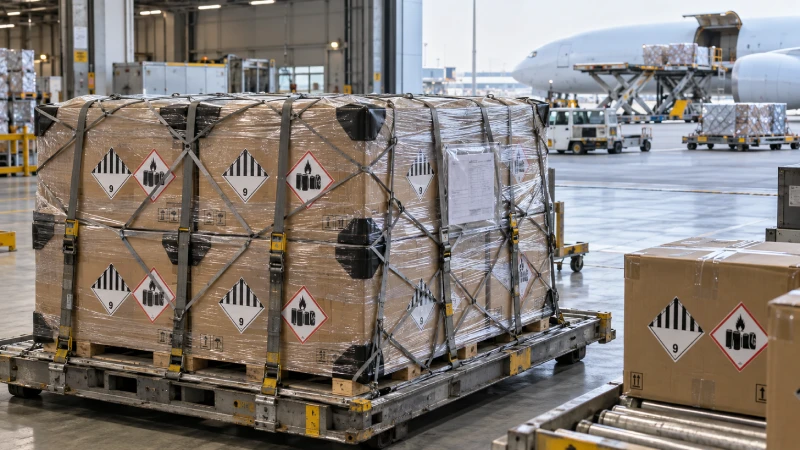
Shipping Lithium Batteries by Sea from China to Germany
Sea freight is governed primarily by the International Maritime Dangerous Goods Code, or IMDG Code.
The IMDG Code 2024 Edition incorporating Amendment 42-24 became mandatory on January 1, 2026. See the IMO IMDG Code information page.
Lithium batteries remain Class 9 dangerous goods when transported by sea, but ocean rules should not simply be copied from IATA air-freight requirements.
Depending on the cargo, the shipment can require:
- correct UN classification;
- compliant packaging;
- package marking and labelling;
- dangerous-goods transport documentation;
- container placarding where applicable;
- container or vehicle packing documentation where applicable;
- stowage and segregation compliance;
- shipping-line approval;
- port and terminal acceptance.
For general container pricing context, see our 20ft & 40ft container shipping cost from China to Germany guide. Dangerous-goods acceptance and DG surcharges must be reviewed separately.
Does the Air 30% SoC Rule Automatically Apply to Sea Freight?
No.
The IATA state-of-charge restrictions described above are air-transport provisions and should not automatically be transferred to an IMDG shipment.
Sea freight must be evaluated under the current IMDG provisions and the shipping line’s own acceptance requirements.
The absence of the IATA air 30% rule does not mean an ocean battery shipment is unrestricted.
FCL vs LCL for Lithium Batteries
Both FCL and LCL may be possible for eligible lithium battery cargo, but acceptance depends on the classification and the parties involved.
For FCL, the shipping line must accept the dangerous goods on the intended vessel and route.
For LCL, additional acceptance points can include:
- consolidator;
- origin CFS;
- shipping line;
- transshipment facility;
- destination CFS;
- destination handling agent.
A shipping line accepting a UN number does not necessarily mean a particular LCL consolidator will accept the same cargo.
Avoid claims such as:
“Lithium batteries can always ship by LCL.”
The more accurate position is:
LCL eligibility must be confirmed for the battery classification, consolidator, origin warehouse, shipping line, route and destination handling arrangement.
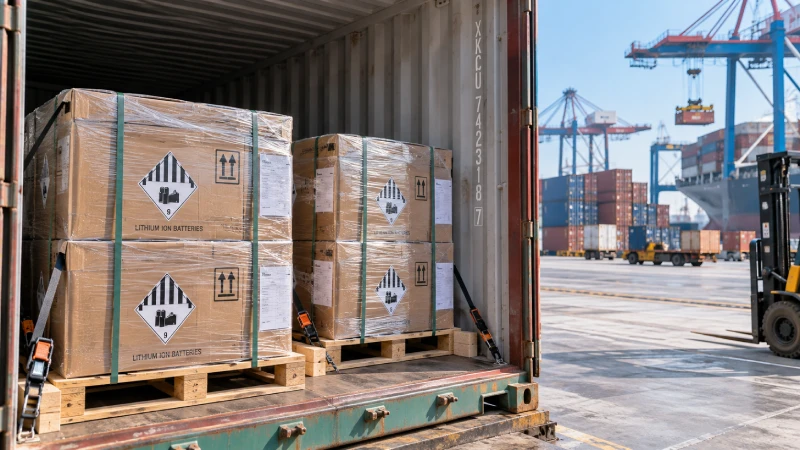
Can Lithium Batteries Be Shipped from China to Germany by Rail?
Lithium battery cargo may be eligible for China-Europe rail transportation in some cases, but rail acceptance should never be described as universal.
On the European side, international dangerous-goods rail transport operates within the RID framework. EU inland dangerous-goods requirements also apply to transport by road and rail between Member States.
Germany’s GGVSEB implements dangerous-goods requirements for road, rail and inland-waterway transport and requires applicable ADR/RID/ADN provisions to be observed.
For a China-to-Germany rail shipment, practical acceptance can depend on:
- Chinese departure terminal;
- rail service provider;
- battery UN number;
- battery configuration;
- quantity;
- container arrangement;
- transit countries;
- border crossings;
- transshipment points;
- destination terminal;
- current operator policy.
Do not write:
“China-Europe rail accepts lithium batteries.”
A more accurate statement is:
Some lithium battery shipments may be eligible for China-Europe rail services, but the actual route and operator must be pre-cleared before cargo is delivered to the rail terminal.
For any named China-to-Germany railway operator or specific service:
Needs confirmation before publishing.
Pro Tip: Check rail eligibility using the actual Chinese departure terminal and planned corridor. “China to Germany by rail” is too broad to determine dangerous-goods acceptance.
Packaging Requirements for Lithium Batteries
Correct packaging is one of the most safety-critical parts of lithium battery transport.
The exact packaging configuration depends on the:
- battery type;
- UN number;
- battery size;
- shipping configuration;
- transport mode;
- applicable packing instruction;
- quantity;
- applicable special provisions.
At a general level, compliant preparation is intended to:
- protect batteries against damage;
- prevent short circuits;
- protect exposed terminals;
- prevent unintended movement;
- prevent accidental activation of equipment where applicable;
- meet applicable packaging performance standards;
- display the required marks and labels.
Exact packaging should be selected and verified by people competent in dangerous-goods preparation.
This article intentionally does not provide a simplified DIY packaging procedure because the correct packaging design depends on the shipment classification and transport mode.
Do Not Try to Avoid Dangerous-Goods Requirements
Lithium batteries should never be hidden or incorrectly described in order to obtain an ordinary cargo booking.
Unsafe or non-compliant practices include:
- declaring a battery shipment only as “electronics”;
- describing batteries as accessories while omitting their DG status;
- declaring batteries as contained in equipment when they are actually separate;
- using UN38.3 documentation from a different battery model;
- removing required marks or labels;
- intentionally splitting or misdescribing cargo to avoid applicable requirements.
Undeclared or misdeclared batteries create serious safety risks and can lead to rejection, delay, inspection, storage charges and regulatory consequences.
Damaged, Defective or Recalled Lithium Batteries
A damaged or defective battery must not be treated as a normal battery shipment.
Warning signs can include:
- swelling;
- leakage;
- puncture;
- crushing;
- unusual heat;
- evidence of a thermal incident;
- manufacturer safety recall;
- suspected internal damage.
Air transport rules for damaged or defective batteries are substantially more restrictive than those for normal batteries, and carrier policies can prohibit them.
For a normal freight inquiry, damaged, defective or recalled batteries should be referred for specialist dangerous-goods review before any transport option or price is confirmed.
Do not assume that replacing the outer carton makes a damaged battery eligible for transport. The condition of the battery itself is what matters.
Documents Commonly Needed Before Booking
Lithium battery bookings usually require more technical information than ordinary general cargo.
| Document or information | Why it matters |
|---|---|
| UN38.3 Test Summary | Verifies the tested battery design type |
| Battery specification sheet | Confirms chemistry, voltage, capacity, Wh or lithium content |
| Battery and cell model numbers | Matches the cargo to technical documentation |
| Commercial invoice | Supports customs classification and valuation |
| Packing list | Confirms package count, dimensions and weights |
| Shipping configuration | Determines alone / packed with / contained in equipment |
| State of charge | Important for applicable lithium-ion air shipments |
| Net battery weight | May be required for DG assessment and booking |
| Dangerous Goods Declaration | Required for applicable regulated shipments |
| Packaging information | Supports compliance with applicable packing provisions |
| SDS | Supporting information if requested |
| Carrier approval | Confirms operational acceptance |
| Importer and EORI information | Supports German/EU customs clearance |
| EU product-compliance documents | Relevant to market access rather than DG transport |
The exact document set depends on the shipment.
An SDS being available does not remove the need to verify UN38.3, and a UN38.3 Test Summary does not remove the need for the applicable dangerous-goods declaration.
Required Data Before Reviewing a Lithium Battery Shipment
To assess a lithium battery shipment from China to Germany, provide as much of the following information as possible.
Battery Information
- battery chemistry: lithium-ion or lithium-metal;
- product name;
- battery manufacturer;
- battery model;
- cell model, if available;
- rechargeable or non-rechargeable;
- nominal voltage;
- capacity in Ah or mAh;
- Wh per cell;
- Wh per battery;
- lithium content for lithium-metal batteries;
- number of cells per battery;
- number of batteries per product;
- number of spare batteries.
Shipping Configuration
Confirm whether the batteries are:
- shipped alone;
- packed with equipment; or
- contained in equipment.
Compliance Documents
Provide:
- UN38.3 Test Summary;
- battery specification sheet;
- SDS if available;
- existing DG classification or declaration if previously prepared;
- any previous carrier approval.
Battery Condition
Confirm whether the batteries are:
- new;
- used;
- damaged;
- defective;
- recalled.
Do not describe damaged or recalled batteries simply as “used.”
Air-Freight Information
If air freight is being considered, provide the battery state of charge where applicable.
Shipment Information
Provide:
- number of cartons or pallets;
- package dimensions;
- gross weight;
- net battery weight if available;
- cargo value;
- pickup city or address in China;
- German delivery postcode;
- preferred transport mode;
- target shipping date.
Providing this information before booking makes it much easier to identify the likely transport pathway and avoid unnecessary DG re-checks.
Carrier Acceptance Is Separate From Regulatory Classification
A shipment may technically comply with the relevant IATA or IMDG provisions and still not be accepted by a particular carrier.
Carrier restrictions can result from:
- operator variations;
- aircraft type;
- route restrictions;
- origin station restrictions;
- transshipment policies;
- dangerous-goods account requirements;
- shipper approval requirements;
- temporary embargoes;
- terminal restrictions;
- internal safety policies.
DHL Express
DHL Express publishes specific lithium battery acceptance requirements and account/shipper restrictions for some battery configurations.
For a particular China-to-Germany shipment, acceptance must still be confirmed against the actual DHL service, account, battery configuration and current route policy.
Needs confirmation before publishing for any service-specific acceptance claim that has not been checked against the current DHL China documentation.
UPS
UPS publishes dangerous-goods and lithium battery requirements that can include approved-shipper restrictions and fully regulated DG treatment for certain standalone battery air shipments.
Whether a specific UPS China-to-Germany service accepts the proposed battery shipment must be checked before publication and booking.
Needs confirmation before publishing.
FedEx
FedEx lithium battery transport is subject to applicable dangerous-goods regulations and FedEx service-specific acceptance requirements.
Exact acceptance for a particular battery classification, Chinese origin and German destination:
Needs confirmation before publishing.
Airlines, Shipping Lines and Rail Operators
Do not assume that an airline accepts a shipment simply because the applicable IATA packing instruction permits transport.
Likewise, do not assume that every shipping line accepting Class 9 dangerous goods accepts every lithium battery shipment on every China-to-Germany service.
The same applies to China-Europe rail.
For any named operator, terminal or service not verified against current acceptance rules:
Needs confirmation before publishing.
Dangerous-Goods Compliance, Customs and Product Compliance Are Different
Lithium battery importers often combine three separate compliance questions into one.
They should be treated separately.
| Compliance layer | Main question | Typical requirements |
|---|---|---|
| Dangerous-goods transport | Can the cargo be transported under the chosen mode? | UN classification, UN38.3, IATA/IMDG/RID/ADR, packaging, marks, labels, DG documentation, carrier approval |
| Customs clearance | Can the goods be legally declared and released into Germany? | HS code, customs value, origin, importer, EORI, commercial invoice, duty, import VAT |
| EU/German product compliance | Can the battery or battery-containing product legally be placed on the market? | EU Battery Regulation, conformity assessment, CE marking where applicable, technical documentation, labelling, producer responsibilities |
These requirements do not replace each other.
UN38.3 does not replace CE or EU product conformity.
CE marking does not replace UN38.3.
Carrier approval does not guarantee customs clearance.
Customs clearance does not prove that the battery complies with EU market rules.
An SDS does not replace the dangerous-goods declaration.
When budgeting the shipment, keep freight and import costs separate as well. Our shipping cost from China to Germany guide explains general cost components for normal commercial shipments.
EU Battery Regulation and German Destination Requirements
Lithium batteries imported from China may also fall within Regulation (EU) 2023/1542 concerning batteries and waste batteries.
These requirements relate to placing batteries on the EU market and should be separated from the question of whether an airline, vessel or rail operator can carry the shipment.
Depending on the battery category, product, economic operator and applicable implementation date, requirements can include:
- conformity assessment;
- EU Declaration of Conformity;
- CE marking;
- technical documentation;
- battery labelling;
- manufacturer or importer information;
- producer registration;
- extended producer responsibility;
- sustainability-related requirements introduced in phases.
The EU Battery Regulation imposes obligations on manufacturers, importers and other economic operators.
Because the Regulation uses phased implementation dates, do not present every obligation as though it became effective on the same date.
For example, battery due-diligence obligations have a later application timeline than many of the Regulation’s other requirements. Always check the effective date of the specific obligation before publishing compliance guidance.
German BattDG
Germany implements important parts of the EU battery framework through the Batterierecht-Durchführungsgesetz (BattDG).
The BattDG includes provisions concerning battery producer registration and extended producer responsibility.
Whether the Chinese seller, German importer, authorized representative or another party is responsible for a particular obligation depends on the commercial structure and the role of the economic operator.
That legal responsibility should be checked separately from the freight booking.
Final Road or Rail Delivery Inside Germany
Dangerous-goods compliance does not necessarily end when the container reaches a German port or when air cargo lands at a German airport.
The inland leg can remain subject to dangerous-goods transport rules.
Germany’s GGVSEB applies to dangerous-goods transport by road, rail and inland waterways together with the relevant ADR, RID or ADN provisions.
This can affect:
- Hamburg port-to-warehouse trucking;
- Bremerhaven inland delivery;
- Frankfurt airport-to-consignee transport;
- Duisburg rail-terminal delivery;
- multimodal door-to-door services.
Final delivery should therefore be considered during the original route planning rather than only after the cargo reaches Germany.
Air vs Sea vs Rail for Lithium Batteries
| Factor | Air freight | Sea freight | China-Europe rail |
|---|---|---|---|
| Relative speed | Fastest | Slowest | Usually between air and sea |
| Main DG framework | IATA/ICAO | IMDG | Route-specific rules plus RID on applicable European rail legs |
| UN3480 standalone batteries | Strong restrictions | Potentially available subject to IMDG/carrier | Operator and corridor dependent |
| SoC rules | Important, including 2026 requirements | Do not automatically apply IATA SoC rules | Route/operator dependent |
| Carrier approval | Critical | Critical | Critical |
| Typical use | Urgent eligible cargo | Larger eligible shipments | Selected pre-cleared cargo/routes |
| Universal acceptance | No | No | No |
There is no single best shipping mode for every lithium battery.
Air freight may be suitable when speed is critical and the battery qualifies for the intended service.
Sea freight may provide more practical options for larger eligible quantities but remains regulated dangerous goods.
Rail can be commercially attractive for some shipments but requires corridor- and operator-specific confirmation.
If transit time is part of the decision, see how long shipping from China to Germany takes for general non-DG timing context. Battery shipments can take longer because acceptance, DG cut-offs and documentation checks may add time.
Common Reasons Lithium Battery Shipments Are Rejected
Lithium battery cargo can be delayed or rejected before departure when booking information does not match the physical shipment.
Common reasons include:
Wrong UN number
The battery configuration has been classified incorrectly.Incorrect “contained in equipment” declaration
Batteries are actually packed separately instead of installed in the equipment.Missing UN38.3 Test Summary
The supplier cannot provide the required design-type information.UN38.3 does not match the model
The document belongs to another cell or battery.Wh rating is unknown
Technical data is incomplete.Lithium content is unavailable
Relevant lithium-metal specifications cannot be verified.Incorrect state of charge
The shipment does not meet applicable air requirements.Packaging is not compliant
The cargo has been prepared as ordinary freight rather than under the applicable dangerous-goods provisions.Marks or labels are incorrect
Hazard communication does not match the classification.Required dangerous-goods documentation is missing
Applicable declarations or supporting records have not been prepared.Shipper is not approved
The carrier requires an approved DG shipper, account or contractual arrangement.Operator variation was not checked
The carrier’s own requirements are stricter than the general regulation.Terminal or consolidator rejects the cargo
This is especially relevant to LCL and rail services.Battery is damaged or recalled
Normal lithium battery provisions may no longer apply.Commercial and DG documents do not match
Invoice descriptions, battery information and dangerous-goods records conflict.Transport compliance is confused with EU product compliance
CE/product documents are presented when the carrier needs UN38.3 and DG information, or transport documents are assumed to satisfy market-access rules.
Recommended Compliance Workflow
A structured review before booking reduces the risk of cargo being rejected later.
Step 1: Identify the Battery Chemistry
Confirm whether the battery is lithium-ion or lithium-metal.
Do not rely only on a product marketing name.
Step 2: Confirm the Shipping Configuration
Determine whether batteries are:
alone, packed with equipment or contained in equipment.
Step 3: Establish the Correct UN Number
Identify the applicable classification:
UN3480, UN3481, UN3090 or UN3091.
Step 4: Verify Technical Specifications
Check:
- Wh rating for lithium-ion;
- lithium content for lithium-metal;
- cell and battery models;
- quantity;
- battery weight;
- relevant limits.
Step 5: Verify UN38.3
Make sure the Test Summary corresponds to the actual battery design being shipped.
Step 6: Select the Potential Transport Mode
Compare air, sea and, where relevant, rail only after the classification is understood.
Step 7: Apply the Correct Modal Rules
Use the current regulations applicable to the intended mode:
- IATA/ICAO for air;
- IMDG for sea;
- RID/ADR and applicable national rules for inland rail and road transport.
Step 8: Obtain Carrier Acceptance
Confirm acceptance with the actual operating carrier and route before delivering cargo to the airport, port, rail terminal or consolidation warehouse.
Step 9: Review German Customs and Product Requirements Separately
Check:
- customs classification;
- EORI requirements;
- customs value;
- duty and import VAT;
- EU Battery Regulation obligations;
- CE/product conformity where applicable;
- German producer-registration obligations.
Pro Tips for Shipping Lithium Batteries from China to Germany
Pro Tip: Classify Before Pricing
A normal air, sea or rail quotation may become irrelevant if the carrier later determines that the battery needs a different service or cannot move on the proposed route.
Pro Tip: Ask for the Battery Model, Not Only the Product Name
“Power tool,” “machine,” “camera” or “electronic product” is not enough information for a dangerous-goods assessment.
The battery model and technical specification are more useful.
Pro Tip: Match UN38.3 to the Actual Battery
A document carrying the supplier’s company name is not enough.
Verify that the model and technical information match the actual cargo.
Pro Tip: Do Not Apply the Air 30% Rule to Every Mode
IATA air-freight SoC provisions and IMDG ocean requirements are not interchangeable.
Pro Tip: Check the Exact Carrier and Route
Regulations establish the compliance framework, but individual airlines, shipping lines, railway operators and couriers can impose stricter acceptance conditions.
Pro Tip: Treat Damaged Batteries as a Separate Case
Do not request an ordinary DG service for swollen, leaking, damaged, defective or recalled batteries.
Specialist review is required first.
Pro Tip: Keep DG Transport and EU Compliance Separate
UN38.3 addresses a transport-testing requirement.
EU Battery Regulation, CE marking and German producer obligations address market compliance.
One does not replace the other.
Check Your Lithium Battery Shipment Before Booking
Shipping lithium batteries from China to Germany should begin with the battery specifications rather than with a freight rate.
Before a transport pathway can be assessed, prepare:
- battery chemistry;
- battery and cell model;
- UN38.3 Test Summary;
- voltage;
- capacity and Wh;
- lithium content where applicable;
- shipping configuration;
- battery condition;
- quantity and net battery weight;
- package dimensions and gross weight;
- pickup location in China;
- German delivery postcode;
- preferred shipping mode.
This information allows the shipment to be reviewed for the likely dangerous-goods pathway and the carrier or route approvals that need to be checked before booking.
CTA Button: Check Battery Shipping Eligibility
Final shipment acceptance remains subject to applicable dangerous-goods regulations, carrier/operator approval, route availability and document review.
FAQ
Can lithium batteries be shipped from China to Germany?
Yes. Many lithium battery shipments can be transported when the correct classification, packaging, documentation and carrier requirements are met. Acceptance still depends on the battery chemistry, specification, configuration, condition, mode and actual carrier.
What UN number applies to lithium-ion batteries?
Lithium-ion batteries shipped alone are generally UN3480. Lithium-ion batteries packed with equipment or contained in equipment are generally UN3481.
What UN number applies to lithium-metal batteries?
Lithium-metal batteries shipped alone are generally UN3090. Lithium-metal batteries packed with equipment or contained in equipment are generally UN3091.
Is UN38.3 required for shipping lithium batteries?
Lithium cells and batteries offered for normal transport generally need to be of a type that has passed the applicable tests under Part III, subsection 38.3 of the UN Manual of Tests and Criteria.
Does the UN38.3 Test Summary need to travel inside every shipment?
Not normally. The Test Summary must be available as required, but it does not generally have to be physically inserted into every package. A carrier or forwarder may still request it during booking or acceptance.
Do I need an SDS to ship lithium batteries?
Not necessarily as a prescribed transport document. A carrier, forwarder, warehouse or customer may request an SDS as supporting information, but it does not replace UN38.3 or required dangerous-goods documentation.
Do lithium-ion batteries have to be below 30% state of charge?
It depends on the air-shipping configuration. UN3480 batteries shipped alone are subject to the applicable 30% SoC restriction, and 2026 rules also affect certain UN3481 batteries packed with equipment under PI 966. Batteries contained in equipment under PI 967 are subject to different provisions and current IATA recommendations.
Can UN3480 lithium-ion batteries travel on passenger aircraft?
Standalone UN3480 lithium-ion batteries are forbidden as ordinary cargo on passenger aircraft and must follow the applicable Cargo Aircraft Only provisions unless a specific approval framework applies.
Are lithium-metal batteries shipped alone allowed on passenger aircraft?
Standalone UN3090 lithium-metal batteries are also forbidden as ordinary cargo on passenger aircraft. Applicable shipments normally require Cargo Aircraft Only handling.
Is sea freight easier than air freight for lithium batteries?
Sea freight uses a different regulatory framework and may provide more options for some battery shipments, but lithium batteries remain dangerous goods under the IMDG Code. Shipping-line, port, terminal and route acceptance still have to be confirmed.
Does the 30% air-freight SoC rule apply to ocean shipping?
Do not automatically apply an IATA air-freight state-of-charge provision to sea freight. Ocean shipments must comply with the applicable IMDG Code provisions and carrier requirements.
Can lithium batteries ship by LCL from China to Germany?
Some lithium battery shipments may be eligible for LCL, but acceptance depends on the battery classification, consolidator, origin CFS, shipping line, route and destination handling arrangements.
Can lithium batteries be shipped by rail from China to Germany?
Potentially. Acceptance depends on the actual Chinese terminal, rail operator, route, transit countries, battery classification and destination arrangement. Any named service needs route-specific confirmation.
Can damaged lithium batteries be shipped?
Damaged, defective or recalled batteries should not be handled as normal lithium battery cargo. Air transport can be prohibited or highly restricted, while other modes can require specialist procedures and operator approval.
Does CE marking replace UN38.3?
No. CE marking relates to EU product conformity, while UN38.3 relates to transport testing of lithium cells and battery design types.
Does UN38.3 mean my battery complies with the EU Battery Regulation?
No. Passing UN38.3 does not prove compliance with Regulation (EU) 2023/1542. EU conformity, labelling, importer obligations, producer registration and other product requirements must be checked separately.
Does German customs clearance prove that a battery is legally compliant for sale?
No. Customs clearance, dangerous-goods transport compliance and EU product-market compliance are separate processes.
Can a freight forwarder guarantee carrier acceptance?
A freight forwarder can review the cargo and coordinate dangerous-goods booking, but final acceptance depends on the operating carrier, route, terminals and applicable regulations.
