
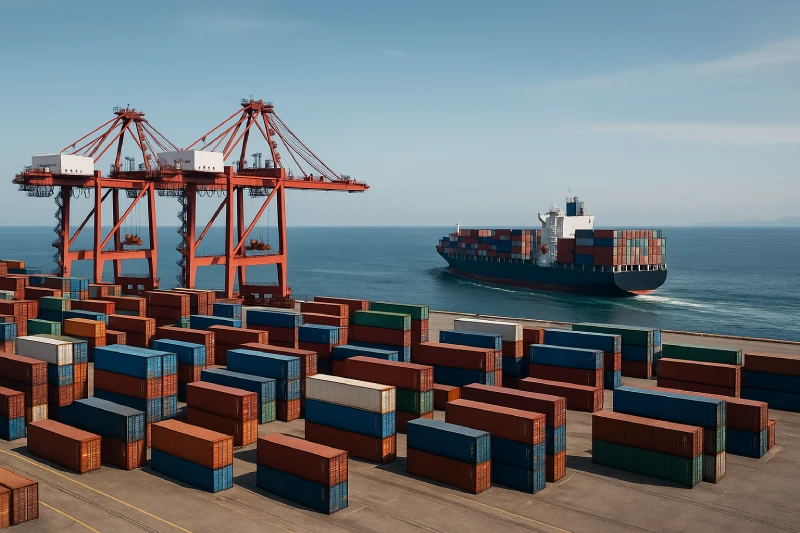
Why Port Selection Matters for Shipping to the USA
When shipping goods from China to the United States, many importers focus first on freight rates, transit times, or transportation modes. However, one critical factor is often underestimated: the choice of the departure port in China.
China has dozens of international seaports, but not all of them serve the US market in the same way. Each port differs in terms of carrier coverage, sailing frequency, cargo specialization, and operational flexibility. Selecting the right port can significantly influence the stability of your supply chain, especially for businesses shipping regularly or managing time-sensitive inventory.
For US-bound shipments, port selection is not simply about choosing the largest or closest port. It involves matching your factory location, cargo type, and delivery priorities with ports that offer reliable routes and consistent service to the United States. A well-chosen port can reduce unnecessary inland transport, improve scheduling predictability, and support smoother overall logistics planning.
In this guide, we explore the top ports in China for shipping to the USA, explain their key strengths, and help you understand how to choose the most suitable port based on real-world shipping considerations—without overwhelming you with cost tables or technical procedures.
For readers who are new to international logistics, understanding the overall shipping from China to the USA process can help put port selection into the right context.
Major China–USA Shipping Gateways
China–USA trade relies on a relatively concentrated group of major seaports that act as primary gateways for exports to the American market. These ports are not selected randomly; they have earned their roles through a combination of geographic advantage, manufacturing proximity, shipping infrastructure, and long-term carrier deployment.
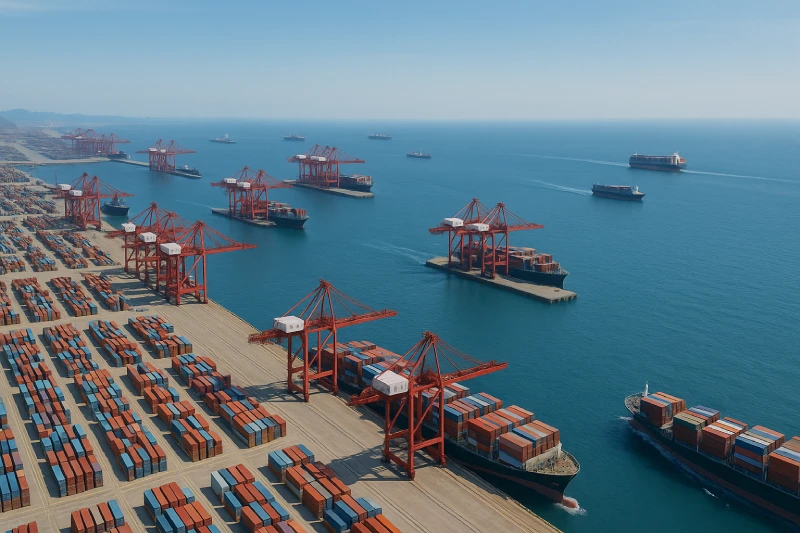
From a high-level perspective, most US-bound cargo departs from three main regions in China. East China ports, centered around the Yangtze River Delta, handle a large share of containerized exports thanks to dense manufacturing clusters and extensive ocean carrier coverage. South China ports, located in the Pearl River Delta, are closely tied to export-oriented factories and are particularly strong on routes to the US West Coast. North China ports serve inland industrial regions and provide strategic access for exporters shipping from northern provinces.
On the US side, routing patterns typically align with destination markets rather than port size alone. Shipments bound for the US West Coast often favor ports with frequent direct sailings across the Pacific, while cargo destined for the East Coast or inland regions may prioritize ports that integrate well with intermodal rail or all-water services via the Panama Canal. As a result, the “best” Chinese port is not universal—it depends on where the cargo is produced and where it ultimately needs to go in the United States.
Understanding these gateway patterns helps importers see port selection as a strategic planning decision, not just an operational detail. In the following sections, we examine the most commonly used Chinese ports for US shipments and explain what types of exporters benefit most from each one.
Port gateways are only one part of the planning process. For a broader view of how different transport options work together, you may also want to explore the best shipping methods from China to the USA.
Top Ports in China for Shipping to the USA
China’s role as the world’s largest exporter is supported by a network of highly specialized seaports. While many ports are capable of handling international shipments, only a select group consistently serves as primary gateways for cargo bound for the United States. Below are the most commonly used Chinese ports for US shipments, along with practical insights into when each port makes the most sense.
1. Shanghai Port (East China)
Shanghai Port is the most widely used port for shipping from China to the USA and serves as a global hub for containerized trade. It offers the broadest carrier coverage, frequent sailings, and strong reliability across both US West Coast and East Coast routes.
This port is particularly well suited for exporters located in the Yangtze River Delta, including Shanghai, Jiangsu, and Zhejiang provinces. It handles a wide range of cargo types, from consumer goods and electronics to industrial products, making it a flexible choice for many industries.
Shanghai is often preferred by shippers who prioritize schedule stability and route options over minimal inland transport distance. For companies shipping regularly or managing complex supply chains, its operational maturity and carrier competition provide long-term advantages.
2. Ningbo-Zhoushan Port (East China)
Ningbo-Zhoushan Port has become one of the most important alternatives to Shanghai for US-bound shipments. Located close to major manufacturing bases in Zhejiang province, it is especially popular among exporters seeking efficient port access without relying on Shanghai’s terminals.
The port supports strong direct services to the United States, particularly for full container load (FCL) shipments. It is commonly used by manufacturers shipping high-volume goods, such as machinery parts, household products, and packaged consumer items.
Ningbo-Zhoushan is often chosen by shippers who want a balance between port efficiency and proximity to factories, especially when inland transport to Shanghai would add unnecessary complexity.
3. Shenzhen Port (South China)
Shenzhen Port, including terminals such as Yantian, Shekou, and Chiwan, is a key gateway for exports from South China to the USA. It plays a major role in trans-Pacific trade, particularly for shipments destined for the US West Coast.
The port is closely linked to export-oriented industries in Guangdong province and is widely used for electronics, high-value consumer goods, and fast-moving products. Its frequent sailings and strong carrier presence make it suitable for shippers with tight production and delivery cycles.
Shenzhen is commonly selected by exporters who value speed, frequency, and proximity to South China factories, especially those serving North American retail or e-commerce supply chains.
4. Guangzhou (Nansha) Port (South China)
Guangzhou Nansha Port has grown steadily as a strategic export hub for South China. It serves a wide range of inland and coastal manufacturers and offers flexibility for both full container and consolidated shipments.
Compared to Shenzhen, Nansha is often favored for shipments originating from western or central parts of the Pearl River Delta. It supports diverse cargo types, including general merchandise, building materials, and mixed consignments.
This port is a practical choice for shippers who prioritize logistical flexibility and regional accessibility, especially when production sites are spread across multiple cities in South China.
5. Qingdao Port (North China)
Qingdao Port is a major port serving North China and plays an important role in US-bound trade from provinces such as Shandong and surrounding industrial regions. It is commonly used for heavier cargo, industrial products, and manufacturing equipment.
The port provides stable services to both US coasts and is often selected by exporters who want to avoid long inland transport to East or South China ports. Its infrastructure supports large-scale exports and consistent handling of industrial shipments.
Qingdao is best suited for shippers seeking regional efficiency and reliable access to US routes from northern manufacturing bases.
6. Tianjin Port (North China)
Tianjin Port serves as the primary international port for Beijing and much of North China’s inland manufacturing economy. It is a strategic choice for exporters located far from coastal production centers.
This port is frequently used for shipments moving toward the US East Coast or inland US destinations, especially when combined with intermodal transportation solutions. It handles a wide variety of goods, including machinery, automotive parts, and general cargo.
Tianjin is often chosen by exporters who need direct access from northern inland regions without routing cargo through southern or eastern ports.
7. Xiamen Port (Southeast China)
Xiamen is a smaller but highly efficient port serving exporters in Fujian and nearby provinces. It is commonly used by small to mid-sized exporters shipping consumer goods, footwear, and light industrial products to the USA.
While its sailing frequency is more limited compared to major hubs, Xiamen offers stable operations and straightforward port procedures. It is particularly suitable for businesses that value simplicity and regional convenience over extensive route selection.
How to Choose the Right Chinese Port for Your Shipment
Choosing the right Chinese port for shipping to the USA is less about finding a “best” port and more about finding the most suitable one for your specific supply chain. Several practical factors should be considered together, rather than in isolation.
Factory Location vs Port Proximity
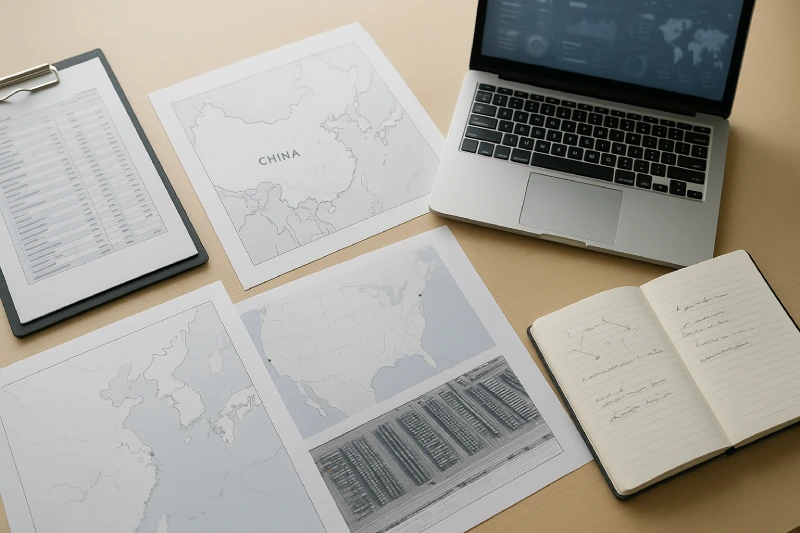
The physical distance between your factory and the departure port plays a major role in port selection. While it may seem logical to always choose the closest port, this is not always the most efficient option. In some cases, slightly longer inland transport to a larger or better-connected port can result in more reliable sailings and smoother overall coordination.
Exporters with factories located deep inland or across multiple regions often benefit from ports that offer flexible inland connections and consistent export volumes, even if those ports are not the geographically nearest.
Cargo Type and Shipment Size
Different ports naturally specialize in different cargo profiles. High-volume full container load (FCL) shipments often align well with ports that offer dense carrier coverage and frequent sailings. Smaller or mixed shipments may be better supported by ports with strong consolidation capabilities and flexible handling arrangements.
Product characteristics also matter. High-value or fast-moving goods may benefit from ports known for operational efficiency, while heavier or industrial cargo may be better suited to ports experienced in handling specialized loads.
Balancing Stability and Flexibility
Some shippers prioritize stable schedules and long-term consistency, especially for recurring shipments tied to retail or production cycles. Others value flexibility, such as the ability to adjust routing or switch carriers when conditions change.
Understanding your priorities—whether stability, flexibility, or a balance of both—helps narrow down the most suitable ports. Rather than optimizing for a single factor, successful exporters evaluate port selection as part of a broader logistics strategy.
While port choice affects routing flexibility, many importers also consider how it may influence overall budgeting, which is explained in more detail in our guide to shipping cost from China to the USA.
Port Selection by US Destination (West Coast vs East Coast)
When shipping from China to the USA, the final destination within the United States often influences port selection more than many exporters initially expect. While ocean carriers manage the trans-Pacific crossing, the alignment between the Chinese departure port and the US destination region plays an important role in overall route efficiency.
Shipments bound for the US West Coast, such as California and the Pacific Northwest, typically benefit from ports that offer frequent direct sailings across the Pacific. South China and East China ports with strong trans-Pacific service networks are commonly used for these routes, supporting steady cargo flow and consistent scheduling. For exporters serving West Coast distribution centers, alignment with these ports can simplify planning and reduce downstream complexity.
For cargo destined for the US East Coast or inland markets, port selection often follows a different logic. These shipments may rely on all-water services, intermodal rail connections, or a combination of both after arrival in the United States. In such cases, exporters may prioritize Chinese ports that integrate well with longer-haul routing strategies rather than focusing solely on direct sailing frequency.
The key takeaway is that port selection should reflect the entire supply chain, not just the ocean leg. When the departure port is chosen with the US destination in mind, exporters gain better predictability and flexibility across the full shipping route.
To better understand how destination choice impacts planning expectations, you can also review how long shipping from China to the USA takes under different routing scenarios.
Common Misconceptions About Choosing Chinese Ports
When selecting a Chinese port for shipping to the USA, many importers rely on assumptions that can lead to suboptimal decisions. Clarifying these common misconceptions helps exporters approach port selection more strategically.
One frequent misunderstanding is that the largest port is always the best option. While major ports offer extensive carrier networks and high sailing frequency, they are not automatically the most suitable for every shipment. For some exporters, a slightly smaller port closer to the factory can provide smoother coordination and fewer inland logistics variables.
Another misconception is that the closest port is always the most efficient choice. Proximity alone does not guarantee reliability or flexibility. In practice, ports with stronger US trade volumes may offer better route consistency, even if they require additional inland transport.
Some shippers also assume that all Chinese ports serve the US market in the same way. In reality, ports differ significantly in their service focus, preferred trade lanes, and operational strengths. Certain ports are more aligned with West Coast distribution, while others integrate better with East Coast or inland US routes.
Understanding these distinctions allows importers to move beyond surface-level assumptions and make port decisions based on how their shipments actually move through the supply chain.
How Winsail Helps Optimize Port Selection for USA Shipments
Choosing the right port is rarely a standalone decision. It requires a clear understanding of factory locations, cargo characteristics, routing preferences, and long-term shipping plans. This is where experienced logistics coordination becomes especially valuable.
Winsail supports exporters by evaluating port options as part of an integrated shipping strategy rather than treating port selection as a fixed rule. By considering factors such as shipment frequency, destination markets in the USA, and operational flexibility, Winsail helps shippers identify ports that align with their broader supply chain goals.
Rather than promoting a one-size-fits-all solution, Winsail focuses on practical port optimization, helping importers reduce unnecessary complexity and improve consistency across repeated shipments. This approach allows businesses shipping from China to the USA to plan with greater confidence, even as market conditions and routing options evolve.
FAQs
What is the busiest port in China for shipping to the USA?
Shanghai is generally considered the busiest and most widely used port for shipments from China to the USA. It offers extensive carrier coverage, frequent sailings, and access to both US West Coast and East Coast routes, making it a common choice for exporters with diverse shipping needs.
Which Chinese port is best for shipping to the US West Coast?
Ports in East China and South China, such as Shanghai and Shenzhen, are commonly used for US West Coast shipments due to their strong trans-Pacific service networks. The best choice often depends on factory location and the need for sailing frequency rather than port size alone.
Can inland factories choose different ports for US shipments?
Yes. Inland factories are not limited to a single port. Many exporters select ports based on routing efficiency, carrier availability, and overall logistics coordination, even if the port is not the closest geographically. Inland transport flexibility makes multiple port options possible.
Does port choice affect customs clearance in the USA?
Port choice in China does not directly change US customs regulations, but it can influence documentation coordination and shipment consistency. Well-aligned port selection can help reduce operational friction and support smoother customs handling on arrival.
Is it possible to change the departure port after booking?
In some cases, port changes are possible before cargo is gated in, but adjustments may require re-coordination with carriers and inland transport providers. Early planning and clear communication make port flexibility easier to manage.
