
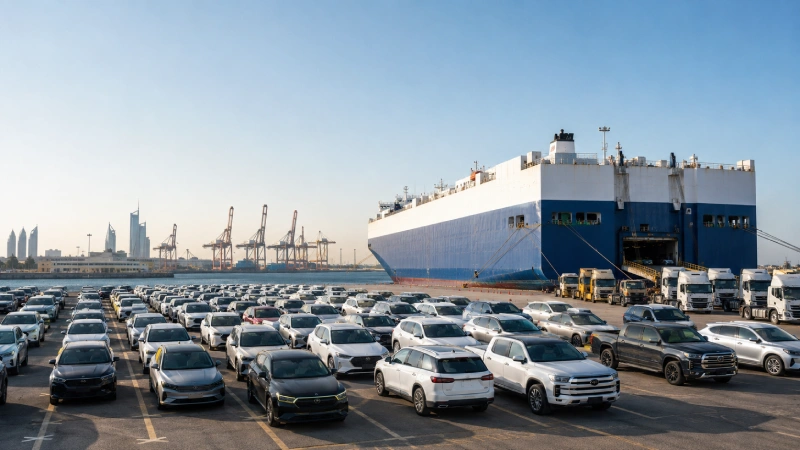
China-made new cars, used vehicles, electric vehicles, pickups, trucks, buses and self-propelled construction vehicles can be shipped to the Middle East by RoRo, container or project-cargo services. Possible gateways include Jebel Ali, Dammam or Al Jubayl, Jeddah, Hamad Port, Sohar, Umm Qasr and Aqaba.
The first decision is not the ocean freight rate. Importers should first confirm whether the vehicle can be imported, cleared, inspected and registered in the final destination country. Port coverage, carrier acceptance, schedules and route surcharges must then be checked for the actual booking date. For the wider planning framework, see Vehicle Shipping from China.
Quick Answer: The best shipping plan depends on the final country, vehicle condition, powertrain, dimensions, import eligibility and current carrier service. Customs clearance at a regional hub does not automatically make the vehicle eligible for registration or onward import into another Middle Eastern country.
What Must Be Checked Before Shipping a Vehicle to the Middle East?
Final destination—not only the discharge port
“Middle East” is a search region, not a single customs or vehicle-registration market. A useful quotation must identify both the discharge port and the final delivery country and city.
Jebel Ali may be used as an import port, free-zone transfer point, re-export hub or regional distribution gateway. A vehicle discharged in Dubai may ultimately be intended for Saudi Arabia, Iraq, Kuwait or another market. However, shipping a vehicle to Jebel Ali does not automatically authorize permanent import, cross-border road transit or registration in the next country.
Re-export, bonded transit and formal import are separate customs procedures. The importer must therefore decide whether the vehicle will be cleared locally, held in a free zone, transferred under bond or exported again before the freight route is selected.
Vehicle import and registration eligibility
Before purchasing or booking a vehicle, confirm whether it is new, used or recently registered. The importer may also need to verify:
- Model year and manufacturing date
- First-registration date and current mileage
- Left-hand-drive or right-hand-drive configuration
- Petrol, diesel, hybrid, battery-electric or other powertrain
- Accident, flood, fire or structural-damage history
- Compliance with GCC or destination-country technical standards
- Whether the importer is an individual, dealer, company or project owner
- Inspection, insurance and registration requirements after customs clearance
A vehicle can be accepted for sea transport and released by customs but still fail a technical inspection or registration procedure.
Customs eligibility and road-registration eligibility should be confirmed separately.
RoRo, Container or Project Cargo: Which Method Should You Use?
RoRo shipping
RoRo shipping is commonly used for passenger cars that can start, steer and brake. It can also handle pickups, commercial trucks, buses and self-propelled construction or project vehicles that fit the carrier’s ramp and deck limits.
RoRo is not limited to new cars. Used vehicles can be shipped when they meet the carrier’s operating, safety and documentation requirements. Acceptance is normally carrier- and voyage-specific. Requirements may cover fuel level, battery state, alarms, tyre condition, fluid leakage, keys, external damage and the vehicle’s ability to move safely through the terminal and vessel ramp.
Non-running vehicles are not accepted by every RoRo operator. Importers should not assume that a damaged or inoperable unit can be delivered to the terminal without prior approval. Undeclared spare parts, commercial cargo or personal belongings should not be left inside the vehicle. Ocean freight also does not automatically include full-value cargo insurance.
For more detailed preparation requirements, read RoRo Car Shipping from China.
Container shipping
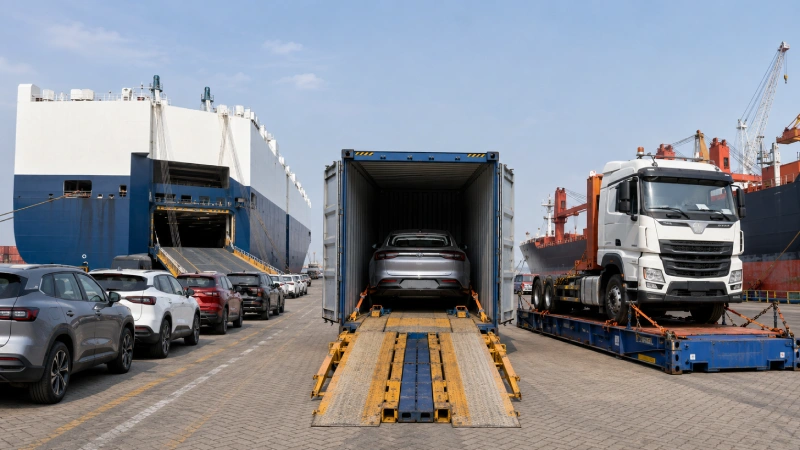
Container shipping may suit one high-value vehicle, a small shipment, a route with limited RoRo coverage or cargo requiring an enclosed transport space. Properly declared spare parts may sometimes move in the same container, subject to customs, carrier and loading-plan approval.
The number of vehicles cannot be determined from the container type alone. A 40HQ should not automatically be quoted as carrying three or four cars. Actual capacity depends on vehicle length, width, height, weight, ground clearance, container-door clearance, loading angle, rack design, axle loading and total weight distribution.
Container shipping reduces some exposure to open-terminal handling but is not automatically safer in every situation. Poor loading, weak lashings, unsuitable support structures, battery issues and difficult unloading at the destination can create separate risks. Non-running vehicles require an approved loading and discharge plan.
For capacity and securing considerations, see Container Car Shipping from China.
Flat rack, breakbulk or conventional vessel
Oversized trucks, high-roof buses, modified vehicles and units exceeding RoRo ramp, deck or container limits may need flat rack, Mafi, breakbulk or conventional-vessel transport.
The carrier and terminal will normally require accurate dimensions, actual shipping weight, centre of gravity, lifting points, lashing points, photographs and a handling proposal. Acceptance may depend on crane capacity, berth equipment, weather restrictions and the availability of suitable unloading equipment at the destination.
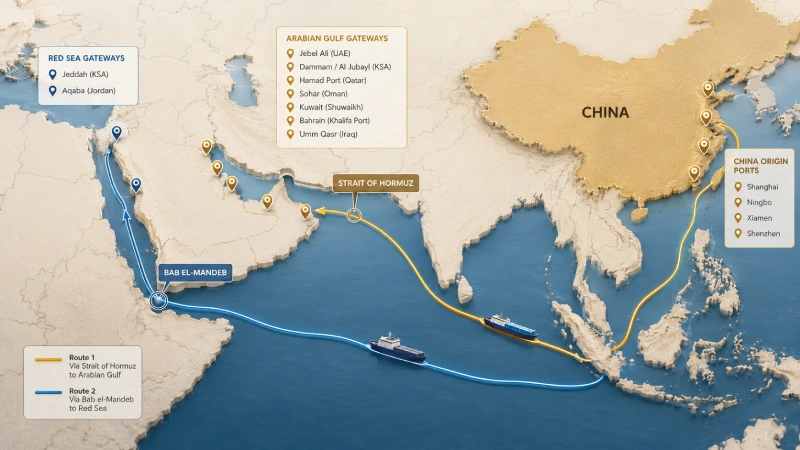
Main Shipping Routes and Vehicle Gateway Ports
Arabian Gulf gateways via the Strait of Hormuz
Possible Arabian Gulf gateways include:
- Jebel Ali, United Arab Emirates
- Dammam or Al Jubayl, Saudi Arabia
- Hamad Port, Qatar
- Sohar, Oman
- Shuwaikh or Shuaiba, Kuwait
- Khalifa Bin Salman Port, Bahrain
- Umm Qasr, Iraq
These ports may serve the UAE, eastern Saudi Arabia, Qatar, Kuwait, Bahrain, Iraq and northern Oman. Jebel Ali is an important automotive and transshipment hub, but it is not automatically the best port for every vehicle shipment.
In 2024, DP World reported the arrival of a COSCO car carrier from Shanghai with 4,800 vehicles. The case demonstrates the capacity of the China–Jebel Ali automotive corridor, but it should not be treated as proof of a fixed current sailing schedule.
A service may be direct or may connect through Singapore or another Asian hub. The practical choice depends on available space, carrier acceptance, vehicle type, final destination, inland distance, port congestion and current operating conditions around the Strait of Hormuz.
Red Sea gateways
Jeddah Islamic Port is a major option for western Saudi Arabia, while Aqaba may serve Jordan and approved regional transit movements. Other Red Sea gateways should be evaluated according to current carrier coverage, security conditions and inland transport arrangements.
A vehicle project for western Saudi Arabia may be better served through Jeddah than through Dammam or Jebel Ali followed by long-distance inland transport. The final comparison should include sea routing, inland distance, border procedures, terminal handling and the importer’s clearance arrangement.
Red Sea services are affected by conditions around Bab el-Mandeb, while Arabian Gulf services have a different operational risk profile around the Strait of Hormuz. These routes should not be compared through one permanent transit-time table.
Direct service versus transshipment
Direct sailings can reduce transfer handling and missed-connection risk, but they may be less frequent or available only for certain ports and cargo volumes.
Transshipment services provide wider destination coverage but add waiting time, change-of-vessel handling and schedule uncertainty. A large dealer fleet, one high-value passenger car and an oversized bus may therefore require completely different routes even when all three are moving to the same Middle Eastern country.
Country-Specific Import Checks
This section provides representative examples only. It is not a complete import guide for every country in the Middle East.
Saudi Arabia
Saudi requirements vary by vehicle category and importer type. Small vehicles, buses and light transport vehicles of 3.5 tonnes or less are generally subject to a five-model-year limit. Heavy transport vehicles above 3.5 tonnes are subject to separate operating-age requirements.
Importers should also verify energy-efficiency requirements, technical conformity and the applicable SASO or SABER process before shipment. The official Saudi vehicle import guidance should be checked together with the commercial importer’s local compliance process.
Rules for personal imports, resident imports and commercial vehicle imports should not be combined. A vehicle that qualifies under one importer category may not qualify under another.
United Arab Emirates
Dubai Customs permits the import of new and used vehicles when the applicable requirements are met. Typical shipment documents may include an original invoice, packing list, bill of lading and importer identification.
Customs valuation and release do not complete the vehicle-entry process. Inspection, insurance and local registration documents may still be required. A vehicle unloaded at Jebel Ali should not be described as automatically eligible for unrestricted movement or registration throughout the GCC.
Oman
Oman Customs currently lists typical age conditions of less than seven years for private used vehicles, less than ten years for trucks and buses, and less than fifteen years for equipment. The vehicle must also comply with current Omani technical standards.
The importer should reconfirm the exact category, manufacturing date, inspection process and customs requirements before purchasing the vehicle or confirming shipment.
Iraq and other changing markets
Iraq and other regional markets may periodically adjust model-year restrictions, pre-arrival declarations, technical requirements, inspection platforms and damaged-vehicle controls.
At quotation stage, the importer should reconfirm the permitted vehicle age, accident or damage history, required inspection, importer qualification, payment channel and local registration process.
Shipments involving sanctioned jurisdictions, restricted companies, listed banks or sensitive end users require separate compliance screening before booking and payment.
GCC conformity does not replace national requirements
A GSO or GCC conformity document may form part of the compliance chain, but it does not replace every national import, energy-efficiency, inspection, certification or registration requirement.
Importers should not assume that one GCC document makes a vehicle automatically acceptable in every Middle Eastern country.
Documents Required for Vehicle Shipping from China
The exact document set depends on the vehicle, exporter, carrier, destination country and importer.
China export documents
Documents may include:
- Commercial invoice
- Sales contract
- Packing list or vehicle list
- VIN or chassis-number list
- Vehicle model and specification information
- Export customs declaration
- Vehicle export licence arranged through an eligible exporter
- Certificate of origin when required
- Manufacturer or conformity documents
- Used-vehicle registration, transfer and cancellation records
- OEM after-sales confirmation where applicable to recently registered used vehicles
China’s 2026 export-licence catalogue continues to cover automobiles. New automobiles use the applicable multiple-use licence arrangement, while used automobiles are managed on a one-shipment-one-licence basis. The licence is issued by the competent commerce authority, not by the freight forwarder. Importers and exporters should refer to the 2026 Export Licence Catalogue published by China’s Ministry of Commerce.
Winsail can coordinate document collection and customs filing with the eligible exporter but does not issue the vehicle export licence.
Carrier and shipping documents
Depending on the shipment, the carrier may request:
- Booking confirmation
- Vehicle condition report
- Vehicle photographs
- Bill-of-lading instructions
- Cargo insurance documents
- Vehicle dimensions and actual weight
- Fuel-level or battery-state information
- Dangerous-goods documents when applicable
- Loading, lashing or lifting plan for oversized vehicles
Destination documents
Depending on the country and importer type, destination documents may include:
- Import licence or importer registration
- Customs or tax identification
- Certificate of origin
- GSO or national conformity documents
- SABER or SASO documents where applicable
- Pre-arrival customs declaration
- Inspection certificate
- Insurance documents
- Vehicle-registration documents
These documents may be required, but they do not form a universal checklist for every shipment.
Step-by-Step Shipping Process
Step 1: Collect complete vehicle information
Provide the vehicle quantity, model, VIN, new or used status, powertrain, running condition, dimensions, weight, photographs, China pickup location, final destination country and delivery city.
Step 2: Confirm destination eligibility
The importer, local customs broker or competent authority should confirm whether the vehicle can be imported, whether age or condition limits apply, which conformity documents are required and whether the importer qualifies for commercial or personal import.
Step 3: Compare ports and transport methods
Compare direct and transshipment services, Arabian Gulf and Red Sea gateways, RoRo, container and project-cargo methods, and the inland distance from each possible port to the final city.
Step 4: Obtain carrier acceptance
Submit complete vehicle data and confirm the sailing, available space, operating-condition rules, electric-vehicle requirements, oversized handling plan and terminal gate-in conditions.
Step 5: Arrange China-side export operations
Coordinate vehicle pickup, condition inspection, yard receiving, eligible exporter, licence information, export customs declaration and delivery to the terminal.
Step 6: Ocean transport and shipment tracking
Prepare the shipping documents and provide departure, transshipment, estimated-arrival and destination pre-alert updates.
Step 7: Destination clearance and registration
The importer or local agent completes the import declaration, duties and taxes, inspection, insurance, vehicle registration and inland delivery.
Shipping Cost and Transit Time
A shipment-specific quotation should be built from the following cost structure:
Total logistics cost = China pickup + origin yard and port charges + export documentation + ocean freight + DG/OOG charges + insurance + destination handling + customs duties and taxes + storage + inland delivery.
Pricing changes according to the pickup city, origin port, discharge port, final delivery point, shipping method, vehicle quantity, dimensions, weight, running condition, powertrain, dangerous-goods requirements, routing, seasonal space, congestion and emergency surcharges.
Total lead time should be divided into:
- Vehicle pickup and export preparation
- Waiting for the selected sailing
- Ocean transit and transshipment
- Destination customs clearance
- Inspection and vehicle registration
- Inland delivery
A historical 18-day direct voyage should not be presented as a permanent standard for all China–Middle East shipments.
Middle East Route Risks and Contingency Planning
Vehicle bookings may be affected by route changes around the Strait of Hormuz, the Red Sea and Bab el-Mandeb. Operational changes can include blank sailings, port omissions, alternative discharge ports, war-risk charges, emergency surcharges, congestion and limited vehicle-yard capacity.
Container shipments may face demurrage, detention and empty-container return restrictions. RoRo cargo may have a short free-storage period after discharge. The shipping plan should consider alternative ports, inland transport, cross-border permits, insurance and sanctions screening.
Route availability and surcharges should be reconfirmed at the time of booking. Operational conditions may change after publication.
How Winsail Coordinates Vehicle Shipping to the Middle East
Winsail can collect and pre-review logistics information, coordinate China pickup and yard receiving, compare RoRo, container and project-cargo options, submit vehicle details to carriers, coordinate bookings, support the eligible exporter with document preparation, arrange export customs filing and communicate with destination agents.
Winsail does not issue vehicle export licences, determine the final HS classification, approve dangerous-goods carriage, guarantee carrier space, certify SABER or GSO compliance, or guarantee destination customs clearance and registration.
Send us the vehicle type, quantity, condition, powertrain, dimensions, pickup city and final destination for a route-specific shipping plan.
Get a Quote
FAQ
How much does it cost to ship a vehicle from China to the Middle East?
Cost depends on the vehicle’s dimensions, weight, condition, powertrain, shipping method, selected port, current space, route surcharges, origin handling, insurance and destination charges. A reliable amount requires a shipment-specific quotation.
How long does car shipping from China to the Middle East take?
Total time includes export preparation, carrier approval, waiting for departure, direct or transshipment sailing, destination customs clearance, inspection, registration and inland delivery. No single transit time applies to every route or country.
Which Middle Eastern port should I choose?
Choose the port according to the final country and city, import eligibility, current carrier coverage, vehicle acceptance, inland distance and total landed cost. Jebel Ali is important but is not automatically the best gateway.
Is RoRo or container shipping better for cars?
RoRo can suit running vehicles and fleet shipments on supported routes. Containers may suit high-value cars, small shipments or destinations with limited RoRo coverage. The better option depends on handling requirements, dimensions, schedules and cost.
Can used cars be shipped from China to the Middle East?
Yes. Used cars can be shipped when Chinese export requirements and carrier conditions are met. Import eligibility still depends on the final country’s model-year, condition, importer, conformity, inspection and vehicle-registration rules.
Can electric vehicles be shipped from China to the Middle East?
Yes, but battery condition, dangerous-goods classification, documentation, state-of-charge instructions, carrier acceptance and destination technical requirements must be checked. See Electric Vehicle Shipping from China for detailed planning.
What documents are needed to export a vehicle from China?
Documents may include the export licence, customs declaration, invoice, sales contract, vehicle list, VIN and specification records, origin or manufacturer documents, booking confirmation and bill of lading. The final list varies by shipment.
Can vehicles be shipped to Jebel Ali and then delivered to another Middle Eastern country?
Sometimes. The movement must be planned as re-export, bonded transit or another lawful procedure. Confirm final-country import eligibility, cross-border permits, customs guarantees, taxes, inspection and registration before booking the first sea leg.
