
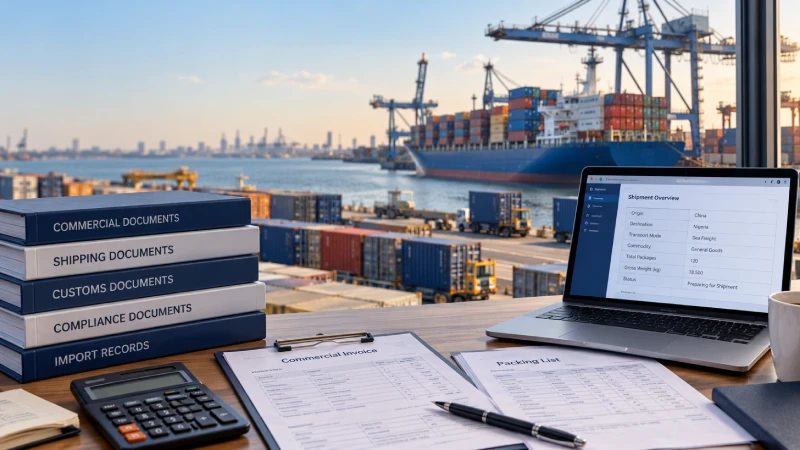
There is no single document package that applies identically to every shipment from China to Nigeria.
The documents you need depend on five main factors:
your product + HS code + Nigerian importer + transport mode + applicable regulator
A shipment of industrial machinery may require a very different compliance file from a shipment of packaged food, cosmetics or ordinary manufactured goods. Even two products moving in the same container may fall under different regulatory requirements.
For that reason, importers should not begin with a generic 15-item shipping checklist. The safer approach is to screen the shipment in four layers:
Commercial documents → transport documents → Nigerian customs documents → product-specific regulatory documents
Nigeria Customs Service also emphasizes that pre-shipment documentation forms the basis for import processing, including Form M, PAAR, customs declaration, assessment and release. Missing, inaccurate or inconsistent documents can create avoidable clearance problems.
Important: Do not ship based only on a generic internet document checklist. The HS classification, intended use and regulatory status of the product can change which certificates, permits and approvals are required.
Nigeria Import Documents at a Glance
The following matrix is a practical screening tool rather than a declaration that every document applies to every shipment.
| Document | Main Purpose | Usually Provided or Prepared By | Stage | Product-Specific? | Relevant Authority / Party |
|---|---|---|---|---|---|
| Proforma Invoice | Supports purchase planning and pre-import processing | Chinese supplier | Before order / pre-shipment | No | Supplier / importer |
| Commercial Invoice | Declares final transaction and cargo details | Chinese supplier | Before shipment | No | Customs / importer |
| Packing List | Shows packages, quantities, weights and dimensions | Chinese supplier | Before shipment | No | Customs / carrier |
| Product Specifications | Supports classification and regulatory screening | Manufacturer / supplier | Before shipment | Often | Regulator / customs |
| Bill of Lading | Sea-freight transport document | Carrier / freight forwarder | After loading | Mode-specific | Shipping line / forwarder |
| Air Waybill | Air-freight transport document | Airline / freight forwarder | After acceptance | Mode-specific | Airline / forwarder |
| Form M | Supports Nigeria’s pre-import documentation process | Nigerian importer through the applicable trade/banking process | Before shipment | May require product-specific documents | Nigeria Customs / trade system |
| PAAR | Pre-arrival assessment supporting customs processing | Nigeria Customs Service | Before arrival / clearance | Linked to shipment documents | NCS |
| Customs Declaration / SGD | Declares imported goods for customs clearance | Importer / licensed declarant | Clearance | No | NCS |
| Product Certificate | Conformity document for relevant SONCAP goods | Exporter / certification route | Before shipment | Yes | SON / approved conformity body |
| SONCAP Certificate | Shipment conformity document for relevant regulated goods | Importer / certification route | Pre-shipment / PAAR stage | Yes | SON |
| NAFDAC Registration / Permit / Approval | Regulatory authorization for applicable products | Nigerian applicant / importer | Depends on product pathway | Yes | NAFDAC |
| Special Permit | Approval for controlled or specially regulated cargo | Importer / competent authority | Usually before shipment | Yes | Relevant regulator |
Nigeria Customs Service continues to describe Form M, PAAR and the Single Goods Declaration (SGD) as connected elements of the import process. Digital workflows can change, so importers should verify the current submission platform and agency instructions rather than relying on screenshots or tutorials from previous years.
Official reference: Nigeria Customs Service
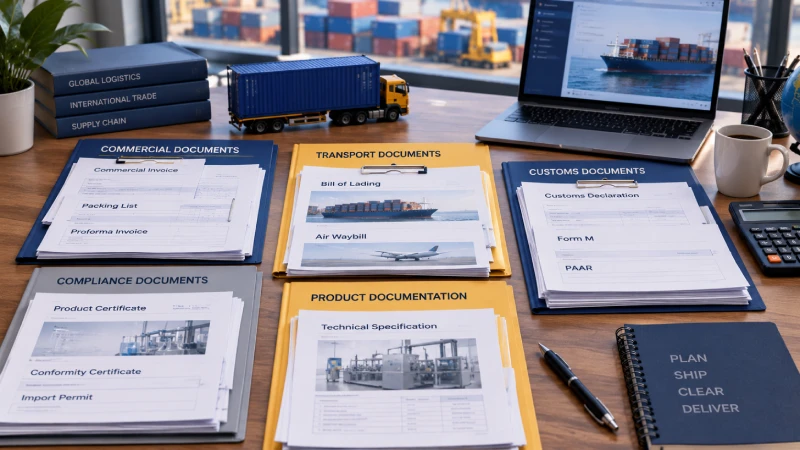
Documents Usually Prepared by the Chinese Supplier
Your Chinese supplier should provide accurate commercial and product information early enough for the Nigerian importer to complete classification and regulatory screening.
For most commercial shipments, ask the supplier for the following information before cargo is booked:
- Proforma Invoice — normally used during purchasing and pre-import preparation.
- Final Commercial Invoice — showing the final seller, buyer, description, quantity, unit price and total value.
- Packing List — showing packages, net and gross weight, dimensions and packing method.
- Detailed product description — more specific than generic descriptions such as “machine parts,” “electronics” or “accessories.”
- Model numbers and technical specifications where relevant.
- Manufacturer name and address where regulatory screening requires manufacturer information.
- Country-of-origin information where required for the transaction or applicable procedure.
- Product test reports, certificates or conformity documents where the relevant regulatory route requires them.
- Material or chemical information where product composition affects classification, dangerous-goods handling or regulatory control.
- Dangerous goods documentation where the cargo is classified as hazardous for transport.
Not every supplier-issued certificate has legal value in Nigeria. A Chinese factory’s own quality statement, CE document or laboratory report should not automatically be treated as a substitute for an approval specifically required by a Nigerian regulator.
The importer should first determine which Nigerian regulatory pathway applies and then tell the supplier exactly what supporting documentation is needed.
Proforma Invoice vs Commercial Invoice
These two documents serve different stages.
A proforma invoice is normally prepared before the transaction is finalized and may support pre-import preparation.
The commercial invoice reflects the final commercial shipment and becomes part of the customs-document package.
The descriptions should remain materially consistent. If pre-import documentation identifies the product as “automatic voltage stabilizers” but the final commercial invoice describes the cargo only as “electrical products,” the difference can create questions during document review.
Shipping Documents — Sea vs Air
The transport document depends primarily on the shipping mode.
| Item | Sea Freight | Air Freight |
|---|---|---|
| Main transport document | Bill of Lading | Air Waybill |
| Common abbreviation | B/L | AWB |
| House document | House Bill of Lading | House Air Waybill |
| Master document | Master Bill of Lading | Master Air Waybill |
| Issued by | Shipping line / NVOCC / forwarder | Airline / forwarder |
| Key details | Shipper, consignee, ports, packages, cargo description | Shipper, consignee, airports, pieces, weight, cargo description |
If you are still deciding which transport mode fits your cargo, compare Sea Freight from China to Nigeria and Air Freight from China to Nigeria.
Bill of Lading
A Bill of Lading (B/L) is the principal transport document used for ocean freight.
Depending on the shipment structure, there may be both a House Bill of Lading (HBL) issued by a freight forwarder or NVOCC and a Master Bill of Lading (MBL) issued by the ocean carrier.
Importers should check:
- consignee name;
- notify party;
- shipper information;
- port of loading;
- Nigerian destination port;
- package count;
- cargo description;
- container number where applicable;
- gross weight;
- freight terms.
Do not wait until the vessel is approaching Nigeria to discover that the consignee name on the B/L does not match the importing entity being used for customs processing.
Air Waybill
An Air Waybill (AWB) is used for air cargo.
Consolidated shipments may involve:
- HAWB — House Air Waybill
- MAWB — Master Air Waybill
The AWB should be checked against the invoice, packing list and Nigerian import documentation, particularly the consignee, cargo description, piece count and weight.
Unlike a traditional negotiable ocean bill of lading, an air waybill functions primarily as an air-transport record rather than a document of title.
House vs Master Transport Documents
The master document records the carrier-level movement. The house document records the forwarder-to-customer shipment.
Both can matter operationally.
For consolidated cargo, the importer or clearing team should know which document number will be referenced for arrival handling and customs clearance instead of assuming the supplier’s copy contains the final transport data.
Nigerian Import and Customs Documents
For standard commercial imports, Nigerian customs documentation should be treated as a connected process rather than as a collection of unrelated forms.
A simplified document flow is:
Importer identification → Form M → shipment documents → PAAR → customs declaration → assessment/payment → examination where applicable → release
For the step-by-step clearance workflow, see Nigeria customs clearance process.
1. Importer Registration and TIN
The Nigerian importer needs the appropriate identity and trade-registration data for customs processing.
Nigeria Customs guidance links importer information with Form M, PAAR and customs declaration processes. Before placing a large order in China, confirm that the intended Nigerian importing entity can actually be used for the planned import transaction.
2. Form M
Form M is a central pre-import document within Nigeria’s standard commercial import framework.
The documents required to support Form M can depend on the product. Where a product falls within SONCAP, the appropriate Product Certificate may form part of the process. Where another regulator controls the product, its authorization may also affect whether the shipment is ready to proceed.
For the detailed filing mechanics, see Form M and PAAR requirements.
3. PAAR
PAAR means Pre-Arrival Assessment Report.
It is produced within the Nigerian customs process before final cargo clearance and supports the assessment of imported goods.
PAAR is therefore not another document that the Chinese supplier simply creates. Its processing depends on the shipment’s import documentation and customs workflow.
4. Customs Declaration / SGD
The importer or authorized declarant submits the customs goods declaration.
Nigeria Customs has continued to use the term Single Goods Declaration (SGD) in public customs materials. Because customs systems and portal workflows can change, the importer or clearing agent should confirm the current operational procedure for the entry being processed.
The declaration uses information from documents such as the commercial invoice, packing list, transport document, PAAR and applicable regulatory approvals.
5. Assessment and Release Documents
After declaration, Customs may assess duties and other applicable charges and apply the relevant risk or examination procedure.
Payment records, inspection or examination results where applicable, and final release information become part of the clearance file.
For landed-cost planning, use Nigeria import duty and taxes rather than estimating duties from a generic product category.
Product-Specific Regulatory Documents
This is the stage where generic import-document checklists most often become unreliable.
Before asking, “Do I have all my documents?”, first ask:
What exactly is the product, what is its HS classification, what is it used for, and which Nigerian authority regulates it?
Simple Document Decision Tree
Step 1 — Identify the product and proposed HS code
↓
Step 2 — Determine whether it falls within SONCAP or another regulatory regime
↓
Step 3 — Check whether an exemption, permit or special pathway applies
↓
Step 4 — Confirm which approval is needed before Form M, before shipment and before PAAR/clearance
↓
Step 5 — Do not release the cargo from China until applicable pre-shipment requirements have been satisfied
SON-Regulated Products
SONCAP is Nigeria’s pre-shipment conformity assessment program for products within its scope.
For SONCAP-regulated products, the Standards Organisation of Nigeria describes two important certification stages:
- Product Certificate (PC) — used in the Form M process.
- SONCAP Certificate (SC) — used for the shipment and relevant PAAR/customs-clearance process.
SON states that regulated imports undergo conformity verification before shipment and that the appropriate SONCAP Certificate demonstrates conformity with applicable standards.
Official reference: SONCAP Services — Standards Organisation of Nigeria
The exact route can vary. SON identifies different Product Certificate routes based on the certification status and shipment arrangement.
Importantly, not every imported product follows the standard SONCAP offshore certification route.
Some products may fall outside the normal SONCAP scope, while qualifying categories may follow an Import Permit route. This distinction should be checked before shipment rather than assumed from the product name alone.
Important: SONCAP exemption does not automatically mean regulatory exemption. A product outside the normal offshore SONCAP route may still be subject to another SON requirement or another Nigerian regulator.
For a dedicated product-screening guide, see SONCAP requirements.
2026 SONCAP Platform Update
Importers should also be careful with old online portal instructions.
The Standards Organisation of Nigeria announced that, effective March 27, 2026, specified SONCAP and Import Permit processes migrated to Nigeria’s National Single Window framework. SON’s announcement states that relevant certificate activation for Form M, PAAR and cargo-clearance purposes is handled through the updated framework.
Official reference: Mandatory Migration of SONCAP and Import Permit Processes to the National Single Window Platform
Do not assume that a tutorial published before this migration still represents the complete current submission process.
NAFDAC-Regulated Products
NAFDAC regulates a different group of products.
Its regulated categories include areas such as:
- food;
- drugs;
- cosmetics;
- medical devices;
- chemicals;
- detergents;
- bottled or packaged water.
The key point is that there is no single document called “the NAFDAC paper” that applies identically to every regulated import.
Depending on the product and purpose of import, the pathway may involve:
- product registration;
- an import permit;
- product-specific certificates;
- manufacturer documents;
- laboratory or technical documentation;
- shipment or port-clearance authorization;
- other supporting information requested for the applicable product category.
Official reference: NAFDAC Regulatory Resources
A shipment of finished cosmetics, for example, should not automatically be treated in the same way as an industrial chemical raw material.
The correct NAFDAC pathway should be determined before the supplier ships the goods.
For more detail, see NAFDAC import requirements.
Other Controlled Products
Some cargo may involve another Nigerian government authority in addition to, or instead of, SONCAP and NAFDAC.
Rather than using an internet list of agencies and assuming it is exhaustive, screen the specific:
- HS code;
- product composition;
- end use;
- importer type;
- whether the cargo is new or used;
- whether it contains controlled substances;
- whether a special sector licence applies.
If another competent authority is triggered, identify its approval and timing requirement before the cargo leaves China.
Which Documents Need to Be Ready Before Shipment?
A useful way to manage import documentation is to divide the process into three stages.
Stage 1: Before Purchase or Order Finalization
Confirm:
- exact product description;
- model and specifications;
- proposed HS classification;
- Nigerian importer identity;
- whether the product is restricted or controlled;
- whether SONCAP applies;
- whether NAFDAC or another regulator applies;
- whether an import permit or special authorization is required.
This is the cheapest stage at which to discover a compliance issue.
Stage 2: Before Shipment from China
Prepare or confirm, as applicable:
- approved proforma-invoice data;
- Form M readiness;
- required Product Certificate;
- required SONCAP or conformity process;
- NAFDAC approval or permit where applicable;
- other regulatory authorization;
- final commercial invoice;
- packing list;
- transport booking data;
- dangerous-goods documentation where relevant.
SON describes SONCAP as a pre-shipment conformity program for regulated products. Do not assume that a missing pre-shipment certificate can simply be obtained after the container has sailed.
Stage 3: Before Arrival in Nigeria
Reconcile:
- final invoice;
- packing list;
- B/L or AWB;
- manifest information;
- Form M;
- SONCAP or applicable permit;
- PAAR documentation;
- declaration data;
- importer and consignee details.
The objective is to have the clearance file substantially prepared before the cargo reaches the Nigerian port or airport.
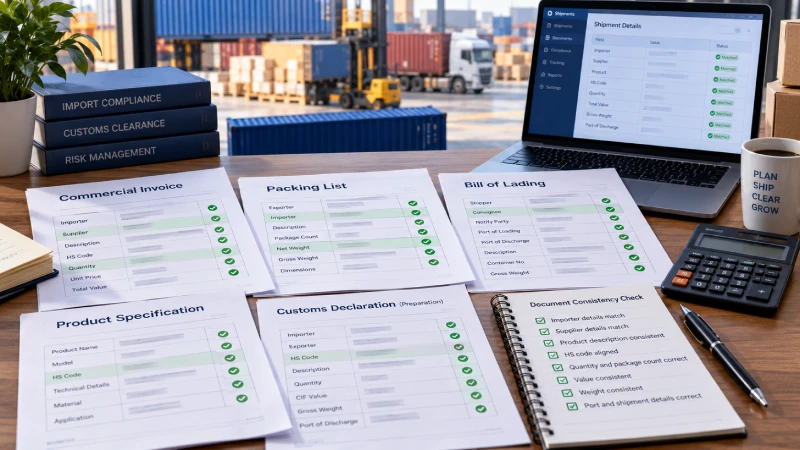
Why Document Consistency Matters
Having every document is not enough.
The information across those documents also needs to make sense as one shipment.
Reconciliation Checklist
Compare the following fields across the Form M, invoice, packing list, B/L or AWB, regulatory documents and customs declaration.
Importer
Use the correct legal importing entity consistently.
Watch for:
- abbreviated company names;
- spelling differences;
- incorrect TIN;
- a different consignee appearing on the transport document.
Supplier / Manufacturer
Determine whether the seller and manufacturer are different parties.
Do not silently substitute one for the other where regulatory documentation identifies the manufacturer.
Commodity Description
Avoid descriptions that are too vague.
Instead of:
“Machines”
use a commercially accurate description such as:
“Automatic liquid filling machine, model XYZ-200”
when that accurately describes the product.
The wording does not need to be character-for-character identical on every document, but the documents should clearly describe the same goods.
HS Code
Use a classification that is supported by the actual product.
The HS code can affect:
- import duty;
- taxes and levies;
- prohibition or restriction status;
- SONCAP treatment;
- regulatory control;
- customs risk review.
Do not select an HS code solely because it appears to have a lower duty rate.
Quantity
Reconcile:
- number of units;
- number of cartons;
- pallets;
- drums;
- containers;
- other packing units.
Value
The transaction value on the commercial documents should be supportable and should not conflict unnecessarily with the pre-import documentation.
Weight
Check:
- net weight;
- gross weight;
- shipping-line or airline data;
- packing-list totals.
Shipment Details
Verify:
- port or airport of loading;
- destination;
- container number where applicable;
- B/L or AWB number;
- vessel or flight details where required.
Pro Tip: Create one shipment master-data sheet before the supplier issues final documents. Record the approved product description, HS code, importer, supplier, quantity, value, package count and weights, then use that sheet to reconcile every document.
Document Checklist by Product Type
The table below is a screening guide only.
Every entry should be read as:
Possible requirement — verify before shipment.
| Product Type | Possible Regulator / Control | Possible Documents | Must Be Checked Before Shipment? |
|---|---|---|---|
| General manufactured goods | SON / NCS depending on product | Invoice, packing list, Form M, PC/SONCAP where applicable, B/L or AWB | Yes |
| Electronics / electrical equipment | SON and other authority where relevant | Product specifications, PC, conformity evidence, SONCAP Certificate, customs documents | Yes |
| Industrial machinery | SON route depends on importer and use | Specifications, invoice, packing list, normal SONCAP documents or qualifying Import Permit pathway | Yes |
| Food | NAFDAC / NCS | Product registration or applicable authorization, manufacturer documents, invoice, packing list, customs documents | Yes |
| Cosmetics | NAFDAC / NCS | Registration and applicable import/clearance documents, product and manufacturer records | Yes |
| Medical devices | NAFDAC and potentially other applicable controls | Registration or authorization, device specifications, supporting certificates | Yes |
| Chemicals | NAFDAC and potentially other controls | Chemical identity, composition/SDS, registration or import permit where applicable, transport DG documents if hazardous | Yes |
| Project cargo | Depends on equipment and end use | Technical specifications, permits where applicable, machinery/conformity documents, transport documents | Yes |
Before booking cargo from China, prepare:
product name + detailed description + proposed HS code + quantity + shipping mode + Nigerian destination
Winsail can help organize the logistics-document workflow and identify which regulatory questions should be resolved before shipment. Regulatory certificates and approvals themselves are issued by the relevant Nigerian authorities or authorized conformity bodies, not by Winsail Logistics.
Common Documentation Mistakes That Cause Problems
Shipping First and Checking Compliance Later
This is one of the highest-risk mistakes.
For a product requiring pre-shipment conformity or a permit, any time saved by loading early can be outweighed by storage, detention, testing, amendment or compliance problems after arrival.
Using a Generic Product Description
Descriptions such as “spare parts,” “equipment,” “chemicals” and “electronics” can provide too little information for reliable classification and regulatory screening.
Obtain the model, function, material and application information before finalizing import documents.
Assuming Every Product Needs SONCAP
SONCAP applies according to the relevant regulatory scope.
Some categories are outside the normal offshore scheme, while certain imports may follow another SON pathway.
The correct question is not:
“Do imports to Nigeria need SONCAP?”
It is:
“Does this specific product and import scenario fall under the SONCAP certification route, another SON route, NAFDAC, or another regulatory regime?”
Assuming SONCAP Exemption Means No SON Control
A SONCAP exemption should not automatically be interpreted as exemption from all Nigerian regulatory requirements.
Verify whether another SON route, import permit, NAFDAC requirement or another regulator applies to the product.
Using Old Portal Instructions
Nigeria’s customs and regulatory systems continue to move toward newer digital workflows.
Importers should verify current agency instructions before submitting a time-sensitive application rather than relying on an old portal tutorial.
Related China-to-Nigeria Shipping Resources
For the overall freight route, start with Shipping from China to Nigeria.
For clearance and transport planning, use:
- Nigeria customs clearance process
- Sea Freight from China to Nigeria
- Air Freight from China to Nigeria
- DDP Shipping from China to Nigeria
- Form M and PAAR requirements
- SONCAP requirements
- NAFDAC import requirements
- Nigeria import duty and taxes
Regulatory Notice
Import requirements in Nigeria can change and may differ according to the product, HS classification, importer, intended use and customs procedure.
This guide is intended for general shipping and import-document planning. It is not a substitute for a classification ruling, legal advice, customs instruction or formal determination by the Nigeria Customs Service, Standards Organisation of Nigeria, NAFDAC or another competent regulator.
Winsail Logistics coordinates international freight and related logistics services for shipments exported from China. Winsail does not issue Form M, PAAR, SONCAP certificates, NAFDAC registrations, import permits or other Nigerian regulatory approvals.
Where a regulatory question affects whether goods may legally ship or clear, confirm the requirement with the responsible Nigerian authority before cargo departure.
Last Updated: October 3, 2026
Reviewed by: Winsail Logistics Team
Official sources accessed: October 3, 2026
Primary official references reviewed for this guide include:
- Nigeria Customs Service
- Standards Organisation of Nigeria — SONCAP Services
- Standards Organisation of Nigeria — SONCAP and Import Permit National Single Window Migration
- NAFDAC Regulatory Resources
What documents does my Chinese supplier need to provide?
Usually start with a proforma invoice, final commercial invoice, packing list and accurate product specifications. Depending on the product, the supplier or manufacturer may also need to support conformity testing, technical documentation or other regulatory requirements.
Does every Nigerian import need SONCAP?
No. SONCAP applies according to the product and regulatory pathway. Some imports may fall outside the normal offshore SONCAP scheme or follow another SON route, but this does not automatically mean the goods are exempt from all regulatory requirements.
Which document is used for sea freight?
The main sea-freight transport document is the Bill of Lading. Depending on the booking structure, a shipment may have both a House Bill of Lading and a Master Bill of Lading.
Which document is used for air freight?
Air cargo uses an Air Waybill. Consolidated shipments may involve both a House Air Waybill and a Master Air Waybill.
When does NAFDAC documentation apply?
NAFDAC requirements may apply to regulated categories such as food, drugs, cosmetics, medical devices, chemicals and related products. The exact registration, permit or clearance documentation depends on the product and import purpose.
Can goods ship before all regulatory approvals are ready?
Do not assume they can. Some requirements are specifically pre-shipment requirements. Determine which approvals must be in place before loading and complete those steps before the goods leave China.
Why must the invoice and Form M descriptions match?
Both documents form part of the same import transaction. Material inconsistencies in the commodity description, value, quantity, importer or classification can create questions during document review and customs processing.
