

Form M and PAAR are related, but they are not interchangeable documents and they occur at different points in the import process.
For a normal commercial shipment from China to Nigeria, Form M is established earlier in the import cycle using preliminary transaction information. PAAR—the Pre-Arrival Assessment Report—comes later, when the shipment and its final commercial and transport documents are available.
The practical connection between them is data continuity. Product descriptions, quantities, values, HS classifications, importer information and applicable regulatory certificates should remain consistent from the original Form M stage through the documents used for PAAR.
That is why many Form M and PAAR problems are not really “Customs paperwork problems.” They begin much earlier, when the Nigerian importer, Chinese supplier, freight forwarder and regulatory parties work from different versions of the shipment information.
Current-system verification: October 3, 2026. Nigeria’s current trade information portal describes Form M applications as going through authorised dealer banks on the B’Odogwu platform and PAAR applications as being made to Nigeria Customs Service through B’Odogwu. Separately, SON moved relevant SONCAP certificate activation for Form M, PAAR and cargo-clearance purposes to the National Single Window from March 27, 2026.
Important: This guide explains the normal Form M–PAAR document relationship. Requirements can differ for special import regimes, exemptions and regulated product categories. It is operational guidance, not legal or regulatory advice.
Form M vs PAAR — Quick Answer
| Document | Process Stage | Purpose | Main Party | Main Supporting Data | What Happens Next |
|---|---|---|---|---|---|
| Form M | Pre-import / before the final shipment-document stage | Establishes the import transaction and its core commercial information | Nigerian importer, with the authorised dealer bank and relevant authorities | Proforma invoice, insurance and applicable regulatory certificates | Shipment preparation continues and final shipping documents are produced |
| PAAR | Pre-arrival, after shipment data and final documents are available | Provides NCS with information for pre-arrival customs assessment | Nigeria Customs Service, based on importer/agent submission | Registered Form M, invoice, packing list, B/L or AWB and applicable regulatory certificates | Customs declaration, assessment and subsequent clearance steps follow |
NCS service guidance lists a registered Form M as one of the documents required for PAAR, together with regulatory certificates where applicable, the transport document, commercial invoice, packing list and certificate of origin.
The easiest way to remember the relationship is:
Form M establishes the transaction earlier. PAAR assesses the arriving shipment using the transaction and final shipment data.
PAAR does not replace Form M, and Form M does not replace PAAR.
What Is Form M?
Form M is part of Nigeria’s pre-import procedure for commercial imports handled through the standard Form M process.
It captures core information about the proposed transaction before the final shipment documents are available. That information later becomes an important reference point for regulatory certificates, shipping documents and PAAR processing.
Current Nigeria Trade Information Portal guidance says Form M is applied for through authorised dealer banks on the B’Odogwu platform. NCS service guidance also describes the importer completing Form M through an Authorised Dealer Bank, followed by the relevant approval and NCS registration stages.
Form M Compliance Overview
| Item | Practical Meaning |
|---|---|
| Importer | The Nigerian importing entity is central to the application and must have the appropriate Nigerian registration and tax identity |
| Supplier | The Chinese supplier’s details should reflect the actual commercial transaction |
| Product description | Should be sufficiently specific to support classification and regulatory checks |
| HS code | Should be reviewed before finalising the transaction because it can affect duty and regulatory requirements |
| Value | Normally begins with the commercial information shown on the proforma invoice |
| Insurance | NCS service guidance lists an insurance certificate among Form M supporting documents |
| Regulatory certificates | Required where the product falls under an applicable regulator |
| Platform workflow | Current public guidance places Form M processing in the B’Odogwu trade workflow |
Form M should therefore not be treated as an isolated bank document that can be completed using approximate product information and corrected casually later.
It creates the first major structured version of the import transaction.
If that version says “industrial electric motor,” for example, while the later invoice, packing list and regulatory certificate describe a different machine configuration, the importer may have to resolve the discrepancy before downstream processing can proceed smoothly.
Information Needed Before Form M Processing
Before the Nigerian importer begins Form M processing, the importer and supplier should agree on the commercial data that will remain stable throughout the shipment.
At minimum, verify:
- Importer legal name and TIN
- Chinese supplier/exporter name
- Specific product description
- Proposed HS classification
- Quantity and units of measurement
- Unit price and total value
- Country of supply and origin where relevant
- Product model, specification or brand where relevant
- Applicable SON, NAFDAC or other regulatory requirements
- Proforma invoice details
- Expected mode of transport
- Any regulatory certificate numbers already available
The HS code deserves particular attention. It is not simply a number added by a forwarder after the cargo has been packed.
The classification can influence customs duty, regulatory agency requirements and whether a product needs certificates or permits before the shipment progresses.
The current National Single Window Trade Information Portal illustrates this clearly: individual HS codes can be linked to different pre-arrival regulatory procedures involving agencies such as SON and NAFDAC.
Pro Tip: Freeze the final product description, proposed HS classification and quantity structure before the supplier produces the final shipment documents.
That does not mean nothing can ever change. It means changes should be identified deliberately rather than discovered when the importer is already trying to process PAAR.
How SONCAP Can Enter the Form M Process
For goods subject to SONCAP, there is an important distinction between the Product Certificate (PC) and the SONCAP Certificate (SC).
SON states that the Product Certificate is used in opening Form M for SONCAP-regulated goods, while the SONCAP Certificate is used for PAAR and customs-clearance processing.
A simplified relationship looks like this:
Confirm whether the product is SONCAP-regulated
↓
Supplier/exporter works with the appropriate conformity-assessment party
↓
Product Certificate issued
↓
Certificate transmitted/activated through the current SON/NSW workflow
↓
Product Certificate supports Form M processing
↓
Shipment-level conformity requirements completed
↓
SONCAP Certificate available and activated
↓
SONCAP Certificate supports PAAR
SON’s May 2026 schematic specifically shows the exporter transmitting the Product Certificate or SONCAP Certificate toward the NSW workflow, the Nigerian importer activating it on the NSW portal, and the activated certificate being used for Form M with the relevant CBN process or for PAAR with NCS, as applicable.
Important 2026 NSW Change
Effective March 27, 2026, SON directed stakeholders to use the National Single Window for the relevant SONCAP and import-permit processes. For certificates generated by approved offshore conformity-assessment firms, SON states that certificate generation can continue through the SON system, while activation for Form M, PAAR and cargo-clearance purposes must occur through NSW.
Therefore, old instructions saying that every SONCAP step is completed entirely in one legacy portal should not be relied on without checking the current system.
For more detail on regulated-product conformity requirements, see SONCAP Requirements for Nigeria Imports from China.
How NAFDAC-Regulated Goods May Change the Workflow
NAFDAC-controlled products require more care because there is no single Form M rule that applies identically to every NAFDAC-regulated shipment.
The correct question is not:
“Does NAFDAC always approve Form M?”
It is:
“What NAFDAC registration, permit, authorization or clearance requirement applies to this particular product and import scenario?”
A practical decision tree is:
Is the product regulated by NAFDAC?
No
→ Follow the normal Form M process and check whether another regulator applies.
Yes
→ Identify the exact product category.
Registered finished food, drug, cosmetic, medical device or another regulated product?
→ Verify the current registration/import requirements for that category.
Chemical, raw material, controlled substance or another permit-based category?
→ Verify the relevant NAFDAC import-permit procedure.
Frozen fish, certain packaging materials, fresh fruits, raw/unprocessed seeds or vegetables, or another relevant borderline category?
→ Check whether the specific NAFDAC authorization-to-open-Form-M procedure applies.
NAFDAC’s published regulatory-resource library contains separate procedures for different product categories, including Form M authorizations, chemical import permits, regulated-product clearance and other import approvals.
This distinction matters because an older NAFDAC guideline titled Guidelines for Issuance of Authorization to Open Form M is specifically directed at identified categories such as frozen fish, packaging materials for NAFDAC-regulated products, fresh fruits, raw and unprocessed seeds and vegetables, and certain borderline products. It should not be interpreted as a universal procedure for every NAFDAC-controlled import.
Before shipping regulated cargo from China, the Nigerian importer should therefore confirm the current requirement against the exact product and HS classification.
For product-specific procedures, continue with NAFDAC Requirements for Goods Imported from China.
What Is PAAR?
PAAR stands for Pre-Arrival Assessment Report.
It occurs later than Form M and uses more complete shipment information.
By the PAAR stage, the transaction has progressed from the preliminary commercial information used for Form M toward the actual shipment. Documents such as the commercial invoice, packing list and transport document are now available.
Current NCS service guidance lists the following among the documents used for PAAR:
- registered Form M;
- applicable regulatory certificates;
- Bill of Lading, Air Waybill or Waybill;
- commercial invoice;
- packing list; and
- certificate of origin.
The current National Single Window Trade Information Portal places PAAR before the customs declaration stage and says the application is made to Nigeria Customs Service through the B’Odogwu platform.
A simplified sequence is:
Final shipment information available
↓
Commercial and transport documents checked
↓
Applicable regulatory certificates linked/verified
↓
PAAR data submitted through the current NCS workflow
↓
NCS processes the PAAR
↓
PAAR supports the downstream customs declaration and assessment process
PAAR is not a guarantee of customs release.
A PAAR does not mean that Customs has completed every declaration, assessment, risk-management, inspection, payment or release requirement.
It is a pre-arrival document within the larger customs process.
For the downstream customs steps, see Customs Clearance in Nigeria for Imports from China.
SONCAP Certificate and PAAR for Regulated Goods
For SONCAP-regulated goods, it is particularly important not to confuse the certificate used at the Form M stage with the certificate used at the PAAR stage.
| Item | Form M Stage | PAAR Stage |
|---|---|---|
| Relevant SONCAP document | Product Certificate (PC) | SONCAP Certificate / Shipment Certificate (SC) |
| Main function | Supports opening/processing of Form M | Supports PAAR and customs-clearance processing |
| Regulated products only? | Yes | Yes |
| Current activation environment | NSW | NSW |
| Needs Nigerian importer involvement? | Yes | Yes |
| Can one assume every imported product needs it? | No | No |
SON explicitly states that the Product Certificate is used for Form M and that the SONCAP Certificate is used to process PAAR for SONCAP-regulated goods.
A SONCAP Certificate is also consignment-specific in a way importers should understand. SON says one SONCAP Certificate cannot be used to clear multiple consignments; it is limited to a single PAAR consignment.
This is one reason split shipments should be discussed before shipping rather than after cargo has already departed China.
Form M → Shipment → PAAR → Declaration
For a typical commercial shipment following the standard process, the relationship can be visualised as:
1. Nigerian importer confirms the proposed import
Importer, supplier, product, quantity, HS code, value and regulatory status are reviewed.
↓
2. Regulatory pre-import requirements are handled where applicable
For example, a SONCAP Product Certificate may be needed for regulated goods.
↓
3. Form M is processed
The importer works through the applicable authorised dealer bank and current B’Odogwu workflow.
↓
4. Chinese supplier prepares and ships the cargo
Final product quantities and shipping details should follow the approved transaction as closely as possible.
↓
5. Final shipment documents are issued
Commercial invoice, packing list and B/L or AWB become available.
↓
6. Shipment-stage regulatory documents are completed where applicable
For example, a SONCAP Certificate may need to be activated through NSW.
↓
7. PAAR is processed
NCS uses the relevant Form M and shipment data for the pre-arrival assessment.
↓
8. Customs declaration follows
The importer/licensed customs agent proceeds with declaration, assessment and subsequent clearance requirements.
The National Single Window itself cautions that import processes shown sequentially can in practice overlap or run in parallel. Special regimes may also follow different procedures.
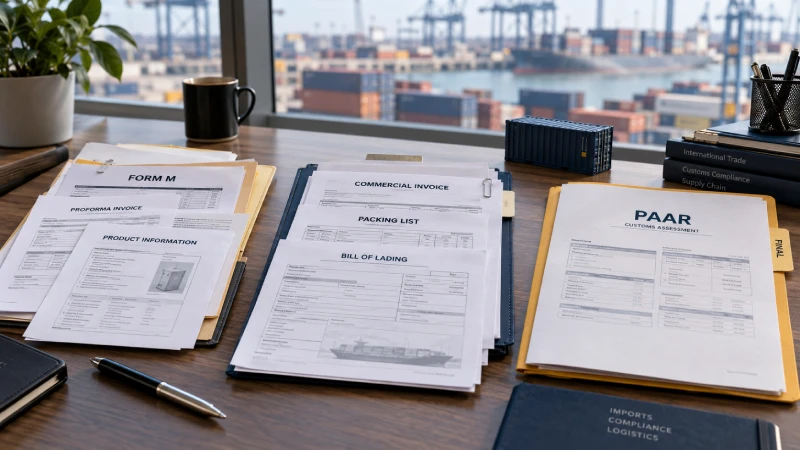
For the wider document set beyond Form M and PAAR, see Documents Required to Import from China to Nigeria.
Data Consistency Checks Before PAAR
This is one of the most important checks for shipments from China to Nigeria.
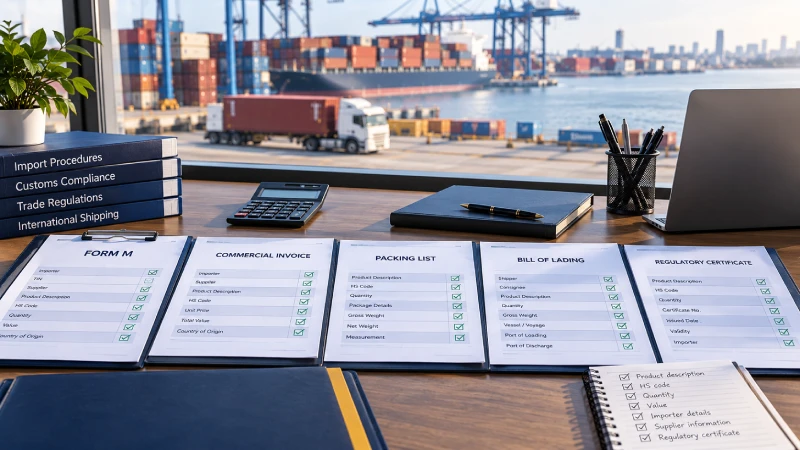
Before PAAR processing, compare the data across:
Form M ↔ Commercial Invoice ↔ Packing List ↔ B/L or AWB ↔ Regulatory Certificates
The wording does not necessarily have to be identical character for character. A shipping line may abbreviate a description, for example.
But the documents must describe the same real transaction without material contradiction.
Form M and PAAR Consistency Table
| Field | Form M | Invoice | B/L / AWB | Regulatory Certificate | Must Match? |
|---|---|---|---|---|---|
| Importer name | Yes | Normally | Consignee/notify details as applicable | Often | Must be consistent with the transaction |
| Importer TIN | Yes | May appear | Usually not a core transport field | Often required for activation | Must correspond where required |
| Supplier/exporter | Yes | Yes | Shipper may be supplier or logistics party depending on arrangement | May appear | Any difference should be explainable |
| Product description | Yes | Yes | Usually abbreviated | Yes for regulated goods | Must describe the same goods |
| HS code | Yes | Often | May not appear | Often | Classification should not conflict |
| Quantity | Yes | Yes | Packages/weight rather than commercial units in some cases | Usually relevant | Must reconcile to the shipment |
| Value | Yes | Yes | Normally not shown | May appear | Form M and invoice values must be reconcilable |
| Model/specification | Where relevant | Where relevant | Often omitted | Important for many regulated goods | Should remain consistent |
| Certificate reference | Where applicable | Sometimes | Normally not required | Yes | Must belong to the correct transaction |
Before PAAR, Check These Seven Areas
Product description
Avoid vague terms such as “machine,” “spare parts,” “equipment” or “accessories” when a more precise commercial description is available.Quantity
Confirm commercial units as well as cartons, pallets, drums or other transport packages.Value
Make sure the final invoice reflects the actual commercial transaction and does not unexpectedly conflict with the earlier Form M data.HS classification
Investigate classification changes before PAAR rather than silently replacing one code with another.Importer identity
Legal name and TIN should belong to the entity responsible for the import transaction.Supplier information
If the invoicing supplier, manufacturer and B/L shipper are different entities, the relationship should be clear.Regulatory certificates
Check that certificates belong to the correct importer, product, shipment and Form M/PAAR transaction where applicable.
Do not wait until cargo reaches Nigeria to discover that the product description or regulatory data cannot support PAAR processing.
What If the Shipment Changes After Form M?
Changes sometimes occur between the proforma-invoice stage and actual production in China.
Common examples include:
- quantity increases or decreases;
- model changes;
- product specification changes;
- supplier changes;
- price changes;
- HS classification changes;
- additional product lines;
- removal of products; or
- one order being split into multiple shipments.
Not every change has the same compliance impact.
A small packaging adjustment is different from replacing the product with a different model that belongs under another HS code or regulatory certificate.
Use This Decision Process
Did anything change after Form M?
No
→ Continue the document-consistency review before shipment and PAAR.
Yes
→ Ask whether the change affects any of the following:
- product identity;
- HS code;
- quantity;
- value;
- supplier;
- regulatory certificate;
- shipment structure; or
- importer data.
No material impact
→ Document the change and confirm that all final shipping documents remain reconcilable.
Possible material impact
→ Stop treating the existing Form M data as automatically valid.
Before the supplier issues final documents, the Nigerian importer should verify the current correction, amendment or regulatory re-linking procedure with the authorised dealer bank, customs agent and relevant regulator.
Has the cargo already shipped?
If yes, the issue becomes more urgent because the final B/L or AWB and shipment-level certificates may already have been created. The importer should resolve the discrepancy before PAAR processing rather than submitting conflicting data and hoping the system accepts it.
Because Nigeria’s customs and NSW systems have been changing, the exact amendment interface should be confirmed at the time of the transaction rather than relying on an old screenshot, legacy NICIS procedure or historical blog post.
For classification and tax implications, see Nigeria Import Duty & Taxes for Goods from China.
Review Form M & PAAR Data Before Shipping from China
For shipments from China, the best time to identify a Form M or PAAR inconsistency is before cargo handover.
A useful pre-shipment review should compare:
- product description;
- proposed HS code;
- quantity;
- proforma/final invoice structure;
- importer details;
- supplier details;
- SONCAP or NAFDAC status;
- shipping-document instructions; and
- whether the shipment will move as one consignment or be split.
Winsail Logistics can help coordinate the China-side shipping documents and cargo information so they remain aligned with the data provided by the Nigerian importer.
The Nigerian importer, authorised dealer bank, regulator and licensed Nigerian customs agent remain responsible for their respective regulatory and customs procedures.
Send Product & HS Code
If you are preparing a shipment from China to Nigeria, provide:
Product name + proposed HS code + quantity + invoice value + supplier location in China + destination in Nigeria + any existing SON/NAFDAC information.
The first objective should be to identify document conflicts before booking and final document issuance—not after the cargo arrives.
For practical prevention measures, continue with How to Avoid Customs Delays When Shipping from China to Nigeria.
Related Nigeria Import Guides
- Documents Required to Import from China to Nigeria — for the wider commercial, shipping and regulatory document set.
- Customs Clearance in Nigeria for Imports from China — for the declaration, assessment and release process after PAAR.
- SONCAP Requirements for Nigeria Imports from China — for regulated-product conformity procedures.
- NAFDAC Requirements for Goods Imported from China — for food, drugs, cosmetics, medical devices, chemicals and other NAFDAC-controlled categories.
- Nigeria Import Duty & Taxes for Goods from China — for tariff classification, duty, VAT and other applicable charges.
- How to Avoid Customs Delays When Shipping from China to Nigeria — for pre-shipment compliance and document-control practices.
- Shipping from China to Nigeria — for freight methods, transit planning and the overall route.
FAQ
What is the difference between Form M and PAAR?
Form M comes earlier and establishes the core import transaction using preliminary commercial and regulatory information. PAAR comes later, after final shipment information is available, and is processed by Nigeria Customs Service as part of the pre-arrival assessment process. A registered Form M is one of the documents supporting PAAR.
Which comes first, Form M or PAAR?
Form M comes first in the normal commercial import sequence. The shipment then progresses to final commercial and transport documentation, after which PAAR can be processed.
Who processes Form M?
The Nigerian importer initiates the Form M process. Current official trade guidance says applications are made through authorised dealer banks on the B'Odogwu platform.
Can the Chinese supplier obtain Form M?
The Chinese supplier does not normally open the Nigerian Form M in its own name. The supplier instead provides the commercial and product information needed by the Nigerian importer and may support product-certificate requirements where applicable.
Is SONCAP required before Form M?
Only where the goods are subject to SONCAP requirements. For SONCAP-regulated products, the Product Certificate is the certificate associated with Form M processing.
Does every product need a SONCAP Certificate for PAAR?
No. SONCAP applies to SONCAP-regulated products, not automatically to every product imported into Nigeria. Other products may fall under NAFDAC or another regulator, while some categories follow different procedures.
What happens if invoice details change after Form M?
The impact depends on what changed. A change in quantity, value, supplier, model, product description or HS code may affect the Form M, regulatory certificate or PAAR data. The importer should verify the current correction or amendment route before PAAR processing.
Does PAAR mean Customs has released the goods?
No. PAAR is a pre-arrival assessment document. Customs declaration, assessment, payment, risk controls, inspection where required and final release occur later in the clearance process.
