

The cheapest quoted freight is not necessarily the cheapest shipment.
A low ocean rate can look attractive when you are comparing freight forwarders, but the number on the first quotation is only one part of the cost. Once supplier pickup, origin handling, destination charges, customs clearance, inland delivery, storage, delays and avoidable handling are added, the option with the lowest freight rate can become the more expensive shipment.
For importers looking for the cheapest shipping from China to Nigeria, the better question is:
Which shipping plan gives me the lowest total cost from my suppliers in China to the point where the cargo is released and delivered in Nigeria?
A practical way to evaluate this is:
Total logistics cost = purchase-to-delivery logistics cost + delay risk + avoidable destination charges
This guide focuses on reducing that total. It does not assume that LCL, FCL, air freight or any particular Nigerian port is always cheapest. The right solution depends on the cargo, supplier locations, packing, shipment size, urgency, destination and current freight market.
For a broader overview of transport methods, customs planning and the overall route, see our China–Nigeria landed-cost planning guide guide. If you need current market references rather than optimization strategy, use our current shipping costs to Nigeria page.
What “Cheapest Shipping” Should Actually Mean
Freight buyers often compare one highly visible number: the international freight rate.
That is understandable, but it creates an incomplete comparison.
For example, one forwarder may quote a lower LCL ocean rate but exclude destination CFS handling. Another may quote slightly higher freight while including more origin charges or using a service that reduces handling after arrival.
The first quote is not automatically cheaper.
For commercial cargo, compare the complete cost stack:
| Cost Layer | What to Check |
|---|---|
| Supplier pickup | Factory locations, number of pickups, truck type and loading conditions |
| China origin | Warehouse, consolidation, export declaration, documentation and terminal handling |
| International freight | LCL, FCL, air or express transport |
| Nigeria destination | Carrier, terminal, CFS, documentation, release and handling charges |
| Customs | Clearance scope, duties and taxes, inspections and required documentation |
| Inland delivery | Lagos delivery or transport to another Nigerian city |
| Time risk | Storage, demurrage, detention, warehouse rent and missed delivery windows |
| Cargo risk | Repacking, damage, non-stackable cargo or special handling |
The goal is not to find the lowest individual line item. It is to minimize the combined logistics bill without creating a larger cost somewhere else.
That distinction becomes especially important for LCL shipments, shipments from multiple Chinese suppliers and cargo that will travel far inland after arriving in Nigeria.
A useful comparison should also keep the service scope identical. A port-to-port sea freight quotation should not be compared directly with a quotation that includes factory pickup, export handling, destination clearance coordination and final delivery. Normalize the scope first, then compare the totals.
Cheapest Method by Shipment Profile
There is no universal shipment size at which one transport mode suddenly becomes the cheapest.
Cargo density, packaging, destination fees, container availability, airline chargeable weight, equipment type and inland delivery can all move the crossover point.
Use shipment profile as the starting point instead.
| Shipment Profile | Usually Compare | Main Cost Risk | What to Verify |
|---|---|---|---|
| Samples | Express vs air | Minimum charges and volumetric weight | Chargeable weight, courier surcharges, clearance scope |
| Small urgent commercial cargo | Air vs express | Paying for speed you do not need | Required arrival date and chargeable kg |
| Small LCL cargo | LCL options | Minimum charges and destination handling | W/M rule, minimums, CFS and release charges |
| Larger LCL cargo | LCL vs FCL | Rising per-unit handling costs | Complete LCL and FCL totals |
| Near-container volume | LCL vs 20ft/40ft FCL | Choosing by CBM alone | Container utilization and destination charges |
| Full-container cargo | 20ft vs 40ft/40HQ FCL | Poor container utilization | Weight, dimensions, equipment and delivery |
| Oversized or heavy cargo | FCL vs special equipment/project solution | Special handling and equipment surcharges | Dimensions, lifting points, weight and carrier acceptance |
For very small, urgent shipments, paying more per kilogram for air freight or express may still produce the lowest business cost if waiting for sea freight would stop production, miss a sales window or create a stockout.
For normal commercial cargo without a tight deadline, sea freight is usually the first mode to evaluate because it generally offers better economics for heavier and larger shipments. But even within sea freight, you still need to decide between LCL shipping and FCL shipping.
Do not make that decision from a generic volume threshold alone.
Compare Lowest-Cost Options
Prepare the cargo type, carton dimensions, total weight, supplier locations, cargo-ready dates and Nigerian delivery point. Compare the available modes using the same origin, destination and delivery scope before choosing the lowest-cost plan.
Consolidate Multiple Chinese Suppliers Before Shipping
If you buy from several factories in China, one of the biggest cost-saving opportunities may happen before the international shipment even begins.
Suppose you purchase electrical parts from Shenzhen, packaging materials from Dongguan and accessories from Foshan.
Shipping three independent international consignments can mean repeating:
- supplier pickup arrangements;
- warehouse or documentation charges;
- minimum freight charges;
- destination release processes;
- customs-related coordination;
- local delivery arrangements.
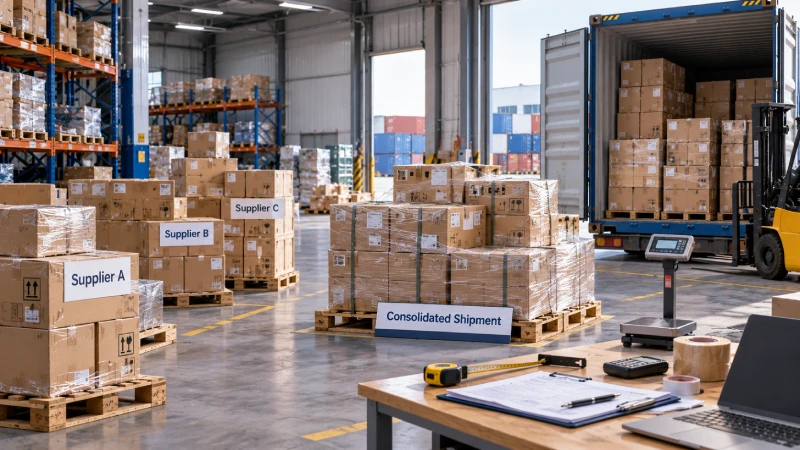
A China cargo consolidation plan changes the workflow.
Without Consolidation
Supplier A → international shipment → Nigeria
Supplier B → international shipment → Nigeria
Supplier C → international shipment → Nigeria
Each shipment may create its own fixed charges and minimums.
With Consolidation
Supplier A + Supplier B + Supplier C → China consolidation warehouse → receiving and checking → packing optimization → one planned export shipment → Nigeria
The cargo can be received under separate supplier references, counted or inspected within the agreed service scope and then prepared for one international shipment.
Using China-side consolidation services can reduce duplicated logistics activity, but consolidation should be planned rather than treated as an automatic saving.
Combining cargo physically does not mean invoices, product descriptions or customs documentation should be artificially combined or simplified. Commercial and customs documents still need to reflect the actual transactions and applicable import requirements.
Timing also matters. If one supplier is two weeks late, waiting for that factory may eliminate part of the freight saving. Compare the saving from consolidation with the inventory or sales cost of delaying cargo that is already ready.
For importers regularly buying from several Chinese factories, this origin-side decision can be more valuable than negotiating a small reduction in the ocean freight rate.
Reduce Chargeable Volume Before You Negotiate the Freight Rate
One of the most overlooked ways to reduce shipping cost from China to Nigeria is changing the cargo before shipment.
Not the product—the way it is packed.
A 5% freight-rate reduction has limited value if inefficient cartons increase your chargeable volume by 15%.
Before booking LCL or loading a container, review the following.
Check Carton Dimensions
Factories sometimes use standard cartons that are convenient for production rather than efficient for export.
Ask whether large void spaces can be safely removed and whether products can be packed more tightly without increasing damage risk. Measure the final export cartons rather than using early product estimates.
Review Unnecessary Pallets
Pallets improve handling and may be necessary for certain cargo, but they also add height and volume.
Do not remove pallets merely to save CBM. Determine whether the cargo genuinely requires palletization based on product strength, handling frequency, destination warehouse requirements and the risk of damage.
Consider Knock-Down or Nested Packing
Furniture, frames, racks, display systems and some machinery components may occupy significantly less space when shipped partially disassembled.
Likewise, compatible products may sometimes be nested inside one another.
This only works when dismantling, repacking and reassembly are safe and commercially practical.
Combine Compatible SKUs
Mixed products can sometimes be packed more efficiently when carton specifications are planned across the entire order rather than independently by each supplier.
This is particularly useful when several suppliers are sending small cartons that can be safely repacked or consolidated into stronger export cartons.
Improve Stackability
Non-stackable cargo wastes vertical container space and can increase the space allocated to an LCL shipment.
Strong export cartons, properly designed crates and flat top surfaces may improve utilization, provided the packaging remains appropriate for the product.
Do Not Sacrifice Cargo Protection
The cheapest packing method is not the one using the least cardboard.
It is the one that minimizes unnecessary shipping volume while still protecting the cargo through warehouse handling, container loading, ocean transport and destination handling.
Damage, repacking or claims can cost far more than the CBM saved through excessive packaging cuts.
For detailed volume-pricing logic, minimum charging and W/M considerations, use our LCL cost per CBM guide.
Compare LCL and FCL on Total Cost, Not Freight Alone
One of the most important cost decisions for sea freight from China to Nigeria is whether to use LCL or FCL.
LCL lets you buy only part of a container, making it attractive when you do not have enough cargo to justify dedicated equipment.
But LCL also introduces consolidation and deconsolidation activity.
Your total LCL calculation should therefore look more like:
LCL total = chargeable LCL units + origin fixed charges + destination LCL charges + customs/clearance scope + delivery
FCL follows a different cost structure:
FCL total = container freight + origin charges + destination container charges + customs/clearance scope + delivery
Why LCL Can Be Cheaper
With smaller cargo, paying for only the space you use normally creates a much lower initial commitment than booking an entire container.
It is also useful when shipment frequency matters more than waiting until enough inventory accumulates for FCL.
Why LCL Can Become Expensive
As volume increases, per-CBM costs are not the only issue.
LCL may include:
- consolidation warehouse handling at origin;
- minimum charges;
- W/M or chargeable-unit rules;
- deconsolidation at destination;
- CFS or warehouse handling;
- shipment-level documentation or release charges.
Some of these are fixed or semi-fixed rather than directly proportional to the ocean freight rate.
Why FCL Can Become More Economical
With FCL, the container becomes the main freight unit.
As utilization increases, the freight cost per saleable unit can fall. Dedicated equipment may also simplify handling compared with shared-container cargo.
However, FCL introduces its own risks, including container-related destination charges, demurrage, detention, trucking and empty-container return requirements.
That is why there should be no universal published crossover such as “always use FCL above X CBM.”
The crossover has to be calculated using live LCL and FCL quotations for the same cargo, date, gateway and final destination.
Pro Tip: When cargo is approaching your forwarder’s LCL/FCL crossover range, request both quotations at the same time. Compare complete destination and delivery costs, not only ocean freight.
For equipment-specific pricing, use the separate 20ft and 40ft container rates page rather than applying a generic crossover rule.
Compare LCL vs FCL
When the shipment is becoming too large for an obvious LCL decision, compare both structures before the cargo leaves the factory. Use the same cargo data, destination, service scope and quotation validity period.

Origin Port and Factory Location Can Change the Cheapest Route
China is not one origin point.
A supplier in Foshan, Suzhou, Ningbo, Qingdao or Xiamen creates a different inland logistics problem.
It therefore makes little sense to select an export port only because its ocean freight is slightly lower.
The calculation should be:
Factory pickup + China origin charges + international freight + schedule
A simple routing comparison may look like this:
| Routing Factor | Option A | Option B |
|---|---|---|
| Distance from factory | Short | Long |
| China trucking | Lower | Higher |
| Ocean freight | Slightly higher | Slightly lower |
| Sailing frequency | Better | Limited |
| Cargo-ready alignment | Good | Requires waiting |
| Overall decision | Compare total | Compare total |
A cheaper ocean rate from a distant port may be erased by additional trucking, tolls, warehouse transfer and waiting time.
For multiple suppliers, the best origin can change again because the consolidation warehouse needs to serve the entire supplier network rather than one factory.
This is why routing should start with factory addresses and cargo-ready dates—not just a list of Chinese port rates.
Choose the Nigerian Gateway Based on Final Destination
The cheapest route does not end when the vessel reaches Nigeria.
The Nigerian Ports Authority identifies Lagos Port Complex at Apapa, Tin Can Island Port Complex, Lekki Deep Sea Port and Onne Port Complex among Nigeria’s port facilities. These are distinct gateways and facilities with different terminal, carrier and inland implications.
That does not mean one port is universally cheaper.
The right gateway depends on factors such as:
| Factor | Why It Matters |
|---|---|
| Carrier service | Not every service calls every Nigerian port |
| Cargo type | Terminal and equipment capabilities vary |
| Final delivery city | Inland haulage can change the total significantly |
| Terminal/CFS arrangement | Destination handling differs by shipment and operator |
| Clearance plan | Broker and cargo-release arrangements matter |
| Schedule | A cheaper route may involve longer waiting or transshipment |
For cargo ultimately delivered in Lagos, a Lagos-area gateway may appear obvious, but the exact carrier service and terminal still need to be checked.
For cargo moving toward other regions, an alternative gateway may sometimes reduce inland transport. In other cases, limited carrier service, transshipment or higher ocean costs may eliminate that advantage.
The correct comparison is therefore:
China origin → Nigerian gateway → clearance point → final delivery location
—not simply:
China port → cheapest Nigerian ocean rate
Before choosing a route, check the actual Nigeria destination charges and, for shared-container cargo, the separate LCL destination charges page.
Timing the Shipment to Avoid Expensive Rate Windows
Freight rates are not static.
Capacity, demand, carrier pricing, fuel-related adjustments and peak-season surcharges can change the economics of a shipment even when the cargo itself has not changed.
A current carrier example shows why the cargo-ready and loading date matter.
On September 30, 2026, CMA CGM announced a Peak Season Surcharge update for cargo loaded from Central and South China to its West Africa Central Range, including Nigeria. The carrier stated that the change applies from October 15, 2026 for applicable short-term contracts, while other freight and local charges remain subject to the shipment and tariff conditions. See the CMA CGM PSS notice for the carrier’s published scope.
This does not mean every China-to-Nigeria shipment will increase by the same amount. Carrier, contract, loading date, equipment and service conditions matter.
It does show why two bookings made around different loading dates can have different economics.
Before booking, check:
- cargo-ready date from every supplier;
- quotation validity;
- planned vessel and cut-off;
- announced PSS or other carrier surcharges;
- Chinese public-holiday and factory-closure periods;
- available space;
- whether waiting for another sailing creates more inventory cost than it saves.
Avoiding urgency is one of the simplest ways to control freight cost.
When cargo has to move on the next available vessel or flight regardless of price, your routing and negotiation options become much narrower.
Seven “Cheap Quote” Warning Signs
A low quotation is useful only when you know what the number actually covers.
1. Destination Charges Are Not Defined
If the quote says only “ocean freight” or “to Lagos,” ask what happens after arrival.
For LCL especially, clarify the destination agent, CFS or warehouse-related cost scope.
2. Nobody Asked for Dimensions
A forwarder cannot reliably calculate LCL, air freight or loading efficiency from total weight alone.
Carton or crate dimensions matter.
3. Cargo Description or HS Code Was Never Discussed
A quotation made without understanding the product may overlook handling, compliance or customs-related issues.
The forwarder does not necessarily need the final customs classification to produce an initial freight comparison, but a vague description such as “parts” is not enough for shipment planning.
4. There Is No Rate Validity
Freight prices can change.
A quote without an expiration date makes it difficult to know whether the price still applies when the cargo is ready.
5. The Destination Is Not Clearly Named
“China to Nigeria” is not a complete routing.
A proper comparison should identify the port, airport, CFS, warehouse or final delivery location relevant to the quoted service.
6. LCL Minimums or W/M Rules Are Missing
A low per-CBM number is meaningless if the shipment is subject to minimum billing or a weight/measurement rule you have not considered.
Ask how the chargeable unit will be determined.
7. “All Inclusive” Is Used Without an Inclusion List
“All inclusive” is only useful when the quotation specifies what is actually included.
Check freight, origin charges, destination charges, customs-clearance scope, duties and taxes, delivery, storage and any conditions or exclusions.
If the service scope cannot be compared line by line, the quotations are not yet comparable.
Use This Quote Comparison Before Choosing the Cheapest Forwarder
Instead of placing quotations side by side and comparing the bold total at the bottom, normalize them first.
| Quote | Supplier Pickup | Origin | Freight | Destination | Customs | Delivery | Rate Validity |
|---|---|---|---|---|---|---|---|
| Forwarder A | Included / Excluded | Included / Excluded | Amount & mode | Listed? | Scope? | Destination? | Date |
| Forwarder B | Included / Excluded | Included / Excluded | Amount & mode | Listed? | Scope? | Destination? | Date |
| Forwarder C | Included / Excluded | Included / Excluded | Amount & mode | Listed? | Scope? | Destination? | Date |
Then confirm that all quotations are based on the same:
- cargo dimensions and weight;
- supplier pickup locations;
- Incoterm or handover point;
- Chinese export port;
- Nigerian gateway;
- customs-clearance scope;
- final delivery address;
- cargo-ready date;
- rate validity period.
Only then does “cheapest” become a meaningful comparison.
A Better Cost-Reduction Order
Importers often begin by asking a forwarder to reduce the freight rate.
That may not be the highest-value place to start.
A better sequence is:
- Confirm the cargo. Make sure weight, dimensions, packaging and product description are accurate.
- Optimize the packing. Reduce unnecessary CBM without reducing cargo protection.
- Consolidate suppliers where practical. Avoid unnecessary separate shipments and repeated minimum charges.
- Compare modes. Check LCL, FCL and, when urgency justifies it, air freight.
- Optimize the route. Include China pickup, export port, Nigerian gateway and inland delivery.
- Compare complete quotations. Normalize origin, freight, destination, customs and delivery scopes.
- Book before urgency removes your options.
Pro Tip: If you are sourcing from several factories, optimize packing and consolidate the purchase before asking carriers or forwarders to cut the freight rate. Structural savings can be larger than a small discount on the ocean line.
How We Determine the Lowest-Cost Shipping Option
A credible “cheapest shipping” recommendation should not begin with a fixed mode.
For a China-to-Nigeria shipment, the decision should be based on:
- product and handling requirements;
- gross weight and packed dimensions;
- number and location of Chinese suppliers;
- cargo-ready dates;
- LCL/FCL/air chargeable basis;
- China pickup and origin charges;
- available carrier routing;
- Nigerian port or cargo-release location;
- destination charges;
- customs-clearance scope;
- inland delivery point;
- timing and delay exposure.
Winsail provides LCL shipping, FCL shipping, sea freight, air freight and China warehouse and consolidation services. That allows different shipment structures to be reviewed rather than treating one transport mode as the automatic answer.
Current freight prices and local charges still need to be checked at quotation stage.
Rate-reference note: Market and carrier information referenced in this guide was reviewed on October 3, 2026. Freight, surcharges, terminal charges and local costs can change after publication. Always confirm the current quotation, validity period, inclusions and destination cost scope before booking.
Send Cargo Details for Cost Comparison
The cheapest shipping plan from China to Nigeria is the one that controls cost from the factory—not just the one showing the lowest ocean freight.
Before arranging the shipment, prepare:
- product description;
- number of packages;
- carton or crate dimensions;
- gross weight;
- supplier addresses in China;
- cargo-ready dates;
- preferred or required Nigerian destination;
- final delivery city;
- LCL/FCL preference, if any;
- required delivery timing.
With those details, you can compare consolidation, packing, LCL, FCL, sea freight and air freight on the same basis and identify where the largest savings actually exist.
For the detailed pricing pages, compare current shipping costs to Nigeria, LCL cost per CBM, 20ft and 40ft container rates, Nigeria destination charges and LCL destination charges separately rather than relying on one headline freight number.
FAQ
What is the cheapest way to ship commercial goods from China to Nigeria?
For larger or heavier non-urgent cargo, sea freight is usually the first option to compare. Smaller shipments may use LCL, while larger shipments should be compared against FCL. The cheapest final option depends on the complete origin, freight, destination and delivery cost rather than transport mode alone.
Is LCL always cheaper than a 20ft container?
No. LCL requires less initial capacity, but its per-unit and destination handling costs can become less competitive as shipment volume increases. When cargo approaches the economic crossover between LCL and FCL, compare live quotations for both options rather than relying on a fixed CBM rule.
Can supplier consolidation reduce China-to-Nigeria freight costs?
Yes, for suitable shipments. Combining compatible cargo from multiple Chinese suppliers can reduce repeated pickup, documentation, minimum freight and destination handling costs. Warehouse costs, supplier timing and documentation requirements should still be included in the comparison.
How can I reduce chargeable CBM?
Review final carton dimensions, void space, unnecessary pallets, knock-down packing, nesting and stackability. Any packaging change should still provide adequate protection during warehouse handling and international transport.
Is the cheapest port-to-port quote always the lowest total cost?
No. A lower ocean rate may come with higher China inland transport, destination charges, Nigerian inland delivery costs or schedule risk. Compare the full route from supplier pickup to the required delivery point.
Does shipping before peak season reduce freight cost?
It can. Capacity pressure and carrier surcharges may increase costs during busy periods, while earlier planning usually gives importers more routing options. There is no guarantee that an earlier sailing will always be cheaper, so current quotations and surcharge notices should still be checked.
Can a more expensive freight rate produce a lower landed logistics cost?
Yes. A slightly higher freight rate can still result in a lower total logistics cost if it reduces destination handling, unnecessary inland transport, poor container utilization, storage exposure or delay risk.
