
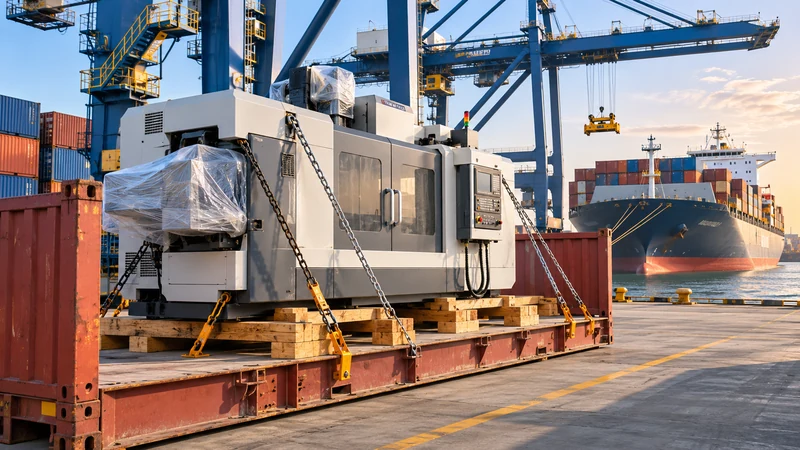
Shipping machinery from China to the UAE starts with packed dimensions, gross weight, centre of gravity, and loading requirements. Machines that fit safely inside standard containers may use 20GP, 40GP, or 40HQ equipment. Oversized or crane-loaded machinery may require Open Top, Flat Rack, RoRo, or Breakbulk transport. Confirm container limits, carrier acceptance, import requirements, inland transport, and site unloading before booking.
For UAE manufacturers, engineering contractors, and industrial equipment buyers, the challenge is not simply moving a machine between two ports. It is ensuring that the machinery can be collected from the Chinese factory, loaded safely, accepted by the carrier, cleared through UAE customs, and delivered to a site prepared to receive it.
A machine may fit inside a shipping container but exceed acceptable floor-loading limits. Another may travel safely by sea but require special road permits or lifting equipment before reaching its final destination.
This guide explains how to assess these requirements before committing to a shipping arrangement.
Before choosing a freight method, confirm four things:
- Machine specifications: Final packed dimensions, gross weight, centre of gravity, and support points.
- Handling requirements: Factory loading facilities, approved lifting points, and securing arrangements.
- UAE delivery conditions: Discharge port, exact delivery address, road access, and unloading facilities.
- Operational approval: Equipment availability, carrier acceptance, customs requirements, and applicable permits.
1. What Machinery Details Do You Need Before Booking Shipping?
The first step in machinery transportation is obtaining accurate technical information from the manufacturer.
A machine’s catalogue dimensions and weight are rarely sufficient for freight planning. Packaging, detachable components, lifting arrangements, and load distribution can all affect the shipping method.
Measure the Machine in Its Final Shipping Configuration
Request the manufacturer’s technical datasheet and confirm the dimensions of every shipping unit after export preparation.
The essential information includes:
- Machinery type, manufacturer, model, and quantity.
- Unpacked length, width, and height.
- Final packed length, width, and height in millimetres.
- Net machine weight and total packed gross weight.
- Crate, skid, and supporting-frame dimensions.
- Number of separate shipping pieces.
- Protruding components or irregular shapes.
- Whether the machine is new, used, or refurbished.
Always confirm whether the stated measurements include export packaging.
For example, a production machine may be 2,200 mm wide before packing. After adding a protective wooden crate and supporting structure, its shipping width may increase enough to prevent entry through a standard container door.
The freight assessment must use the final shipping dimensions, not the original manufacturer’s product dimensions.
Confirm Centre of Gravity, Lifting Points, and Floor Loading
Machinery weight is not always distributed evenly.
Industrial presses, generators, and machining centres may contain heavy components concentrated in one area. This affects how the equipment can be lifted, positioned, supported, and secured during transportation.
Before selecting a container or trailer, obtain:
- The machine’s centre-of-gravity position, where available.
- Manufacturer-approved lifting points.
- Base dimensions and load-bearing contact areas.
- Any restrictions on tilting or transportation orientation.
- Forklift-pocket information, if applicable.
- Lifting drawings or handling instructions.
A machine can weigh less than a container’s published maximum payload and still be unsuitable for that container because of concentrated floor loading.
Container payload, floor-bearing capability, and road axle-load limits are separate checks. Meeting one does not automatically satisfy the others.
For particularly heavy or unbalanced machinery, a qualified party should review load distribution and lifting arrangements.
Can Disassembly Make Machinery Easier to Ship?
Some equipment can be divided into smaller transportable units.
For example, a production-line manufacturer may be able to detach guarding, conveyors, electrical cabinets, or other designed-for-removal components.
This can sometimes make standard-container transport possible.
However, disassembly should be approved by the manufacturer and assessed against:
- Reassembly costs and installation requirements.
- Calibration and mechanical alignment.
- Protection of detached components.
- Warranty conditions.
- Additional packaging and handling.
- The possibility of lost or incorrectly identified parts.
Reducing the shipping dimensions is not necessarily worthwhile if it substantially increases commissioning costs or technical risks.
2. Can Your Machinery Fit in a Standard Shipping Container?
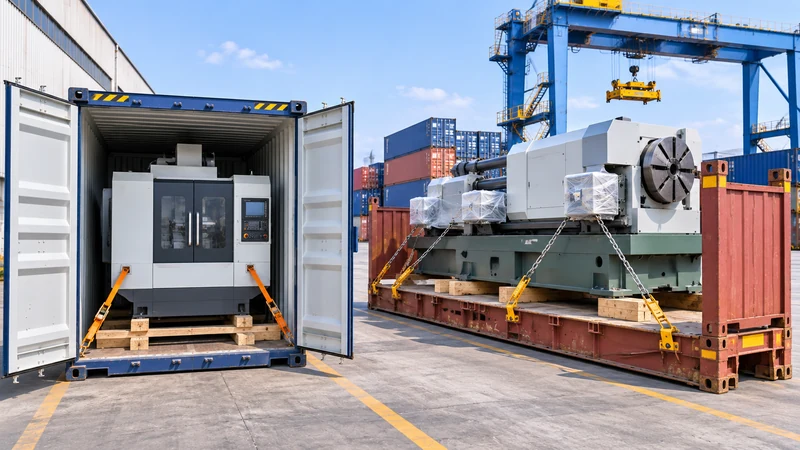
Standard containers are often worth evaluating first for machinery that can be loaded and secured safely. However, physical fit does not equal transport approval.
A proper assessment considers container dimensions, loading access, weight distribution, floor strength, and the ability to unload the machine at its destination.
Check Container Door Clearance and Internal Dimensions
The container door is frequently the first limitation.
A machine may fit within a container’s internal dimensions but be too wide or tall to pass through the door.
The following specifications illustrate the differences between commonly used standard containers.
Reference Standard Container Dimensions
| Specification | 20GP | 40GP | 40HQ |
|---|---|---|---|
| Internal length | 5,900 mm | 12,032 mm | 12,032 mm |
| Internal width | 2,352 mm | 2,352 mm | 2,350 mm |
| Internal height | 2,395 mm | 2,395 mm | 2,700 mm |
| Door width | 2,340 mm | 2,340 mm | 2,340 mm |
| Door height | 2,292 mm | 2,292 mm | 2,597 mm |
Source: Published examples from Hapag-Lloyd’s container equipment specifications. Actual dimensions and permissible weights vary by manufacturer and container unit. Figures are reference values, not guaranteed loading clearances.
A 40HQ provides additional height compared with a 40GP, but its door width is not wider in these examples.
It is therefore incorrect to assume that a wider machine can enter a high-cube container simply because the container is larger.
Illustrative example — not an actual Winsail shipment
A Chinese manufacturer prepares an industrial machine in a crate measuring:
- Length: 5,400 mm
- Width: 2,450 mm
- Height: 2,200 mm
The packed length and height appear compatible with the published internal dimensions of a 20GP container.
However, the crate is 110 mm wider than the example container’s 2,340 mm door opening.
It cannot enter that standard container through the door in its stated configuration.
Changing to a 40HQ does not solve the width limitation. The buyer must investigate a manufacturer-approved packing modification or a different transport arrangement, such as suitable Flat Rack equipment.
Even when the dimensions appear acceptable, clearance for safe loading and securing must still be confirmed.
Check Payload, Weight Distribution, and Equipment Restrictions
Container suitability requires more than comparing cargo weight with maximum payload.
The shipping assessment should also verify:
- The actual container’s maximum gross mass and payload.
- The combined weight of machinery, packaging, and securing materials.
- Concentrated floor loads and supporting contact areas.
- The ability to position and secure the cargo safely.
- Origin and destination handling limitations.
- Applicable inland transport restrictions.
Consider a hypothetical machine weighing 18 tonnes.
Its total weight alone does not determine whether it can travel in a standard container. The assessment also needs to establish how that weight is transferred through the machine base or supporting structure.
Load-spreading arrangements may be required, subject to appropriate technical design and approval.
When Does Machinery Need Special Shipping Equipment?
Specialized transportation should be assessed when:
- The packed machine cannot pass through a standard-container door.
- The equipment must be loaded from above.
- Its dimensions exceed standard-container limits.
- Weight distribution cannot be accommodated safely.
- Its shape prevents satisfactory securing.
- The machine requires individual heavy-lift handling.
- Standard-container unloading would be impractical or unsafe.
Special equipment is not automatically approved for every oversized machine.
The shipping line or specialist operator must confirm the cargo’s dimensions, weight, securing arrangements, handling conditions, and the equipment available for the intended route.
For further guidance on ordinary container shipments, see our FCL shipping from China to UAE guide.
3. Which Shipping Method Is Best for Different Types of Machinery?
Machinery transportation can involve standard containers, specialized containers, or non-containerized shipping.
The appropriate choice depends on the equipment’s final shipping configuration—not simply whether it is described as a CNC machine, excavator, generator, or industrial press.
Machinery Type vs Freight Method
| Machinery type | Candidate shipping methods | Main considerations |
|---|---|---|
| CNC machining centres | 20GP, 40GP, 40HQ, or special equipment | Crate dimensions, concentrated weight, precision protection |
| Packaging and assembly machinery | 40GP, 40HQ, or Open Top | Overall height, modular configuration, loading access |
| Industrial generators | Standard FCL, Flat Rack, or Breakbulk | Weight distribution, lifting points, fuel and battery conditions |
| Excavators and wheel loaders | RoRo, Flat Rack, or Breakbulk | Operating condition, dimensions, securing requirements |
| Injection-moulding machines | 40GP, Open Top, or Flat Rack | Machine length, support footprint, lifting arrangement |
| Transformers and large industrial vessels | Flat Rack or Breakbulk | Individual piece weight, dimensions, engineered handling |
| Modular production lines | Multiple standard or special units; project cargo | Module identification, delivery sequence, reassembly requirements |
These are potential methods for initial screening. Suitability and service availability must be confirmed for each shipment.
20GP, 40GP, and 40HQ for Container-Compatible Machinery
A 20GP container may be suitable for compact, relatively dense machinery, provided its weight can be distributed and secured acceptably.
A 40GP container offers more length for larger machines, multiple packed units, or modular factory equipment.
A 40HQ container provides additional internal height for suitable machinery that is too tall for a standard-height container.
The choice should account for handling access and load distribution as well as dimensions.
A larger container is not necessarily safer or cheaper. The actual cargo footprint, securing plan, transport restrictions, and available equipment determine whether the arrangement works.
Open Top Containers for Overhead Loading
An Open Top container is designed to accommodate loading through its roof opening.
It may be considered when machinery cannot enter through the rear doors but can be lowered into the container using an approved overhead lifting method.
Common considerations include:
- The available roof-opening dimensions.
- Cargo width and overall height.
- Lifting equipment and approved lifting points.
- Weight distribution and internal support.
- Cargo securing and weather protection.
- Any out-of-gauge protrusion above the container.
An Open Top container does not automatically solve an over-width problem.
Similarly, cargo extending above the normal equipment profile may require additional carrier approval, special stowage, and higher charges.
Flat Rack Containers for Out-of-Gauge Machinery
Flat Rack containers have a platform-like structure with end walls or end frames, depending on equipment design. They do not have the fixed side walls and roof of an ordinary dry container.
They are commonly evaluated for machinery that is too wide or too tall for conventional equipment.
Potential cargo includes large industrial generators, oversized machine frames, and certain construction machines.
Flat Rack planning requires particular attention to:
- Total cargo dimensions, including projections.
- Cargo centre of gravity.
- Base contact points and weight distribution.
- Appropriate bedding or load-spreading arrangements.
- Approved lashing and securing points.
- Weather protection.
- Vessel and terminal acceptance.
Out-of-gauge cargo can also affect vessel stowage because it may occupy space beyond the Flat Rack’s normal footprint.
A Flat Rack’s rated payload does not guarantee acceptance of a specific heavy machine. The actual load configuration must be reviewed.
RoRo Shipping for Mobile Construction Machinery
Roll-on/Roll-off (RoRo) shipping may be an option for construction equipment and other machinery that can be moved safely on and off a suitable vessel.
Examples can include certain excavators, wheel loaders, forklifts, and mobile industrial vehicles.
However, acceptance depends on the equipment and the operator’s requirements.
Important checks include:
- Whether the machine is operational and mobile.
- Availability of approved towing or roll-trailer arrangements if it cannot drive.
- Ramp capacity and approach angles.
- Overall dimensions, axle loads, and ground clearance.
- Approved securing points.
- Fuel, battery, and other safety requirements.
- Actual RoRo service availability at both ports.
A non-operational machine is not automatically excluded from every RoRo arrangement, but the handling method requires advance approval.
RoRo should not be described as a universally cheaper option than Flat Rack or Breakbulk shipping.
Breakbulk and Project Cargo for Large Equipment
Breakbulk shipping involves transporting cargo as individual pieces rather than packing it into standard shipping containers.
It may be suitable for particularly large or heavy machinery when containerized options are not practical.
Examples include large industrial vessels, exceptionally heavy machine components, and oversized project modules.
The transport plan may require:
- Cargo-specific lifting and handling arrangements.
- Suitable vessel and terminal capabilities.
- Engineered supporting structures.
- Approved stowage and sea-fastening plans.
- Heavy-lift or cargo-condition surveys.
- Coordination between origin and destination contractors.
Breakbulk describes a method of moving cargo. Project cargo refers more broadly to shipments requiring coordinated technical and logistical planning, sometimes across several modes of transportation.
A single industrial project may therefore include standard containers, Flat Racks, and Breakbulk pieces.
Standard vs Special Container Suitability
| Transport option | Loading access | Main suitability checks | Typical limitation |
|---|---|---|---|
| 20GP | Rear doors | Dimensions, payload, floor loading, securing | Limited length and door clearance |
| 40GP | Rear doors | Length, handling access, weight distribution | Standard door height and width |
| 40HQ | Rear doors | Additional height, door clearance, payload | Extra height does not increase door width |
| Open Top | Roof opening or suitable end access | Top lifting, cargo width, height, securing | Roof-opening and side-wall limitations |
| Flat Rack | Open-sided platform | Weight distribution, OOG dimensions, lashings | Carrier acceptance and special handling |
| RoRo | Vessel ramp or approved rolling arrangement | Mobility, axle loads, ramp limits | Service and equipment eligibility |
| Breakbulk | Cargo-specific lifting | Piece weight, geometry, vessel capability | More complex handling and coordination |
The final choice should be based on an approved transportation arrangement and a comparison of total delivered costs.
Need to Check Whether Your Machinery Can Be Shipped?
If you are unsure whether a machine can use a standard container, share its packed dimensions, gross weight, photographs, and lifting information.
Winsail can review possible shipping arrangements from China and help identify the additional technical and delivery requirements that need confirmation.
Check Machinery Shipping Feasibility
4. How Should Machinery Be Packed, Loaded, and Collected in China?
Once the transport method has been identified, the Chinese manufacturer’s preparation becomes critical.
Poor export packaging, unsuitable lifting arrangements, or incomplete loading information can delay collection and create damage risks before the machinery reaches the port.
Arrange Factory Pickup and Confirm Loading Responsibilities
Before arranging collection, establish exactly where the machine will be handed over and who is responsible for loading.
The parties should confirm:
- Factory address and site contact.
- Cargo-ready and collection dates.
- Agreed Incoterms and handover location.
- Available factory loading equipment.
- Required truck or trailer access.
- Machine movement from the production area to the loading point.
- Responsibility for crane or forklift arrangements.
- Whether specialist lifting or loading assistance is necessary.
A manufacturer may have the capability to produce heavy industrial machinery but lack suitable lifting equipment for loading it onto a transport vehicle.
This is particularly important when a machine must be moved from inside a workshop through restricted doors or narrow factory roads.
Do not arrange collection solely because the supplier has confirmed that production is complete.
Specify Export Crating and Corrosion Protection
Machinery packaging should reflect the machine’s design, sensitivity, handling method, and anticipated transport conditions.
Depending on the equipment, suitable protection may involve:
- Engineered wooden crates or steel supporting frames.
- Reinforced skids and stable support points.
- Moisture barriers and desiccants.
- Corrosion protection for exposed metal surfaces.
- Protection of electrical cabinets and control panels.
- Blocking of movable components.
- Separate packaging for detachable accessories.
- Clear lifting and handling marks.
Precision machinery may also require vibration-sensitive packaging or particular transportation orientations.
Wooden packaging needs appropriate compliance checks.
Under ISPM 15, relevant raw-wood packaging and dunnage are subject to phytosanitary requirements. Packaging made entirely from qualifying processed materials, such as plywood, may be exempt.
A mixed crate containing plywood panels and solid-wood supports still needs its regulated wood components assessed.
Ask the packaging supplier to confirm the materials and applicable treatment or marking requirements before dispatch.
Prepare Loading, Blocking, and Lashing Plans
Machinery must be supported and secured against forces encountered during road and sea transport.
The appropriate arrangement depends on the cargo, container or vehicle, transportation route, and applicable safety requirements.
Before loading, qualified personnel should verify:
- Container or trailer condition.
- Machine orientation.
- Centre-of-gravity location.
- Load-bearing contact areas.
- Suitable bedding and load distribution.
- Approved lifting and securing points.
- Blocking and lashing arrangements.
- Protection against movement or contact damage.
- Access for inspection and unloading.
The IMO/ILO/UNECE CTU Code provides internationally recognized guidance on packing and securing cargo transport units.
It is not a substitute for cargo-specific engineering, carrier approval, or applicable mandatory requirements.
Photographs should document the machine’s condition, packing, support points, and completed securing arrangements.
Complete Export and Safety Checks Before Dispatch
Before the shipment leaves the factory or origin facility, confirm that all export and safety information is consistent.
For applicable packed-container shipments, the Verified Gross Mass (VGM) must be established under SOLAS requirements.
A cargo weight declaration alone is not necessarily the container’s VGM.
Machinery may also contain fuel, batteries, fluids, or components that require dangerous-goods screening.
The applicable classification and shipping requirements must be confirmed from the actual machine specification under the current IMDG Code and carrier rules.
The following documents or records may be required:
- Commercial invoice and packing list.
- Machine and packaging drawings.
- Loading photographs.
- Lifting and securing information.
- Applicable safety or dangerous-goods declarations.
- Container VGM submission.
- OOG approval, where required.
- Export customs documentation.
The key checkpoint is simple: the machine should not be dispatched until the selected loading and shipping arrangement is technically feasible and the required approvals are in place.
5. Which UAE Port and Inland Delivery Route Should You Choose?
For machinery shipped from China to the UAE, port selection affects more than ocean freight.
The intended discharge port must support the cargo’s handling requirements, while inland transportation must be feasible for the final delivery address.
Jebel Ali Port and Khalifa Port are important gateways to evaluate, but their suitability depends on the actual shipment and available services.
Jebel Ali Port vs Khalifa Port for Machinery Shipping
Jebel Ali Port, operated by DP World in Dubai, offers container and general-cargo facilities, including infrastructure for Breakbulk and RoRo operations.
It may be considered for machinery destined for Dubai and surrounding industrial areas.
Khalifa Port, operated within AD Ports Group’s port network, is an important gateway for Abu Dhabi. Its published facilities cover containers, general cargo, RoRo, and Breakbulk handling.
It is relevant to buyers delivering machinery into KEZAD, Mussafah, and other Abu Dhabi industrial locations.
However, general port capabilities do not guarantee that a particular vessel, terminal, or machinery shipment can be handled.
UAE Machinery Port and Industrial Delivery Assessment
| Decision factor | Jebel Ali Port | Khalifa Port |
|---|---|---|
| Location | Dubai | Abu Dhabi emirate |
| Relevant industrial destinations | Dubai and surrounding industrial areas | KEZAD, Mussafah, and Abu Dhabi industrial areas |
| Cargo handling to evaluate | Containers, specialized cargo, RoRo, Breakbulk | Containers, general cargo, RoRo, Breakbulk |
| Inland transport | Confirm route, permits, and final delivery access | Confirm route, permits, and final delivery access |
| Customs arrangement | Verify receiving entity and applicable Dubai customs procedures | Verify receiving entity and applicable Abu Dhabi customs procedures |
| Booking decision | Based on accepted service, handling, routing, and total cost | Based on accepted service, handling, routing, and total cost |
A port closer to the receiving factory is not automatically the best option.
If the required vessel or specialized handling service is unavailable, another gateway may offer a more practical arrangement.
The final comparison should include ocean routing, cargo handling, customs procedures, inland transportation, and unloading requirements.
Confirm Current UAE Routing and Special Cargo Availability
Operational note — checked November 14, 2026
Shipping arrangements through Middle Eastern ports are subject to changing operational conditions.
In its November 6, 2026 regional update, Hapag-Lloyd reported that Jebel Ali was handling only ad hoc vessel calls amid the regional conflict situation. This is a dated carrier operational report, not a guarantee that identical conditions apply to every shipping line or subsequent sailing.
For machinery shipments, obtain confirmation of:
- Actual discharge port and terminal.
- Vessel and booking acceptance.
- Direct service, transshipment, or alternative routing.
- Availability of the requested special equipment.
- OOG, RoRo, or Breakbulk acceptance.
- Applicable destination handling arrangements.
- Any additional onward transport or customs transit.
Alternative UAE gateways may be considered when operationally suitable, but ordinary container availability at another port does not establish its ability to receive a specific heavy or out-of-gauge machine.
Routing and availability should always be rechecked before booking.
Delivering Machinery to Dubai, Abu Dhabi, KEZAD, and Mussafah
The final destination should be identified by its exact delivery point, not just the city.
Delivery to a Dubai warehouse differs significantly from transporting an industrial machine through a factory gate and positioning it inside a production building.
Common delivery situations include:
Dubai industrial premises: Confirm site access, local delivery restrictions, unloading equipment, and whether the machine is going to a warehouse, factory, or construction project.
Abu Dhabi factories: Verify the receiving location, transport approach, entry requirements, and site lifting arrangements.
KEZAD facilities: Establish whether the receiving entity operates within a free-zone or domestic economic-zone arrangement and confirm the applicable customs and delivery procedures.
Mussafah industrial sites: Check access roads, industrial facility restrictions, turning space, and suitable unloading arrangements.
For every destination, distinguish among:
- Delivery to the site gate.
- Delivery to an accessible unloading area.
- Unloading from the vehicle.
- Internal positioning of the machinery.
- Installation and commissioning.
These activities may involve different contractors and contractual responsibilities.
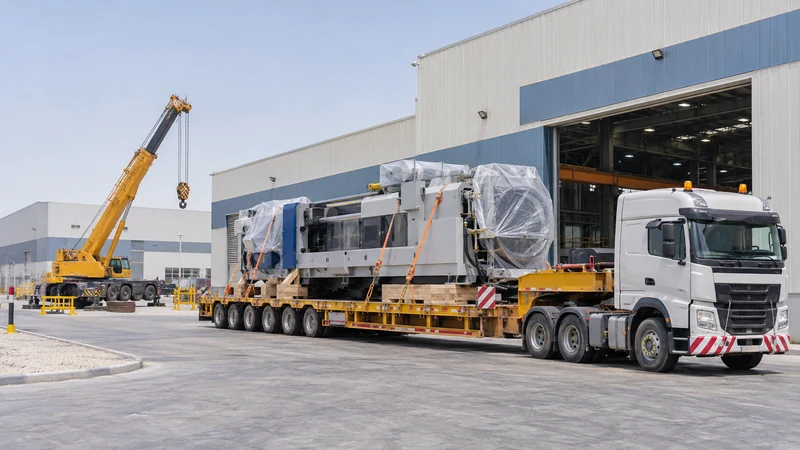
Plan Heavy Haulage, Road Permits, and Site Unloading
Oversized or heavy machinery may require transport arrangements beyond a standard container truck.
Depending on the vehicle and loaded cargo, the delivery assessment may need to consider:
- Overall loaded vehicle dimensions and mass.
- Axle loading and road restrictions.
- Bridge and overhead clearances.
- Turning radius and site approach roads.
- Abnormal-load permits and escorts.
- Industrial-zone entry permissions.
- Permitted movement times.
- Suitable ground conditions.
- Crane or forklift access.
- Unloading contractor availability.
Dubai’s Roads and Transport Authority provides a mobility permit process for overweight and over-dimension vehicles. Requirements in Abu Dhabi must be checked through the applicable authorities and operators.
The actual route determines which approvals are needed.
Illustrative scenario — not an actual Winsail shipment
An industrial press is imported through Khalifa Port for an Abu Dhabi factory.
Ocean transportation and port discharge are completed, but the delivery vehicle cannot enter the factory because the access gate is too narrow for its loaded dimensions.
The receiving site has also not arranged suitable lifting equipment.
The machine may consequently incur additional waiting, handling, or storage charges.
This illustrates why port acceptance, road feasibility, and final-site unloading must be confirmed separately.
For additional information about Abu Dhabi routing, see our shipping from China to Khalifa Port guide.
6. What Customs Documents and Product Compliance Checks Are Required?
Industrial machinery imported into the UAE must be supported by accurate commercial information and the customs documentation applicable to the intended import procedure.
Some equipment also requires product-specific regulatory approval.
These requirements should be checked before shipping, especially for expensive or specialized industrial machines.
Prepare the Commercial and Shipping Documents
Common documentation may include:
| Document | Purpose | Key check |
|---|---|---|
| Commercial invoice | Establishes commercial details and declared value | Consistent machine description, quantity, and value |
| Packing list | Identifies each shipping unit | Accurate dimensions, weight, marks, and piece count |
| Bill of lading | Records shipment and transport details | Correct consignee, shipment details, and release requirements |
| Certificate of origin | Supports origin information | Required form and applicable authentication |
| Technical specification | Supports classification and compliance assessment | Model, function, technical characteristics |
| Importer registration details | Identifies the responsible importing entity | Correct licence and customs registration |
| Product permits or certificates | Supports applicable regulated-goods requirements | Approval obtained where required |
The importer or appointed customs representative should verify the documentation needed by the relevant UAE customs authority.
A machine’s HS classification should reflect its actual function and technical characteristics, not a generic description such as “factory equipment.”
Incomplete or inconsistent descriptions can delay classification, compliance screening, and customs release.
Verify Whether the Machinery Requires Product Conformity Approval
Not every industrial machine is subject to the same UAE product conformity requirements.
Some products fall under technical regulations administered by the UAE Ministry of Industry and Advanced Technology (MoIAT), while others may be subject to different regulatory arrangements.
Before dispatch, the importer should:
- Identify the machine’s technical function and relevant HS classification.
- Determine whether the product falls within an applicable UAE technical regulation.
- Check whether MoIAT conformity certification or another approval is required.
- Obtain the manufacturer’s test reports and technical documents where necessary.
- Confirm the applicable approval process with the responsible authority.
The MoIAT conformity certification service specifically addresses products subject to technical regulations.
Its existence should not be interpreted as meaning that every commercial or industrial machine requires an ECAS certificate.
Electrical characteristics, intended use, equipment category, and the applicable regulation may affect the assessment.
Additional Considerations for Used or Refurbished Machinery
Used machinery may require closer documentation and condition checks.
The importer should establish:
- Manufacturing year and equipment identity.
- Current operating condition.
- Previous use and refurbishment history.
- Presence of oil, fuel, or other residual substances.
- Cleaning or decontamination requirements where relevant.
- Available safety and technical documentation.
- Product-specific import restrictions or approvals.
A used machine should not be assumed to be either automatically acceptable or universally prohibited.
The relevant requirements depend on the equipment and intended import arrangement.
Confirm the Importer, Taxes, and Delivery Responsibilities
The buyer and seller must identify the legal importer and the party responsible for customs clearance.
Applicable customs duties depend on the correct HS classification, import procedure, and any valid exemption.
UAE import VAT must also be considered according to the applicable tax rules and the importer’s VAT registration and accounting position.
Eligible industrial establishments may be able to apply through MoIAT for customs-duty exemptions on qualifying machinery or equipment. Such relief is subject to licensing, registration, approval, and other applicable conditions; it is not automatic.
Free-zone treatment requires separate verification. Delivery into a free zone does not establish a universal exemption from customs duties or VAT.
For machinery purchased under DDP terms, confirm that the seller can legally and practically fulfil the agreed import-clearance obligations.
Under Incoterms® 2020, DDP does not automatically require the seller to unload the machinery at the destination. DPU, by contrast, specifically includes seller unloading obligations.
The parties should state the exact delivery point and unloading responsibilities in the contract.
For a more detailed explanation, see our DDP shipping from China to UAE guide.
7. How Are Machinery Shipping Costs and Delivery Timelines Calculated?
Machinery freight costs depend on the complete transportation arrangement.
A standard-container shipment generally involves different handling and equipment requirements from an oversized machine transported on a Flat Rack or as Breakbulk cargo.
Comparing ocean freight prices alone can therefore be misleading.
Understand the Full Machinery Shipping Cost Structure
A machinery shipment may involve the following cost components:
- Factory preparation and export packaging.
- Origin lifting and loading.
- China inland transportation.
- Export customs and terminal handling.
- Container or specialized equipment charges.
- Ocean freight and applicable surcharges.
- OOG handling or specialist cargo surveys.
- Destination terminal and cargo-release charges.
- Customs clearance, applicable duties, and taxes.
- UAE inland transportation.
- Permits, escorts, or special delivery arrangements.
- Site unloading and lifting.
- Cargo insurance.
- Storage, demurrage, detention, or waiting costs where applicable.
Not every cost applies to every shipment, and the party responsible depends on the agreed commercial terms.
A complete quotation should identify what is included, excluded, or subject to confirmation.
Heavy Machinery Shipping Quote Checklist
| Cost or service item | What should be confirmed? | Quotation status |
|---|---|---|
| Factory loading | Who supplies the lifting equipment and personnel? | Included / Excluded / Conditional |
| Export packaging | Are crates, supports, and securing preparation covered? | Included / Excluded / Conditional |
| China inland transport | Is pickup from the exact factory address included? | Included / Excluded / Conditional |
| Origin handling | Are terminal and special cargo charges included? | Included / Excluded / Conditional |
| Ocean freight | Which cargo method, carrier, and routing are proposed? | Included / Excluded / Conditional |
| Destination handling | Are discharge and special handling charges covered? | Included / Excluded / Conditional |
| Customs and taxes | Who manages and pays the applicable obligations? | Included / Excluded / Conditional |
| UAE inland delivery | Is transport to the exact receiving site included? | Included / Excluded / Conditional |
| Permits and escorts | Are required approvals and movement arrangements covered? | Included / Excluded / Conditional |
| Site unloading | Is crane or forklift unloading included? | Included / Excluded / Conditional |
| Insurance | What coverage is included or separately offered? | Included / Excluded / Conditional |
| Waiting and storage | Who bears additional charges if delays occur? | Included / Excluded / Conditional |
Ask providers to identify unresolved technical approvals and the quotation’s validity period.
Compare Quotations on a Like-for-Like Basis
Two quotations are comparable only when they cover the same cargo and operational responsibilities.
For example, one proposal might cover sea freight and port delivery, while another includes China factory loading and UAE inland transportation.
The second proposal may cost more but cover substantially more work.
Before selecting a service provider, compare:
- Machine and packaging specifications.
- Pickup and delivery locations.
- Transport equipment and handling methods.
- Carrier acceptance status.
- Customs and terminal obligations.
- Site unloading responsibilities.
- Insurance arrangements.
- Schedule assumptions and exclusions.
Illustrative Cargo Weight Calculation
Suppose a machine shipment includes:
| Component | Weight |
|---|---|
| Machinery | 8,700 kg |
| Export crate and supporting structure | 950 kg |
| Separately packed accessories | 350 kg |
| Total packed cargo weight | 10,000 kg |
If this cargo is loaded into a shipping container, the applicable VGM calculation must account for the container tare and any additional packing or securing material not already included, following an approved verification method.
The packed cargo weight does not independently establish container suitability.
Total Machinery Delivery Cost
A useful cost framework is:
Total Delivery Cost = Origin Preparation + Origin Transport and Handling + International Freight + Destination Charges + Applicable Duties and Taxes + Inland Delivery and Unloading + Insurance and Other Agreed Costs
The result depends on the actual agreed scope. Tax treatment and any recoverable VAT should be handled according to the importing entity’s circumstances.
Build a Realistic Delivery Schedule for Industrial Projects
Industrial equipment buyers should plan backward from the required on-site date.
A realistic shipment plan includes more than the estimated ocean transit.
Key milestones are:
- Machine production completion and technical release.
- Export packing and loading-plan approval.
- Factory collection and origin customs procedures.
- Equipment availability and booking confirmation.
- Ocean departure and any transshipment.
- Arrival and cargo availability at the UAE discharge port.
- Customs and terminal release.
- Inland transport and site-access approval.
- Unloading and condition acceptance.
- Installation and commissioning by the responsible technical parties.
These milestones can depend on one another.
For example, a shipping booking may be available, but the manufacturer may not have completed the lifting drawings needed for special cargo approval.
Similarly, customs release does not guarantee that the delivery vehicle can enter the receiving site immediately.
Transit estimates should therefore be based on the actual vessel schedule, route, cargo type, and delivery arrangements rather than a fixed number of days applied to all machinery shipments.
8. How Do You Protect Machinery Against Damage and Delivery Risks?
Machinery can be exposed to several types of risk between the Chinese factory and the final UAE receiving site.
Understanding these risks helps buyers specify packaging, handling, inspection, and insurance requirements before dispatch.
Identify the Main Transport and Handling Risks
Potential damage scenarios include:
- Incorrect lifting or use of unsuitable lifting points.
- Crate or supporting-frame failure.
- Machinery movement due to insufficient securing.
- Water ingress and corrosion.
- Damage to exposed parts during special cargo handling.
- Vibration affecting sensitive components.
- Impact during factory loading or destination unloading.
- Delays that disrupt installation schedules.
Different machines require different precautions.
A precision machining centre may need particular protection against moisture, shock, and movement, while a large industrial vessel may require engineered lifting and support arrangements.
The manufacturer and qualified handling parties should determine the appropriate protection measures.
Review Marine Cargo Insurance and Coverage Limitations
Machinery buyers should consider cargo insurance and review the actual policy wording.
Important questions include:
- What is the insured value?
- Which Institute Cargo Clauses or equivalent terms apply?
- Are war and strikes risks covered where relevant?
- Does coverage extend to loading and unloading?
- Are there exclusions related to insufficient packing?
- Is the machine new, used, or refurbished?
- Are specialist surveys required?
- When does insurance coverage begin and end?
An “All Risks” description does not mean that every possible loss is insured.
Ordinary cargo insurance should not be assumed to cover installation damage, testing and commissioning losses, or financial losses caused by delivery delays.
Where these exposures matter, the buyer should seek appropriate specialist insurance advice.
Record Machine Condition Before Loading and After Delivery
Documenting the machinery’s condition can help distinguish pre-existing damage from transit-related damage.
Recommended records include:
- Machine identification and serial numbers.
- Photographs before packing.
- Export packaging and securing records.
- Loading inspection photographs.
- Relevant cargo survey reports.
- Arrival and unloading photographs.
- Notes identifying visible damage or shortages.
If damage is discovered, the receiver should document the condition, notify the relevant parties promptly, and follow the applicable insurance and carrier notice requirements.
Do not dispose of damaged packaging or alter evidence before understanding the survey or claims requirements.
9. Machine Shipping Technical Data Checklist
A machinery shipping assessment is more useful when technical and delivery information is provided together.
The following checklist can be shared with the Chinese manufacturer, procurement team, or freight coordinator before requesting transport arrangements.
Machine Specifications and Packing Details
| Required information | What to provide |
|---|---|
| Machinery identification | Type, manufacturer, model, serial number, and quantity |
| Bare dimensions | Machine length × width × height in mm |
| Packed dimensions | Final length × width × height of each shipping piece in mm |
| Weight | Net weight, packaging weight, and gross weight in kg |
| Centre of gravity | Manufacturer’s drawing or available technical information |
| Support footprint | Base dimensions and load-bearing contact points |
| Lifting arrangements | Approved lifting points, drawings, and restrictions |
| Packaging | Crate/skid specifications and protection measures |
| Disassembly | List of removable parts and manufacturer approval |
| Equipment condition | New, used, or refurbished |
| Safety information | Fuel, batteries, fluids, and relevant hazardous components |
Pickup, Shipping, and Handling Requirements
| Required information | What to provide |
|---|---|
| China factory | Full collection address and site contact |
| Cargo readiness | Confirmed or expected cargo-ready date |
| Origin loading | Available crane, forklift, or other handling facilities |
| Loading restrictions | Door clearance, floor access, lifting limitations |
| Shipping terms | Agreed Incoterms and responsibilities |
| Preferred transport | Standard container or special cargo option, if already assessed |
| Supporting documents | Technical datasheet, packing drawings, photographs |
UAE Destination and Delivery Readiness
| Required information | What to provide |
|---|---|
| Consignee | Importing company and relevant contact details |
| Intended discharge port | Jebel Ali, Khalifa Port, or another proposed gateway |
| Final destination | Exact address, industrial zone, and delivery point |
| Customs arrangement | Mainland/free-zone status and responsible importer |
| Site access | Gate dimensions, approach roads, and restrictions |
| Unloading facilities | Available equipment and responsible contractor |
| Delivery requirement | Required on-site date and receiving time window |
| Project coordination | Person responsible for site access and unloading approval |
| Cargo value | Commercial value and insurance requirements |
For oversized or complex machinery, additional drawings, lifting plans, engineering reviews, and approval documentation may be necessary.
Documents Needed for a Machinery Shipping Assessment
Where available, prepare these supporting files:
- Manufacturer’s technical specification sheet.
- General arrangement or dimensional drawing.
- Centre-of-gravity and lifting drawings.
- Final packing plan.
- Photographs of the machinery and its base.
- Commercial invoice or purchase specification.
- China factory loading information.
- UAE receiving-site photographs or access drawings.
Incomplete information does not necessarily prevent an initial discussion, but it may limit the reliability of a proposed transport method or price.
The most useful first submission includes final packed dimensions, gross weight, lifting information, China pickup location, and exact UAE delivery destination.
FAQ
Can I Ship Machinery in a 40HQ Container if It Is Taller Than the Door Opening?
Not necessarily. A 40HQ has greater internal height than a standard-height container, but the machine still needs a physically feasible and approved loading method. If the packed machine cannot pass safely through the door, its internal fit is not enough to make standard-container transportation suitable. The manufacturer may be able to approve a different packing configuration or partial disassembly. Otherwise, an Open Top, Flat Rack, or another appropriate arrangement should be assessed.
Can Used Industrial Machinery Be Shipped from China to the UAE?
Used machinery may be shipped when the equipment meets the applicable import, safety, and regulatory requirements. The importer should check the machine's condition, technical classification, relevant product restrictions, and supporting documentation before booking. Additional attention may be needed for residual fuel or oil, contaminated equipment, missing technical identification, or regulated components. There is no reliable basis for treating all used industrial machinery as automatically permitted or prohibited.
Who Is Responsible for Unloading Heavy Machinery at the UAE Factory?
Unloading responsibility depends on the agreed contract and delivery terms. Under Incoterms® 2020, DAP and DDP generally place destination unloading on the buyer, while DPU specifically requires the seller to unload at the named place. However, the parties should also confirm the actual service contract and whether unloading equipment, rigging, internal movement, or installation is included. For heavy machinery, identify the responsible unloading contractor and establish site readiness before dispatch.
Can an Excavator or Forklift Use RoRo Shipping if It Cannot Drive?
Possibly, but only if the RoRo operator accepts a suitable handling arrangement. Some non-operational equipment may be moved using approved towing, roll trailers, or other specialist arrangements where available. Acceptance depends on dimensions, weight, condition, ramp and deck restrictions, and securing requirements. A machine's inability to drive does not always rule out RoRo, but it makes advance technical and operational confirmation particularly important.
What Happens if My Machinery Arrives Before the UAE Site Is Ready?
The shipment may be delayed between port release and final delivery. Depending on the cargo arrangement, this could lead to storage, demurrage, detention, vehicle waiting, or additional handling charges. The outcome depends on the terminal, equipment, service contract, and available alternatives. For large industrial machines, confirm the receiving date, site access, unloading equipment, and responsible personnel before the shipment departs China. If site readiness changes, review the delivery and storage options as early as possible.
Request a Machinery Shipping & Delivery Assessment
Shipping machinery from China to the UAE requires coordination between the manufacturer, shipping providers, relevant authorities, and the receiving site.
The right freight method is the one that can accommodate the machine’s physical characteristics, meet the necessary operational requirements, and support a feasible delivery plan.
Winsail Logistics can help assess potential shipping arrangements for machinery exported from China, including standard container options, specialized cargo considerations, and the information needed for UAE delivery planning.
To request an assessment, prepare:
- Machinery type, model, and quantity.
- Final packed dimensions and gross weight.
- Technical drawings and photographs.
- Centre-of-gravity and lifting information, where available.
- China factory pickup address.
- UAE discharge preference and final delivery address.
- Cargo-ready date and required on-site date.
- Receiving-site access and unloading details.
- Agreed shipping terms and required service scope.
The information will support a preliminary assessment of possible freight methods and the technical or operational checks required before a shipment-specific proposal can be confirmed.
Request a Machinery Shipping & Delivery Assessment
Last Updated: November 14, 2026. Content Scope: Commercial machinery exported from China to the United Arab Emirates. Operational details and routing information are subject to verification at the time of booking.
Shipping and compliance notice: This guide is intended for preliminary planning of commercial machinery shipments from China to the UAE. Container suitability, vessel acceptance, routing, import approvals, customs treatment, insurance, road permits, and final-site delivery depend on shipment-specific circumstances. Lifting, load distribution, and cargo securing should be reviewed by qualified personnel where required. Final shipping arrangements remain subject to the relevant carrier, terminal, authority, and service-provider approvals.
