
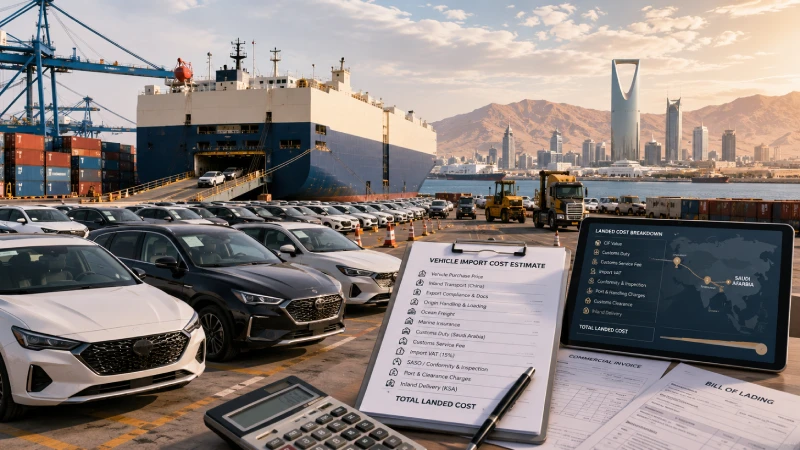
Buying a vehicle in China and paying ocean freight are only the beginning of the import budget. The real car import cost from China to Saudi Arabia can also include customs valuation adjustments, duty, 15% import VAT, the customs service fee, SASO compliance, destination handling, customs clearance, storage and inland delivery.
If you need the wider eligibility, documentation and transport process first, read Shipping Cars from China to Saudi Arabia.
This guide focuses specifically on calculating the customs-cleared landed cost rather than repeating the full import procedure. It provides a working framework for private buyers, dealers, fleet purchasers, Chinese vehicle exporters and EV importers.
Important: Saudi tariffs, customs valuation, conformity requirements and port charges may change. The Saudi importer should verify the VIN, HS code, customs value and applicable fees with ZATCA, SASO and a licensed local customs broker before purchase and shipment.
Quick Answer: How Much Does It Cost to Import a Car from China to Saudi Arabia?
For preliminary budgeting, a standard passenger car under an applicable HS 8703 classification may often be estimated using 5% customs duty, while Saudi import VAT is 15%.
However, VAT is not simply 15% of the vehicle purchase price. It is calculated on a broader taxable base that can include the accepted CIF value, customs duty, customs service fee and other taxable amounts in the customs declaration.
Saudi Arabia also applies a customs service fee of 0.15% of the incoming goods value including freight and insurance, subject to a minimum of SAR 15 and maximum of SAR 500 for ordinary taxable imports.
For a vehicle with an accepted CIF customs value of SAR 100,000, an illustrative 5% duty produces combined duty, VAT and customs service fee of approximately SAR 20,922.50.
That still excludes SASO-related costs, shipping-line charges, terminal handling, customs clearance, storage and domestic delivery. A vehicle that falls outside normal age or energy-efficiency requirements may also face an additional charge of at least SAR 20,000 where the special route is available.
What Does “Total Landed Cost” Include?
Before calculating anything, define where the calculation ends.
| Cost Level | What It Includes |
|---|---|
| CIF Port Cost | Vehicle, China-side costs, ocean freight and marine insurance |
| Customs-Cleared Cost | CIF plus duty, VAT, compliance, port and customs-clearance costs |
| Drive-Away Cost | Customs-cleared cost plus domestic delivery, inspection, registration, insurance and plates |
This article primarily uses customs-cleared landed cost.
A drive-away budget should add post-clearance expenses separately because registration, insurance and final delivery depend on the buyer, vehicle and destination city.
Total Landed Cost Formula
A practical formula is:
Total landed cost = vehicle purchase price + China inland/export costs + origin handling/loading + ocean freight + marine insurance + Saudi customs duty + customs service fee + import VAT + conformity/inspection + destination charges + customs clearance + storage/demurrage + inland delivery
Some costs are fixed or predictable. Others are shipment-dependent, compliance-dependent or delay-dependent.
Avoid double counting. A CIF purchase already includes agreed freight and insurance, while an FOB quotation already includes agreed origin-side responsibilities. An “ocean freight only” quotation should never be treated as a complete destination quotation.
Step 1 — Start with the Correct Vehicle Purchase Price
EXW, FCA, FOB, CFR and CIF prices cannot be compared as though they represent the same cost.
An EXW quotation may require you to add inland transport, export handling and port delivery. A FOB quotation includes more China-side responsibility, while CIF normally includes ocean freight and insurance to the named destination.
The purchase contract should identify:
- Vehicle price and Incoterm
- Export-document responsibility
- China delivery point
- Insurance scope
- Registration or export-service costs
- Required after-sales documents
A low purchase invoice also does not guarantee a low Saudi customs value. ZATCA may review whether the declared transaction value is acceptable.
Step 2 — Add China Inland and Export Costs
China-side costs can extend well beyond a customs declaration fee.
Depending on whether the vehicle is new, used or electric, the budget may include inland pickup, inspection, temporary storage, eligible export-enterprise services, export-licence coordination, transfer-for-export registration, customs documentation and port delivery.
For used vehicles, review How to Export Used Cars from China before finalizing the purchase.
From January 1, 2026, China’s vehicle-export controls require additional attention to electric passenger-car export licensing and recently registered used vehicles. Used vehicles registered for 180 days or less may require manufacturer-issued after-sales maintenance confirmation.
Container shipments may additionally require professional loading, lashing, trucking and VGM submission. EV shipments may also involve dangerous-goods documentation, battery information, vehicle-condition declarations and carrier approval.
Step 3 — Calculate RoRo or Container Freight and Insurance
Ocean freight should be compared on a total route cost, not only the carrier’s base freight.
| Cost Factor | RoRo | Container |
|---|---|---|
| Freight basis | Vehicle, dimensions or route | Container type |
| Loading | Generally simpler | Professional loading and lashing required |
| China trucking | Depends on port arrangement | Usually required |
| Destination | Vehicle-terminal charges | THC, unloading and empty return |
| EV costs | Carrier review or surcharge | DG documentation and container handling |
| Non-running cars | Often restricted | May be considered with special loading |
For more detail, see RoRo Car Shipping from China.
Marine insurance should be confirmed separately rather than assumed to be included. Check freight validity, fuel surcharges, peak-season adjustments, war-risk charges and transshipment costs before budgeting.
The cheapest ocean-freight quotation is not automatically the cheapest landed-cost option.
Step 4 — Determine the Saudi Customs Value
The supplier invoice and the accepted Saudi customs value are not necessarily identical.
A typical customs-value framework is:
Customs value = accepted transaction value + freight + insurance + applicable valuation additions
ZATCA may examine the invoice, transaction conditions, related-party issues and supporting documents. Foreign-currency values are converted according to the applicable exchange rate used for customs purposes.
For vehicles, ZATCA may also refer to the local agent’s new-vehicle price if the invoice value is not accepted. Its vehicle rules provide depreciation mechanisms, including maximum depreciation limits of 50% for passenger cars and 80% for trucks.
Therefore, buying a vehicle unusually cheaply does not automatically mean Saudi duty and VAT will be calculated from that same low figure.
Importers should review the official ZATCA Vehicle Import Controls before committing to a used vehicle.
Step 5 — Calculate Saudi Customs Duty
For preliminary planning, a normal passenger vehicle classified under an applicable HS 8703 tariff line may be estimated at:
Customs duty = accepted CIF customs value × applicable tariff rate
For an ordinary passenger car, 5% can be used as a working estimate, but it must not be treated as a universal Saudi vehicle customs-duty rate.
The actual rate depends on the complete HS code, vehicle category, powertrain, specifications and tariff in force on the declaration date.
BEVs should not automatically be treated as duty-free, and trucks, buses, pickups or special-purpose vehicles should not simply inherit the passenger-car rate. Routing a Chinese vehicle through another GCC port also does not automatically make it GCC-origin cargo.
Use the ZATCA Integrated Customs Tariff Inquiry to confirm the applicable classification and rate.
Step 6 — Add the 0.15% Customs Service Fee
Saudi Arabia’s customs service fee for ordinary taxable imports is calculated at:
Customs service fee = incoming goods value including freight and insurance × 0.15%
The ordinary minimum is SAR 15 and the maximum is SAR 500.
This is separate from customs duty, customs-broker charges, shipping-line documentation charges and terminal handling. It may also form part of the VAT taxable base.
Step 7 — Calculate 15% Import VAT Correctly
A common mistake is:
Vehicle invoice × 15%
A more appropriate working formula is:
VAT taxable base = CIF customs value + customs duty + customs service fee + other taxable customs-declaration amounts
Then:
Import VAT = VAT taxable base × 15%
This is why describing Saudi border taxation simply as “5% duty plus 15% VAT” can understate the amount actually paid.
The VAT calculation should be based on the amounts accepted in the customs declaration, not merely the Chinese seller’s vehicle price.
Worked Example: SAR 100,000 CIF Passenger Car
Assume Saudi Customs accepts a CIF value of SAR 100,000, the applicable duty is confirmed at 5%, and no age or energy-efficiency compensation applies.
| Item | Calculation | Amount |
|---|---|---|
| CIF customs value | — | SAR 100,000.00 |
| Customs duty | 100,000 × 5% | SAR 5,000.00 |
| Customs service fee | 100,000 × 0.15% | SAR 150.00 |
| VAT taxable base | 100,000 + 5,000 + 150 | SAR 105,150.00 |
| Import VAT | 105,150 × 15% | SAR 15,772.50 |
| Border duty, VAT and service fee | — | SAR 20,922.50 |
| Subtotal after border taxes | — | SAR 120,922.50 |
The SAR 120,922.50 figure is not yet the final landed cost. Compliance, shipping-line charges, terminal handling, customs brokerage, examination, storage and inland delivery remain to be added.
This example also depends on three conditions:
- ZATCA accepts SAR 100,000 as the customs value.
- The applicable tariff rate is confirmed at 5%.
- The vehicle does not require an additional age or energy-efficiency payment.
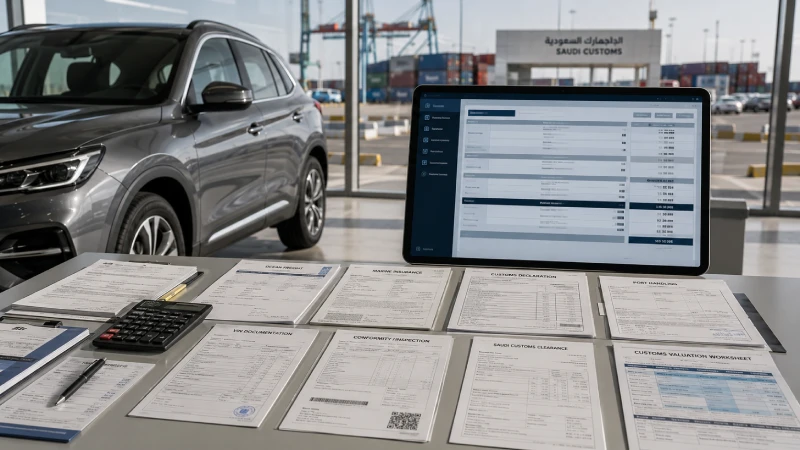
SASO, GSO, SABER and Vehicle Inspection Costs
Vehicle conformity costs should not be represented as one universal “SABER fee.”
SASO currently provides an imported-car registration request that can be used before arrival to check vehicle information such as VIN, technical specifications, age and energy-efficiency status.
Where an imported-vehicle inspection is required, SASO lists a fee of SAR 300 per vehicle.
Other vehicles—particularly new models, commercial batches and EVs—may involve type approval, technical studies, testing, model registration, electric-vehicle conformity certification or shipment-level certification.
These charges can be vehicle-level, application-level, batch-level or model-level costs. Importers should therefore obtain the correct conformity route before calculating a final budget.
Use the official SASO Imported Car Registration Request to begin the vehicle-specific review.
Additional Fee for Age or Energy-Efficiency Non-Compliance
Some used light vehicles that do not meet normal age or energy-efficiency requirements may qualify for an alternative route involving additional compensation.
The charge can range from 20% to 50% of the vehicle value, with a minimum of SAR 20,000.
This route is limited to Saudi citizens and Premium Residency holders and should not be treated as a general solution for ordinary residents or commercial dealers.
The exact amount depends on the vehicle, its current value, type and actual fuel-economy performance. The official ZATCA vehicle calculator should be used for vehicle-specific estimates.
Paying the compensation also does not make otherwise prohibited damaged, flooded or burned vehicles acceptable.
Saudi Port, Shipping-Line and Customs Clearance Charges
Destination charges can materially change the final cost even when the ocean-freight rate looks attractive.
Shipping-Line Charges
Possible items include:
- Delivery order
- Documentation
- Equipment handling
- Manifest amendment
Terminal and Port Charges
Possible items include:
- Terminal handling
- Vehicle handling
- Scanning
- Inspection movement
- Storage
Container-Specific Charges
Container imports may additionally face:
- Container unloading
- Empty-container return
- Demurrage
- Detention
Customs and Local Service Charges
These may include:
- Customs broker
- Transport authorization
- Inspection attendance
- Inland transport
- Applicable local VAT on services
For this reason, every freight quotation should clearly state what is included and excluded. A low ocean-freight figure can be misleading if substantial destination charges are payable separately.
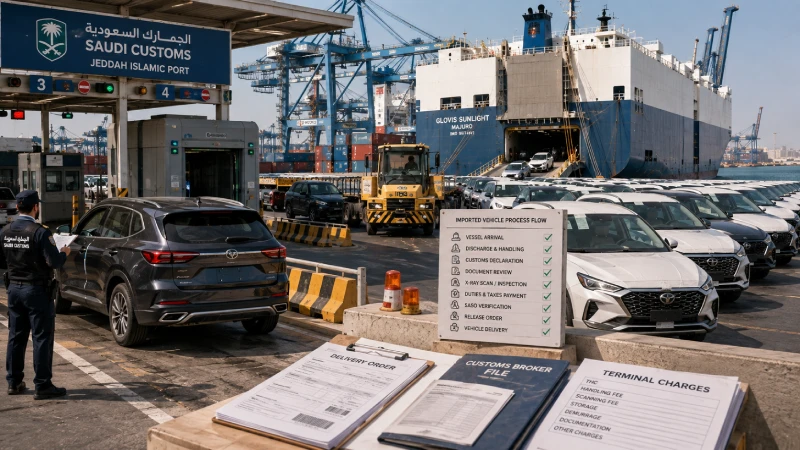
Dammam or Jeddah: Which Port Produces the Lower Landed Cost?
Port selection should be based on the final delivered cost, not only the international freight rate.
| Final Destination | Port Strategy to Evaluate |
|---|---|
| Dammam, Khobar, Eastern Province | Dammam or another suitable eastern gateway |
| Riyadh / Central Region | Compare sea freight plus inland transport |
| Jeddah, Makkah, Medina / Western Region | Jeddah or King Abdullah Port where suitable |
| Multi-city dealer network | Compare port, storage and distribution costs |
The cheapest ocean freight does not always produce the lowest delivered cost.
A slightly higher sea rate can still save money when the port is closer to the final consignee or offers a more efficient handling and inland-distribution arrangement.
New Car vs Used Car vs Electric Car Cost Differences
Different vehicle types create different landed-cost risks.
| Vehicle Type | Main Additional Cost Risks |
|---|---|
| New fuel vehicle | Model conformity, GSO/SASO and freight |
| Used fuel vehicle | Customs valuation, inspection, age and energy efficiency |
| Battery electric vehicle | China licensing, Saudi EV conformity and DG shipping |
| HEV/PHEV | Powertrain classification, fuel-system rules and carrier review |
| Non-compliant older vehicle | 20%–50% compensation, minimum SAR 20,000 where eligible |
| Commercial fleet | Model approval, batch certificates, yard and distribution |
Electric vehicles deserve particular attention. Under IMDG Amendment 42-24, applicable battery-powered vehicles are subject to updated dangerous-goods classifications and carrier procedures.
See Electric Vehicle Shipping from China for the transport side.
Personal Importer vs Commercial Dealer Cost
For a private buyer, import VAT will normally form part of the final economic cost.
For an eligible VAT-registered Saudi business, import VAT may potentially be recoverable as input tax where the vehicle is used for taxable business activity, the importer and VAT entity are correctly aligned, documentation is complete and no input-tax restriction applies.
Commercial buyers may therefore need two calculations:
- Cash landed cost: what must actually be paid during importation.
- Net cost after recoverable VAT: the accounting cost after any valid VAT recovery.
Recovery should never be assumed automatically or treated as an immediate discount.
Saudi Arabia’s used-car profit-margin VAT mechanism also does not reduce the VAT charged when a used vehicle is first imported from China.
Costs That Common Calculators Usually Miss
Simple Saudi car import tax calculators often omit the costs that create the largest budget surprises, including:
- Customs revaluation
- Missing SASO model data
- Certificate corrections or reissuance
- EV dangerous-goods surcharges
- Bill of lading amendments
- Incorrect VIN documentation
- Customs examination movement
- Container unloading
- Empty-container return delays
- Storage, demurrage or detention
- Non-running vehicle handling
- Battery-damage issues
- Inland transport insurance
- Service quotations stated before local VAT
- Port-to-Riyadh or other long-distance inland delivery
A realistic landed-cost calculation needs a contingency allowance for these conditional items.
How to Reduce the Total Landed Cost Legally
The strongest savings usually come from preventing compliance and delay costs rather than trying to reduce the declared value.
Before purchase:
- Verify the VIN, model year and vehicle history.
- Confirm the importer’s eligibility.
- Check the SASO compliance route.
- Confirm the complete HS code.
- Estimate a supportable customs value.
- Compare complete RoRo and container costs.
- Select the port according to the final delivery city.
- Prepare clearance documents before arrival.
- Keep invoice, VIN and shipping documents consistent.
- Obtain written EV carrier acceptance where required.
- Monitor free time and vehicle pickup deadlines.
- Include a contingency budget for conditional costs.
Do not understate the vehicle value, split genuine payments to reduce the declared value, use an incorrect HS code, hide accident or battery damage, or misrepresent a new vehicle as a lower-value used vehicle.
Landed-Cost Checklist Before Buying the Vehicle
Confirm at least the following before paying the supplier:
- Importer type
- Personal use or resale
- VIN
- Make and model
- New or used status
- Model year
- Manufacture date
- Mileage
- Vehicle history
- Fuel, BEV, HEV or PHEV powertrain
- Complete HS code
- Purchase price and Incoterm
- Estimated accepted customs value
- Applicable duty rate
- VAT treatment
- Energy-efficiency status
- Possible additional vehicle import fee
- GSO/SASO/SABER route
- China export requirements
- RoRo or container method
- Origin and destination charges
- Saudi port
- Final delivery city
- Inland transport
- Customs broker
- Storage contingency
- Whether supplier and local quotations include VAT
How Winsail Prepares a Car Landed-Cost Estimate
Winsail can collect the vehicle and VIN information, coordinate China pickup and eligible export parties, compare RoRo and container options, obtain origin and ocean-freight costs, organize the estimated CIF cost base and coordinate destination-charge information with Saudi partners.
The estimate can separate customs duty, VAT, destination costs and conditional compliance expenses so buyers can see where the budget comes from.
Winsail does not determine ZATCA’s final customs value, issue SASO/SABER approvals, guarantee a tariff rate, guarantee VAT recovery or guarantee Saudi vehicle registration.
FAQ
What is the customs duty on cars imported into Saudi Arabia?
A normal HS 8703 passenger car may use 5% as an initial budgeting rate, but the final rate must be confirmed from the complete HS code, vehicle type and tariff applicable on the customs declaration date.
Is Saudi import VAT calculated on the vehicle price only?
No. The 15% VAT base generally includes the accepted CIF customs value, customs duty, customs service fee and other taxable amounts included in the customs declaration.
How much are the duty and VAT on a SAR 100,000 CIF car?
Using a 5% duty rate, 0.15% customs service fee and no additional compensation, the illustrative combined duty, VAT and service fee is approximately SAR 20,922.50.
Are electric cars exempt from Saudi customs duty?
Do not assume so. The applicable BEV tariff must be confirmed using its complete HS classification. EVs may also generate additional Saudi conformity and dangerous-goods shipping costs.
Will Saudi Customs accept the purchase invoice from China?
Not automatically. ZATCA may verify the transaction value and supporting documents and may apply its vehicle-valuation rules if the submitted invoice is not accepted.
What is the additional fee for an older or inefficient used car?
For eligible Saudi citizens and Premium Residency holders, certain vehicles may incur compensation of 20%–50% of vehicle value, with a minimum of SAR 20,000. The exact amount should be checked with the official ZATCA calculator.
Does every imported car need the same SABER certificate?
No. The conformity route depends on the vehicle, database status, GSO registration, powertrain, importer and whether the import is a single vehicle or commercial shipment.
Is RoRo cheaper than container shipping?
Not necessarily. Compare freight, loading, terminal charges, storage exposure, EV surcharges, container-related costs and inland delivery rather than ocean freight alone.
Can a Saudi business recover import VAT?
An eligible VAT-registered business may be able to recover qualifying import VAT, subject to vehicle use, documentation and Saudi input-tax restrictions. The treatment should be confirmed with a Saudi tax professional.
What information is needed for an accurate landed-cost estimate?
Provide the VIN, make and model, model year, new or used condition, powertrain, purchase price, Incoterm, China pickup location, vehicle dimensions, Saudi port, final city, importer type and available conformity documents.
