
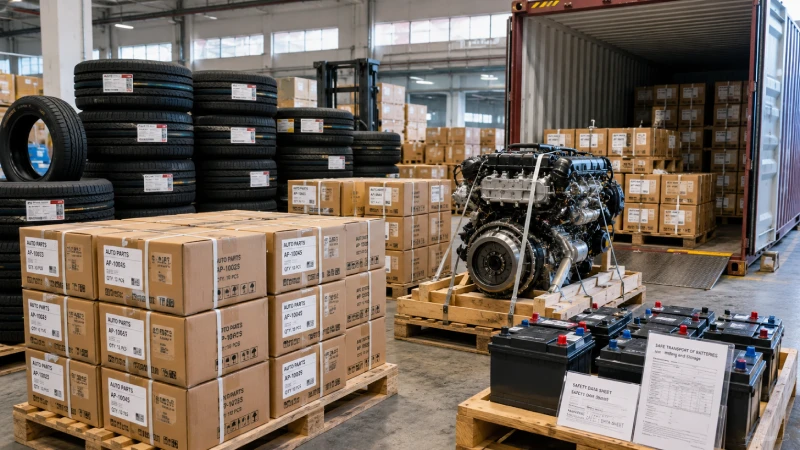
Shipping auto parts from China to Ghana can be simple when the cargo is limited to new, dry mechanical parts. It becomes a different logistics project when the same order includes tyres, vehicle batteries, airbags, aerosols or used engines with residual fluids.
For Ghanaian wholesalers, repair chains, tyre dealers, fleet operators and vehicle dealers, the safest approach is to classify each product before booking freight. Different items can trigger different dangerous-goods, packing, carrier and Ghana compliance requirements.
For the wider route, transport modes and destination process, see shipping from China to Ghana.
Auto Parts Shipping Matrix: Ordinary, Regulated or Dangerous Goods?
“Auto parts” is too broad for freight classification. Start by separating the shipment by product type.
| Product Type | Typical Shipping Review | Key Information Required | Main Risk |
|---|---|---|---|
| New dry mechanical parts | Usually general-cargo review | Product, material, SKU, weight | Packing and conformity |
| New tyres | Normally non-DG, but compliance still needs checking | Size, application, quantity, condition | Standards and loading |
| Lead-acid batteries | Pre-booking classification review | Chemistry, construction, electrolyte, condition | Leakage and short circuit |
| Lithium batteries | DG review | Chemistry, rating, configuration, condition, test evidence | Fire and thermal runaway |
| Airbags / pretensioners | Separate DG pre-review | Manufacturer, part number, classification evidence | Pyrotechnic components |
| Lubricants / chemicals | SDS-based review | Exact product and SDS | Flammability or environmental hazards |
| Aerosols | DG pre-review | Product specification and SDS | Pressurized contents |
| Used parts | Condition-specific review | Functionality, contamination, residual fluids | Waste and leakage risk |
The Ghana Standards Authority currently lists Motor Vehicle Batteries and Vehicle Spare Parts among its High Risk Goods categories. Product-level conformity checks are therefore important before assuming that every spare part can enter as unrestricted general cargo. See the GSA Import Inspection guidance.
Which Auto Parts Usually Ship as Ordinary Cargo?
Many new, clean and dry mechanical parts can normally move as general cargo when they contain no batteries, pyrotechnic devices, pressurized gas or hazardous liquids.
Common examples include brake discs, bearings, belts, gaskets, control arms, fasteners, dry filters, hoses, body panels, mirrors and dry radiators.
The product name alone is not enough. Gas struts, some shock absorbers, electronic assemblies and fluid-containing components may require additional review.
Vehicle Batteries Must Be Classified Before Freight Is Booked
“Car battery” is not a sufficient cargo description. Before arranging car battery shipping Ghana movements, identify the exact chemistry, construction, configuration and condition.
What Must Be Confirmed About Battery Chemistry?
For lead-acid batteries, confirm whether the unit is flooded or wet, another sealed or non-spillable construction such as AGM or VRLA where applicable, whether electrolyte is present, and whether the battery is new or used.
For lithium batteries, confirm:
- lithium-ion or lithium-metal chemistry where applicable
- rechargeable or non-rechargeable
- manufacturer and model
- technical rating
- new, used, damaged, defective or recalled condition
Also confirm whether the battery is shipped alone, packed with equipment or contained in equipment.
Why Lead-Acid and Lithium Batteries Follow Different Rules
Lead-acid battery review focuses on electrolyte, leakage characteristics, construction, terminal protection, short-circuit prevention and applicable packing provisions.
Lithium batteries have a different hazard profile. Their assessment can involve chemistry, energy rating, configuration, condition, packaging, test evidence and mode-specific restrictions. The UN Manual of Tests and Criteria contains the lithium cell and battery testing framework, including subsection 38.3. See the UN Manual of Tests and Criteria resources.
Air freight can also impose state-of-charge and operator-acceptance conditions for particular lithium battery configurations. Battery classification should therefore be completed before an air-freight booking is treated as final.
Battery Classification Workflow
1. Confirm chemistry
↓
2. Confirm construction and electrolyte status
↓
3. Confirm whether the battery is alone, packed with equipment or contained in equipment
↓
4. Confirm new, used, damaged or defective condition
↓
5. Collect technical specifications, SDS and test evidence where applicable
↓
6. Select sea or air transport
↓
7. Complete DG and carrier acceptance review
Do not assign a battery UN number from the phrase “car battery” alone.
Why Airbags and Seatbelt Pretensioners Need a Separate DG Check
Airbags are not simply interior spare parts. Airbag inflators, modules, seatbelt pretensioners and related safety devices may contain pyrotechnic or other dangerous components.
Before shipment, provide the manufacturer, part number, product description, manufacturer classification information, SDS or DG documentation where applicable, and supporting test information where required.
Never assign one universal DG class or UN number to every product described as an airbag.
Tyre Shipping from China to Ghana
Tyres are operationally simpler than batteries, but tyre shipping China Ghana orders still require both Ghana compliance and container planning.
Confirm the condition, application, size, manufacturer or brand, construction, required markings and quantity. Check the applicable Ghana standard and conformity route against the exact tyre product rather than relying on an old draft standard found online.
What About Used Tyres?
New and used or retreaded tyres should not automatically be treated as the same import category.
The official sources reviewed do not support a blanket statement that all used tyres are either prohibited or freely importable. Verify current GSA and GRA requirements for the exact goods before purchase, including condition, standards and markings.
How to Plan Tyre Container Loading Efficiently
There is no reliable universal answer to “How many tyres fit in a 40HQ?” Capacity changes with tyre diameter, width, profile, rim size, SKU mix, container type, packing method and unloading method.
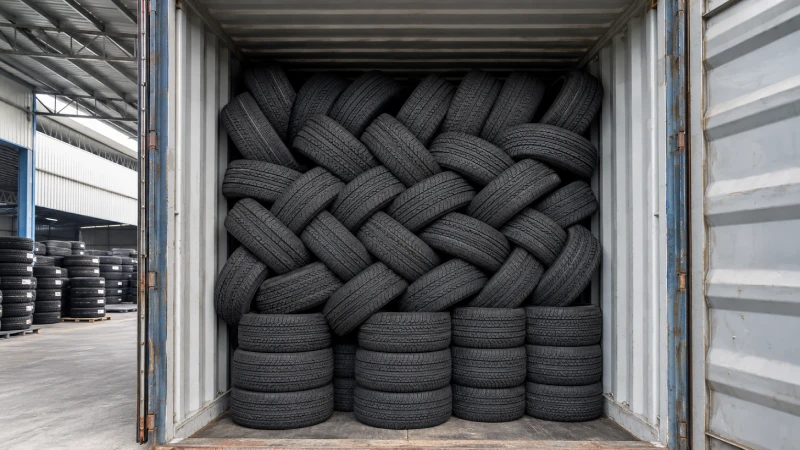
Can Tyres Be Laced or Interlaced?
Interlaced or fishbone loading can be suitable when properly executed. The priorities are:
- stable rows
- controlled deformation
- clear SKU identification
- safe unloading
- preventing movement during transport
Tyre-loading plans should be based on actual dimensions rather than generic container quantities.
What About Nesting Tyres?
Putting smaller tyres inside larger tyres should not be treated as universally acceptable simply to increase utilization. Check the tyre manufacturer’s packing guidance and the carrier or loading SOP for the specific product. The method should not damage the tyre or create an unstable cargo unit.
Ghana Compliance Pre-Check for Auto Parts
Because Vehicle Spare Parts and Motor Vehicle Batteries appear within GSA’s High Risk Goods categories, the applicable Ghana standard and required conformity evidence should be checked before loading.
A practical pre-check should confirm the exact product, new or used condition, applicable Ghana standard, High Risk Goods status, required conformity evidence, DG status, HS classification, brand/IP status and importer documentation.
Do not assume every automotive SKU follows the same conformity procedure. EasyPASS should not be treated as a blanket rule for every imported auto part.
Do Not Apply Used-Vehicle Rules to Loose Spare Parts
Ghana’s PVoC programme under GS 4510:2022 is specifically aimed at imported used vehicles and is scheduled for implementation from October 1, 2026. It should not automatically be applied to cartons of brake pads, bearings, tyres, batteries or engines.
For complete vehicles, see shipping cars from China to Ghana.
Loose spare parts still require their own product-specific standards, customs and DG assessment.
HS Codes and Customs Documents for Mixed Auto Parts
A mixed shipment should not be declared only as “auto parts — 500 cartons.” HS classification starts from the actual component, and different SKUs can fall under different tariff headings or regulatory requirements.
Core documents commonly include the Bill of Lading or Air Waybill, commercial invoice, detailed packing list, Import Declaration Form where applicable, importer identification, and any required agency permits or certificates.
Ghana Revenue Authority processes import declarations through ICUMS. See the GRA Import Procedures.
For destination preparation, see customs clearance in Ghana.
Used Parts, Engines and Gearboxes Need Extra Checks
Used mechanical parts should be reviewed for condition, contamination, residual liquids and intended reuse. Used electrical or electronic components can require additional waste-status screening.
Engines and Gearboxes with Residual Fluids
A used engine should not automatically be treated as ordinary dry cargo.
Before shipment:
- confirm whether fuel remains
- drain fuel where required
- remove uncontrolled free liquid
- cap and seal openings
- provide leak containment
- secure the unit on a strong skid or crate
- provide cleaning or drainage information when requested
- check whether another regulated component remains installed
A gearbox containing lubricant residue should also be reviewed according to the actual substance and condition.
Branded Auto Parts and Intellectual Property Risk
Separate genuine OEM parts, authorized branded aftermarket products, unbranded aftermarket parts and goods carrying copied trademarks or logos.
For branded goods, retain commercial invoices and authorization, distribution or trademark-license documentation where relevant. Counterfeit components can create customs and intellectual-property risk even if the rest of the shipment is legitimate.
Consolidating Multiple Guangzhou Auto Parts Suppliers
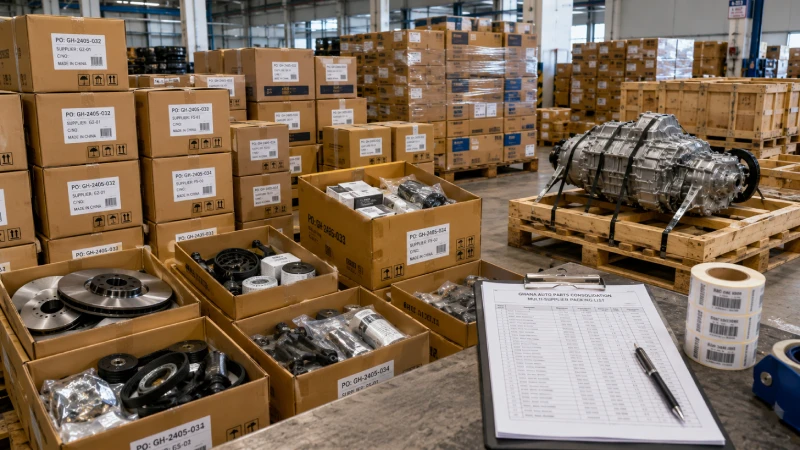
A Ghanaian wholesaler may buy brake pads in Guangzhou, lamps in Foshan, suspension parts from another factory and tyres from a separate supplier. The operational risk is often losing control of SKUs.
A controlled workflow should include:
- Obtain the PO and SKU list before cargo arrives.
- Give each supplier a warehouse delivery reference.
- Require buyer PO numbers and clear carton marks.
- Receive each supplier as a separate batch.
- Record carton count, weight, dimensions and receiving photos.
- Reconcile physical quantities against the SKU list.
- Separate shortages, excess pieces, damaged cartons and wrong SKUs.
- Keep DG or regulated cargo segregated pending approval.
- Repack or palletize where required.
- Produce the final packing list from warehouse-confirmed quantities.
For the wider workflow, see China to Ghana cargo consolidation.
SKU Consolidation Checklist
For each SKU, record:
- supplier and PO number
- buyer SKU and manufacturer part number
- exact description and brand
- ordered and received quantity
- pieces per carton and carton number
- gross and net weight
- dimensions
- country of origin
- regulatory or DG flag
- discrepancy status
A carton mark such as Buyer SKU + PO + Supplier + Carton Number makes warehouse reconciliation much easier.
How the Packing List Should Be Organized
Whenever practical, use one line per SKU or product variant.
| Field | Why It Matters |
|---|---|
| Supplier / PO | Traceability |
| SKU / Part Number | Warehouse reconciliation |
| Exact Product Name | Customs and compliance |
| Brand | Product and IP identification |
| New / Used | Regulatory screening |
| Quantity / UOM | Shortage control |
| Cartons / Carton IDs | Physical reconciliation |
| Net / Gross Weight | Freight and declaration |
| Dimensions / CBM | Load planning |
| HS Code Status | Customs preparation |
| Regulatory / DG Flag | Booking control |
For tyres, add tyre size. For batteries, add chemistry and shipping configuration.
Packing Requirements by Product
| Cargo | Recommended Packing Approach |
|---|---|
| Small dry parts | Export cartons, bags or dividers, SKU labels |
| Heavy metal parts | Reinforced cartons or pallets with corrosion protection |
| Lamps / fragile plastics | Foam and edge protection |
| Body panels | Shape protection and crates where needed |
| Engines / gearboxes | Strong skid or crate, tie-down points, leak containment |
| Batteries | Packing based on exact transport classification |
| Tyres | Stable, size-specific stow |
| Aerosols / chemicals | DG-compliant packing after classification |
A wooden crate protects cargo but does not change its DG classification.
LCL, FCL or Air Freight?
| Mode | Best Suited To | Key Consideration |
|---|---|---|
| LCL | Smaller compatible spare-parts orders | More handling; DG acceptance may be limited |
| FCL | Tyres, multiple suppliers, heavy crates, larger orders | Better physical cargo control |
| Air Freight | Urgent, compact, valuable parts | Stricter DG restrictions |
Choose by volume, weight, urgency, cargo value, fragility, SKU complexity and DG status rather than an arbitrary CBM threshold.
For sea freight, the IMDG Code 2024 Edition incorporating Amendment 42-24 became mandatory on January 1, 2026. Air shipments must follow current IATA rules and operator variations.
Dangerous Goods Should Be Cleared Before the Cargo Reaches Tema
Do not wait until the container reaches Tema to discover that a battery, airbag or chemical needed extra approval. Complete carrier acceptance before final booking; China-side DG packaging requirements and Ghana destination permits may also need separate checks.
Supplier Delivery Checklist
Before warehouse delivery, collect:
- supplier, PO and SKU details
- exact quantities and cargo condition
- carton count, weight, dimensions and marks
- cargo-ready date and product photos
- country of origin
- DG or regulated-product declaration
- SDS and battery test documents where applicable
- Ghana conformity evidence and brand authorization where relevant
Ghana Compliance Checklist Before Loading
- Exact products and SKUs confirmed
- New or used condition confirmed
- HS classification reviewed
- Applicable Ghana standards checked
- High Risk Goods status checked
- CoC, CoA or test evidence checked where applicable
- Battery chemistry and configuration confirmed
- Airbags and pretensioners reviewed separately
- SDS obtained where applicable
- Used-component condition checked
- Brand and IP status reviewed
- Carrier DG acceptance completed where required
- Destination permits prepared where required
- Warehouse quantities reconciled
Information Needed for an Auto Parts Shipping Quote
Prepare the pickup location, number of suppliers, cargo-ready date, destination, Incoterm, delivery scope and preferred transport mode.
For the cargo, provide exact product names, SKUs, condition, quantities, packing, dimensions, gross weight, CBM and brand status. Add tyre sizes for tyres; for batteries, provide chemistry, configuration, condition and supporting documents. For airbags, chemicals or engines, provide classification information, SDS, drainage status or photos where applicable.
Accurate data before consolidation reduces booking risk.
FAQ
Are all auto parts from China to Ghana ordinary cargo?
No. Many dry mechanical parts can move as general cargo, but batteries, airbags, aerosols, chemicals and some used parts need additional review.
Which car parts should receive a dangerous-goods pre-check?
Vehicle batteries, airbags, pretensioners, aerosols, automotive chemicals, pressurized components and equipment containing residual dangerous liquids should be screened before booking.
What battery information is needed before shipping to Ghana?
Confirm the exact chemistry, construction, manufacturer and model, technical rating, shipping configuration, condition, SDS and applicable test evidence. “Car battery” alone is not sufficient.
Are airbags dangerous goods?
Some airbags and related safety devices contain pyrotechnic or other dangerous components. Classification depends on the exact product and supporting manufacturer or test information.
Can tyres be laced inside a shipping container?
Interlaced or fishbone loading can be suitable when stability is maintained and damaging deformation is avoided. Plan from actual tyre dimensions and SKU mix.
Can smaller tyres be nested inside larger tyres?
Only after checking the requirements for the particular tyres and loading method. Nesting should not automatically be used simply to increase container capacity.
Does Ghana ban used tyres?
A blanket conclusion should not be assumed from the official sources reviewed. Current GSA and GRA requirements should be checked for the exact tyre type, condition and intended import before purchase.
Does Ghana’s October 2026 used-vehicle PVoC apply to loose spare parts?
Not automatically. The announced programme concerns imported used vehicles under GS 4510:2022. Loose tyres, batteries, engines and other spare parts require their own product-specific conformity and customs assessment.
