
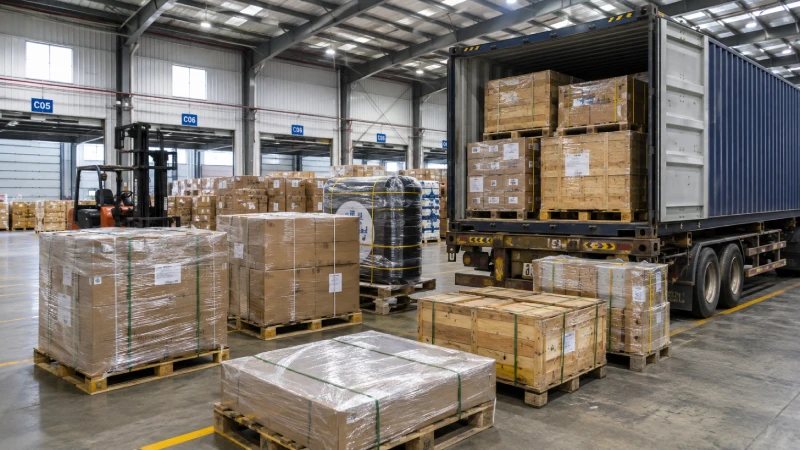
If you are comparing LCL shipping cost from China to the UK per CBM, the first number you see is rarely the number you will finally pay.
A freight forwarder may quote an ocean rate such as US$55 per CBM, US$90 per W/M, or US$150 per revenue ton, but that figure may cover only the international ocean-freight portion of the shipment. China pickup, origin CFS handling, documentation, UK destination handling, customs clearance and final delivery can all sit outside that headline rate.
That is why two freight quotations showing the same “$80/CBM” can produce very different final costs.
For UK importers, the more useful question is not simply:
“What is the LCL rate per CBM?”
It is:
“What is my chargeable W/M, what charges are fixed or variable, and what will the shipment cost under the exact service scope I need?”
This guide explains that pricing logic for commercial LCL shipments from China to Great Britain, including examples for 1, 3, 5, 8, 10 and 12–15 CBM.
For a broader comparison of sea freight, air freight, express, customs, transit times and delivery options, see Shipping from China to the UK.
Quick Answer: How Much Does LCL Shipping from China to the UK Cost per CBM?
There is no single reliable China-to-UK LCL rate that applies to every shipment.
Public China–UK LCL market references checked in September 2026 vary substantially. Ocean-only or base-freight figures can appear from roughly US$30 to US$150 per CBM or revenue ton, while some forwarders publish higher service prices that include different origin, destination or delivery components. These figures should not be compared directly until the service scope is clear.
As a practical planning reference, this article uses US$55–150 per chargeable W/M only to illustrate the possible base ocean-freight component.
It is not a Winsail quotation and does not include every China or UK charge.
| Cargo volume | Base ocean-freight illustration* | Initial planning direction |
|---|---|---|
| 1 CBM | $55–150 | Check minimum and fixed charges carefully |
| 3 CBM | $165–450 | Usually worth pricing as LCL |
| 5 CBM | $275–750 | Often a strong LCL volume |
| 8 CBM | $440–1,200 | LCL can remain practical |
| 10 CBM | $550–1,500 | Start comparing 20ft FCL |
| 12 CBM | $660–1,800 | Compare LCL and FCL carefully |
| 15 CBM | $825–2,250 | Always obtain both LCL and FCL quotes |
*Illustration based only on US$55–150 × chargeable CBM/RT. It excludes China pickup, local CFS charges, documentation, UK destination charges, customs clearance, delivery, Customs Duty, import VAT and shipment-specific surcharges.
Pro Tip: At approximately 10–15 CBM, obtain both LCL and FCL quotations. There is no universal CBM point at which FCL automatically becomes cheaper.
For broader route-level LCL and FCL benchmarks, see Shipping Cost from China to UK.
How Much Is LCL Shipping from China to the UK per CBM?
The problem with answering this question with one number is that different freight companies use the phrase “LCL rate per CBM” differently.
One quotation may mean:
- China CFS to UK CFS
- ocean freight only
- ocean freight plus selected origin charges
- port-to-port
- port-to-door
- consolidated door-to-door service
These are not equivalent products.
The wide spread in publicly advertised rates does not necessarily mean one company is expensive and another is cheap. They may simply be quoting different parts of the transportation chain.
Why Two $80/CBM Quotes Can Cost Different Amounts
Consider two hypothetical quotations.
Quote A
- Ocean freight: $80/W/M
- China CFS: separate
- documentation: separate
- UK deconsolidation: separate
- customs clearance: separate
- UK delivery: separate
Quote B
- Freight/CFS package: $110/W/M
- selected China handling included
- documentation included
- UK charges still separate
Looking only at $80 versus $110 would suggest that Quote A is cheaper.
That conclusion may be wrong.
The correct comparison is the total cost for the same shipment scope.
For example:
Supplier door in China → consignee warehouse in Birmingham
should be compared against another quotation covering:
Supplier door in China → consignee warehouse in Birmingham
not against a CFS-to-CFS quotation.
How LCL W/M Pricing Actually Works
LCL freight is commonly priced using W/M — Weight or Measure.
The China-to-UK LCL shipping guide explains the operational groupage process behind W/M charging, consolidation and destination handling.
DHL Global Forwarding explains that LCL pricing compares cargo weight in metric tonnes with cargo volume in cubic metres and charges according to whichever produces the larger quantity. Industry terminology also commonly describes a revenue ton on the same 1,000 kg versus 1 CBM basis.
In simplified form:
Chargeable W/M = greater of:
- cargo volume in CBM
- gross weight in metric tonnes
Example 1: Bulky but Relatively Light Cargo
Your shipment is:
- 8 CBM
- 2,500 kg
Convert weight to metric tonnes:
2,500 kg = 2.5 tonnes
Compare:
- volume: 8
- weight: 2.5
The chargeable quantity is therefore approximately:
8 W/M
If the ocean rate were US$100/W/M, the base freight calculation would be:
8 × $100 = $800
before other applicable charges.
Example 2: Dense Cargo
Your shipment is:
- 2 CBM
- 3,200 kg
Weight:
3.2 tonnes
Compare:
- volume: 2
- weight: 3.2
The chargeable quantity becomes:
3.2 W/M
Even though the cargo physically occupies only 2 CBM, freight may be calculated using 3.2 revenue tons.
This is particularly relevant for dense commodities such as:
- metal components
- machinery parts
- hardware
- stone products
- some industrial materials
Why CBM Alone Is Sometimes Misleading
If an importer asks:
“How much is 2 CBM from China to the UK?”
the forwarder still needs the cargo weight.
Two shipments occupying exactly 2 CBM could have different chargeable quantities.
That is why a proper LCL request should always include:
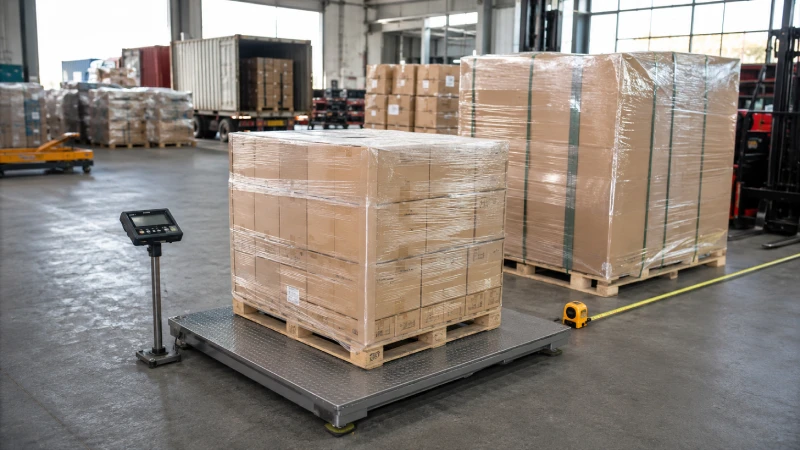
final dimensions + total CBM + gross weight
rather than CBM alone.
Minimum LCL Charges Can Change the Economics of Small Shipments
Very small shipments can be disproportionately expensive because many LCL tariffs use a minimum charge.
The exact rule varies by consolidator and trade lane.
One consolidator may apply a minimum around 1 W/M, while another tariff may use 2 W/M or another shipment minimum. The applicable rule should be confirmed on the specific China-to-UK quotation.
This matters especially for shipments such as:
- 0.4 CBM
- 0.7 CBM
- 1 CBM
- one small commercial pallet
Suppose your shipment measures only 0.6 CBM.
If the applicable tariff has a 1 W/M minimum, the ocean calculation may still start at 1 W/M rather than 0.6.
And even if the freight itself is inexpensive, the shipment can still require:
- documentation
- warehouse handling
- customs processing
- cargo release
- UK delivery
Those costs do not fall proportionally just because the shipment occupies less than one cubic metre.
This is why the effective cost per CBM is often highest on very small LCL shipments.
What Makes Up the Real China-to-UK LCL Cost?
A realistic LCL budget should be viewed as a chain of costs rather than a single freight rate.
DHL notes that LCL invoices typically contain local origin and destination charges in addition to the international freight rate, and cargo loading, unloading and handling can also form part of the cost structure.
A useful planning formula is:
Estimated logistics cost before duty and VAT =
China pickup
+ origin CFS charges
+ export and documentation charges
+ ocean freight based on W/M
+ UK destination CFS/deconsolidation
+ destination documentation/release
+ customs-clearance service
+ UK delivery
+ optional or special handling
1. Factory Pickup in China
If the supplier sells under EXW or another arrangement where collection is your responsibility, the cargo must first move from the factory to the nominated consolidation warehouse.
Pickup cost depends on factors such as:
- supplier location
- distance to the consolidation warehouse
- shipment volume and weight
- vehicle requirement
- loading conditions
- whether the factory has loading equipment
- number of collection addresses
A shipment collected from a factory near Shenzhen will have a different origin cost structure from cargo collected inland and trucked to a South China CFS.
The supplier’s Incoterm therefore matters.
A cheap ocean rate does not compensate for an expensive origin collection arrangement.
2. Origin CFS Handling
LCL cargo normally passes through a Container Freight Station (CFS) before export.
At the origin CFS, cargo may need to be:
- received
- measured
- weighed
- checked against booking information
- handled by forklift
- sorted
- staged
- consolidated with other shipments
- loaded into a shared container
These handling costs are one reason LCL pricing differs from FCL pricing.
With FCL, the entire container is allocated to one shipment. With LCL, multiple consignments are being assembled into one container and must later be separated again.
For more detail on the consolidation process, see Ocean Freight Consolidation (LCL) Services from China.
3. Export Documentation and Handling
Depending on the agreed service scope and Incoterm, additional China-side charges can include:
- export declaration coordination
- documentation
- House Bill of Lading preparation
- handling or administration fees
- warehouse documentation
- security or carrier-related surcharges where applicable
The exact charging structure varies.
There is no reliable universal “China documentation fee” that should be applied to every shipment.
4. Ocean Freight
This is normally the part advertised as:
US$X per W/M
or:
US$X per CBM
For most light or moderately dense cargo, CBM will often determine the freight quantity.
For dense cargo, weight may become the determining factor.
This is only one line in the complete LCL cost structure.
For a broader explanation of sea-freight services, see Ocean Freight from China.
5. UK Destination CFS and Deconsolidation
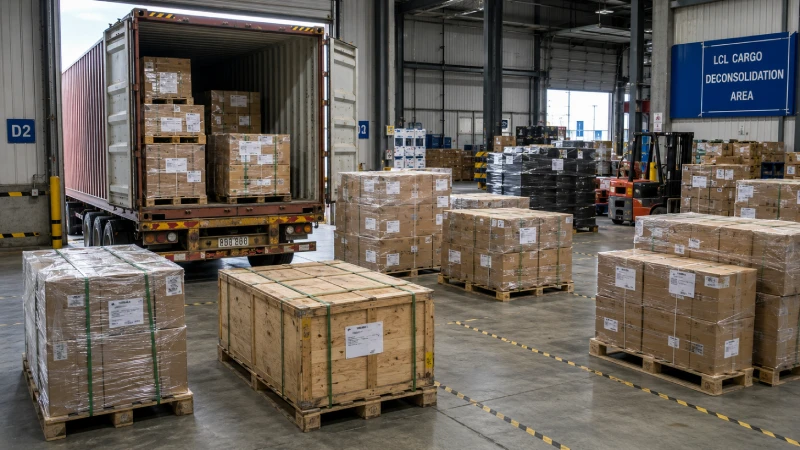
After the shared container arrives in the UK, the individual LCL shipment is not normally ready to drive directly from the vessel to the consignee.
The container first needs to enter the destination handling process.
This can involve:
- vessel discharge
- movement into the relevant destination handling facility
- container stripping or devanning
- separation of individual consignments
- warehouse handling
- cargo release processing
This distinction is important:
UK port arrival does not equal cargo ready for final delivery.
A destination CFS charge should not automatically be treated as identical to a generic “port charge.” Different operators may itemise destination costs differently.
6. Destination Documentation and Cargo Release
LCL shipments can also incur shipment-level destination charges for activities such as:
- release processing
- documentation
- handling administration
- delivery-order related processing where applicable
These may be fixed per shipment rather than purely per CBM.
For a 1 CBM shipment, a fixed £X documentation charge is effectively £X per CBM.
For a 10 CBM shipment, the same fixed charge is spread over ten cubic metres.
That is one reason larger LCL shipments can have a lower effective cost per CBM even when the headline ocean rate has not changed.
7. UK Customs Clearance
Customs clearance should be kept separate from Customs Duty and import VAT.
A freight forwarder or customs agent may charge for preparing or submitting the customs declaration.
That is a service charge.
Customs Duty and import VAT are government taxes, calculated according to the customs treatment of the goods.
They should not be mixed together in a freight comparison.
For commercial imports into England, Scotland or Wales, the importer will generally need a GB EORI number. GOV.UK also states that the correct commodity code is needed for the import declaration and helps determine the applicable duty, VAT and any relevant import measures.
8. UK Final Delivery
Once the cargo is released, it still needs to reach the importer, warehouse, distributor, 3PL or other nominated destination.
UK delivery pricing can depend on:
- destination postcode
- shipment CBM
- weight
- pallet count
- vehicle size
- commercial or residential access
- forklift availability
- tail-lift requirement
- timed delivery
- booking requirements
- restricted-access locations
For e-commerce or 3PL inventory deliveries, an appointment may also be required.
A Birmingham warehouse, central London destination, Manchester distribution centre and remote Scottish postcode should not be expected to carry the same final-mile cost.
That is why a meaningful China-to-UK LCL quotation should include the actual UK delivery postcode whenever door delivery is required.
Where an end-to-end scope is required, see Door-to-Door Shipping from China.
9. Palletisation and Other Conditional Costs
Depending on the cargo, other possible charges include:
- palletisation
- repacking
- re-palletisation
- compliant wood packaging
- cargo insurance
- non-stackable handling
- dangerous-goods handling
- inspection
- storage
- special delivery arrangements
These items should only be included where they actually apply.
LCL Cost Logic for 1, 3, 5, 8, 10 and 12–15 CBM
The most useful way to understand China-to-UK LCL pricing is to watch what happens as shipment volume grows.
The following examples use an illustrative base-ocean range of US$55–150 per chargeable W/M.
Again, these are not delivered quotations.
| Shipment | Illustrative ocean component | What matters most |
|---|---|---|
| 1 CBM | $55–150 | Fixed/minimum charges |
| 3 CBM | $165–450 | Fixed-cost dilution |
| 5 CBM | $275–750 | Strong LCL candidate |
| 8 CBM | $440–1,200 | Check destination W/M charges |
| 10 CBM | $550–1,500 | Begin FCL comparison |
| 12 CBM | $660–1,800 | Compare total LCL vs 20ft FCL |
| 15 CBM | $825–2,250 | FCL comparison becomes essential |
1 CBM: Why the Ocean Rate Can Be Misleading
Suppose you see an advertised ocean rate of $70/CBM.
It is tempting to think:
1 CBM × $70 = $70 total shipping
That is not how a complete LCL movement normally works.
The shipment may still require:
- pickup
- warehouse handling
- one document set
- export processing
- UK deconsolidation
- one customs declaration
- cargo release
- one final delivery
Most of those activities do not become 90% cheaper simply because the shipment is only 1 CBM.
For this reason, very small commercial LCL shipments can have a high effective cost per CBM.
For particularly small or light cargo, it can also be worth comparing the total LCL solution with air freight or express shipping rather than assuming sea freight must be cheapest.
3 CBM: Fixed Charges Begin to Spread Out
At around 3 CBM, LCL often starts to make stronger economic sense for normal commercial cargo.
An illustrative ocean calculation might be:
3 × $55–150 = $165–450
But the more important change is that shipment-level charges are now spread across 3 CBM instead of 1 CBM.
You should still ask whether the quotation includes:
- supplier pickup
- China CFS
- documentation
- UK destination handling
- clearance
- delivery
At this volume, comparing quote scope is often more useful than trying to save another $5 or $10 on the ocean rate.
5 CBM: A Strong LCL Evaluation Zone
For many general commercial shipments, 5 CBM is a natural LCL volume.
Illustrative base ocean freight:
5 × $55–150 = $275–750
Five cubic metres is still far below the usable volume of a 20ft container, so paying for an entire container may not make economic sense under many market conditions.
But a good importer should still compare:
- EXW versus FOB quotation scope
- supplier pickup cost
- destination handling
- delivery postcode
- cargo density
- pallet dimensions
The correct question is not simply:
“Who has the lowest 5 CBM ocean rate?”
It is:
“Who has the lowest credible total cost for the exact service scope I need?”
8 CBM: LCL Can Still Work, but Variable Destination Costs Matter More
Illustrative base ocean freight:
8 × $55–150 = $440–1,200
At 8 CBM, LCL can still be commercially attractive.
However, variable charges become more important because some local charges are calculated on W/M.
If a UK destination handling charge is also multiplied by 8 W/M, it can materially affect the total.
At this volume, check carefully for:
- destination CFS charges
- palletisation
- non-stackable cargo
- UK delivery
- multiple supplier collections
10 CBM: Start Requesting an FCL Alternative
Illustrative base ocean freight:
10 × $55–150 = $550–1,500
Ten cubic metres does not automatically mean that FCL will be cheaper.
But this is the point where a disciplined importer should usually start asking:
“What would the same shipment cost in a 20ft FCL container?”
Why?
Because LCL charges continue to rise with chargeable W/M.
At the same time, many FCL charges are container-based rather than multiplied by every additional cubic metre.
That means the two cost curves begin moving closer together as volume increases.
The current Shipping Cost from China to UK page provides broader LCL and FCL pricing context for this comparison.
12–15 CBM: Always Compare LCL and FCL
At 12 CBM:
12 × $55–150 = $660–1,800
At 15 CBM:
15 × $55–150 = $825–2,250
Those figures represent only the illustrative ocean portion.
LCL may also continue accumulating:
- W/M-based origin handling
- W/M-based destination handling
- consolidation costs
- deconsolidation costs
- individual cargo handling
FCL operates under a different charging structure.
This is why 12–15 CBM is better treated as a comparison zone, not an automatic switching point.
The sensible decision is to quote both modes using the same origin, destination, cargo data and service scope.
Pro Tip: At approximately 10–15 CBM, request both an LCL and a 20ft FCL quotation. Compare the complete transport cost, not just the ocean line.
For broader FCL route planning, return to Shipping from China to the UK and compare current container benchmarks in Shipping Cost from China to UK.
Why Small LCL Shipments Are Disproportionately Expensive
One of the biggest misconceptions in LCL shipping is that every cost scales directly with CBM.
It does not.
Think of the shipment cost as two groups.
Variable Costs
These can increase as cargo volume or weight increases:
- ocean freight
- CFS handling
- some terminal handling
- some warehouse charges
Shipment-Level or Minimum Costs
These may exist even when the cargo is very small:
- documentation
- customs declaration
- release processing
- delivery minimum
- administrative fees
A 1 CBM shipment still needs an import entry.
It does not require one-tenth of an import entry because it is one-tenth the size of a 10 CBM shipment.
Therefore:
Effective cost per CBM = total shipment cost ÷ actual CBM
can be much higher at 1 CBM than at 5 or 8 CBM.
This is also why an advertised $55/CBM ocean rate can coexist with a final logistics cost many times greater than $55 for a one-CBM shipment.
How Density, Palletisation and Stackability Affect LCL Cost
Dense Cargo Can Be Charged by Weight
Remember the W/M rule.
If you have:
- 4 CBM
- 1,800 kg
volume probably determines the chargeable quantity.
But if you have:
- 4 CBM
- 5,500 kg
weight may become more important.
This often surprises importers shipping dense industrial products.
Always provide both weight and dimensions before requesting a rate.
Palletisation Can Increase Your CBM
A supplier may initially provide carton measurements totalling:
4.2 CBM
After the cargo is palletised, the final shipping dimensions may become:
4.8 CBM
The forwarder may then rate the shipment using 4.8 CBM rather than the original carton total.
The same issue can occur when cartons overhang the pallet or when extra protection is added around the goods.
Pro Tip: Request freight pricing based on the final packed or palletised shipping dimensions, not only the product or factory-carton dimensions.
Non-Stackable Cargo Can Change Space Utilisation
LCL works because multiple shipments share container space.
If your freight cannot have other cargo safely stacked above it, it can reduce the consolidator’s usable container capacity.
This can lead to a different pricing treatment or surcharge.
Examples may include:
- fragile machinery
- irregular crates
- equipment with restricted top loading
- cargo requiring special protection
Do not assume that a 4 CBM non-stackable shipment will always be priced in exactly the same way as 4 CBM of standard stackable cartons.
Consolidating Goods from Several Chinese Suppliers
LCL is especially useful for UK importers buying from several factories in China.
When several factories are involved, use the multi-supplier cargo consolidation guide to plan receiving, checking and combining cargo before export.
Instead of shipping:
- 1.5 CBM from Supplier A
- 2 CBM from Supplier B
- 1 CBM from Supplier C
as three separate international shipments, the cargo may be collected into a China warehouse and prepared as one larger shipment, depending on timing and documentation requirements.
This can help reduce duplication and create a more manageable international movement.
However, supplier consolidation is not automatically free.
It can involve:
- multiple China pickup charges
- warehouse receiving
- storage
- sorting
- carton checking
- labelling
- palletisation
- consolidation handling
The cost-benefit therefore depends on the actual supplier locations and cargo volumes.
Information to Collect from Each Supplier
Before arranging consolidation, obtain:
- supplier name and pickup address
- cargo-ready date
- carton quantity
- final packed dimensions
- gross weight
- product description
- commercial invoice
- packing list
- battery, liquid or dangerous-goods information where relevant
If the suppliers finish production on very different dates, warehouse storage time should also be considered.
Winsail can coordinate supplier collection and consolidation in China depending on the agreed shipment scope and warehouse arrangement.
What Happens at the UK End of an LCL Shipment?
The UK destination process is one of the most overlooked parts of China-to-UK LCL pricing.
A full container belongs to one shipper.
An LCL container can contain cargo belonging to many different importers.
After arrival, those consignments must be separated before individual shipments can continue inland.
A simplified workflow is:
UK port arrival
→ container discharge
→ movement for LCL handling
→ deconsolidation/devanning
→ individual shipment identification
→ customs/release process
→ collection
→ UK road delivery
This additional handling is one reason LCL can take longer than FCL even when the two shipments travel on a similar ocean route.
It is also why a low China-to-UK ocean rate does not tell you the complete cost.
Destination CFS Is Not Final Delivery
Importers should distinguish between:
CFS-to-CFS
and:
door delivery
If your quotation ends at a UK CFS, you may still need to arrange:
- cargo release
- customs clearance
- collection
- domestic haulage
Always confirm the exact place where the freight forwarder’s responsibility ends.
Delivery Postcode Matters
For a door-delivery quotation, provide the complete UK postcode.
Road freight cost can change according to:
- distance from the handling warehouse
- regional coverage
- delivery vehicle
- shipment weight
- pallet count
- unloading conditions
For larger LCL shipments, delivery cost can be significant enough to change the result of an LCL-versus-FCL comparison.
Storage Can Become an Avoidable Cost
LCL cargo may incur storage if it cannot be cleared or collected within the applicable free period.
Common causes include:
- missing customs information
- incorrect commodity classification
- importer documentation delays
- duty or VAT payment problems
- delivery appointment delays
- customs or regulatory holds
Do not confuse LCL warehouse storage with FCL container demurrage or detention. They are different cost mechanisms, even though all can arise from delayed cargo movement.
How Much Extra Time Does LCL Consolidation Add?
Transit-time estimates are often presented as though the shipment begins when the vessel sails and ends when the vessel arrives.
For an LCL importer, that is incomplete.
The actual supply-chain timeline can include:
Before Sailing
- supplier pickup
- arrival at China CFS
- cargo receiving
- consolidation
- cut-off
- waiting for the planned sailing
After Vessel Arrival
- container discharge
- movement to destination CFS
- deconsolidation
- shipment availability
- customs clearance
- UK road delivery
Therefore, when comparing shipping options, ask for:
cargo-ready-to-delivery lead time
rather than only:
port-to-port transit time
For more detailed mode-by-mode timing, see How Long Does It Take to Ship from China to UK?.
When Should You Compare LCL with FCL?
There is no universal CBM number that guarantees one mode will be cheaper.
The result depends on:
- current LCL W/M rate
- current 20ft FCL rate
- China origin charges
- UK destination charges
- cargo density
- commodity
- season
- pickup arrangement
- destination postcode
- loading conditions
- service routing
Do Not Compare Cargo CBM with Container Capacity
This is an important distinction.
A 20ft container may physically accommodate substantially more than 15 CBM of many cargo types.
That does not mean you need to fill it completely before FCL can make economic sense.
The correct comparison is:
Total LCL cost for your shipment
versus:
Total 20ft FCL cost for the same shipment
not:
Your cargo volume
versus:
Maximum physical container capacity
FCL can occasionally become economically attractive before the container is physically full because LCL charges continue accumulating with W/M and additional cargo handling.
Conversely, LCL can remain cheaper at relatively high CBM when the LCL lane is competitive and FCL rates are high.
That is why the 10–15 CBM range should trigger a comparison, not an automatic mode change.
How to Compare China-to-UK LCL Quotes Correctly
A good freight quotation should allow you to understand what you are actually buying.
Before selecting a forwarder, compare all quotations on the same basis.
Step 1: Use the Same Service Scope
Choose one comparison basis, for example:
China supplier door → UK warehouse door
or:
China CFS → UK CFS
Do not compare an EXW door-to-door rate with a FOB port-to-port rate and conclude that one forwarder is more expensive.
Step 2: Check Every Cost Category
Ask whether the quotation includes:
| Cost item | Question to ask |
|---|---|
| China pickup | Included from supplier address? |
| Origin CFS | Included or charged per W/M? |
| Export handling | Included? |
| Export documentation | Included? |
| Ocean freight | Rate per W/M? |
| Minimum | 1 W/M, 2 W/M or another minimum? |
| B/L/documentation | Included or separate? |
| UK destination CFS | Included? |
| Deconsolidation | Included? |
| Cargo release | Included? |
| Customs clearance service | Included? |
| UK delivery | To the exact postcode? |
| Tail lift | Required and included? |
| Palletisation | Required and included? |
| Insurance | Included or optional? |
| Storage | What are the free-time and charging rules? |
| Customs Duty | Excluded or included under a defined arrangement? |
| Import VAT | Excluded or handled under an agreed import structure? |
Step 3: Confirm Chargeable W/M
Do not accept only:
“Your shipment is around 6 CBM.”
Ask for the actual rating information:
- measured CBM
- gross weight
- chargeable W/M
- minimum quantity
- final billed quantity
This is particularly important for dense cargo.
Step 4: Confirm the Cargo Assumptions
Tell the forwarder whether the goods are:
- general cargo
- stackable
- palletised
- non-stackable
- oversized
- battery-containing
- liquid
- potentially dangerous goods
Also confirm:
- delivery postcode
- forklift availability
- tail-lift requirement
- delivery booking requirement
A quotation based on incomplete cargo data can change once the freight reaches the warehouse.
Are Customs Duty and Import VAT Included in the Per-CBM Rate?
Usually, a standard ocean freight rate expressed as $/CBM or $/W/M should not be assumed to include UK Customs Duty or import VAT.
Those taxes are calculated separately according to the import.
Customs Duty Depends on the Commodity Code
There is no universal Customs Duty rate for goods imported from China into the UK.
The UK Trade Tariff is used to identify:
- commodity code
- Customs Duty
- VAT treatment
- possible tariff measures
- licences or restrictions where applicable
The correct commodity code is required on the customs declaration and helps determine the taxes, duties and regulatory measures that may apply.
Therefore, do not use a supplier’s Chinese HS code blindly without checking whether the UK classification and treatment are correct.
Freight Can Form Part of the Customs Value
UK customs valuation is not necessarily based only on the supplier’s product invoice.
HMRC guidance on customs valuation explains that transport, loading and handling costs up to the relevant place of introduction can form part of customs value under the applicable valuation rules.
The correct treatment depends on the Incoterm and how the transaction value has been constructed.
This is one reason importers should not casually calculate Customs Duty from the supplier invoice alone.
Import VAT Is Not Simply “20% of the Supplier Invoice”
Many normal commercial goods are subject to the UK’s standard VAT rate, but the correct VAT rate and calculation must be checked for the actual commodity.
HMRC’s import VAT guidance explains that the import VAT value starts with customs value and can also include applicable Customs Duty and qualifying incidental expenses such as transport, insurance and handling.
Costs to a further UK destination that are already known when the goods are imported may also need to be included in the import VAT value.
That is why a simplistic formula such as:
supplier invoice × 20%
is not a reliable general method for calculating UK import VAT.
Postponed VAT Accounting
If the UK importer is VAT registered and satisfies the relevant conditions, Postponed VAT Accounting (PVA) may allow the business to account for import VAT through its VAT Return instead of paying the import VAT upfront at import.
HMRC’s Postponed VAT Accounting guidance explains the applicable process and reporting requirements.
The importer should confirm the intended VAT treatment with its customs representative and accountant or tax adviser where necessary.
Winsail can coordinate freight and customs-clearance arrangements where applicable, but does not provide UK legal or tax advice.
Great Britain vs Northern Ireland
This article primarily addresses imports into Great Britain — England, Scotland and Wales.
GOV.UK states that businesses moving goods into or out of Great Britain generally need an EORI number beginning with GB.
Movements involving Northern Ireland can require different customs treatment and, depending on the circumstances, an XI EORI. The applicable tariff framework and declaration requirements may also differ.
If the final destination is in Northern Ireland, confirm the correct import and customs structure before booking rather than assuming the GB process applies unchanged.
For the latest requirements, check the official GOV.UK EORI guidance.
Before You Request an LCL Quote
To receive a useful China-to-UK LCL quotation, prepare the following information:
- China pickup city and full supplier address
- number of suppliers
- UK delivery postcode
- product description
- commodity code if known
- carton or pallet quantity
- final packed dimensions
- total CBM
- gross weight
- cargo value
- Incoterm
- cargo-ready date
- stackable or non-stackable status
- palletisation requirements
- battery, liquid or dangerous-goods information
- delivery booking or tail-lift requirements
Incomplete data produces unreliable freight comparisons.
A quotation prepared from:
“5 CBM general goods from China to UK”
will be much less accurate than one prepared from:
“5.2 CBM / 1,380 kg machinery accessories, 4 pallets, EXW Foshan, delivery to B24 postcode, stackable, cargo ready September 15.”
Before You Accept the Cheapest LCL Quote
Check these points first:
- Is the rate based on CBM or W/M?
- What is the minimum chargeable quantity?
- Is factory pickup included?
- Are origin CFS charges included?
- Are documentation charges included?
- What UK destination fees are excluded?
- Is customs clearance included?
- Does the quote include the exact UK delivery postcode?
- Does delivery require a tail lift?
- What happens if final dimensions increase after palletisation?
- Are the goods assumed to be stackable?
- Are Customs Duty and VAT excluded?
- How long is the rate valid?
- What happens if the planned sailing changes?
- When can storage charges begin?
A detailed £1,000 quotation may be cheaper than an incomplete £700 quotation that later adds several destination costs.
The boldest number on the quote is not necessarily the number you should compare.
The Most Important Rule: $X per CBM Is Not Your Final Delivered Cost
For China-to-UK LCL freight, keep three different numbers separate.
1. Base Ocean Rate
For example:
US$80/W/M
This may cover primarily the international freight leg.
2. Total Logistics Cost
This can include:
- China collection
- origin handling
- freight
- destination handling
- customs-clearance service
- delivery
3. Landed Import Cost
This goes beyond freight and may also involve:
- product purchase value
- Customs Duty
- import VAT
- applicable regulatory or inspection costs
- other import-related expenses
These three numbers answer different questions.
When comparing freight forwarders, compare the same number against the same number.
FAQ
How much does LCL shipping from China to the UK cost per CBM?
There is no fixed market rate. Public 2026 references vary widely according to route, timing and inclusions. For planning, the base ocean component may be shown as a per-CBM or per-W/M rate, but China pickup, CFS handling, UK destination charges, customs clearance and delivery can be separate.
Is LCL sea freight charged by weight or CBM?
LCL is commonly charged using W/M, or Weight or Measure. The shipmentu0026#x27;s cubic metres are compared with its weight in metric tonnes, and the larger quantity is generally used for the freight calculation.
What does W/M mean on an LCL freight quote?
W/M means Weight or Measure. In metric LCL pricing, the common comparison is 1 CBM versus 1 metric tonne, or 1,000 kg, with the larger quantity used as the chargeable revenue quantity.
What is the minimum charge for LCL shipping from China?
There is no universal minimum. Some consolidators may use around 1 W/M, while others may apply 2 W/M or another minimum. Confirm the minimum on the specific China-to-UK quotation.
Why can UK destination charges be higher than the ocean freight?
The ocean rate covers only part of the shipment. UK destination costs can include CFS handling, deconsolidation, documentation, cargo release, customs-clearance service and final road delivery.
When is FCL cheaper than LCL from China to the UK?
There is no fixed break-even point. Start comparing LCL with a 20ft FCL option at around 10 CBM and compare both carefully in the 12–15 CBM range using the same origin, destination and service scope.
Does the LCL rate per CBM include UK Customs Duty and import VAT?
A standard freight rate per CBM should not be assumed to include Customs Duty or import VAT unless a wider delivered service and import structure have been explicitly agreed. Duty depends on commodity classification, while import VAT follows UK valuation and VAT rules.
Request an Itemised China-to-UK LCL Cost
The most reliable way to compare LCL freight is to stop asking only:
“How much per CBM?”
Instead, compare the complete shipment structure:
China pickup → origin CFS → ocean freight → UK destination handling → customs → final delivery
For small and medium shipments, LCL can provide an efficient way to move commercial cargo without paying for a complete container.
For larger part loads, especially around 10–15 CBM, compare LCL against FCL and the current container-rate structure before selecting a mode. Use Shipping Cost from China to UK for broader cost planning and Shipping from China to the UK for the full route overview.
Winsail Logistics can coordinate China-side collection, consolidation, LCL ocean freight and destination delivery arrangements depending on the cargo, importer setup and agreed service scope.
For an itemised comparison, prepare:
- China pickup location
- UK postcode
- cargo description
- CBM
- gross weight
- number of suppliers
- Incoterm
- cargo-ready date
The result will be far more useful than any generic “US$X per CBM” number published online.
Continue with related UK shipping guides
Use these focused guides for the next part of your China-to-UK shipping plan.
