
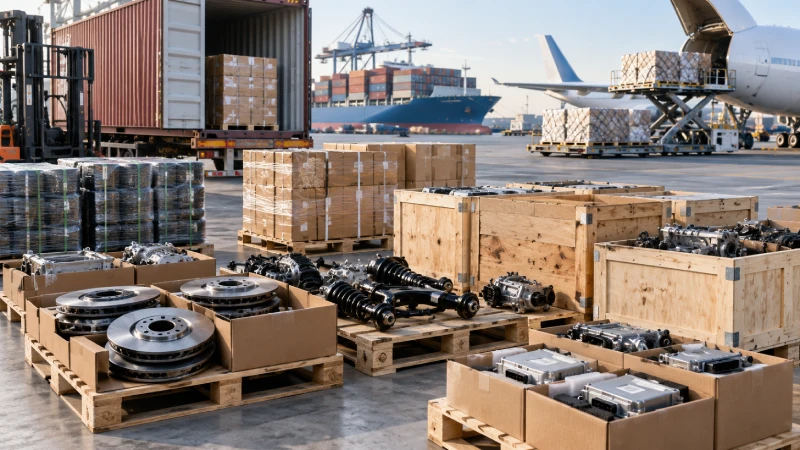
Shipping auto parts from China to the UK is not simply a matter of choosing between air freight and sea freight. A shipment of brake discs, ECUs, lithium battery modules, lubricants, tyres or airbag assemblies may involve very different transport, customs and product-compliance requirements.
For UK automotive distributors, repair networks, aftermarket businesses and commercial importers, the first question should therefore be what exactly is being shipped? Once the cargo is correctly identified, you can compare air freight, LCL and FCL, check whether dangerous-goods rules apply, prepare the customs information and confirm any UK market requirements.
For a broader overview of freight routes, ports, shipping methods, customs and delivery options, see Shipping from China to the UK.
Quick Answer: Air freight is generally most suitable for urgent, high-value or stockout-sensitive auto parts. LCL works well for smaller multi-SKU inventory shipments that do not require a full container, while FCL is often more practical for larger or repeat bulk orders. However, batteries, airbags, liquids and some electrical or safety-related components may require additional transport or regulatory review. Accurate product descriptions, commodity classification, importer details and cargo documents should be confirmed before booking.
Why “Auto Parts” Is Not Enough to Plan a Shipment
“Auto parts” is a purchasing category, but it is usually too broad for freight booking, customs classification or regulatory screening.
A carton described only as “car accessories” tells a freight forwarder very little about what is actually being transported. A dry steel bracket may move as straightforward general cargo, while a lithium-ion battery module or undeployed airbag assembly can require specialist handling and documentation.
The same problem applies at customs. HMRC’s UK Trade Tariff requires enough information about a product—such as its type, use, materials, production method and packaging—to identify the correct commodity code. The commodity code then affects the duty, VAT and any measures or documentary controls that may apply.
Before requesting a freight quote, provide the actual component description wherever possible.
Useful information may include:
- Exact part name and function
- Manufacturer part number or SKU
- Materials
- Whether the product is new, replacement or another type
- Vehicle application
- Whether it contains electrical components
- Whether it contains a battery
- Whether it contains oil, another liquid or gas
- Whether it contains a pyrotechnic device
- Quantity
- Gross weight
- Carton or pallet dimensions
Auto Parts Cargo-Risk Table
| Part type | Main logistics issue | Possible regulatory / DG consideration |
|---|---|---|
| Dry mechanical parts | Dense weight, rust, impact damage and uneven pallet loading | Often relatively straightforward freight, but assemblies containing fluids, gases or other regulated contents need separate screening |
| Electrical / electronic components | ESD, moisture, fragile connectors and higher cargo value | Automotive type approval, EMC or another product-specific rule may apply depending on the component |
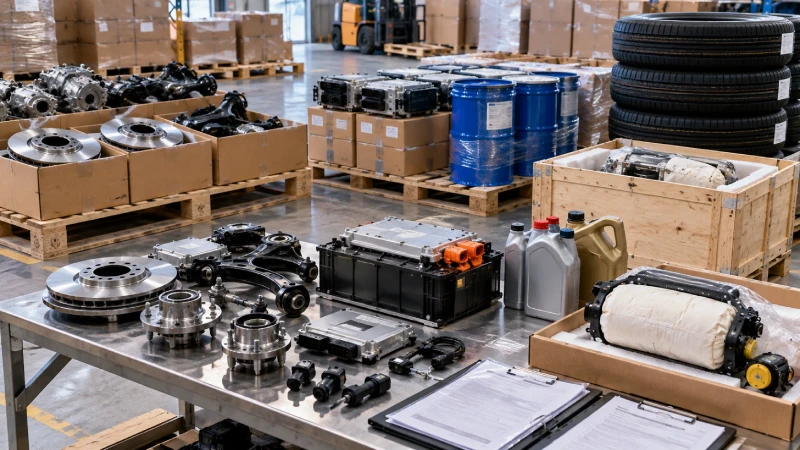
| Batteries / battery modules | Short circuit, heat generation, weight and terminal protection | Chemistry and configuration determine transport requirements; lithium batteries require specialist DG review |
| Lubricants / oils / liquids | Leakage, packaging compatibility and contamination | Transport classification depends on the actual substance; an SDS may be required |
| Airbags / seat-belt pretensioners | Accidental activation and specialist handling | Pyrotechnic content can create dangerous-goods and storage requirements |
| Tyres | High volume relative to weight and poor utilisation in mixed cargo | Usually a product and space-utilisation issue rather than automatically DG; labelling and automotive requirements may apply |
This distinction matters because customs acceptance, carrier acceptance and legal permission to place a product on the UK market are three separate questions.
A shipment can be physically transportable without necessarily satisfying UK product requirements, and a product that is legal to sell may still require dangerous-goods procedures during transport.
Air, LCL or FCL: Which Works Best for Auto Parts?
There is no single best freight method for automotive parts. The decision should reflect not only weight and volume, but also inventory urgency, SKU value, stockout risk, handling requirements and cargo classification.
For LCL or containerised orders, Winsail’s ocean freight service can compare ocean options against weight, volume and handling risk.
For urgent parts and airport routing, use the China-to-UK air freight guide to compare chargeable weight, timing and delivery scope.
Air Freight for Urgent Replacement Stock
Air freight is most useful when waiting several additional weeks for sea freight would create a larger commercial loss than the extra transport cost.
Typical situations include:
- Urgent workshop or repair-network shortages
- Production-line shortages
- Back-ordered customer parts
- Launch inventory
- High-value electronic components
- Compact, high-margin SKUs
- Emergency replenishment
For automotive distributors, this means the cheapest freight option is not always the cheapest business decision.
If a critical component is unavailable and vehicles cannot be repaired or customer orders cannot be fulfilled, the cost of lost sales, downtime and emergency purchasing may justify air freight.
However, urgency does not override dangerous-goods rules.
Lithium batteries carried by air must comply with applicable ICAO Technical Instructions, including requirements relating to testing, packaging, marking, labelling and documentation. The UK Civil Aviation Authority highlights UN Manual of Tests and Criteria Part III, subsection 38.3 as an important requirement for lithium batteries.
A battery module therefore cannot simply be moved as ordinary air cargo because the importer needs it urgently.
Pro Tip: Before rejecting air freight as “too expensive,” compare the freight premium with the cost of being out of stock.
LCL for Smaller Inventory Replenishment
Less than Container Load shipping is often a good fit for automotive businesses importing several pallets or mixed SKUs without enough volume for a full container.
It can work particularly well for:
- Periodic aftermarket replenishment
- Multiple cartons or pallets
- Mixed spare-part ranges
- Consolidated supplier orders
- Smaller distributor purchases
Do not evaluate LCL only by the ocean-freight rate per cubic metre.
The total shipment can also include:
- Pickup in China
- Export handling
- Consolidation charges
- Origin CFS charges
- Ocean freight
- Destination deconsolidation
- UK handling
- Customs clearance
- Delivery
Dense automotive products can also behave differently from lightweight consumer goods. Brake discs, wheel hubs, bearings and metal suspension parts can create substantial weight even when the CBM is relatively modest.
There is therefore no universal rule such as “LCL is always cheaper below 15 CBM.” Shipment weight, destination costs, handling requirements, DG classification and current carrier pricing all affect the crossover point.
Pro Tip: Compare the complete LCL landed logistics cost against an FCL option, not an LCL ocean-freight line item against an FCL all-in quote.
FCL for Bulk and Repeat Orders
Full Container Load shipping becomes more relevant for larger automotive orders, repeat inventory flows and shipments where reducing consolidation handling is commercially useful.
Possible examples include:
- Large aftermarket replenishment orders
- Repeat distributor inventory
- Palletised mechanical components
- Bulk brake, suspension or drivetrain parts
- Multiple product lines loaded from one or several suppliers
Container planning should consider both space and payload.
A container filled with relatively light bumpers or body panels may reach its usable volume first. Dense metal components may instead approach operational weight limits before the container looks physically full.
Final delivery should also be considered during planning. Heavy cargo can affect unloading requirements, vehicle selection and warehouse handling at the UK destination.
Air vs LCL vs FCL for Auto Parts
| Shipping situation | Air freight | LCL | FCL |
|---|---|---|---|
| Critical replacement stock | Strong fit | Usually too slow | Usually too slow |
| Small multi-SKU replenishment | Possible | Strong fit | Usually excessive |
| High-value compact components | Strong fit | Possible | Depends on volume |
| Heavy bulk mechanical parts | Often expensive | Good at smaller volume | Strong at scale |
| Repeat distributor replenishment | Useful for urgent SKUs | Good | Strong |
| DG component | Subject to airline/DG acceptance | Subject to consolidator acceptance | Subject to DG requirements |
Consider a Hybrid Replenishment Strategy
An automotive importer does not necessarily need to move an entire purchase order by the same mode.
If five SKUs are creating an immediate stockout but the rest of the order is routine inventory, the urgent cartons may move by air while the balance moves by LCL or FCL.
This approach can be more economical than either:
- Sending everything by air
- Waiting for the entire shipment by sea
It is especially relevant to distributors managing hundreds or thousands of different automotive SKUs with different sales velocities.
What Your Chinese Supplier Must Provide Before Booking
Many avoidable shipping delays begin with incomplete cargo information.
Before requesting space from a carrier or consolidator, the supplier should provide enough commercial and technical information to determine how the cargo should be handled.
Use Precise Cargo Descriptions
Avoid descriptions that are too general for customs or transport screening.
| Avoid | Better operational description |
|---|---|
| Auto parts | New cast-iron passenger-car brake disc, aftermarket replacement, part no. XXX |
| Electronics | Automotive electronic control module, 12V, no standalone battery, part no. XXX |
| Battery | Lithium-ion vehicle battery module with chemistry, voltage, Wh rating and configuration supplied separately |
| Oil | Synthetic transmission lubricant, package size and SDS reference provided |
| Airbag | New automotive airbag module containing pyrotechnic inflator; supplier transport classification attached |
These descriptions are examples of the level of detail, not pre-approved customs descriptions.
The correct commodity code, dangerous-goods classification and regulatory status still need to be determined for the actual product.
Shipping Data Required
For a normal freight quotation, prepare:
- China pickup address or supplier city
- Number of cartons, crates or pallets
- Dimensions of each package
- Gross weight
- Total CBM
- Stackability
- Cargo value
- Incoterm with the supplier
- Required delivery date
- UK delivery postcode
- Whether wooden pallets or crates are used
For mixed-SKU shipments, a packing list that identifies which SKUs are packed in each carton or pallet can make receiving and destination handling easier.
Additional Technical Data for Higher-Risk Parts
Where relevant, obtain:
- Safety Data Sheet
- Battery chemistry
- Battery voltage and Watt-hour rating
- Battery configuration
- UN 38.3 test information
- Applicable UN transport classification
- Pyrotechnic classification
- Liquid composition and transport information
- Manufacturer packaging instructions
Pro Tip: Request technical cargo documents before the goods arrive at the freight warehouse. Discovering that a product needs specialist handling after delivery to the terminal can create additional delays and costs.
UK Customs: Commodity Codes, Duty, VAT and EORI
Automotive importers should avoid assuming that every component follows the same customs treatment.
For shipment-level customs and cargo-insurance coordination, see Winsail’s customs and cargo-insurance support.
The UK customs clearance guide explains declaration preparation, representation and cargo-release steps in more detail.
There Is No Single “Auto Parts HS Code”
Many motor-vehicle parts fall within tariff heading 8708, but that does not mean every item used in a vehicle should automatically be declared there.
Depending on the product, relevant tariff areas can include, for example:
- Chapter 40 for certain rubber products and tyres
- Heading 8507 for electric accumulators
- Heading 8511 for certain ignition or starting equipment
- Heading 8512 for certain lighting or signalling equipment
- Heading 8708 for many parts and accessories of motor vehicles
These are classification families only—not ready-to-use customs declarations.
HMRC’s guidance on importing goods into the UK explains that the commodity code used for an import can determine matters including Customs Duty, import VAT, licences and other tariff measures.
Pro Tip: Do not automatically copy the HS code used by the Chinese supplier for export into the UK import declaration. Check the appropriate UK Trade Tariff classification.
Customs Duty Depends on the Exact Part
It is not accurate to say that “UK car parts duty is X%.”
The result can depend on:
- Commodity code
- Origin
- Customs value
- Tariff measures
- Suspensions or reductions
- Any trade-remedy measure that applies
The UK Trade Tariff should therefore be checked against the actual component before calculating landed cost.
Import VAT
The standard UK VAT rate is currently 20% for most goods and services, although the VAT treatment should still be checked for the actual product rather than assumed universally. See the current UK VAT rates.
Import VAT is also not calculated simply by taking 20% of the Chinese factory invoice.
HMRC’s import VAT valuation guidance explains that the VAT value can include the customs value plus Customs Duty and other applicable charges, together with relevant incidental expenses.
For commercial importers, this makes VAT treatment an important part of landed-cost and cash-flow planning.
Postponed VAT Accounting
Eligible UK VAT-registered businesses may be able to use postponed VAT accounting (PVA) to account for import VAT on their VAT Return instead of paying it immediately when the goods are imported.
HMRC states that businesses registered for VAT in the UK may be able to account for import VAT in this way, subject to the applicable conditions and declaration process. See HMRC’s postponed VAT accounting guidance.
Whether PVA is appropriate should be confirmed with the importer’s customs and tax advisers.
GB EORI vs Northern Ireland
Businesses importing into England, Scotland or Wales generally need an EORI number beginning with GB. For movements involving Northern Ireland, an XI EORI may also be required.
See the current GOV.UK guidance on making an import declaration and EORI requirements.
Do not treat GB and Northern Ireland as identical destinations when preparing customs or compliance instructions.
Which Auto Parts Need Dangerous Goods Screening?
One of the most common mistakes in automotive freight is assuming that anything described as a “vehicle part” can travel as ordinary cargo.
Most dry mechanical components are relatively straightforward, but some automotive products require closer screening.
Batteries and Battery-Containing Components
Battery shipments should first be separated by chemistry and configuration.
Possible categories include:
- Lithium-ion batteries
- Lithium battery modules
- Batteries packed with equipment
- Batteries contained in equipment
- Lead-acid batteries
- Other battery chemistries
These do not all follow identical transport rules.
For lithium batteries transported by air, the UK Civil Aviation Authority requires compliance with the applicable ICAO dangerous-goods requirements. The CAA highlights UN 38.3 testing, correct packing, marking, labelling and documentation as important parts of the process.
Carrier acceptance can also vary by:
- Battery chemistry
- Watt-hour rating
- State of charge
- Whether batteries are standalone or contained in equipment
- Packaging
- Route
- Airline policy
A dedicated battery-shipping guide should be consulted when batteries or battery-containing components are included in the shipment.
Airbags and Seat-Belt Pretensioners
Undeployed airbags and seat-belt pretensioners deserve separate treatment because they can contain pyrotechnic material.
The UK Health and Safety Executive advises businesses to obtain the UN hazard classification of airbags and pretensioners from the supplier. HSE guidance shows that these devices can be classified differently for transport depending on the product and its packaging, including Classes 1, 2 or 9 in different circumstances.
See the HSE guidance on storing and handling airbags and seat-belt pretensioners safely.
This means it would be incorrect to state either:
- All airbags are ordinary cargo
- All airbags are Class 1 explosives
The actual device, supplier classification and transport packaging should be reviewed before booking.
Lubricants, Oils and Other Liquids
A liquid automotive product should not automatically be declared dangerous goods simply because it contains oil.
Equally, an automotive lubricant should not automatically be assumed to be non-hazardous.
Its transport treatment depends on the actual formulation and applicable classification.
Where relevant, obtain:
- Product name
- Composition
- SDS
- Transport section of the SDS
- Packaging size
- Flash-point or other technical information if required for classification
The freight forwarder and carrier can then determine whether specialist acceptance is required.
Mechanical Assemblies Containing Fluids or Other Regulated Contents
Even a product that looks like a mechanical spare part can require additional review if it is:
- Pre-filled with oil
- Contaminated with residual fuel
- Pressurised
- Fitted with a battery
- Supplied with another regulated substance
This is particularly important when importing assemblies rather than individual dry components.
Which UK Product Compliance Rules Can Apply to Auto Parts?
Transport compliance and UK market compliance are separate checks.
A freight carrier agreeing to transport a component does not prove that the product is legally compliant for sale or installation in the UK.
Automotive Type Approval May Apply to Specific Components
The UK’s Vehicle Certification Agency administers vehicle type approval, including requirements that can apply to vehicles, systems, components and separate technical units.
VCA’s current GB Type Approval technical guidance recognises separately approved automotive components and aftermarket components. The exact approval route depends on the component and its circumstances; not every replacement part follows one identical process.
VCA guidance also distinguishes components approved separately from those covered through vehicle or system approval.
Therefore, do not make statements such as:
“All replacement auto parts need GB Type Approval.”
Instead, determine whether the particular component is subject to an applicable automotive regulatory act or UNECE requirement.
Do Not Assume Every Auto Part Requires UKCA
The UK product-marking system is more nuanced than many import guides suggest.
Department for Business and Trade guidance states that UKCA and CE requirements vary by product sector. CE requirements continue to be recognised in many Great Britain product sectors, while some sectors operate under regulatory systems outside the general UKCA/CE regimes.
See the current GOV.UK guidance on product regulations by sector and UKCA/CE approaches.
The correct question is therefore:
Which regulations apply to this particular component?
—not:
“Does every car part need UKCA?”
Electrical and Electronic Auto Parts
Automotive electronics can include:
- ECUs
- Sensors
- Lighting components
- Cameras
- Control modules
- Infotainment equipment
- Chargers
- Telematics devices
Depending on the exact product and how it is supplied or used, different automotive, electromagnetic compatibility, electrical or environmental rules may need to be reviewed.
RoHS is a good example of why blanket claims should be avoided.
Current UK RoHS guidance covers many categories of electrical and electronic equipment but specifically lists means of transport, apart from certain two-wheeled electric vehicles, among the exclusions. Separate component circumstances can also matter.
So an importer should not automatically assume that every electronic vehicle component is either:
- Inside RoHS
- Outside RoHS
The actual product and supply scenario should be reviewed.
A dedicated electronics-shipping guide should be consulted when a shipment contains ECUs, sensors, chargers, telematics products or other sensitive automotive electronics.
WEEE and Producer Responsibilities
If a product qualifies as electrical and electronic equipment within the UK WEEE rules, the business placing it on the UK market can have producer responsibilities.
Environment Agency guidance states that commercial importers can be considered EEE producers where they import qualifying EEE into the UK. The precise obligation depends on whether the product is within scope and on the supply-chain structure.
See the current GOV.UK guidance on electrical and electronic equipment producer responsibility.
Again, automotive use alone does not prove that WEEE applies.
Batteries Placed on the UK Market
Dangerous-goods transport rules and battery producer-responsibility rules are different issues.
A battery may be correctly shipped but still create environmental obligations for the business placing it on the UK market.
Current UK guidance requires qualifying battery producers to register and report according to the applicable battery category and volumes. Batteries incorporated into electrical products can also create separate battery reporting obligations.
See the GOV.UK guidance on waste batteries producer responsibility.
The importer should therefore review both:
- How the battery can be transported
- What obligations arise when it is placed on the UK market
Tyres
Tyres are another example where freight risk and product requirements are different.
From a logistics perspective, tyres are usually primarily a volume and container-utilisation issue.
From a UK market perspective, vehicle tyre labelling rules can apply. Current DVSA guidance requires applicable tyres sold on the UK market to carry information covering factors such as fuel efficiency, wet grip and external noise, with different requirements depending on whether tyres are supplied in Great Britain or Northern Ireland.
See the current GOV.UK guidance on vehicle tyre labelling rules.
GB and Northern Ireland Are Not the Same Market
Great Britain means England, Scotland and Wales.
Northern Ireland operates under different arrangements for many manufactured products under the Windsor Framework. Relevant EU product rules can continue to apply there, and CE or CE plus UKNI marking can be relevant depending on the product and conformity-assessment route.
See the GOV.UK guidance on placing CE or CE and UKNI marked products on the Northern Ireland market.
A component imported for a distributor in Birmingham should therefore not automatically receive identical product-compliance advice to one intended for the Northern Ireland market.
Regulatory information checked: September 2026. Product-specific requirements should be verified before purchasing or placing goods on the UK market.
How to Pack and Load Auto Parts for China–UK Freight
Automotive shipments often combine heavy, irregular and high-value products. Packaging should reflect the actual failure risk rather than simply meeting the minimum requirement for export.
Dense Mechanical Components
Products such as:
- Brake rotors
- Bearings
- Wheel hubs
- Suspension parts
- Cast components
- Transmission parts
can create concentrated pallet loads.
Consider:
- Reinforced export cartons or crates
- Sufficient pallet strength
- Strapping
- Blocking against movement
- Corrosion protection
- Centre-of-gravity control
- Forklift access
- Even weight distribution
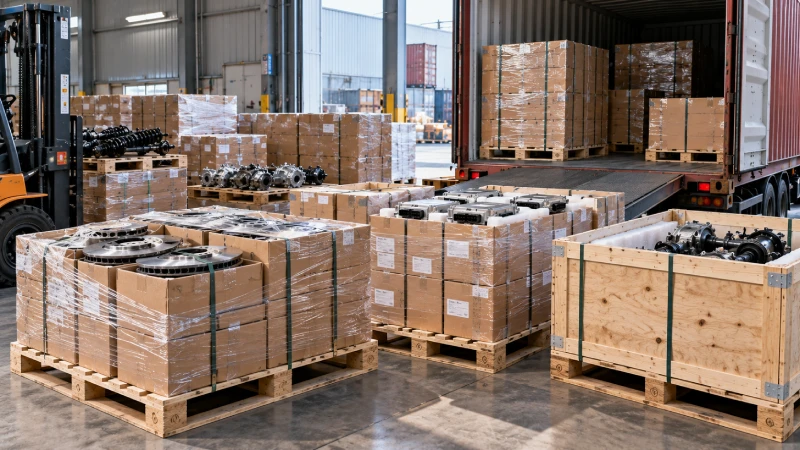
A pallet should not appear stable only because it is wrapped in plastic. Heavy parts must be physically secured against shifting during handling and sea movement.
Electronics and ECUs
Automotive electronics may need:
- Antistatic packaging
- Moisture barriers
- Connector protection
- Shock absorption
- Anti-crush outer cartons
- Carton-level part-number labels
For higher-value SKUs, the outer packaging should not rely only on retail packaging designed for shelf display.
Large or Irregular Parts
Bumpers, body panels, exhaust systems and similar components can generate substantial chargeable volume even when the actual weight is low.
This is particularly important for air freight, where pricing can be based on chargeable weight rather than scale weight alone.
For LCL, irregular packaging can also reduce stackability and increase the practical space used in consolidation.
Mixed-SKU Shipments
For distributor and 3PL shipments, consider:
- SKU labels on every carton
- Pallet-level packing lists
- Purchase-order references
- Carton numbering
- Consistent supplier labels
- Separation of DG cargo where required
Better shipment identification at origin can reduce receiving errors at the UK warehouse.
Wooden Pallets and Crates
If solid wood packaging material is used, confirm compliance with ISPM 15 before export.
UK government guidance states that wood packaging material used with imported goods must meet the ISPM 15 international standard. See the current GOV.UK guidance on wood packaging requirements for imports.
Calculate the Real Landed Logistics Cost—not Just the Freight Rate
A low freight headline does not necessarily mean a low landed cost.
Automotive businesses should compare the complete logistics chain from the supplier in China to the receiving warehouse in the UK.
Air Freight Cost Drivers
Air freight pricing can depend on:
- Chargeable weight
- Cargo dimensions
- Departure airport
- Routing
- Service level
- Carrier capacity
- Fuel and security surcharges
- Dangerous-goods handling
- Destination terminal charges
- Customs
- Final delivery postcode
Compact high-value parts can work well by air, while large lightweight automotive panels may become expensive because of volumetric weight.
LCL Cost Drivers
For LCL, include:
- Supplier pickup
- CFS handling in China
- Export charges
- Freight basis
- UK deconsolidation
- Destination handling
- Customs
- Warehouse charges if applicable
- Final delivery
A low ocean rate per CBM can be misleading if destination and deconsolidation costs are not included.
FCL Cost Drivers
FCL costs can include:
- Container type
- Loading location
- Trucking to port
- Shipping line
- Sailing
- UK port charges
- Customs
- UK container haulage
- Unloading arrangement
- Potential demurrage or detention exposure
For dense auto parts, container and road-delivery weight also need to be planned carefully.
Compare Total Logistics Cost
| Cost component | Air | LCL | FCL |
|---|---|---|---|
| China pickup / origin | ✓ | ✓ | ✓ |
| Main freight | Chargeable-weight basis | Volume/weight basis | Container basis |
| DG handling | If applicable | If accepted/applicable | If applicable |
| UK destination charges | ✓ | Often significant | ✓ |
| Customs Duty | Commodity-specific | Commodity-specific | Commodity-specific |
| Import VAT | Based on importer/tax treatment | Based on importer/tax treatment | Based on importer/tax treatment |
| UK final delivery | ✓ | ✓ | ✓ |
Current freight prices can change quickly with carrier capacity, season, fuel costs, routing and equipment availability.
For planning purposes, request a shipment-specific quote using the latest:
- Cargo dimensions
- Weight
- Pickup address
- UK postcode
- Shipping date
- DG status
Avoid making procurement decisions using an old online “average rate” without confirming what charges it includes.
Can Auto Parts Be Shipped DDP from China to the UK?
DDP can be workable for some China–UK automotive shipments, but it should not be treated as simply another transport mode.
The real question is whether the importer, customs, VAT and delivery structure supports a compliant DDP arrangement.
Before confirming DDP, review:
- Exact product
- GB or Northern Ireland destination
- Importer structure
- EORI
- Customs representation
- Commodity code
- Customs Duty
- VAT treatment
- PVA arrangement if relevant
- Product compliance
- DG requirements
- Final delivery scope
HMRC distinguishes direct and indirect customs representation.
Under direct representation, the representative acts in the importer’s name. Under indirect representation, the representative acts in their own name on behalf of the importer and can share liability for customs debt.
HMRC also states that where a business is not established in the UK and imports into Great Britain, a customs representative can only act indirectly on its behalf. See HMRC’s customs representation guidance.
That makes importer structure an important part of DDP feasibility.
Winsail can review door-to-door or DDP feasibility for a specific shipment subject to the importer structure, commodity, VAT treatment, customs arrangement, cargo characteristics and final delivery scope.
DDP should not be interpreted to mean that Winsail automatically:
- Acts as UK importer of record
- Assumes the importer’s tax obligations
- Guarantees customs clearance
- Certifies UK product compliance
Pro Tip: Confirm who will be importer, how customs representation will work and how import VAT will be accounted for before accepting a DDP structure—not after the shipment has left China.
Auto Parts Shipping Checklist Before You Book
Use this checklist before sending a shipment request.
Cargo Information
- Exact product description
- Manufacturer part number / SKU
- Product function
- Materials
- New / replacement / other status
- Quantity
- Carton or pallet count
- Gross weight
- Package dimensions
- Total CBM
- Cargo value
Cargo-Risk Screening
- Does the product contain a battery?
- Is a standalone battery included?
- Does it contain oil or another liquid?
- Does it contain gas or pressurised material?
- Is it an airbag or seat-belt pretensioner?
- Does it contain another pyrotechnic item?
- Is an SDS available where relevant?
- Is battery transport documentation available where relevant?
- Has the supplier provided the transport classification where required?
UK Import Setup
- Is the destination Great Britain or Northern Ireland?
- Who is the UK importer?
- Is the correct EORI available?
- Has the commodity code been reviewed?
- Has Customs Duty been checked?
- Is VAT treatment understood?
- Will PVA be used if eligible?
- Does the tariff indicate a licence or additional measure?
- Is the customs representation arrangement confirmed?
Product Compliance
- Does automotive type approval apply?
- Does another product-specific regulation apply?
- Is the product intended for GB or NI?
- Are required approvals, certificates or technical documents available?
- Have producer-responsibility obligations been reviewed where relevant?
Freight Planning
- Required delivery date
- Air, LCL or FCL candidate
- China pickup address
- UK delivery postcode
- Supplier Incoterm
- Warehouse or 3PL booking requirement
- Loading / unloading restrictions
- Stackability confirmed
- ISPM 15 wood packaging confirmed where applicable
Plan Your Auto Parts Shipment from China to the UK
The right freight solution starts with the cargo information.
For urgent replacement stock, air freight may be the practical option. For smaller multi-SKU replenishment, LCL can provide a flexible sea-freight solution. For larger repeat orders, FCL may offer better control and lower unit transport cost.
But freight mode should only be selected after the part type has been reviewed.
A dry brake component, ECU, battery module, lubricant, tyre and airbag assembly should not automatically receive the same shipping instructions.
To review a shipment, prepare:
- Exact part descriptions
- Carton or pallet count
- Dimensions
- Gross weight
- Pickup location in China
- UK delivery postcode
- Required delivery date
- Technical or DG documents where relevant
Winsail Logistics can coordinate China–UK freight options and identify additional shipment information that may be required before booking, depending on the agreed service scope and cargo review.
For broader route planning, transit considerations, shipping methods and UK destination options, return to Shipping from China to the UK.
FAQs
What is the best way to ship auto parts from China to the UK?
It depends on urgency, volume, weight, value and cargo type. Air freight is generally best for urgent or high-value replacement stock. LCL is often suitable for smaller palletised or mixed-SKU inventory shipments, while FCL is usually more appropriate for larger or repeat bulk orders. If batteries, airbags, regulated liquids or other dangerous goods are included, carrier acceptance should be confirmed first.
How long does it take to ship car parts from China to the UK?
Air freight normally provides a much shorter replenishment cycle than sea freight, while LCL and FCL should generally be planned on a weeks rather than days basis. Actual timing depends on origin, routing, carrier, service level, customs, destination handling and the final UK postcode, so current schedules should be confirmed before booking.
Do I need an EORI number to import car parts from China to the UK?
Commercial businesses importing goods into England, Scotland or Wales generally need an EORI beginning with GB. Shipments involving Northern Ireland may require an EORI beginning with XI, depending on the movement and customs arrangement.
How much Customs Duty do I pay on auto parts imported into the UK?
There is no single Customs Duty rate for all automotive components. The applicable duty depends on the UK commodity classification and other tariff measures, so the UK Trade Tariff should be checked using the exact product description before calculating landed cost.
Can lithium car batteries be shipped by air from China to the UK?
Some lithium battery shipments can move by air, but acceptance depends on battery type, configuration, documentation, packaging and airline requirements. Lithium batteries are regulated dangerous goods for air transport, so the actual battery must be reviewed before an air-freight service is confirmed.
Do car parts imported into the UK need UKCA or CE marking?
Not all automotive parts have one identical UKCA or CE requirement. The correct treatment depends on the specific product and the regulations that apply to it. Automotive type approval may apply to certain components, while other product rules may apply to other goods. Northern Ireland also follows different arrangements from Great Britain.
Can airbags and seat-belt pretensioners be shipped from China to the UK?
Potentially, but they require product-specific screening. Undeployed airbags and pretensioners can contain pyrotechnic material, and their transport classification may differ according to the device and packaging. The supplieru0026#x27;s UN hazard classification should be obtained before booking.
Continue with related UK shipping guides
Use these focused guides for the next part of your China-to-UK shipping plan.
