

Importing commercial goods from China into the UK involves more than collecting a commercial invoice and handing it to a freight forwarder. Before the shipment leaves China, the importer should be able to identify the goods accurately, confirm who will act as the UK importer, provide the information required for the customs declaration, and determine whether the product triggers any additional licences, certificates or dangerous-goods documentation.
For broader freight planning—including shipping methods, route options, delivery arrangements, transit times and freight costs—see our Shipping from China to the UK guide. This article focuses specifically on the documents and customs information you should prepare before shipping.
Important: Most of this guide focuses on commercial imports into Great Britain—England, Scotland and Wales. Northern Ireland can follow different customs and product-compliance rules, so do not automatically use a Great Britain document checklist for an NI shipment.
Quick Answer: What Documents Do You Need to Import from China to the UK?
For a typical commercial shipment from China to Great Britain, you should normally be ready with a commercial invoice, packing list and transport document—such as a Bill of Lading or sea waybill for ocean freight, or an Air Waybill for air freight.
Your customs representative will also need accurate import information, which normally includes the UK importer details and EORI number, commodity code, customs value, country of origin and applicable customs procedure. VAT information and Postponed VAT Accounting instructions may also be relevant.
Additional paperwork depends on the actual goods. Food, plant products, batteries, chemicals, dangerous goods, regulated manufactured products and controlled goods can require extra certificates, licences, declarations or transport documents.
There is no universal “certificate pack” that applies to every shipment from China.
UK Import Documents Checklist at a Glance
Use this table as an initial pre-shipment checklist rather than assuming that every row applies to every consignment.
| Document or Information | Usually Needed? | Main Purpose | Usually Supplied By | When to Confirm |
|---|---|---|---|---|
| Commercial invoice | Typical | Transaction details and customs valuation | Supplier/exporter | Before booking |
| Packing list | Typical | Physical cargo and package details | Supplier/exporter | Before cargo collection |
| Bill of Lading / sea waybill | Sea freight | Transport record | Carrier / forwarder | Before final issuance |
| Air Waybill | Air freight | Air transport record | Airline / forwarder | Before departure |
| UK importer details | Typical | Customs declaration | Importer | Before booking |
| GB EORI | Usually required for GB commercial imports | Customs identification | Importer | Before customs filing |
| Commodity code | Customs declaration requirement | Tariff classification | Importer / broker based on product data | Before shipment |
| Customs value information | Typical | Duty and import VAT calculation | Supplier + importer + forwarder where relevant | Before declaration |
| Country of origin | Typical | Tariff and regulatory treatment | Supplier/importer | Before declaration |
| Incoterm | Typical | Clarifies commercial cost/responsibility structure | Buyer and seller | At purchase stage |
| VAT / PVA instructions | If applicable | Import VAT treatment | Importer | Before declaration |
| Import licence | Product dependent | Regulatory permission | Importer / relevant party | Before shipment |
| Product compliance evidence | Product dependent | Market compliance | Manufacturer / importer | Before purchase or shipment |
| Dangerous-goods documents | Cargo dependent | Safe/legal transport | Shipper / consignor | Before booking |
| Customs representation authorisation | When using an agent | Authorises customs representative | Importer | Before declaration |
The official GOV.UK import process similarly requires businesses to identify the commodity code, determine the customs value, confirm whether licences or certificates apply and decide who will make the customs declaration.
A. Standard Shipping Documents for China-to-UK Cargo
For normal commercial cargo, the first group of documents is primarily created during the purchase and transportation process.
Commercial Invoice
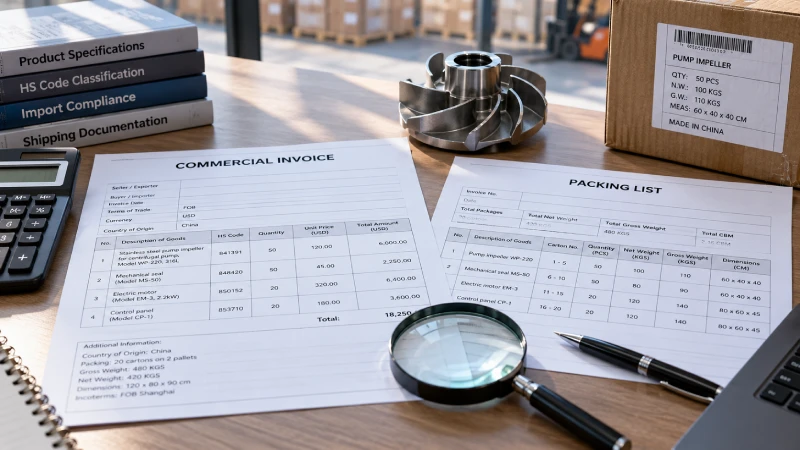
The commercial invoice is one of the most important documents in a China-to-UK shipment. It tells the customs broker what was sold, who sold it, who purchased it and how much the goods are worth.
A practical commercial invoice should normally contain:
- seller/exporter legal name and address
- buyer/importer legal name and address
- consignee details where different
- invoice number
- invoice date
- clear line-by-line product descriptions
- model, SKU or part number where useful
- quantity and unit of measure
- unit price
- line value
- total invoice value
- currency
- country of origin
- agreed Incoterm and named place
- relevant freight or insurance information where this affects valuation
- commodity code if it has already been correctly verified
One important distinction:
Do not assume that putting an HS code supplied by the Chinese factory on the invoice automatically makes it the correct UK commodity code.
The commodity code needed for the UK import declaration should be checked against the UK Trade Tariff using accurate product information.
Packing List
The packing list describes how the goods are physically packed rather than establishing their commercial value.
It commonly includes:
- number of cartons, pallets or crates
- package numbers
- shipping marks
- contents of each package
- quantities
- gross weight
- net weight where relevant
- dimensions
- total CBM where used operationally
The most important practical rule is simple:
The commercial invoice, packing list and actual cargo should tell the same story.
If an invoice lists 1,000 pieces but the packing list shows 960, or the supplier declares 18 cartons while 20 cartons are collected, the discrepancy should be resolved before departure.
Bill of Lading, Sea Waybill or Air Waybill
The transport document depends on the shipping method.
For ocean freight, this may be a:
- Bill of Lading
- sea waybill
- House Bill of Lading and Master Bill of Lading in a consolidated forwarding structure
For air freight, the transport record is normally an:
- Air Waybill
- House AWB and Master AWB where a freight forwarder is involved
These documents record transport information such as:
- shipper
- consignee
- notify party
- origin and destination
- packages
- weight
- cargo description
A B/L or AWB does not replace the commercial invoice, customs declaration or product-specific regulatory documentation.
For more information about choosing the transport method itself, see Ocean Freight from China and Air Freight from China.
Supporting Commercial and Valuation Records
Sometimes the customs broker needs more than the invoice value shown by the supplier.
Supporting information may include:
- purchase order
- sales contract
- proof of payment
- freight invoice
- insurance invoice
- information about assists, royalties or other valuation adjustments
- evidence supporting the declared transaction
UK customs valuation follows specific HMRC rules, so it is not always accurate to treat the supplier’s invoice total—or a simple “CIF value”—as the complete customs value in every situation.
For more complicated transactions, customs valuation should be checked separately rather than trying to solve the entire issue through the commercial invoice alone.
How to Write a Commercial Invoice Description UK Customs Can Actually Use
One of the most avoidable documentation problems in China sourcing is an invoice with descriptions such as:
Parts
Accessories
Electronics
Samples
Plastic products
Those descriptions may be convenient for the supplier, but they are often too vague to support reliable commodity classification or customs review.
Bad vs Better Commercial Invoice Descriptions
| Too Vague | Better Description | Why It Is Better |
|---|---|---|
| Parts | Stainless steel pump replacement impeller, 316L stainless steel, for centrifugal water pump, model WP-220 | Identifies item, material and function |
| Electronics | 12V DC LED power supply, aluminium housing, 60W, model PS-60 | Identifies electrical function and specification |
| Plastic products | Injection-moulded polypropylene storage box with lid, 25-litre capacity | Identifies material and actual product |
| Machine | Automatic stainless-steel liquid filling machine, four-head, model LF-4 | Clarifies machine function and type |
A useful description formula is:
What is it? + What is it made from? + What does it do? + What model or type is it?
Depending on the product, classification may also depend on:
- composition
- power rating
- dimensions
- manufacturing method
- capacity
- intended use
- whether the item is a complete product or only a component
That level of detail matters because commodity classification can depend on the product’s material, function, design and use—not simply the name the supplier normally uses in China.
Do Not Bundle Different Products Under One Generic Description
Suppose a shipment contains:
- stainless-steel pump impellers
- rubber sealing rings
- electric motors
- electronic control boards
The commercial invoice should not simply state:
Machine parts – USD 18,000
Those items may have different commodity classifications and different regulatory implications.
Line-by-line descriptions make both freight documentation and customs preparation easier.
Carry Out a Three-Way Document Check
Before cargo is collected from the supplier, compare:
Commercial Invoice ↔ Packing List ↔ Actual Cargo
Check that the following match:
- product names
- quantities
- model or part numbers
- package count
- weights
- consignee/importer information
Correcting a supplier invoice while the goods are still in China is usually much easier than resolving conflicting paperwork after the shipment reaches the UK.
B. Customs and Import Information Your UK Broker Will Need
Not everything required for customs clearance is a physical “document.”
The UK customs clearance guide explains how this information is used through pre-arrival declaration, customs checks and release.
Some of the most important items are data supplied by the UK importer.
UK Importer Details and EORI
For imports into England, Scotland or Wales, a business normally needs an EORI number beginning with GB. Businesses moving goods to or from Northern Ireland may need an EORI beginning with XI, depending on the movement.
Before shipment, confirm:
- importing company legal name
- registered/business address
- GB EORI
- VAT registration number where applicable
- customs broker details
- consignee/delivery address
Do not assume that the final delivery address is automatically the importer.
For example, cargo may be delivered to:
- an Amazon fulfilment centre
- a third-party warehouse
- a 3PL
- a distributor’s warehouse
- a project site
The physical receiver and the party acting as importer are not necessarily the same entity.
Commodity Code
The commodity code is one of the most important pieces of customs information.
It can affect:
- Customs Duty
- import VAT treatment
- import licences
- restrictions
- quotas
- trade-remedy measures
- additional declaration requirements
The applicable UK commodity code should be checked using the UK Trade Tariff.
Should You Use the HS Code Given by Your Chinese Supplier?
Use it as a reference—not automatically as the final answer.
A Chinese supplier may provide a code used for Chinese export purposes. The UK importer or appointed customs representative should still verify the appropriate UK commodity code using the actual product specifications.
If the product is difficult to classify, give the broker enough technical information to make a meaningful assessment.
Do not simply send:
“Pump component — supplier says HS 8413.”
Instead provide:
- what component it is
- material
- function
- whether it forms part of a specific pump type
- model/specification
- technical sheet or photographs where useful
Customs Value
The customs declaration needs a value for the imported goods.
The broker may therefore need:
- invoice value
- currency
- Incoterm
- international freight costs
- insurance costs
- related transaction information
- other amounts relevant under the applicable valuation method
The correct calculation depends on HMRC customs valuation rules rather than a universal formula.
This is another reason the Incoterm should be clear. A FOB Shanghai purchase, for example, allocates costs differently from a CIF or DAP transaction, which may affect what supporting figures the broker needs when establishing the customs value.
For broader landed-cost planning, see shipping cost from China to the UK.
Country of Origin
Country of origin is not automatically the same as the country the shipment departs from.
If products manufactured in another country are consolidated in Shenzhen and exported from China, the port of departure does not itself make China the origin.
Origin can affect:
- tariff treatment
- import controls
- trade-remedy measures
- origin declarations
- other tariff measures
For genuine China-manufactured goods, the supplier should be able to provide accurate manufacturing-origin information.
Do You Always Need a Certificate of Origin?
No.
A separate Certificate of Origin should not be presented as a universal document for every China-to-UK shipment.
Customs still needs the relevant origin information, but whether a separate certificate or other evidence is required depends on the applicable tariff measure, regulatory rule or commercial requirement.
Check the current UK Trade Tariff rather than requesting certificates simply because another import checklist says they are “mandatory.”
Customs Duty and Other Tariff Measures
Do not check only the basic duty percentage.
The commodity code and origin should be reviewed together because the tariff may also show:
- import restrictions
- licence requirements
- additional duties
- trade remedies
- declaration-document codes
This is particularly relevant for some China-origin products that may be subject to UK trade-remedy measures.
A product that normally attracts a particular headline Customs Duty rate may therefore require additional analysis before the final landed cost is known.
VAT Number and Postponed VAT Accounting
For UK VAT-registered businesses, Postponed VAT Accounting (PVA) may allow import VAT to be accounted for through the VAT Return rather than being paid upfront at import.
HMRC explains when businesses can use Postponed VAT Accounting.
If another business—such as a customs agent, broker, forwarder or express operator—is importing on your behalf and PVA is to be used, the importer should provide the relevant instructions before the import declaration is made.
Before customs filing, confirm:
- Is the importer VAT registered?
- Is PVA intended?
- Has the broker been told?
- Has written authorisation been provided where required?
- Is the correct VAT number being declared?
- Is the correct EORI linked to the declaration?
Do not wait until after the declaration has been submitted to decide how import VAT should be handled.
Customs Representation Authorisation
Many UK importers appoint a customs broker, freight forwarder or other intermediary to complete the customs declaration.
The commercial arrangement should specify whether the representative is acting:
- directly
- indirectly
HMRC provides guidance on appointing someone to deal with customs on your behalf.
Using a customs broker does not mean the importer should ignore what is being declared. The importer should still exercise appropriate due diligence over the information submitted under its EORI.
Great Britain or Northern Ireland? Check Before Preparing the Final Document Pack
For customs and product compliance, “the UK” cannot always be treated as one identical regulatory territory.
| Issue | Great Britain | Northern Ireland |
|---|---|---|
| Territory | England, Scotland and Wales | Northern Ireland |
| Typical EORI | GB | XI may be required |
| Customs framework | GB import rules | NI-specific arrangements may apply |
| Product compliance | GB product regime | Relevant EU-aligned rules continue in many sectors |
| Product markings | Depends on product/sector | CE or CE + UKNI can apply |
| Recommended approach | GB document review | Separate NI review required |
Current government guidance maintains separate Great Britain and Northern Ireland product-compliance pathways. In Northern Ireland, CE and CE+UKNI arrangements can apply to relevant manufactured products.
If the delivery destination is Belfast or elsewhere in Northern Ireland, confirm the customs and compliance structure before shipping rather than reusing a document checklist prepared for London, Felixstowe or Manchester.
C. Product-Specific Import Documents: Only When the Rules Require Them
The standard commercial document pack is only the starting point.
For products that may require conformity marking, use the CE versus UKCA guide before relying on supplier paperwork.
The actual commodity may trigger additional requirements.
Do not ask your Chinese supplier simply to “send all UK certificates.” First determine which UK rules apply to the actual product.
Manufactured and Regulated Products
Depending on the product sector, relevant compliance evidence may include:
- Declaration of Conformity
- technical documentation
- test reports
- appropriate product marking
- manufacturer/importer identification
- safety information
- user instructions
- third-party conformity assessment where required
Do not use a blanket rule such as:
“Every electrical product imported from China requires a UKCA certificate.”
The UKCA and CE framework varies by sector. Product compliance should therefore be checked against the applicable current UK product regulations.
The importer should also confirm its own obligations before placing regulated products on the market rather than assuming that factory test documents alone settle UK compliance.
Food and Products of Animal Origin
Food should not be treated as one regulatory category.
Requirements vary according to the commodity and its risk classification.
Depending on the product, checks may involve:
- commercial documentation
- health certificate
- official certificate
- importer declaration
- IPAFFS pre-notification
- relevant Border Control Post
- import licence or authorisation
For example, certain products of animal origin may require a health certificate, while lower-risk products can follow a different document route.
If you import food from China, determine the exact commodity and risk category before booking the freight.
Plants, Seeds and Plant Products
Plants and plant products imported from non-EU countries such as China are classified into different plant-health risk categories.
Depending on the category, requirements can include:
- phytosanitary certificate
- registration as an importer
- IPAFFS notification
- document upload
- documentary, identity or physical checks
- entry through a suitable Border Control Post
Do not therefore state that every wooden or plant-derived product needs a phytosanitary certificate.
CITES-Controlled Goods
Goods containing protected animal or plant species can fall under the Convention on International Trade in Endangered Species—CITES.
Potential examples can include certain:
- timber
- leather
- animal-derived materials
- plant ingredients
- decorative products
- specimens and derivatives
If the product is a CITES-listed specimen, the relevant permit or certificate requirements must be checked before import.
Solid Wood Packaging and ISPM 15
This issue often creates unnecessary confusion.
If commercial cargo enters Great Britain using regulated solid wood packaging, such as wooden pallets, crates or dunnage, the packaging generally needs to comply with ISPM 15.
Examples include:
- solid wood pallets
- wooden crates
- timber packing cases
- dunnage
The key point is the ISPM 15 mark.
Do not automatically request a “fumigation certificate” for every shipment using wooden pallets. Instead, check whether the wood packaging itself is compliant and correctly marked.
D. Dangerous and Controlled Cargo Documents
Dangerous goods require a different document review because transport regulations apply in addition to customs and import requirements.
Dangerous-Goods Transport Documents
Dangerous goods must first be classified correctly.
Depending on the cargo and transport mode, the consignor may need to provide:
- dangerous-goods transport document
- UN number
- proper shipping name
- dangerous-goods class
- packing group where applicable
- package information
- relevant declarations
- supporting technical or safety data
The exact documentation should be confirmed against the current rules for the selected transport mode.
Air Dangerous Goods
Dangerous goods transported by air are subject to ICAO technical requirements and commonly use the IATA Dangerous Goods Regulations operational framework.
Where required, the shipment may need a:
Shipper’s Declaration for Dangerous Goods
It is not required for every cargo simply because a product contains a battery or chemical component. The exact requirement depends on classification and any applicable exception.
Lithium Batteries
Battery shipments require particular attention because document, packaging and transport requirements depend on factors including:
- lithium-ion or lithium-metal
- standalone battery
- battery packed with equipment
- battery contained in equipment
- battery capacity
- lithium content
- state of charge where relevant
- sea freight or air freight
- carrier acceptance rules
Supporting information may include, depending on the shipment:
- battery specification
- UN classification
- UN 38.3 test summary
- SDS where relevant
- dangerous-goods declaration
- packaging information
Needs confirmation before publishing: Exact lithium-battery documentation should be confirmed against the current air or sea dangerous-goods rules and the selected carrier before booking.
Do not assume one battery document pack works for every shipment.
Chemicals and Other Hazardous Cargo
Chemical cargo may require:
- Safety Data Sheet
- dangerous-goods classification
- proper shipping name
- UN number
- packing group
- flash point or other technical information where relevant
- compliant packaging
- dangerous-goods transport declaration
Again, an SDS should not be presented as a universal import certificate for every product.
Its relevance depends on the substance and how the cargo is classified and supplied.
Controlled Goods and Import Licences
Some products require UK licences, permits or additional approvals before import.
The safest workflow is:
Identify product → confirm commodity code → check UK Trade Tariff measures → check product-specific authority → obtain required approval before shipping.
Do not rely on generic lists claiming that all electronics, textiles, machinery or steel products require UK import licences.
The exact control depends on the commodity and current legislation.
Who Prepares What? Supplier, Forwarder, Importer or Customs Broker
One of the easiest ways to avoid missing documents is to assign responsibility before cargo is booked.
| Item | Chinese Supplier / Exporter | Freight Forwarder / Carrier | UK Importer | Customs Broker |
|---|---|---|---|---|
| Commercial invoice | Usually prepares | May review operationally | Verifies transaction and importer details | Uses for declaration |
| Packing list | Usually prepares | Checks cargo information | Reviews | Uses where relevant |
| B/L or AWB | Supplies shipping details | Usually coordinates/issues | Checks consignee details | References where needed |
| Product specifications | Provides | Relays | Ensures sufficient information is available | Uses for classification/advice |
| Commodity code | May provide Chinese HS reference | May assist | Should ensure UK classification is addressed | May classify/advise/file depending scope |
| EORI | Not normally supplier’s responsibility | Requests where required | Provides | Uses on declaration |
| Customs value | Provides transaction value | Provides freight costs where relevant | Confirms transaction/value information | Declares |
| Origin | Provides manufacturing information | Relays | Verifies where necessary | Declares |
| Import licence | May supply supporting source documents | Checks operational acceptance | Ensures licence requirement addressed | Declares relevant references |
| Product compliance documents | Manufacturer supplies evidence | Not normally product certifier | Responsible for applicable importer obligations | Usually outside broker’s compliance role |
| DG documents | Shipper/consignor provides cargo information | Checks transport acceptance | Provides supporting information where relevant | Uses customs data where applicable |
| Customs declaration | No | May coordinate | Authorises and supplies data | Usually prepares/files when appointed |
The exact responsibility can change depending on:
- Incoterm
- customs representation structure
- transport mode
- importer arrangement
- commercial contract
- agreed freight-forwarding scope
For that reason, the table should be used as a planning guide rather than a substitute for the actual shipping contract.
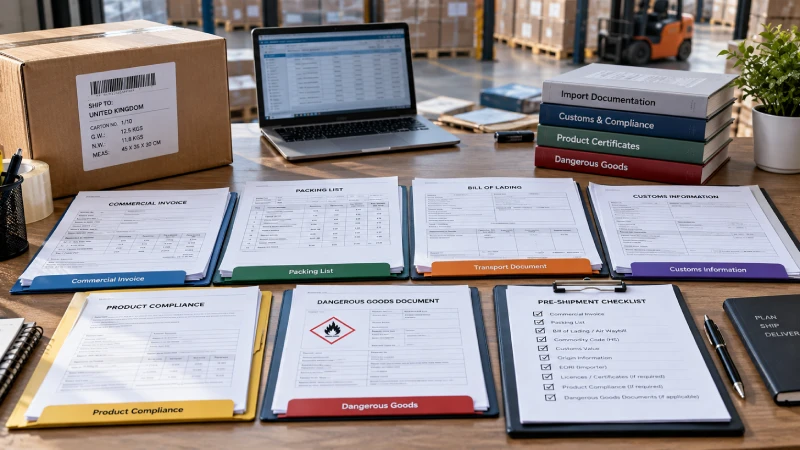
Pre-Shipment Document Checklist Before Cargo Leaves China
This is the point where the importer, supplier and forwarder should stop and verify the shipment.
Commercial Invoice and Packing
- Final commercial invoice received
- Supplier and buyer legal names are correct
- Product descriptions are specific
- Model/SKU/part numbers are correct where relevant
- Quantities are correct
- Unit prices and total values are correct
- Currency is stated
- Country of origin has been confirmed
- Incoterm and named place are clear
- Packing list matches the invoice
- Package count is correct
- Gross/net weights are reasonable
- Dimensions/CBM have been checked where relevant
UK Importer and Customs
- UK importing entity confirmed
- GB EORI verified
- Northern Ireland / XI requirements checked if relevant
- VAT registration information confirmed
- PVA decision confirmed where applicable
- Customs representative appointed
- Written customs authorisation provided
- Commodity code reviewed
- Product specifications supplied for classification
- Origin confirmed
- Customs value basis understood
- UK Trade Tariff measures checked
Product Compliance and Controlled Goods
- Product-specific UK regulation checked
- Import licence requirement checked
- Product conformity documentation reviewed where applicable
- Dangerous-goods status confirmed
- Lithium battery status disclosed
- Chemical/DG information supplied where relevant
- Food/animal-product controls checked
- Plant/phytosanitary controls checked
- CITES status checked where relevant
- Solid wood packaging complies with ISPM 15 where applicable
Transport Documents
Before the final B/L or AWB is issued, check:
- shipper name
- consignee name
- notify party
- package count
- gross weight
- cargo description
- origin/destination
- final delivery information where relevant
Pro Tip: For multi-supplier consolidation in China, standardise product descriptions and invoice formats before the goods reach the consolidation warehouse. Fixing five inconsistent supplier invoices at the last minute can create unnecessary delays before export.
Common China-to-UK Documentation Mistakes
Even routine shipments can be delayed when the data supplied to the forwarder or customs broker is incomplete.
1. The Invoice Only Says “Parts” or “Accessories”
Problem: The description does not adequately identify the goods.
Better approach: Add product name, material, function, model and relevant specifications.
2. The Supplier’s HS Code Is Used Without UK Verification
Problem: A Chinese export classification is treated as automatically valid for UK import purposes.
Better approach: Use the supplier’s code as a reference and verify the UK commodity code using the UK Trade Tariff and actual product specifications.
3. Invoice and Packing List Quantities Do Not Match
Typical discrepancies include:
- invoice: 1,000 units; packing list: 960
- invoice: 20 cartons; cargo: 22 cartons
- different gross weights
- different product descriptions
Resolve inconsistencies before departure.
4. The Wrong Company Is Treated as the UK Importer
A delivery warehouse does not automatically become the importer.
This is especially important for:
- Amazon inventory
- 3PL warehouses
- project-site deliveries
- distributor warehouses
- DDP transactions
Confirm the legal importing party, EORI and customs representation before booking.
5. PVA Instructions Are Given Too Late
If the importer wants to use Postponed VAT Accounting through an appointed party, that instruction needs to be handled before the declaration is submitted.
6. Product Certificates Are Checked Only After the Vessel Departs
If a product requires:
- health certification
- phytosanitary documentation
- import licence
- CITES permit
- conformity assessment
- dangerous-goods approval
discovering the requirement after departure may create far more serious problems than an incomplete packing list.
Check product compliance before booking the shipment.
7. Northern Ireland Is Treated as Identical to Great Britain
A Belfast shipment can have different requirements from a Birmingham shipment.
Confirm NI-specific customs and product requirements early.
Does DDP Mean the UK Buyer Does Not Need Import Documents?
No—not automatically.
DDP reallocates commercial responsibilities between seller and buyer, but it does not remove UK customs, VAT or product-compliance rules.
Before agreeing to a China-to-UK DDP shipment, clarify:
- Who will legally act as importer?
- Which EORI will appear on the declaration?
- Who is represented by the customs broker?
- Who pays Customs Duty?
- How will import VAT be treated?
- Will PVA be used?
- Who receives and retains the customs entry?
- Who is responsible for product compliance?
- Are any import licences or certificates required?
- Is the arrangement workable for the final delivery destination?
Do not assume that:
“DDP means the freight forwarder automatically becomes the UK importer of record.”
The workable structure depends on the commodity, importer arrangement, VAT treatment, customs representation and service scope.
Winsail may coordinate DDP or other door-to-door arrangements subject to shipment review and an agreed customs and delivery structure. Product compliance, importer status and UK tax treatment should be confirmed for the individual shipment.
For more information on the service model, see DDP Shipping from China and Door-to-Door Shipping from China.
Keep Your UK Import Records After Customs Clearance
Document control should continue after the goods have been released.
Depending on the transaction, retain relevant records such as:
- commercial invoice
- packing list
- customs declaration records
- B/L or AWB
- import VAT records
- C79 where applicable
- postponed import VAT statements where applicable
- licences and permits
- product compliance documentation
- customs valuation evidence
- origin evidence
- customs broker instructions and authorisations
The official GOV.UK import process advises businesses to retain relevant commercial invoices and customs paperwork after importing.
Do not discard the document pack simply because the container or air shipment has been delivered.
China-to-UK Import Document Decision Checklist
If you are unsure whether your shipment is ready, answer these five questions.
1. Can You Describe Every Product Accurately?
If the answer is only:
accessories
components
samples
electronics
you probably need better product information.
2. Has the UK Commodity Code Been Reviewed?
Do not rely only on the supplier’s Chinese HS code.
3. Is the UK Importer Clearly Identified?
Confirm:
- legal business name
- EORI
- VAT status where relevant
- customs representative
4. Is the Customs Value Supportable?
Make sure the commercial invoice, Incoterm and relevant freight/insurance information are available.
5. Could the Goods Trigger Extra Controls?
Pay particular attention to:
- food
- animal products
- plants
- chemicals
- batteries
- dangerous goods
- regulated machinery/electrical goods
- medical products
- CITES-controlled materials
- controlled goods
If the answer is yes, complete the product-specific review before the cargo leaves China.
FAQs
What documents do I need to import goods from China to the UK?
For a typical commercial shipment into Great Britain, you will normally need a commercial invoice, packing list and the relevant transport document, such as a Bill of Lading or Air Waybill. The customs declaration also requires information such as the importer/EORI, commodity code, customs value and origin. Additional licences, certificates or compliance documents depend on the product.
What information should be on a commercial invoice for a UK import?
A practical commercial invoice should identify the seller, buyer, goods, quantity, price, currency, origin and transaction terms. Product descriptions should be specific enough to identify what the goods actually are rather than using vague wording such as u0026quot;partsu0026quot; or u0026quot;accessories.u0026quot;
Do I need a Certificate of Origin when importing from China to the UK?
Not for every shipment. The country of origin must be determined correctly for customs purposes, but a separate Certificate of Origin is not a universal requirement for all China-to-UK imports. Check the UK Trade Tariff and any applicable product or tariff measure.
Do I need an EORI number to import from China?
Businesses importing commercial goods into England, Scotland or Wales generally need an EORI beginning with GB. Imports involving Northern Ireland may require an XI EORI depending on the movement.
Does the HS code need to appear on the commercial invoice?
The applicable UK commodity code must be used for the import declaration. Including a verified code on the invoice can help the forwarder and customs broker, but do not assume that a code supplied by a Chinese factory is automatically the correct UK classification.
Who prepares the UK customs declaration?
The importer can complete customs formalities itself or appoint a customs agent, broker or other eligible representative. Many commercial importers use an intermediary, but the importer should still exercise due diligence over the information declared.
Does DDP shipping mean I do not need UK customs paperwork?
No. A DDP commercial arrangement does not remove customs, import VAT, importer identity or product-compliance requirements. The importer structure, EORI, customs representation, taxes and regulatory responsibilities still need to be clearly defined.
Prepare the Documents Before You Book the Shipment
For most China-to-UK commercial shipments, good documentation starts before the goods leave the supplier—not when the vessel arrives at Felixstowe or the air shipment reaches the UK.
For shipment-level document checks and declaration coordination, see Winsail’s customs and cargo-insurance support.
The practical sequence is:
Confirm product → check importer → review commodity code → confirm customs value and origin → identify product controls → prepare commercial documents → authorise customs representative → book shipment.
If you are purchasing from multiple suppliers, using a China consolidation warehouse or shipping commercial cargo that includes batteries, machinery, controlled products or other non-standard goods, send the product and documentation information to your forwarder early.
Winsail Logistics can coordinate China-side pickup, consolidation, international freight and shipment-document communication depending on the agreed service scope. Customs clearance and door-to-door arrangements can also be coordinated where applicable, subject to the commodity, importer structure and destination requirements.
For freight methods, route planning, shipping costs and delivery options, continue to our Shipping from China to the UK guide.
Continue with related UK shipping guides
Use these focused guides for the next part of your China-to-UK shipping plan.
