
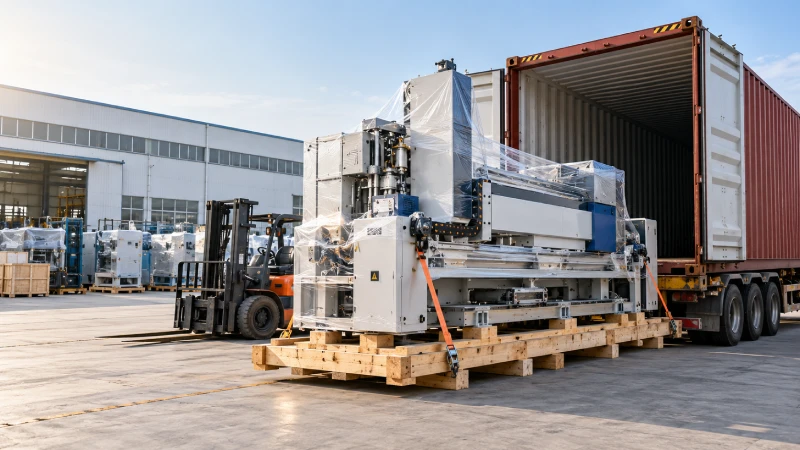
Shipping machinery from China to the UK is rarely just a matter of choosing a freight rate and booking a container.
For a normal palletised shipment, dimensions, weight and destination may be enough to produce an initial freight plan. Machinery requires more information. A machine may fit inside a container by external dimensions but still be difficult to load because of its weight distribution. Another machine may require top loading because it cannot pass through the container doors. An oversized unit may fit on a flat rack but still require special approval, lashing arrangements and specialist road transport after arrival in the UK.
For manufacturers, equipment distributors and project buyers, the correct shipping method therefore depends on the packed machine, how it can be lifted and secured, and whether it can ultimately reach and be unloaded at the UK delivery site.
For broader information on sea freight, air freight, transit times, ports and general route planning, see our Shipping from China to the UK guide. This article focuses specifically on industrial machinery, heavy equipment and production-line shipments.
Quick Answer: How Should Machinery Be Shipped from China to the UK?
For machinery that remains within normal container dimensions and acceptable loading limits, FCL shipping is usually the first option to assess. A 20ft, 40ft or 40HC container can provide enclosed transport with fewer cargo-handling stages than non-containerised alternatives.
Heavy machinery that still fits inside the container may also move by FCL, but dimensions alone are not enough. The machine’s gross weight, footprint, centre of gravity, loading method and weight distribution need to be reviewed.
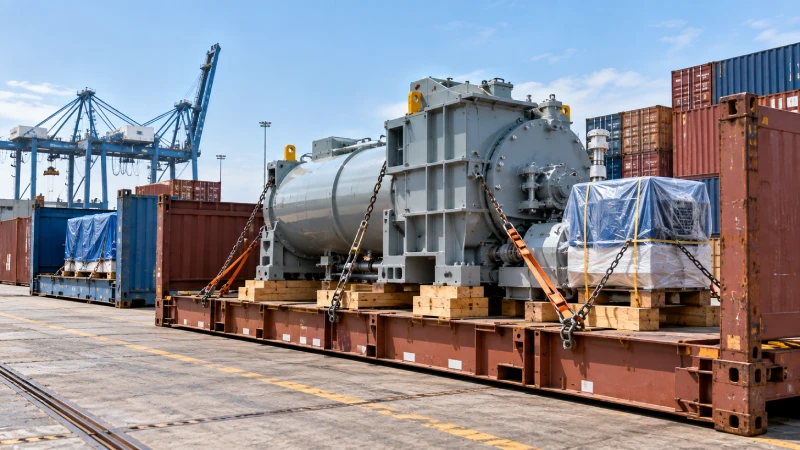
If the machine requires top loading or is over-height, an open top container may be considered. Machinery that is over-width, over-height, irregularly shaped or requires side access may require a flat rack. Equipment that cannot practically move on container equipment, or complete production lines involving multiple oversized pieces, may need breakbulk or project-cargo planning.
| Machinery category | Initial shipping option to assess | Main issue to check |
|---|---|---|
| Standard containerised machinery | 20ft / 40ft / 40HC FCL | Packed dimensions and loading access |
| Heavy but in-gauge machinery | FCL | Gross weight, footprint and load distribution |
| Oversized / OOG machinery | Open top or flat rack | Exact OOG dimensions and carrier approval |
| Complete production line | Mixed FCL / special equipment / project cargo | Package-level and delivery sequencing |
Before requesting a shipping plan, prepare the packed L × W × H, gross weight of each package, base dimensions, centre of gravity, lifting information, photos or drawings, China pickup address and UK delivery postcode.
That information is far more useful than simply sending the machine model and purchase value.
Which Type of Machinery Are You Shipping from China to the UK?
The first decision should not be “FCL or flat rack?”
It should be:
What does the machinery look like after it is packed and ready for transport?
Standard Containerised Machinery
Many industrial machines can still be shipped inside conventional containers.
Depending on the machine and packing design, this may include equipment such as:
- CNC machines
- Packaging machinery
- Pumps and compressors
- Food-processing machinery
- Workshop equipment
- Manufacturing equipment
- Control cabinets
- Machine components and accessories
A standard container protects the equipment from direct weather exposure and normally creates a simpler port-to-port transport chain than OOG cargo.
However, the manufacturer’s catalogue dimensions are not sufficient for equipment selection. Once a machine is placed on a steel base, export skid or wooden case, its shipping dimensions may change significantly.
The assessment should use the final packed dimensions, including:
- Export skid
- Wooden crate
- Protective frame
- Motors or control boxes that protrude from the main body
- Lifting attachments that cannot be removed
The loading method also matters. A machine can theoretically fit inside the internal container space but still be impossible to move through the container doors or position safely inside.
For more general container planning, see FCL Shipping from China.
Heavy but In-Gauge Machinery
This category deserves particular attention because it is frequently misunderstood.
A machine does not automatically require a flat rack simply because it is heavy. Some dense industrial equipment can remain within standard container dimensions.
At the same time:
Fitting dimensionally does not automatically mean the machine can safely move in a standard container.
The shipment may require review of:
- Gross machine and package weight
- Package footprint
- Concentrated floor load
- Container payload
- Weight distribution
- Centre of gravity
- Position inside the container
- Factory loading equipment
- UK road transport
- Destination unloading equipment
Container payload specifications also vary between carriers and equipment series, so a generic maximum weight taken from an online container chart should not be treated as an automatic booking limit.
For particularly dense machinery, the base area matters because several tonnes concentrated over a small footprint create a different loading problem from the same weight spread across a long skid.
Oversized and Out-of-Gauge Machinery
When the packed equipment exceeds standard container dimensions or cannot be loaded conventionally, special container equipment should be assessed.
Typical reasons include:
- Excessive height
- Excessive width
- Irregular shape
- Top-loading requirement
- Side-loading requirement
- Lifting arrangement incompatible with normal container doors
The two most common containerised options are open top containers and flat racks.
The shipping line normally needs accurate dimensions and weight before confirming whether an OOG unit is acceptable. Approximations such as “about three metres wide” are not sufficient for final booking.
Complete Production Lines and Project Cargo
Shipping a complete production line creates a different problem from moving one machine.
A production-line shipment might include:
- Primary machines
- Conveyors
- Steel frames
- Electrical cabinets
- Control systems
- Tooling
- Spare parts
- Auxiliary equipment
- Installation materials
These pieces do not necessarily need to use the same freight method.
A project might use several standard containers for normal equipment, one open top for a tall machine and one flat rack for a large frame. Only the units that genuinely require special handling need to move as OOG cargo.
For larger or heavier projects where container equipment is no longer practical, Project Logistics or China Breakbulk Shipping arrangements may need to be assessed.
The shipment should therefore be planned at package level, rather than simply asking how many containers the complete factory line will require.
FCL, Open Top, Flat Rack or Breakbulk: Which Equipment Fits the Machine?
The most cost-effective machinery solution is usually the least complex equipment that can handle the cargo safely and practically.
| Equipment | Best considered when | Loading access | Main planning concern | UK delivery implication |
|---|---|---|---|---|
| 20ft FCL | Compact, often dense machinery | Rear doors | Weight distribution and positioning | Normal container haulage may be possible |
| 40ft / 40HC FCL | Larger or multiple packaged machines | Rear doors | Dimensions, payload and distribution | Receiving site must unload the container |
| Open Top | Top loading or over-height cargo | Top and rear | Lifting, over-height and weather protection | Crane or special unloading may be required |
| Flat Rack | Over-width, over-height or irregular equipment | Top and sides | OOG approval, securing and exposure | Specialist road transport may be needed |
| Breakbulk / Project Cargo | Equipment not practical on container equipment | Project-specific | Lifting, terminal and vessel coordination | Inland movement must be planned individually |
When Standard FCL Is the Best Starting Point
If the packed machine fits comfortably within a standard container and the weight can be safely distributed, FCL usually offers several practical advantages:
- Enclosed protection
- Normal container handling through the port
- Fewer special-equipment approvals
- Simpler inland transport
- Easier integration into regular China-UK container services
For compact but heavy machinery, a 20ft container may sometimes deserve assessment before a 40ft container because the objective is not simply to maximise cubic capacity.
The correct choice still depends on the actual cargo and equipment specifications.
When to Consider an Open Top Container
An open top is useful when the machine needs to be lowered into the container by crane or when conventional rear-door loading is impractical.
It can also be used for certain over-height cargo.
However, an open top should not be treated as a universal solution for anything that is too tall for a standard container.
Over-height cargo may affect:
- Vessel slot allocation
- Shipping-line approval
- Terminal handling
- Lashing
- Weather protection
- UK road clearance
The complete routing therefore needs to be checked before booking.
When Flat Rack Shipping Is More Suitable
Flat racks are often considered for machinery that is:
- Over-width
- Over-height
- Irregularly shaped
- Difficult to load through container doors
- Designed for crane loading
- Better secured from the side
Unlike an enclosed container, a flat rack leaves much more of the cargo exposed.
That increases the importance of:
- Seaworthy wrapping
- Corrosion protection
- Water protection
- Securing points
- Lashing
- Blocking and bracing
Accurate OOG dimensions must include the actual packed cargo and any components extending beyond the standard equipment envelope.
When Breakbulk or Project Cargo Should Be Assessed
Breakbulk becomes relevant when a machine cannot practically or safely move on standard or special container equipment.
Examples may include exceptionally large industrial units or projects involving multiple large components.
The decision should consider:
- Heaviest individual piece
- Largest dimensions
- Lifting requirements
- Available vessel services
- Port handling capability
- Terminal arrangements
- UK road delivery requirements
- Installation schedule
Breakbulk should not automatically be described as cheaper simply because equipment is large. For some projects, special container equipment remains operationally simpler; for others, breakbulk becomes the more workable solution.
For machinery-specific planning beyond the UK route, see Shipping Machinery from China.
What Information Is Needed Before a Machinery Freight Quote Is Reliable?
A machinery quotation based only on “one CNC machine, 12 tonnes” should be treated as preliminary.
The following information helps determine the actual transport requirement.
Packed Dimensions and Gross Weight
For every package, provide:
- Quantity
- Packed length
- Packed width
- Packed height
- Net weight
- Gross weight
- Base/skid dimensions
For a multi-machine project, list each package separately rather than supplying only the total weight.
| Information | Example format | Why it matters |
|---|---|---|
| Packed dimensions | L × W × H in mm | Determines container/OOG feasibility |
| Gross weight | Weight per package | Equipment and trucking assessment |
| Base dimensions | Length × width | Helps assess load distribution |
| Centre of gravity | Marked drawing/location | Important for lifting and securing |
| Lifting points | Drawing/photos | Helps plan handling |
| Packing | Crate/skid/frame | Protection and ISPM 15 review |
| Battery/liquids | Exact configuration | Carrier/DG review |
| UK destination | Full postcode | Inland transport planning |
Centre of Gravity and Lifting Points
Machinery is frequently asymmetrical. The visual centre of a machine is not necessarily its centre of gravity.
Where relevant, request from the manufacturer:
- Marked centre of gravity
- Lifting-point locations
- Lifting diagram
- Lifting lug information
- Preferred loading orientation
- Confirmation whether the machine can be tilted
- Removable components that could reduce dimensions
The freight forwarder can use this information for logistics planning, but should not be presented as the party certifying the engineering safety of lifting points.
Packing and Wood Packaging
Industrial machinery may be shipped using:
- Full wooden crates
- Open wooden skids
- Steel frames
- Vacuum or barrier wrapping
- Corrosion-protection materials
- Combinations of these methods
If solid wood packaging material is used for goods entering Great Britain, UK government guidance on wood packaging material requires it to comply with ISPM 15. The Forestry Commission also states that the ISPM 15 mark itself is the relevant evidence for applicable wood packaging; a separate treatment certificate does not simply replace the required mark.
This should be checked while the machine is still at the Chinese factory, not after the container reaches the UK.
Pro Tip: Do not confuse FSC certification with ISPM 15. They address different issues.
Batteries, Oil, Fuel and Other Liquids
Ask the supplier directly whether the machine contains:
- Lithium batteries
- Lead-acid batteries
- Hydraulic oil
- Lubricating oil
- Coolant
- Fuel
- Compressed gas
- Refrigerant
- Chemicals
- Paint or cleaning products
Having oil or a battery does not automatically make every machine dangerous goods.
However, the substance, battery chemistry, capacity, quantity and installation configuration can affect carrier acceptance and documentation. Dangerous-goods requirements also depend on transport mode and classification.
This information must therefore be reviewed before booking rather than discovered during port or airline acceptance.
Customs and Commercial Information
Prepare:
- Detailed machine description
- Manufacturer
- Model
- Commercial invoice
- Packing list
- Proposed HS/commodity code
- Purchase value
- Origin information where relevant
- Serial numbers where commercially necessary
- Agreed Incoterm
Do not automatically copy the full tariff code provided by a Chinese supplier into the UK import declaration.
HMRC notes that only part of the international classification is common globally; product-specific treatment must still be checked against the UK tariff. The UK Trade Tariff uses the commodity code to determine applicable duty, VAT and measures such as licences or restrictions.
Packing, Weight Distribution and Securing Machinery for Ocean Transport
Machinery packing is not simply about building a wooden box around the equipment.
The packing system needs to protect the machine while allowing it to be lifted, positioned and secured for several transport stages.
Plan for Transport Forces, Not Just Storage Protection
Machinery may experience:
- Vibration
- Vessel motion
- Acceleration and braking
- Lifting forces
- Repeated handling
- Humidity
- Condensation
- Salt-air exposure
Sensitive metal surfaces, control systems and precision equipment may therefore require moisture and corrosion protection in addition to mechanical protection.
Centre of Gravity and Concentrated Loads Matter
For heavy machinery, the gross weight alone provides only part of the picture.
The CTU Code published by IMO, ILO and UNECE provides guidance covering loading and securing cargo in containers and other transport units. It addresses issues such as load distribution and safe packing for combined sea and land transport.
A heavy machine with a narrow base may require a different loading arrangement from machinery of the same weight distributed across a larger skid.
Important questions include:
- Where will the load sit inside the container?
- Is the centre of gravity offset?
- How is weight transferred through the skid?
- Are appropriate securing points available?
- Can the machine move longitudinally or laterally?
- Does the base require engineered load spreading?
These questions should be resolved before the container arrives at the factory.
Open Top and Flat Rack Cargo Needs Additional Attention
OOG machinery typically requires more detailed securing and protection.
Depending on the cargo and carrier, this may involve:
- Lashing plan
- Blocking and bracing
- Lifting drawings
- Photographs
- Centre-of-gravity information
- Detailed protrusion dimensions
- Weather protection
Shrink wrapping alone should not be treated as a complete seaworthy protection strategy for exposed industrial machinery.
Remember the Verified Gross Mass
For machinery loaded into containers, SOLAS Verified Gross Mass requirements still apply.
UK Maritime and Coastguard Agency guidance confirms that the shipper is responsible for providing the VGM of a packed container to the carrier.
The packed machinery, securing materials, dunnage and container itself all contribute to the final gross mass.
UK Customs, Import VAT and Machinery Compliance
Moving the cargo through customs and proving that a machine can legally be placed on the UK market are related issues, but they are not the same process.
Commodity Code and EORI
For imports into England, Scotland or Wales, businesses normally need the appropriate GB EORI. Movements involving Northern Ireland may require different arrangements, including an XI EORI in relevant cases. GOV.UK import guidance should be checked against the actual shipment structure.
The correct commodity code affects:
- Customs Duty
- Import VAT treatment
- Possible tariff measures
- Licences or certificates
- Other import restrictions
There is no reliable universal statement such as:
“UK machinery import duty is X%.”
Different machines can fall under different tariff classifications. Always check the actual product using the current UK Trade Tariff.
Import VAT and Postponed VAT Accounting
Import VAT should also be planned before shipment.
HMRC’s import VAT valuation guidance explains that the value used for import VAT can include relevant incidental expenses in addition to the customs value, depending on the circumstances.
For eligible UK VAT-registered businesses, Postponed VAT Accounting (PVA) may allow import VAT to be accounted for through the VAT Return rather than paid at the border. See HMRC guidance on postponed VAT accounting.
Whether PVA should be used is part of the importer’s VAT and customs setup. A freight quotation should not assume a particular VAT treatment without confirming the import structure.
Does Machinery Need CE or UKCA Marking?
This is one area where outdated UK import guides can cause problems.
As of current UK government guidance, machinery placed on the Great Britain market can use UKCA or recognised CE marking routes, provided the relevant regulatory requirements are satisfied. The UK government extended recognition of CE-marked products in this machinery framework beyond the previous transition deadline. See the GOV.UK guidance on the Supply of Machinery (Safety) Regulations 2008.
Therefore, it is incorrect to make a blanket statement that:
“All machinery imported into Britain must now be UKCA marked.”
But it is equally incorrect to assume:
“A CE sticker automatically means the machine is compliant.”
Depending on the machinery, compliance can involve:
- Applicable essential safety requirements
- Conformity assessment
- Technical documentation
- Declaration of Conformity
- Relevant marking
- Instructions in English
For partly completed machinery, different documentation such as assembly instructions and a Declaration of Incorporation may apply.
Product compliance should be checked as part of the purchasing process rather than treated as a customs document to prepare after the vessel arrives.
Pro Tip: Customs clearance does not certify machinery safety compliance. A declaration passing through customs and a machine satisfying applicable UK product rules are separate matters.
Great Britain and Northern Ireland Are Different
For this guide, “Great Britain” means:
- England
- Scotland
- Wales
Northern Ireland operates under different arrangements for certain customs and manufactured-product rules.
Current UK government guidance for Northern Ireland specifically covers CE and CE+UKNI routes depending on the applicable conformity-assessment arrangement.
If machinery is destined for Belfast or another Northern Ireland location, confirm the NI-specific customs and product requirements rather than applying GB procedures automatically.
Choosing the UK Gateway for Machinery and OOG Cargo
For standard FCL machinery, the UK arrival port may be selected mainly according to:
- Carrier schedule
- China origin
- Ocean routing
- Final UK destination
- Available trucking
- Total landed transport cost
Major container gateways such as Felixstowe, Southampton and London Gateway may all be relevant depending on the route.
The calculation changes when the cargo becomes oversized.
OOG Port Selection Requires More Than Distance
For open top, flat rack or breakbulk cargo, check:
- Whether the selected service accepts the OOG unit
- Special equipment availability
- Terminal handling arrangements
- Lifting requirements
- Lashing or unlashing arrangements
- De-vanning or transfer requirements
- Storage
- Heavy-haul road access
DP World currently lists project-cargo, OOG, flat-rack handling, de-vanning and breakbulk capabilities at London Gateway and Southampton.
That does not mean every oversized machine can automatically use those terminals. The individual cargo still needs operational review.
The Nearest UK Port Is Not Always the Best Port
For normal cargo, reducing inland distance is often useful.
For OOG machinery, the nearest port can still be the wrong choice if:
- The ocean service is unsuitable
- Special equipment is unavailable
- Terminal handling is more difficult
- Road restrictions affect the final route
- Another gateway allows simpler transfer to specialist transport
For large industrial cargo, port selection and inland delivery should therefore be assessed together.
Plan UK Site Access and Machinery Unloading Before the Vessel Sails
One of the most preventable machinery-shipping problems occurs when transport is planned as far as the UK postcode but nobody checks whether the equipment can actually enter or be unloaded at the site.
A container reaching the factory gate is not the same as the machine reaching its installation position.
UK Delivery Site Checklist
Before confirming the inland leg, check:
- Full delivery postcode
- Road access
- Gate width
- Entrance height
- Turning space
- Yard dimensions
- Surface condition
- Overhead obstacles
- Loading-bay arrangement
- Delivery restrictions
- Appointment requirements
- Available unloading equipment
This becomes especially important for factories located on older industrial estates, restricted urban roads or sites not designed for articulated vehicles.
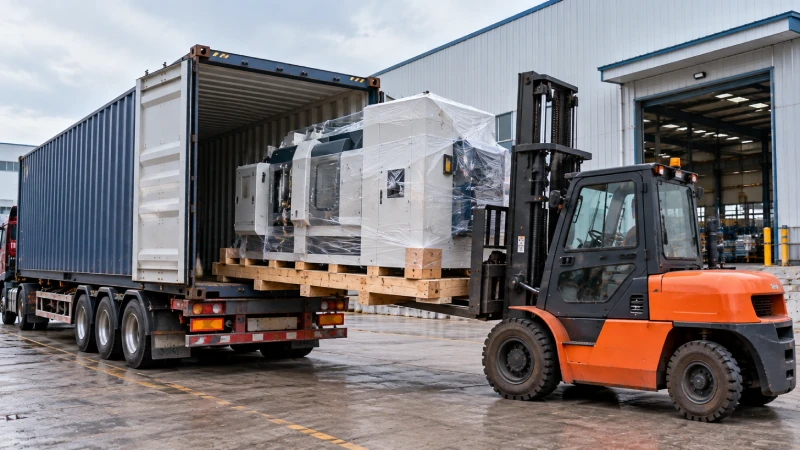
Who Will Unload the Container?
Standard container haulage should not automatically be assumed to include machinery unloading.
Before shipment, define:
- Who opens the container
- Whether unloading occurs while the vehicle waits
- How long unloading should take
- Whether the consignee supplies a forklift
- Whether a mobile crane is required
- Whether the container needs another unloading arrangement
- How and when the empty container will be returned
Poor planning can create waiting time and potentially contribute to detention or other equipment charges.
When Forklift Unloading May Work
A forklift plan should take account of:
- Machine gross weight
- Load centre
- Rated forklift capacity
- Fork length
- Skid design
- Container doorway
- Manoeuvring space
- Yard condition
Do not choose a forklift purely because its headline capacity appears to exceed the machine weight.
When Crane Unloading May Be More Appropriate
Crane unloading may need consideration for:
- Top-lift machinery
- Open-top shipments
- Flat-rack cargo
- Machines too heavy for available forklifts
- Crates that cannot be safely accessed by forks
A crane provider may require:
- Lift weight
- Centre of gravity
- Lifting-point drawing
- Lifting radius
- Crane setup position
- Ground conditions
- Rigging information
These requirements should be identified before the cargo leaves China.
Pro Tip: For heavy machinery, start planning the destination unloading before booking the ocean shipment. Changing the UK delivery plan after arrival is usually more expensive than designing it correctly from the beginning.
When Does Heavy Machinery Need Specialist UK Road Transport?
Not every heavy machine requires an abnormal-load vehicle.
The road-transport decision depends on the complete loaded vehicle configuration, including:
- Vehicle and trailer
- Total weight
- Axle loads
- Width
- Height
- Length
- Cargo projections
- Route
UK rules regulate vehicle weights and dimensions. Loads that cannot move under normal Construction and Use or Authorised Weight requirements may enter the Special Types framework, including STGO arrangements for certain abnormal indivisible loads. See the GOV.UK Special Types enforcement guide.
Where specialist transport is required, planning may involve:
- Trailer configuration
- Axle distribution
- Route survey
- Bridge checks
- Low-clearance review
- Authority notifications
- Police notification where applicable
- Escorts where applicable
- Restricted delivery times
- Site-access assessment
This is another reason why an OOG shipment should not be quoted solely from the ocean freight portion.
The correct question is not:
“How much is a flat rack from China to the UK?”
It is:
“What is required to move this exact machine from the Chinese factory all the way to this UK site?”
How Machinery Shipping Costs from China to the UK Are Built
Machinery shipping costs depend on much more than the ocean freight rate.
For that reason, a single “machinery shipping price per tonne” is rarely useful.
For broader route-level pricing guidance, see Shipping Cost from China to UK.
Standard FCL Machinery
A typical cost structure may include:
- Factory pickup
- Export packing
- Loading
- China inland trucking
- Export customs processing
- Ocean freight
- Destination charges
- UK customs clearance
- Customs Duty and import VAT where applicable
- UK container haulage
- Unloading if separately arranged
- Cargo insurance if required and available
For standard FCL cargo, current rates should be checked against the actual sailing and booking period.
Open Top and Flat Rack
Special equipment may add cost through:
- Equipment availability
- OOG surcharges
- Additional vessel space
- Special terminal handling
- Crane operations
- Lashing
- Securing materials
- Weather protection
- Specialist trucking
- Equipment repositioning
Two machines with the same gross weight can therefore have very different freight costs if one is in-gauge and the other is significantly over-width.
Breakbulk and Project Cargo
Project pricing can be influenced by:
- Number of packages
- Heaviest lift
- Largest dimensions
- Vessel service
- China loading location
- Origin and destination terminal
- Crane requirements
- Storage
- Road transport
- Permits or notifications
- Delivery schedule
For this type of cargo, case-by-case pricing after dimensional and handling review is more useful than publishing artificial rate ranges.
Transit Time vs Total Project Lead Time
Importers should also distinguish vessel transit from the complete project timeline.
A standard FCL shipment may mainly involve:
- Booking
- Container positioning and loading
- Export processing
- Ocean transport
- Customs clearance
- UK delivery
OOG machinery can add:
- Technical cargo review
- Carrier OOG approval
- Special-equipment confirmation
- Loading-plan preparation
- Terminal arrangements
- Inland route review
The vessel itself does not necessarily travel more slowly because it carries machinery. Instead, the pre-shipment and destination planning stages can make total lead time longer.
From Chinese Factory to UK Site: A Practical Machinery Shipping Workflow
A practical machinery shipment can be divided into four stages.
Stage 1: Establish Transport Feasibility
Step 1 — Collect machine data
Obtain packed dimensions, weight, photos, packing details, CoG and lifting information.
Step 2 — Select the probable equipment
Assess standard FCL first where practical, then open top, flat rack or project cargo where dimensions and handling require it.
Step 3 — Check customs and product requirements
Review the commodity code, importer structure, EORI, tax treatment and applicable machinery compliance before departure.
Stage 2: Prepare the Loading Plan
Step 4 — Confirm export packing
Check corrosion protection, lifting access and ISPM 15 where relevant.
Step 5 — Prepare handling and securing information
For heavy/OOG units, this may include lifting drawings, CoG details and securing requirements.
Step 6 — Obtain carrier or special-equipment approval
Do not assume a flat rack or open top is confirmed until the shipping line has reviewed the relevant cargo details and equipment is available.
Stage 3: Load and Export from China
Step 7 — Arrange factory loading
Coordinate the empty container or other transport equipment with the factory’s crane, forklift and working schedule.
Step 8 — Complete export handling
Secure the machinery, prepare shipping documentation and provide the required verified container weight.
Stage 4: Import and Deliver in the UK
Step 9 — Complete the agreed customs process
The UK importer and customs representative should have the necessary information before arrival.
Step 10 — Coordinate terminal and inland handling
For OOG cargo, confirm any special terminal or transfer arrangements.
Step 11 — Deliver and unload
Ensure the site, lifting equipment and receiving team are ready.
Special Planning for Production Lines
For a complete line, create a master package list containing:
- Package number
- Machine/component
- Dimensions
- Weight
- Container/equipment assignment
- Installation sequence
- Delivery priority
For example, control cabinets, spare parts and main process machinery may arrive in different containers but need to be identified as one coordinated project.
Shipping every container simply in the order the suppliers finish production can create unnecessary problems at installation.
Can Machinery Be Shipped DDP from China to the UK?
Potentially, but DDP should not be offered as a default solution before the import structure is understood.
A workable arrangement may depend on:
- Who is the seller and buyer
- Who will be the importer/declarant
- EORI structure
- Commodity code
- Customs Duty
- Import VAT
- Customs representation
- Product compliance
- Licences or controls
- UK delivery requirements
- OOG or heavy-haul requirements
- Unloading scope
HMRC distinguishes between direct and indirect customs representation. Its customs representation guidance states that where a business is not established in the UK and imports into Great Britain, it can only ask a customs representative to act indirectly; under indirect representation, the representative can share liability for Customs Duty and import VAT.
That is one reason a non-UK seller cannot simply assume that a freight company can always become the required customs party for every DDP shipment.
For a UK manufacturer that already has:
- A GB EORI
- VAT registration
- Established customs procedures
- Access to PVA where applicable
- Its own compliance process
an importer-controlled structure such as DAP or another agreed Incoterm may sometimes be more practical.
There is no universal answer.
Winsail can assess or coordinate door-to-door arrangements where applicable, depending on the importer structure, VAT treatment, customs representation, commodity, equipment and agreed delivery scope. DDP feasibility should be confirmed shipment by shipment.
For a broader explanation of this service structure, see DDP Shipping from China.
Pre-Booking Checklist for UK Machinery Importers
Before the machinery leaves the Chinese factory, confirm the following.
Cargo Data
- Packed dimensions for every unit
- Gross weight for every unit
- Base or skid dimensions
- Centre of gravity
- Lifting points
- Machine photos
- Technical or lifting drawings where available
Packing
- Export crate or skid confirmed
- Relevant solid wood is ISPM 15 compliant
- Corrosion protection considered
- Moisture protection considered
- Securing arrangement planned
Machine Condition
- Battery status confirmed
- Hydraulic oil declared
- Fuel status confirmed
- Coolant declared
- Refrigerant/gas declared where applicable
- Other chemicals declared
Customs and Compliance
- UK commodity code reviewed
- Importer structure confirmed
- GB or relevant XI EORI confirmed
- Duty and VAT treatment checked
- PVA arrangement checked where relevant
- Machinery conformity requirements reviewed
- Necessary licences/certificates checked
UK Delivery
- Final postcode confirmed
- Vehicle access checked
- Gate dimensions checked
- Turning area checked
- Forklift/crane requirement confirmed
- Site unloading responsibility agreed
- Heavy-haul assessment completed if required
If several of these points are still unknown, the freight plan should be considered preliminary.
FAQs
How do you ship heavy machinery from China to the UK?
Start by confirming the machine's final packed dimensions, gross weight, footprint, centre of gravity and lifting method. If it fits safely in standard equipment, FCL is normally the first option to assess. Over-height cargo may require an open top, while over-width or irregular machinery may require a flat rack. Larger units may need project-cargo or breakbulk planning.
Should I use a 20ft, 40ft, open top or flat rack for machinery?
The choice depends on more than cargo volume. Check packed dimensions, door access, gross weight, load distribution, centre of gravity and loading method. A heavy compact machine may still move in standard FCL, while lighter but oversized machinery may require special equipment.
What information is needed to quote machine shipping from China to the UK?
Provide packed L × W × H and gross weight for every package, base dimensions, centre of gravity, lifting points, photos or drawings, packing details, battery/oil/liquid information, China pickup address, machine description and the final UK delivery postcode.
Do machines imported from China need CE or UKCA marking?
It depends on the product and applicable UK legislation. Current Great Britain machinery guidance allows relevant machinery to use recognised CE or UKCA routes where the applicable requirements are met. Northern Ireland follows a different framework, so product-specific compliance should be confirmed before shipment.
Do wooden machinery crates need ISPM 15 for the UK?
Solid wood packaging material imported into Great Britain must meet applicable ISPM 15 requirements. Compliant packaging should carry the proper ISPM 15 marking.
Can machinery be shipped DDP from China to the UK?
It may be possible, but only when the importer structure, customs representation, EORI, VAT treatment, commodity, compliance and final delivery arrangement are workable. DDP should be confirmed shipment by shipment rather than treated as an automatic service.
What if the machine is too heavy or large for normal UK road transport?
The complete loaded vehicle and route need to be assessed. Certain abnormal indivisible loads may require specialist vehicles, STGO arrangements, authority notifications, route planning or other controls depending on dimensions and weight.
Plan the Machinery Shipment Before the Machine Leaves the Factory
The most important decision in shipping machinery from China to the UK is not choosing between FCL, open top and flat rack.
It is determining whether the complete transport chain is workable.
A suitable plan connects:
machine design → export packing → lifting → container or project equipment → securing → customs → UK product requirements → port handling → inland transport → site access → unloading.
Missing one part of that chain can turn an apparently straightforward container shipment into an expensive handling problem after arrival.
For standard machinery, the solution may be as simple as a correctly loaded FCL container. For a dense industrial machine, the main challenge may be weight distribution rather than size. For oversized equipment, ocean booking, terminal handling and UK road delivery may need to be planned together. Complete production lines may require several different transport solutions coordinated as one project.
Winsail Logistics is a China-based freight forwarder and can coordinate machinery shipping arrangements from Chinese factories to the UK depending on the cargo, equipment availability and agreed service scope. OOG, project cargo, customs arrangements and final-site delivery should be reviewed individually rather than assumed in advance.
To assess a shipment, prepare:
packed dimensions + gross weight per package + base dimensions + centre of gravity + lifting points + photos/drawings + packing method + battery/oil/liquid status + machine description + China pickup location + UK delivery postcode + site unloading requirements.
With those details available before booking, equipment selection, freight pricing and UK delivery planning can be based on the actual machine rather than assumptions.
