
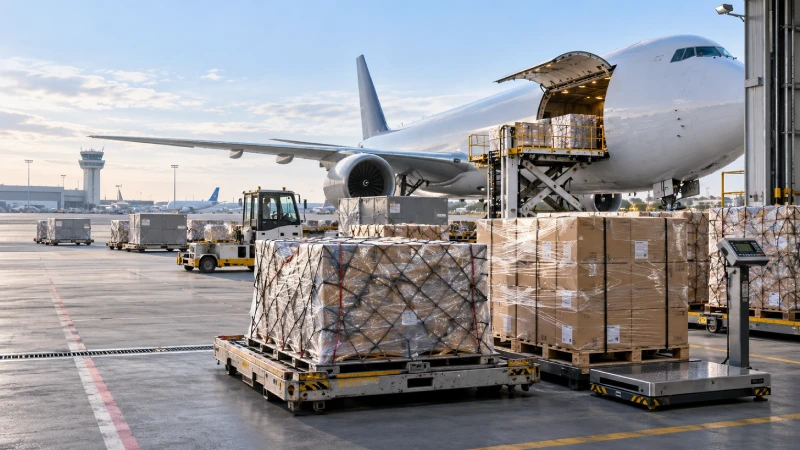
If you are importing commercial goods from China to Germany by air, asking “What is the air freight price per kg?” is a useful starting point—but it is not enough to calculate your final shipping cost.
Air freight is normally charged according to chargeable weight, which may be higher than the actual weight of your cargo. The applicable per-kilogram rate also changes according to shipment size, origin airport, airline, routing, cargo type, available capacity and whether you need airport-to-airport or door-to-door service.
For most China–Germany shipments, Frankfurt Airport (FRA) is the main reference gateway, although Munich (MUC), Cologne/Bonn (CGN) and Leipzig/Halle (LEJ) can be useful depending on your cargo, airline options and final German delivery address.
As a market reference, Xeneta reported an average China-to-Western-Europe air cargo spot rate of approximately USD 3.85/kg in August 2026. This is a corridor-level market benchmark, however—not a guaranteed China-to-Frankfurt quotation and not a German door-delivered price. See the latest market context from Xeneta.
The practical question is therefore not simply:
“What is the air freight rate per kg?”
It is:
“What is my chargeable weight, which rate tier applies, and what other charges must be added before my cargo reaches my address in Germany?”
This guide explains exactly how to work that out.
If you need a broader comparison of air, sea, rail and express transportation, see our Shipping Cost from China to Germany guide. For the complete route overview, see Shipping from China to Germany. This page focuses specifically on how commercial air freight pricing works.
How Is Air Freight from China to Germany Priced?
The basic calculation appears simple:
Air Freight = Chargeable Weight × Applicable Air Freight Rate
But that is only the main transport component.
A complete China-to-Germany shipment can involve several additional costs:
- pickup from your supplier in China;
- export customs clearance;
- origin terminal handling;
- security screening;
- air freight;
- carrier fuel or other applicable surcharges;
- air waybill and documentation charges;
- destination terminal handling in Germany;
- import customs clearance;
- import duty and VAT where applicable;
- final delivery from the German airport to your warehouse or business address.
This is why two forwarders may both quote “air freight” while presenting very different totals.
One quotation may be airport-to-airport only, while another includes pickup in China, customs brokerage and delivery to your German postcode.
Airport Rate vs Door-to-Door Air Freight Cost
| Quote Type | Typical Scope | What You Need to Check |
|---|---|---|
| Airport-to-airport | Air transport between origin and destination airports | Pickup, customs, handling and final delivery normally separate |
| Door-to-airport | China pickup plus export handling and air transport | German clearance and delivery usually separate |
| Airport-to-door | Air transport plus destination services | Confirm China origin charges |
| Door-to-door | China pickup through delivery in Germany | Confirm customs duty, VAT and special charges |
| DDP | Defined delivered-duty-paid solution | Confirm importer, tax and compliance responsibilities shipment by shipment |
Never compare a USD 3.50/kg airport rate directly with a USD 5.00/kg door-to-door quotation without first checking what each rate includes.
Pro Tip: When requesting air freight rates, ask whether the quoted USD/kg figure is a net airline rate, all-in airfreight rate, airport-to-airport rate or part of a door-to-door quotation.
Chargeable Weight: The Number That Determines Your Air Freight Bill
The most important concept in air freight pricing is chargeable weight.
Airplanes have both weight and space constraints. Dense cargo consumes a lot of weight capacity, while lightweight cartons can consume a large amount of aircraft space.
For this reason, airlines compare:
1. Actual gross weight
and
2. Volumetric weight
The higher figure normally becomes the chargeable weight.
IATA air cargo guidance uses a volume conversion based on 6,000 cubic centimetres per kilogram for applicable general air cargo calculations. See IATA chargeable-weight guidance.
What Is Actual Weight?
Actual weight is the physical gross weight of the shipment.
It includes more than the net weight of the products themselves. Depending on how the goods are packed, it can include:
- products;
- cartons;
- protective materials;
- wooden cases;
- pallets;
- wrapping and other transport packaging.
If your products weigh 280 kg but the packed shipment weighs 300 kg, the relevant actual weight is 300 kg, not 280 kg.
What Is Volumetric Weight?
Volumetric weight converts the space occupied by your cargo into a billing weight.
For general air freight, a common calculation is:
Volumetric Weight (kg) = Length × Width × Height (cm) × Quantity ÷ 6,000
For shipments measured in cubic metres, the practical shortcut is:
1 CBM ≈ 166.7 kg of volumetric weight
or approximately:
CBM × 167 = Volumetric Weight in kg
Actual Weight vs Volumetric Weight
Consider these two shipments:
| Cargo | Actual Weight | Volumetric Weight | Chargeable Weight |
|---|---|---|---|
| Dense machinery parts | 300 kg | 100 kg | 300 kg |
| Lightweight cartons | 85 kg | 400 kg | 400 kg |
The machinery is charged according to its actual weight because it is heavy relative to its volume.
The lightweight cartons are charged at 400 kg even though they physically weigh only 85 kg because they occupy much more aircraft space.
This is one of the main reasons why asking a forwarder:
“What is your China-to-Germany rate for 100 kg?”
may not produce a useful answer until carton dimensions are supplied.
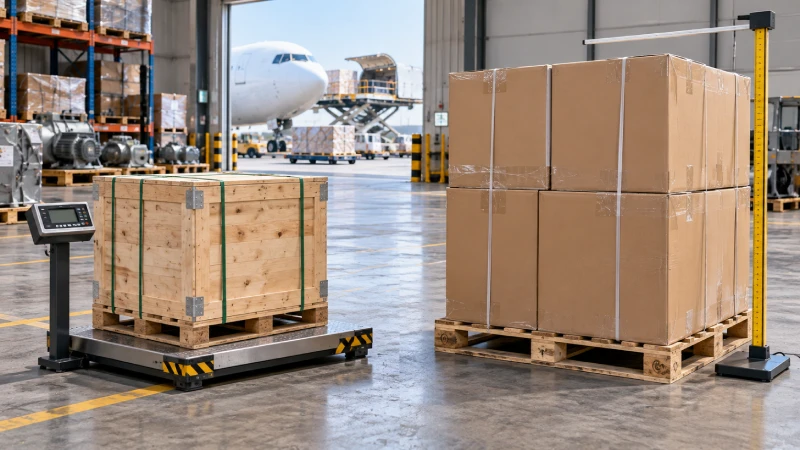
Chargeable Weight Calculator: Bulky Lightweight Cargo
Suppose you are importing:
10 cartons
Each carton measures:
80 × 60 × 50 cm
The total physical weight is:
85 kg
First calculate volumetric weight:
80 × 60 × 50 × 10 ÷ 6,000 = 400 kg
Your comparison is therefore:
| Weight Type | Result |
|---|---|
| Actual gross weight | 85 kg |
| Volumetric weight | 400 kg |
| Chargeable weight | 400 kg |
The freight calculation would therefore normally start from approximately 400 kg, not 85 kg.
If you found a market reference of USD X.XX/kg and simply multiplied it by 85 kg, you would substantially underestimate your freight cost.
This is especially important for products such as:
- plastic components;
- lamps and lighting fixtures;
- furniture parts;
- foam products;
- display materials;
- empty containers;
- large consumer-product cartons.
Pro Tip: Always obtain the final packed carton dimensions, not only the product dimensions shown by your supplier. Pallets, wooden cases and protective packaging can increase chargeable weight.
Chargeable Weight Example: Dense Cargo
Now consider machinery components with:
Actual weight: 300 kg
Volume: 0.60 CBM
Volumetric weight is approximately:
0.60 × 167 = 100 kg
The comparison becomes:
| Weight Type | Result |
|---|---|
| Actual gross weight | 300 kg |
| Volumetric weight | ~100 kg |
| Chargeable weight | 300 kg |
In this case, the physical weight determines the air freight charge.
Dense commercial goods can therefore have a much more favorable relationship between actual weight and aircraft space than large lightweight products.
Why Air Freight Rates Change at 45, 100, 300, 500 and 1,000 kg
Air cargo pricing is not normally one flat rate for every shipment size.
Carriers use tariff structures and quantity-based weight breaks. Common commercial references include:
| Rate Band | Meaning |
|---|---|
| M | Minimum charge |
| N / under 45 kg | Normal rate |
| +45 | Rate for shipments meeting the 45 kg break |
| +100 | Rate for 100 kg+ shipments |
| +300 | Rate for 300 kg+ shipments |
| +500 | Rate for 500 kg+ shipments |
| +1,000 | Rate for 1,000 kg+ shipments |
The exact structure varies by carrier and route, but the general principle is important:
As shipment weight increases, the rate per kg may decrease.
IATA’s TACT system provides current airline tariffs, rates, rules and schedules, which is one reason a professional air freight quotation should be based on current carrier data rather than an old internet rate table. See IATA TACT.
Why 300 kg Does Not Simply Cost Three Times as Much as 100 kg
Suppose a shipment has:
100 kg chargeable weight
It may be quoted using a +100 rate.
Another shipment has:
300 kg chargeable weight
It may qualify for a lower +300 rate.
The 300 kg shipment therefore uses more freight capacity, but its cost per kilogram may be lower.
The same principle can apply at +500 kg and +1,000 kg.
This is why commercial importers should request the applicable weight-break rate rather than extrapolating from the rate paid on a previous smaller shipment.
Can a 480 kg Shipment Be Charged as 500 kg?
Sometimes the next weight break can produce a lower total freight charge.
Consider a 480 kg chargeable shipment.
Instead of looking only at:
480 × +300 rate
the forwarder should also check:
500 × +500 rate
If the lower +500 tariff produces a smaller total freight amount, rating the shipment at the higher break may be commercially advantageous where the applicable tariff permits it.
The principle is:
480 × R300
versus:
500 × R500
If:
500 × R500 < 480 × R300
the +500 calculation may be preferable.
This does not mean every carrier or quotation will work this way. It means that experienced air freight pricing should check the next breakpoint rather than mechanically multiplying the exact shipment weight by one tariff.
Pro Tip: If your chargeable weight is close to 100, 300, 500 or 1,000 kg, ask whether the next rate break produces a lower total freight cost.
Air Freight Examples for 100 kg, 300 kg, 500 kg and 1,000 kg
Before looking at rates, first determine what weight the airline will actually charge.
| Shipment | Actual Weight | Volume | Approx. Volumetric Weight | Chargeable Weight | Relevant Rate Tier |
|---|---|---|---|---|---|
| Dense shipment | 100 kg | 0.40 CBM | 67 kg | 100 kg | +100 |
| Bulky 100 kg shipment | 100 kg | 0.80 CBM | 134 kg | ~134 kg | +100 |
| Dense commercial cargo | 300 kg | 1.00 CBM | 167 kg | 300 kg | +300 |
| Bulky shipment | 500 kg | 4.00 CBM | ~668 kg | ~668 kg | Usually +500 |
| Dense large shipment | 1,000 kg | 5.00 CBM | ~835 kg | 1,000 kg | +1,000 |
The important lesson is that a shipment described as “500 kg of goods” may not be a 500 kg air freight shipment.
If those goods occupy 4 CBM, the airline may calculate approximately 668 kg of chargeable weight.
That difference directly affects the final freight amount.
Current Air Freight Cost from China to Frankfurt: What Can We Reliably Say?
Air freight prices move frequently. Capacity, demand, fuel costs, e-commerce traffic, holidays, geopolitical disruption and airline schedule changes can all affect short-term pricing.
For that reason, Winsail Logistics does not recommend treating a static internet rate as a guaranteed shipping price.
Current China-to-Europe Market Benchmark
Xeneta reported that China-to-Western-Europe spot air freight rates averaged approximately USD 3.85/kg in August 2026, following a month-on-month decline.
This is useful for understanding the overall condition of the market, but it should not be interpreted as:
- a guaranteed Shanghai-to-Frankfurt rate;
- a +100 kg rate;
- a +500 kg rate;
- a door-to-door Germany rate;
- a rate including customs clearance;
- a rate including import duty or VAT;
- a rate including German final delivery.
See the source at Xeneta.
Indicative Frankfurt Market References
One August 2026 market update published the following indicative general-cargo references from China to Frankfurt:
| Chargeable Weight | Indicative Market Reference |
|---|---|
| +100 kg | USD 2.51–6.34/kg |
| +300 kg | USD 2.37–6.20/kg |
| +1,000 kg | USD 2.30–5.22/kg |
These ranges are extremely broad because different origins, carriers, routings and available capacities can produce very different results. The source also explicitly states that the figures are indicative and that customs clearance, duties and destination delivery are excluded unless otherwise stated. See the market reference from BSI Freight.
There is therefore no responsible way to convert this table into a universal Winsail rate such as:
“China to Germany air freight costs USD 3.20/kg.”
A shipment from Shenzhen to Frankfurt at 1,100 kg and a 110 kg shipment from an inland Chinese factory may both be “China-to-Germany air freight,” but they are very different pricing cases.
For an actual shipment, request a current quotation based on the cargo-ready date and complete packed dimensions.
Why Two China-to-Frankfurt Quotes Can Have Different Rates
It is entirely normal for two valid air freight quotations to have noticeably different USD/kg figures.
Understanding why helps importers compare them properly.
1. China Origin Airport
A shipment originating near:
- Shanghai/PVG;
- Guangzhou/CAN;
- Shenzhen/SZX;
- Beijing/PEK;
may have different airline and consolidation options.
If your supplier is in an inland manufacturing city, the cheapest international flight may also require domestic trucking to a major gateway.
A lower airline rate can therefore be offset by higher origin transportation or handling costs.
The correct comparison is:
Factory → China gateway → German gateway → German destination
not simply:
airport rate A vs airport rate B.
2. Airline Capacity
Air cargo can move through:
- passenger aircraft belly capacity;
- dedicated freighters;
- scheduled cargo allocations;
- consolidations;
- spot capacity.
Available space affects pricing.
A carrier with limited space on a particular departure may quote much more aggressively for a later flight—or charge a premium for immediate capacity.
3. Direct vs Connecting Flights
A direct service and a connecting service should not automatically be treated as equivalent.
| Factor | Direct Flight | Connecting Service |
|---|---|---|
| Transit time | Usually shorter | Usually longer |
| Transfer points | Fewer | More |
| Rate | Can command a premium | Can be more economical |
| Capacity options | Depends on lane | Can provide more alternatives |
| Best for | Urgent/high-value cargo | Flexible commercial cargo |
Recent China–Europe market reporting has noted periods when connecting capacity remained more available while direct capacity was tighter. That can create a noticeable premium for faster direct services. See BSI Freight’s China–Europe air freight update.
Pro Tip: For non-critical cargo, request both a fast direct option and a best-value connecting option. The lowest reasonable total cost may not come from the fastest flight.
What Is Included in an Air Freight Price per KG?
One of the biggest mistakes when comparing air freight quotes is assuming the quoted USD/kg rate represents the complete shipping cost.
It often does not.
A typical cost structure may look like this:
| Cost Component | Typical Charging Basis | Automatically Included in USD/kg Air Rate? |
|---|---|---|
| Factory pickup in China | Truck / shipment | Usually no |
| Export customs clearance | Shipment | Usually no |
| Origin terminal handling | Shipment / kg | Depends |
| Security screening | Shipment / kg | Depends |
| Main air freight | Chargeable kg | Yes |
| Carrier/fuel-related surcharge | kg / shipment | Depends on quote |
| Air waybill/documentation | AWB | Usually separate |
| German terminal handling | Shipment / kg | Usually separate |
| Customs brokerage | Declaration / shipment | No |
| Customs duty | Customs calculation | No |
| Import VAT | Tax calculation | No |
| German final delivery | Shipment / postcode | No |
Always request a cost breakdown if the scope is unclear.
A quotation stating:
Air freight: USD X.XX/kg
is not enough to determine your landed logistics cost.
Fuel, Security and Airline Surcharges
Air freight quotations can contain carrier surcharges in different ways.
One forwarder may show:
Air freight: USD X.XX/kg
and then list a surcharge separately.
Another may quote an:
all-in airfreight rate
that combines applicable airline charges into one figure.
Because the structure can differ by carrier, lane and contract, German importers should not compare the headline KG rate without checking the quotation notes.
Ask specifically:
Are fuel, security and current airline surcharges included in this rate?
If the answer is no, request the additional amount before comparing quotations.
Minimum Charges: Why Small Air Shipments Can Be Expensive per KG
Air cargo involves fixed operational costs regardless of whether the shipment weighs 20 kg or 300 kg.
These can include:
- airway bill processing;
- export documentation;
- terminal handling;
- security processing;
- customs brokerage;
- warehouse release;
- delivery administration.
Airlines and forwarders may also apply a minimum freight charge.
Suppose the nominal air rate is represented by R, but the carrier’s applicable minimum freight charge is M.
If:
Chargeable Weight × R < M
the minimum charge may apply instead.
This is why very small commercial shipments can have a high effective cost per kilogram.
A 25 kg shipment might technically have a low air rate, but after minimum freight, handling and delivery charges are added, an integrated express courier may be more competitive.
When Can DHL, FedEx or UPS Express Be Cheaper Than Air Freight?
For small shipments, do not automatically assume conventional air freight is cheaper than express courier.
Express companies combine several logistics stages into one network, often including:
- collection;
- export processing;
- international transportation;
- destination handling;
- customs-processing infrastructure;
- final delivery.
This can make express commercially attractive for smaller shipments despite a relatively high headline transport price.
Volumetric Weight Is Different
Another important difference is dimensional-weight calculation.
General air cargo commonly uses:
Length × Width × Height ÷ 6,000
DHL Express publishes a standard volumetric divisor of 5,000 cm³/kg for relevant express services. See the DHL volumetric-weight guidance.
That means the same bulky carton can produce a higher volumetric weight under an express calculation.
For example:
60 × 50 × 40 cm
General air freight:
120,000 ÷ 6,000 = 20 kg
Express using a 5,000 divisor:
120,000 ÷ 5,000 = 24 kg
For dense goods, this difference may not matter.
For lightweight bulky products, it can matter significantly.
Practical Decision Guide
| Shipment Profile | Express | Standard Air Freight |
|---|---|---|
| Below 45 kg | Always worth comparing | Minimum charges may hurt |
| 45–100 kg | Compare both | Increasingly competitive |
| 100–300 kg | Sometimes competitive | Usually strong candidate |
| 300 kg+ | Less commonly the best choice | Typically better suited |
| Palletized commercial cargo | Often less suitable | Designed for this use |
| Bulky lightweight cartons | Check 5,000 divisor carefully | 6,000 divisor may help |
There is no universal rule that “express is cheaper below 100 kg.”
The correct threshold depends on cargo density, courier account discounts, pickup location, German postcode and required delivery speed.
Pro Tip: For shipments below approximately 100 kg, ask for both express and standard air freight options before booking.
Frankfurt Airport: The Main Reference Gateway for China–Germany Air Freight
Frankfurt Airport is normally the most important gateway to consider for general commercial air cargo entering Germany.
Fraport reported approximately 2.1 million metric tons of freight and mail in 2025, maintaining Frankfurt’s position as a major European air cargo hub with extensive passenger-belly and freighter connectivity. See Fraport’s 2025 traffic figures.
For German importers, this scale can provide:
- extensive airline choices;
- direct and connecting capacity;
- established cargo handling infrastructure;
- customs and brokerage options;
- road connections throughout Germany and neighboring EU markets.
But a competitive China-to-FRA airline rate does not necessarily mean the final door-delivered cost is cheapest.
You must still consider what happens after the aircraft lands.
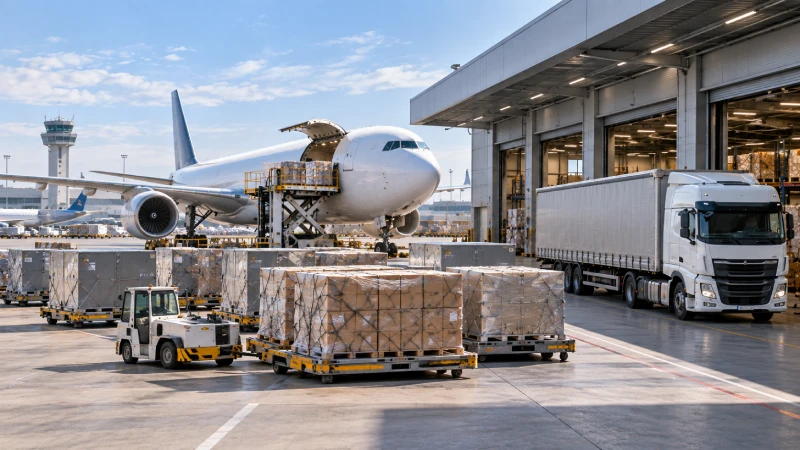
What Costs Can Be Added After Cargo Arrives at Frankfurt?
Terminal Handling
Imported cargo needs to be:
- unloaded;
- processed;
- entered into the cargo handling system;
- stored until release;
- transferred to the consignee or nominated trucking provider.
Handling charges vary according to airline, terminal operator, forwarder arrangement, shipment weight and cargo characteristics.
There is therefore no single universal “Frankfurt handling fee” that applies to every shipment.
Storage
Storage becomes an important risk if cargo cannot be released promptly.
Common reasons include:
- missing commercial documents;
- customs classification questions;
- EORI problems;
- customs examination;
- importer delays;
- unpaid destination charges;
- cargo requiring special authorization.
Even if your China-to-Frankfurt air rate is excellent, several days of avoidable airport storage can eliminate the saving.
Pro Tip: Where possible, send the commercial invoice, packing list, HS-code information and importer details to the customs broker before the aircraft arrives.
German Customs Clearance Is Separate from Air Freight Pricing
Air freight cost and import taxation should be treated separately.
German Customs explains that import charges can include customs duty, import VAT and, for applicable products, excise duties. Customs valuation and the tariff classification of the goods affect the amount payable. See German Customs guidance on duties and taxes.
For commercial imports, the importer and broker also need the correct customs identification information.
Germany’s customs authority states that an EORI number is used to identify economic operators in customs procedures and is required in relevant customs declarations. See German Customs EORI guidance.
For an air freight quotation, distinguish carefully between:
Customs brokerage fee
A service charge for preparing and processing the declaration.
Customs duty
A government charge determined according to factors including tariff classification and customs value.
Import VAT
A tax calculated according to the applicable German/EU rules.
These are not interchangeable.
A quotation saying:
“Customs clearance included”
does not automatically mean:
“Customs duty and import VAT included.”
For product-specific tariff questions, use the relevant German Customs and EU tariff resources and verify the HS code before shipment.
For a deeper explanation, see our Import Duties and Taxes from China to Germany guide.
Final Delivery from Frankfurt to Your German Address
Once your cargo has cleared customs, the remaining cost depends heavily on the final delivery address.
The rate from Frankfurt Airport to a consignee in Frankfurt is obviously not the same as delivery to Hamburg, Munich, Berlin or a remote industrial location.
German delivery charges may depend on:
- destination postcode;
- chargeable or physical weight;
- number of pallets;
- pallet dimensions;
- stackability;
- loading-meter requirements;
- hazardous-goods status;
- tail-lift requirement;
- appointment delivery;
- residential vs commercial location;
- groupage vs dedicated truck.
For a true door-to-door comparison, use:
China Origin Costs + Air Freight + German Destination Charges + Customs Brokerage + German Delivery
rather than comparing only:
USD/kg airline rate.
Pro Tip: Ask for the total cost to your exact German postcode. The cheapest airport-to-airport quotation is not necessarily the cheapest door-to-door option.
Frankfurt vs Munich vs Cologne/Bonn vs Leipzig/Halle
Frankfurt is the logical primary gateway for this article, but it is not the only airport worth considering.
German Air Cargo Gateway Comparison
| Airport | Main Strength | When to Consider It |
|---|---|---|
| Frankfurt (FRA) | Large general cargo network and international connectivity | Most standard China–Germany air freight |
| Munich (MUC) | Strong southern German catchment and passenger-belly network | Bavaria and southern Germany |
| Cologne/Bonn (CGN) | Major express and cargo ecosystem | NRW, express-oriented freight |
| Leipzig/Halle (LEJ) | Major DHL Express hub and 24/7 operation | Express networks and central/eastern Germany |
Frankfurt Airport — FRA
Frankfurt should normally be the first gateway to check for general commercial cargo because of its scale, freighter connections, passenger belly capacity and road connectivity.
It is especially useful when you need several carrier or routing options rather than relying on one service.
Munich Airport — MUC
Munich can be commercially attractive for cargo destined for Bavaria and other parts of southern Germany.
Munich Airport recorded approximately 339,671 tonnes of commercial air freight in 2025, up more than 10% year on year. Passenger aircraft belly capacity represented a particularly large share of its freight activity. See the Munich Airport 2025 financial report.
For a consignee near Munich, Nuremberg or another southern German industrial area, a slightly different air rate into MUC may still produce a competitive total door cost by reducing inland trucking.
Cologne/Bonn Airport — CGN
Cologne/Bonn is an important option for North Rhine-Westphalia and express logistics.
The airport describes itself as one of Europe’s major cargo airports and states that UPS, FedEx and DHL operate hubs there, giving CGN a particularly strong courier and express logistics profile. See Cologne Bonn Airport.
Leipzig/Halle Airport — LEJ
Leipzig/Halle is especially significant because of DHL’s large express operation.
DHL describes Leipzig as the largest hub in its global Express network, operating around the clock to support time-critical shipments. See DHL Hub Leipzig.
For certain express or central/eastern German flows, this network can be relevant even though FRA remains the more useful general reference point for standard China–Germany air freight comparisons.
Which German Airport Is Cheapest?
There is no permanent answer.
Instead compare:
China factory → departure airport → German gateway → customs → final German postcode
For example, FRA may have a cheaper air rate but require a longer domestic truck movement.
MUC might have a slightly higher air rate but lower final delivery cost for a consignee in Bavaria.
The best routing is the one with the strongest total landed logistics cost and acceptable transit time, not necessarily the lowest airport rate.
When Does Rail Freight Become More Economical Than Air?
There is no single kilogram threshold where air freight suddenly becomes uneconomical.
Cargo value, density, urgency and inventory requirements matter.
However, once shipments reach several hundred kilograms, importers should increasingly compare air freight with Rail Freight from China to Germany.
A practical approach is:
| Shipment Size | Recommended Comparison |
|---|---|
| Around 100 kg | Air vs express |
| Around 300 kg | Air remains strong; consider rail if non-urgent |
| Around 500 kg | Compare air and rail |
| Around 1,000 kg+ | Strongly compare air, rail and potentially sea |
| High-CBM bulky cargo | Compare alternative modes earlier |
This is not a rigid rule.
A 500 kg shipment of urgent automotive components may still clearly justify air freight.
A non-urgent 500 kg shipment with a large cubic volume may be more economical by rail.
Rail becomes more attractive when:
- delivery is not extremely urgent;
- the shipment is too expensive by air;
- cargo is moving on a planned replenishment cycle;
- the importer can tolerate longer transit;
- the products are suitable for the available rail service.
When Does Sea Freight Become More Economical?
Sea freight should be considered even earlier when cargo is bulky and non-urgent.
For example, a lightweight shipment can have:
Actual weight: 500 kg
but:
Volume: 8 CBM
Its air volumetric weight could be approximately:
8 × 167 = 1,336 kg
The shipment would therefore be charged as roughly 1.3 tonnes by air even though it physically weighs only 500 kg.
That is exactly the type of shipment where sea LCL may deserve serious consideration.
Sea freight becomes increasingly attractive when:
- cargo is bulky;
- unit value is relatively low;
- inventory is planned well in advance;
- delivery is not urgent;
- the importer can tolerate a longer transit cycle.
Do not select a transport mode according to kilograms alone.
Use:
cargo density + urgency + inventory cost + total transport cost
to make the decision.
See our Sea Freight from China to Germany guide for the full comparison.
How to Get an Accurate Air Freight Quote from China to Germany
A reliable forwarder cannot calculate an accurate rate from:
“300 kg from China to Germany.”
At minimum, provide:
| Information | Why It Matters |
|---|---|
| Commodity | Determines cargo acceptance and handling requirements |
| China pickup city | Determines origin transportation and gateway options |
| Incoterm | Defines who handles which origin costs |
| Carton/pallet quantity | Required for handling and volume |
| Gross weight | Used for chargeable-weight calculation |
| Exact packed dimensions | Determines volumetric weight |
| Cargo value | Relevant to customs and insurance |
| Stackability | Affects capacity and handling |
| Battery/DG/liquid/magnet status | Can affect airline acceptance and rates |
| Cargo-ready date | Required for current space and spot pricing |
| German postcode | Required for final delivery |
| Delivery deadline | Helps select direct vs connecting service |
| Importer/EORI information | Supports customs planning |
Example Quote Request
A useful RFQ should look more like this:
Commodity: Automotive components
Pickup: Shenzhen, China
Quantity: 12 cartons
Gross Weight: 320 kg
Dimensions: 60 × 50 × 45 cm × 12 cartons
Cargo Ready Date: 18 September
Destination: 603xx, Frankfurt, Germany
Service Required: Air freight, door-to-door
Cargo Type: General cargo, no battery, no DG
With this information, Winsail can calculate chargeable weight, compare available airlines and determine whether direct, connecting, express or another transport mode makes the most commercial sense.
How to Read a China–Germany Air Freight Quote
Before booking, check more than the total price.
| Quote Item | What to Confirm |
|---|---|
| Chargeable weight | Actual or volumetric? |
| Rate band | +100, +300, +500 or +1,000? |
| Airline | Which carrier/service? |
| Origin airport | PVG, CAN, SZX or another gateway? |
| Destination airport | FRA, MUC, CGN, LEJ or other? |
| Routing | Direct or connecting? |
| Transit estimate | Airport-to-airport or door-to-door? |
| Rate validity | Until which date? |
| Space | Quotation only or confirmed booking? |
| Fuel/security charges | Included or separate? |
| China pickup | Included? |
| Export customs | Included? |
| German handling | Included? |
| Customs brokerage | Included? |
| Duty and VAT | Included or payable separately? |
| Final delivery | Which German postcode? |
| Storage | What happens if customs release is delayed? |
A very cheap USD/kg rate may still result in an expensive shipment if destination charges are excluded.
Likewise, a slightly higher freight rate can sometimes produce a lower total cost if it includes better routing, lower handling or more efficient final delivery.
How to Reduce Your China–Germany Air Freight Cost
Importers usually have more control over air freight cost than they think.
Reduce Unnecessary Packaging Volume
If volumetric weight is higher than actual weight, reducing carton size can directly reduce freight cost.
Work with your supplier to eliminate excessive empty space where product protection allows.
Consolidate Purchase Orders
Several small shipments may each incur minimum charges.
Combining them into one +100, +300 or +500 kg shipment can sometimes improve the per-kilogram rate and reduce repeated documentation charges.
Keep Delivery Dates Flexible
If your cargo can accept a connecting flight or departure one or two days later, additional capacity options may become available.
Compare More Than One China Gateway
For suppliers located between major export regions, trucking to another gateway can occasionally produce a better overall routing.
The calculation should include domestic trucking, however—not simply the airline rate.
Split Urgent and Non-Urgent Cargo
You do not necessarily need to move the entire purchase order by air.
One strategy is to ship the quantity needed immediately by air while moving replenishment inventory by rail or sea.
This can protect stock availability without paying air freight on every unit.
Check Your China–Germany Air Freight Cost
The most accurate way to determine air freight cost is to calculate the shipment using its final packed dimensions, gross weight, China origin and German delivery postcode.
Send Winsail Logistics:
- commodity;
- number of cartons or pallets;
- gross weight;
- dimensions of each package type;
- pickup city in China;
- cargo-ready date;
- destination postcode in Germany;
- required delivery time.
We can then compare the relevant chargeable-weight tier, airport options and routing rather than applying a generic internet rate to your shipment.
FAQ
How much does air freight from China to Germany cost per kg?
There is no fixed China-to-Germany air freight price per kg. Xeneta reported an average China-to-Western-Europe spot rate of approximately USD 3.85/kg for August 2026, but this is a market benchmark rather than a shipment-specific Frankfurt quotation. Actual pricing depends on chargeable weight, origin airport, airline, routing, cargo type, departure date and service scope.
How is chargeable weight calculated for air freight from China to Germany?
Compare actual gross weight with volumetric weight. A common general-air-cargo formula is Length × Width × Height in cm × Quantity ÷ 6,000. The higher figure normally becomes the chargeable weight.
How many kilograms is 1 CBM for air freight?
Using the common 6,000 cm³/kg airfreight conversion, 1 CBM is approximately 166.7 kg of volumetric weight, commonly rounded to 167 kg.
What is the air freight rate for 100 kg from China to Germany?
A 100 kg shipment will typically fall into a +100 rate category if its chargeable weight is at least 100 kg, but there is no universal +100 China–Germany rate. The actual price depends on origin airport, carrier, routing, capacity, cargo type and date.
Why is the 500 kg air freight rate sometimes cheaper per kg than the 300 kg rate?
Airlines commonly use quantity-based tariff breaks. Larger shipments may qualify for lower per-kilogram +500 or +1,000 rates even though the total shipment cost is still higher.
Is Frankfurt the cheapest airport for air freight from China?
Not always. Frankfurt offers extensive airline and cargo options, but the lowest airport rate does not automatically produce the lowest door-delivered cost. Munich, Cologne/Bonn or Leipzig/Halle may be useful depending on the final German destination and service type.
Does an air freight rate include German customs duty and VAT?
Usually not unless the quotation explicitly states otherwise. Air freight, customs brokerage, customs duty, import VAT and final delivery should be treated as separate cost categories.
When is express cheaper than standard air freight?
Express can be competitive for smaller shipments because pickup, international transport, destination processing and final delivery are integrated into one network. It is especially worth comparing express and standard air freight below 45 kg and often again in the 45–100 kg range.
Should I use air or rail freight for a 500 kg shipment?
It depends on urgency, density, cargo value and delivery requirements. A dense urgent 500 kg shipment may still justify air freight, while a non-urgent bulky shipment may be more economical by rail.
When should I choose sea freight instead of air freight?
Sea freight becomes increasingly attractive when cargo is bulky, lower value and non-urgent. Compare total cost based on cargo volume, urgency and inventory needs rather than using a fixed kilogram threshold.
Do batteries or dangerous goods cost more to ship by air?
They can. Lithium batteries, dangerous goods, certain chemicals, liquids and other restricted cargo may require additional documentation, special packaging, carrier approval and specific handling, so they should be quoted separately.
Final Takeaway
The most important thing to remember about the air freight cost from China to Germany per kg is that the kilogram rate is only one part of the calculation.
Start with:
Actual Weight vs Volumetric Weight → Chargeable Weight
Then determine:
Applicable Weight Break → Airline and Routing → Included Surcharges
Finally add:
China Origin Costs → German Airport Handling → Customs Brokerage → Final Delivery
For a small shipment, compare standard air freight with express.
For shipments around several hundred kilograms, begin comparing rail where your schedule allows.
For bulky and non-urgent cargo, compare sea freight based on total cubic volume.
And when comparing two China–Germany air freight quotations, do not choose one simply because its USD/kg figure is lower.
Compare the same service scope, the same chargeable weight and the complete cost to your German destination.
That is how you determine what air freight from China to Germany actually costs.
