
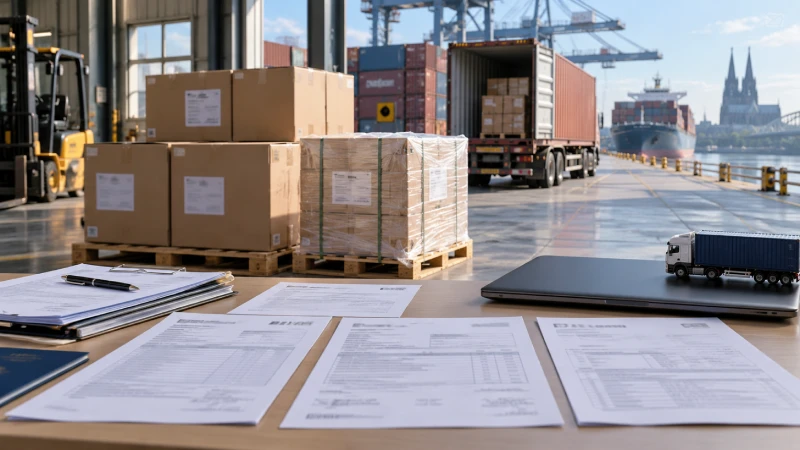
Importing goods from China into Germany requires more than collecting a commercial invoice and a packing list. The documents and information needed depend on the product, customs classification, transport mode, importer structure and whether the goods are subject to EU product, safety or licensing rules.
For a straightforward shipment of non-regulated commercial goods, the document pack may be relatively simple. A shipment involving lithium batteries, chemicals, machinery, food, plants or other regulated products can require additional compliance or transport documents.
The most important point is this:
Not every shipment from China to Germany requires every document in this checklist.
A useful way to prepare is to separate the requirements into five groups:
- core shipping documents;
- customs and import information;
- product-specific compliance documents;
- dangerous-goods documents; and
- origin, licence or certificate requirements that apply only to certain goods.
This guide explains what each document does, when it is likely to be needed and what should be checked before the cargo leaves China.
If you are still planning the overall route, shipping method or destination, start with our Shipping from China to Germany guide.
Quick Answer: What Documents Do You Need to Import from China to Germany?
For a typical commercial shipment from China to Germany, the basic shipping file will usually include:
- a commercial invoice;
- a packing list; and
- the relevant transport document, such as a Bill of Lading, sea waybill, Air Waybill or rail transport document.
For German or EU customs clearance, the importer or customs representative also needs accurate import information. This normally includes the importer and EORI details, correct CN/TARIC classification, customs value, Incoterm and country of origin.
Depending on the product, additional documents may be required. Examples include an EU Declaration of Conformity for products covered by applicable CE-marking legislation, a Safety Data Sheet for certain hazardous substances or mixtures, a UN38.3 test summary for applicable lithium batteries, or an import licence or official certificate for regulated goods.
An SDS, CE-related documentation, Certificate of Origin or import licence should therefore not be added automatically to every shipment checklist. First identify the exact product and check which rules apply.
Germany Import Documents Checklist at a Glance
| Document or information | Typical status | Main purpose | Usually provided or prepared by |
|---|---|---|---|
| Commercial invoice | Usually needed | Transaction, product and valuation information | Chinese supplier/exporter |
| Packing list | Usually needed operationally | Package contents, weights and dimensions | Supplier/exporter |
| Bill of Lading / sea waybill | Sea freight | Evidence and details of sea carriage | Carrier/forwarder |
| Air Waybill | Air freight | Air transport record | Airline/forwarder |
| Rail transport document | Rail freight | Rail carriage information | Rail operator/forwarder |
| Importer details | Required for customs declaration | Identifies the importing party | Importer |
| EORI | Normally required for customs operations | EU customs identification | Importer/declarant |
| CN/TARIC classification | Required customs information | Determines tariff and regulatory measures | Importer/broker |
| Customs value | Required customs information | Basis for customs duties | Importer/broker |
| Incoterm and named place | Usually relevant | Clarifies commercial cost allocation | Buyer and seller |
| Country of origin | Required customs information | Determines origin-related treatment | Importer with supplier information |
| Customs representation authorisation | Conditional | Authorises broker representation | Importer |
| EU Declaration of Conformity | Product-specific | Supports conformity obligations | Manufacturer/importer |
| Technical documentation | Product-specific | Supports regulatory compliance | Manufacturer |
| Safety Data Sheet | Conditional | Chemical/hazard information | Supplier/manufacturer |
| UN38.3 test summary | Lithium-battery specific | Supports battery transport compliance | Manufacturer/distributor |
| Dangerous-goods transport document | Conditional | Dangerous-goods transport compliance | Shipper |
| Import licence / official certificate | Product-specific | Regulated-goods approval | Importer / competent authority |
| Certificate or proof of origin | Conditional | Supports origin requirements where applicable | Exporter / authority / importer |
Pro Tip: Do not treat this table as a pack-everything list. Start with the first two columns and identify whether each item is typical, transport-mode specific, product-specific or conditional.
1. Core Shipping Documents
Core shipping documents describe the commercial transaction, physical cargo and transportation arrangement. They are usually the first documents requested by a freight forwarder or customs broker, but they are only one part of the import process.
Commercial Invoice
The commercial invoice is one of the most important documents in a China-to-Germany shipment.
It provides the commercial information customs and other parties use to understand what was sold, by whom, to whom and at what value.
A well-prepared commercial invoice should normally contain enough information to identify the transaction and the goods without relying on vague internal product names.
What Should Be on the Commercial Invoice?
Depending on the transaction, check that it includes:
- seller/exporter legal name and address;
- buyer/importer legal name and address;
- consignee if different from the importer;
- invoice number and date;
- accurate product description;
- model, SKU or part number where relevant;
- quantity and unit of measure;
- unit price;
- total line value;
- total invoice value;
- currency;
- country of origin information;
- Incoterm and named place; and
- relevant freight or insurance information where needed for valuation.
A commodity code may also be shown where the classification has been properly confirmed, but the code provided by a Chinese supplier should not automatically be treated as the final EU customs classification.
Avoid Vague Product Descriptions
A commercial invoice should allow someone unfamiliar with your purchase order to understand what the product actually is.
| Too vague | Better description |
|---|---|
| Machine parts | Stainless-steel replacement impeller for centrifugal water pump, model WP-220 |
| Electronics | 24V DC LED power supply, 100W, aluminium housing, model PS-100 |
| Plastic products | Injection-moulded polypropylene storage container, 30 L |
| Accessories | Stainless-steel mounting bracket for industrial conveyor system |
| Motor | 750W AC induction motor for industrial conveyor equipment |
| Cable | Insulated copper electrical cable, 3-core, 1.5 mm² |
The exact information required for tariff classification varies by product. Material, composition, technical specifications, function and intended use can all matter.
Pro Tip: Do not combine products with materially different characteristics into a single invoice line called “parts,” “accessories” or “samples.” They may require different classifications, duty treatment or compliance checks.
Commercial Invoice vs Pro Forma Invoice
A commercial invoice is normally used where an actual sale has taken place.
A pro forma invoice may appear in other scenarios, such as:
- samples;
- warranty replacements;
- goods sent free of charge;
- temporary transactions; or
- transactions where no conventional sale invoice exists.
However, “free of charge” does not automatically mean a customs value of zero.
German Customs explains that transaction value is the starting point where the transaction-value method can be used, while other valuation methods exist where it cannot.
If samples, replacement goods or related-party goods are being shipped without an ordinary sales price, discuss the valuation basis with the customs representative before arrival.
Packing List
The packing list describes how the goods are physically packed.
It should usually show:
- number of cartons, crates, pallets or other packages;
- package numbers;
- shipping marks where used;
- product and quantity per package;
- net weight where relevant;
- gross weight;
- dimensions;
- total cubic volume;
- palletisation information; and
- special packaging where applicable.
The packing list should agree with the physical shipment and commercial invoice.
Use a Three-Way Check Before Pickup
A simple pre-shipment check can prevent many documentation problems:
Commercial Invoice ↔ Packing List ↔ Actual Cargo
Verify the product descriptions, quantities, models, number of packages, weights and consignee details.
If the packing list says 48 cartons but the warehouse hands 52 cartons to the forwarder, correct the paperwork before departure instead of leaving the discrepancy to be discovered later.
Bill of Lading, Air Waybill or Rail Transport Document
The transport document depends on how the cargo moves from China to Germany.
| Shipping method | Typical transport document |
|---|---|
| FCL sea freight | Bill of Lading or sea waybill |
| LCL sea freight | Bill of Lading / House Bill of Lading |
| Air freight | Air Waybill |
| China-Europe rail | Applicable rail waybill / rail transport record |
| Express courier | Courier shipment/transport record |
These documents contain transportation information such as the shipper, consignee, routing, packages, weight and cargo description.
In consolidated freight, there may also be both master and house transport documents.
The transport document does not replace the commercial invoice, packing list or customs declaration. Each document serves a different purpose.
For a broader comparison of sea, air and rail options, see our Shipping from China to Germany guide.
2. Customs and Import Information Needed for Germany
One of the most common misconceptions is that everything required by customs must exist as a separate PDF or paper certificate.
It does not.
Some of the most important requirements are data elements used in the customs declaration, including the importer, commodity code, value, origin and customs procedure.
That is why a complete shipping-document folder can still result in clearance problems if the underlying customs information is wrong.
Importer Details and EORI Number
Before the shipment leaves China, determine who will legally act as the importer and who will lodge or be represented in the customs declaration.
The importer is not automatically:
- the delivery warehouse;
- the freight forwarder;
- the final end customer; or
- whoever appears in the “ship to” field of a purchase order.
The correct legal entity and customs structure must be established.
The European Commission states that an EORI number is mandatory for customs clearance for relevant customs operations in the EU, including import, export and transit. Economic operators established in EU customs territory require an EORI, while certain non-EU operators also need one when carrying out specified customs activities.
For a deeper explanation of importer identification, see EORI Number for Importing from China to Germany.
Importer Information Checklist
Confirm:
- legal company name;
- registered address;
- EORI;
- VAT information where relevant;
- consignee details;
- customs representative; and
- final delivery destination.
Pro Tip: Do not list a German fulfilment warehouse as the importer simply because the shipment is delivered there. Confirm the importer structure before issuing the final commercial invoice and transport instructions.
HS Code, CN Code and TARIC Classification
Importers often receive an HS code from their Chinese supplier and assume that the same number can be copied into a German customs declaration.
That is risky.
The EU classification system goes beyond the international six-digit Harmonized System.
A simplified structure is:
HS → CN → TARIC
The EU Combined Nomenclature is based on the Harmonized System and uses eight-digit CN codes. TARIC integrates additional EU tariff, commercial-policy and regulatory measures. See the European Commission’s Combined Nomenclature guidance and TARIC database guidance.
Correct classification can affect:
- customs duty;
- anti-dumping or countervailing duties;
- tariff quotas;
- import restrictions;
- licences;
- product controls;
- certificates; and
- supporting-document codes.
What Information May Be Needed to Classify a Product?
Depending on the commodity:
- material;
- composition;
- principal function;
- technical characteristics;
- power rating;
- size;
- manufacturing process;
- intended use;
- whether it forms part of another machine;
- chemical composition; or
- product drawings and datasheets.
Pro Tip: Use the supplier’s Chinese HS code as reference information—not as proof that the same classification applies in Germany. Confirm the appropriate EU CN/TARIC classification.
Customs Value
Customs value is another area where importers frequently make incorrect assumptions.
The amount shown at the bottom of the supplier’s commercial invoice is important, but it is not automatically the final customs value.
The European Commission states that three key elements affect the calculation of customs duties: tariff classification, customs value and origin. Transaction value is the primary valuation method and consists of the total amount paid or payable, subject to required additions and deductions.
German Customs similarly describes the transaction-value method as the first method considered before alternative valuation methods are applied.
Depending on the transaction, records relevant to customs valuation can include:
- commercial invoice;
- purchase order;
- sales contract;
- payment records;
- freight invoice;
- insurance costs;
- commissions or brokerage;
- assists supplied by the buyer;
- royalties or licence fees; and
- related-party information.
Transport and associated costs up to the relevant point of entry into EU customs territory can also affect the customs value where the applicable valuation rules require their inclusion.
For duty and tax planning, see Germany Import Duty & VAT from China. If you are budgeting the wider landed cost, see Shipping Cost from China to Germany.
Incoterm and Named Place
The Incoterm tells the buyer and seller how agreed transportation responsibilities, costs and risks are allocated.
Common China-to-Germany terms include:
- EXW;
- FCA;
- FOB;
- CIF;
- DAP; and
- DDP.
However, customs value should not be determined by looking only at the three-letter Incoterm.
For example, FOB Shanghai tells customs and the broker more than simply writing FOB. Similarly, CIF Hamburg is clearer than CIF because it identifies the named point relevant to the commercial arrangement.
For documentation purposes, use the Incoterm together with the named place and the agreed Incoterms version.
Pro Tip: The Incoterm helps identify which costs are included in the sales price, but it does not by itself determine the correct customs value, tariff classification or import taxes.
Country of Origin
Country of origin and country of shipment are not always the same thing.
Goods may leave a warehouse in China but contain materials or undergo production steps in multiple countries. Customs origin is determined under specific rules.
The European Commission explains that rules of origin identify the “economic nationality” of goods rather than simply the country from which they are shipped. For non-preferential origin, products involving more than one country may need to be assessed based on the relevant last substantial transformation rules.
For release for free circulation in the EU, non-preferential origin is a mandatory part of the declaration under the EU’s non-preferential origin rules.
Potential origin information may therefore include:
- country of manufacture;
- manufacturing process;
- sourcing of major materials;
- production location;
- supplier origin statements; and
- other evidence where customs requests it.
This does not mean every shipment requires a formal Certificate of Origin. That distinction is explained later in this guide.
Customs Broker Authorisation
Many importers appoint a freight forwarder or customs broker to handle customs formalities.
Depending on the representation arrangement, the broker may require:
- company details;
- EORI;
- VAT information;
- signed customs authorisation or power of attorney;
- commercial invoice;
- packing list;
- classification instructions;
- valuation information;
- origin information; and
- supporting documents required by TARIC.
A broker authorisation is therefore an example of a conditional document, not something that must automatically accompany every shipment.
For the broader clearance process, see Germany Customs Clearance for Imports from China.
Entry Summary Declaration and ICS2
The Entry Summary Declaration, or ENS, is part of EU safety and security controls for goods entering the customs territory.
The European Commission states that carriers are required to provide advance cargo information through an ENS for goods entering the EU.
Under Import Control System 2, inaccurate or incomplete pre-arrival data can lead to requests for additional information and can delay processing.
For most commercial importers, the carrier or other relevant logistics party handles the ENS filing. However, they rely on accurate information from the shipper, supplier, forwarder and importer.
That makes precise cargo descriptions important before the shipment departs—not only when the German customs declaration is prepared.
3. Product-Specific Compliance Documents
Shipping documents and customs documents do not automatically prove that a product is legally compliant for placing on the German or wider EU market.
Product compliance is a separate question.
Before requesting random “certificates” from a Chinese supplier, determine:
- exactly what the product is;
- which EU legislation applies;
- what conformity procedure is required;
- which documents must exist; and
- what obligations fall on the EU importer.
Does Every Product Imported into Germany Need CE Marking?
No.
This is one of the most common mistakes in online import guides.
The European Commission explicitly states that not all products require CE marking. CE marking is compulsory only for products covered by legislation that requires it, and it should not be placed on products where the relevant CE-marking rules do not apply.
Depending on the product and applicable legislation, CE-related rules may apply to categories such as:
- machinery;
- certain electrical equipment;
- radio equipment;
- toys;
- personal protective equipment;
- certain measuring instruments;
- medical devices; and
- other products covered by relevant EU harmonisation legislation.
The first question should therefore not be:
“Does my supplier have a CE certificate?”
It should be:
“Which EU legislation applies to this specific product, and what conformity documentation does that legislation require?”
EU Declaration of Conformity and Technical Documentation
Where CE-marking legislation applies, the EU Declaration of Conformity and technical documentation can be important parts of the compliance file.
The European Commission’s CE marking guidance states that manufacturers are responsible for carrying out the required conformity assessment, preparing the technical file, issuing the EU Declaration of Conformity and affixing the CE marking where required.
For products imported from outside the EU, EU importer and distributor guidance explains that importers must verify that the manufacturer has taken the necessary steps and that required documentation is available.
Depending on the legislation, the compliance file may involve:
- EU Declaration of Conformity;
- applicable EU legislation;
- manufacturer information;
- exact product/model identification;
- applicable harmonised standards;
- conformity assessment records;
- test reports;
- risk assessment;
- technical drawings;
- instructions;
- labelling information; and
- notified-body involvement where required.
Avoid the Generic “CE Certificate” Approach
A Chinese supplier may send a document labelled “CE Certificate,” but that title alone does not establish compliance.
Instead, check:
- which directive or regulation is being claimed;
- whether the product/model matches;
- whether the standards are relevant;
- whether the issuing/testing organisation’s role is appropriate;
- whether the EU Declaration of Conformity is correctly prepared; and
- whether the supporting technical documentation actually exists.
Pro Tip: Ask for the applicable EU Declaration of Conformity and supporting conformity documentation, rather than simply requesting “a CE certificate.”
Examples of Product-Specific Documentation
Different products may trigger completely different requirements.
| Product/regulatory situation | Documents that may apply | Needed for every shipment? |
|---|---|---|
| Product covered by CE legislation | EU DoC, technical documentation, conformity records | No |
| Certain construction products | Applicable Declaration of Performance / conformity documentation | No |
| Hazardous chemical substance or mixture | SDS and applicable REACH/CLP information | No |
| Food / certain animal products | Health or border-control documentation | No |
| Plants / regulated plant products | Phytosanitary documents | No |
| CITES-controlled products | CITES permits/certificates | No |
| Certain medical products | Sector-specific conformity/registration documentation | No |
| Product subject to TARIC restrictions | Relevant licence, certificate or supporting-document code | No |
| Product under trade-defence measures | Supporting documentation prescribed by the measure | No |
The exact requirements should be checked against the product’s classification and applicable EU legislation.
Because TARIC integrates restrictions, import controls, trade-defence measures and supporting-document codes, it should be checked before the goods are shipped.
Pro Tip: Product compliance should be reviewed while you are sourcing or preparing production—not after the container reaches Hamburg.
4. Dangerous Goods Documents
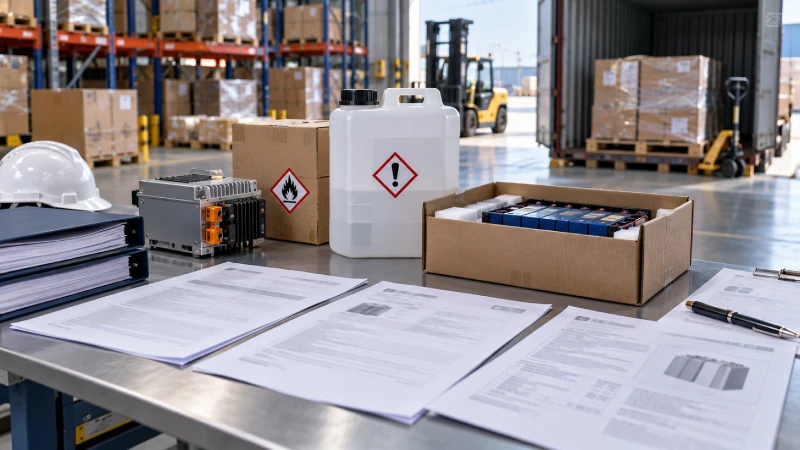
Dangerous-goods documentation is different from ordinary customs documentation.
A shipment can be correctly declared for customs purposes and still be unacceptable for transportation because the dangerous-goods classification, packaging, marking or documentation is incomplete.
Requirements also vary by transport mode.
Air, ocean, road and rail dangerous-goods rules are not identical.
Dangerous-Goods Information to Confirm
Where the cargo is classified as dangerous goods, the logistics parties may need information such as:
- UN number;
- proper shipping name;
- dangerous-goods class;
- subsidiary risk where applicable;
- packing group where applicable;
- flash point or other relevant properties;
- quantity;
- packaging type;
- battery configuration where applicable;
- technical/safety information; and
- dangerous-goods transport declaration where required.
Do not assume there is one universal dangerous-goods form that works for sea, air and rail freight.
The freight forwarder or carrier should review the classification against the rules applicable to the chosen transport mode.
Safety Data Sheet: When Is an SDS Needed?
A Safety Data Sheet provides information about a substance or mixture, including hazards, handling, storage, transport, first aid, firefighting and exposure controls.
However, an SDS is not a universal document for every imported product.
ECHA states that an SDS should be provided in circumstances including where a substance or mixture is classified as hazardous under CLP, where a substance is PBT or vPvB, or where it is included in the Candidate List of substances of very high concern. Certain other mixtures can trigger SDS provision on request.
Where an SDS is relevant to your shipment, review details such as:
- correct product or chemical name;
- manufacturer or supplier;
- revision date;
- composition;
- hazard classification;
- handling and storage;
- emergency measures;
- transport information;
- UN classification where relevant; and
- packaging or exposure information.
Pro Tip: An SDS does not automatically prove that the shipment has been correctly prepared for dangerous-goods transport. Transport classification, packaging, labelling, marking and carrier rules still need to be checked.
Lithium Batteries and UN38.3
Lithium battery shipments are a common source of documentation problems because requirements depend on:
- lithium-ion versus lithium-metal;
- standalone batteries;
- batteries packed with equipment;
- batteries contained in equipment;
- watt-hour rating or lithium content;
- battery design;
- quantity; and
- transport mode.
Depending on the shipment, relevant records can include:
- battery specification;
- applicable UN number;
- UN38.3 test summary;
- SDS where relevant;
- dangerous-goods declaration where required;
- package information;
- battery marking information; and
- carrier-specific forms or confirmations.
UNECE’s Manual of Tests and Criteria specifies the information that must be available in the lithium cell or battery test summary under subsection 38.3.5. This includes manufacturer information, test-laboratory information, test-report identification, battery description, tests and results, and the relevant edition of the Manual used.
UN38.3, SDS and DG Declaration Are Not the Same Document
These terms are sometimes used interchangeably by inexperienced shippers, but they serve different purposes.
UN38.3 test summary ≠ Safety Data Sheet ≠ Dangerous Goods Declaration
One document does not automatically replace another.
If your cargo contains lithium batteries, tell the forwarder before booking rather than describing the shipment simply as “electronics.”
5. Origin, Licences and Certificates Where Applicable
Origin documentation and import licences are another area where generic online checklists often create confusion.
Some articles imply that every shipment from China needs a formal Certificate of Origin and import licence.
That is incorrect.
Is a Certificate of Origin Required for Every Shipment from China to Germany?
No.
What is required is a correct determination and declaration of origin.
For goods released for free circulation in the EU, non-preferential origin forms part of the customs declaration. The declarant is responsible for correctly determining it and should hold adequate information about the relevant production or processing under the EU’s non-preferential rules of origin.
However, the European Commission also explains that customs authorities should not normally require a third-country non-preferential Certificate of Origin as proof except in specified cases.
This distinction is important:
Origin information is required; a separate Certificate of Origin is conditional.
For ordinary China-to-Germany commercial imports, do not automatically order a Certificate of Origin merely because it appears on a generic freight checklist.
Check whether the product, tariff measure or particular commercial requirement actually requires one.
Preferential and Non-Preferential Origin Are Different
EU customs distinguishes between preferential and non-preferential origin.
Non-preferential origin is relevant to matters such as:
- normal tariff treatment;
- anti-dumping measures;
- safeguards;
- quotas;
- trade restrictions; and
- statistics.
Preferential origin is relevant when a trade arrangement provides reduced or zero tariffs to qualifying originating goods and an appropriate proof of origin is used. See the European Commission’s proof of origin guidance.
Do not assume that a document showing “Made in China” automatically creates preferential tariff treatment.
Import Licences, Permits and Official Certificates
Many ordinary manufactured products can be imported without a product-specific import licence.
Other goods are subject to controls.
Depending on the commodity and circumstances, regulated categories can include:
- animals or animal products;
- certain foods;
- plants and plant products;
- chemicals;
- CITES-controlled products;
- certain agricultural goods;
- fluorinated-gas-related products;
- ozone-depleting substances;
- dual-use or controlled items;
- sanctioned or restricted goods;
- certain regulated industrial products; and
- goods affected by trade-defence measures.
TARIC records numerous tariff and non-tariff measures, including import controls, prohibitions and restrictions, CITES-related controls, veterinary and phytosanitary controls and supporting-document codes.
A Better Way to Check Licence Requirements
Use this order:
Identify the product → Confirm CN/TARIC classification → Review TARIC measures → Check applicable product legislation → Identify the exact required licence/certificate
Do not begin by asking:
“What licences do imports from China need?”
That question is too broad.
Ask:
“What licences or supporting documents apply to this specific TARIC classification and product?”
Pro Tip: Carry out this check before the cargo leaves China. Discovering a missing licence after arrival can create storage charges, customs delays or, in more serious cases, prevent release.
Who Prepares Which Import Documents?
Document responsibility is shared across several parties.
| Party | Typical responsibility |
|---|---|
| Chinese supplier/exporter | Commercial invoice, packing list, product details, manufacturing/origin information |
| Manufacturer | Product technical documentation, EU DoC where applicable, UN38.3 information where applicable |
| Freight forwarder | Booking data, house transport documents where applicable, transport coordination |
| Carrier | Master transport documents and carrier records |
| German/EU importer | EORI, importer information, classification, valuation, origin and product compliance responsibilities |
| Customs representative | Prepares/submits declaration using information and supporting documents supplied by importer |
| Competent authority / relevant body | Official licences, permits or certificates where legislation requires them |
Responsibilities can change according to the contractual and customs structure.
A freight forwarder arranging transportation should not automatically be described as the German importer simply because it controls the shipment booking.
Germany Import Documents Checklist Before Shipping
The safest time to resolve documentation problems is before the shipment departs from China.
Use the following checklist as a final review.
A. Commercial Invoice
- Seller/exporter legal name is correct
- Buyer/importer legal name is correct
- Consignee is identified if different
- Invoice number and date are included
- Product descriptions are specific
- Models or part numbers are shown where relevant
- Quantities are correct
- Unit prices and total values are correct
- Currency is stated
- Country of origin information has been checked
- Incoterm and named place are shown
- Freight and insurance information is available where relevant
B. Packing and Transport
- Packing list agrees with the invoice
- Number of cartons/pallets/crates is correct
- Gross and net weights have been checked
- Dimensions and CBM have been checked
- Shipping marks are correct
- B/L, AWB or rail instructions are correct
- Shipper and consignee information is consistent
C. Customs Information
- Actual importer has been identified
- EORI has been confirmed
- Customs representative has been appointed where needed
- EU CN/TARIC classification has been checked
- Customs value basis has been reviewed
- Country of origin has been determined
- TARIC measures have been reviewed
- Relevant customs procedure has been confirmed
D. Product Compliance
- Checked whether CE-marking legislation applies
- EU Declaration of Conformity is available where required
- Required technical documentation is accessible
- Product labelling has been reviewed
- Instructions/language requirements have been checked where applicable
- Relevant import licence/certificate has been identified
- Product-specific restrictions have been reviewed
E. Dangerous Goods
- Dangerous-goods status has been confirmed
- UN number has been confirmed where applicable
- SDS is available where required
- UN38.3 test summary is available for applicable lithium batteries
- Dangerous-goods declaration has been prepared where required
- Packaging and marking requirements have been checked with the carrier
Common Documentation Mistakes That Delay Germany Imports
The number of documents is usually less important than their accuracy and consistency.
| Common mistake | Why it creates problems | Better approach |
|---|---|---|
| Invoice says only “parts” | Insufficient information to classify goods | Describe material, function and product type |
| Chinese HS code copied automatically | EU CN/TARIC classification may differ | Verify EU classification |
| Invoice and packing list disagree | Raises questions about actual cargo | Reconcile before pickup |
| Wrong entity shown as importer | Can create EORI/customs representation issues | Confirm importer before shipping |
| Incoterm has no named place | Cost allocation becomes unclear | Use terms such as FOB Shanghai or CIF Hamburg |
| Invoice total assumed to equal customs value | Required valuation adjustments may be missed | Review customs valuation basis |
| Generic “CE certificate” accepted | May not demonstrate applicable EU compliance | Identify legislation and required conformity documents |
| Certificate of Origin treated as universal | It is not required for every shipment | Determine origin and check specific proof requirements |
| SDS used as the only DG document | SDS does not replace transport compliance | Check DG classification and modal rules |
| Battery shipment booked as “electronics” | Carrier may discover lithium content later | Declare battery configuration before booking |
| Import licence checked after arrival | Clearance may be blocked | Check TARIC before departure |
Pro Tip: Consistency Matters Across Every Document
A customs broker should not have to choose between conflicting versions of your cargo information.
Check that the following are consistent:
Commercial Invoice → Packing List → Booking → Transport Document → Customs Instructions → Actual Cargo
Small discrepancies such as different model numbers, weights or company names can create unnecessary clarification requests.
Recommended Pre-Shipment Document Workflow
A structured workflow is more reliable than waiting for the forwarder to request documents one at a time.
Step 1: Identify the German or EU Importer
Confirm the legal entity responsible for the import and its EORI before arranging the final shipment structure.
Step 2: Identify the Product Properly
Collect enough product information to understand exactly what is being imported.
This may include:
- technical datasheets;
- composition;
- materials;
- product photos;
- intended function;
- drawings;
- power specifications; or
- battery information.
Step 3: Confirm the CN/TARIC Classification
Use the product information—not only the Chinese supplier’s HS code—to establish the correct EU classification.
Then review tariff and non-tariff measures.
Step 4: Review Product Compliance
Determine whether the product is covered by:
- CE-related legislation;
- REACH/CLP;
- food or animal-product controls;
- phytosanitary requirements;
- CITES;
- F-gas rules;
- other sector-specific legislation; or
- special import restrictions.
Step 5: Check Dangerous-Goods Status
Do this before requesting the final freight booking.
Dangerous goods can affect:
- carrier acceptance;
- route;
- freight rate;
- packaging;
- labels;
- available flights or sailings; and
- documentation.
Step 6: Prepare the Commercial Invoice and Packing List
Use accurate product descriptions and make sure quantities, weights, packages and values are consistent.
Step 7: Confirm Customs Value and Origin
Do not wait until the vessel or flight arrives.
Provide supporting information to the customs representative where the transaction is more complicated than a simple unrelated-party sale.
Step 8: Prepare Transport-Mode-Specific Documentation
Check the final shipping instructions for:
- sea freight;
- air freight;
- rail freight; or
- courier transportation.
For FCL shipments, our 20ft & 40ft Container Shipping Cost from China to Germany guide also explains the other cost components that should be considered beyond the ocean rate.
Step 9: Send the Customs File Before Arrival
Do not wait until the cargo is discharged at Hamburg, Bremerhaven or reaches the destination terminal.
Allow the broker time to identify missing information.
Step 10: Perform a Final Cross-Check
Before departure, compare:
Invoice → Packing List → Transport Instructions → Customs Information → Compliance Documents → Actual Cargo
A short document review in China can prevent days of clarification after arrival.
When Should You Start Preparing Germany Import Documents?
Ideally, documentation checks should begin before production is complete, particularly where the goods are regulated.
For ordinary general cargo, the final invoice, packing list and transport information can normally be completed closer to pickup.
For products involving CE compliance, chemicals, dangerous goods, lithium batteries, licences or official certificates, documentation should be reviewed much earlier.
Waiting until the goods are already packed can be expensive if you discover that:
- the product requires different labelling;
- a test report does not cover the actual model;
- a licence is missing;
- battery packaging is unsuitable;
- the TARIC classification triggers a control you did not expect; or
- the proposed carrier cannot accept the cargo.
Documentation should therefore be part of the purchasing and shipping plan—not merely a customs-clearance task.
How Long Can Documentation Problems Delay a Shipment?
There is no standard delay.
A minor clarification may be resolved quickly.
A classification, valuation, origin or compliance question can take much longer if supporting information must be obtained from a factory or third party in China.
Other delays can arise when:
- customs requests additional evidence;
- the shipment is selected for inspection;
- a carrier requires corrected DG documents;
- an import licence is missing;
- the importer/EORI information is incorrect; or
- the cargo data provided for pre-arrival safety filing is incomplete.
If transit time is important to your purchasing schedule, see How Long Does Shipping from China to Germany Take?.
Not Sure Which Documents Apply to Your Germany Shipment?
There is no single document pack that fits every China-to-Germany shipment.
The right checklist depends on the commodity, technical specifications, EU classification, importer structure, Incoterm, transport method and whether the goods are regulated or classified as dangerous goods.
Send us your:
- product description;
- HS/TARIC code if already known;
- product specifications;
- quantity;
- package dimensions and weight;
- Incoterm;
- pickup location in China;
- destination in Germany; and
- preferred shipping method.
Winsail Logistics can review the logistics-document requirements before departure and coordinate shipping information with the relevant parties involved in the shipment.
CTA: Check My Germany Shipment Documents
FAQ
What documents do I need to import goods from China to Germany?
For a typical commercial shipment, the starting documents usually include a commercial invoice, packing list and relevant transport record such as a Bill of Lading, Air Waybill or rail transport document. Customs clearance also requires accurate importer/EORI information, EU tariff classification, customs value and country of origin. Product-specific compliance documents, dangerous-goods documents, licences or certificates are required only where the goods or circumstances trigger those requirements.
Does every shipment from China to Germany need an EORI number?
An EORI is the customs identification number used for relevant customs operations in the EU. The practical question for each shipment is which party is acting as importer or declarant and whose EORI is being used.
Do I need a Certificate of Origin for imports from China to Germany?
Not for every shipment. Non-preferential origin must be correctly determined and declared when goods are released for free circulation in the EU, but a separate Certificate of Origin is conditional and is not universally required.
Can I use my Chinese supplier’s HS code for German customs?
Do not assume that you can. The EU uses its own Combined Nomenclature and TARIC system. Use the supplier's code as a starting reference and confirm the EU classification based on the actual product.
Does every product imported into Germany need CE marking?
No. CE marking applies only to products covered by EU legislation requiring it. Determine the legislation applicable to the exact product before requesting CE-related documentation from the supplier.
Is a “CE Certificate” enough for importing into Germany?
Not necessarily. Where CE-marking legislation applies, compliance can involve an EU Declaration of Conformity, technical documentation, appropriate conformity assessment, test evidence and other requirements depending on the legislation.
Is customs value the same as the commercial invoice total?
Not always. Transaction value is the main EU customs valuation method, but EU rules can require specified additions or deductions. Transport costs and other items can affect customs value depending on how the transaction is structured.
Does every chemical shipment need an SDS?
No. An SDS is required in specific circumstances, particularly for hazardous substances or mixtures and certain other regulated substances. The requirement depends on the substance or mixture and its regulatory status.
Do lithium batteries shipped from China to Germany need UN38.3 documentation?
Lithium cells and batteries subject to the applicable UN transport framework must meet relevant testing requirements, and the prescribed test summary must be made available. The rest of the shipping documentation depends on the battery type, configuration, quantity and transport mode.
Is an SDS the same as a Dangerous Goods Declaration?
No. An SDS communicates chemical and safety information, while a dangerous-goods transport document serves a different transport-compliance function. UN38.3 documentation for lithium batteries is another separate requirement.
Who is responsible for preparing the German customs declaration?
The importer may handle customs formalities directly where appropriate or appoint a customs representative. In practice, many commercial shipments use a customs broker or forwarding agent, but accurate classification, valuation, origin and compliance information must still be supplied and supported by the relevant parties.
Do I need an import licence for every shipment from China?
No. Many ordinary commercial products do not require a product-specific import licence. Licences, permits or official certificates apply where the commodity or trade measure is regulated, so TARIC should be checked using the correct product classification.
Should I prepare customs documents before the goods leave China?
Yes, particularly for complex or regulated shipments. At minimum, confirm the importer, EORI, classification, origin, customs-value basis and product compliance requirements before departure. Dangerous goods, lithium batteries, chemicals or licensed goods should be reviewed even earlier.
What is the most important document for German customs clearance?
There is no single document that guarantees customs clearance. The commercial invoice is fundamental, but customs also relies on accurate classification, customs value, origin, importer information and any supporting documents required for the specific goods.
Final Takeaway
The safest approach to Germany import documentation is not to collect every certificate you can find.
It is to identify what your specific shipment actually requires.
For most shipments, start with:
Commercial Invoice + Packing List + Transport Document + Importer/EORI + CN/TARIC + Customs Value + Incoterm + Origin
Then ask three additional questions:
- Does this product trigger EU product-compliance requirements?
- Is it dangerous goods or does it contain lithium batteries or regulated chemicals?
- Does TARIC or another applicable rule require a licence, certificate or additional supporting document?
If the answer to any of those questions is yes, add the relevant documents to the file before shipment.
That approach keeps the documentation process practical, avoids requesting irrelevant paperwork and reduces the risk of discovering missing information only after the cargo arrives in Germany.
