

If you are importing machinery, electronics, spare parts, household goods, or other commercial products from China to Tanzania in a shared container, the ocean freight journey is only one part of the shipping process. Your cargo must also pass through receiving, consolidation, deconsolidation, customs coordination, and final collection procedures.
These activities explain why an LCL shipment may involve separate warehouse handling charges, additional documentation, and more handover points than a full-container shipment.
For an overview of routes, transportation methods, and import planning, see our shipping from China to Tanzania guide. This article focuses specifically on what happens inside the container freight station (CFS) process and how to manage the handover of LCL cargo in Dar es Salaam.
Quick Answer
With less-than-container-load (LCL) shipping, the origin CFS in China receives, counts, and prepares individual consignments for a shared container. After arrival at Dar es Salaam, a designated destination operator arranges deconsolidation and release for each consignee. Because different parties perform these activities, origin and destination handling may be invoiced separately. Vessel arrival, customs release, and physical cargo collection are different milestones, each requiring confirmation.
Data Note — October 2026
This guide references the Tanzania Ports Authority (TPA) Sea Ports Tariff Book dated January 2026 and published Tanzania Revenue Authority (TRA) import procedures. Public port tariffs do not necessarily represent the handling charges billed to an individual LCL consignee. Facility-specific CFS charges, storage conditions, and release requirements must be confirmed with the appointed operator and clearing agent before shipment.
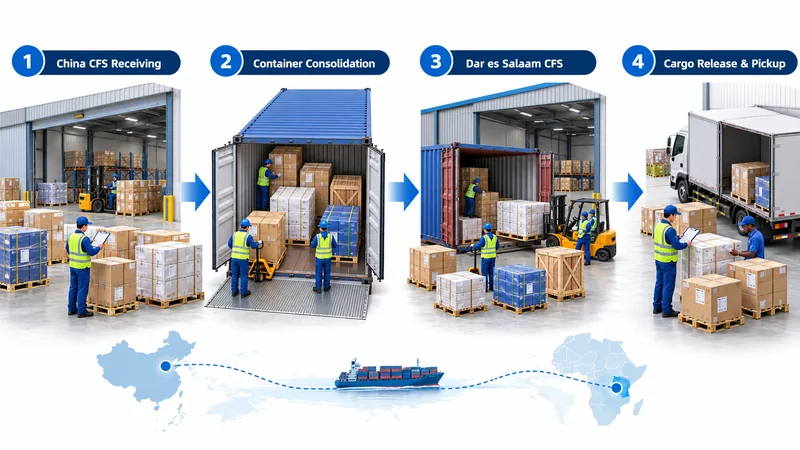
China Origin CFS vs Dar es Salaam Destination CFS: What Changes?
A container freight station is a facility used to handle cargo that does not require an entire shipping container. In LCL shipping, individual consignments from different shippers are combined for ocean transportation and separated again at the destination.
Although both origin and destination facilities may be called CFS warehouses, their responsibilities are different.
What Happens at the China Origin CFS?
The China origin CFS receives cargo before it is loaded into a consolidated container.
Depending on the service arrangement, the receiving operator may:
- Record the number of cartons, pallets, or crates delivered.
- Check external packaging and shipping marks.
- Measure cargo dimensions and record gross weight.
- Identify damaged or incorrectly labeled packages.
- Prepare cargo for consolidation with compatible shipments.
- Coordinate container stuffing and export handover.
The receiving warehouse, consolidation facility, and container-stuffing location are not necessarily the same physical location.
After the required export arrangements are completed, the consolidator prepares the shared container for ocean shipment.
What Happens at the Dar es Salaam Destination CFS?
At the destination, the objective changes from assembling shipments to separating and releasing them.
Depending on the terminal, customs, and consolidation arrangements, the destination process can involve transferring a container to an authorized stripping facility, opening it, identifying individual consignments, and preparing cargo for collection.
Each consignee’s packages must be matched against the relevant cargo records.
Cargo may also require customs verification, documentary release, payment of handling charges, or other authorized procedures before collection.
China Origin CFS vs Dar es Salaam Destination CFS
| Handling stage | China origin CFS | Dar es Salaam destination CFS |
|---|---|---|
| Main function | Consolidate individual shipments | Deconsolidate shared containers |
| Cargo receipt | Receive goods from suppliers or transport providers | Receive or identify cargo under the destination arrangement |
| Cargo checking | Record packages, dimensions, weight, and visible condition | Reconcile shipments and record visible discrepancies |
| Physical handling | Sorting, pallet movement, and container stuffing | Container stripping, sorting, and cargo movement |
| Key documents | Warehouse receipt, receiving tally, packing list | Arrival notice, stripping tally, release documents |
| Customs interface | Export documentation and clearance coordination | Import declaration, examination, and release coordination |
| Final handover | Consolidated container to the transport chain | Individual consignment to an authorized collector |
| Possible additional charges | Receiving, storage, repacking, special handling | CFS handling, storage, inspection support, release-related services |
The two facilities can have different operators, contracts, and billing arrangements. Charges may already be included in the freight quotation or billed separately.
The important question is not simply whether a fee is described as a CFS charge. It is which activity the fee covers, who performed it, and whether that activity is already included elsewhere.
For the wider distinction between shared-container and full-container transport, see sea freight from China to Tanzania.
Before Cargo Enters the China CFS: Booking, Cutoff, and Warehouse Receipt
Many LCL handling problems begin before a container is loaded.
A shipment may miss its planned departure because the supplier delivers cargo late, uses incorrect shipping marks, or fails to provide the documents required by the receiving facility.
Confirming warehouse instructions in advance helps prevent these avoidable problems.
Confirm the Receiving Warehouse and Cargo Cutoff
Before sending goods from a Chinese supplier, obtain written receiving instructions from the freight forwarder or consolidator.
These should identify:
- The full name and address of the receiving warehouse.
- The booking number or shipment reference.
- Cargo receiving hours and any appointment requirements.
- The latest acceptable cargo delivery date.
- Required shipping marks and package identification.
- Packing list and other documents required for acceptance.
- Special receiving conditions for heavy, oversized, fragile, or non-stackable cargo.
Three dates require particular attention: the cargo receiving cutoff, the shipping documentation cutoff, and the planned vessel departure date.
They are not interchangeable.
A supplier may deliver cargo before the vessel sails but still miss the consolidation cutoff. In that situation, the cargo may need to wait for another available consolidation.
Storage, rebooking, or additional handling costs may arise depending on the operator’s conditions.
What Should a CFS Warehouse Receipt Show?
A warehouse receipt or cargo receiving record provides evidence that a facility accepted a stated quantity of cargo.
The document should be checked against the supplier’s packing list.
| Receiving record field | What the importer should verify |
|---|---|
| Booking or reference number | Matches the assigned shipment |
| Shipper or supplier | Correct supplying company |
| Receiving date | Cargo arrived within the agreed cutoff |
| Package count | Cartons, pallets, or crates match the dispatch record |
| Gross weight | Recorded weight is consistent with supporting documents |
| Dimensions or volume | Measured figures are available where applicable |
| External cargo condition | Damage or packaging exceptions are recorded |
| Receiving remarks | Shortages, excess packages, or identification problems are documented |
A warehouse receipt does not automatically prove that the warehouse opened every carton or checked each product inside.
For sealed cartons, receiving records may confirm only the number and apparent external condition of the packages.
Importers should retain the supplier’s dispatch records, receiving confirmation, and any documented discrepancies.
What Happens If the Supplier Misses the Cutoff?
A missed cutoff can affect the planned consolidation even when the shipment is otherwise ready.
The forwarder may need to confirm another receiving window, revise the sailing arrangement, or arrange temporary storage.
Changes can also affect export documentation and delivery commitments.
Pro Tip: Ask the consolidator to confirm the cargo cutoff, document cutoff, and shipping-mark requirements in writing before instructing your supplier to dispatch the goods.
Businesses requiring broader consolidation support can review our LCL consolidation services from China.
From Receiving to Container Stuffing: Cargo Protection and Liability
Once cargo has been accepted at the origin facility, the consolidator must prepare it for transport with other consignments.
Unlike FCL shipping, where one shipment typically occupies the container, LCL cargo shares space with goods belonging to other shippers.
This introduces additional cargo-handling and stowage considerations.
Cargo Compatibility, Packing, and Stowage
Before loading, the consolidator should assess the cargo’s physical characteristics and any special acceptance requirements.
Important considerations include:
- Whether cartons can support stacking.
- Whether heavy items could damage lighter packages.
- Whether cargo requires pallets or additional wrapping.
- Whether liquids, fragile products, or sensitive equipment require special protection.
- Whether incompatible commodities must be segregated.
- Whether the declared cargo is acceptable for the planned consolidation.
Some goods, including regulated dangerous cargo, may require separate arrangements or may not be accepted in a particular general-cargo consolidation.
Good packaging remains the shipper’s responsibility under the applicable contractual arrangements, even when the warehouse performs additional handling.
Which Documents Help Establish Cargo Condition?
Several documents may become important if damage or shortages are discovered later.
Warehouse receiving record: Shows the recorded packages and apparent condition when cargo was accepted.
Stuffing tally: May identify what was loaded into the shared container.
House Bill of Lading (HBL): Generally documents the individual shipment under the consolidator or NVOCC’s transport arrangement.
Master Bill of Lading (MBL): Covers the ocean carrier’s transport arrangement for the consolidated container.
Container and seal records: Help identify the equipment and its movement through the shipping chain.
Handling photographs: May provide additional evidence when available, although routine photography is not guaranteed.
These records serve different purposes. An HBL should not be treated as a substitute for a detailed warehouse condition report.
Who Is Responsible for Damage During Container Loading?
Responsibility depends on when the damage occurred, who had custody of the cargo, the applicable contract, and the available evidence.
For example, damage recorded before the CFS accepts a shipment raises different questions from damage documented during container stuffing or destination stripping.
The importer should distinguish between:
- Physical custody of the shipment.
- Liability under the relevant transport or warehouse contract.
- Transfer of commercial risk under the agreed Incoterms rule.
- Coverage under any cargo insurance policy.
These responsibilities do not always rest with the same party.
When damage occurs, preserving receiving records, handling reports, and written notifications is more useful than immediately assuming which operator is legally responsible.
Dar es Salaam Arrival Notice, Deconsolidation, and Cargo Release
For Tanzania importers, the destination handling process is often the most important part of LCL cargo planning.
The vessel may arrive at Dar es Salaam before an individual shipment becomes available for collection.
Understanding the separate operational milestones helps importers coordinate their clearing agents, documents, and transport arrangements.
Who Issues the LCL Arrival Notice?
An arrival notice informs the relevant parties about the expected or actual arrival of a shipment.
Depending on the shipping arrangement, it may be issued by the shipping line, shipping agent, NVOCC, destination consolidator, or another appointed representative.
For LCL cargo, the consignee should ensure the notice or related instructions identify the relevant house shipment rather than relying solely on information about the master container.
Important details to check include:
- Vessel and voyage information.
- Estimated or actual arrival date.
- HBL or relevant shipment reference.
- Consignee details.
- Destination handling contact.
- Document submission requirements.
- Applicable payment and cargo-release instructions.
If the destination CFS is not identified, ask the consolidator to confirm where the cargo will be made available.
From Vessel Arrival to CFS Deconsolidation
A typical operational sequence is:
Vessel Arrival → Container Discharge → Authorized Transfer, if Required → CFS Stripping → Cargo Segregation → Release Requirements → Cargo Collection
The physical handling and customs processes may overlap rather than occurring in one rigid sequence.
After the container reaches the designated stripping location, its contents are separated into individual consignments.
Packages must then be identified against the relevant manifest, house shipment records, or destination handling documents.
Cargo selected for examination may require additional coordination before release.
The exact procedures depend on the terminal, CFS operator, customs requirements, and transport contract.
Customs Release Is Different From a Delivery Order
Tanzania’s import clearance procedures are administered by the Tanzania Revenue Authority through the Tanzania Customs Integrated System (TANCIS).
According to the official TRA import procedures, an importer is required to appoint a licensed Clearing and Forwarding Agent (CFA). The authority encourages documentation to be lodged before vessel arrival, with guidance referring to at least seven days in advance.
Documents commonly required for an import declaration include the commercial invoice, packing list, transport documents, importer authorization, and applicable permits or certificates.
For regulated products, additional requirements may apply.
Where goods fall under Tanzania Bureau of Standards PVoC requirements, the necessary conformity documentation should be arranged before shipment in accordance with the applicable rules.
For product-specific declarations and customs requirements, see our customs clearance in Tanzania guide.
However, completing customs clearance does not necessarily mean the consignee can immediately collect the packages.
Three separate conditions must be checked:
- Customs release: The relevant customs requirements have been satisfied and release has been authorized.
- Documentary release: The carrier, NVOCC, or responsible handling party has completed the applicable delivery-order or house shipment release process.
- Physical cargo availability: The cargo has been identified, processed, and made available for collection by the designated facility.
Payment of relevant destination charges and confirmation of collection authority may also be required.
What Confirms That Cargo Is Ready for Collection?
Before arranging a truck, the consignee or appointed clearing agent should obtain confirmation that:
- Applicable customs-release requirements are complete.
- Necessary delivery-order or cargo-release instructions are available.
- The destination CFS has identified the individual consignment.
- Outstanding charges and holds have been checked.
- The cargo can be collected from the confirmed location.
- The required collection reference and identification documents are available.
A truck dispatched before these conditions are satisfied may incur unnecessary waiting or failed-collection expenses.
Dar es Salaam CFS Handling Charges: What Is Payable and Who Bills It?
One of the most common sources of confusion in LCL shipping is the difference between the quoted ocean freight charge and the destination invoice.
An importer may pay for ocean transportation before departure and later receive separate charges associated with documentary release, cargo handling, customs clearance, or collection.
These charges should be evaluated individually rather than grouped together as unspecified port fees.
TPA Port Tariffs vs Destination CFS Charges
The Tanzania Ports Authority publishes tariffs for specified port and cargo-handling services.
Its Sea Ports Tariff Book dated January 2026 distinguishes between multiple types of cargo-handling operations.
Clause 11.1 covers container stevedoring, including LCL container handling. The published notes indicate that the specified LCL stevedoring charge includes certain transfer and stripping/stuffing activities and is charged to the carrier’s account.
This distinction matters.
A published container-level charge payable by the carrier should not automatically be converted into a separate charge payable by each LCL consignee.
The same tariff book contains a CFS schedule under Clause 16 identified as Export CFS. That schedule should not be used as a general price list for imported LCL cargo at every destination CFS in Dar es Salaam.
Destination operators may apply their own documented contractual charges, subject to the services performed and relevant rules.
The importer therefore needs an itemized quotation or invoice from the responsible party.
Which Destination Charges May Apply?
The following matrix identifies possible expenses and the evidence needed to verify them.
Dar es Salaam LCL Destination Charge Audit Matrix
| Charge item | Potential charging party | Billing basis to check | Evidence to request |
|---|---|---|---|
| Delivery-order or documentation fee | Shipping agent or NVOCC | Per document or shipment | Published tariff or contractual fee schedule |
| Destination CFS handling | CFS operator or consolidator | W/M, shipment, or specified service | Handling invoice and applicable terms |
| Deconsolidation-related services | Relevant handling operator | Contracted service basis | Confirmation of inclusion or separate service |
| Port or terminal charges | Relevant port or terminal party | Applicable published or contractual unit | Correct tariff clause and payer |
| Customs-clearance service | Licensed clearing agent | Agreed professional fee | Clearing-agent quotation |
| Cargo examination support | Authorized service provider | Actual examination or handling service | Examination record and itemized charge |
| Storage | Facility holding the cargo | Agreed storage unit and period | Free-time terms and storage calculation |
| Additional rehandling or repacking | Facility or contracted provider | Work performed | Service instruction and invoice |
| Cargo collection or inland delivery | Transport provider | Agreed transport service | Pickup or delivery quotation |
Not every listed charge will apply to every shipment.
Some services may already be included in an LCL freight package. Others may be required only when cargo is selected for inspection, remains in storage, or needs additional handling.
How to Check an Itemized CFS Invoice
Before paying a destination invoice, ask five questions.
1. Who is issuing the charge?
Identify the legal entity and whether it acts as the carrier, NVOCC, CFS operator, clearing agent, or another service provider.
2. What service was performed?
A line labeled “handling” should be supported by a clear description of the work or contractual charge.
3. What billing unit applies?
Check whether the charge is calculated by weight/measurement, package, shipment, document, container, storage period, or another agreed unit.
4. Was the service already included?
Compare the invoice with the original freight quotation and the agreed list of inclusions and exclusions.
5. What tariff or contract supports the amount?
Request the applicable charge schedule, validity date, currency, tax treatment, and any minimum charge.
The goal is not to assume that every additional charge is incorrect. It is to make each expense traceable to a documented service or obligation.
For a broader explanation of freight-rate units and shipment minimums, review shipping cost per CBM from China to Tanzania.
What Triggers CFS Storage and Examination Costs?
Storage can become payable when cargo remains at a facility beyond the applicable free period or other agreed conditions.
Additional handling may arise when cargo must be moved, separated, opened, inspected, repacked, or otherwise processed beyond the services already included.
Importers should not assume that all CFS facilities calculate free time from the vessel’s arrival date.
Depending on the arrangement, a facility or contract may use a different defined starting event.
Confirm the following before arrival:
- When the storage clock starts.
- How many free days apply, if any.
- Whether the period is measured in calendar days or another basis.
- The chargeable unit and rate progression.
- How examination or document-related delays are treated.
- Who is contractually responsible for additional expenses.
Review My LCL Handling Plan
Winsail Logistics can review your proposed LCL shipping arrangements, cargo measurements, China receiving requirements, and available destination handling information to help identify documentation gaps and charges that require confirmation before shipment.
LCL Cargo Inspection, Shortages, and Damage Claims at the CFS
LCL cargo passes through several handling stages. If cartons are damaged, missing, or incorrectly identified, the available records can help establish where the discrepancy arose.
Importers should have a procedure for checking cargo condition before accepting the final handover.
Inspect the Cargo Before Collection
When access and the facility’s rules permit, the consignee or authorized representative should inspect the external condition of the cargo and reconcile the available package count.
Important checks include:
- Torn, crushed, or visibly wet packaging.
- Broken pallets or damaged wrapping.
- Missing cartons or crates.
- Incorrect shipping marks.
- Signs that cartons have been opened or resealed.
- Differences between the cargo presented and the release documents.
Visible discrepancies should be reported through the facility’s documented exception procedure.
Signing an unqualified collection receipt can complicate later disputes over apparent damage or shortages, depending on the applicable contract and law.
Reconcile the Origin and Destination Records
When a shortage is discovered, compare the documents created at different points in the shipping chain.
| Record | What it helps establish |
|---|---|
| Supplier packing list | Quantity and packaging declared by the supplier |
| China CFS receiving record | Packages recorded on arrival at the warehouse |
| Container stuffing tally | Cargo recorded as loaded, if available |
| House Bill of Lading | Shipment description under the transport contract |
| Destination stripping tally | Packages identified during deconsolidation |
| CFS exception report | Recorded damage or shortage at destination |
| Final collection receipt | Cargo handed over to the authorized collector |
A discrepancy between the supplier’s packing list and China receiving record requires a different investigation from a discrepancy between the stuffing tally and destination stripping record.
Missing cartons should also be distinguished from missing products inside intact cartons.
These situations involve different types of evidence.
Who Should Receive a Damage or Shortage Notice?
The appropriate notification parties depend on the transport agreement and the nature of the loss.
They may include the destination handling facility, contractual carrier or NVOCC, freight forwarder, and cargo insurer.
The importer should:
- Record the discrepancy promptly in writing.
- Preserve packaging, photographs, and relevant receipts.
- Request a handling or exception report where available.
- Identify the contractual claims notification requirements.
- Arrange an independent survey if required or appropriate.
- Notify the cargo insurer under the policy conditions, where insurance applies.
Claims deadlines and liability limits can differ under the transport contract, applicable law, and insurance policy. There is no single universal deadline that can safely be applied to every LCL shipment.
Pro Tip: Before signing an unqualified cargo collection receipt, compare the package count with the destination CFS tally and document visible shortages or damage using the facility’s prescribed procedure.
Cargo insurance can provide additional protection where purchased and applicable, but it does not eliminate the need for good packaging, accurate documents, and timely claim notification.

Pre-Shipment and Pre-Collection Checklist for Tanzania Importers
An effective LCL shipment requires preparation at both ends of the route.
The following checklist can help a purchasing manager or import coordinator track the main handover requirements.
Before Cargo Is Delivered to the China CFS
- Confirm the booking and shipment reference.
- Verify the receiving warehouse address and operating instructions.
- Confirm cargo and documentation cutoffs.
- Check the carton count, packaging, and shipping marks.
- Confirm special cargo acceptance requirements.
- Provide the commercial invoice and packing list as instructed.
- Request receiving confirmation and retain exception records.
- Review origin handling and freight inclusions.
Before the Vessel Arrives in Dar es Salaam
- Confirm the destination handling contact and cargo facility.
- Check the HBL, consignee details, and arrival notice.
- Appoint a licensed Tanzanian clearing and forwarding agent.
- Prepare the documents needed for import declaration.
- Confirm product-specific permits or conformity requirements.
- Request a breakdown of destination charges.
- Verify storage terms and expected cargo availability.
- Agree on the intended collection or inland delivery arrangement.
Before Collecting the Cargo
- Confirm completion of applicable customs-release requirements.
- Obtain the necessary delivery-order or release authorization.
- Check outstanding CFS charges and cargo holds.
- Verify the confirmed pickup location and collection procedure.
- Reconcile the available package count.
- Record visible damage or shortages before accepting handover.
- Retain the final collection receipt and supporting records.
For goods regulated under the Tanzania Bureau of Standards PVoC programme, check the applicable pre-shipment conformity requirements. A Certificate of Conformity is required for consignments subject to that programme; it is not a blanket requirement for every imported product.
This guide addresses the import-handling chain for cargo entering Tanzania Mainland through Dar es Salaam. Zanzibar-specific import procedures should be verified separately where relevant.
FAQ
Does a China CFS warehouse receipt prove that all products inside my cartons were checked?
Not necessarily. A standard receiving record may confirm package quantity, weight, measurements, and apparent external condition. It does not automatically establish that sealed cartons were opened or individual products counted. If product-level inspection is required, arrange it separately and confirm the inspection scope in writing.
Who sends the LCL arrival notice in Dar es Salaam?
The issuing party depends on the shipment structure. A shipping line or its agent may communicate information about the master container, while the NVOCC or destination consolidator may provide instructions relating to an individual house shipment. Ask your freight forwarder to identify the party responsible for your HBL release.
Can I collect LCL cargo immediately after customs clearance?
Not always. Customs release is one requirement, but documentary release, outstanding charges, completion of deconsolidation, and confirmation of cargo availability may also be necessary. Obtain confirmation from the responsible destination handling party before arranging collection.
Are TPA LCL stevedoring charges the same as destination CFS handling fees?
Not automatically. TPA’s published tariff identifies specified container-handling charges and their stated charging conditions. A destination CFS or consolidator may separately invoice services under its applicable arrangement. Check the invoice against the relevant tariff, contract, and services provided.
When does CFS storage free time begin in Dar es Salaam?
There is no reliable single starting point for every facility and LCL contract. The applicable terms may define free time by cargo arrival, unloading, availability, or another event. Request the facility’s written free-time conditions and storage calculation before arrival.
What should I do if fewer cartons arrive than were recorded at the China CFS?
Compare the China receiving record, loading evidence, HBL description, destination stripping tally, and collection record. Report the discrepancy promptly, preserve evidence, and notify the responsible contractual parties and cargo insurer where applicable.
Does an LCL door-to-door quotation include CFS handling, customs duties, and taxes?
Not automatically. Door-to-door describes the transportation scope, while included charges depend on the written agreement. DDP is a separate Incoterms rule under which the seller assumes import-clearance and applicable duty and tax obligations, subject to a legally executable arrangement. Confirm all inclusions and exclusions before booking.
Plan Your LCL Cargo Handover with Winsail Logistics
Successful LCL shipping from China to Dar es Salaam depends on more than securing space in a shared container.
The most important operational controls are accurate receiving records, clearly defined consolidation and cutoff arrangements, appropriate cargo protection, early customs preparation, transparent destination charges, and properly documented cargo collection.
When these responsibilities are identified before departure, importers are better positioned to coordinate their suppliers, consolidators, clearing agents, and delivery providers.
Review My LCL Handling Plan
Share your cargo description, number of packages, dimensions, gross weight, China receiving location, shipment-ready date, and intended delivery point in Tanzania.
Winsail Logistics can help review the proposed freight-handling scope and identify which CFS services, documents, charges, and third-party release requirements need confirmation before booking.
Disclaimer: This article provides general operational guidance for LCL shipments to Dar es Salaam. Actual facilities, handling charges, customs procedures, release requirements, storage conditions, and liability depend on the shipment contract, cargo type, applicable regulations, and appointed service providers. Confirm current requirements with the responsible operators and a licensed Tanzanian clearing agent before shipment or collection.
