

Customs clearance is an important step when importing commercial goods from China to the UAE. Whether your shipment arrives at Jebel Ali Port, Khalifa Port, Dubai International Airport, or another entry point, the goods must follow the applicable customs procedures before they can be released for their intended use or movement.
For UAE importers, customs clearance involves more than submitting a commercial invoice and paying import duties. The process depends on the importer’s eligibility, customs registration, authorized declaration arrangements, HS classification, product compliance requirements, and whether the goods are entering the UAE mainland, a free zone, or a re-export procedure.
This guide explains how UAE import customs clearance works, who is responsible for each stage, what should be checked before shipping from China, and how to prevent and resolve common customs delays.
Quick Answer: How Does Customs Clearance Work in the UAE?
Customs clearance in the UAE requires an eligible importer or authorized declarant, accurate shipping documents, the correct customs procedure, and any product-specific approvals. A declaration is submitted to the relevant customs authority, which may verify documents, assess charges, or inspect the goods before release. For shipments from China, confirm importer registration, broker authorization, product classification, and the intended destination before departure.
What Does Customs Clearance in the UAE Actually Involve?
UAE customs clearance is the formal process through which goods are declared to the competent customs authority and processed under the applicable customs procedure.
For commercial imports, customs authorities use declaration information to identify the goods, verify their classification, origin and value, assess applicable customs charges, and determine whether additional regulatory controls are required.
The process may involve electronic document verification, customs assessment, physical examination, and coordination with other government authorities.
What Happens Between Cargo Arrival and Customs Release?
A commercial shipment normally goes through several operational stages:
- Importer and declaration readiness: Confirm who is eligible to import the goods and who is authorized to submit the customs declaration.
- Cargo and document verification: Match transport records with the commercial invoice, packing list, and other supporting documents.
- Customs declaration: Submit the correct declaration through the relevant customs system.
- Customs assessment: Customs reviews the declared goods and applicable requirements.
- Inspection or additional approval: Complete any examination, permit verification, or information request.
- Applicable charges and release: Fulfill relevant payment and regulatory conditions before customs release.
These activities do not always occur strictly in this order. Some customs systems allow declarations to be processed before the goods physically arrive.
For example, Abu Dhabi Customs identifies pre-arrival and arrival-stage clearance options under its Clearance of Goods service.
Customs Release Is Not the Same as Cargo Delivery
One important distinction is that customs release does not necessarily mean the cargo is immediately available at the importer’s warehouse.
After customs approval, the shipment may still require:
- A carrier-issued delivery order or equivalent release authorization.
- Settlement of applicable terminal and local handling charges.
- Container release or cargo handover arrangements.
- Gate passes or terminal collection appointments.
- Inland transportation to the final delivery address.
For containerized cargo arriving at Jebel Ali, the freight forwarder or delivery coordinator must confirm both customs status and the carrier’s and terminal’s release requirements.
Practical takeaway: Track customs release, carrier release, and physical cargo collection as separate milestones. A shipment can complete customs processing while still awaiting operational handover.
Who Is Responsible for Customs Clearance in the UAE?
Customs clearance typically involves four principal parties: the importer, an authorized customs broker or declarant, the freight forwarder, and the relevant customs authority.
Their responsibilities are connected, but they are not interchangeable.
Importer: The Party Responsible for the Import Arrangement
The importer is the party identified under the applicable customs procedure as responsible for the import declaration and associated obligations.
For a standard commercial mainland import, the importer generally needs an appropriate legal and commercial arrangement to import the declared goods.
Depending on the procedure, the importer may need to:
- Maintain a valid trade license and applicable customs registration.
- Ensure the declared goods are consistent with its permitted business activities.
- Provide accurate product descriptions, values, quantities, and origin information.
- Obtain any required product permits or regulatory approvals.
- Authorize an eligible customs broker to act on its behalf.
- Fulfill applicable duty, VAT, and customs recordkeeping obligations.
The buyer, consignee, and legal importer may be different parties in some transactions. Their actual roles must be confirmed before shipment.
A company receiving goods at its warehouse should not automatically be assumed to be the legally eligible importer simply because its name appears on the delivery instructions.
Authorized Customs Broker: The Declaration Specialist
An authorized customs broker or eligible clearing agent handles customs-related activities within the scope of its registration and authorization.
These activities may include preparing declarations, submitting supporting information, communicating with customs, coordinating examinations, and resolving procedural questions.
However, a broker must have the necessary permission to act.
For example, Dubai Customs explains that qualifying clearing and forwarding agents need the relevant Customs Business Code and authorization from the goods owner to submit declarations on the consignee’s behalf.
Appointing a broker does not automatically transfer every legal responsibility away from the importer.
Freight Forwarder: The Logistics Coordinator
A freight forwarder coordinates the physical transportation and related logistics activities.
For shipments from China to the UAE, these services may include China-side pickup, export documentation coordination, freight booking, international transportation, arrival notification, and arranging communication with UAE-side service providers.
A freight forwarder can also help identify missing shipment information before departure.
However, providing freight forwarding services does not automatically authorize a company to submit UAE customs declarations or act as the legal importer.
A forwarding company may separately provide customs brokerage services where it holds the required permissions, but that capability must be verified rather than assumed.
Customs Authority: The Regulatory Decision-Maker
The competent customs authority administers the relevant customs procedures.
Its responsibilities may include:
- Processing customs declarations.
- Reviewing HS classification, customs value, and origin.
- Checking restricted-goods requirements.
- Selecting shipments for inspection.
- Assessing applicable customs duties and charges.
- Approving, rejecting, or otherwise determining the status of declarations.
- Administering customs controls, enforcement, and release conditions.
The customs authority makes the regulatory decision. Neither the importer nor the freight forwarder can guarantee that a shipment will be approved without further checks.
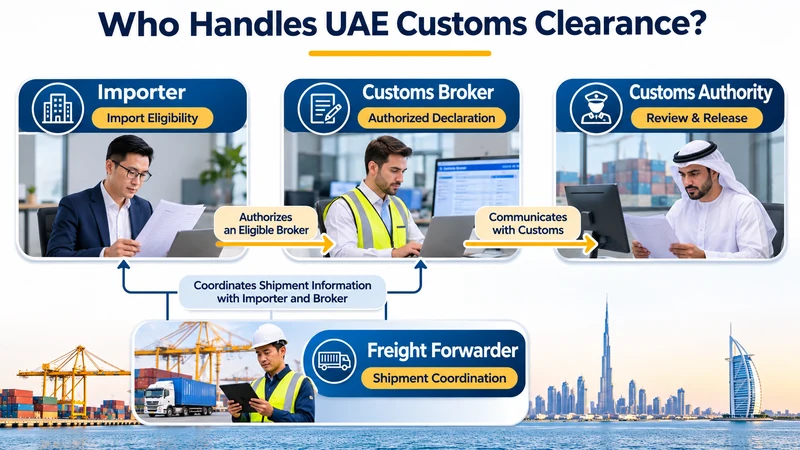
Importer vs Broker vs Forwarder Responsibilities
| Party | Primary Role | Typical Responsibilities | Declaration Authority | Important Boundary |
|---|---|---|---|---|
| Importer | Responsible importing party under the applicable procedure | Import eligibility, product details, permits, records, applicable obligations | May declare directly if eligible and permitted | Cannot assume every product or procedure is covered by its existing license |
| Authorized Customs Broker | Customs declaration and clearance specialist | Filing, customs communication, examination coordination, authorized corrections | Subject to registration and authorization | Does not automatically replace the importer’s legal responsibilities |
| Freight Forwarder | Transportation and logistics coordination | China pickup, freight booking, document coordination, arrival updates, delivery planning | Only if separately eligible and authorized | Freight forwarding alone does not confer customs declaration authority |
| Customs Authority | Regulatory administration and control | Declaration review, assessment, inspection, customs decisions and release | Exercises statutory customs powers | Does not manage the importer’s commercial delivery arrangements |
Before booking, the importer should identify who will submit the declaration, whose customs registration will be used, and who will respond if customs requests additional information.
What Must Be Confirmed Before Shipping Goods from China?
The most effective way to reduce avoidable customs problems is to complete the essential checks before the supplier dispatches the goods.
A commercial invoice and packing list may be accurate from the Chinese exporter’s perspective but still be insufficient for the intended UAE import procedure.
Confirm the Importer, Trade License, and Customs Registration
Start by confirming the intended importer’s legal identity.
The importer and appointed clearing representative should check:
- Whether the importer has the appropriate license or other legal eligibility for the transaction.
- Whether the business activity covers the goods being imported, where applicable.
- Whether customs registration or a customs business code is required.
- Whether the registration remains valid.
- Whether the intended declarant has the necessary authorization.
- Whether additional approvals are required for the product or transaction.
In Dubai, the Customs Business Code is an important element of commercial customs registration.
Dubai Customs explains that license holders clearing goods for local sale should obtain a Customs Business Code and use the appropriate declaration type. Authorized clearing agents must also satisfy the applicable registration and authorization requirements.
These are Dubai-specific administrative requirements. Other emirates may have different registration systems, service channels, or special clearance arrangements.
Importers should not assume that a Dubai customs code is universally interchangeable with every other UAE customs registration.
Check HS Classification, Customs Value, and Country of Origin
Three declaration elements deserve particular attention.
HS Classification
The Harmonized System (HS) classification identifies the goods for customs tariff and regulatory purposes.
A product’s classification may influence applicable duty, import restrictions, and the documents required by the authorities.
A code supplied by a Chinese manufacturer should be treated as a starting point for verification, not automatic confirmation of the correct UAE tariff classification.
The importer or authorized specialist should review the product’s materials, function, specifications, and relevant UAE tariff requirements.
Customs Value
Customs value is used for customs assessment under the applicable valuation rules.
The commercial invoice is important evidence, but the accepted customs value may also require consideration of freight, insurance, adjustments, or other relevant transaction information.
An invoice showing a low or incomplete value does not guarantee that customs will accept that amount.
Country of Origin
Country of origin identifies where goods originate under the applicable origin rules.
It is not necessarily the same as the country from which the shipment was dispatched.
For example, a Chinese trading company may export components manufactured in another country. The declared origin should reflect the applicable rules and supporting evidence, rather than automatically stating China because the exporter is located there.
| Declaration Information | Why It Matters | Pre-Shipment Check |
|---|---|---|
| HS Classification | Affects tariff and regulatory treatment | Confirm the UAE classification using product specifications |
| Customs Value | Supports customs valuation and assessment | Reconcile invoice, transaction, freight, and insurance information |
| Country of Origin | Supports origin-related customs requirements | Confirm manufacturing origin and relevant evidence |
| Product Description | Helps customs identify the goods | Use specific descriptions rather than generic terms |
| Quantity and Weight | Supports document reconciliation and cargo verification | Match invoice, packing list, and transport details |
Verify Shipping Documents and Declaration Data
The required supporting documents depend on the selected customs procedure and shipment characteristics.
Commercial shipments commonly involve documents such as:
- Commercial invoice.
- Packing list.
- Bill of Lading or Air Waybill.
- Certificate of Origin, where required.
- Importer registration and authorization information.
- Applicable product permits or conformity documents.
- Arrival and delivery-order information, when required for the relevant stage.
The documents should tell a consistent story.
The declared product description, importer name, quantity, shipment references, and commercial information should agree across the relevant records.
For a detailed document-by-document explanation, see our guide to documents required for shipping from China to UAE.
Identify Restricted Goods and Product Approval Requirements
Not every product can be imported under the same conditions.
Some goods may be prohibited. Others may be permitted only when the importer obtains approval from a relevant government authority or satisfies specified technical requirements.
Examples of product categories that may require additional checks include certain:
- Electrical and electronic products.
- Telecommunications equipment.
- Food and food-contact products.
- Medical or healthcare-related goods.
- Chemicals and controlled materials.
- Regulated industrial products.
The applicable authority depends on the actual product.
For products subject to relevant UAE technical regulations, the Ministry of Industry and Advanced Technology (MoIAT) administers conformity-related services.
Other products may fall under the responsibility of different federal or emirate-level regulators.
Importers should confirm the specific product requirements before shipping rather than assuming that all electronics, machinery, or consumer goods require the same certificate.
Pre-shipment rule: If a permit or regulatory approval is required, confirm the responsible authority, application requirements, and approval timing before committing cargo to departure.
UAE Customs Clearance Workflow: From Arrival to Cargo Release
The UAE customs clearance process can be understood as a sequence of preparation, declaration, customs review, satisfaction of applicable conditions, and release.
The following workflow describes common commercial import activities. The exact sequence depends on the emirate, customs procedure, cargo characteristics, and whether pre-arrival processing is permitted.
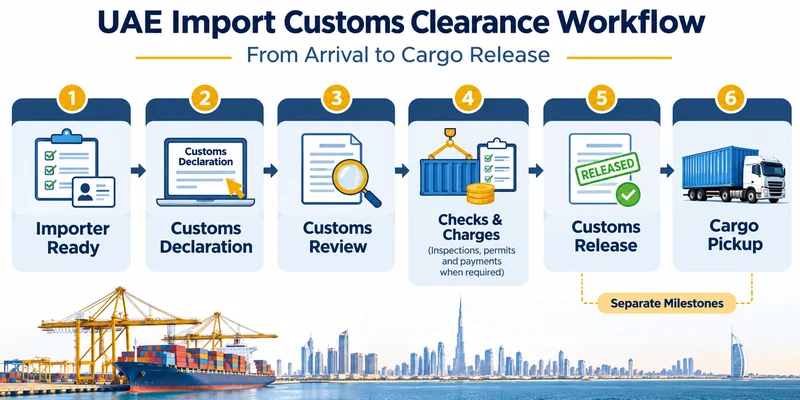
Step 1: Confirm Cargo Arrival Information and Declaration Readiness
Before the shipment arrives, the importer and logistics coordinator should confirm the transport references and whether the customs declaration can be prepared.
For sea freight, this may involve the Bill of Lading, vessel information, arrival notice, manifest references, and container details.
For air freight, relevant information may include the Air Waybill, flight and cargo references, and airport handling details.
The responsible parties should also confirm:
- The intended importer.
- The eligible declarant.
- The correct customs procedure.
- Product classification and value.
- Any required permits.
- Whether the necessary documents are available.
Pre-arrival processing may be possible where the competent customs authority permits it. However, early submission does not remove subsequent inspection, payment, or release requirements.
Step 2: Prepare and Submit the Customs Declaration
An eligible importer or authorized declarant prepares the declaration through the appropriate customs service.
The declaration normally contains information identifying the importer, goods, transport movement, customs procedure, classification, origin, value, and supporting documentation.
For example, goods imported for UAE mainland use should not automatically be declared under the same procedure as goods entering a free-zone storage arrangement or moving under a re-export procedure.
The correct declaration type should be determined before filing.
After submission, the declarant should retain the relevant reference number and monitor the declaration’s status.
Step 3: Customs Review and Risk Assessment
Customs authorities review the declaration in accordance with applicable procedures and controls.
Depending on the shipment, this may involve:
- Electronic verification.
- Documentary review.
- HS classification or customs valuation questions.
- Restricted-goods checks.
- Requests for additional information.
- Selection for examination.
Not every commercial shipment requires physical inspection.
However, accurate documents do not guarantee that goods will be released without examination. Customs authorities retain the ability to apply appropriate controls.
Step 4: Resolve Inspection or Permit Requirements
When an examination or additional check is required, the importer and authorized broker should coordinate the response.
Possible requirements include document clarification, cargo scanning, physical inspection, sample examination, or approval from another competent authority.
The cargo may need to be made accessible at an approved inspection location.
If customs requests technical product information, the importer may need supporting specifications, manufacturer records, photographs, or other evidence.
Any requested changes to the declaration must follow the relevant authority’s permitted correction procedure.
The parties should avoid altering invoices or product information merely to obtain a more favorable clearance result.
Step 5: Complete Applicable Duty, VAT, and Fee Arrangements
Customs release may depend on settlement or proper accounting of applicable charges and satisfaction of other regulatory conditions.
These may involve customs duty, declaration charges, relevant service fees, and import VAT where applicable.
The amount and method of accounting depend on factors including product classification, customs value, importer status, the declaration procedure, and any applicable exemptions or special arrangements.
Import VAT is not necessarily paid in the same way by every importer. The applicable process can depend on the importer’s VAT registration and the relevant Federal Tax Authority rules.
A freight quotation should clearly distinguish customs administration, brokerage charges, duty and tax obligations, and terminal or delivery costs.
For a detailed explanation of duty, VAT, and landed-cost planning, see our UAE Import Duty and VAT Guide for China Shipments.
Step 6: Obtain Customs Release and Arrange Cargo Collection
Once the applicable customs requirements have been satisfied, the shipment may receive the relevant customs release status.
The logistics coordinator must then confirm whether the carrier and terminal have completed their separate handover conditions.
For sea freight, these may include delivery order arrangements, container release, applicable terminal charges, and collection instructions.
For air freight, cargo collection depends on the airline or handling agent’s release procedures and the airport’s relevant requirements.
After collection, the cargo can move according to the approved customs procedure and agreed delivery arrangements.
A shipment cannot be treated as available for unrestricted domestic delivery merely because a declaration reference has been issued.
UAE Customs Clearance Workflow
| Stage | Main Activity | Responsible Parties | Required Information | Potential Hold Point |
|---|---|---|---|---|
| 1. Readiness | Confirm importer, declarant and customs procedure | Importer / Broker | License, customs registration, authorization | Invalid registration or unclear importer |
| 2. Cargo Information | Confirm arrival and transport references | Carrier / Forwarder | B/L, AWB, manifest, arrival details | Missing or inconsistent cargo information |
| 3. Declaration | Prepare and submit the appropriate declaration | Eligible Declarant | Invoice, packing list, HS code, origin, permits | Missing information or incorrect procedure |
| 4. Customs Assessment | Review declared information and applicable controls | Customs Authority | Declaration and supporting evidence | Classification, valuation or compliance query |
| 5. Examination | Complete applicable inspections or regulatory checks | Customs / Authorized Parties | Cargo access, permits, technical evidence | Inspection or approval pending |
| 6. Payment Arrangements | Resolve applicable charges and accounting requirements | Relevant Liable / Payment Party | Assessment and payment instructions | Outstanding payment or conditions |
| 7. Customs Release | Complete customs clearance requirements | Customs Authority | Approved declaration and satisfied conditions | Unresolved customs requirements |
| 8. Cargo Handover | Arrange release, pickup and onward delivery | Carrier / Terminal / Forwarder | Release references and collection instructions | Delivery order, terminal or transport issue |
Important: This table illustrates a general workflow rather than a mandatory sequence. Pre-arrival declarations, customs assessments, examinations, and payment arrangements may occur in a different order under the applicable procedure.
Does Customs Clearance Differ Between Dubai and Abu Dhabi?
The UAE operates within a wider customs and regulatory framework, but import clearance is administered through the competent customs authorities and their applicable procedures.
For practical shipment planning, the importer must identify the correct customs authority, entry point, and declaration arrangement.
Dubai Customs and the Customs Business Code
Dubai Customs administers the applicable customs procedures for goods entering, leaving, or moving under relevant customs arrangements in Dubai.
Businesses conducting commercial customs transactions may need to register with Dubai Customs and obtain a Customs Business Code.
Declaration activities may involve the Dubai Customs electronic services and relevant Dubai Trade arrangements.
The registration, declaration type, and authorization requirements must match the transaction.
For example, a Dubai mainland importer clearing goods for local distribution should verify its registration and declaration arrangements before its cargo arrives at Jebel Ali.
The fact that a freight forwarder handles the international shipment does not, by itself, mean the forwarder has authority to declare the goods.
Abu Dhabi Customs and Its Clearance Services
Abu Dhabi Customs administers customs clearance services for the relevant entry points and customs movements under its jurisdiction.
Its official services include the Clearance of Goods service and customs declaration enquiries.
The Abu Dhabi Customs Services portal identifies procedures for goods entering or leaving customs ports, including certain pre-arrival processing arrangements and different commercial customs movements.
Abu Dhabi Customs has also introduced digital clearance arrangements for certain users outside the UAE.
However, availability of a digital service does not mean that every overseas company may import every product without applicable authorization, regulatory checks, or legal obligations.
Importers should verify their eligibility for the specific declaration procedure.
What About Shipments Delivered to Other Emirates?
The cargo’s port of entry and final delivery location are not always the same.
A shipment may arrive through Dubai and be delivered to a customer in Abu Dhabi or Sharjah after the appropriate customs and transport arrangements have been completed.
The destination address alone does not automatically determine which customs authority processes the initial declaration.
Similarly, goods moving under transit, customs-controlled, or other special procedures may require arrangements beyond a standard domestic delivery.
Before booking, confirm the entry point, intended customs treatment, actual importer, and final destination with the responsible customs representative.
Mainland, Free Zone, or Re-export: Which Customs Procedure Applies?
A critical question in UAE customs clearance is what will happen to the goods after they enter the country.
Goods imported for domestic sale may require a different customs procedure from goods entering a free zone for storage or merchandise intended for onward export.
Goods Imported for UAE Mainland Use or Sale
Mainland import clearance generally concerns goods entering domestic circulation for activities such as wholesale distribution, retail sale, business use, or project delivery.
The responsible importer must follow the applicable declaration procedure and satisfy customs, tax, and product-regulatory requirements.
For example, machinery imported for installation at a mainland factory may involve different documentation and compliance questions from ordinary consumer goods.
The importer should confirm both customs eligibility and any requirements related to the particular product.
Goods Entering a UAE Free Zone
Free zones can support storage, manufacturing, logistics, and international distribution activities.
However, goods entering a free zone must still follow the applicable customs and zone-entry procedures.
Free-zone entry is not equivalent to unrestricted release into the UAE mainland market.
A company receiving cargo in a free zone should confirm:
- Its eligibility to receive the goods.
- The appropriate customs movement or entry procedure.
- Warehouse receiving and cargo-control requirements.
- Whether the goods will remain in the zone.
- Whether they may subsequently enter UAE mainland circulation.
A free zone is also not automatically a VAT Designated Zone.
The UAE Federal Tax Authority distinguishes between ordinary free zones and Designated Zones that meet specific statutory conditions.
The applicable tax treatment depends on the status of the zone, the goods, the transaction, and the movement involved.
For current tax-related guidance, refer to the Federal Tax Authority’s Free Zones and Designated Zones for Tax Purposes clarification, updated October 2, 2026.
Goods Intended for Re-export
Some businesses import goods into the UAE as part of an international distribution arrangement.
For example, merchandise shipped from China may be stored or handled in the UAE before being exported to another country.
The customs treatment depends on whether the cargo is imported for re-export, placed under a qualifying free-zone arrangement, or re-exported following an earlier import procedure.
These movements are not necessarily interchangeable.
Depending on the applicable procedure, the importer may need to consider declaration types, customs controls, guarantees or deposits, movement deadlines, and evidence of onward export.
The intended procedure should be determined before arrival rather than corrected only after the goods have entered under an unsuitable declaration.
Mainland Import vs Free Zone Entry vs Re-export
| Customs Scenario | Intended Use | Main Customs Consideration | Key Action Before Shipping |
|---|---|---|---|
| Mainland Import | UAE domestic sale, business use or project delivery | Applicable import declaration, eligibility, duty/VAT and product controls | Confirm importer, declaration, permits and clearance responsibilities |
| Free Zone Entry | Storage, processing, consolidation or distribution under a free-zone arrangement | Applicable zone-entry and customs movement rules | Confirm zone status, consignee eligibility and receiving procedure |
| Import for Re-export | Goods intended to leave the UAE under a qualifying procedure | Declaration type, applicable controls, evidence and possible guarantees | Confirm re-export eligibility and required arrangements |
| Free Zone to Mainland | Goods subsequently entering UAE domestic circulation | Additional customs procedure and applicable tax/regulatory treatment | Confirm the mainland importer and required declaration |
For a broader comparison of destination planning, see our Free Zone vs Mainland Delivery in UAE guide.
Why Do Shipments Get Held by UAE Customs?
A customs hold means that additional action or a condition may need to be completed before the goods can be released.
The reason may be administrative, documentary, regulatory, or related to customs examination.
Not every hold indicates a violation. Some shipments are selected for verification as part of normal customs controls.
Document and Declaration Discrepancies
A mismatch between the commercial invoice, packing list, transport records, and declaration can lead to further review.
Examples include inconsistent importer names, incorrect quantities, vague product descriptions, or missing transport references.
The best prevention is to reconcile documents before the supplier dispatches the cargo.
Incorrect HS Classification or Customs Value
Customs may question the declared classification or value where the supplied information is insufficient or inconsistent with the applicable requirements.
The importer or authorized broker may need to provide product specifications, transaction records, freight details, or other evidence.
An official correction or reassessment may be required.
Missing Product Permits or Importer Authorization
Clearance can be delayed if the declared importer does not meet the applicable eligibility requirements or if necessary product approvals are unavailable.
This is particularly relevant for regulated goods.
Obtaining a permit after arrival may not always be possible within the desired delivery schedule. In some circumstances, additional formal procedures may be necessary.
Customs Examination and Cargo Verification
Selected shipments may undergo document verification, scanning, or physical inspection.
The authorized parties should confirm the inspection instructions, ensure cargo accessibility, and supply requested supporting evidence.
Where the inspection concerns possible discrepancies, the importer should avoid assuming the goods will be released immediately after examination.
Common Customs Hold Causes
| Hold Cause | Warning Sign | How to Prevent It | Recommended Corrective Action | Primary Coordination |
|---|---|---|---|---|
| Importer registration mismatch | Importer or declarant information rejected | Verify registration and authorization | Confirm the correct eligible party and complete required corrections | Importer / Broker |
| Incorrect HS classification | Classification query or reassessment | Review technical specifications before filing | Provide product evidence and follow the authority’s classification procedure | Importer / Broker |
| Customs valuation discrepancy | Additional value information requested | Reconcile invoice and transaction records | Submit genuine supporting commercial documents | Importer / Broker / Supplier |
| Missing product approval | Regulatory hold or permit pending | Check product controls before dispatch | Contact the competent regulator and follow the required process | Importer / Regulator |
| Physical examination | Inspection requested | Prepare accurate packing information and cargo access | Coordinate the examination and respond to findings | Broker / Terminal / Customs |
| Unresolved customs charges | Release conditions outstanding | Confirm the payment and accounting arrangement | Resolve the applicable payment or assessment issue | Responsible Payment Party |
| Cargo information mismatch | Manifest or physical quantity differs | Reconcile shipment records before departure | Investigate the discrepancy and request authorized corrections | Carrier / Forwarder / Importer |
These are representative hold scenarios, not a statistical ranking of customs delay causes.
What Should You Do If Your Shipment Is on Hold?
First, ask the authorized declarant to identify the actual reason for the hold.
A statement such as “customs is checking the cargo” may not provide enough information for the importer to take action.
A useful response procedure is:
- Confirm the official status. Obtain the relevant declaration reference and the stated reason or outstanding requirement.
- Identify the responsible authority. Determine whether the issue comes from customs, another regulator, or a separate carrier or terminal process.
- Collect the requested evidence. Ask the supplier or importer for product specifications, invoices, permits, or other genuine supporting records.
- Assign a response owner. Ensure one authorized party coordinates the customs response.
- Evaluate commercial consequences. Check potential storage, demurrage, detention, and delivery implications.
- Track resolution. Retain correspondence, accepted amendments, and release confirmation.
If an authority issues an adverse decision or identifies a compliance violation, the importer should obtain qualified local advice on the available procedures and remedies.
A customs hold should not be addressed by fabricating documents, changing commercial values without justification, or attempting an unauthorized clearance arrangement.
How Long Does UAE Customs Clearance Take?
There is no single reliable clearance time that applies to all commercial shipments entering the UAE.
The elapsed time depends on the selected procedure, documentation readiness, importer eligibility, regulatory approvals, customs examination, and completion of release conditions.
An electronically processed declaration may progress differently from a shipment requiring physical inspection or additional product approval.
Even when a customs service publishes a processing target, that target should not be treated as a guarantee of door delivery.
What Determines the Clearance Timeline?
Important variables include:
- Whether the declaration can be prepared before arrival.
- Availability and accuracy of the required documentation.
- Importer and customs broker authorization.
- Product-specific permits or conformity requirements.
- Customs assessment and inspection decisions.
- Resolution of declaration or valuation queries.
- Applicable duty, VAT, and fee arrangements.
- Carrier and terminal release procedures.
- Cargo collection appointments and transport availability.
Air freight should not automatically be described as having a faster customs decision than sea freight. The transport mode affects the overall journey, but customs processing remains subject to the applicable controls.
Track Three Separate Milestones
Declaration Submitted → Customs Released → Cargo Collected
These are different stages.
An importer planning urgent production materials should monitor each one rather than relying on a single estimated customs clearance date.
Where timing is critical, arrange pre-shipment document checks, confirm approval requirements, and allow a suitable contingency for examinations or release issues.
Pre-Shipment Customs Readiness Checklist for UAE Importers
Before confirming a shipment from China, the importer and logistics team should complete seven essential checks.
- Importer confirmed: The intended importer and consignee are correctly identified.
- Customs procedure identified: Mainland import, free-zone entry, re-export, or another applicable procedure has been determined.
- Registration and authorization checked: The relevant customs code, registration, and broker authority are valid where required.
- Product information reviewed: HS classification, country of origin, customs value, and technical descriptions have been verified.
- Documents reconciled: Invoice, packing list, and transport instructions are accurate and consistent.
- Regulatory requirements checked: Applicable restrictions, permits, and product approvals have been confirmed.
- Release and delivery responsibilities agreed: Customs charges, terminal release, collection, and final delivery arrangements are clear.
Completing these checks cannot eliminate customs examination or guarantee release, but it can reduce avoidable administrative and document-related problems.
Illustrative Scenario: Mechanical Components Shipped to Jebel Ali
Consider a UAE mainland distributor purchasing a shipment of mechanical components from a Chinese manufacturer.
The goods are scheduled to arrive at Jebel Ali Port before delivery to the distributor’s warehouse in Dubai.
Before departure, the distributor confirms its importing eligibility and appoints an appropriately authorized customs broker.
The supplier provides the commercial invoice, packing list, and technical product descriptions. The importer and broker review the proposed HS classification, origin, value, and any product-specific requirements.
The freight forwarder coordinates shipping information and the arrival arrangements.
When the required shipment information is available, the eligible declarant prepares the appropriate Dubai import declaration.
Customs then processes the declaration and may request further information or examination. Applicable conditions must be satisfied before customs release.
After release, the logistics coordinator confirms carrier and terminal handover requirements and arranges delivery.
This example illustrates a typical coordination process. It is not a record of an actual Winsail shipment, and the exact procedure depends on the goods and importing arrangements.
Review Customs Readiness Before Shipping from China
Identifying a customs problem after the shipment reaches the UAE can create unnecessary operational complications.
A more effective approach is to clarify the importing arrangement, required information, and responsibilities while the cargo is still being prepared in China.
Winsail Logistics can assist with China-side shipping coordination, review supplied commercial and transport information for logistics consistency, and help identify customs-readiness questions that should be confirmed with the responsible UAE importer, broker, or authority.
For a pre-shipment review, prepare:
- Product name, description, and technical specifications.
- HS code, if known.
- Commercial invoice or draft invoice.
- Packing list, including quantities, weight, and dimensions.
- China pickup location.
- Intended UAE entry point and final delivery address.
- Importer and consignee details.
- Mainland, free-zone, or re-export requirements.
- Appointed customs broker information, if available.
- Planned shipment date.
Request a Pre-Shipment Readiness Review
The review helps clarify shipping and documentation coordination needs. It does not replace formal customs classification, importer authorization, regulatory approval, or a customs release decision.
FAQ
Can a Freight Forwarder Submit a Customs Declaration in the UAE?
A freight forwarder cannot automatically submit customs declarations simply because it arranges international transportation. Declaration authority depends on the relevant registration, licensing, authorization, and customs procedures. A forwarding company may also provide customs brokerage if it meets the applicable requirements. In Dubai, authorized clearing agents must satisfy Dubai Customs' registration and authorization conditions. Importers should confirm who will submit the declaration, whose registration will be used, and how that party has been authorized.
Can UAE Import Customs Clearance Be Started Before the Goods Arrive?
Certain UAE customs procedures and systems permit pre-arrival declaration processing when the required information is available. Abu Dhabi Customs identifies pre-arrival clearance options for eligible movements. However, inspections, regulatory approvals, payment arrangements, and cargo-release conditions may still apply. Ask the authorized declarant whether advance submission is available for the specific entry point, procedure, and shipment.
Does Customs Clearance at Jebel Ali Cover Delivery to Another Emirate?
Goods arriving at Jebel Ali may be cleared under the appropriate Dubai customs procedure and subsequently transported to another emirate, depending on their customs status and intended movement. A final delivery address in Abu Dhabi or Sharjah does not automatically require a separate import declaration there. Transit or other special customs movements may involve additional requirements. Confirm the entry procedure and delivery route with the responsible customs representative.
What Happens if UAE Customs Disagrees with the Declared HS Code or Value?
Customs may request supporting evidence, reassess the declaration, or require action under the applicable procedure. HS classification queries may call for product specifications and technical information. Valuation queries may require genuine invoices, transaction records, or freight evidence. Any declaration amendment must follow the authority's permitted process. Importers should not alter documents merely to obtain a lower assessment.
Can Goods Be Moved into UAE Mainland After Entering a Free Zone?
Goods may move from a UAE free-zone arrangement into mainland circulation when the applicable customs and regulatory requirements are met. The transfer may require a suitable declaration, an eligible importer, supporting documents, product approvals, and applicable duty or VAT treatment. Entry into a free zone does not automatically constitute clearance for domestic sale. Confirm the movement procedure and importing party before arranging the transfer.
Confirm Your UAE Shipment’s Customs Requirements Before Dispatch
Successful customs clearance begins with accurate information and a legally appropriate import arrangement, not simply with the cargo’s arrival at the UAE port or airport.
For commercial shipments from China, the most important questions are who will import the goods, who is authorized to submit the declaration, which customs procedure applies, and whether the cargo satisfies the relevant regulatory requirements.
Once those points are clear, the importer and logistics partners can coordinate document preparation, customs processing, release, and final transportation more effectively.
Winsail Logistics supports China-origin international freight planning and shipment coordination. Where suitable arrangements are available, the team can also help coordinate information with relevant UAE-side service providers.
If you are preparing to ship commercial goods from China to Dubai, Abu Dhabi, Sharjah, or another UAE destination, share your cargo details, importer information, planned entry point, and delivery address to clarify the next steps.
Review My UAE Shipment
Official References
- Dubai Customs — Frequently Asked Questions — Commercial customs registration, Customs Business Code, and authorized clearing-agent requirements.
- Abu Dhabi Customs — Official Services — Clearance of Goods, customs declaration services, and applicable pre-arrival options.
- Federal Tax Authority — Free Zones and Designated Zones for Tax Purposes — Official clarification dated October 2, 2026, concerning free-zone and designated-zone tax distinctions.
Last Updated: November 13, 2026
Disclaimer
This article provides general logistics and customs-readiness information for commercial shipments from China to the UAE. It does not constitute legal, customs, regulatory, or tax advice.
Importer eligibility, customs registration, declaration requirements, HS classification, valuation, product permits, duty, VAT, free-zone treatment, and cargo release conditions depend on the specific goods, parties, customs procedure, and competent authority.
Importers should confirm binding requirements with the relevant UAE customs authority, authorized customs professionals, product regulators, and qualified advisers before dispatch.
Winsail Logistics may assist with shipment-information review and logistics coordination but cannot guarantee customs clearance, regulatory approval, or delivery timelines.
