
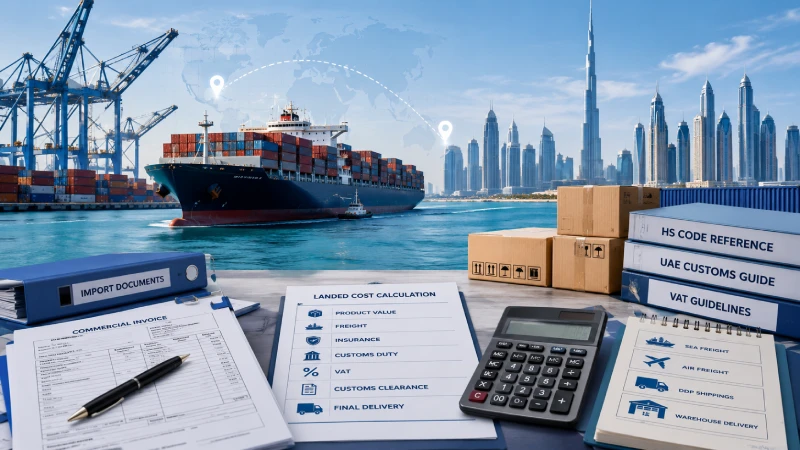
When planning shipping from China to UAE, importers should not only compare freight rates. The real question is usually landed cost: product value, international freight, insurance, import duty, VAT, customs documentation, port or airport charges, inspection risk, and final delivery to Dubai, Jebel Ali, Abu Dhabi, Sharjah, a free zone, or a mainland warehouse. This guide explains how UAE import duty and VAT commonly affect China shipments, so buyers can prepare documents earlier, compare quotes more accurately, and reduce cost surprises before cargo leaves China.
This article is for general logistics planning only. It does not provide legal, customs, or tax advice. UAE duty, VAT, customs valuation, HS code classification, and product compliance requirements should be confirmed with UAE customs, the Federal Tax Authority, relevant authorities, or a licensed advisor before shipment. Winsail Logistics can help with document review and logistics coordination, but final duty and VAT treatment depends on UAE customs and relevant authorities.
Quick Answer: How UAE Import Duty and VAT Affect China Shipments
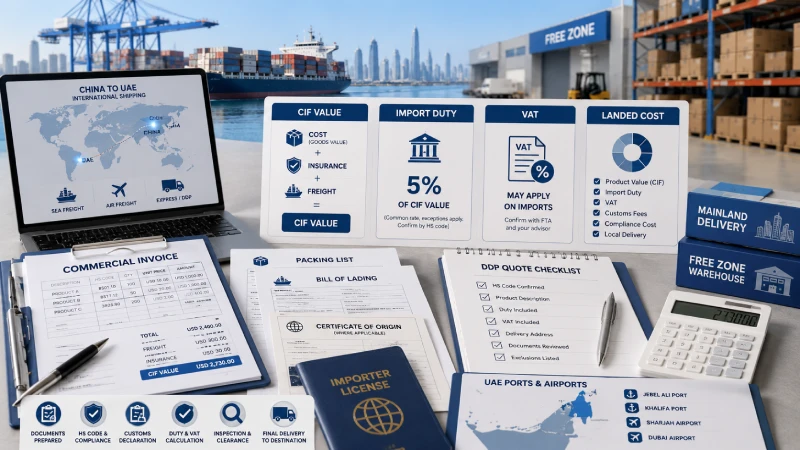
For many commercial imports into the UAE, customs duty is commonly calculated based on CIF value, which means the cost of goods, insurance, and freight. Dubai Customs publicly states that the customs duty rate in Dubai is 5% of CIF value, except for certain categories such as alcohol and cigarettes, but the actual rate should always be confirmed by HS code and product category before shipment. See the official Dubai Customs FAQ for general reference.
VAT may also apply to imports into the UAE. The UAE Federal Tax Authority provides official VAT guides and references for businesses to understand their tax obligations, and importers should confirm VAT treatment with their finance team or tax advisor before cargo is shipped. See the official UAE Federal Tax Authority VAT guides for current guidance.
A practical landed cost estimate should include more than the supplier invoice and freight rate. Importers commonly need to consider duty, VAT, customs declaration fees, inspection, storage, permits, compliance certificates, and final delivery charges.
| Landed Cost Component | What It Means | Why It Matters |
|---|---|---|
| Product value | Commercial invoice value from supplier | Used for customs review |
| Freight cost | Air, sea, express, or DDP shipping cost | May affect CIF value |
| Insurance | Cargo insurance if arranged | Commonly part of CIF planning |
| Customs duty | Often calculated on CIF value | Must be confirmed by HS code |
| VAT | May apply on imports | Important for finance planning |
| Customs fees | Declaration, handling, and local charges | Can increase landed cost |
| Compliance cost | ECAS, permits, labels, or testing | Product-specific risk |
| Final delivery | Free zone, warehouse, or mainland delivery | Affects quote scope |
Need a landed cost estimate before shipment? Send Winsail your product name, invoice value, packing list, HS code if available, and UAE delivery address.
What Is CIF Value and Why It Matters
CIF means Cost, Insurance, and Freight. In practical customs planning, this means the declared value for duty review may not be limited to the supplier’s product price. International freight and insurance may also be relevant when calculating the customs value.
For example, if a supplier quotes FOB Shenzhen and the buyer separately pays for ocean freight to Jebel Ali, the freight cost may still need to be considered when planning the customs value. This is why a low product price or low freight rate does not always mean a low landed cost.
| CIF Element | Meaning | Buyer Checkpoint |
|---|---|---|
| Cost | Product value shown on commercial invoice | Is the invoice accurate and consistent? |
| Insurance | Cargo insurance cost, if applicable | Is insurance included or separate? |
| Freight | International transport cost to UAE | Is freight included in the quote? |
| CIF value | Common customs valuation basis | Should be reviewed before shipment |
Importers comparing shipping cost from China to UAE should ask whether the quote is FOB-to-port, CIF-style, DAP, DDP, or full door-to-door. Each quotation type may include different responsibilities and exclusions.
Pro Tip: Before confirming a shipment, ask your forwarder to separate product value, freight cost, insurance, customs clearance, duty, VAT, and final UAE delivery. This makes landed cost planning much clearer for purchasing and finance teams.
UAE Import Duty: What Importers Should Know
UAE import duty is commonly connected to the HS code, product category, origin, declared value, and final destination. Although many importers use 5% of CIF value as a basic planning reference, this should not be treated as a fixed rule for every product. Dubai Customs provides an Integrated Customs Tariff tool that importers and brokers can use when reviewing tariff classification and requirements.
Some goods may have different duty treatment, special permits, restrictions, or product conformity requirements. This is especially important for electronics, electrical appliances, cosmetics, toys, batteries, food-contact products, telecom items, medical-related goods, branded products, and products that may fall under regulated categories.
The HS code should be checked before shipment, not after the cargo arrives in the UAE. A wrong HS code can cause underestimation of duty, customs questions, document amendment, inspection, delay, storage cost, or quote disputes. For larger commercial shipments, the importer should also confirm whether the UAE consignee has the proper license and authority to import that product category.
VAT and Landed Cost Planning
VAT is an important part of UAE landed cost planning. The Federal Tax Authority provides VAT guides, public clarifications, and official resources to help businesses understand their VAT obligations. Importers should review these resources and confirm their position with a qualified tax advisor or finance team, especially when shipment value is high or goods are imported regularly.
For purchasing teams, VAT may look like just another import charge. For finance teams, it can affect cash flow, accounting treatment, documentation, and whether VAT may be recoverable under the importer’s own tax position. This is why VAT should not be discussed only after goods arrive.
When planning sea freight, air freight, or DDP delivery, buyers should ask three questions: Is VAT included in the quote? Who is responsible for import declaration? Will the importer receive the documents needed for accounting? The answers may differ depending on whether the shipment is handled as standard freight, express courier, broker-assisted clearance, or DDP service.
HS Code, Product Category, and Customs Risk
The HS code is more than a tariff number. It can affect import duty, VAT review, inspection risk, customs documents, restricted status, and whether extra approvals are needed. Two products with similar commercial names may have different HS codes if their material, function, use, or technical specification is different.
For regulated products, importers may need to check conformity requirements before shipment. MoIAT provides services for UAE Certificates of Conformity for regulated products subject to technical regulations, and also references product status statement services for customs shipment situations. See MoIAT’s conformity certificate service for official product compliance direction.
| Risk Factor | Why It Affects Landed Cost | What to Confirm |
|---|---|---|
| Unclear HS code | May change duty or permit requirements | Confirm classification before shipment |
| Regulated product | May need ECAS or other approval | Check MoIAT or relevant authority requirements |
| Vague invoice | May trigger customs questions | Use clear product descriptions |
| Low declared value | May cause valuation review | Use accurate transaction value |
| Brand goods | May require authorization | Prepare brand documents if needed |
| Battery goods | May need transport and customs checks | Confirm air/sea acceptance |
| DDP quote unclear | May exclude duty, VAT, or inspection | Request written scope |
This is also where customs clearance in UAE becomes a planning issue, not just an arrival process. The earlier documents are checked, the easier it is to reduce avoidable clearance problems.
Free Zone vs Mainland Duty/VAT Considerations
Free zone and mainland delivery can affect duty and VAT planning. Trade.gov notes that goods destined for the UAE mainland are subject to duty under GCC customs rules, while goods destined for free trade zones may be exempt from duties. It also notes that re-exports from UAE free zones to third-market destinations beyond GCC customs zones may be exempt from duty. See the Trade.gov UAE customs regulations guide for reference.
This does not mean every free zone shipment is automatically free of cost or documentation requirements. Importers should confirm whether goods will remain in a free zone, be re-exported, or later enter mainland UAE. A shipment stored in Jebel Ali Free Zone for re-export may be planned differently from cargo delivered to a mainland Dubai warehouse for local sale.
| Scenario | Planning Direction | Key Question |
|---|---|---|
| Mainland delivery | Duty and VAT commonly need planning at import | Who is importer of record? |
| Free zone storage | Duty treatment may differ while goods remain in FTZ | Will goods enter mainland later? |
| Free zone re-export | May have different duty treatment | What is the final market? |
| Free zone to mainland | Duty/VAT may apply when transferred | Who handles the transfer declaration? |
| DDP to mainland | Quote must define duty/VAT scope | Are duty and VAT included in writing? |
For buyers comparing free zone vs mainland delivery in UAE, the delivery address is not just a logistics detail. It can affect customs planning, quote structure, and document requirements.
How Duty and VAT Affect DDP Shipping
DDP shipping can be convenient, especially for small commercial cargo, samples, e-commerce shipments, and importers who want a simplified door-to-door process. However, DDP should not be understood as “everything is automatically included” unless the quotation clearly says so.
For DDP shipping from China to UAE, the quote should define whether import duty is included, whether VAT is included, who acts as importer or declaration party, what documents are available to the buyer, and what costs are excluded. Some DDP quotations may exclude inspection, storage, product permits, special certificates, customs amendment fees, or penalties caused by incorrect documents.
| DDP Quote Checklist | Why It Matters |
|---|---|
| Product description | Prevents vague customs declaration |
| HS code | Helps confirm duty and restrictions |
| Invoice value | Affects customs valuation |
| Duty inclusion | Avoids surprise import charges |
| VAT inclusion | Important for finance planning |
| Delivery address | Mainland/free zone affects scope |
| Product compliance | Regulated goods may need approval |
| Exclusions | Reduces quote disputes |
DDP may not be suitable for every shipment. For high-value commercial goods, regulated products, branded products, or goods requiring formal importer records, buyers should confirm the proper import structure before shipment.
Pro Tip: When comparing DDP quotes, do not only compare the total price. Compare what is included, what is excluded, what documents you will receive, and whether the cargo can be legally and smoothly cleared under that service model.
Documents Needed for Duty and VAT Review
Document preparation is one of the most effective ways to reduce landed cost uncertainty. Trade.gov notes that companies importing goods into the UAE need the correct trade license, and its import documentation guidance references common documents such as commercial invoice, bill of lading or air waybill, proof of insurance, packing list, certificate of origin where applicable, and other certificates as required. See the Trade.gov UAE import documentation guide for general document direction.
For most China-to-UAE shipments, importers should prepare:
- Commercial invoice
- Packing list
- Bill of lading or air waybill
- Certificate of origin, if applicable
- Insurance details, if applicable
- Product name, material, use, and technical specification
- HS code, if already confirmed
- Importer trade license or consignee details
- Product certificates, permits, or conformity documents, if required
- Brand authorization, if applicable
- Final UAE delivery address
A separate article on documents required for shipping from China to UAE can support buyers who need a more detailed checklist before booking.
Common Mistakes That Increase Landed Cost
Many landed cost problems are avoidable. The most common mistake is comparing supplier price and freight rate without checking customs value, HS code, VAT, and destination type. Another mistake is using vague product descriptions such as “parts,” “accessories,” “samples,” or “goods,” which can create customs questions.
Importers also increase risk when they rely only on the supplier’s HS code without UAE-side confirmation. A supplier may choose a code based on China export declaration, but UAE customs treatment may still need separate review. This is especially important for mixed cargo, electrical goods, products with batteries, branded goods, and regulated products.
Other common mistakes include assuming every product has the same duty rate, ignoring VAT cash flow, shipping regulated goods without checking MoIAT or ECAS requirements, failing to confirm whether the delivery point is free zone or mainland, and accepting a DDP quote without written duty/VAT inclusion.
How Winsail Helps with Pre-Shipment Review
Winsail Logistics helps importers review shipment information before cargo leaves China. This includes checking commercial documents for logistics consistency, confirming quote scope, comparing freight modes, coordinating with UAE-side agents or brokers, and helping buyers understand whether their shipment is better suited for sea freight, air freight, express, or DDP service.
For larger or heavier cargo, sea freight from China to UAE is commonly used for cost efficiency, especially when transit time is flexible. For urgent, high-value, or smaller shipments, air freight from China to UAE may be more suitable, but buyers should still check customs value, VAT, and clearance requirements before shipping.
Winsail can help with document review and logistics coordination, but final duty rate, VAT treatment, HS code acceptance, product approval, and customs release decisions depend on UAE customs, the Federal Tax Authority, MoIAT, and other relevant authorities. For tax accounting, VAT recovery, or legal interpretation, importers should consult qualified local advisors.
FAQ
What is the import duty rate in UAE?
For many goods, importers commonly use 5% of CIF value as a planning reference. Dubai Customs states 5% of CIF value for Dubai customs duty, except for categories such as alcohol and cigarettes. However, the actual rate should be confirmed by HS code, product type, and customs requirements before shipment.
Is VAT charged on imports into UAE?
VAT may apply to imports into the UAE. Importers should review UAE Federal Tax Authority resources and confirm VAT obligations, documentation, and accounting treatment with their finance team or tax advisor.
How is CIF value calculated for UAE customs?
CIF generally means cost, insurance, and freight. In landed cost planning, this means the customs value may include the commercial invoice value, international freight, and insurance where applicable. Final customs valuation should be confirmed with the relevant customs process or broker.
Does DDP shipping include duty and VAT?
It depends on the quote. Some DDP quotes include duty, some include duty and VAT, and some exclude VAT, inspection, storage, permits, or special charges. Importers should request written confirmation before shipment.
Are free zone shipments treated the same as mainland shipments?
No. Free zone and mainland shipments may be planned differently. Goods entering mainland UAE are generally treated differently from goods stored in a free zone or re-exported from a free zone. Final treatment should be confirmed based on destination and customs declaration process.
What documents are needed to confirm import duty and VAT?
Importers commonly need the commercial invoice, packing list, bill of lading or air waybill, product description, HS code, certificate of origin if applicable, insurance details if applicable, consignee information, trade license details, and any required product certificates or permits.
Final CTA
Before shipping from China to the UAE, send Winsail your product details, invoice value, packing list, HS code if available, cargo volume and weight, and UAE delivery address. Our team can help review your logistics scope, identify document gaps, compare freight and DDP options, and support landed cost planning before shipment.
Get a UAE landed cost review before your cargo leaves China.
Disclaimer
This guide is for general logistics planning only and does not constitute legal, customs, or tax advice. Import duty, VAT, customs valuation, HS code classification, product conformity, and free zone or mainland treatment should be confirmed with UAE customs, the Federal Tax Authority, MoIAT, relevant authorities, or licensed advisors before shipment. Winsail Logistics can support document review and logistics coordination, but final duty/VAT treatment depends on UAE customs and relevant authorities.
