
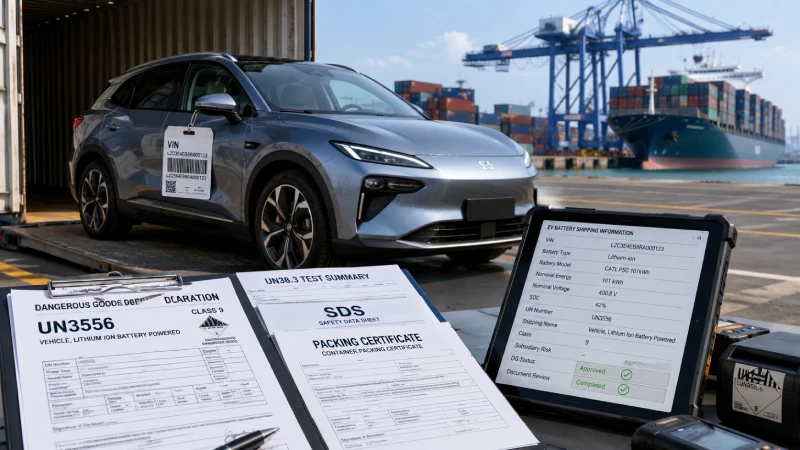
Shipping an electric vehicle by sea requires more than collecting a UN38.3 document and an MSDS. Before booking, the shipment must first be classified correctly, and the paperwork should then be separated into three layers: IMDG transport documents, carrier or terminal-specific supporting documents, and export, customs and destination-import documents.
For a complete EV, the file can include the correct UN classification, a Dangerous Goods Declaration, a Container/Vehicle Packing Certificate, a traceable UN38.3 Test Summary, SDS, battery specifications, SOC information and vehicle-condition records. The exact requirements depend on battery chemistry, whether the battery remains installed, vehicle condition, container or RoRo transport, the ports involved and the actual carrier.
Importantly, successful export customs clearance does not mean an ocean carrier must accept the vehicle. If you are planning vehicle shipping from China, dangerous-goods acceptance should therefore be checked before the vehicle reaches the terminal.
Quick EV Battery Document Checklist
The most practical way to organize EV battery shipping documents is by function rather than treating every requested item as a universal international certificate.
| Document | Required or Conditional | Usually Issued or Prepared By | Typical Submission Stage |
|---|---|---|---|
| Correct UN number and Proper Shipping Name | Required to confirm | DG specialist / consignor | Before booking |
| Dangerous Goods Declaration / Transport Document | Required where applicable | DG-trained consignor | Before DG cut-off |
| Container/Vehicle Packing Certificate | Applicable to containerized DG | Packer / inspector | After loading |
| UN38.3 Test Summary | Must be available; commonly requested | Battery manufacturer | Pre-booking review |
| SDS / MSDS | China- or carrier-specific requirement | Manufacturer / supplier | Pre-booking |
| Battery specification sheet | Frequently requested | Manufacturer / exporter | Pre-booking |
| SOC declaration | Conditional | Exporter / vehicle handler | Before loading |
| Vehicle or battery condition declaration | Common for used EVs | Exporter / inspector | Pre-booking |
| Commercial invoice and packing list | Commercial/customs requirement | Seller / exporter | Customs stage |
| Import and conformity documents | Destination-specific | Importer | Before shipment |
For China-origin dangerous goods, domestic rules also require the consignor to submit applicable dangerous-goods safety information before carriage, including the Dangerous Goods Safe Transport Declaration and safety technical information. Where containerized dangerous goods are involved, an applicable Container Packing Certificate is also required. See the Ministry of Transport’s current rules on the supervision of ships carrying dangerous goods.
For the broader workflow, see electric vehicle shipping from China.
First Determine What Is Being Shipped
The document list cannot be finalized until the cargo configuration is clear.
Complete EV With the Traction Battery Installed
IMDG Code Amendment 42-24 became mandatory on January 1, 2026. Complete vehicles powered by lithium-ion, lithium-metal and sodium-ion batteries now have dedicated entries:
- UN3556 — VEHICLE, LITHIUM ION BATTERY POWERED
- UN3557 — VEHICLE, LITHIUM METAL BATTERY POWERED
- UN3558 — VEHICLE, SODIUM ION BATTERY POWERED
These are Class 9 entries. The previous practice of broadly declaring lithium-battery EVs under UN3171 is therefore no longer appropriate under the current IMDG classification. The change is reflected in the IMO IMDG Code and implementation notices issued by maritime authorities.
SP961, SP962, P912, vessel type, loading position and the actual transport configuration still require professional review. Correct classification does not mean automatic carrier acceptance.
For a practical explanation of the new classification, see our UN3556 electric vehicle shipping guide.
A Removed or Spare EV Battery
Once a traction battery is removed from the vehicle, the complete-vehicle UN number cannot simply follow it.
Depending on chemistry and transport configuration, standalone or equipment-associated batteries may instead involve UN3480 or UN3481 for lithium-ion batteries, UN3090 or UN3091 for lithium-metal batteries, or UN3551 and UN3552 for sodium-ion batteries.
This distinction becomes especially important when spare batteries are loaded in the same container as vehicles. The vehicle’s UN3556 documentation does not automatically cover an additional battery. That battery must be classified, packaged and declared according to its own transport status and accepted by the carrier.
Damaged, Defective, Recalled or Waste Batteries
A damaged or defective traction battery is a different risk category from an ordinary used battery. Special packing, approvals or handling may apply, and some carriers may refuse the shipment entirely.
Do not assume that an ordinary UN38.3 Test Summary makes a collision-damaged, flooded, leaking, swollen, recalled or thermally compromised battery acceptable for sea transport.
Dangerous Goods Declaration and Transport Document
The Dangerous Goods Declaration, often incorporated into a Multimodal Dangerous Goods Form, communicates the regulated cargo information to the carrier and vessel operator.
Depending on the shipment, it normally identifies the:
- UN number and Proper Shipping Name
- Class 9 classification
- Applicable subsidiary hazard, if any
- Quantity, weight and cargo description
- Shipper’s declaration
- Signature and date
- Emergency contact information where required by the carrier or local rules
A packing group should only be entered where one is actually assigned. Do not invent a Packing Group for UN3556 simply because a booking or dangerous-goods form contains that field.
The consignor remains responsible for the accuracy of the declaration. Dangerous-goods documents should therefore be prepared or checked by personnel with the appropriate training and knowledge.
IMDG Section 5.4 allows the dangerous-goods transport information and packing-certificate declaration to appear in a combined document or as separate documents. Carrier instructions still determine the exact format and submission process. Maersk, for example, explains the distinction between the Dangerous Goods Declaration and the Container/Vehicle Packing Certificate in its sea-transport documentation guidance.
An SDS or UN38.3 Test Summary supports the shipment file, but neither document replaces the Dangerous Goods Declaration.
Container/Vehicle Packing Certificate
For applicable dangerous goods loaded into a freight container, the packing party normally needs to certify that the cargo transport unit has been packed correctly.
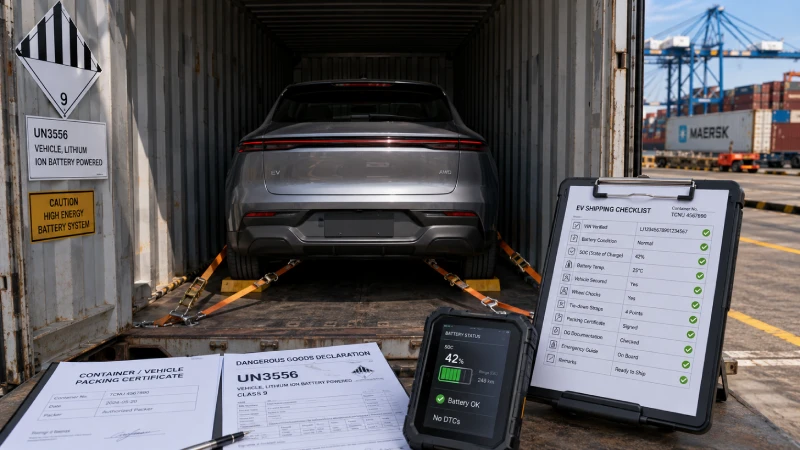
The certificate covers matters such as container condition, secure loading, segregation, markings and placards, and compliance with applicable packing requirements. For an EV, the loading team must also make sure the vehicle is prevented from moving and is secured using suitable wheel restraints and tie-down methods.
For China-origin cargo, the applicable container-packing process may involve the 《集装箱装箱证明书》, with the responsible inspector checking the loading operation and signing the document where required. The packing certificate proves how the cargo transport unit was packed; it does not prove that the battery design passed UN38.3 testing.
UN38.3 Test Summary—Not Just a “Battery Certificate”
The UN38.3 Test Summary for an EV is one of the most misunderstood documents in battery logistics.
What UN38.3 Proves
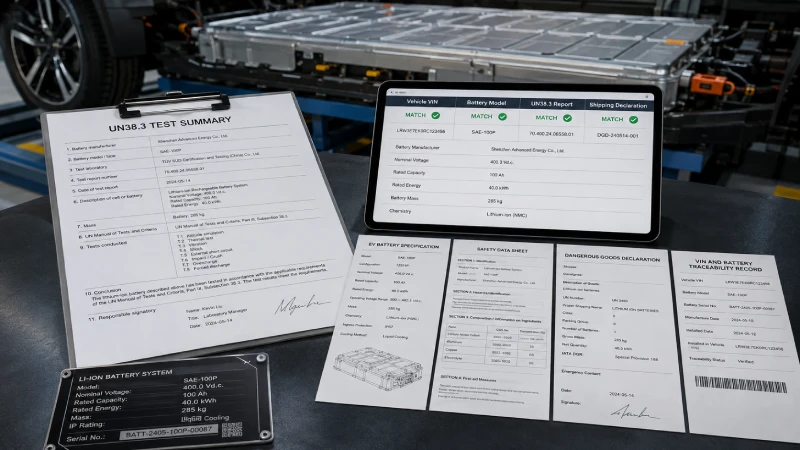
Lithium cells and batteries must be of a design that has completed the applicable transport-safety tests in subsection 38.3 of the UN Manual of Tests and Criteria. The Test Summary provides traceability between the tested battery design and the battery being offered for transport.
PHMSA explains that battery manufacturers and subsequent distributors must make the Test Summary available and identifies the information it should contain in its UN38.3 Test Summary guidance.
Test Summary vs Full Test Report
A UN38.3 Test Summary is not the same document as the complete laboratory test report.
For routine supply-chain verification and many carrier booking reviews, the Test Summary is normally the document requested. A regulator, approval authority or carrier conducting a higher-risk review may ask for additional supporting evidence or the full report.
A simple sentence stating “UN38.3 compliant,” a general certificate of conformity, or a note in an SDS is not a substitute for a complete, traceable Test Summary.
What a Valid Test Summary Should Contain
A complete Test Summary typically identifies:
- Battery manufacturer name and contact information
- Test laboratory information
- Unique test report number
- Test date
- Battery type, model and physical description
- Battery mass
- Wh rating or lithium content, where applicable
- List of tests conducted
- Edition or revision of the UN Manual used
- Responsible person’s name, title and signature information
Most importantly, the battery model shown on the Test Summary must correspond to the battery actually fitted to the EV.
Does UN38.3 Expire?
There is no universal rule requiring a UN38.3 Test Summary to be renewed every year simply because another calendar year has passed. Where a battery design changes in a way that requires retesting, revised test documentation may be necessary. A carrier may also impose its own document-age or review policy.
The practical rule is simple: the Test Summary must remain traceable to the actual battery design being shipped.
SDS or MSDS—When Is It Required?
An SDS provides safety information about the battery or hazardous material, including composition, hazard identification, firefighting measures, first aid, handling, storage and transport information.
For China-origin dangerous-goods transport, safety technical documentation is part of the information the consignor may need to provide before carriage. Individual carriers, terminals and destination countries may also require a specific language, revision date or document format.
However, the documents are not interchangeable:
SDS ≠ UN38.3 Test Summary ≠ Dangerous Goods Declaration.
A sentence in Section 14 of an SDS stating that a battery has passed UN38.3 does not replace the traceable Test Summary. Likewise, an SDS does not perform the shipper’s dangerous-goods declaration function.
Battery Specification and Vehicle-to-Battery Traceability
A useful battery specification sheet should connect the vehicle record with the battery technical file. Typical data includes:
- Vehicle make, model and model year
- VIN or chassis number
- Battery manufacturer
- Battery model or part number
- Battery chemistry
- Nominal voltage
- Capacity in kWh or Wh
- Battery mass
- New or used status
- Installed, packed with equipment or standalone status
The booking information, VIN list, battery specification, SDS and UN38.3 documentation should tell the same technical story.
Providing a Test Summary for another battery made by the same manufacturer is not sufficient if the battery model or tested design cannot be linked to the unit actually fitted in the vehicle. This traceability check is one of the most useful steps for avoiding rejection during dangerous-goods pre-approval.
Is an SOC Certificate Mandatory for Ocean Shipping?
There is no universal IMDG rule stating that every complete EV shipped by sea must have an SOC below 30%.
The commonly quoted 30% figure is more closely associated with certain air-transport requirements for lithium batteries and should not be copied automatically into ocean-shipping procedures.
For RoRo and PCTC operations, vessel operators may establish their own State of Charge limits. EMSA guidance for alternative-fuel vehicles in RoRo spaces recommends, in general, a displayed SOC between 20% and 50%, while also recognizing manufacturer and operational requirements. See the EMSA guidance on alternative-fuel vehicles.
ECG’s 2026 SOC overview also notes that many shipping lines use a maximum 50% policy following EMSA guidance, but shippers should confirm the requirement directly with the actual carrier. See the ECG EV SOC requirements overview.
Where a carrier requests an SOC declaration, useful fields can include:
- VIN
- Battery model
- Measured SOC
- Measurement date and method
- Responsible company or person
- Signature or stamp
The correct SOC is therefore the level accepted in writing by the actual carrier for that shipment, not a universal percentage copied from another transport mode.
Additional Documents Requested by Carriers or Ports
Carrier dangerous-goods departments, RoRo operators and terminals can impose requirements beyond the core IMDG documentation.
Depending on the vessel and route, they may request:
- EV booking questionnaire
- Letter of Indemnity
- Vehicle photographs
- Battery-enclosure or underbody photographs
- Non-damaged battery declaration
- Independent survey or inspection report
- OEM emergency-response guide
- Towing and emergency-handling instructions
- Transport-mode activation instructions
- Fire-response information
- 24-hour emergency contact
- Marking or placarding confirmation
- Pre-approval from the carrier’s dangerous-goods desk
These are carrier- or route-specific requirements. They should not be presented as documents that every shipment must provide solely because IMDG applies.
Extra Documents for Used EVs
Used electric vehicles often receive additional scrutiny because age, accident history and battery condition can affect transport acceptance.
Supporting documents may include a vehicle condition report, battery diagnostic or health report, accident and repair history, photographs of the underbody and battery enclosure, confirmation that the battery is not swollen, leaking or visibly damaged, and an independent survey report where requested.
Ownership and export documentation must also be complete. For the broader China-side paperwork, see used car export documents from China.
A vehicle being able to drive normally does not by itself prove that its traction battery is suitable for ocean carriage. A used EV with signs of battery damage should be disclosed before booking rather than discovered at the terminal.
Commercial, Customs and Destination Documents
Battery safety documentation is only one part of the shipment file.
Commercial and customs documents may also include:
- Commercial invoice
- Packing list
- Sales contract
- Export customs declaration
- Vehicle certificate, title or registration records
- Bill of lading instructions
- Certificate of Origin
- Verified Gross Mass, where applicable
- Destination import permit
- Vehicle conformity or inspection certificate
- Destination-specific homologation or registration documents
These documents do not prove battery transport safety. However, missing or inconsistent paperwork can still prevent export clearance, bill-of-lading issuance, destination customs clearance or vehicle registration.
Who Should Issue Each Document?
Responsibility should follow the party that controls the underlying information.
| Document | Typical Responsible Party |
|---|---|
| UN38.3 Test Summary | Battery manufacturer / subsequent supply-chain holder |
| SDS and battery specifications | Battery manufacturer / supplier |
| Vehicle-to-battery traceability | Vehicle manufacturer / exporter |
| SOC or vehicle-condition declaration | Exporter / inspection party |
| Dangerous Goods Declaration | DG-trained consignor |
| Container/Vehicle Packing Certificate | Packer / responsible inspection party |
| Independent condition survey | Independent surveyor |
| Carrier questionnaire or LOI | Carrier template completed by the relevant shipper |
| Commercial and export documents | Exporter / customs representative |
A freight forwarder can coordinate the file, communicate with the carrier and identify missing information, but it should not be presented as the issuer of the original UN38.3 test evidence or official government certificates.
Pre-Booking Document Verification Workflow
A safer workflow is to complete document verification before the vehicle reaches the port:
- Confirm the vehicle type, battery chemistry, vehicle condition and whether the battery is installed or standalone.
- Determine the correct 2026 UN number and Proper Shipping Name.
- Obtain a traceable UN38.3 Test Summary from the battery or vehicle supply chain.
- Cross-check the SDS, battery specifications, VIN, SOC and vehicle-condition information.
- Submit the file to the actual carrier’s dangerous-goods desk for pre-approval.
- After loading, finalize the applicable packing certificate, dangerous-goods transport documents and VGM.
- Ask the destination agent to confirm import permits, conformity requirements and local documentation.
Do not send the vehicle to the terminal solely because a freight salesperson has said that “EVs can ship.” Carrier acceptance should be linked to the actual vehicle data, route, vessel and sailing.
Common Documentation Mistakes That Cause Rejection
Frequent problems include:
- Using UN3171 for a lithium-ion BEV in 2026
- Substituting an SDS for the UN38.3 Test Summary
- Presenting a Test Summary for the wrong battery model
- Showing inconsistent quantities or weights across the DGD, invoice and booking data
- Applying an aviation 30% SOC rule to every ocean shipment
- Hiding accident, battery damage, recall or waste status
- Adding an undeclared spare battery inside the vehicle container
- Requesting dangerous-goods approval only after loading
- Using an outdated carrier template or incorrect Proper Shipping Name
A completed DGD is an important transport document, but it does not guarantee that a carrier, terminal or destination authority will accept the shipment.
Final Pre-Shipment Checklist
Before releasing the EV for shipment, confirm:
- Cargo configuration and battery chemistry confirmed
- Correct UN number and Proper Shipping Name confirmed
- Dangerous Goods Declaration prepared where applicable
- Container/Vehicle Packing Certificate arranged where applicable
- UN38.3 Test Summary matched to the actual battery
- SDS reviewed
- Battery specification linked to VIN
- SOC requirement confirmed with the carrier in writing
- Used, damaged, accident or recall status disclosed
- Carrier dangerous-goods approval obtained
- Required markings and placards checked
- Export and destination import documents reviewed
FAQ
Is a UN38.3 certificate required for every EV shipped by sea?
“UN38.3 certificate” is commonly used informally, but UN38.3 Test Summary is the more accurate term for the supply-chain document. The battery design must meet the applicable testing requirements, and a traceable Test Summary should be available when required.
Does the full UN38.3 laboratory report need to be submitted?
Usually not for routine booking. The Test Summary is normally used, although regulators, carriers or special-risk reviews may request additional evidence or the full laboratory report.
Can an SDS replace the UN38.3 Test Summary?
No. The SDS communicates hazard and safety information, while the Test Summary documents the tested battery design. Neither document replaces the Dangerous Goods Declaration.
Is an SOC certificate mandatory for all ocean shipments?
No universal global requirement applies to every complete EV. SOC limits and declaration formats may be set by the carrier, vessel operator or terminal, so the actual requirement should be confirmed before booking.
Does a UN38.3 Test Summary expire?
It does not automatically become invalid every year. A design change requiring retesting can trigger revised documentation, while individual carriers may impose separate document-review policies.
Are additional documents required for a used EV?
Frequently. Carriers may request vehicle-condition declarations, battery diagnostics, photographs, accident history or a third-party inspection depending on the vehicle, route and perceived risk.
Can a spare EV battery be placed inside the same container as the vehicle?
Potentially, but only after separate classification, packaging, declaration and carrier approval. UN3556 documentation for the complete vehicle cannot simply be extended to cover an additional standalone battery.
Who is responsible for the Dangerous Goods Declaration?
The consignor is responsible for correctly communicating dangerous-goods information. The declaration should be prepared or reviewed by personnel with the appropriate dangerous-goods knowledge and training.
Send the Vehicle and Battery Details Before Booking
Before requesting an EV ocean-freight booking, prepare the make, model, year, VIN, battery chemistry, battery model and capacity, new or used status, accident or damage history, installed or standalone battery configuration, loading port, discharge port and preferred container or RoRo method.
WINSail can help review the available logistics documents, coordinate carrier pre-approval requirements and compare practical shipping options. Original UN38.3 testing evidence, official certificates and final carrier acceptance remain the responsibility of the appropriate manufacturers, authorities and transport operators.
