
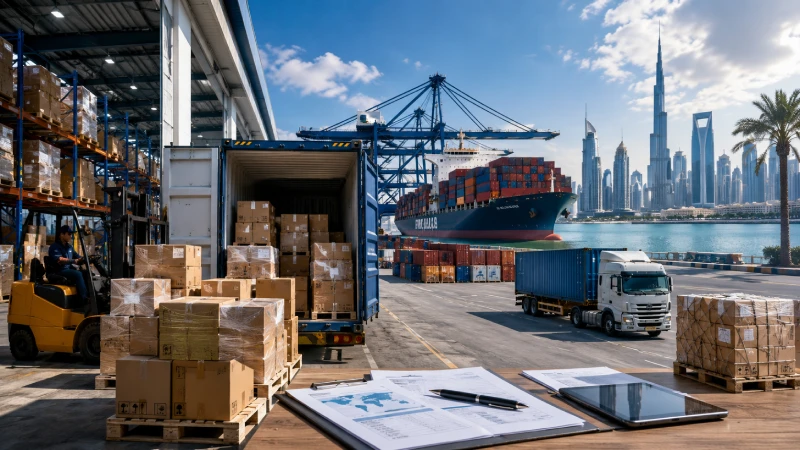
For importers who do not have enough cargo to fill a full container, LCL shipping can be a practical way to move goods from China to the UAE without paying for unused container space. If you are still comparing all available transport options, including air freight, FCL, DDP, and sea freight routes, you can first review our main guide to shipping from China to UAE. This article focuses only on LCL shipping: when it makes sense, how cost per CBM works, why transit time may be longer than FCL, what handling risks importers should plan for, and how to arrange delivery to Dubai, Abu Dhabi, Sharjah, Ajman, JAFZA, or UAE mainland.
Quick Answer: Is LCL Shipping Good for China to UAE Cargo?
LCL shipping is usually a good option when your cargo volume is too small for a full container but too large or too costly for air freight. For many UAE importers, LCL works well for shipments such as 1–15 CBM of cartons, mixed commercial goods, e-commerce inventory, samples moving into regular orders, spare parts, accessories, display materials, and general cargo that can be safely packed and handled with other shipments.
The biggest advantage is flexibility. Instead of booking a full 20ft or 40ft container, your cargo shares container space with other shipments moving to the UAE. This allows smaller importers, trading companies, and online sellers to ship more economically while still using sea freight.
However, LCL is not always the cheapest or safest option. Because the cargo is consolidated, loaded, unloaded, separated, and handled through multiple warehouse points, it normally involves more handling than FCL. This makes packaging, cargo labeling, document accuracy, and delivery planning especially important.
LCL may not be the best choice for very fragile cargo, high-value goods, urgent orders, oversized items, poorly packed products, or shipments that are already close to a full container volume. In those cases, comparing LCL with FCL, air freight, or DDP before booking is the safer decision.
LCL Shipping Cost from China to UAE
LCL shipping cost from China to UAE is usually calculated based on CBM, also called cubic meter volume. In simple terms, the more space your cargo takes inside the shared container, the higher the freight cost will be. For some dense cargo, forwarders may also consider weight and use a revenue ton calculation, depending on the cargo type and chargeable basis.
A common mistake is to compare only the ocean freight rate. In reality, LCL cost includes several parts: origin pickup in China, delivery to the consolidation warehouse, export handling, China customs declaration, CFS charges, ocean freight, UAE destination handling, deconsolidation, documentation, customs clearance service, possible storage, and final delivery.
That is why importers should not evaluate LCL only by the lowest “per CBM” number. A quote with a low ocean freight rate but unclear destination charges may become more expensive after arrival. If you are researching cost structure in more detail, the article on shipping cost per CBM from China to UAE should be used as a supporting reference once published.
The main LCL cost factors include:
| Cost Factor | Where It Happens | Why It Matters |
|---|---|---|
| Supplier pickup | China origin city | Inland trucking affects total cost |
| Consolidation warehouse | China | Cargo must be received before cut-off |
| Export handling | China | Includes CFS and export process costs |
| Ocean freight | China to UAE | Based on CBM, route, and schedule |
| Deconsolidation | UAE destination CFS | Cargo must be separated after arrival |
| Destination charges | UAE | Often overlooked in LCL quotes |
| Final delivery | Dubai, Sharjah, Abu Dhabi, Ajman, JAFZA, mainland | Distance and access affect delivery cost |
A good LCL quote should clearly show what is included and what is not included. Importers should ask whether the quote covers origin charges, export declaration, ocean freight, UAE destination charges, customs clearance service, and delivery to the final address.
Pro Tip: Do not compare LCL quotes only by ocean freight. Ask for a full charge breakdown from China warehouse to UAE destination, especially if delivery is required to a free zone, industrial area, or mainland warehouse.
LCL Shipping Time from China to UAE
LCL shipping time from China to UAE is usually longer than FCL, even when the ocean sailing time looks similar. The reason is simple: LCL cargo must go through consolidation before departure and deconsolidation after arrival.
For FCL, one shipper usually loads a dedicated container. After arrival, the container can move through the import process as one shipment. For LCL, your cargo is one part of a shared container. Before loading, the warehouse needs to receive cargo from multiple suppliers or shippers. After arrival in the UAE, the shared container must be opened, separated, checked, and released shipment by shipment.
If you are planning a delivery deadline, it is better to review how long to ship from China to UAE from a total logistics timeline perspective instead of only looking at port-to-port sailing days.
A typical LCL timeline includes:
| Stage | What Happens | Possible Time Risk |
|---|---|---|
| Supplier pickup | Goods are collected from the factory or warehouse | Supplier delay or cargo not ready |
| China CFS | Cargo is measured, received, and consolidated | Missing cut-off or warehouse delay |
| Ocean freight | Shared container moves to UAE | Vessel schedule or transshipment changes |
| UAE deconsolidation | Cargo is separated at destination warehouse | CFS queue or document mismatch |
| Customs clearance | Import documents are checked | HS code, invoice, or permit issue |
| Final delivery | Cargo is delivered to consignee | Delivery appointment or access problem |
Winsail can help estimate a realistic schedule based on origin city, sailing plan, consolidation cut-off, UAE destination, and document readiness. However, no forwarder should promise an exact delivery date for every LCL shipment, because vessel schedules, port operations, customs inspection, warehouse release, consignee readiness, and local delivery arrangements can all affect the final timeline.
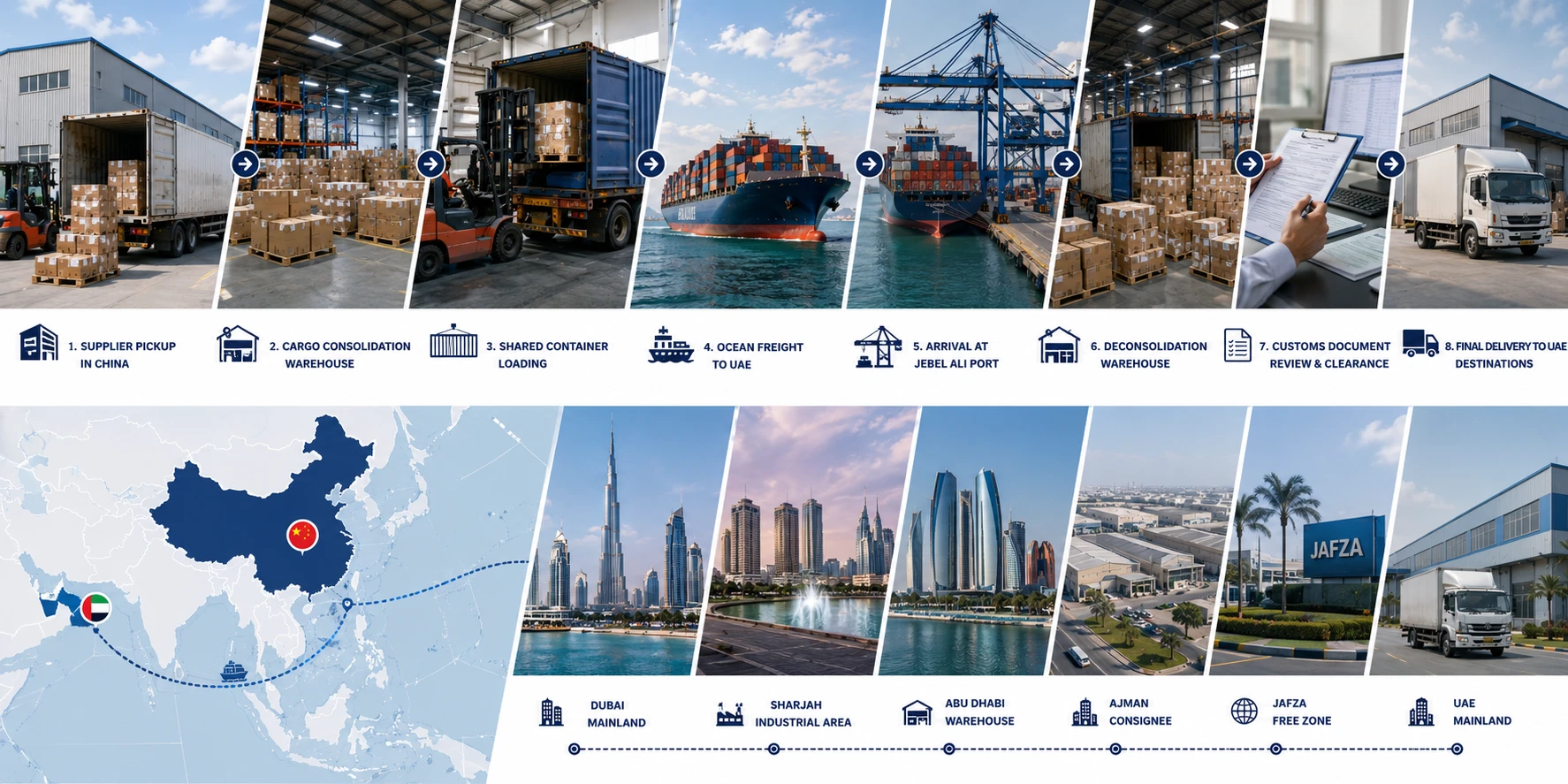
How LCL Works: Consolidation, Ocean Freight and Deconsolidation
LCL shipping from China to UAE usually starts with cargo collection from the supplier. The supplier may deliver the cargo to a nominated China warehouse, or the forwarder may arrange pickup from the factory. At this stage, the importer should provide a packing list, carton dimensions, gross weight, cargo photos, product name, and consignee details.
After the cargo arrives at the consolidation warehouse, it is measured and checked. The warehouse confirms CBM, carton count, outer packaging condition, shipping marks, and whether the cargo can be loaded with other goods. If multiple suppliers are involved, each supplier’s cargo must be clearly labeled to avoid confusion during consolidation and deconsolidation.
The cargo is then consolidated into a shared container with other LCL shipments moving to the UAE. For most UAE-bound LCL cargo, Jebel Ali is a major destination gateway because of its strong sea freight network and logistics infrastructure. Importers using sea freight from China to UAE should understand that LCL is not simply “small sea freight”; it is a warehouse-to-warehouse process with several operational steps.
Once the container arrives in the UAE, it is moved to the destination CFS or warehouse for deconsolidation. The container is opened, and each shipment is separated according to documents and marks. After that, destination charges are calculated, documents are prepared for customs clearance, and the cargo can be released for final delivery after the import process is completed.
Final delivery may be arranged to Dubai, Sharjah, Abu Dhabi, Ajman, JAFZA, or UAE mainland. Each destination has different delivery considerations. For example, delivery to a Dubai warehouse may be simpler than delivery into a free zone facility that requires consignee coordination, gate access, or appointment confirmation.
LCL vs FCL Shipping to UAE
LCL is not always better than FCL. The right choice depends on cargo volume, cargo value, handling risk, urgency, destination charges, and delivery requirements.
LCL is usually suitable when the shipment is small or medium in size and the importer wants to avoid paying for a full container. FCL becomes more attractive when cargo volume increases, when goods are fragile, when the importer needs better schedule control, or when destination charges make LCL less competitive.
For importers comparing both options, a separate review of FCL shipping from China to UAE can help identify the break-even point.
| Factor | LCL Shipping | FCL Shipping |
|---|---|---|
| Best for | Small and medium cargo | Larger cargo volume |
| Cost basis | CBM or revenue ton | Container rate |
| Handling | More warehouse handling | Less handling after loading |
| Transit control | Less predictable | More direct and controllable |
| Cargo space | Shared container | Dedicated container |
| Destination charges | Higher per CBM risk | More predictable per container |
| Damage risk | Higher due to handling | Lower if loaded properly |
A simple rule is this: if your cargo is small, LCL may reduce upfront shipping cost. If your cargo is larger, fragile, or time-sensitive, FCL may protect the shipment better and simplify the process.
Best Cargo Types for LCL Shipping from China to UAE
LCL shipping works best for cargo that is easy to pack, stack, label, and separate. Good LCL cargo is usually packed in strong export cartons, has clear shipping marks, and does not require special handling.
Suitable cargo types include general merchandise, e-commerce inventory, small consumer goods, spare parts, accessories, display items, small tools, hardware, non-fragile samples, and mixed SKU commercial cargo.
Some cargo can still move by LCL but requires extra planning. Furniture parts, machinery components, glass items, tiles, stone samples, lighting products, electronics, and branded goods need stronger packaging, clearer documentation, and risk review before booking.
| Cargo Type | LCL Suitability | Main Risk | Planning Advice |
|---|---|---|---|
| Cartoned consumer goods | High | Carton compression | Use strong export cartons |
| E-commerce stock | High | SKU confusion | Use clear labels and packing list |
| Spare parts | High | Small item loss | Pack by carton and mark clearly |
| Furniture parts | Medium | Scratches or dents | Use pallets or wooden crates |
| Machinery parts | Medium | Heavy handling | Confirm weight and lifting method |
| Glass or fragile goods | Low to medium | Breakage | Reinforce packaging or compare FCL |
| Regulated goods | Case by case | Permit or customs issue | Confirm before shipment |
Pro Tip: For LCL, packaging is not only about protecting the product. It also helps warehouse staff identify, stack, separate, and release the cargo correctly after deconsolidation in the UAE.
UAE Destination Charges and Delivery Planning
Destination planning is one of the most important parts of LCL shipping to the UAE. Many importers focus on China-side cost and ocean freight, but the final landed cost can change significantly after destination charges are added.
Typical UAE-side LCL charges may include destination CFS, deconsolidation, documentation, delivery order fee, customs clearance service fee, inspection-related handling if applicable, warehouse storage if documents are delayed, and final delivery.
Delivery planning also depends on where the cargo needs to go. Dubai, Sharjah, Abu Dhabi, Ajman, JAFZA, and UAE mainland are not the same from a logistics perspective.
For Dubai mainland delivery, the importer should confirm warehouse address, contact person, unloading availability, and whether delivery appointment is needed. For Sharjah and Ajman, industrial area access and truck timing may affect delivery. Abu Dhabi delivery may involve longer inland trucking from Jebel Ali. JAFZA delivery requires more attention to free zone procedures, consignee license, gate access, and document coordination.
If your shipment is routed via Jebel Ali, the future article on shipping from China to Jebel Ali can support port-specific planning. For cargo delivered directly to commercial warehouses, stores, or distribution points in Dubai, shipping from China to Dubai can be used as a city-level reference.
Before requesting an LCL quote, importers should prepare the following information:
| Information Needed | Why It Matters |
|---|---|
| Supplier address in China | Determines pickup and warehouse routing |
| Cargo CBM and gross weight | Determines chargeable basis |
| Carton count and dimensions | Helps avoid measurement disputes |
| Product name and HS code | Supports customs review |
| Cargo photos | Helps assess packaging risk |
| UAE delivery address | Affects final delivery cost |
| Free zone or mainland status | Affects customs and delivery planning |
| Consignee/importer details | Needed for clearance coordination |
Customs Documents and Risk Points
LCL shipments require accurate documents because the cargo cannot move smoothly after deconsolidation if invoice, packing list, consignee details, or product information is incomplete.
Common documents for LCL shipping from China to UAE include commercial invoice, packing list, bill of lading or house bill of lading, certificate of origin where required, HS code, importer details, trade license or customs registration information where applicable, and product permits for restricted goods.
Importers can use documents required for shipping from China to UAE as a supporting checklist when preparing shipment paperwork.
Common risk points include vague product descriptions, incorrect HS codes, invoice value mismatch, missing consignee information, unclear carton marks, incomplete packing list, and product categories that require special approval. These issues can delay release after arrival and may create storage or additional handling charges.
For UAE import planning, it is also important to understand that customs clearance, duty, VAT, and product approval decisions depend on UAE customs authorities, importer records, product classification, and supporting documents. Winsail can help review documents, coordinate with agents, and explain risk points, but final clearance acceptance and tax assessment are not something a forwarder can guarantee.
If your cargo involves special product categories or uncertain classification, review customs clearance in UAE before booking the shipment.
When to Upgrade from LCL to FCL or DDP
LCL is a useful solution, but it should not be used automatically for every small or medium shipment. Importers should consider upgrading to FCL when cargo volume approaches the FCL break-even point, when goods are fragile or high value, when the cargo cannot be mixed with other shipments, or when predictable delivery timing matters more than saving a small amount of freight cost.
FCL may also be better when cargo needs to remain sealed from supplier loading to destination release. This reduces handling points and can lower the risk of damage, carton loss, or shipment confusion.
DDP may be considered in some cases, especially for samples, small e-commerce cargo, or importers without a mature import setup in the UAE. However, DDP shipping from China to UAE should not be treated as a universal solution. For commercial goods, branded goods, electronics, cosmetics, food-contact products, chemicals, batteries, high-value cargo, or regulated products, compliance must be reviewed before accepting a DDP plan.
A practical comparison looks like this:
| Situation | Best Option to Review |
|---|---|
| 2–5 CBM general cargo | LCL |
| 10–15 CBM mixed cartons | Compare LCL and FCL |
| 18 CBM or more | Usually compare FCL first |
| Fragile or high-value cargo | FCL may be safer |
| Urgent small cargo | Air freight or express |
| Small e-commerce cargo | LCL or DDP, depending on compliance |
| No clear UAE importer setup | Review DDP carefully |
The best method is not the one with the lowest first quote. It is the method that balances cost, timing, customs risk, cargo safety, and delivery practicality.
How Winsail Helps Reduce LCL Handling Risks
Winsail supports importers by reviewing shipment details before cargo enters the LCL process. This includes supplier coordination, cargo readiness checking, CBM confirmation, gross weight review, carton count confirmation, cargo photo request, route planning, and packaging advice.
Before shipment, Winsail helps importers understand whether the cargo is suitable for LCL or whether FCL, air freight, or DDP should be compared. During consolidation, the focus is on warehouse receiving, cargo marks, measurement, loading schedule, and communication with the supplier. After arrival in the UAE, the focus shifts to deconsolidation follow-up, destination charge explanation, customs document coordination, and final delivery planning.
| Risk | Why It Happens | Winsail Support |
|---|---|---|
| CBM dispute | Different measurement methods | Confirm dimensions before booking |
| Cargo damage | Multiple handling points | Recommend stronger packaging |
| Delay at CFS | Consolidation or deconsolidation queue | Plan a realistic timeline |
| Destination charge surprise | Quote scope unclear | Provide charge breakdown |
| Customs delay | Document mismatch | Pre-check invoice and packing list |
| Delivery failure | Consignee not ready | Confirm address and delivery details |
LCL shipping is not only about booking container space. It is about controlling many small details before they become expensive problems at destination.
FAQs About LCL Shipping from China to UAE
How much does LCL shipping from China to UAE cost?
LCL cost depends on CBM, gross weight, origin city in China, destination in the UAE, cargo type, warehouse handling, destination charges, customs clearance service, and final delivery. A reliable quote should be based on a packing list, carton dimensions, product details, and delivery address.
How long does LCL shipping from China to UAE take?
LCL usually takes longer than FCL because it includes consolidation in China and deconsolidation in the UAE. The total timeline depends on supplier readiness, warehouse cut-off, vessel schedule, destination CFS release, customs clearance, and final delivery arrangements.
Is LCL cheaper than FCL for UAE shipments?
LCL is often cheaper for smaller cargo because the importer pays for shared container space instead of a full container. However, when cargo volume increases or destination charges are high, FCL may become more cost-effective.
What is the minimum CBM for LCL shipping?
Many LCL services can accept very small shipments, but minimum chargeable volume or minimum handling charges may apply. For very small or urgent cargo, air freight or express may be more practical than LCL.
What documents are needed for LCL to UAE?
Common documents include commercial invoice, packing list, bill of lading, certificate of origin where required, HS code, consignee/importer details, and permits or approvals for restricted goods.
Can LCL be delivered door-to-door in UAE?
Yes, LCL can often be arranged with door delivery in the UAE. However, door delivery depends on customs clearance status, consignee readiness, delivery address, free zone or mainland requirements, duty/VAT arrangements, and local access conditions.
