

If you are planning shipping from China to Saudi Arabia, document preparation should start before the cargo is booked, not after it arrives at the port or airport. Many Saudi import delays are not caused by the shipping route itself, but by missing certificates, inconsistent invoice details, unclear HS codes, incorrect consignee information, or late SABER-related checks. This checklist helps importers prepare the right documents before booking, before departure from China, and before Saudi customs clearance begins.
Quick Saudi Arabia Import Documents Checklist
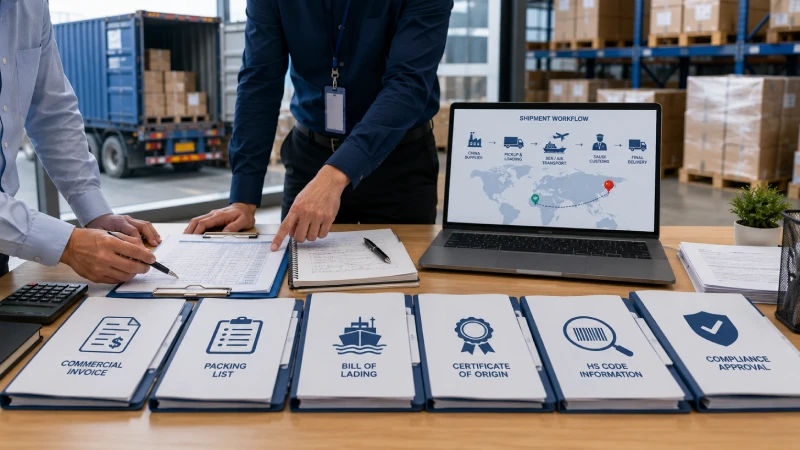
For most China-to-Saudi shipments, the basic document set usually includes a commercial invoice, packing list, bill of lading or air waybill, certificate of origin, HS code information, importer details, and product-related certificates where applicable. If the product is regulated, additional SABER, SASO, IECEE, MSDS, test reports, or other approvals may be required.
| Document / Information | Usually Needed For | Prepared By |
|---|---|---|
| Commercial invoice | Most shipments | Supplier / exporter |
| Packing list | Most shipments | Supplier / exporter |
| Bill of lading or air waybill | Sea or air freight | Carrier / forwarder |
| Certificate of origin | Many import shipments | Exporter / chamber process |
| HS code information | Duty, compliance, and classification | Importer / broker / supplier |
| SABER / SASO documents | Regulated products | Importer / certification body |
| Product certificates | Product-specific approval | Supplier / importer |
| Importer / consignee details | Customs clearance and delivery | Saudi importer |
| Broker information | Clearance coordination | Importer / customs broker |
| Delivery address | DDP and door delivery | Importer / consignee |
This article is more checklist-driven than a general Saudi Arabia customs clearance guide. It focuses on what should be prepared before shipment, so the importer, supplier, forwarder, and customs broker can work from the same document basis.
What to Prepare Before Booking the Shipment
Before you book LCL, FCL, air freight, DDP, or project cargo service, the freight forwarder needs enough information to understand the cargo and identify document risks. At this stage, importers should not wait for final documents. Draft documents are already useful for review.
Before booking, prepare:
- Product name and clear product description
- Product photos or catalog
- HS code suggestion, if available
- Supplier name and pickup address in China
- Commercial invoice draft
- Packing list draft
- Number of cartons, pallets, crates, or packages
- Gross weight, net weight, and CBM
- Incoterms, such as EXW, FOB, CIF, DAP, or DDP
- Saudi consignee and delivery address
- Whether the product may need SABER, SASO, IECEE, MSDS, or other approval
This early review is especially important when the goods include electrical products, building materials, machinery, auto parts, batteries, chemicals, branded goods, consumer products, or project equipment.
What to Confirm Before Cargo Leaves China
Before the cargo departs from China, the document set should be much more complete. Any mismatch at this stage can create delays later in Saudi Arabia.
Before departure, confirm:
- Final commercial invoice
- Final packing list
- Correct shipping marks
- Final cargo weight and dimensions
- Certificate of origin arrangement
- Bill of lading or air waybill instructions
- Correct consignee and notify party
- HS code consistency across documents
- Product certificate status, where applicable
- SABER or SASO-related documents, where applicable
- DDP responsibility and delivery address, if using DDP service
For urgent shipments by air freight from China to Saudi Arabia, this review needs to be done even faster because the cargo may arrive before document corrections are completed. For sea freight from China to Saudi Arabia, importers have more transit time, but document errors can still cause arrival delays, storage charges, or clearance problems.
Commercial Invoice Checklist for Saudi Imports
The commercial invoice is one of the most important documents in the Saudi import document set. It shows what is being sold, who is selling it, who is buying it, the declared value, the currency, and the trade terms.
A strong commercial invoice should usually include:
- Seller / exporter name and address
- Buyer / importer name and address
- Consignee details, if different from buyer
- Invoice number and date
- Clear product description
- Quantity and unit
- Unit price and total value
- Currency
- Country of origin
- HS code, if available
- Incoterms
- Package quantity
- Gross weight and net weight, if included
- Signature or company stamp, if required by the transaction
The most common problem is using vague product descriptions. Descriptions such as “parts,” “accessories,” “machine,” or “goods” may not be enough for classification and certificate review. A better description explains what the product is, what it is made of, and how it is used.
For example, “LED lighting fixture for indoor commercial use” is stronger than “lights.” “Steel machinery spare parts for packaging equipment” is clearer than “parts.”
Packing List Checklist: Weight, Volume, Packages, and Marks
The packing list supports warehouse handling, freight calculation, customs review, and final delivery planning. For LCL and air freight, packing details directly affect chargeable volume and cargo handling. For FCL, they help confirm container loading and package count.
A practical packing list should include:
- Product name
- Number of cartons, pallets, crates, or packages
- Quantity per package
- Gross weight and net weight
- Dimensions per package
- Total CBM
- Shipping marks
- Pallet or crate numbers
- Fragile, heavy, stackability, or handling notes
- Dangerous goods notes, if applicable
For LCL cargo, inaccurate package dimensions can affect warehouse receiving and freight charges. For air freight, wrong dimensions can change the chargeable weight. For project cargo, missing crate dimensions may affect truck selection, lifting plan, and site delivery.
Bill of Lading or Air Waybill Checklist
For sea freight, the bill of lading is the key transport document. For air freight, the air waybill performs a similar transport function, but the process and release method are different.
For sea freight shipments, confirm these bill of lading details:
- Shipper
- Consignee
- Notify party
- Port of loading
- Port of discharge
- Final destination, if shown
- Container number for FCL
- Seal number for FCL
- Package count
- Gross weight
- Measurement / CBM
- Cargo description
- Freight terms
- Original BL, telex release, or sea waybill arrangement
For air freight shipments, confirm these air waybill details:
- Shipper
- Consignee
- Airport of departure
- Airport of destination
- Number of pieces
- Gross weight
- Chargeable weight
- Goods description
- Special handling notes
- Battery or DG information, if applicable
The consignee and notify party must be checked before the BL or AWB is issued. If the consignee name does not match the importer arrangement, the shipment may need document amendments before release.
Certificate of Origin: What Importers Should Check
The certificate of origin helps identify where the goods were produced or manufactured. For Saudi imports, importers should check whether the certificate of origin is needed for their specific shipment and make sure it matches the commercial invoice and packing list.
Important details to check include:
- Exporter name
- Importer or consignee name
- Product description
- Country of origin
- Quantity
- Invoice reference
- Shipment details, where applicable
A common mistake is preparing the certificate of origin too late. Another issue is using product descriptions that do not match the invoice. If one shipment contains goods from different origins, the origin information should be clearly separated and consistent.
HS Code Information: Why It Should Be Checked Early
HS code information affects customs classification, duty, VAT, certificate requirements, and DDP cost estimates. The supplier may provide a China export HS code, but the Saudi importer or Saudi customs broker should confirm the import classification for Saudi Arabia.
To support HS code review, prepare:
- Product photos
- Product catalog or datasheet
- Material composition
- Function and application
- Model number
- Voltage, power, or technical specifications
- Whether the item is a finished product, spare part, accessory, or component
- Industry use, such as construction, automotive, electronics, or machinery
HS code mistakes can create bigger document problems. For example, a SABER certificate may be linked to a product category that does not match the invoice description. A DDP quotation may also become inaccurate if the product is classified under a different duty or compliance requirement.
SABER, SASO, and Product Certificates Where Applicable
Not every product requires the same certificate, but regulated products should be checked before shipment. If the importer waits until cargo arrives in Saudi Arabia, document correction may become slower and more expensive.
For regulated goods, importers may need to prepare or confirm:
- SABER product certificate, where applicable
- Shipment certificate, where applicable
- SASO-related conformity documents
- IECEE certificate for applicable electrical products
- Test reports
- Technical datasheet
- Product photos
- Model list
- Manufacturer information
- Labeling details
- User manual or instruction documents, where required
For a deeper guide on conformity requirements, importers should review SABER certificate for Saudi imports before arranging shipment. This checklist only explains how SABER-related documents fit into the shipping document workflow.
Products that often need extra attention include electrical appliances, lighting products, building materials, machinery, auto parts, toys, consumer goods, batteries, telecom products, chemicals, food-contact items, and medical-related goods.
Product-Specific Documents and Special Approvals
Some cargo requires more than the basic invoice, packing list, and transport document set. The required documents depend on product type, HS code, and Saudi import rules.
| Cargo Type | Possible Supporting Documents |
|---|---|
| Lithium batteries | MSDS, UN38.3, battery declaration, DG documents |
| Chemicals | MSDS, composition details, safety documents |
| Electrical products | Test reports, IECEE, technical datasheet |
| Telecom devices | Type approval or wireless-related documents |
| Medical products | Product registration or approval documents |
| Food-contact products | Material safety or compliance documents |
| Machinery | Technical datasheet, model list, certificate documents |
| Project cargo | Packing drawings, lifting points, weight per crate |
| Wooden packaging | Fumigation or treatment documents, where applicable |
The safest approach is to check these documents before cargo pickup in China. Once the cargo is already in transit, it becomes harder to correct product descriptions, certificate names, model lists, or consignee arrangements.
Importer, Consignee, and Broker Information
Saudi clearance depends not only on product documents, but also on correct importer and consignee information. Before booking, the importer should confirm who will act as consignee and who will handle customs clearance.
Prepare the following:
- Legal company name
- Commercial registration details, where needed
- VAT or tax information, where applicable
- Importer contact person
- Phone number and email
- Full delivery address
- Consignee name for BL or AWB
- Notify party
- Customs broker details
- Broker authorization, if required
- Warehouse or site delivery contact
This is especially important for DDP shipments. In DDP shipping from China to Saudi Arabia, the forwarder must understand the importer arrangement, document responsibility, duty and tax basis, and final delivery address before confirming the shipping plan.
DDP Shipping Documents from China to Saudi Arabia
DDP shipping does not mean the importer can ignore documentation. In fact, DDP often requires earlier document review because the forwarder must estimate cost, compliance risk, clearance feasibility, and delivery requirements before shipment.
Before requesting a DDP quote, prepare:
- Product name and photos
- HS code suggestion
- Commercial invoice value
- Packing list
- Cargo weight and CBM
- Supplier address in China
- Delivery address in Saudi Arabia
- Product certificate status, where applicable
- Whether the goods are branded, regulated, oversized, fragile, battery-powered, or dangerous
Before shipment, confirm:
- Final invoice and packing list
- Final delivery contact
- Unloading requirements
- Truck access conditions
- SABER or product certificate documents, where applicable
- Consignee or importer arrangement
- Any special handling requirements
A common mistake is asking for a DDP price with only a product name and total weight. Without clear HS code information, invoice value, product photos, and delivery address, the DDP quote may not reflect the real clearance and delivery risk.
Document Checklist by Shipping Method
Different shipping methods require different document attention.
| Shipping Method | Documents / Details to Check | Main Risk |
|---|---|---|
| LCL shipping | Carton or pallet dimensions, shipping marks, warehouse receiving details, supplier consolidation documents | Wrong CBM, package mismatch, warehouse delay |
| FCL shipping | Container number, seal number, loading list, BL instructions, final packing list | BL amendment, container release delay |
| Air freight | Chargeable weight, AWB details, flight deadline, product description, MSDS or battery documents where applicable | Cargo arrives before documents are corrected |
| DDP shipping | HS code, invoice value, delivery address, consignee arrangement, certificate status | Incorrect duty, tax, compliance, or delivery basis |
| Project cargo | Crate dimensions, lifting points, packing drawings, weight per package, site delivery restrictions | Trucking, lifting, or site delivery failure |
| Multi-supplier shipment | Standardized invoice format, product names, packing lists, and shipping marks | Confusing document set and clearance questions |
For LCL cargo, the importer should pay close attention to package count, CBM, and shipping marks. For FCL cargo, the BL instructions, container number, seal number, and final loading details should be confirmed before vessel departure. For air freight, the document review must happen quickly because the shipment may arrive in Saudi Arabia within days.
Project cargo requires the most detailed preparation. In addition to commercial documents, the importer may need packing drawings, lifting points, crate dimensions, center of gravity information, unloading plans, and site contact details. If the delivery site has access limits, crane requirements, or strict project timelines, these should be reviewed before booking.
Common Document Mistakes That Delay Saudi Customs Clearance
Many delays can be prevented before cargo leaves China. Common document mistakes include:
- Commercial invoice and packing list do not match
- Product description is too vague
- HS code is missing or inconsistent
- Certificate of origin is arranged too late
- Consignee name differs across documents
- BL or AWB details are incorrect
- SABER or product certificates are checked after arrival
- Invoice value does not match the DDP quotation basis
- Multiple suppliers use different names for the same product
- Battery, chemical, or regulated product documents are missing
- Delivery address is incomplete for DDP shipments
- Project cargo dimensions are not confirmed before booking
- Wooden packaging documents are ignored where applicable
- Shipping marks do not match the packing list
For a broader explanation of the clearance process after arrival, importers can also read Saudi Arabia customs clearance. However, most document problems should be solved before the cargo departs from China.
What Winsail Can Review Before Cargo Leaves China
Winsail can help importers review the shipment document basis before cargo pickup, booking, departure, or customs clearance. This is especially useful when the shipment involves multiple suppliers, regulated products, DDP service, air freight urgency, LCL consolidation, FCL containers, or project cargo.
Before shipment, Winsail can review:
- Commercial invoice draft
- Packing list draft
- Cargo description
- Product photos and basic specifications
- HS code consistency
- Package count, weight, and CBM
- BL or AWB instructions
- Consignee and notify party details
- Supplier pickup information
- Saudi delivery address
- DDP document basis
- Product certificate risk signals
Winsail can also coordinate with Chinese suppliers to correct document details before cargo leaves the factory or warehouse. This helps reduce last-minute changes, arrival delays, storage costs, and communication problems between supplier, importer, broker, and forwarder.
Final Pre-Shipment Advice
Saudi import document preparation should be treated as part of the shipping plan, not as a last-minute customs task. Before cargo leaves China, importers should confirm the commercial invoice, packing list, BL or AWB instructions, certificate of origin, HS code information, consignee details, and product-specific certificates where applicable.
For DDP shipments, regulated goods, air freight, LCL consolidation, FCL containers, and project cargo, early document review is even more important. A small mistake in product description, consignee name, HS code, or certificate status can create unnecessary delays after arrival.
If you are preparing a shipment from China to Saudi Arabia, send Winsail your product details, invoice draft, packing list, cargo size, supplier address, and Saudi delivery address. Our team can review the document basis before cargo leaves China and recommend the right shipping solution for your cargo.
FAQ
What documents are usually required to import goods into Saudi Arabia?
Most shipments need a commercial invoice, packing list, bill of lading or air waybill, certificate of origin where applicable, HS code information, importer details, and product-related certificates where required.
Do all Saudi imports need SABER documents?
No. SABER requirements depend on product type, HS code, and Saudi technical regulations. Regulated products should be checked before shipment.
Who should confirm the HS code for Saudi imports?
The supplier can suggest a code, but the Saudi importer or customs broker should confirm the local import classification.
What documents are needed for DDP shipping to Saudi Arabia?
DDP shipments usually require product details, invoice value, packing list, HS code information, delivery address, consignee arrangement, and product certificates where applicable.
Are LCL and FCL documents different?
The core documents are similar, but LCL needs more attention to package dimensions, shipping marks, and consolidation details. FCL needs accurate container, seal, loading, and BL information.
What documents are needed for air freight to Saudi Arabia?
Air freight shipments need a commercial invoice, packing list, air waybill, cargo weight and dimensions, consignee details, and special documents such as MSDS or battery declarations where applicable.
What are the most common document mistakes?
Common mistakes include invoice and packing list mismatches, vague product descriptions, wrong consignee details, missing HS codes, late certificate checks, and incomplete delivery information.
Can Winsail review my documents before shipment?
Yes. Winsail can review your invoice, packing list, product details, HS code consistency, BL/AWB instructions, and DDP document basis before cargo leaves China.
