
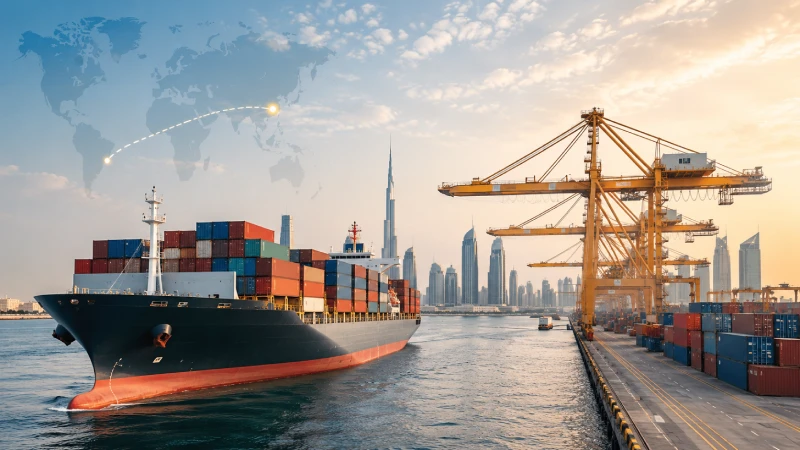
If you are comparing different logistics options for the UAE market, start with the main shipping from China to UAE route guide, then use this sea freight guide to decide whether ocean shipping is the right choice for your cargo. Sea freight from China to UAE is usually the most practical option for importers moving bulky, heavy, or regular commercial shipments such as furniture, building materials, machinery, auto parts, retail inventory, and re-export cargo through Dubai or Abu Dhabi.
Unlike air freight or express shipping, sea freight is not only about the sailing time. The final result depends on shipment volume, FCL or LCL choice, China origin port, UAE destination port, customs documents, consignee readiness, destination charges, and final delivery conditions. For UAE importers, the route also needs to match the final business scenario: Dubai mainland delivery, JAFZA storage, KEZAD industrial delivery, Dubai South warehousing, Sharjah or Ajman distribution, Abu Dhabi project delivery, or re-export to another Gulf, African, or Middle Eastern market.
Quick Answer: Is Sea Freight the Best Way to Ship from China to UAE?
Sea freight is usually the best way to ship from China to UAE when your cargo is too large, too heavy, or too costly to move by air. It is especially suitable when the shipment is not extremely urgent and the buyer wants to reduce logistics cost per unit. For example, a furniture importer, construction material buyer, machinery distributor, auto parts wholesaler, or UAE trading company may save significantly by using LCL or FCL sea freight instead of air freight.
For small samples, urgent spare parts, documents, or lightweight high-value products, air freight or express shipping may still be better. But for commercial cargo with predictable purchasing cycles, sea freight normally gives importers more flexibility in cost control and shipment planning.
Sea freight is also useful for UAE trading companies that use Dubai as a regional distribution base. Cargo can arrive at Jebel Ali, move into JAFZA or a mainland warehouse, and then be distributed locally or re-exported to other markets. DP World describes Jebel Ali Port as offering container management, cargo handling, deep-water access, and links by road, rail, and inland waterway, which explains why it is such an important gateway for UAE-bound cargo.
Before booking, importers should compare sea freight with air, express, and DDP options. If your cargo is time-sensitive, highly regulated, or requires special customs handling, the cheapest ocean freight quote may not be the safest option.
Send Winsail your cargo name, supplier city, CBM, gross weight, target UAE destination, and delivery requirement. Our team can help check whether sea freight, air freight, or another shipping solution is more suitable.
Pro Tip: Sea freight is not only about the ocean leg. For UAE shipments, port choice, documents, destination charges, and delivery readiness can change the final landed cost.
Sea Freight Cost from China to UAE
Sea freight cost from China to UAE depends on several variables, so importers should avoid relying on a single fixed rate without checking shipment details. The main cost drivers include cargo volume, gross weight, container size, China origin city, export port, destination port, shipping season, carrier space, destination charges, customs process, and whether the delivery scope is port-to-port or port-to-door.
For LCL shipments, the cost is usually calculated by volume, commonly based on CBM, although weight may also matter for dense cargo. For FCL shipments, the cost is based on the container, such as 20GP, 40GP, or 40HQ. A full container may look more expensive at first, but the cost per unit can be lower if the cargo volume is large enough.
Importers comparing sea freight with other methods can refer to shipping cost from China to UAE for a broader cost comparison across LCL, FCL, air freight, express, and DDP options.
| Cost Factor | Why It Matters for UAE Shipments | Importer Check |
|---|---|---|
| Cargo volume | Determines whether LCL or FCL is more economical | Confirm total CBM |
| Gross weight | Affects handling, loading, and trucking | Check carton, pallet, and total weight |
| Container type | 20GP, 40GP, and 40HQ have different cost efficiency | Match container to cargo volume |
| China origin | Inland pickup and origin port choice affect total cost | Confirm supplier city |
| UAE destination port | Jebel Ali, Khalifa Port, or another routing may affect delivery | Match port to final address |
| Destination charges | Local fees can affect landed cost | Ask what is included and excluded |
| Delivery scope | Port-only and port-to-door pricing are different | Confirm warehouse, free zone, or site delivery |
A practical quote request should include the commercial invoice, packing list, supplier address, cargo photos if available, HS code if known, UAE consignee details, and final delivery address. Without these details, any cost estimate may be too general for real booking decisions.
Request a sea freight quote from Winsail with your cargo details, CBM, weight, supplier location, and UAE destination. We can help compare LCL, 20GP, 40GP, and 40HQ options.
Sea Freight Transit Time from China to UAE
Sea freight transit time from China to UAE should be understood as a planning range, not a guaranteed delivery date. The port-to-port sailing time is only one part of the total timeline. Importers also need to consider China pickup, export handling, container loading, customs declaration, vessel cutoff, UAE port arrival, document exchange, customs release, delivery order, and final trucking.
For a full timeline comparison across different methods, importers can also review how long to ship from China to UAE.
| Route Stage | What Happens | Planning Note |
|---|---|---|
| China pickup | Cargo moves from supplier to warehouse or port | Add buffer before vessel cutoff |
| Export handling | Booking, loading, declaration, and terminal process | Documents must be ready |
| Ocean transit | Vessel sails from China port to UAE port | Depends on carrier and routing |
| UAE arrival | Container discharge and local port process | Consignee should prepare early |
| Customs and release | Declaration, possible inspection, duty/VAT process | Depends on cargo and importer status |
| Final delivery | Delivery to free zone, warehouse, mainland, or project site | Check access and unloading |
Delays often happen when importers focus only on the sailing schedule and ignore destination readiness. For example, if the consignee cannot provide the correct documents, cannot arrange customs declaration on time, or does not know who will pay destination charges, the cargo may wait after arrival and create storage or demurrage risk.
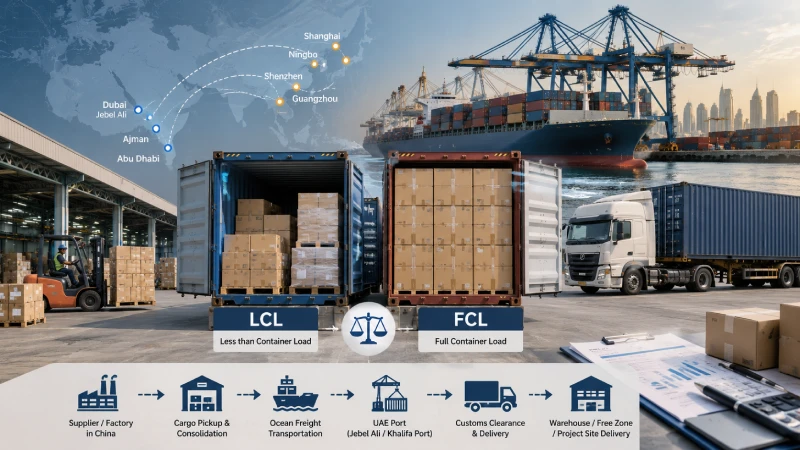
FCL vs LCL Sea Freight to UAE
The biggest decision in sea freight from China to UAE is whether to ship by FCL or LCL.
FCL, or full container load, is usually better for importers shipping larger volumes, regular purchase orders, high-value cargo, fragile goods, or cargo that needs better control during loading. A full container can be loaded at the factory or consolidation warehouse in China and then shipped as one container to the UAE. This reduces handling compared with LCL and can be safer for furniture, tiles, stone, machinery, auto parts, and mixed retail inventory. If your shipment is large enough, FCL shipping from China to UAE may provide better cost-per-unit and more predictable handling.
LCL, or less than container load, is better when your cargo does not fill a full container. It allows multiple importers’ cargo to share container space. This can reduce the entry cost for small and medium shipments, trial orders, and mixed supplier purchases. However, LCL involves consolidation in China and deconsolidation in the UAE, which means more handling and sometimes a longer total lead time. For smaller orders, LCL shipping from China to UAE can still be the most practical option, but the cargo should be packed strongly and labeled clearly.
| Item | LCL Sea Freight to UAE | FCL Sea Freight to UAE |
|---|---|---|
| Best for | Small or medium shipments | Larger commercial shipments |
| Cost basis | Usually charged by CBM | Charged by container |
| Handling | More handling during consolidation | Less handling if loaded properly |
| Transit control | Depends on consolidation schedule | More direct control |
| Cargo risk | Higher for fragile or irregular cargo | Better for fragile or valuable cargo |
| Buyer type | Small importer, trial order, mixed suppliers | Wholesaler, distributor, project buyer |
| Main concern | Local charges and handling risk | Container loading and utilization |
Pro Tip: If your shipment is close to the LCL/FCL break-even point, FCL may be safer and more predictable even if the first quote looks slightly higher.
Send Winsail your packing list and product photos. We can check whether LCL, 20GP, 40GP, or 40HQ is more suitable for your UAE shipment.
Main UAE Seaports for China Shipments
Jebel Ali Port for Dubai, JAFZA, and Re-export Cargo
Jebel Ali is the most common UAE gateway for many China shipments, especially cargo destined for Dubai, JAFZA, Sharjah, Ajman, Dubai South, and re-export trading companies. It is a strong option for importers who sell into the UAE mainland or distribute goods to other Gulf, Middle Eastern, and African markets.
For companies operating in JAFZA, Jebel Ali can be especially convenient because the free zone is directly connected to Dubai’s logistics and trading ecosystem. JAFZA describes itself as DP World’s flagship free zone and the largest customs bonded zone in the Middle East.
Khalifa Port for Abu Dhabi, KEZAD, and Industrial Cargo
Khalifa Port is an important option for Abu Dhabi-bound cargo, KEZAD industrial delivery, manufacturing supply chains, construction projects, automotive parts, machinery, bulk-related cargo, and large commercial shipments. AD Ports describes Khalifa Port as a deep-water multipurpose port handling containers, general cargo, RoRo, dry bulk, liquid and gas cargo.
For Abu Dhabi importers, Khalifa Port may reduce inland trucking distance compared with routing everything through Dubai. It can also be a strong fit for industrial companies, factories, and project cargo linked to KEZAD or Abu Dhabi mainland delivery.
Sharjah, Ajman, Dubai South, and Mainland Delivery
Not every UAE shipment ends at the port. Many importers need delivery to a warehouse, showroom, free zone facility, construction site, or distribution center. Cargo may arrive at Jebel Ali and then move by truck to Sharjah or Ajman. Other shipments may move to Dubai South for logistics and warehousing, or to Abu Dhabi mainland for project delivery.
| UAE Destination / Scenario | Likely Routing Option | Planning Note |
|---|---|---|
| Dubai mainland warehouse | Jebel Ali | Strong carrier coverage and shorter local delivery |
| JAFZA company | Jebel Ali / JAFZA | Useful for storage, trading, and re-export |
| Sharjah or Ajman | Often Jebel Ali | Compare trucking and port charges |
| Abu Dhabi mainland | Khalifa Port or Jebel Ali | Choose based on total landed cost |
| KEZAD industrial cargo | Khalifa Port | Good fit for industrial supply chains |
| Dubai South warehouse | Jebel Ali plus inland delivery | Confirm appointment and receiving rules |
| Oversized machinery | Case-by-case | Check permits, equipment, and unloading |
The best port is not always the cheapest ocean freight rate. It should be chosen based on the final destination, consignee setup, customs process, and delivery plan.
Best Cargo Types for Sea Freight from China to UAE
Sea freight is highly suitable for cargo that is large, heavy, or regularly imported in commercial quantities. Common examples include furniture, tiles, marble, stone, sanitary ware, lighting, machinery, auto parts, tires, packaging materials, retail stock, hotel equipment, restaurant equipment, and construction project materials.
For building materials, sea freight helps reduce unit logistics cost, but packaging and loading quality matter. Tiles, stone, and sanitary ware need strong pallets, edge protection, weight distribution checks, and careful container loading. Furniture should be protected from moisture, compression, and carton damage. Machinery may require wooden cases, lifting points, accurate dimensions, and unloading planning at the destination.
If machinery is oversized, overweight, or cannot fit into a standard container, the shipment may require open-top, flat rack, breakbulk, or project cargo shipping support. In that case, the quote should not be treated like a normal container shipment. The logistics team needs dimensions, weight, center of gravity, lifting method, site access, permits, and port handling requirements before confirming a solution.
| Cargo Type | Sea Freight Suitability | Main Planning Risk |
|---|---|---|
| Furniture | High | Moisture, carton strength, loading pressure |
| Tiles and stone | High | Breakage, pallet weight, container floor load |
| Machinery | High | Dimensions, lifting, unloading |
| Auto parts | High | Mixed SKUs, carton marks, packing list accuracy |
| E-commerce inventory | Medium to high | SKU sorting and warehouse receiving rules |
| Electronics | Medium | Moisture, shock, and compliance checks |
| Oversized cargo | Case-by-case | Equipment, permits, and route planning |
Customs, Documents and Destination Charges
Sea freight to UAE requires proper document preparation before departure. The common documents include commercial invoice, packing list, bill of lading, consignee details, HS code, certificate of origin where required, and product-specific certificates or approvals when applicable. Some cargo may also require special documents for regulated products, wooden packaging, batteries, chemicals, electronics, food-contact products, or controlled items.
Importers should review documents required for shipping from China to UAE before cargo leaves China. Document problems are easier to correct before shipment than after the container arrives at the UAE port.
Dubai Customs states that customs declaration services cover movement of goods under regimes such as import, export, transit, transfer, and temporary admission. This matters because UAE cargo may be imported for local sale, moved into a free zone, transferred, temporarily admitted, or re-exported. The correct customs route depends on the importer’s license, consignee status, cargo type, and intended use.
Importers should also understand destination charges. These may include terminal handling, delivery order fee, documentation fees, customs broker fee, inspection-related costs if selected, port storage, demurrage, trucking, unloading, and free zone transfer fees. Some charges are not included in a basic ocean freight quote, so buyers should ask clearly what is included and excluded.
For UAE import compliance, customs clearance in UAE should be handled with accurate product classification, consignee readiness, and local broker support. Winsail can help coordinate shipment planning, export handling in China, document checklist review, freight booking, and communication with UAE-side partners where applicable. However, final customs declaration, duty/VAT payment, local approvals, and cargo release depend on the UAE importer, consignee, licensed broker, product classification, and local authority requirements.
Pro Tip: Many UAE shipment delays are not caused by the vessel. They happen because HS codes, invoice values, consignee details, certificates, or delivery order arrangements are not ready before arrival.
Before booking, send Winsail your invoice draft, packing list, cargo photos, consignee details, and delivery address. We can help identify common logistics risks before the shipment leaves China.
Port-to-Door, Free Zone, and Mainland Delivery Options
Sea freight from China to UAE can be arranged under different delivery scopes. The right scope depends on how much local control the importer already has.
Port-only service is suitable when the UAE importer has its own customs broker, shipping agent, and trucking provider. In this case, Winsail can focus on China-side coordination, export handling, and sea freight to the agreed UAE port.
Port-to-door coordination may be suitable when the importer needs help moving cargo from the UAE port to a warehouse, shop, free zone facility, or project site. This must be checked case by case because customs release, local trucking, site access, unloading equipment, and local partner coverage can affect feasibility.
Free zone delivery is common for companies using JAFZA, KEZAD, or Dubai South. JAFZA is often connected with Dubai trading and re-export cargo. KEZAD is more relevant for Abu Dhabi industrial and manufacturing-related cargo. Dubai South may be relevant for logistics, warehousing, aviation-linked distribution, and e-commerce inventory planning.
UAE mainland delivery may include Dubai, Abu Dhabi, Sharjah, Ajman, or other emirates. Importers should confirm delivery appointment, truck access, warehouse receiving hours, forklift or crane availability, unloading responsibility, and whether heavy cargo or oversized cargo faces road or site restrictions.
DDP can be discussed for some shipments, but DDP shipping from China to UAE should never be treated as a universal solution. It depends on cargo type, cargo value, compliance documents, consignee situation, service availability, and UAE regulations. For commercial shipments, importers should confirm customs, duty/VAT, and compliance responsibilities before booking.
How Winsail Helps Plan China to UAE Sea Freight
Winsail helps importers plan sea freight from China to UAE with a practical focus on shipment mode, port routing, cost structure, documents, and delivery coordination. Instead of only offering a freight rate, our team can help compare LCL and FCL, recommend a suitable China origin port, check whether Jebel Ali or Khalifa Port is more practical, coordinate supplier pickup, arrange warehouse consolidation, support container loading planning, and manage China export handling.
For UAE-bound shipments, Winsail can also help importers review basic document readiness, identify common destination charge risks, and coordinate with UAE-side partners for port-to-door delivery where applicable. For machinery, construction materials, furniture, auto parts, and project-related cargo, early planning can reduce avoidable delays and handling problems.
However, final customs clearance, duty/VAT payment, local regulatory approval, and cargo release depend on the UAE importer, consignee, licensed customs broker, product classification, and local authority requirements. Winsail helps reduce logistics mistakes, but import compliance must be confirmed before shipment.
Planning sea freight from China to UAE? Send Winsail your cargo name, supplier location, CBM, gross weight, packing list, and UAE delivery address. We can help build a realistic LCL, FCL, port-to-port, or port-to-door shipping plan.
FAQ
How long does sea freight from China to UAE take?
Sea freight from China to UAE should be planned as a full logistics timeline, not only a port-to-port sailing schedule. The total time depends on China pickup, export handling, vessel schedule, UAE port arrival, customs release, destination charges, and final delivery.
Is Jebel Ali the best port for UAE sea freight?
Jebel Ali is often the best port for Dubai, JAFZA, re-export cargo, Sharjah, Ajman, Dubai South, and many UAE mainland deliveries. However, Khalifa Port may be more suitable for Abu Dhabi, KEZAD, industrial cargo, and some project shipments.
Is LCL or FCL better for UAE shipments?
LCL is better for smaller shipments that do not fill a full container. FCL is better for larger volume, fragile cargo, high-value cargo, regular shipments, or goods that should reduce handling risk. Importers should compare total landed cost, not only the freight rate.
What documents are needed for sea freight to UAE?
Common documents include commercial invoice, packing list, bill of lading, consignee details, HS code, and certificate of origin where required. Some products may need additional certificates, approvals, or compliance documents depending on cargo type and UAE regulations.
Can Winsail arrange port-to-door delivery in UAE?
Winsail can help coordinate port-to-door delivery in UAE when cargo type, customs release, delivery address, local partner coverage, truck access, and unloading conditions are confirmed. Final feasibility must be checked before shipment.
Can sea freight be used for DDP shipping to UAE?
Sea freight can be used for DDP shipping to UAE in some cases, but DDP must be checked carefully. It depends on cargo type, value, compliance documents, destination, importer responsibility, and service availability.
Final CTA
Sea freight from China to UAE can be highly cost-effective when the shipment is planned correctly. The key is choosing the right mode, port, container option, document process, and delivery scope before booking. Whether your cargo is moving to Dubai, Jebel Ali, Abu Dhabi, Khalifa Port, Sharjah, Ajman, JAFZA, KEZAD, Dubai South, or a UAE mainland warehouse, Winsail can help you compare options and reduce avoidable logistics risks.
Send us your cargo details, packing list, supplier location, and UAE destination to get a practical China to UAE sea freight plan.
