
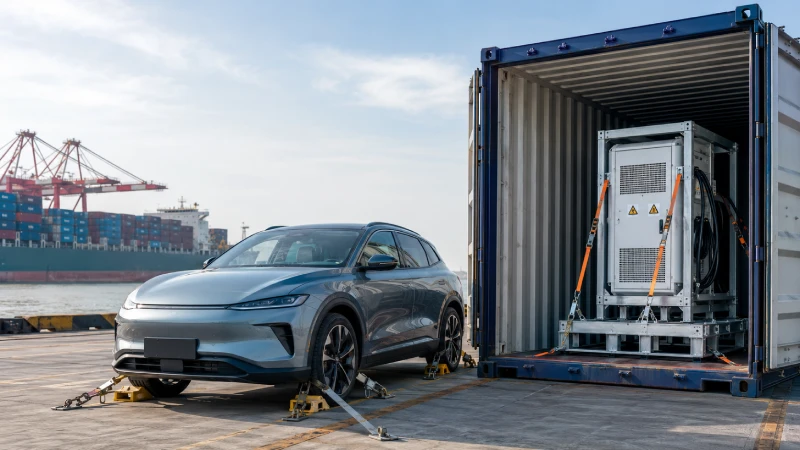
Yes, an electric vehicle and charging station can generally be shipped together from China to Ethiopia in the same container, subject to carrier approval. However, they remain two different cargo types for compliance purposes.
A lithium-ion battery-powered EV is handled under dangerous-goods rules, while an ordinary AC wallbox or DC charger without a separate lithium battery or energy-storage module is normally general cargo. They must therefore be classified, described and documented separately.
For importers arranging electric vehicle shipping from China, the key rule is simple: the vehicle must be safe to transport, the charger must be technically suitable and compliant for use in Ethiopia, and the China–Djibouti–Ethiopia route must be checked before loading.
Can an EV and Charging Station Be Shipped in the Same Container?
A mixed EV-and-charger container is operationally possible, but acceptance depends on the exact cargo configuration.
| Shipment Combination | Generally Feasible? | Main Conditions |
|---|---|---|
| EV + AC wallbox without battery | Yes | DG booking, separate declaration and secure packing |
| EV + DC fast charger | Yes | Weight, dimensions and technical documents confirmed |
| EV + charger with backup battery | Depends | Internal battery classification must be checked |
| EV + charger with energy storage | Special review | Separate DG assessment required |
| EV + spare traction battery | Higher risk | Spare battery is not covered by UN 3556 |
| RoRo EV + loose commercial charger inside vehicle | Usually unsuitable | RoRo carriers often restrict cargo inside vehicles |
Final acceptance depends on the carrier, ports and inland arrangements. The safest principle is same container, separate compliance. Similar logic applies when shipping a car and spare parts in one container.
Ethiopia’s EV Import Context and the Djibouti Route
Ethiopia is landlocked, so imported EVs are normally discharged at Djibouti and then moved inland into Ethiopia. A typical route is:
China port → Port of Djibouti → Ethiopia transit corridor → dry port such as Modjo → final destination
Policy support for EVs does not mean every model automatically qualifies for clearance or registration. The importer must still confirm import eligibility, licensing, customs and registration rules. Booking instructions should distinguish the Port of Loading, Port of Discharge, Place of Delivery and Final Destination. For the broader process, see vehicle shipping from China.
How EVs Are Classified Under the IMDG Code in 2026
UN 3556 Replaces the Generic UN 3171 Entry
The IMO IMDG Code Amendment 42-24 became mandatory on January 1, 2026. Relevant battery-powered vehicle entries include:
- UN 3556 — Vehicle, Lithium Ion Battery Powered
- UN 3557 — Vehicle, Lithium Metal Battery Powered
- UN 3558 — Vehicle, Sodium Ion Battery Powered
These are Class 9 entries. A conventional lithium-ion BEV should not continue to be booked automatically under the older generic UN 3171 entry simply because previous documents used that number.
Documents Commonly Requested for the EV
Depending on the carrier and route, the file may include UN 38.3 evidence, battery specifications, SDS where requested, a Dangerous Goods Declaration, VIN details, battery-condition and SOC records, the Container/Vehicle Packing Certificate, and loading or lashing photographs. These documents serve different purposes; an SDS does not replace UN 38.3 evidence or the Dangerous Goods Declaration. See EV battery documents required before ocean shipping for the wider document workflow.
Do Not Automatically Apply the Airfreight 30% SOC Rule
There is no universal IMDG rule requiring every complete EV shipped by sea to have an SOC of 30% or less. Carriers, terminals or insurers may impose their own limits, so the selected carrier’s written requirement should be confirmed before loading.
Is the Charging Station Dangerous Goods?
Not every EV charger is dangerous cargo.
Ordinary EVSE Without a Battery
An AC wallbox or DC charging cabinet without a regulated battery, energy-storage module or other dangerous component is normally general cargo rather than dangerous goods solely because it charges EVs.
Charger With an Internal Battery
If the unit includes a UPS battery, communications backup battery, removable battery pack or emergency-power module, the battery chemistry and configuration must be checked to determine the correct transport classification.
Mobile Chargers and Energy-Storage Chargers
Battery-buffered fast chargers, mobile charging units and chargers combined with BESS require separate dangerous-goods assessment. A spare traction battery is also not part of the vehicle’s UN 3556 classification merely because it is shipped beside the EV.
Ethiopian Technical Requirements for Charging Equipment
Ethiopia’s Electric Vehicle Charging System Directive No. 1034/2024 establishes technical, safety and licensing requirements for EV charging systems.
IEC 61851 and Type-Test Evidence
Charging modes should follow IEC 61851 or applicable Ethiopian standards, with relevant type-test evidence available. Outdoor equipment also requires ingress-protection evidence under IEC 60529.
Depending on the charger, the technical file may need to address IEC 61851-1, IEC 61851-23, IEC 61851-24, IEC 60529 and applicable connector or EMC standards. A CE mark should not be presented as automatic Ethiopian import or operating approval.
Safety and Installation Requirements
The directive addresses overcurrent protection, earth-leakage protection, earthing, switching, cabling, fire protection, metering and communications, with applicable outdoor ingress-protection requirements.
Product Approval Is Different From Station Licensing
Three separate issues must be distinguished:
- product testing and certification;
- charger import and customs clearance; and
- permission to install and operate a charging station at a specific site.
A charger clearing customs does not automatically authorize paid public charging operations.
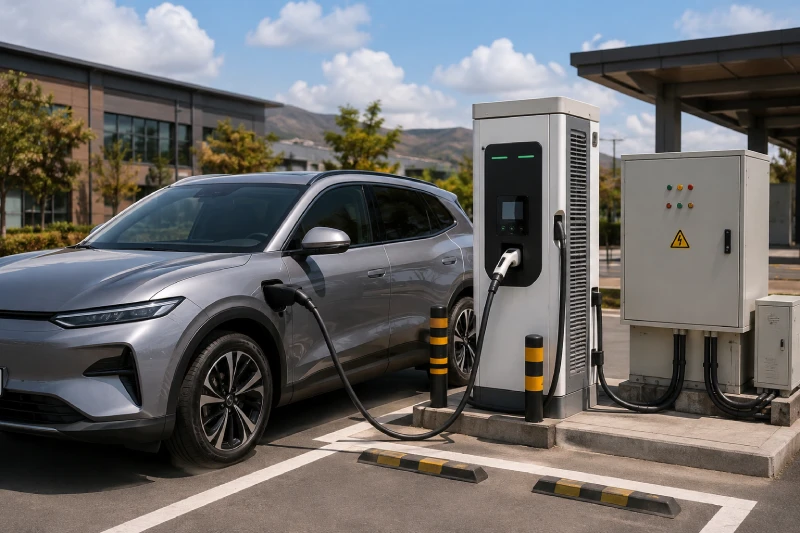
Will a Chinese Charger Work With the Imported EV?
Compatibility should be verified before purchase or loading.
| Check | What to Confirm |
|---|---|
| Vehicle inlet | GB/T, CCS, CHAdeMO or another interface |
| Charger connector | Physical compatibility |
| Communication | Vehicle-charger handshake and protocol |
| AC input | Site voltage, phases, frequency and capacity |
| DC output | Vehicle battery voltage range |
| Battery platform | 400 V, 800 V or other architecture |
| Charger power | 7 kW, 22 kW, 60 kW, 120 kW, etc. |
| Backend | OCPP, SIM/network support and remote management |
| Service | Firmware, spare parts and technical support |
Many China-market EVs use GB/T charging interfaces, while Ethiopia’s directive refers to CCS and CHAdeMO as major international systems for public and captive charging infrastructure.
A GB/T vehicle and charger may work together technically, but that does not prove Ethiopian public-network or licensing compliance. An adapter is not a universal solution to connector, protocol and safety differences.
How to Pack the EV and Charger in One Container
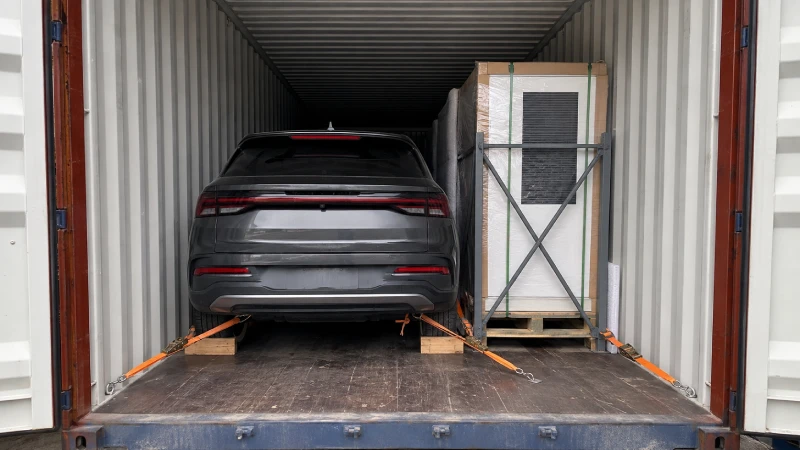
A practical loading procedure is:
- Confirm carrier acceptance of the applicable UN 3556 vehicle.
- Declare the charger model, dimensions, weight and battery configuration.
- Produce a loading plan using actual cargo dimensions.
- Pack the charger on an independent pallet, crate or engineered support.
- Do not place a heavy charging cabinet loosely inside the vehicle.
- Prevent the charger from contacting the EV or battery underbody.
- Secure the EV with suitable wheel chocks, straps and lashing points.
- Check total cargo and securing weight against container payload limits.
- Photograph the cargo before, during and after loading.
- Apply required dangerous-goods markings and placards.
Even if the charger itself is general cargo, the EV’s dangerous-goods status still affects the booking and transport unit.
Separate Customs Declarations Inside One Shipment
Sharing one container does not turn the EV and charger into one customs commodity.
The vehicle should be identified separately by brand, model, VIN, status, propulsion type, value and HS classification. The charger should separately show AC/DC type, rated power, voltage, connector, model, battery content, value and HS classification. Do not hide a commercial charger inside the vehicle price or assume EV tariff treatment automatically applies to it.
China-side requirements must be checked separately. From January 1, 2026, export-license management applies to qualifying pure-electric passenger vehicles with VINs under the referenced customs commodity number 8703801090. The official rule is published by the Ministry of Commerce of China. A freight forwarder cannot replace an eligible manufacturer or authorized exporter in obtaining the required government qualification.
Documents Required for the Combined Shipment
Vehicle and Dangerous-Goods Documents
Typical documents include commercial invoice and packing list, bill-of-lading instructions, certificate of origin where applicable, Chinese EV export-license information, VIN and technical specifications, UN 38.3 evidence, SDS where requested, the Dangerous Goods Declaration, SOC and battery-condition records, the Container/Vehicle Packing Certificate, and vanning photographs.
Charger and Ethiopia Import Documents
Depending on the product and intended use, prepare a separately itemized invoice, charger specifications, IEC type-test and IP evidence, connector and communications information, manuals, certification records, Certificate of Conformity where applicable, importer and insurance documents, Ethiopian customs records, and Djibouti–Ethiopia transit documents.
Whether a specific charger SKU is subject to mandatory conformity assessment should be checked against the current regulated-product scope rather than assumed solely because it is electrical equipment.
Home, Captive and Public Charging Are Regulated Differently
Ethiopia’s directive distinguishes home, captive and public charging.
Home charging remains subject to electrical and safety requirements. Captive charging serves dedicated fleets, while public charging involves additional licensing, metering and operational obligations. Public and captive services may require site-specific licensing, so importing a charger does not create an automatic right to operate a public charging station.
Does Shipping Chargers Satisfy the Importer’s Infrastructure Obligation?
Not by itself. Importers or assemblers may face local infrastructure or service requirements, but procurement should not rely only on media reports. Confirm current site, power, grid-connection and licensing requirements with the relevant Ethiopian authorities. Shipping the hardware is only one part of compliance; installation and licensing remain local responsibilities.
Recommended Pre-Shipment Workflow
- Verify the Ethiopian importer’s business and import eligibility.
- Confirm that the vehicle can be imported and registered.
- Verify the Chinese exporter and 2026 export-license requirements.
- Identify battery chemistry and the correct UN number.
- Match UN 38.3 and battery documentation to the vehicle.
- Confirm the vehicle charging inlet.
- Verify charger power, connector, protocol and IEC evidence.
- Check whether conformity assessment applies.
- Define home, captive or public charging use.
- Have the Ethiopian broker pre-review HS classifications and documents.
- Submit the DG booking file to the carrier.
- Obtain written acceptance before loading.
- Arrange Djibouti transit and Ethiopia inland transport.
Common Mistakes That Delay EV-and-Charger Shipments
Common problems include using UN 3171 for a lithium-ion EV in 2026, applying an aviation 30% SOC rule to all ocean EV shipments, treating an SDS as a substitute for UN 38.3 or a Dangerous Goods Declaration, failing to declare batteries inside the charger, hiding the charger’s value inside the vehicle price, treating a spare traction battery as part of UN 3556, pairing a GB/T vehicle with incompatible equipment, assuming CE automatically means Ethiopian approval, and ignoring the Djibouti-to-Ethiopia transit leg.
FAQ
Can an electric car and EV charger be shipped in one container?
Yes, subject to carrier approval and safe loading. The EV and charger still require separate cargo classification, commercial descriptions and supporting documents.
Is an EV charging station classified as dangerous goods?
Not automatically. A charger without a battery or energy-storage system is normally general cargo. Units with lithium batteries or integrated storage require separate review.
What UN number applies to a lithium-ion EV in 2026?
For an applicable lithium-ion battery-powered vehicle under IMDG Amendment 42-24, the entry is UN 3556 — Vehicle, Lithium Ion Battery Powered.
Do I need a UN 38.3 Test Summary for an EV shipped by sea?
A traceable UN 38.3 Test Summary should be available for the installed battery design, and carriers commonly request it during pre-approval.
Can a GB/T charger be installed in Ethiopia?
It may be technically compatible with a GB/T vehicle, but installation and operation depend on Ethiopian standards, certification, electrical design and the intended charging category.
Does an EV charger need an Ethiopian Certificate of Conformity?
It may, depending on the specific product and current conformity-assessment scope. The exact SKU should be checked before shipment.
Can charging stations be carried inside an EV shipped by RoRo?
This should not be assumed. RoRo carriers commonly restrict commercial goods inside vehicles, so container shipping is generally more practical for significant charging equipment.
Does importing charging equipment allow the importer to operate a public charging station?
No. Equipment importation and permission to operate a charging business are separate processes, and local site licensing may still be required.
Approve the Vehicle, Charger and Route Before Loading
EVs and charging stations can travel together to Ethiopia, but the vehicle, charging equipment and China–Djibouti–Ethiopia route must be reviewed as separate compliance layers.
For 2026 shipments, lithium-ion EVs should be reviewed under the UN 3556 framework, while chargers require their own classification, compatibility and Ethiopian technical-compliance checks. WINSail can coordinate DG booking, container loading, shipping documentation and inland transport, while final export licensing, product certification, carrier approval, import clearance and charging-station licensing remain with the relevant parties and authorities.
