

Shipping from China to Dodoma requires more than booking international freight to Tanzania. For commercial importers, distributors, and construction contractors, the critical final stage is moving cleared cargo from Dar es Salaam to the correct receiving location in Dodoma.
Whether you are importing retail stock, machinery, building materials, or equipment for a development project, you need to coordinate customs release, inland transportation, delivery appointments, unloading, and potentially the return of an empty shipping container.
This guide focuses on the inland delivery process for Dodoma-bound cargo. For a broader comparison of shipping methods, international freight costs, and Tanzania import requirements, see our shipping from China to Tanzania guide.
Quick Answer
Shipments from China to Dodoma usually enter Mainland Tanzania through Dar es Salaam Port for sea freight or Julius Nyerere International Airport (DAR) for air freight. After import clearance and cargo release, goods move inland—typically by truck—to a Dodoma warehouse or project site. FCL deliveries also require unloading and empty-container return planning. Rail freight may be an option for eligible containers, but schedules, terminal transfers, and availability need confirmation.
Data Note — October 2026
This guide reflects publicly available information on Tanzania’s import procedures, the Dar es Salaam–Dodoma road corridor, and rail freight developments reviewed in October 2026. Actual transportation availability, clearance times, charges, and delivery arrangements depend on the shipment, carrier, receiving location, and service provider. No fixed door-to-door rate or transit-time guarantee is implied.
1. How Does Shipping from China to Dodoma Work?
Dodoma is an inland destination in central Tanzania. Unlike Dar es Salaam, it does not receive international container vessels, so most commercial imports require an additional domestic transportation stage.
The appropriate route depends on cargo volume, urgency, container requirements, and the final receiving address.
Sea Freight via Dar es Salaam Port
Dar es Salaam is Tanzania’s principal seaport and a major gateway for imported commercial cargo.
A typical ocean shipment follows this sequence:
China Supplier → China Export Port → Dar es Salaam Port → Import Clearance → Inland Delivery → Dodoma Receiver
Sea freight can be arranged as either a Full Container Load (FCL) or Less than Container Load (LCL).
With FCL shipping, the importer uses a dedicated container, typically a 20-foot or 40-foot unit. Following customs and carrier release, the loaded container may be transported to the consignee’s premises, provided the delivery arrangements and applicable carrier conditions allow it.
FCL is particularly relevant to distributors importing larger quantities of inventory, commercial machinery, or palletized building materials.
With LCL shipping, shipments from multiple customers share container space. The cargo generally undergoes deconsolidation at an applicable Container Freight Station (CFS) or other approved facility before being handed over for inland transportation.
For Dodoma deliveries, the LCL collection point and handling arrangements should be identified before the cargo arrives.
Air Freight via Julius Nyerere International Airport
Air freight is generally more suitable for urgent commercial goods, high-value components, or critical spare parts than for large quantities of low-value cargo.
Shipments can enter Tanzania through Julius Nyerere International Airport (DAR) in Dar es Salaam, subject to available flights and cargo acceptance.
After arrival, the shipment must complete the applicable airport cargo-release and import-clearance procedures before onward transportation to Dodoma.
Air cargo is normally delivered inland as individual packages, pallets, or other suitable handling units rather than inside an ocean shipping container.
For detailed guidance on route selection and chargeable weight, read air freight from China to Tanzania.
Which Shipping Method Should You Choose?
| Method | Suitable Cargo | Key Delivery Consideration |
|---|---|---|
| FCL Sea Freight | Large inventory orders, machinery, containerized project materials | Truck selection, unloading facilities, empty-container return |
| LCL Sea Freight | Smaller commercial shipments and mixed inventory | Deconsolidation, cargo collection, inland handling |
| Air Freight | Urgent spare parts, electronics, time-sensitive stock | Airport release, cargo dimensions, inland dispatch |
Do not choose a mode solely because its international freight rate appears lower. For small LCL shipments, destination handling and inland delivery may represent a significant part of the final cost.
The comparison should cover the entire journey to the named Dodoma destination.
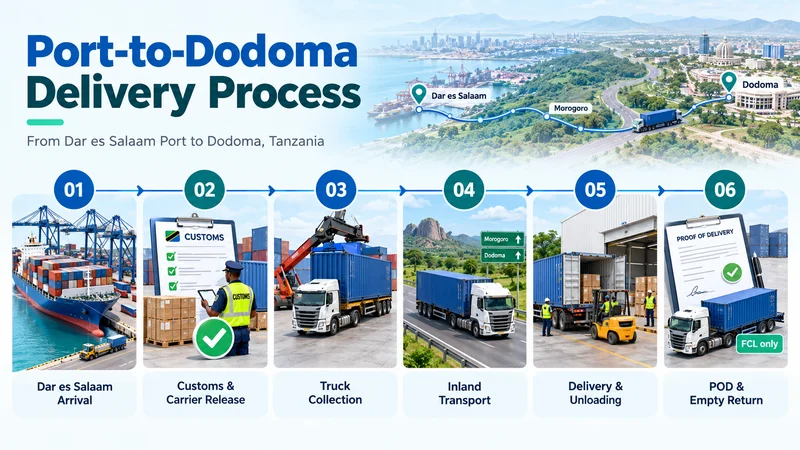
2. From Dar es Salaam Arrival to Dodoma: Customs Release and Truck Dispatch
The vessel’s arrival does not mean the container is immediately available for road transportation.
Before dispatching a truck, the importer and appointed service providers need to establish that the cargo has completed the necessary customs, shipping-line, and terminal-release procedures.
Prepare Import Documents Before Arrival
Tanzania normally requires importers to appoint a licensed Clearing and Forwarding Agent (CFA).
According to the Tanzania National Business Portal’s import procedures, declarations are processed through the Tanzania Customs Integrated System (TANCIS). Importers and their agents are urged to prepare and submit declarations with supporting documents at least seven days before arrival.
Typical documentation includes:
- Commercial invoice with accurate goods descriptions and values.
- Packing list identifying quantities, packages, and gross weights.
- Bill of Lading (B/L) or Air Waybill (AWB).
- Importer’s authorization for the appointed clearing agent.
- Applicable import permits and exemption documents, where relevant.
- Product conformity documentation when required.
Some regulated goods may require additional approval. For example, products covered by Tanzania Bureau of Standards (TBS) Pre-shipment Verification of Conformity (PVoC) requirements may need a Certificate of Conformity (CoC) before shipment.
These requirements depend on the actual product classification and should be checked before the cargo leaves China.
Incomplete or inconsistent documentation can delay customs processing and, consequently, inland truck dispatch.
Customs Release, Delivery Order, and Container Collection
The Tanzania Ports Authority (TPA) describes several operational steps in the port import process.
The appointed CFA coordinates customs clearance and the applicable shipping-agent and port-release documentation. Port charges and other amounts may need to be paid before collection can proceed.
For relevant port cargo movements, the process also involves registration of the collecting vehicle and driver before gate access and cargo release.
The exact sequence depends on the terminal, container status, shipping line, and import declaration.
For importers planning delivery to Dodoma, the important distinction is between three milestones:
- Cargo arrived: The vessel or aircraft has reached the destination gateway.
- Cargo released: Applicable customs, carrier, and facility requirements have been satisfied.
- Cargo dispatched: A suitable vehicle has collected the goods and commenced inland transportation.
Only the third milestone establishes that the domestic delivery journey has begun.
Port-to-Dodoma Responsibility Timeline
The following table identifies the operational handovers that should be confirmed before a shipment is treated as ready for delivery.
| Milestone | Party Responsible for Confirmation | Required Evidence | Scheduling Impact |
|---|---|---|---|
| Pre-arrival preparation | Importer and licensed CFA | Invoice, packing list, transport document, permits | Missing documents may delay clearance |
| Customs processing | CFA and relevant authorities | Declaration and release status | Cargo cannot be collected until applicable requirements are met |
| Shipping-line and terminal release | CFA, carrier agent, and facility | Applicable Delivery Order, release confirmation, payments | Controls collection eligibility |
| Truck collection booking | Transport provider and collection facility | Confirmed vehicle, driver, and pickup instructions | Depends on cargo readiness |
| Inland dispatch | Transport provider | Gate-out or collection record | Starts domestic delivery movement |
| Dodoma receiving appointment | Consignee or site manager | Confirmed unloading window | Prevents unsuccessful delivery attempts |
| Cargo handover | Driver and authorized receiver | Signed delivery receipt or POD | Establishes delivery outcome |
| Empty-container return, if applicable | Agreed transport party and container depot | Accepted empty-return confirmation | Supports container-account closeout |
This timeline should be used alongside the actual shipment’s release instructions. The responsible commercial party for each expense or obligation must be established in the contract.
For more information about port-related payments, see Dar es Salaam destination charges and port fees.
Pro Tip — Avoid Premature Truck Booking
Confirm customs release, carrier documentation, terminal collection authorization, and the receiver’s availability before committing to a fixed truck collection slot. Booking too early can create unnecessary waiting or cancellation costs.
3. Dar es Salaam to Dodoma: Road Transport and Rail Freight Options
After release, cargo needs to move from the Dar es Salaam gateway to its final destination in central Tanzania.
Road haulage is a practical option for many commercial shipments, while rail freight may be considered when suitable equipment, terminal arrangements, and confirmed service are available.
Road Freight via the Central Corridor
The Dar es Salaam–Morogoro–Dodoma corridor provides an important road connection between Tanzania’s main seaport and the capital.
For ordinary containerized commercial cargo, trucking offers the flexibility to deliver directly to a warehouse or an accessible project site.
However, planning should start with the actual pickup and delivery locations rather than a generic Dar-to-Dodoma distance.
A shipment collected from a port terminal may have different handling and dispatch requirements from cargo collected at a CFS, dry port, or inland warehouse.
Vehicle selection also depends on:
- Container size and loaded gross weight.
- Cargo dimensions and weight distribution.
- Road and bridge restrictions.
- Destination gate width, turning space, and surface conditions.
- Whether specialized lifting or unloading equipment is needed.
Traffic, weighbridge procedures, road conditions, and receiver schedules can affect arrival planning.
In June 2026, TANROADS reported proposed road-infrastructure developments, including the Morogoro–Dodoma widening project. These announcements should not be interpreted as confirmation that all proposed improvements have been completed.
Can SGR Rail Freight Be Used for Dodoma Cargo?
Rail transport is an emerging consideration for cargo moving toward Dodoma.
On February 17, 2026, Tanzania Railways Corporation (TRC) announced the start of container-carrier transportation on the Standard Gauge Railway (SGR), including an initial container movement from Pugu toward Ihumwa in Dodoma.
This development is relevant to importers evaluating future inland transport options.
However, it does not establish that every container arriving at Dar es Salaam can automatically be booked on a regular Pugu–Ihumwa freight service.
Before selecting rail, confirm:
- Whether commercial container space is available for the required departure.
- Cargo and container acceptance requirements.
- Transfer arrangements between the arrival facility and the rail loading point.
- Rail terminal handling and documentation.
- Collection from Ihumwa and final road delivery in Dodoma.
- Total charges across all transport and handling stages.
Rail freight should be quoted as a complete intermodal movement, not simply as the price of the train journey.
A rail option that requires additional handling and truck transfers may be less suitable for an urgent single-container shipment than direct road haulage.
When Is Direct Trucking the Better Option?
Direct trucking is often operationally simpler when a shipment must reach one specific Dodoma warehouse or project site with minimal intermediate handling.
It can also be preferable when the consignee needs a delivery appointment synchronized with labor, forklifts, or other equipment.
Rail may deserve consideration for eligible container volumes where suitable train capacity, terminal access, and last-mile transportation are confirmed.
The most useful comparison is therefore total release-to-delivery cost, handling requirements, and schedule reliability, rather than theoretical road versus rail travel time alone.
4. Delivering Cargo to a Dodoma Warehouse vs. a Project Site
Not every delivery address in Dodoma has the same operating conditions.
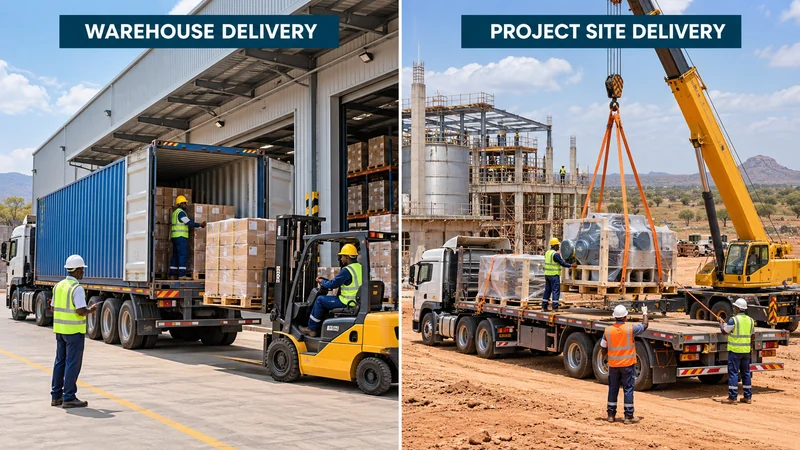
A distribution warehouse may have regular receiving hours and mechanical handling equipment. A construction site may operate under access restrictions, temporary ground conditions, or a scheduled lifting operation.
These differences affect truck selection, delivery timing, unloading, and potential additional charges.
Commercial Warehouse Delivery
For a commercial warehouse, the receiving arrangements should be confirmed before the shipment leaves Dar es Salaam.
The warehouse should provide:
- Full delivery address and location pin.
- Name and telephone number of the receiving contact.
- Normal receiving hours and appointment requirements.
- Vehicle access and unloading-bay restrictions.
- Availability of forklifts or other suitable handling equipment.
- Expected unloading time.
- Procedure for checking and signing the delivery receipt.
For an FCL shipment, confirm whether the warehouse can unload directly from a container mounted on a truck chassis or requires another arrangement.
If the warehouse is already receiving other shipments, the delivery should be allocated a realistic unloading slot.
Construction and Project-Site Delivery
Construction projects require more detailed advance planning.
Equipment may be delivered to an unfinished facility, an infrastructure project, or a temporary materials yard where standard warehouse equipment is unavailable.
The project manager should confirm the precise vehicle entrance and provide information about site conditions.
Particular attention should be given to:
- Road access for loaded trucks and trailers.
- Temporary roads and ground stability.
- Turning and reversing space.
- Overhead obstructions and height restrictions.
- Authorized delivery hours and site security requirements.
- Availability and suitability of cranes, forklifts, or rigging equipment.
- Safe unloading and cargo-staging areas.
For heavy machinery, oversized equipment, or unusual lifting requirements, review the delivery as a specialist movement rather than ordinary general cargo.
Our project logistics services provide an overview of considerations for complex and oversized shipments.
Warehouse vs. Project-Site Delivery Checklist
| Delivery Requirement | Commercial Warehouse | Construction / Project Site |
|---|---|---|
| Address confirmation | Warehouse gate and receiving address | Site entrance and exact unloading location |
| Receiving contact | Warehouse manager or receiving team | Project supervisor or logistics coordinator |
| Delivery appointment | Operating hours and unloading-bay availability | Approved site access and lifting schedule |
| Truck access | Loading bay, turning space, height restrictions | Road conditions, turning radius, ground stability |
| Unloading equipment | Forklift, pallet truck, or receiving crew | Crane, forklift, rigging equipment, or specialist handling |
| Cargo inspection | Package count and visible condition | Item identification, package count, and condition verification |
| Waiting-time exposure | Congested loading bay or unavailable personnel | Site delays, missing equipment, access restrictions |
| Container return | Unloading must fit agreed transport terms | Coordinate lifting completion with equipment-return deadline |
The receiving location should be assessed before dispatch, not after the truck arrives.
For example, a truck carrying a full container of construction equipment may reach the correct site but remain unable to unload because the crane has been scheduled for another day.
That problem can affect truck availability, equipment-use charges, and the project’s delivery schedule even when the international shipment has arrived without delay.
Plan Delivery to Dodoma
Winsail Logistics can review shipping requirements from China to Dodoma and discuss suitable freight and inland delivery arrangements, subject to shipment-specific service availability.
Provide your cargo details, final delivery address, receiving conditions, required delivery window, and unloading equipment information so the proposed transportation scope can be assessed.
5. FCL Unloading, LCL Handover, and Empty-Container Returns
The delivery process is not necessarily complete when a loaded truck reaches the consignee.
For FCL shipments, the unloading method and return of the empty container can be important parts of the transportation agreement.
FCL: Live Unloading vs. Container Drop
Two arrangements may be considered, subject to the transport provider’s and carrier’s conditions.
Live unloading means the truck remains at the destination while the consignee unloads the container. After unloading, the vehicle takes the empty equipment to the required return facility.
This arrangement requires the consignee to have personnel and equipment ready within the agreed unloading period.
A drop-container arrangement involves leaving the container at an approved destination temporarily and collecting it later.
However, container drops are not automatically permitted or included in standard trucking quotations. They may require suitable lifting equipment, additional vehicle movements, and specific carrier authorization.
The importer should confirm the proposed method before the shipment is booked.
Empty-Container Return Responsibilities
An ocean shipping container is generally carrier-controlled equipment. After unloading, the empty unit must be returned in accordance with the shipping line’s applicable instructions.
The shipping line or its agent may specify the return depot, acceptance requirements, and relevant deadlines.
The delivery agreement should identify who is responsible for:
- Organizing unloading at Dodoma.
- Confirming the container is empty and suitable for return.
- Arranging the empty movement to the designated depot.
- Obtaining evidence of return acceptance.
- Handling additional equipment-use or transport costs caused by delays, where contractually applicable.
Pro Tip — Protect the Container Return Window
Agree on the unloading slot, the permitted equipment-use period, and the designated empty-return location before the container leaves Dar es Salaam. A missing forklift or delayed site appointment can create costs beyond the original trucking rate.
LCL and Air Cargo Handover
LCL shipments normally require deconsolidation before individual consignments can be released for delivery.
The inland vehicle may therefore carry pallets, crates, or loose packages rather than an international shipping container.
Air freight similarly requires handling at the airport cargo facility before domestic delivery.
For these shipments, receiving documentation should identify the number of packages, their visible condition, and any shortage or damage noted at handover.
Importers should retain delivery records, especially when cargo has passed through multiple handling locations.
6. What Does Shipping from Dar es Salaam to Dodoma Cost?
There is no single reliable inland delivery price that applies to every shipment moving from Dar es Salaam to Dodoma.
The cost depends on the actual cargo, collection facility, required vehicle, destination address, and service responsibilities.
A quote for transporting an unloaded pallet shipment to a city warehouse is not directly comparable with a quote for carrying a full container to a construction site and returning the empty equipment.
Costs Before Inland Dispatch
Before goods leave the Dar es Salaam gateway, the importer may need to account for:
- Customs brokerage and regulatory processing.
- Import duties, VAT, and other applicable taxes.
- Shipping-line documentation and release charges.
- Port or terminal handling.
- CFS or other storage and handling services.
- Storage, demurrage, or other delay-related charges where applicable.
These items may be billed by different parties and should not be treated as a single universal destination fee.
For a more detailed breakdown, refer to Dar es Salaam port charges for imports.
Inland Trucking and Delivery Charges
A useful inland transport quotation should identify its calculation basis and included operations.
At minimum, request confirmation of:
- The exact pickup location in Dar es Salaam.
- The final delivery address in Dodoma.
- Container size or cargo weight and dimensions.
- Required vehicle and trailer configuration.
- Included loading, unloading, and waiting time.
- Empty-container return arrangements, if applicable.
- Additional delivery stops or restricted receiving hours.
- Responsibility for site equipment and extra handling.
For standard container movements, some providers may quote a round-trip transportation arrangement. Others may itemize separate vehicle, waiting, and empty-return services.
A low initial trucking price may be less economical if essential operations are excluded.
Dodoma Inland Delivery Cost and Responsibility Matrix
| Charge Category | When It May Apply | What to Confirm |
|---|---|---|
| Customs brokerage | Import declaration and clearance services | Licensed agent, included work, agreed fee |
| Port / terminal handling | Cargo processing and release | Facility, current tariff, billing party |
| Inland trucking | Moving released cargo to Dodoma | Pickup location, vehicle, destination, included movements |
| Truck waiting | Vehicle held beyond agreed free waiting time | Included hours and additional charging basis |
| Unloading equipment | Forklift, crane, labor, specialist lifting | Who arranges and pays |
| Empty-container return | FCL equipment returned after unloading | Depot, collection, transport scope |
| Storage / demurrage / detention | Applicable facility or carrier time limits exceeded | Charge type, free time, start/end rules |
| Special-site services | Restricted access, additional trips, specialist handling | Scope, approval, and separate charges |
Demurrage, detention, and storage should not be treated as identical charges. Their definitions and charging periods can differ between shipping lines and facilities.
Where relevant, consult the applicable carrier tariff and facility rules rather than relying on a general market estimate.
DAP, DPU, and DDP: What Does Door Delivery Include?
The phrase door-to-door shipping describes a transportation arrangement. It does not automatically establish who must pay customs duties or unload the cargo.
Under Incoterms® 2020, the distinctions include:
| Incoterms Rule | Import Clearance and Duties | Unloading at the Named Destination |
|---|---|---|
| DAP — Delivered at Place | Buyer’s responsibility | Seller is not required to unload |
| DPU — Delivered at Place Unloaded | Buyer’s responsibility | Seller must arrange and bear the unloading obligation |
| DDP — Delivered Duty Paid | Seller’s responsibility | Seller is generally not required to unload |
These rules allocate obligations between the buyer and seller under the sales contract. A separate freight-service agreement must also clearly define the services the forwarder or its contractors will actually perform.
DDP should not be offered merely because a freight quotation is described as “all-inclusive.” The seller must be able to meet the import clearance and tax responsibilities lawfully.
For commercial imports into Tanzania, the legal importer arrangement and involvement of a licensed CFA must be confirmed.
Always specify the exact named place of delivery, such as the receiving warehouse or project-site entrance, rather than using only “Dodoma, Tanzania.”
For additional service-scope information, see door-to-door shipping from China.
7. How to Schedule and Confirm Delivery in Dodoma
Successful inland delivery requires a shipment plan built around both cargo readiness and the receiver’s availability.
The required delivery date should be communicated early, particularly where imported equipment supports a construction schedule or a commercial launch.
Information to Provide Before Booking
Prepare the following information for your freight forwarder and the appointed Tanzania-side parties:
Shipment information
- China supplier and pickup location.
- Cargo-ready date.
- Product description and applicable HS code, if known.
- Package count, dimensions, gross weight, and commercial value.
- Preferred sea or air freight service and container type, where relevant.
Import and delivery information
- Tanzanian consignee and appointed CFA details.
- Exact Dodoma delivery address and location pin.
- Name and contact number of the authorized receiver.
- Required delivery window.
- Warehouse or project-site access information.
- Available unloading machinery and personnel.
- Preferred delivery terms and named destination.
- Empty-container return requirements for FCL shipments.
For project cargo, photographs of the approach road, entry gate, unloading area, and lifting equipment can help identify potential problems before transportation begins.
Plan Backward from the Required Delivery Date
If goods are needed for a particular project milestone, planning should begin with the required unloading date rather than the vessel’s estimated arrival.
Work backward through the necessary stages:
Required Site Delivery → Confirmed Receiving Slot → Inland Dispatch → Cargo Release → Customs Processing → International Arrival
This approach helps identify which activities can be prepared in advance.
For example, the receiver can check gate access and reserve unloading equipment while import documents are being reviewed.
However, a provisional site appointment should not be mistaken for a guaranteed truck arrival.
When clearance, transportation, or receiving arrangements change, the relevant parties should agree on a revised delivery window before committing to additional costs.
For particularly time-sensitive projects, consider whether essential spare parts or commissioning components should move separately from bulk cargo, subject to available transport options and budget.
Confirm Proof of Delivery and Closeout
After unloading, obtain a signed delivery record identifying the shipment, delivered quantities, and receiving party.
Where relevant, record container and seal details, visible cargo damage, missing packages, or unloading exceptions.
For an FCL shipment, also request confirmation that the empty container has been accepted at the required return location.
Finally, reconcile the transport invoice against the agreed service scope, including any documented waiting time, extra handling, or return costs.
Confirm Your Dodoma Delivery Plan
Winsail Logistics can help assess freight arrangements from China and discuss inland delivery requirements for commercial and project cargo destined for Dodoma.
Confirm Your Dodoma Delivery Plan
Share your shipment specifications, China pickup location, consignee details, exact Dodoma address, and receiving conditions. Available transportation arrangements and quotation inclusions can then be confirmed for the specific shipment.
FAQ
Can my full container remain sealed until it reaches Dodoma?
It may be possible to transport an FCL container to Dodoma without routine unpacking at Dar es Salaam, depending on customs procedures, inspections, carrier conditions, and the agreed delivery arrangement. Customs or other authorized inspections may require the container to be opened, so sealed delivery cannot be guaranteed without confirmation.
Can my goods be held in Dar es Salaam until my Dodoma site is ready?
Storage may be arranged at an appropriate facility, subject to cargo type, space availability, release status, and facility acceptance. Check storage charges, equipment-use deadlines, and whether unloading the container into storage is necessary. Keeping a shipping-line container longer may create additional equipment-use charges.
What happens if my warehouse misses the delivery appointment?
The transport provider may need to wait, reschedule delivery, or make alternative arrangements. Extra charges can arise when the agreed waiting period is exceeded or another vehicle movement is required. Responsibility follows the agreed transport terms.
Can my shipment use the SGR railway from Dar es Salaam to Dodoma?
Potentially, if an eligible shipment has a confirmed commercial service. TRC announced initial container-carrier operations between Pugu and Ihumwa in February 2026, but that does not guarantee space on a particular departure. Rail planning must also cover terminal transfers, handling, discharge, and final trucking.
Can one shipment be delivered to two different addresses in Dodoma?
Multiple delivery stops may be arranged if the transport provider accepts the routing and cargo can be handled safely and compliantly. Confirm the extra stop, unloading responsibilities, equipment, and charges. For FCL cargo, also check container-opening arrangements and the empty-return deadline.
Do I need a Tanzanian importer and licensed clearing agent for door delivery?
Commercial goods entering Mainland Tanzania normally require a compliant import arrangement and an appointed licensed Clearing and Forwarding Agent. Door-to-door transportation does not eliminate customs obligations or establish a lawful DDP arrangement. Confirm the importer, applicable permits, tax responsibilities, and broker authorization before shipment.
Can delivery be arranged outside normal business hours?
After-hours delivery may be possible when the transport provider and receiver approve it. Project sites may require additional security authorization, staff, lighting, lifting equipment, and safety arrangements. Availability and any extra charges must be confirmed before dispatch.
