
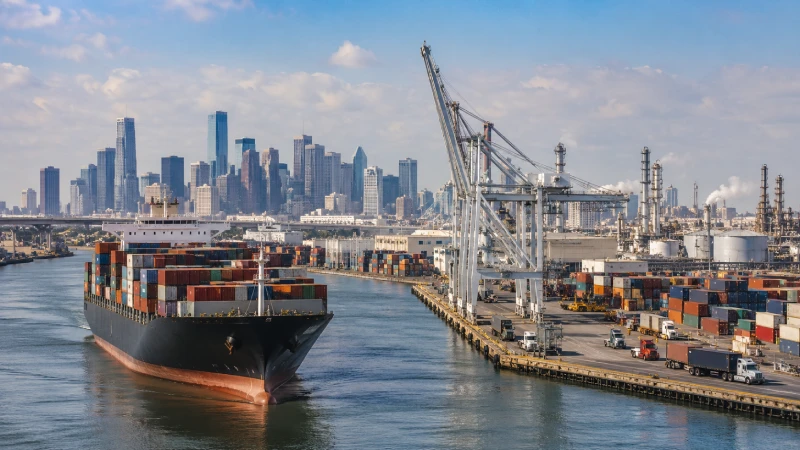
For importers evaluating Shipping from China to USA, Houston can be an effective gateway for cargo destined for Texas, the US Gulf Coast and parts of the South-Central United States. However, choosing Houston should not be based on destination state alone. The right route depends on where the cargo will ultimately be delivered, whether it can move in standard container equipment, and whether the receiving facility has the space and equipment required to unload it safely.
A shipment of palletized consumer goods going to a Houston warehouse has very different planning requirements from a heavy machine being delivered to an industrial plant. Even when both shipments arrive through the same port region, their container selection, inland transport, appointment procedures and unloading costs may be completely different.
This guide explains how to evaluate Houston as a destination gateway by looking at three factors:
- The final delivery region
- The cargo’s physical characteristics
- The receiving site’s unloading capability
Is Houston the Right Gateway for Your Shipment?
Houston is commonly evaluated for shipments serving Greater Houston, Texas distribution centers, Gulf Coast industrial facilities and customers in nearby South-Central markets.
Its geographic position can make it attractive for cargo moving to energy, construction, manufacturing, warehousing and industrial customers. However, Houston is not automatically the best US gateway for every shipment going to Texas.
A route that looks shorter on a map may become more expensive if it requires:
- A longer or less convenient ocean routing
- Specialized container equipment
- Heavy-haul permits
- Extended container drayage
- Crane or rigging services
- Long driver waiting times
- Difficult empty-container returns
- Delivery to a site without adequate unloading equipment
Importers should evaluate the entire movement from the Chinese supplier to the final receiving point, rather than comparing ocean freight alone.
Quick Houston Gateway Suitability Matrix
| Shipment scenario | Initial Houston fit | Main point to verify |
|---|---|---|
| Standard FCL shipment to a Houston warehouse | Strong potential fit | Receiving appointment and unloading capacity |
| Consumer goods delivered elsewhere in Texas | Evaluate total route | Inland mileage and alternative gateways |
| Machinery for a Gulf Coast industrial facility | Strong potential fit | Dimensions, weight, lifting and site access |
| Heavy components packed in a dry container | Detailed review required | Payload, axle weight and weight distribution |
| Oversized machinery or crates | Specialized review required | Equipment, terminal acceptance and road permits |
| Small LCL shipment to a distant inland location | Compare options | Destination charges and final-mile cost |
| Cargo for a West Coast customer | Usually compare alternatives | Total inland distance from Houston |
| Cargo for an East Coast customer | Route comparison required | Ocean routing and inland delivery economics |
Houston is usually most attractive when the gateway, cargo and delivery location work together. When only the delivery state appears suitable but the cargo or receiving site creates complications, another routing option may provide a better result.
Match the Cargo Profile to the Handling Plan
Cargo characteristics should be reviewed before selecting the shipping method. The quotation cannot be planned accurately using only a product name and total shipment weight.
Standard Dry-Container Cargo
Standard containerized cargo may include:
- Cartons
- Palletized consumer products
- Packaged industrial components
- Building materials
- Warehouse inventory
- Non-hazardous manufactured goods
These shipments may move in standard dry containers when their dimensions, weight and loading method remain within the equipment’s practical limits.
Even relatively straightforward cargo still requires planning. Dense pallets may create uneven floor loading, moisture-sensitive products may need additional protection, and high-value goods may require stronger packaging or improved cargo insurance.
Importers needing more detailed guidance on equipment sizes and loading limitations can refer to Container Shipping from China to USA.
Heavy and Dense Cargo
A shipment can fit physically inside a container while still creating transportation problems because of its weight.
Heavy products require verification of:
- The weight of each package
- Total cargo weight
- Weight distribution inside the container
- Container payload limitations
- Truck and chassis configuration
- Axle-weight restrictions
- Forklift capacity at origin and destination
The load should not be concentrated in one small section of the container without proper support and distribution. Exact legal road weight also depends on the truck, chassis, axle arrangement and inland route, so a general container payload figure should not be treated as an inland transport guarantee.
Machinery and Industrial Equipment
Machinery shipments may include production equipment, pumps, motors, processing units, construction equipment and industrial assemblies.
To plan shipping machinery from China to Houston, the freight forwarder normally needs more than the machine’s catalogue dimensions. The required information should include:
- Packed length, width and height
- Gross and net weight
- Number of packages
- Center of gravity, when relevant
- Lifting points
- Base or skid dimensions
- Whether the machine can be tilted
- Whether components can be removed
- Sensitivity to shock, moisture or corrosion
- Presence of batteries, oils or regulated materials
A machine that cannot pass through a standard container door may still be suitable for an open-top container, flat rack or another specialized solution. This must be confirmed before the cargo is collected or export packaging is finalized.
Oversized and Non-Containerized Cargo
Cargo may require specialized evaluation when it is:
- Wider than standard container equipment
- Too tall for normal container loading
- Too heavy for standard handling
- Top-loaded by crane
- Shipped on a flat rack
- Moved as breakbulk cargo
- Delivered using specialized trailers
Houston has facilities that may support containerized, breakbulk and project-related cargo movements. However, importers should not assume that every terminal, vessel or service will accept a specific oversized unit.
The freight forwarder must verify the proposed carrier, equipment availability, terminal acceptance, lifting requirements and inland transport plan before confirming the booking.
FCL or LCL for China-to-Houston Freight
Both FCL and LCL can be used for sea freight from China to Houston, but industrial cargo often requires a more careful comparison than standard commercial goods.
When FCL May Be the Better Choice
Full container load shipping may be preferable when:
- The cargo nearly fills a container
- Machinery should not be mixed with unrelated cargo
- Handling needs to be minimized
- The shipment is fragile, dense or difficult to stack
- The buyer wants greater control over container loading
- The receiving site can unload the container directly
FCL can reduce the number of cargo-handling stages, although it does not eliminate the need for proper packing, blocking and securing.
For additional mode-specific information, readers can review FCL Shipping from China to USA.
When LCL May Be Suitable
LCL shipping may work when:
- The cargo volume is relatively small
- Products are properly palletized or crated
- The cargo can tolerate consolidation handling
- It does not require unusual lifting equipment
- The importer has reviewed destination and delivery charges
For industrial shipments, LCL should not be selected only because the ocean freight appears lower. Consolidation, destination warehouse handling and final delivery may materially affect the total cost.
Importers comparing smaller shipments should also review LCL Shipping from China to USA before choosing the service.
Basic Equipment Options
| Cargo profile | Equipment to evaluate | Main planning question |
|---|---|---|
| Standard cartons or pallets | Dry container | Does the cargo fit normal loading and weight limits? |
| High-volume lightweight cargo | High-cube container | Is the extra internal height useful? |
| Tall machinery | Open-top or specialized review | Can it be loaded through the container doors? |
| Overwidth equipment | Flat-rack review | Can it be secured and moved legally inland? |
| Rolling machinery | Container, flat rack or RoRo review | Can it be driven or lifted safely? |
| Non-containerizable industrial cargo | Breakbulk or project review | Are suitable vessel and terminal arrangements available? |
Actual equipment selection should follow packed cargo dimensions, not unfinished machine specifications.
Plan the Houston Delivery Site Before Booking
For industrial and heavy cargo, the delivery site can determine whether the selected shipping plan is practical.
A port-to-door quotation should therefore include information about the warehouse, factory, project site or industrial facility receiving the cargo.
Confirm Site Access
The consignee should verify:
- Full delivery address and ZIP code
- Gate width
- Internal road width
- Turning space
- Overhead clearance
- Road and yard surface conditions
- Truck parking or staging space
- Security procedures
- Driver check-in requirements
- Restrictions on heavy vehicles or container trucks
A facility may have enough room to store the cargo but insufficient space for a tractor and container chassis to enter, turn or wait.
Dock Delivery or Ground-Level Unloading
A warehouse with a loading dock may be able to receive palletized cargo directly from a container. A construction site or industrial plant may require ground-level unloading.
Before delivery, confirm:
- Whether a loading dock is available
- Whether the dock matches the expected trailer arrangement
- Whether a dock leveler is available
- Whether the cargo can be removed through the container doors
- Whether the container must be opened and unloaded from ground level
There is no universal receiving setup suitable for every container or machine.
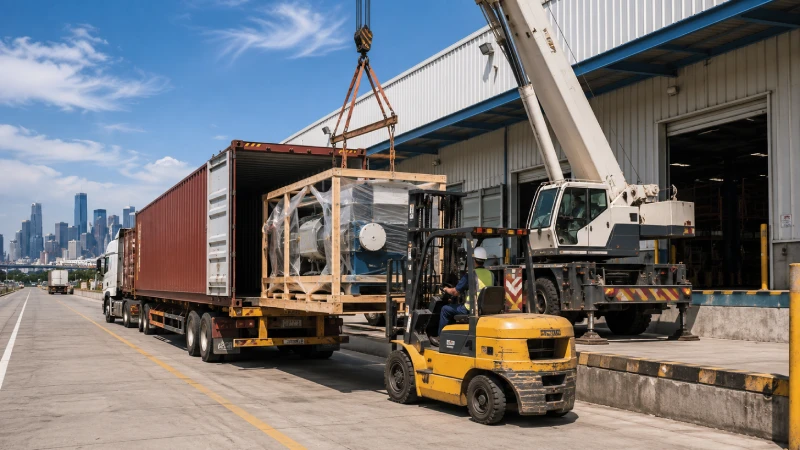
Forklift, Crane and Rigging Requirements
The presence of a forklift does not mean the site can unload every package.
The receiving party should provide:
- Forklift rated capacity
- Fork length
- Maximum lift height
- Available attachments
- Crane capacity, if applicable
- Mobile crane access
- Rigging crew availability
- Approved machine lifting points
- Ground conditions for crane setup
For heavy machinery, the lifting equipment must be matched to the actual package weight and center of gravity.
Live Unload Versus Container Drop
During a live unload, the driver remains on site while the container is emptied. This can work when the cargo is palletized, unloading equipment is ready and the facility can complete receiving within the allowed period.
A container drop gives the consignee more time to unload, but it may require:
- Sufficient yard space
- Permission to leave the container
- Chassis availability
- A scheduled pickup
- Coordination of the empty return
Drop arrangements may also create additional chassis, detention or storage exposure if the container is not unloaded and returned on time.
Inland Delivery Beyond Houston
Houston may serve cargo delivered outside the immediate metropolitan area, but the total inland plan should be compared carefully.
Greater Houston and Gulf Coast Destinations
Houston can be a logical choice for shipments moving to:
- Houston-area warehouses
- Distribution centers
- Gulf Coast manufacturing sites
- Energy-related facilities
- Chemical and industrial corridors
- Construction or infrastructure projects
For nearby deliveries, port-to-door trucking may provide a relatively direct connection. However, the exact terminal, delivery address and equipment requirements still affect drayage cost.
Central and North Texas
Shipments destined for Austin, San Antonio or Dallas–Fort Worth may also be routed through Houston, depending on the ocean service and total inland cost.
The importer should compare:
- Port-to-door mileage
- Trucking and possible rail options
- Delivery urgency
- Container and chassis availability
- Receiving-site appointment rules
- Empty-container return requirements
- Alternative West Coast or Gulf gateways
Houston should not be selected simply because the customer is located in Texas. A route through another US gateway may sometimes provide a better total transit or cost profile.
Nearby States and Regional Markets
Houston may also be evaluated for cargo delivered to Louisiana, Oklahoma, Arkansas, New Mexico or other South-Central destinations.
The final decision should be based on the complete route rather than port proximity alone. For a broader gateway comparison, refer to Shipping Routes from China to USA.
What Determines Shipping Cost from China to Houston?
China-to-Houston shipping cost depends on more than ocean freight.
Origin and Ocean Charges
The origin portion may include:
- Supplier pickup
- Export handling
- Customs documentation
- Origin terminal charges
- Container loading
- Blocking and securing
- Ocean freight
- Specialized equipment surcharges
Houston and Inland Charges
Destination costs may include:
- Terminal or CFS handling
- Customs clearance
- Port drayage
- Chassis usage
- Fuel and tolls
- Driver waiting time
- Delivery appointments
- Container drop charges
- Storage, demurrage or detention
- Empty-container return
- Forklift, crane or rigging services
Heavy, oversized or difficult-to-handle cargo may also require permits, escorts, specialized trailers or route studies.
Instead of comparing only port-to-port rates, importers should evaluate the full origin-to-destination movement. National pricing factors are explained in more detail in Shipping Cost from China to USA.
Packaging, Securing and Cargo Insurance
Industrial cargo may pass through multiple handling stages before reaching the final customer. Packaging must therefore be designed for ocean transport, inland trucking and unloading.
Recommended controls may include:
- Export-grade crates or skids
- Internal blocking and bracing
- Balanced weight distribution
- Moisture barriers
- Desiccants
- Corrosion protection
- Shock or tilt indicators
- Clearly marked lifting points
- Loading photographs
Machinery should not be secured only by its external covering. The machine, skid, crate and container securing system must work together.
Cargo insurance should also be considered for valuable, fragile or unusual equipment. Coverage should be reviewed according to cargo value, packaging, transport method, exclusions and deductible rather than assuming all damage is automatically covered.
Information Required for an Accurate Quote
A request such as “one machine from China to Houston” is not sufficient for a dependable route and equipment assessment.
Provide the following information:
- Cargo description
- HS code, if available
- Number of packages
- Dimensions of each package
- Gross weight of each package
- Total shipment weight
- Center of gravity, if relevant
- Containerized or non-containerized status
- Lifting points
- Stackability
- China pickup address
- US delivery address and ZIP code
- Delivery-site type
- Dock availability
- Forklift, crane or rigging equipment available
- Live-unload or drop preference
- Appointment requirements
- Cargo-ready date
- Cargo photographs or drawings
The more complete the cargo and site information, the easier it is to identify unsuitable equipment or delivery arrangements before they create delays and additional charges.
Request a China-to-Houston Cargo and Delivery Assessment
Houston can be a practical gateway for standard containers, machinery, industrial components and cargo serving Texas or the Gulf Coast. However, the correct plan depends on how the cargo is packed, where it will be delivered and how it will be unloaded.
Winsail Logistics can evaluate the China pickup point, ocean routing, container or specialized equipment, Houston-area handling, inland delivery and receiving-site requirements as one coordinated movement.
Send your cargo specifications, pickup address, final US delivery address, unloading information and cargo-ready date to request a route and equipment assessment—not just a standard ocean freight rate.
FAQ
Is Houston the best US gateway for shipments from China to Texas?
Houston can be a strong option for cargo serving Greater Houston, the Gulf Coast and some inland Texas markets. However, ocean routing, inland mileage, delivery urgency and cargo-handling requirements should be compared with alternative gateways.
Can machinery be shipped from China to Houston in a standard container?
Yes. Many machines can be shipped in dry containers when their packed dimensions, weight, loading method and weight distribution are suitable. Tall, wide or unusually heavy machinery may require open-top, flat-rack or specialized handling.
Is FCL or LCL better for industrial equipment?
FCL is often preferred for heavy, fragile or high-value industrial cargo because it reduces consolidation handling. LCL may be suitable for smaller, properly crated shipments when destination handling and inland charges have been reviewed.
Can oversized cargo be shipped through Houston?
Potentially, but the carrier, vessel, terminal, equipment, stevedoring and inland route must be confirmed for the specific shipment. Specialized acceptance should never be assumed before review.
What unloading information is needed for Houston warehouse delivery?
Provide the receiving hours, appointment rules, dock availability, forklift capacity, site access, yard space and whether the container will be live-unloaded or dropped.
Can containers arriving in Houston be delivered to Dallas?
Yes. Houston may be evaluated for deliveries to Dallas–Fort Worth and other inland Texas destinations. The best route depends on inland transport cost, schedule, container availability and alternative gateway options.
Do heavy loads require special permits in Texas?
Cargo exceeding applicable road size or weight limits may require permits, an approved route, specialized trailers or escorts. Exact packed dimensions and weights are required before this can be determined.
What should I send for a China-to-Houston freight quote?
Send the cargo description, dimensions, weights, HS code if available, pickup address, final delivery address, unloading capability, appointment requirements and cargo-ready date.
