

Shipping furniture from China to Kenya is mainly a volume, packing, compliance and delivery-planning problem.
Unlike dense machinery or small consumer goods, furniture can fill container space long before it reaches the container’s weight limit. A shipment that looks simple on a supplier’s quotation can become expensive after export cartons, protective packaging, pallets, irregular shapes and destination handling are included.
This is especially important for commercial buyers importing:
- hotel furniture;
- office furniture;
- restaurant tables and chairs;
- apartment or residential project furniture;
- school furniture;
- cabinets and storage systems;
- sofas and upholstered furniture;
- bedroom sets;
- flat-pack furniture;
- mixed FF&E orders from several Chinese suppliers.
For these shipments, the important question is not simply:
“How much is sea freight from China to Kenya?”
A better question is:
“What is the most practical way to move this exact furniture order from the Chinese suppliers to Mombasa, Nairobi or the final project site?”
That means looking at final packed CBM, LCL versus FCL, 20GP versus 40HQ, supplier consolidation, moisture protection, wood packaging, Kenya import requirements and the inland delivery plan together.
Data Note: Kenya import documentation and freight-market conditions can change. Regulatory information below is based on official sources available at the time of writing. Duties, taxes, product standards, freight rates and shipment-specific requirements should be reconfirmed before cargo is released from the suppliers.
Quick Answer: What Is the Best Way to Ship Furniture from China to Kenya?
For most commercial furniture orders, sea freight is the main shipping method because furniture usually takes up a large amount of space compared with its weight.
Small shipments can move by LCL, where your cartons share container space with other cargo.
As furniture volume increases, you should compare LCL against a dedicated 20GP FCL container instead of assuming that LCL will remain cheaper. There is no universal CBM number at which FCL automatically wins, but when the final packed shipment reaches the low-to-mid-teens CBM range, it is sensible to calculate both options using the same pickup, destination and delivery scope.
For larger orders, especially lightweight and flat-packed furniture, a 40HQ often deserves serious consideration because additional cubic capacity can be more valuable than additional payload.
The final decision should consider more than freight price:
- final packed CBM;
- carton dimensions and loading geometry;
- whether the furniture is flat-packed or assembled;
- number of Chinese suppliers;
- damage risk;
- LCL consolidation and deconsolidation handling;
- Kenya compliance status;
- Mombasa destination costs;
- Nairobi or other inland delivery;
- project delivery sequence;
- unloading conditions at the final site.
For multi-supplier hotel or commercial projects, the most economical shipment is often the one planned before the factories finish packing, rather than the one with the lowest ocean-freight line on a quotation.
Why Furniture Needs a Different Shipping Plan
Furniture does not behave like ordinary general cargo.
The same 15 CBM can produce very different logistics outcomes depending on whether the shipment contains neatly packed knock-down cabinets, oversized sofas, dining tables with stone tops or irregular reception counters.
Four issues matter particularly.
High Volume
Furniture is often cube-sensitive rather than weight-sensitive.
A shipment may occupy most of the usable container space while remaining far below the container’s maximum payload.
This means CBM calculation is usually one of the first things that should be checked when comparing freight options.
Irregular Dimensions
Nominal CBM does not tell you whether cartons can actually fit efficiently inside a container.
Long tabletops, sofas, bed frames, cabinets and non-stackable cartons can create dead space.
Two orders with the same total CBM may therefore require completely different loading plans.
Damage Risk
Furniture may contain:
- finished wood surfaces;
- painted panels;
- upholstery;
- glass;
- marble or engineered stone;
- exposed corners;
- decorative hardware.
Every additional handling stage increases the importance of good export packing.
This is one reason why the LCL-versus-FCL decision for furniture cannot be based only on ocean freight.
Multiple Suppliers
A hotel project may involve bedroom furniture from one factory, sofas from another, tables and chairs from another and decorative pieces from several additional suppliers.
The shipment therefore becomes a supplier coordination and consolidation project, not just a booking from one factory to one port.
For a broader view of available transport modes, customs and routing, see our complete guide to shipping from China to Kenya.
LCL vs FCL: When Does FCL Become More Practical for Furniture?
This is usually the most important shipping decision for a furniture importer.
The simple version is:
- smaller shipments → normally start by checking LCL;
- larger shipments → compare FCL;
- very bulky orders → evaluate 40GP or 40HQ.
The real decision is more complicated.
When LCL Still Makes Sense for Furniture
LCL can work well when you are importing:
- a small trial order;
- furniture samples;
- one category from one supplier;
- a small commercial restocking shipment;
- the first batch of a larger project;
- cargo from suppliers with different production schedules.
With LCL, you pay for space in a shared container instead of booking the whole unit.
This can prevent you from paying for a partly empty container when your order is genuinely small.
But furniture buyers should look beyond the quoted LCL ocean-freight amount.
An LCL shipment can include costs connected with:
- supplier pickup;
- consolidation warehouse receiving;
- origin CFS handling;
- export handling;
- chargeable CBM;
- documentation;
- destination CFS or deconsolidation;
- Mombasa handling;
- customs-related logistics;
- final delivery.
The cargo also normally passes through more handling stages than a dedicated container.
That does not mean LCL is unsafe. It means the packing standard should match the handling environment.
When Should You Compare LCL With a 20GP?
There is no official or universal rule saying:
“At 15 CBM, furniture must move by FCL.”
Freight-market pages often publish thresholds around 12, 13 or 15 CBM, but those figures depend on assumed LCL rates, FCL rates and local charges.
For a real furniture shipment, a better planning rule is:
Once the final packed volume reaches the low-to-mid-teens CBM range, calculate LCL and 20GP FCL side by side.
The comparison should use the same logistics scope.
For example, do not compare:
LCL ocean freight to Mombasa
against:
FCL delivered to Nairobi.
That comparison tells you very little.
Instead compare something like:
Factory pickup → Mombasa cleared logistics stage
or
China warehouse → final Nairobi delivery
for both options.
| Decision Factor | LCL | FCL |
|---|---|---|
| Small furniture order | Usually worth evaluating first | May leave too much unused space |
| Increasing CBM | Cost normally rises with chargeable volume | Becomes increasingly worth comparing |
| Cargo handling | More consolidation/deconsolidation handling | More control over container loading |
| Fragile finishes | Strong export packing is important | Reduced shared-cargo handling, but packing still matters |
| Multiple suppliers | Suitable for consolidating small lots | Suppliers can also be consolidated into one dedicated container |
| Loading sequence | Limited control after consolidation | Greater control over stuffing |
| Project delivery | Useful for partial batches | Often easier to plan as one project load |
| Cost decision | Compare full logistics cost | Compare full logistics cost |
Why Furniture Can Favor FCL Before the Container Looks Full
A buyer sometimes asks:
“If my goods are only 16 CBM, why should I even consider a 20ft container?”
Because CBM is not the only variable.
A dedicated container may become operationally attractive when the cargo includes:
- fragile finished surfaces;
- long or awkward cartons;
- non-stackable pieces;
- several suppliers;
- products that should not be compressed by other cargo;
- a hotel or project shipment that needs a controlled loading plan.
FCL also gives the loading team more control over where each product is positioned.
That can matter when you are shipping expensive furniture even if the container is not theoretically filled to its maximum cubic capacity.
It does not mean FCL will always be cheaper.
The correct answer comes from a current comparison.
Pro Tip: When your furniture reaches the low-to-mid-teens CBM range, request both an LCL and an FCL calculation using the same pickup point, destination and delivery scope.
Compare LCL and FCL
Prepare the product description, number of packages, final packed dimensions, gross weight, pickup city and final Kenya destination before requesting the comparison.
20GP, 40GP or 40HQ for Furniture?
Once FCL becomes realistic, the next question is usually container size.
Furniture importers often focus on the advertised cubic capacity of the container.
That figure is useful—but it is not the same as usable furniture capacity.
As one carrier reference, standard dry-container specifications are approximately:
| Container | Nominal Capacity |
|---|---|
| 20ft Standard | ~33 m³ |
| 40ft Standard | ~67 m³ |
| 40ft High Cube | ~76 m³ |
These are nominal equipment specifications, not promises about how much furniture you can physically load. Carrier equipment and operational limits can vary.
When a 20GP Can Work
A 20GP may suit:
- moderate furniture volumes;
- comparatively compact cartons;
- heavier furniture;
- orders where a larger container would leave substantial unused space.
The decision should come from the actual packing list.
For example, 22 CBM of compact flat-pack cartons may load very differently from 22 CBM of sofas and assembled chairs.
Why 40HQ Is Often Worth Checking for Furniture
A 40HQ provides significantly more internal volume than a standard 20ft container.
That extra height and overall cubic capacity can be useful for:
- flat-packed cabinets;
- wardrobes;
- bedroom furniture;
- chairs;
- lightweight sofas;
- hotel room furniture;
- large mixed FF&E orders.
But this does not mean that a 40HQ carrying furniture will hold its full nominal cubic capacity.
You still lose usable space because of:
- carton dimensions;
- loading orientation;
- container door dimensions;
- fragile goods;
- non-stackable cartons;
- irregular products;
- required protection;
- unavoidable void space.
For furniture, loading geometry matters almost as much as total CBM.
Nominal CBM Is Not Loadable CBM
Imagine two suppliers each declare 30 CBM.
Supplier A has rectangular flat-pack cartons that can be stacked safely.
Supplier B has assembled sofas, oversized tables and fragile decorative chairs.
Both show the same number on a spreadsheet.
They are not the same logistics problem.
Before choosing a container, collect the final:
- carton length;
- carton width;
- carton height;
- package quantity;
- gross weight;
- stackability;
- loading restrictions.
A container-loading plan can then determine whether the theoretical CBM actually works.
Do not wait until the container arrives at the warehouse to discover that a major piece cannot pass through the door or cannot be positioned safely.
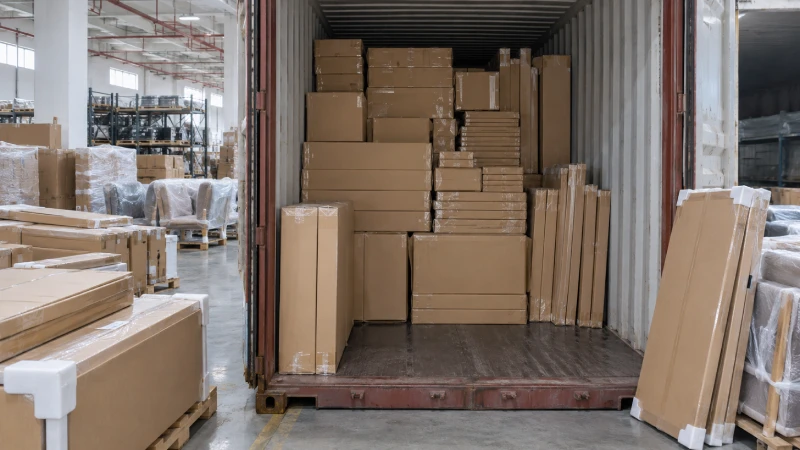
Flat-Pack vs Assembled Furniture: Reduce CBM Before You Reduce Freight
One of the most effective freight decisions may happen at the product-design or supplier-packing stage.
Furniture that can be safely shipped flat-packed often occupies substantially less space than the same item shipped fully assembled.
That can affect:
- LCL chargeable CBM;
- FCL container utilization;
- the number of containers required;
- warehouse storage;
- final delivery handling.
How Packing Style Changes CBM
Consider a dining table.
An assembled table occupies the complete three-dimensional space around its legs.
If the design allows the legs to be removed and packed alongside the tabletop, the export carton may become much thinner.
Multiply that difference across hundreds of hotel tables, desks or cabinets and the freight impact can become significant.
The same principle applies to:
- beds;
- cabinets;
- desks;
- wardrobes;
- shelving;
- tables;
- modular furniture.
But flat-packing is not automatically the best solution.
Flat-Pack vs Assembled Furniture
| Factor | Flat-Pack | Assembled |
|---|---|---|
| Freight volume | Often lower | Often higher |
| Container utilization | Usually easier to optimize | Can create irregular voids |
| Site assembly | Required | Limited or none |
| Number of packages | Can increase | Often fewer |
| Hardware control | Important | Usually simpler |
| Site labor | Higher | Lower |
| Factory assembly control | Less final assembly at factory | Product can leave factory assembled |
| Damage considerations | Panels and edges need protection | Finished item needs strong overall protection |
For a hotel project, reducing shipping volume is not useful if the site has no qualified installation team or if hundreds of furniture sets arrive with unidentified hardware.
The correct solution is a balance between:
factory cost + freight + destination handling + site assembly.
Pro Tip: Never finalize freight from dimensions shown in a product catalogue. Ask the supplier for final export-carton dimensions after the packing design is approved.
Does Flat-Packing Reduce Import Duty?
Do not assume so.
Flat-packing can change freight volume, but disassembling furniture for transport does not automatically mean it receives a different customs classification or lower tax treatment.
Classification depends on the actual product and the applicable tariff rules.
The Kenyan importer and clearing agent should verify the HS classification before landed-cost calculations are finalized.
Consolidating Furniture From Multiple Suppliers in China
For a commercial furniture buyer, one of the biggest advantages of planning logistics in China is the ability to coordinate several factories before export.
Instead of asking every supplier to ship independently, cargo can be collected into a consolidation plan.
A typical workflow is:
- Prepare a supplier shipment list.
- Confirm the cargo-ready date for each factory.
- Arrange pickup or supplier delivery to the warehouse.
- Receive and count the packages.
- Match cartons against the supplier or PO.
- Check visible packing condition.
- Measure final packed dimensions.
- Confirm shipping marks.
- Confirm document and compliance status.
- Build the container-loading plan.
- Load the container according to the agreed sequence.
This is particularly useful when sourcing from furniture manufacturing areas in Guangdong or when products come from several cities.
When Supplier Consolidation Makes Sense
Consolidation is especially relevant to:
- hotel projects;
- apartment projects;
- restaurant fit-outs;
- office projects;
- schools;
- furniture distributors buying different ranges.
For example, one hotel project might involve:
- beds from Supplier A;
- bedside tables from Supplier B;
- lounge chairs from Supplier C;
- wardrobes from Supplier D;
- dining furniture from Supplier E.
If every factory makes its own shipping decision, the buyer may end up with:
- multiple LCL consignments;
- repeated local charges;
- inconsistent shipping marks;
- mismatched documentation;
- products arriving at different times.
A consolidation plan can provide much better visibility.
What Should Be Checked During Consolidation?
A useful supplier tracker can look like this:
| Supplier | Product | Packages | Final CBM | Cargo Ready | Compliance | Loading Priority |
|---|---|---|---|---|---|---|
| Supplier A | Beds | — | — | — | — | — |
| Supplier B | Cabinets | — | — | — | — | — |
| Supplier C | Chairs | — | — | — | — | — |
The critical point is to work from final shipment data, not preliminary purchase-order information.
For each supplier, confirm:
- actual package quantity;
- final dimensions;
- gross weight;
- shipping mark;
- product description;
- invoice;
- packing list;
- export documentation;
- required conformity documents.
This became even more important in Kenya in 2026.
From 1 September 2026, KRA states that importers must obtain and retain an export declaration, export entry, customs export certificate or equivalent export-country document. KRA says the record should include information such as exporter and importer details, goods description, quantity, value, tariff classification and country of export, and records should be retained for at least five years. See the KRA Finance Act 2026 guidance.
That means supplier documentation should be treated as part of the shipment plan—not something to fix after the container arrives in Mombasa.
Avoid Letting One Supplier Delay the Whole Shipment
A common project problem is that five factories are ready but the sixth is late.
You then have to decide whether to:
- wait;
- store the ready goods;
- ship the incomplete batch;
- move the late supplier’s products separately.
There is no universal correct choice.
The decision depends on:
- project deadline;
- warehouse cost;
- remaining CBM;
- value of the delayed goods;
- next sailing;
- impact on installation.
Set a cargo-ready cut-off date before collection starts.
That prevents a small supplier delay from silently changing the entire container schedule.
Plan My Consolidated Shipment
Prepare your supplier list, pickup cities, expected ready dates and preliminary packing data so the consolidation plan can be built before collection starts.
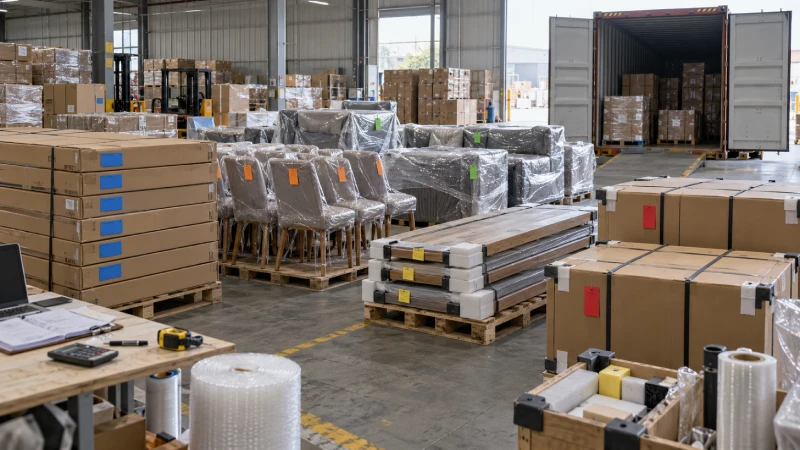
Furniture Packaging, Moisture and Wood Packaging for Ocean Freight
A low freight rate does not help if furniture reaches Kenya scratched, swollen, moldy or broken.
Packing should be decided based on the actual product—not one generic furniture standard.
Protect Surfaces, Edges and Fragile Components
Depending on the furniture, export packing may require:
- reinforced cartons;
- corner protection;
- foam or EPE protection;
- surface film;
- internal spacers;
- separate hardware bags;
- internal bracing;
- stronger protection for glass or stone;
- protective sheets between finished panels.
The correct packing design depends on the item.
For example:
Upholstered chair needs different protection from a marble table.
Flat-pack cabinet panel needs different edge protection from an assembled sofa.
Glass display furniture requires different handling from metal office shelving.
Do not ask only:
“Is it export packed?”
Ask:
“How exactly will this product be packed, stacked and handled?”
Moisture and Container Condensation
Furniture can be particularly sensitive to moisture during ocean transport.
Products containing:
- timber;
- MDF;
- particleboard;
- plywood;
- upholstery;
- fabrics;
- foam;
- leather or similar materials
may be affected by high humidity or condensation if cargo, packaging and container conditions are poorly controlled.
Potential problems include:
- mold;
- staining;
- odor;
- swollen engineered-wood panels;
- surface damage;
- damp cartons.
Risk control starts before container loading.
Important points include:
- avoid loading visibly wet cargo;
- avoid wet pallets or cartons;
- confirm furniture materials are sufficiently dry for shipment;
- keep cargo protected during warehouse handling;
- use suitable moisture protection where necessary;
- consider appropriate desiccant solutions based on the shipment.
There should not be one universal statement such as:
“Use X bags of desiccant in every 40HQ.”
The correct quantity depends on the product, moisture condition, route, packaging system and desiccant specification.
Wooden Furniture Is Not the Same as Wood Packaging
This distinction is easy to miss.
A wooden dining table is the product.
A solid-wood pallet, crate, block or dunnage used to transport it is wood packaging material.
International phytosanitary controls such as ISPM 15 are specifically relevant to regulated wood packaging material.
KEPHIS maintains services connected with ISPM 15 wood-treatment auditing and marking, reflecting Kenya’s phytosanitary control of wood packaging material. See the KEPHIS Service Charter.
If a Chinese supplier plans to build solid-wood crates or use raw-wood pallets, confirm the applicable treatment and marking requirement before the packaging is made.
Do not discover this after cargo has already been collected.
Operational Warning: The exact phytosanitary requirement can depend on the packaging material and shipment. Confirm the current Kenya requirement before loading solid-wood pallets, crates or dunnage.
Kenya Import Compliance for Furniture
Freight planning should not be finalized until the Kenya-side import requirements have been checked.
Furniture can involve:
- customs classification;
- PVoC / CoC;
- Certificate of Origin;
- Advance Cargo Declaration;
- export-country documents;
- import duties and taxes;
- other requirements depending on the exact materials or components.
Do not assume that every product called “furniture” follows the same compliance path.
Advance Cargo Declaration for Containerized Cargo
This is now an important part of China-to-Kenya container planning.
KRA launched its Advance Cargo Declaration (ACD) platform for containerized cargo on 3 August 2026.
According to KRA, exporters shipping containerized cargo to Kenyan ports obtain an ACD reference at the loading stage after submitting:
- draft Bill of Lading;
- commercial invoice;
- freight invoice;
- export declaration.
The ACD reference is then endorsed on the Bill of Lading before the shipment proceeds to the Kenyan port. See the KRA Advance Cargo Declaration notice.
For furniture importers, this has a practical consequence:
Do not finish the container and then start collecting inconsistent supplier documents.
The product description, invoice data, export declaration, HS information and shipping documentation should be coordinated earlier.
This matters even more for a multi-supplier container.
Certificate of Origin
KRA’s Certificate of Origin requirement took effect in 2025, with full enforcement from 1 October 2025, subject to specified exceptions and provisional measures.
KRA states that imported consignments generally need a COO issued by a competent authority in the exporting country, while certain official export documents may be accepted in exceptional cases subject to Customs verification and approval. See the KRA Certificate of Origin notice.
For a commercial furniture order from China, the practical approach is simple:
confirm the COO arrangement before shipment rather than treating it as an arrival-stage document.
PVoC and Certificate of Conformity
KEBS operates the Pre-Export Verification of Conformity (PVoC) program to assess applicable imported products against Kenyan standards, approved specifications and other relevant requirements.
Its current framework identifies contracted inspection companies for general goods and places China within the active contractor structure. KEBS instructs importers/exporters to ensure products subject to the program receive the required CoC or other relevant conformity documentation before shipment. See the KEBS PVoC page.
KEBS also provides exemption and destination-inspection procedures, so the correct approach is not to write:
“Every furniture shipment always follows exactly the same PVoC procedure.”
Instead:
- identify the exact furniture products;
- establish the applicable Kenyan standards;
- check whether each product falls within the relevant PVoC process or exemption;
- coordinate testing/inspection with the current appointed provider where required;
- obtain the required conformity documentation before shipment.
For hotel and FF&E projects, perform this check by product category, not once for the entire container.
Do Not Use One HS Code for an Entire Hotel Furniture Project
A mixed FF&E order may include:
- sofas and chairs;
- tables;
- cabinets;
- beds;
- mattresses;
- mirrors;
- lighting;
- electrical furniture;
- decorative products;
- hardware;
- spare components.
Calling everything “furniture” on the purchase order does not mean it belongs under one customs classification.
Correct classification affects:
- import duty;
- excise treatment;
- VAT calculations;
- PVoC requirements;
- government permits;
- documentation.
The importer and Kenyan clearing agent should therefore review the actual SKU/category list before landed-cost estimates are approved.
Kenya has applied furniture-specific excise provisions to certain imported furniture under tariff heading 9403 in recent tax legislation. The exact current treatment, rate and applicability should be verified against the tariff and legislation in force when the shipment is imported rather than applying one percentage to every FF&E item.
Furniture Import Compliance Checklist
| Requirement | Why It Matters | When to Check |
|---|---|---|
| HS classification | Determines tax and regulatory treatment | Before landed-cost approval |
| KEBS/PVoC applicability | Determines conformity route | Before shipment |
| CoC where applicable | Supports KEBS clearance | Before shipment |
| Certificate of Origin | Kenya import documentation requirement | Before shipment |
| China export declaration/equivalent | KRA documentation requirement | Export stage |
| ACD | Required for applicable containerized cargo | Before loading/proceeding to Kenya |
| Invoice & packing list alignment | Supports customs/document consistency | Before final documents |
| Kenyan clearing-agent review | Confirms entry preparation | Before arrival |
Check My Kenya Import Requirements
Share the furniture description, materials, available HS codes, supplier documents and Kenya importer details early enough to identify issues before the goods are loaded.
Shipping Furniture Through Mombasa to Nairobi or an Inland Destination
If the furniture is going to Nairobi, a hotel in another county or a construction site inland, arrival at Mombasa is only one part of the logistics plan.
The inland movement should be considered when deciding the shipment method in China.
For example, an importer choosing between LCL and FCL should also consider:
- how the cargo will be cleared;
- whether it remains containerized inland;
- how loose LCL cargo will be collected;
- inland trucking;
- unloading access;
- container return requirements;
- destination storage.
Mombasa Clearance and Road Delivery
For an FCL shipment, the destination plan may involve:
- vessel arrival at Mombasa;
- customs and regulatory clearance coordination;
- container release;
- truck arrangement;
- delivery to warehouse or project site;
- container unloading;
- empty-container return where applicable.
For LCL, the cargo will generally require deconsolidation before the importer collects or arranges inland delivery of the individual shipment.
These two processes have different cost structures.
That is another reason why an LCL-versus-FCL comparison should include the destination stage.
When Nairobi ICD May Be Relevant
Kenya Ports Authority operates inland container depots including Nairobi ICD.
KPA states that Nairobi ICD is connected to Mombasa by rail services and that imports can move from Mombasa to inland depots under Through Bill of Lading arrangements. See the Kenya Ports Authority Inland Container Depots page.
This can be relevant for cargo destined for Nairobi and the wider hinterland.
However, do not assume that every Nairobi-bound furniture container should automatically move through the ICD.
The practical route depends on:
- carrier arrangement;
- Bill of Lading;
- customs setup;
- consignee preference;
- clearing-agent plan;
- final delivery address;
- current operating conditions.
Decide the inland strategy before the B/L and booking details are finalized.
Plan the Final Furniture Unloading Before the Truck Leaves Mombasa
A hotel buyer may spend weeks optimizing the container and still overlook one simple question:
Can the site actually unload it?
Before inland delivery, confirm:
- can a container truck reach the location?
- is there a loading bay?
- can the truck turn and wait?
- is a forklift available?
- is manual unloading sufficient?
- are any pieces too heavy to handle manually?
- is crane handling required?
- what are the site’s delivery hours?
- is temporary storage available?
- are installation crews ready?
These details can determine whether direct project-site delivery is practical.
For example, a container may be economical from China to Nairobi, but delivering it directly to a constrained city-center property could create a very different unloading plan from delivery to an industrial warehouse.
Check My Mombasa-to-Nairobi Route
Provide the Kenya delivery location and cargo/container plan so the port-to-inland movement can be reviewed together with the international shipment.
Hotel and Project Furniture Delivery: Plan by Room, Zone and Installation Sequence
A hotel furniture container should not be treated as one undifferentiated pile of cartons.
At the project site, every carton eventually needs to become a specific item in a specific room, floor or area.
That means good project logistics starts with identification.
Useful carton information may include:
- project name;
- supplier;
- purchase-order number;
- item code;
- room type;
- floor;
- zone;
- carton sequence;
- quantity;
- handling instruction.
The exact marking system should match the buyer’s project-management process.
Load for the Delivery Sequence, Not Only Maximum CBM
Container-loading teams naturally want to maximize utilization.
For project shipments, that is only part of the goal.
Suppose the installation team needs lobby furniture first, but those cartons are loaded at the very front of the container behind every guest-room product.
The loading may be efficient from a CBM perspective and inefficient operationally.
For hotel or project cargo, balance:
container utilization + product protection + unloading sequence.
The correct order may be influenced by:
- construction phase;
- room handover;
- warehouse layout;
- installation teams;
- product fragility.
Pro Tip: Use the same room or zone code on the supplier PO, carton label, packing list and site receiving list. Where practical, incorporate that sequence into the container-loading plan.
Oversized Furniture May Need a Different Equipment Check
Most furniture fits into standard dry containers.
Some project products do not.
Examples can include:
- oversized reception desks;
- large prefabricated counters;
- exceptionally long sofas;
- large stone tables;
- architectural joinery;
- feature furniture.
Before booking, compare the packed item dimensions against:
- container internal dimensions;
- door opening;
- loading method;
- lifting equipment.
If the product cannot be loaded safely into a standard dry container, alternative equipment such as open-top or flat-rack solutions may need evaluation.
Do not wait until loading day to check.
Motorized or Battery-Powered Furniture Needs Separate Review
Some modern furniture includes:
- electric recliner motors;
- lithium battery packs;
- height-adjustment systems;
- electrical controls;
- charging systems.
These products should not automatically be classified as dangerous goods simply because they contain electrical components.
But if batteries or other regulated components are present, identify them early so the freight forwarder and carrier can review:
- battery type;
- battery specification;
- installation status;
- relevant transport documentation;
- DG acceptance if applicable.
A normal furniture booking should not suddenly become a battery-compliance problem after cargo reaches the warehouse.
What Information Do You Need for an Accurate Furniture Shipping Quote?
For furniture, “10 sofas and 20 tables” is not enough information for a reliable freight plan.
The forwarding team needs shipment data.
Cargo Information
Provide:
- exact furniture description;
- material;
- flat-pack or assembled;
- package quantity;
- final carton dimensions;
- gross weight;
- total CBM;
- stackable or non-stackable;
- glass, stone or fragile components;
- oversized pieces;
- battery or electrical components.
Supplier Information
For each supplier:
- supplier/company name;
- pickup address;
- pickup city;
- cargo-ready date;
- package quantity;
- CBM;
- purchase Incoterm.
This is especially important if one container will collect goods from several Chinese factories.
Packaging Information
Confirm:
- cartons;
- pallets;
- crates;
- solid-wood packaging;
- special protection;
- moisture-sensitive cargo.
Photos of final export packing can also be useful for planning.
Kenya Destination
Do not write only:
Nairobi.
Provide, where possible:
- Mombasa / Nairobi / other city;
- warehouse or project-site destination;
- postcode or exact delivery area;
- container-access conditions;
- unloading requirements.
If inland delivery is required, the actual delivery point matters.
Import and Compliance Information
Where available, provide:
- proposed HS code;
- commercial invoice;
- product specification;
- PVoC / CoC status;
- Certificate of Origin status;
- importer details;
- clearing-agent details;
- expected shipping date.
Furniture Shipping Quote Checklist
Cargo
- Product
- Materials
- Packages
- Final dimensions
- Gross weight
- CBM
- Flat-pack / assembled
- Fragile / non-stackable
Suppliers
- Number of factories
- Pickup cities
- Cargo-ready dates
- Incoterms
Destination
- Mombasa / Nairobi / other location
- Final address
- Unloading conditions
- Project deadline
Compliance
- HS code if available
- PVoC status
- CoC if applicable
- COO arrangement
- Export documentation
- Importer / clearing-agent status
The better the input data, the more meaningful the LCL, FCL and inland-delivery comparison becomes.
Send Cargo Details
For a furniture shipment originating in China, send the supplier locations, product list, package quantities, final dimensions, weight and Kenya destination so the shipment can be evaluated from pickup through the required delivery scope.
FAQ
What is the cheapest way to ship furniture from China to Kenya?
For most commercial furniture, sea freight is usually the first method to evaluate because furniture is bulky. A small shipment may be cheaper by LCL because you pay only for shared container space. As CBM increases, a dedicated container can become more competitive. Compare origin handling, destination charges, consolidation or deconsolidation and inland delivery rather than ocean freight alone.
When does FCL become more practical for furniture?
There is no universal cutoff. As a practical planning approach, when a furniture shipment reaches the low-to-mid-teens CBM range, compare LCL and 20GP FCL using current prices and the same logistics scope. Fragile, awkward or project cargo may justify checking FCL earlier.
Is a 40HQ better than a 20GP for furniture?
Not always. A 40HQ offers substantially more cubic capacity, which is useful for lightweight, bulky and flat-packed furniture. The decision should still be based on final packed dimensions, loading geometry and current freight costs.
Does flat-pack furniture reduce shipping cost from China to Kenya?
It often can because flat-packing may reduce total CBM and improve container utilization. However, it can also increase package quantity, hardware-management requirements and site assembly labor. It does not automatically reduce import taxes.
Does furniture imported into Kenya require PVoC and a CoC?
KEBS applies its PVoC framework to goods subject to the program and also provides exemption and destination-inspection arrangements for qualifying cases. Check the exact product, applicable Kenya Standard and current PVoC route before shipment.
Do wooden pallets and crates need ISPM 15 treatment for Kenya?
Do not confuse the furniture product with wood packaging. Solid-wood pallets, crates, blocks and dunnage can fall under phytosanitary wood-packaging controls such as ISPM 15. Confirm the packaging material and current KEPHIS requirement before shipment.
Can my furniture container move from Mombasa to Nairobi ICD?
Potentially. KPA operates Nairobi ICD and states that it is connected to Mombasa by rail services, including movements using Through Bill of Lading arrangements. Whether this is the right route depends on the carrier, B/L arrangement, customs plan, consignee and final destination.
Plan the Furniture Shipment Before the Factories Finish Packing
Shipping furniture from China to Kenya becomes much easier when freight decisions are made early.
The correct sequence is usually:
Furniture specification
↓
Packing method
↓
Final package dimensions and CBM
↓
Supplier consolidation plan
↓
LCL / 20GP / 40HQ comparison
↓
Kenya compliance check
↓
Container loading
↓
Mombasa
↓
Nairobi / warehouse / hotel / project site
The biggest mistake is to leave logistics until every supplier has already packed the goods.
By then, it may be too late to improve:
- carton dimensions;
- flat-pack design;
- supplier synchronization;
- container utilization;
- compliance documents;
- loading sequence.
If you are buying furniture from several Chinese factories, start with a complete supplier and packing list.
Once final CBM, cargo-ready dates and the Kenya destination are clear, you can compare the shipment as a complete operation rather than choosing between isolated freight prices.
Official Source Note
Kenya import requirements referenced in this guide were checked against current information from the Kenya Revenue Authority, Kenya Bureau of Standards, Kenya Ports Authority and Kenya Plant Health Inspectorate Service. Key current requirements include Kenya’s containerized-cargo ACD system introduced in August 2026, export-country documentation rules effective September 2026, Certificate of Origin requirements, the KEBS PVoC framework and current inland-container-depot information.
Regulatory Disclaimer: Import requirements depend on the exact product, material, HS classification, intended use and regulations in force at the time of shipment. Importers should confirm current tariff treatment, KEBS requirements, permits, customs procedures and tax obligations with the relevant Kenyan authorities and their licensed clearing agent before shipment.
Rate Data Note: Freight rates, LCL/FCL break-even points, port charges and inland-delivery costs change with the market. Any numerical freight quote should state its validity period, routing and included logistics scope.
